Tag: child care

  • New report praises Ohio saving rescue plan funds, but warns of ‘precarious’ state of child care

    New report praises Ohio saving rescue plan funds, but warns of ‘precarious’ state of child care

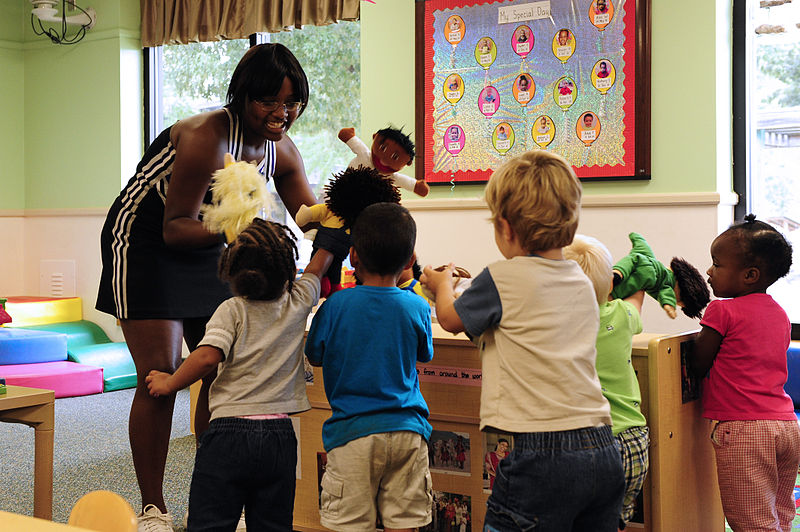
    Photo courtesy Wikimedia Commons.

    “The annual cost of care for two children in a center is 93% more than the average rent payment and 28% more than the average mortgage payment in Ohio,” the study stated.

    By:  Oho Capital Journal

    A new analysis looking at child care in several states, including Ohio, shows big costs and staffing shortages, but also some proactive actions taken by states to prepare for the expiration of pandemic-era federal funding.

    The Century Foundation released a new report showing “a wave of increasing prices, economic damage, staffing shortages and reduced wages for early childhood educators,” and a “dire need for investment at the state and federal levels in child care to lower costs for working families,” according to a release announcing the report.

    “The annual cost of care for two children in a center is 93% more than the average rent payment and 28% more than the average mortgage payment in Ohio,” the study stated.

    Julie Kashen, director of women’s economic justice at the Century Foundation said the report showed what many parents are contending with every day: “finding and affording child care is taking a huge toll on families’ budgets and remains a big source of stress.”

    “At the same time, we’re seeing these are solvable problems: when elected leaders listen to parents and invest in care, it makes a difference,” Kashen said in a statement.

    The states chosen in the study were Ohio, New York, Pennsylvania, Virginia and Wisconsin, due to the “outsized political attention right now in light of the 2024 election,” the study stated.

    Taking all of the states together, the Century Foundation study showed 30 to 40% of child care programs in the five states would have been forced to close without the ARPA “stabilization grants” distributed to the child care sector.

    “These challenges existed long before anyone had heard of COVID-19, but were exacerbated by the pandemic and made better by the ARPA funds,” the study stated.

    The end of pandemic-era funding began in September of 2023, with the Century Foundation estimated that more than three million children nationally would lose access to child care. Ohio was reported to have 6,265 child care programs which received ARPA grants, with 33% that would have closed without them, according to the most recent study by the Century Foundation.

    The foundation previously projected more than 130,000 Ohio children would lose child care, and more than 2,000 child care programs expected to close because of the so-called “child care cliff.”

    While the study of ARPA funding usages in Ohio showed the state having only spent 2/3 of its supplemental Child Care Development Block Grant from the ARPA monies “left room for longer term investments,” the state’s child care sector is still “in a precarious state.”

    Between 2019 and 2023, Ohio’s child care employment levels fell by 26%, 11% of the state’s programs were lost in that period and 10% of the licensed programs have disappeared since 2019.

    Citing state data, the study found “worsening” supply shortages. The data showed that in 2024, Ohio had 30%, or 2,700, fewer providers compared to 2018 levels.

    Alongside the decreases came a 25% increase in the price of child care since 2019, with the average annual price for an infant listed as $12,351 in the foundation’s most recent study.

    Child care has been a hot topic in Ohio, with advocacy groups and families throughout the state sounding the alarm of the state of child care, including its inaccessibility and high costs. The child care sector’s issues could have longterm impacts on the entire state economy, amounting to billions in impacts, according to policy advisors and advocates brought together by the Federal Reserve Bank of Cleveland.

    Before they left for a summer break that will continue until after the November general election, the Ohio General Assembly saw the introduction of several bills aimed at addressing the child care system in the state, thought it’s unclear whether those bills will see passage before the end of the current GA in December. If they aren’t passed through by the end of the year, all bills would have to be reintroduced in 2025.


    Susan Tebben
    Susan Tebben

    Susan Tebben is an award-winning journalist with a decade of experience covering Ohio news, including courts and crime, Appalachian social issues, government, education, diversity and culture. She has worked for The Newark Advocate, The Glasgow (KY) Daily Times, The Athens Messenger, and WOUB Public Media. She has also had work featured on National Public Radio.

    Ohio Capital Journal is part of States Newsroom, the nation’s largest state-focused nonprofit news organization.

    MORE FROM AUTHOR

  • DeWine Announces Additional Funding to Support Child Care Centers

    DeWine Announces Additional Funding to Support Child Care Centers

    Ohio Governor Mike DeWine announced that applications are now being accepted for a fourth round of child care stabilization grants and that steps were being taken to increase the base rates for publicly funded child care beginning February 4, 2024.

    “We have been focused on increasing the safe, stable, quality child care programs to ensure Ohio’s youngest students have the best possible foundation for their future learning,” said Governor DeWine. “We are now focusing on supporting early childhood professionals in order to increase the availability of child care spaces for working parents and caregivers.”

    “Child care employers are balancing employee shortages and increasing costs,” said Ohio Department of Children and Youth Director Kara Wente. “Increasing the base rate reimbursement for publicly funded child care will help more than 5,000 programs across the state. This sustained increase in reimbursements and another round of one-time grant money will help struggling providers support children and their families.”

    The application for a fourth round of child care stabilization grants is now open on the Ohio Child Care Resource and Referral Association website at Http://occrra.org. The $200 million childcare discretionary funding grants from the federal American Rescue Plan Act (ARPA) can be used for operating costs, workforce recruitment and retention, expanding access, or mental health and wellbeing of students and employees.

    The base reimbursement rate for publicly funded child care will increase to the 35th percentile of the 2022 market rate survey as part of an effort for reimbursement rates to increase to the 50th percentile by December 2024.

  • Bipartisan sponsors, advocates: Support Ohio bill improving pregnancy, housing, infant services

    Bipartisan sponsors, advocates: Support Ohio bill improving pregnancy, housing, infant services

    BY:  Ohio Capital Journal

    The state’s operating budget is showing progress in the areas of infant supports, including a housing pilot program to benefit pregnant people and even doula services, but a bipartisan duo in the Ohio House wants to do better.

    State Reps. Andrea White, R-Kettering, and Latyna Humphrey, D-Columbus, joined with advocacy groups on Tuesday to talk about House Bill 7, with supporters heading straight to a proponent hearing immediately following the press conference on the bill.

    White and Humphrey introduced the bill to the House Families and Aging Committee on April 25, but as the budget process continues with various appropriations showing up and being revised from the governor’s initial executive proposal, White said it’s important to keep up with funding, especially when it comes to Ohio’s infants and mothers.

    “Ohio’s doing very well, but we’re not going to accept no for an answer,” White said.

    HB 7 has provisions to support doula services, pregnancy and postpartum individuals, children and families in poverty, early intervention, child care, a cost savings study for the Medicaid program and the Head Start Program.

    “The initiatives in this bill will support and empower families … and establish systemic changes that will remove barriers to services and reduce administrative burden to both programs and the state,” said Julie Stone, executive director of the Ohio Head Start Association.

    The legislators and groups supporting the legislation pointed to widely reported statistics showing Ohio as one of the lowest-succeeding in the country when it comes to infant mortality, with 1 out of 150 babies unable to live to see their first birthday, and the infant mortality rate at 14.1 per 1,000 births for Black babies in Ohio, and 5.5 per 1,000 for white babies.

    “In this case, if we do not invest now, there will not be an opportunity, for many, for us to pay later because we are losing too many lives,” White said.

    Improving supports for the doula program in Ohio has been an ongoing struggle, with various bills attempting to bring funding to the effort, including one currently sitting in the Ohio Senate.

    In HB 7, like similar legislation attempted in the past, the Ohio Board of Nursing would be required to establish a registry of certified doulas, a Doula Advisory Board would be established within the board of nursing, and the Department of Medicaid would house a program to cover doula services through a Medicaid provider agreement.

    Doula programs have frequently asked for Medicaid reimbursement to be a part of the resources they can access, since many programs are using their own funds or that of donors to provide pregnancy-related services and education.

    “The doula programs are clearly one of the more outstanding programs we have seen in this nation,” said Angela Dawson, executive director for the Ohio Commission on Minority Health.

    The doula programs already work to improve pregnancy outcomes throughout the state with 12 “infant mortality hubs” funded throughout the state as well, according to Dawson. But full investment into doula services could actually end up saving the state money through avoidance of complications in pregnancy, and raising the state’s ranking when it comes to infant mortality.

    “The reality is that Ohio has never achieved the infant mortality goal for African American babies, we have an opportunity before us … let our vote prepare the state for the children,” Dawson said.

    The current draft of the budget, which is still up for approval in the Ohio Senate, includes $16 million in funding for the Healthy Beginnings at Home program, a research study that tests the impacts of rental assistance and housing services on infant mortality.

    Under HB 7, the program would receive $15 million more in fiscal year 2024 “to support stable housing initiatives for pregnant mothers and to improve maternal and infant health outcomes,” according to an analysis by the Legislative Service Commission, and $1 million in both 2024 and 2025 for the Move to Prosper program, “which makes affordable rental housing available in neighborhoods that offer access to opportunities.”

    Amy Riegel, executive director of the Coalition on Homelessness and Housing in Ohio, said the funding would allow them to expand the study to more areas in the state, and “make it a statistically significant study that can be replicated” nationally.

    ___________________

    Susan Tebben is an award-winning journalist with a decade of experience covering Ohio news, including courts and crime, Appalachian social issues, government, education, diversity and culture. She has worked for The Newark Advocate, The Glasgow (KY) Daily Times, The Athens Messenger, and WOUB Public Media. She has also had work featured on National Public Radio.
    MORE FROM AUTHOR

  • Awaiting budget proposal, child advocates hope for more

    Awaiting budget proposal, child advocates hope for more

    Getty Images

    BY: SUSAN TEBBEN – Ohio Capital Journal

    As policymakers await the newest budget priorities to be laid out by Gov. Mike DeWine, advocates for the state’s children are hoping comprehensive child well-being will be at the top of the list.

    The Ohio Children’s Budget Coalition released their policy agenda for the 2024-2025 state budget, which they hope will include whole-child services to address housing, health, child care, economic stability, and adoption of the Fair School Funding Plan, which was only approved for two years of the six-year phase-in so far.

    “Children do not come in pieces, and neither should the policies and investments that crucially provide and pave the way for them to grow and flourish into successful adulthood,” said Katherine Ungar, senior policy associate with the Children’s Defense Fund-Ohio.

    Recommendations by the OCBC also targeted structural racism, the effects of which “negatively impact child outcomes,” according to the announcement of budget priorities.

    “The budget is a moral document that reflects our state’s priorities,” OCBC co-leader and Children’s Defense Fund-Ohio policy associate Matthew Tippit said in a statement.

    The policy report also laid out challenges to combatting the teacher shortage the state has suffered from for several years, with the Bureau of Labor Statistics stating 21,000 fewer teachers were employed in K-12 public school in the state from September 2021 to September 2019.

    The state has faced recruitment and retention issues, which the coalition attributes to “mounting pressures related to the COVID-19 pandemic, under-resourced schools, politicization of education and lack of respect for educators and the education profession.”

    “While a mass exodus of experienced educators from the teaching profession has not yet materialized, it is cause for significant concern when so many are expressing deep frustrations over what they believe is a lack of support and respect for the work they do with students,” the report stated.

     Groundwork Ohio

    The policy recommendations also come on the heels of a recent early childhood dashboard released by the advocacy group Groundwork Ohio. The dashboard has been in the works since 2021 to “help inform policy makers about the realities facing Ohio families with young children.”

    Groundwork Ohio president and CEO Shannon Jones said the dashboard “tells us where to focus on making positive change for infants, toddlers and preschoolers.”

    The report found that one in five Ohio infants don’t have access to child care or early learning and six in 10 children aren’t ready to attend school based on kindergarten readiness, fourth-grade reading proficiency and eighth-grade math proficiency.

    Racial issues appeared as part of Groundwork Ohio’s analysis, with the group finding that infant mortality rates are still above the U.S. average in Ohio “with a large and appalling racial disparity.”

    “While there are many ways we can begin to improve outcomes for young children, focusing state efforts on its very youngest citizens is an urgent moral imperative as well as a wise state investment,” according to the report.

    The organization was encouraged by state performance in areas like eighth grade math proficiency and improved homeless students and housing cost burdens.

    Early investments are needed to benefit Ohio children throughout their lives, the dashboard concluded as state performance compared to the rest of the country was worse in categories such as early intervention service access and young child poverty.

    Large disparities were found particularly in Black, Hispanic and Native American/American Indian children living below the poverty level.

    The state has also worsened in terms of kindergarten literacy, chronic absenteeism and special needs preschools, according to the dashboard.

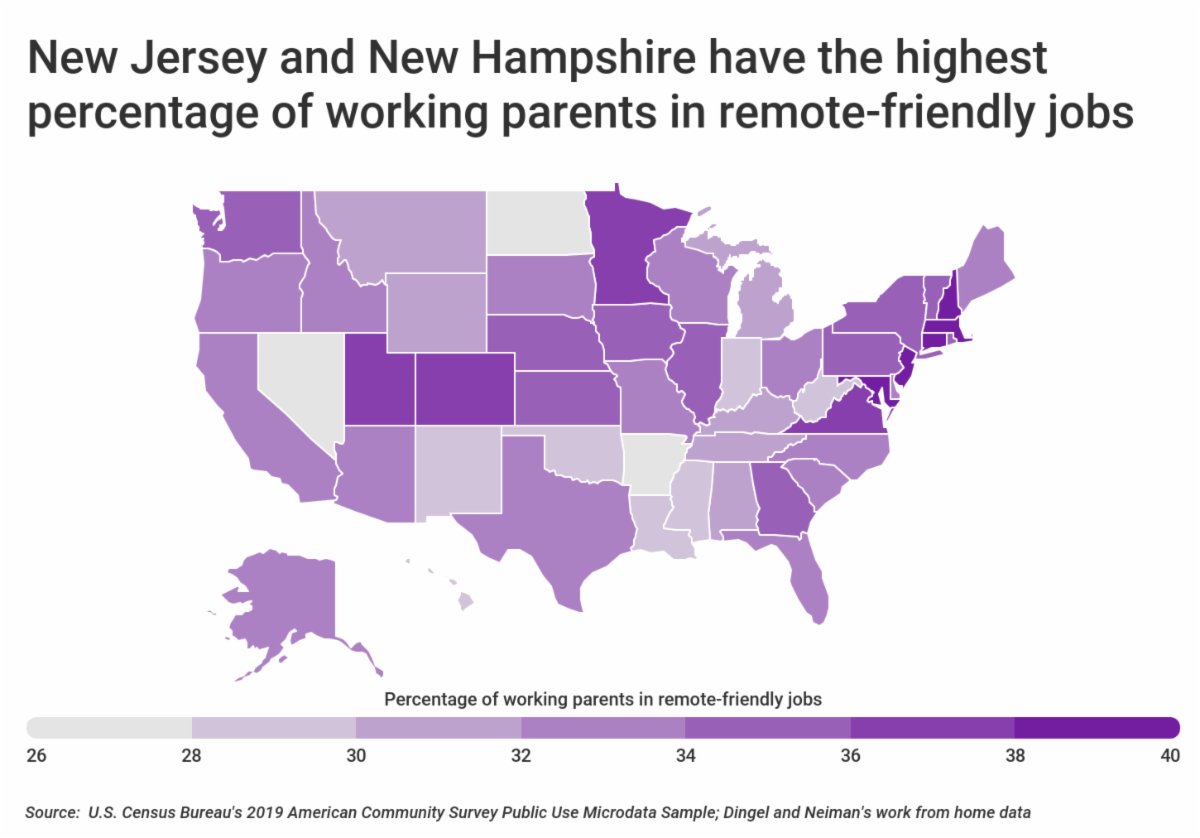
  • In Ohio, 32.7% of parents work in remote-friendly jobs

    In Ohio, 32.7% of parents work in remote-friendly jobs

    The COVID-19 pandemic has resulted in a major shift towards remote work. While working from home has its benefits for certain individuals, including no commute time, a better work-life balance, and increased productivity, it can be hard for parents—especially mothers—to work from home while juggling family responsibilities. Additionally, not all occupations are conducive to remote work. A recent study by University of Chicago researchers shows that 37 percent of jobs in the U.S. are able to be performed entirely at home, but this varies substantially across cities. When considering working parents, Census Bureau data combined with data from the aforementioned study show that about 34 percent hold remote-friendly jobs.

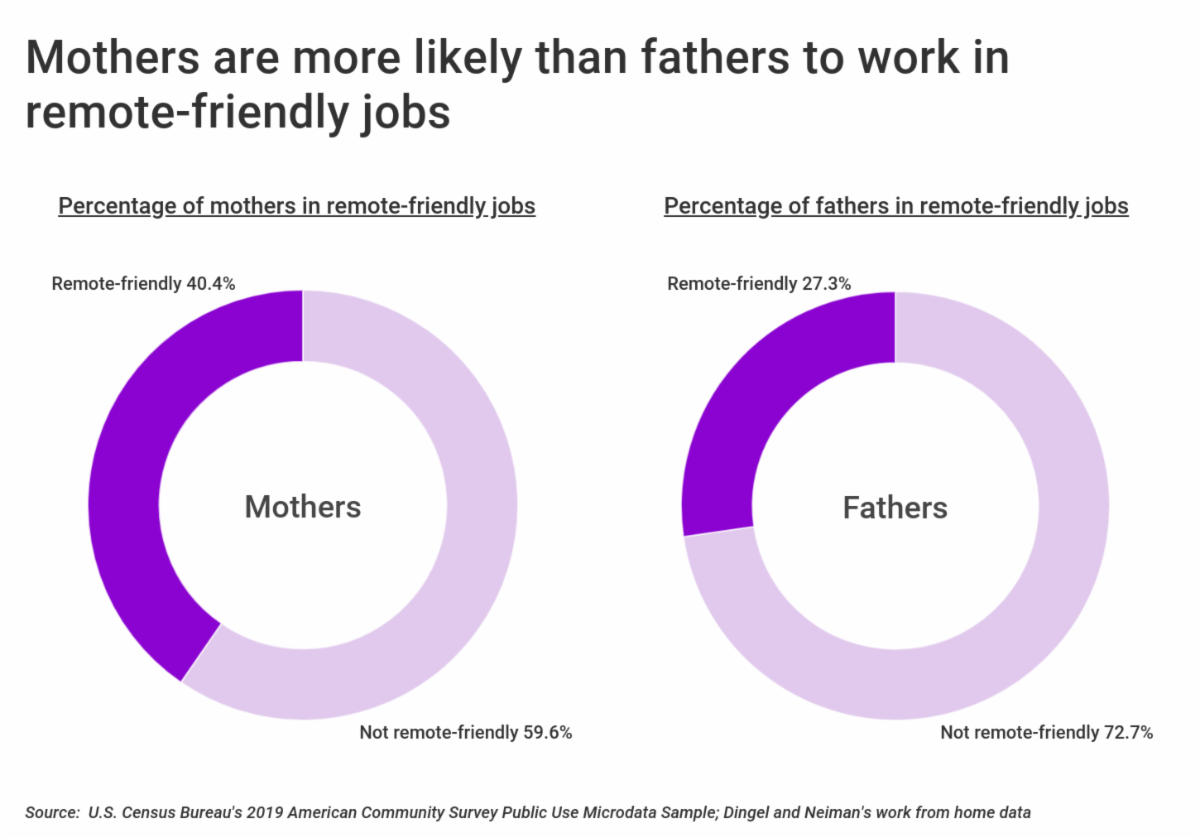
    According to occupational data from the U.S. Census Bureau, working mothers are more likely than working fathers to work in remote-friendly jobs. Over 40 percent of working mothers work in remote-friendly jobs compared to just 27 percent of working fathers. However, several studies show that working from home is harder for moms than it is for dads. As schools and day care centers closed during the pandemic, the gender gap in household chores and child care has widened. Research indicates that women working from home are more likely to take on a disproportionate share of housework and child care, while men are more likely to report an increase in productivity.

    Due to differences in local economies, there is significant variation in the share of jobs that can be performed at home across cities and states. For instance, places that rely heavily on agriculture, manufacturing, retail, and hospitality tend to have fewer jobs that can be performed at home, while areas with more business and professional jobs tend to have a large share of jobs that can be done remotely. At the state level, the Northeast tends to have more working parents in remote-friendly jobs with New Jersey and New Hampshire boasting the highest shares at 40.1 and 38.6 percent, respectively. At the opposite end of the spectrum, North Dakota and Nevada have the lowest shares of working parents in remote-friendly jobs, at 27.4 and 25.9 percent, respectively.

    To find the states with the most parents working from home, researchers at RetailMeNot analyzed the latest data from the U.S. Census Bureau as well as data from a University of Chicago study on remote-friendly occupations. The researchers ranked states according to the percentage of working parents in remote-friendly jobs. Researchers also calculated the percentage of working fathers and mothers in remote-friendly jobs and the percentage of fathers and mothers who work (either full-time or part-time).

    The analysis found that in Ohio, 32.7% of working parents have remote-friendly jobs. Here is a summary of the data for Ohio:

    • Percentage of working parents in remote-friendly jobs: 32.7%
    • Percentage of working fathers in remote-friendly jobs: 26.3%
    • Percentage of working mothers in remote-friendly jobs: 39.3%
    • Percentage of fathers who work: 91.5%
    • Percentage of mothers who work: 74.2%

    For reference, here are the statistics for the entire United States:

    • Percentage of working parents in remote-friendly jobs: 33.6%
    • Percentage of working fathers in remote-friendly jobs: 27.3%
    • Percentage of working mothers in remote-friendly jobs: 40.4%
    • Percentage of fathers who work: 92.1%
    • Percentage of mothers who work: 72.4%

    For more information, a detailed methodology, and complete results, you can find the original report on RetailMeNot’s website: https://www.retailmenot.com/blog/cities-with-most-parents-working-from-home.html

  • Governor DeWine announces Early Childhood Mental Health Credential

    Governor DeWine announces Early Childhood Mental Health Credential

    Columbus, Ohio – Ohio Governor Mike DeWine today announced the launch of Ohio’s new Infant Mental Health Credential for early childhood professionals, the first of its kind in the state. This credential provides professional development to support the social-emotional needs of Ohio’s youngest children. Early childhood professionals who hold this credential will have met the state’s minimum core standards.

     “When children are young, they are building the foundation for the rest of their lives. It’s important that we ensure they have the emotional and behavioral skills to succeed,” said Governor DeWine. “This new credential guarantees that those early childhood professionals have specialized skills and training to help young children reach their best possible wellness.”

    Applications are being accepted through the Ohio Child Care Resource and Referral Association. Early childhood system professionals working in the following categories may apply:

    • Child Care
    • Early Learning
    • Home Visiting
    • Community Health
    • Early Intervention
    • Maternal Health
    • Infant and Early Childhood Mental Health
    • Primary Health
    • Occupational Therapy
    • Any Additional Allied Health Professionals

    For more information on Ohio’s Infant Mental Health Credential, please visit https://occrra.org/our-resources-page/


  • Loveland KinderCare Education Open House on July 21

    Loveland KinderCare Education Open House on July 21

    Advertisement

    KinderCare Education is at 10695 Loveland Madeira Road

    Come join the fun activities, enjoy refreshments and meet and greet the staff!

    Touch a truck with the Loveland Fire Department!

    Enjoy Loveland Dairy Whip ice cream treats!!

    FREE Registration for all new families!

    RSVP @ 300552@klcorp.com or 513-683-2641 for more details.