Tag: Children’s Health Insurance Program

  • Federal agency asks DeWine to improve child Medicaid enrollment

    Federal agency asks DeWine to improve child Medicaid enrollment

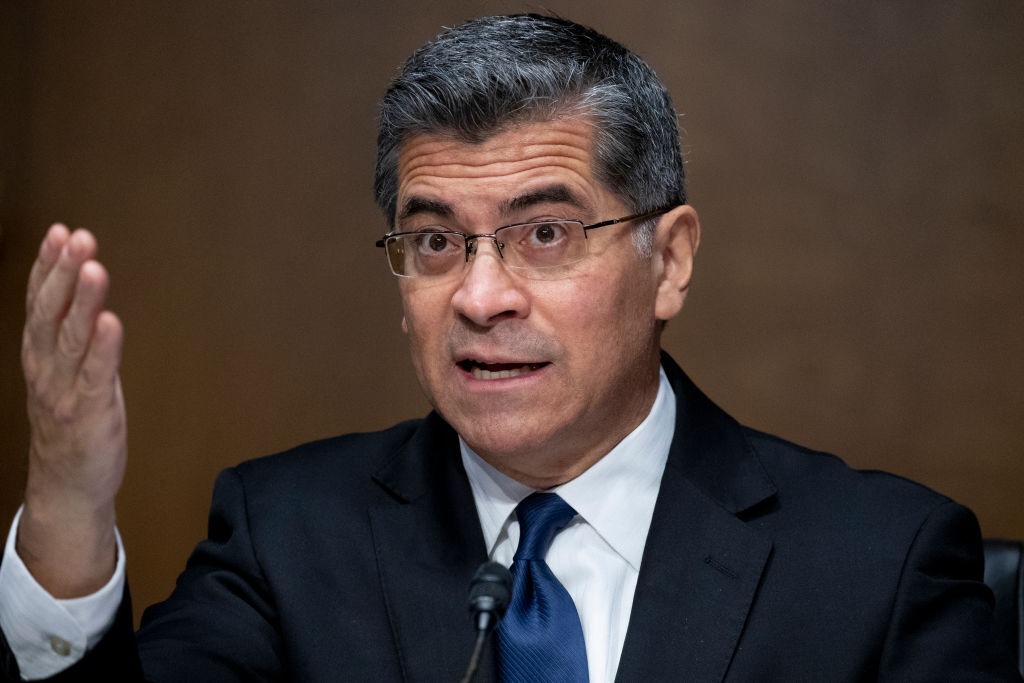
    Xavier Becerra, U.S. Secretary of Health and Human Services. (Photo by Michael Reynolds-Pool/Getty Images)

    BY:  Ohio Capital Journal

    In a recent letter to Ohio Gov. Mike DeWine, the U.S. Department of Health and Human Services said Ohio is among the top states with children losing Medicaid coverage.

    HHS Secretary Xavier Becerra sent a letter to DeWine urging the state to “ensure that no child in your state who still meets eligibility criteria for Medicaid or (the Children’s Health Insurance Program) loses their health coverage” for any reason, including “red tape” or “other avoidable reasons” as COVID-19 enrollment provisions start to fade away.

    The letter said Ohio’s Medicaid and CHIP — a program that gives health coverage to children whose families aren’t eligible for Medicaid — enrollment declined by more than 86,000 children as of Sept. 2023.

    That represents a 6% drop since March of this year, and makes Ohio the fourth-highest in declines across the U.S. during that period, the U.S. Department of Medicaid found.

    Texas was the highest with a decline of 524,909, followed by Florida with 366,633 and Georgia with 149,080.

    Becerra said keeping Medicaid enrollment up is especially important for communities of color, with more than half of children in the U.S. on Medicaid or CHIP in Hispanic, Black, Asian/Pacific Islander, American Indian or Alaska Native communities, according to the U.S. Department of Medicaid.

    “My department stands ready to do all that we can to help your state advance this goal, including by providing Ohio with the flexibility to pause procedural disenrollments for children while it adopts other strategies to ensure eligible children remain enrolled,” Becerra wrote.

    Procedural disenrollments happen when program participants don’t complete the renewal process, which can happen because the state does not have correct contact information, or simply because the participant doesn’t meet the renewal timeline.

    Those disenrollments had been halted in March 2020, but the halt ended on March 31 of this year.

    According to a tracker by KFF — nonpartisan health policy researchers formerly known as the Kaiser Family Foundation — Ohio has seen more than 514,000 individuals disenrolled as of Dec. 13, 2023, and across the states KFF studied, 71% of disenrolled participants lost their coverage because of procedural disenrollment.

    In Ohio, that number was slightly higher than the national amount, at 74%. Only 26% of those who lost coverage in Ohio were disenrolled because they were determined to be ineligible, according to KFF.

    Nationally, the analysis showed four in 10 Medicaid disenrollments were children for the 21 states who released data by age group.

    Becerra noted suggestions from HHS for Ohio to improve enrollment rates by allowing Medicaid managed care organizations to help with renewals, and giving an extra year for those who haven’t gone through the renewal process yet.

    He also encouraged improvements to the auto-renewal process, and increased outreach efforts to places such as schools and community organizations.

    The Ohio House Democratic Caucus was quick to jump on the letter’s contents, with state Rep. Dr. Beth Liston, D-Dublin, writing on behalf of the caucus to urge DeWine to continue the pause on procedural disenrollment for the next year, “while Medicaid works with the Centers for Medicare & Medicaid Services to adopt policies ensuring that children remain enrolled.”

    “No child in Ohio should go without access to the care they need,” Liston wrote in a letter to DeWine. “Every Ohioans deserves to know that their family will have coverage when they need it most.”

    DeWine’s spokesperson, Dan Tierney, verified to the OCJ that the HHS “has communicated with our administration and noted Ohio is farther ahead in redeterminations than other states, which means Ohio Medicaid is doing a better job complying with these directives than other states, which is something to be commended.”

    Tierney also said with Medicaid/CHIP numbers, perspective is also needed.

    “Ohio is our nation’s seventh largest state, so it is unsurprising that Ohio ranks where it does in this ranking of raw numbers,” he said.


    Susan Tebben
    SUSAN TEBBEN

    Susan Tebben is an award-winning journalist with a decade of experience covering Ohio news, including courts and crime, Appalachian social issues, government, education, diversity and culture. She has worked for The Newark Advocate, The Glasgow (KY) Daily Times, The Athens Messenger, and WOUB Public Media. She has also had work featured on National Public Radio.

    MORE FROM AUTHOR

  • Study shows uninsured children could increase with loss of pandemic-era coverage

    Study shows uninsured children could increase with loss of pandemic-era coverage

    Getty Images.

    “As we begin the process of redetermining eligibility for the first time in three years, we must pay particular attention to children’s needs to minimize the number of children who lose coverage.”

    Kelly Vyzral

    BY: SUSAN TEBBEN – Ohio Capital Journal

    A new study warns of a sharp rise in uninsured children in Ohio and across the country if pandemic-era coverage is allowed to fade away.

    The Georgetown University Health Policy Institute’s Center for Children and Families studied the impact of the Children’s Health Insurance Program (CHIP) and Medicaid on bringing down state’s uninsured rate, finding that it “proved to be a critical lifeline for more than half of the nation’s children during the pandemic.”

    Now that a March 2020 provision increasing the federal contribution to state Medicaid programs while requiring states to maintain continuous coverage for Medicaid patients during the COVID-19 public health emergency will be going away, the number of children falling under those protections will also be decreasing.

    “These children are at grave risk of losing coverage inappropriately in states that do not handle the renewal process with the utmost care,” the study stated.

    Because of a loss of income eligibility and “bureaucratic snafus,” the study estimates up to 6.7 million children in the U.S. will lose coverage because of the “unwinding” of pandemic-era programs, scheduled to happen on April 1.

    “The uninsured rate for children could easily more than double if states have inadequate staffing levels and overwhelmed call centers and do not take the time and care needed to properly conduct eligibility checks after the federal protections lift,” the study stated.

    From February 2020 to August 2022, Ohio saw a 26.7% increase in Medicaid and CHIP enrollment, ranking them 29th in the nation based on data from the Centers for Medicare & Medicaid Services. The share of enrollment made up by children in Ohio was 25.6%.

    “As we begin the process of redetermining eligibility for the first time in three years, we must pay particular attention to children’s needs to minimize the number of children who lose coverage,” Kelly Vyzral, senior health policy associate for the Children’s Defense Fund-Ohio, said in response to the study.

    The Children’s Defense Fund-Ohio said nearly half of children in Ohio are covered by Medicaid and other public health insurance programs. The study showed 54% of all American children are covered by Medicaid of CHIP.

    Ohio already has the 12-month continuous Medicaid and CHIP child eligibility for those under age 19 recommended by the study to mitigate losses and gaps in coverage.

    Continuous eligibility protects parents who see an increase in income during a 12-month period from losing child Medicaid or CHIP coverage.

    Ohioans should verify contact information with local benefits offices or through the Medicaid patient portal to avoid cancellation of child insurance, Vyzral said.

    Ohio must complete Medicaid eligibility checks by May 2024.

  • Ohio health care leaders want child health investment by year’s end

    Ohio health care leaders want child health investment by year’s end

    Adobe Stock photo.

    BY: SUSAN TEBBEN – Ohio Capital Journal

    A coalition of health care advocates want to see congressional investment in child health care by the end of the year, including permanent funding for the Children’s Health Insurance Program.

    The coalition, Protect Our Care Ohio, held a press event to push for improvements to maternal health, child outcomes and the issues like discrimination that can increase mortality and lower birth rates, particularly in Black Americans and Black Ohioans.

    “Our Black babies are dying at a rate of three times that of which babies, even here in Toledo/Lucas County,” said Celeste Smith, former coordinator of the Toledo/Lucas County Commission on Minority Health.

    An 2020 analysis by the Commonwealth Fund showed that maternal deaths have been increasing in the U.S., but that most of those deaths are preventable. They found that a “relative undersupply of maternity care providers, especially midwives” and a lack of “comprehensive postpartum supports” contributes to the mortality rates in the country.

    The study also found that more than half of pregnancy-related deaths happen after birth.

    The CDC found that Black babies make up the highest number of deaths per live births in the country as well, with a maternal death rate for Black mothers of three to four times the rate of white mothers.

    Part of the problem, Ohio health advocates say, is the price of health care. For those families that have insurance, often the plans they can afford leave holes in coverage. Many plans chosen for their affordability have high deductibles, even those provided by an employer.

    “Employee-sponsored health care is no longer the gold standard,” said Erika White, chair of the Healthy Lucas County CHIP (Children’s Health Insurance Program). “In reality, many families can not afford their employer health plans and that means the care that we need for our children is falling to the side.

    It is for that reason that the CHIP program through Medicaid is such a needed resource, White said.

    The CHIP program works through Medicaid and separate CHIP programs and is funded both through states and federal block grants.

    According to an annual report filed with the U.S. Department of Medicaid, Ohio’s child enrollment in CHIP rose more than 4% between 2020 and 2021. The increase was due to “economic and policy changes related to the COVID-19 pandemic,” according to the report.

    The Ohio Department of Medicaid has “educated state agency partners and numerous community stakeholders that work with low-income families” to increase outreach efforts, but in terms of reaching uninsured children, Ohio “does not have an effective way to measure” the outreach methods, the report stated.

    One way the problem could be helped is through the permanent authorization of funds for CHIP, which is currently active through June 2023.

    “CHIP is a block grant program, meaning Congress must act periodically to extend funding for the program,” White said.

    A lapse in the funding could mean a lack of health care access for millions of children, more than 9 million nationally in most recent figures from the U.S. Department of Medicaid.

    spending bill being considered by Congress could be the way forward for child health care funding, and an easy way for lawmakers to show their priorities, Smith says.

    “As we reach the end of the year, Congress has not just an opportunity but an obligation to take meaningful action to confront this preventable crisis,” Smith said.

  • Report: Rate of uninsured Ohio children rises significantly

    Report: Rate of uninsured Ohio children rises significantly

    After hitting a historically low rate in 2016, the number of uninsured children has gradually grown to eliminate progress made in the country. Ohio, alone, had a double-digit jump in the three-year study.

    Susan TebbenSusan Tebben is an award-winning journalist with a decade of experience covering Ohio news, including courts and crime, Appalachian social issues, government, education, diversity and culture. She has worked for The Newark Advocate, The Glasgow Daily Times, The Athens Messenger, and WOUB Public Media. She has also had work featured on National Public Radio.

    Nationally, the rate of children not covered by medical insurance was down to 4.7% in 2016, but started to increase again the year after, according to a new study by Georgetown University Health Policy Institute’s Center for Children and Families.

    In 2019, the rate had jumped to 5.7%, an increase of 726,000 more children since the Trump Administration took office in 2016, the study showed.

    “Much of the gain in coverage that children made as a consequence of the Affordable Care Act’s major coverage expansions implemented in 2014 has now been eliminated,” the study noted in its key findings.

    The data was collected from single-year estimates by the U.S. Census Bureau’s American Community Survey from the three years.

    Ohio was one of several states that saw an increase of more than 20,000 uninsured children from 2016 to 2019.

    Ohio’s uninsured rate went up 26% from 2016 to 2019. Data from 2019 show 131,000 Ohio children without insurance, up from 104,000 in 2016.

    Ohio child health advocates say a lack of health insurance contributes to worse life outcomes, which extend to education and societal shortcomings.

    “This damaging trend will have long-term consequences for children and communities across Ohio because without health coverage, children cannot access the care they need to grow and thrive,” said Tracy Najera, executive director of the Children’s Defense Fund Ohio, in response to the study.

    The study attributed declines in Medicaid enrollment as the start of the decrease in insured children. Public coverage for children includes Medicaid and the Children’s Health Insurance Program (CHIP).

    The largest national increase in uninsured children, 320,000, came between 2018 and 2019, and represents the largest annual jump in more than a decade, the authors of the study said.

    “Moreover, since this data was collected prior to the pandemic, the number of uninsured children is likely considerably higher in 2020, as families have lost their jobs and employer-sponsored insurance, though it is impossible to know yet by precisely how much,” the study stated.

    The study comes as some K-12 schools see spikes in COVID-19 rates, and cases in ages 0-19 represent the fifth highest age group in the state, according to state data.

    Texas and Florida had the highest rates, representing 41% of the overall increase in child non-coverage, with about 1 million children in Texas lacking health insurance in 2019, and an estimated 343,000 uninsured children in Florida.