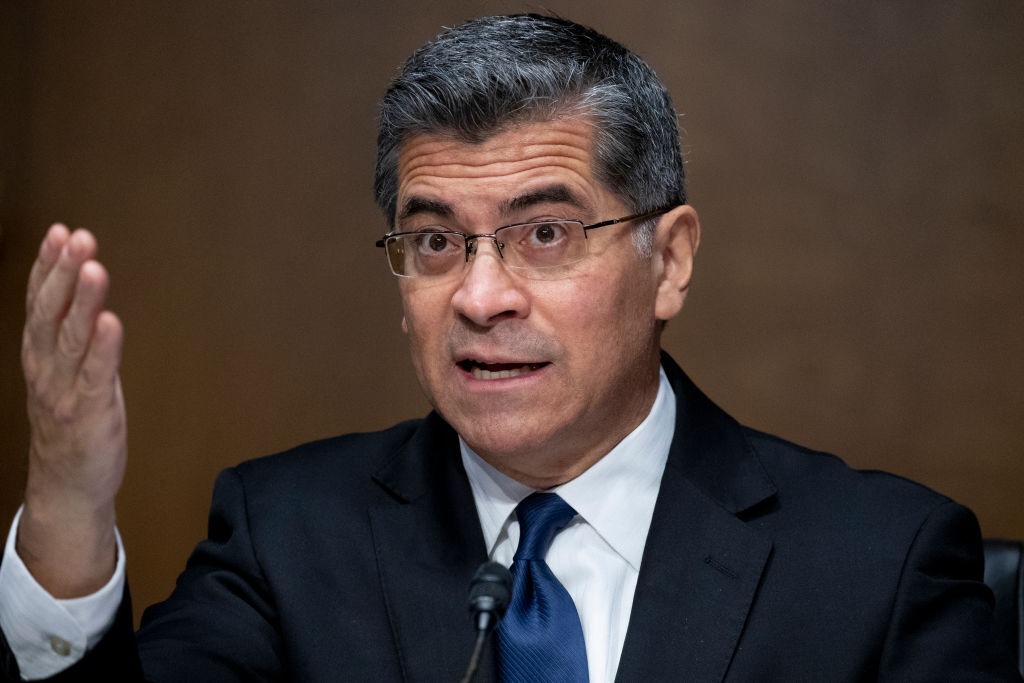
Xavier Becerra, U.S. Secretary of Health and Human Services. (Photo by Michael Reynolds-Pool/Getty Images)
In a recent letter to Ohio Gov. Mike DeWine, the U.S. Department of Health and Human Services said Ohio is among the top states with children losing Medicaid coverage.
HHS Secretary Xavier Becerra sent a letter to DeWine urging the state to “ensure that no child in your state who still meets eligibility criteria for Medicaid or (the Children’s Health Insurance Program) loses their health coverage” for any reason, including “red tape” or “other avoidable reasons” as COVID-19 enrollment provisions start to fade away.
The letter said Ohio’s Medicaid and CHIP — a program that gives health coverage to children whose families aren’t eligible for Medicaid — enrollment declined by more than 86,000 children as of Sept. 2023.
That represents a 6% drop since March of this year, and makes Ohio the fourth-highest in declines across the U.S. during that period, the U.S. Department of Medicaid found.
Texas was the highest with a decline of 524,909, followed by Florida with 366,633 and Georgia with 149,080.
Becerra said keeping Medicaid enrollment up is especially important for communities of color, with more than half of children in the U.S. on Medicaid or CHIP in Hispanic, Black, Asian/Pacific Islander, American Indian or Alaska Native communities, according to the U.S. Department of Medicaid.
“My department stands ready to do all that we can to help your state advance this goal, including by providing Ohio with the flexibility to pause procedural disenrollments for children while it adopts other strategies to ensure eligible children remain enrolled,” Becerra wrote.
Procedural disenrollments happen when program participants don’t complete the renewal process, which can happen because the state does not have correct contact information, or simply because the participant doesn’t meet the renewal timeline.
Those disenrollments had been halted in March 2020, but the halt ended on March 31 of this year.
According to a tracker by KFF — nonpartisan health policy researchers formerly known as the Kaiser Family Foundation — Ohio has seen more than 514,000 individuals disenrolled as of Dec. 13, 2023, and across the states KFF studied, 71% of disenrolled participants lost their coverage because of procedural disenrollment.
In Ohio, that number was slightly higher than the national amount, at 74%. Only 26% of those who lost coverage in Ohio were disenrolled because they were determined to be ineligible, according to KFF.
Nationally, the analysis showed four in 10 Medicaid disenrollments were children for the 21 states who released data by age group.
Becerra noted suggestions from HHS for Ohio to improve enrollment rates by allowing Medicaid managed care organizations to help with renewals, and giving an extra year for those who haven’t gone through the renewal process yet.
He also encouraged improvements to the auto-renewal process, and increased outreach efforts to places such as schools and community organizations.
The Ohio House Democratic Caucus was quick to jump on the letter’s contents, with state Rep. Dr. Beth Liston, D-Dublin, writing on behalf of the caucus to urge DeWine to continue the pause on procedural disenrollment for the next year, “while Medicaid works with the Centers for Medicare & Medicaid Services to adopt policies ensuring that children remain enrolled.”
“No child in Ohio should go without access to the care they need,” Liston wrote in a letter to DeWine. “Every Ohioans deserves to know that their family will have coverage when they need it most.”
DeWine’s spokesperson, Dan Tierney, verified to the OCJ that the HHS “has communicated with our administration and noted Ohio is farther ahead in redeterminations than other states, which means Ohio Medicaid is doing a better job complying with these directives than other states, which is something to be commended.”
Tierney also said with Medicaid/CHIP numbers, perspective is also needed.
“Ohio is our nation’s seventh largest state, so it is unsurprising that Ohio ranks where it does in this ranking of raw numbers,” he said.