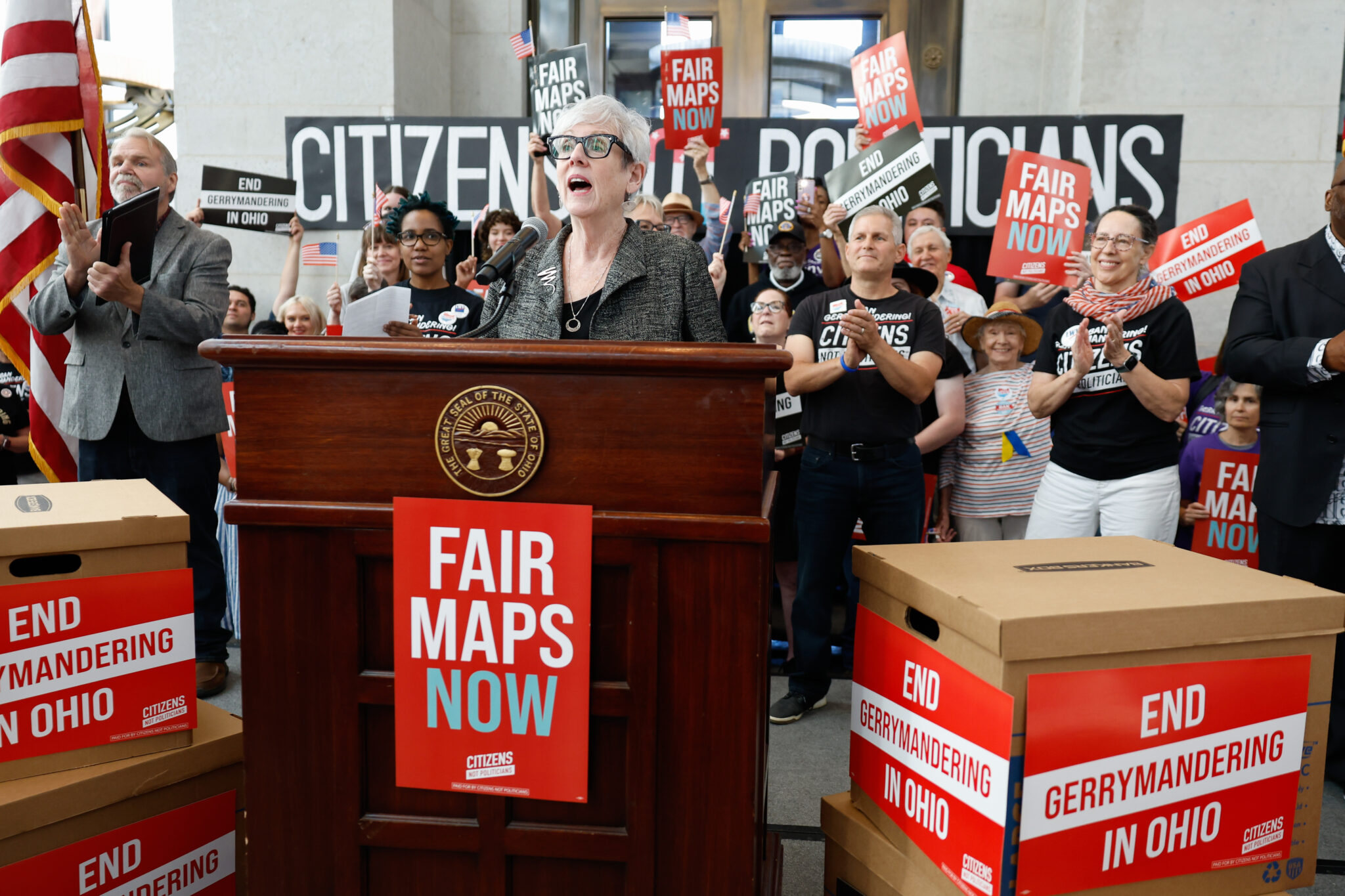
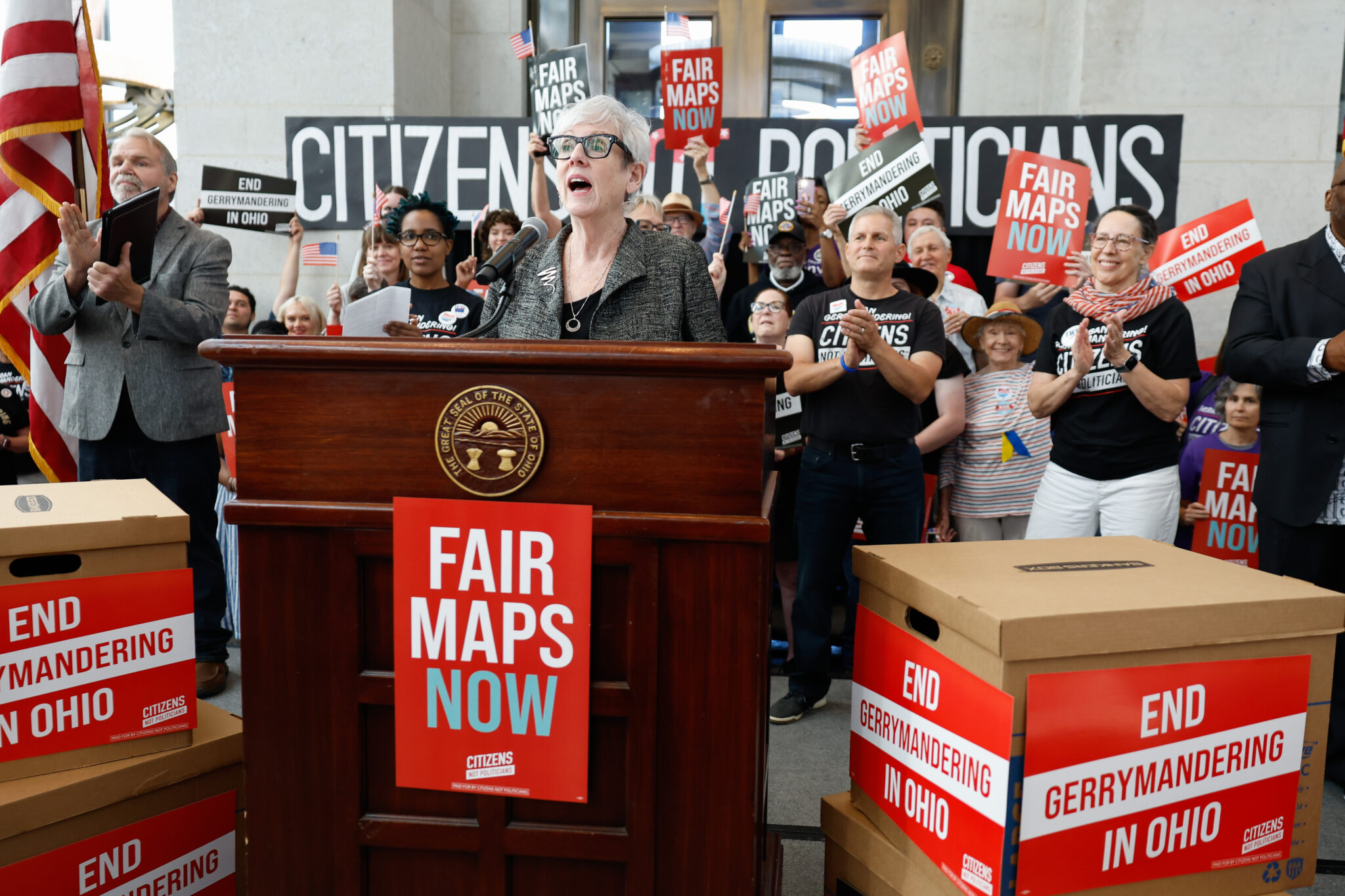
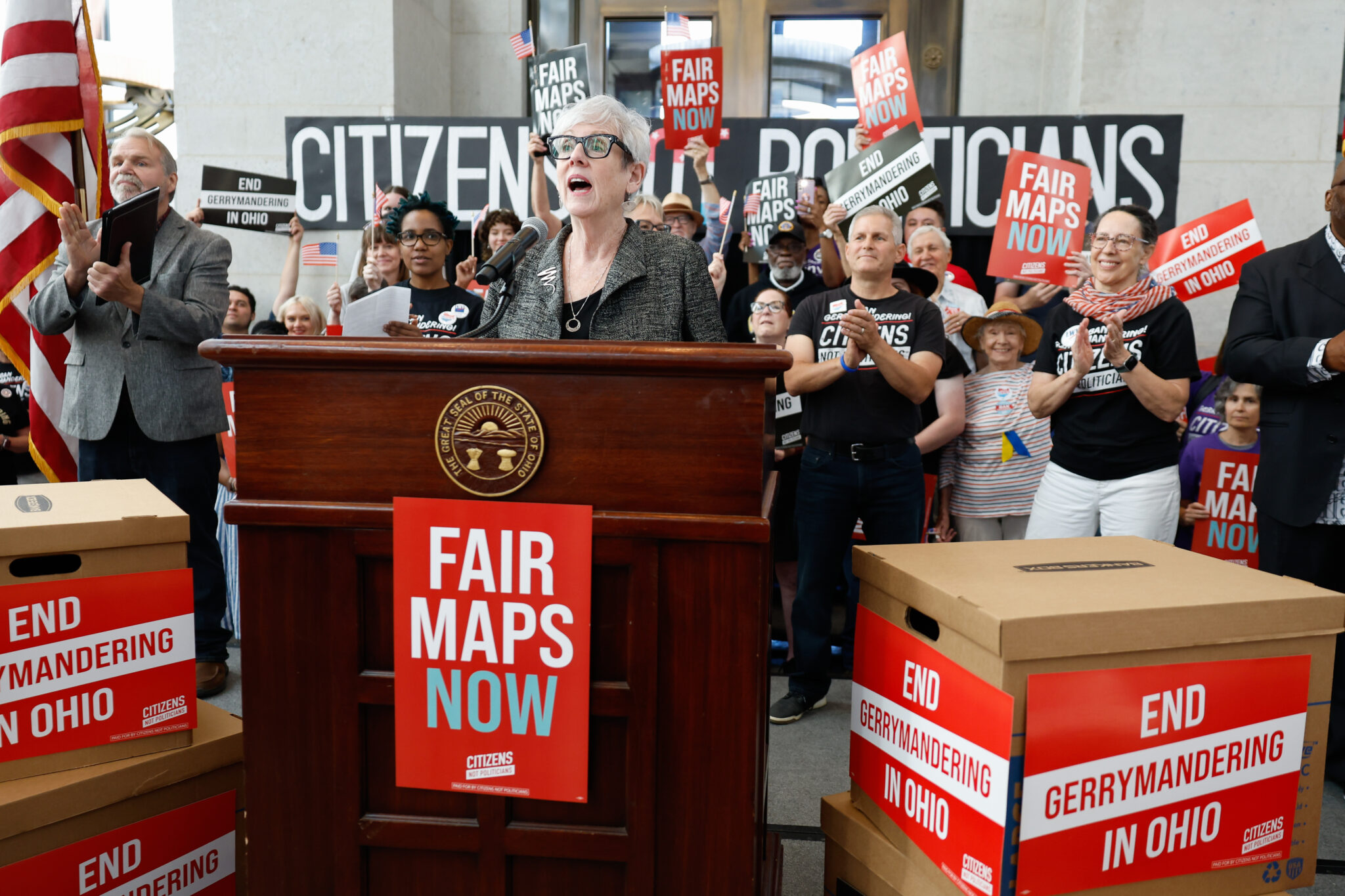
Retired Ohio Supreme Court Chief Justice Maureen O’Connor speaks to supporters at the Citizens Not Politicians rally, July 1, 2024, at the Statehouse in Columbus, Ohio. (Photo by Graham Stokes for Ohio Capital Journal. Republish only with original story.)
Even though Ohioans will be voting on Issue 1, which would remove politicians from the redistricting if approved, it’s possible redistricting will go before the state’s high court again.
The justices elected to the Ohio Supreme Court in 2024 will be the ones deciding on any challenges to new maps if Ohio voters pass the proposed Issue 1 anti-gerrymandering amendment this November.
Even though Ohioans will be voting on Issue 1, which would remove politicians from redistricting if approved, it’s possible redistricting will go before the state’s high court again.
“Maps, no matter who draws them, are certainly subject to challenge, and they’re subject to challenge for violating the provisions of the Ohio Constitution,”said University of Cincinnati Political Science Professor David Niven. “So we’re not done no matter what happens with Issue One. … There are still unhappy political actors who will go to the courts in some cases, questioning the process.”
Redistricting and past Supreme Court rulings
Redistricting is currently done through the Ohio Redistricting Commission — which includes the governor, the secretary of state, the state auditor and four legislative leaders (two from each party). In 2015, 71% of Ohioans voted in favor of a constitutional amendment to create a bipartisan redistricting commission to draw legislative districts in 2021.
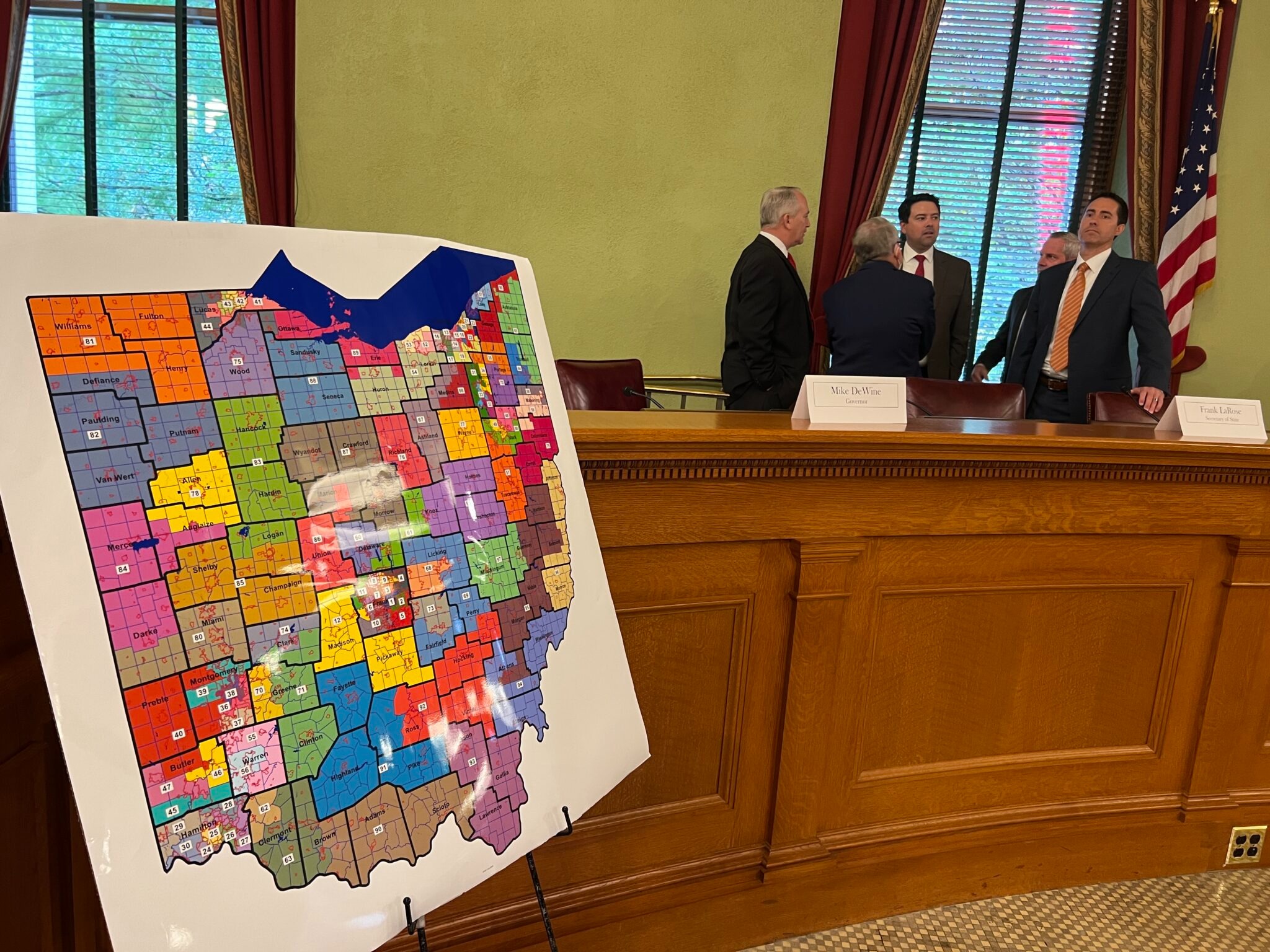
Six different Statehouse district maps and two congressional maps have gone through the current redistricting process. The Ohio Supreme Court ruled five of the Statehouse maps unconstitutionally gerrymandered and both congressional maps were rejected as unconstitutional.
A federal court ordered Ohio voters to use the last of the gerrymandered Statehouse maps in 2022 since the commission ran out of time to come up with a constitutionally approved map. State lawmakers are currently occupying those districts.
Republican former Ohio Supreme Court Chief Justice Maureen O’Connor, who served on the state’s high court from 2003 to 2022, talked about this in an ad for Issue 1.
“Seven times career politicians have so blatantly gerrymandered our voting district maps that the Ohio Supreme Court ruled the maps unconstitutional. Seven times,” she said in the ad. “Issue One bans politicians from drawing voting maps. It will restore power to where it belongs, with citizens not politicians.”
Citizens Not Politicians, a nonpartisan coalition, is behind the proposed constitutional amendment. Issue 1 would create a 15-member Ohio Citizens Redistricting Commission made up of Republicans, Democratic and independent citizens. It would prohibit current or former politicians, political party officials, lobbyists and large political donors from being on the commission.
Ohio Supreme Court races
Republicans currently have a 4-3 majority on the Ohio Supreme Court. Depending on the outcome of the election, the Democrats could flip the court or the Republicans could tighten their grip.
“The makeup of the court makes a tremendous difference,” Executive Director of Common Cause Ohio Catherine Turcer said. “Are these folks that are going to serve on the court going to look at new voting districts with an eye to what’s in the Ohio Constitution and to what is actually good for Ohio voters, or are they going to be swayed by partisan interests?”
Ohio Republican lawmakers added party labels to the previously nonpartisan Ohio Supreme Court races starting in 2022.
Incumbent Democratic Justice Michael P. Donnelly is being challenged by Republican Hamilton County Court of Common Pleas Judge Megan Shanahan.
Incumbent Democratic Justice Melody Stewart is being challenged by incumbent Republican Justice Joseph Deters, who decided not to run for his current seat and instead chose to go up against Stewart.
Democratic candidate Lisa Forbes, of the Eighth District Court of Appeals, and Republican candidate Dan Hawkins, of the Franklin County Court of Common Pleas, are fighting for Deters’ open seat.
Deters recently talked briefly about redistricting on a right-wing Cleveland radio show.
“I think it’s kind of humorous to watch when the other side can’t win, they want to change the rules whether it’s hacking the U.S. Supreme Court because they don’t have the justices they like, or getting rid of the Electoral College because they don’t have a clear advantage in the Electoral College like they do, and it’s just a flat popular vote. And now redistricting,” he said on Strictly Speaking with Bob Frantz.
Megan Henry is a reporter for the Ohio Capital Journal and has spent the past five years reporting in Ohio on various topics including education, healthcare, business and crime. She previously worked at The Columbus Dispatch, part of the USA Today Network.
Ohio Capital Journal is part of States Newsroom, the nation’s largest state-focused nonprofit news organization.
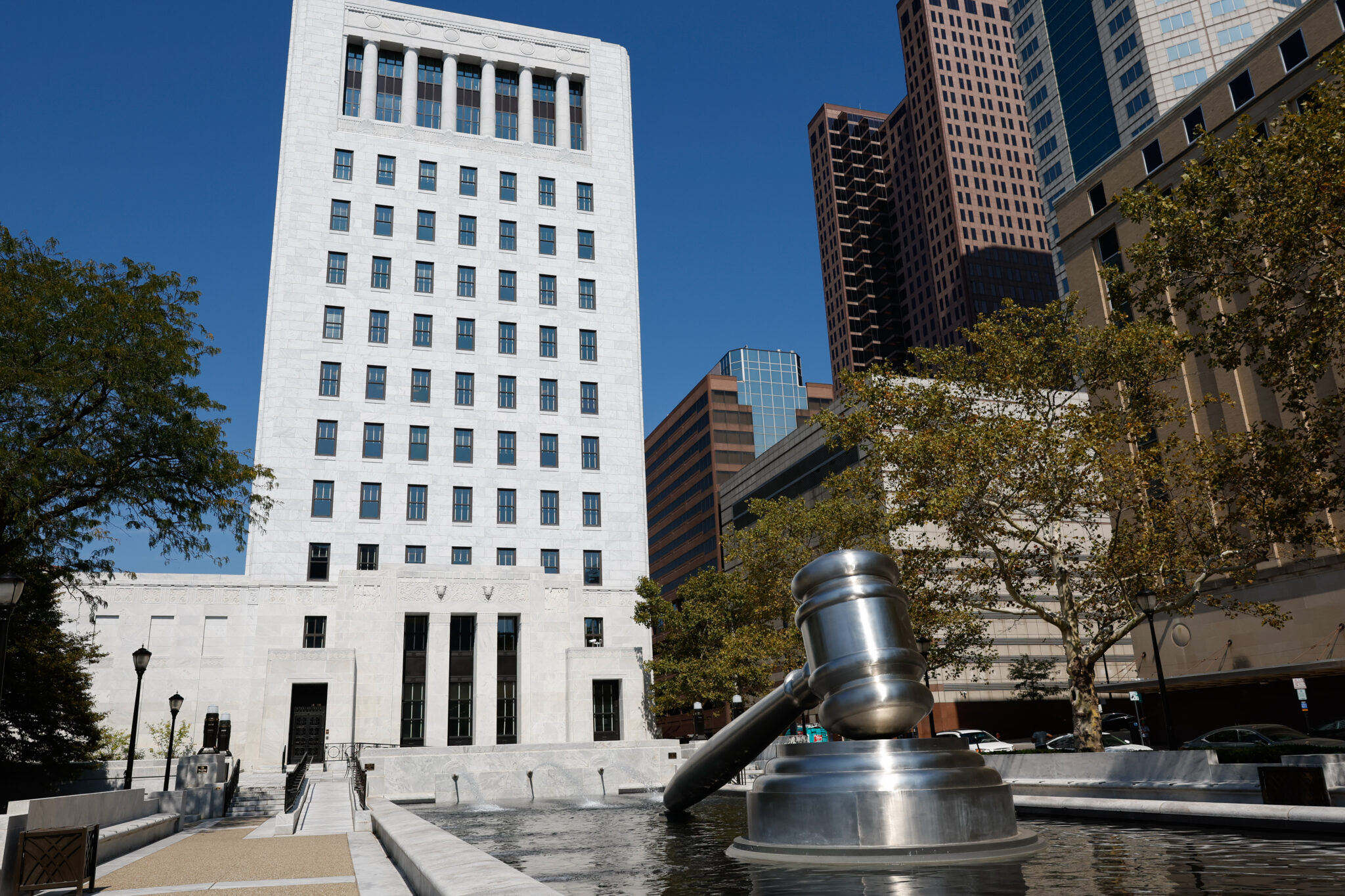
The Gavel outside the Supreme Court of the State of Ohio, September 20, 2023, at 65 S. Front Street, Columbus, Ohio. (Photo by Graham Stokes for Ohio Capital Journal. Republish photo only with original article.)
Republican majority rejects 6 of 8 changes requested by anti-gerrymandering advocates proposing the amendment
The Ohio Supreme Court largely approved ballot summary language for November’s Issue 1 anti-gerrymandering amendment on Monday, sending the language back to the Ohio Ballot Board for two revisions.
A 4-3 Republican majority rejected 6 of 8 revisions requested by anti-gerrymandering advocates, while Democratic justices on the court said that was inadequate and that the summary needed “a nearly complete redrafting.”
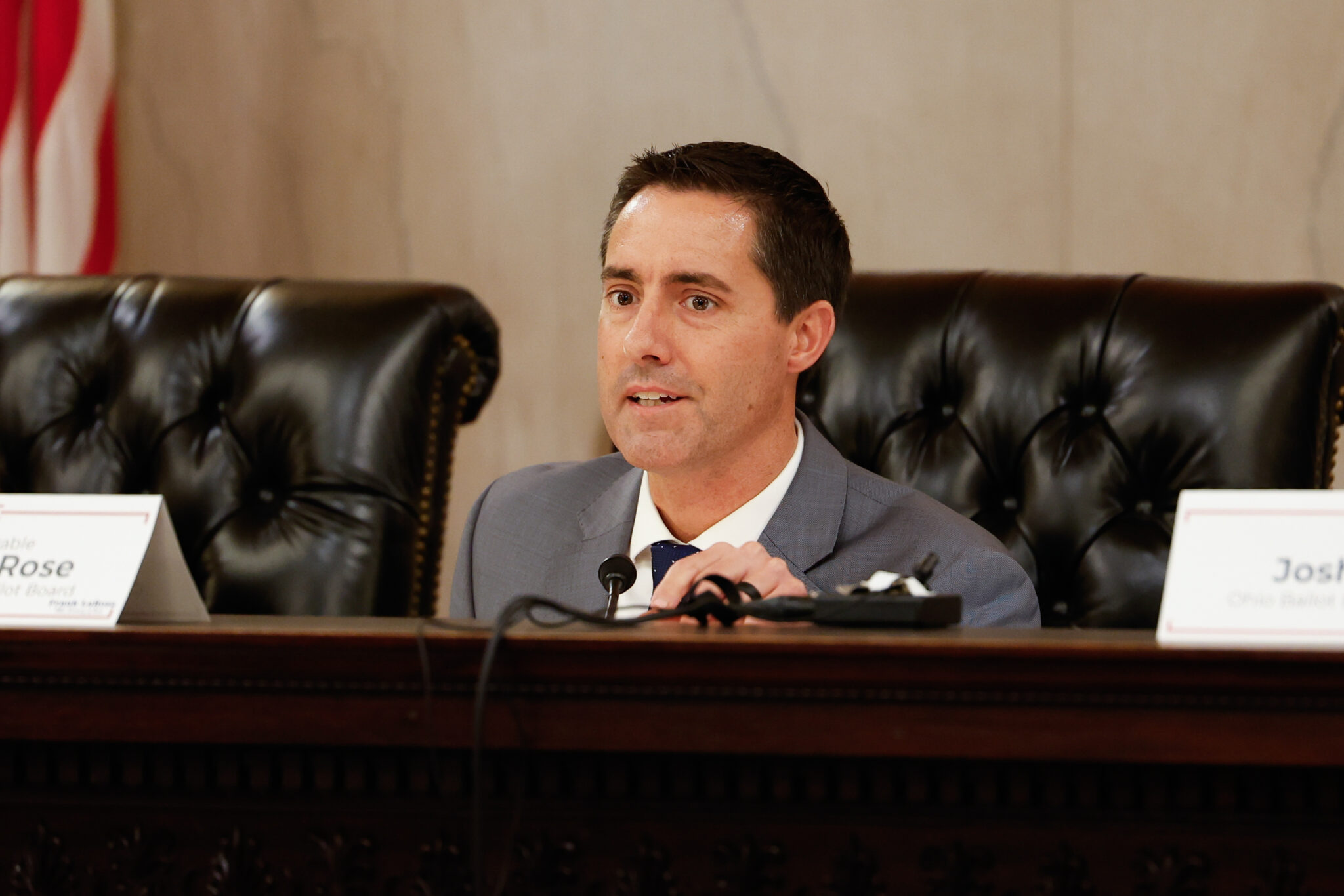
The summary was written by Ohio Secretary of State Frank LaRose, who opposes the amendment, and approved 3-2 by the Ohio Ballot Board, which is chaired by LaRose. LaRose is also a member of the current Ohio Redistricting Commission that the amendment proposes to replace with citizen commissioners.
While the court allowed most of the summary language in a decision released Monday night, it ordered the board to include in the summary “language that accurately conveys” that “the public would have the right to express itself to the new redistricting commission” under the terms of the amendment, written by anti-gerrymandering coalition Citizens Not Politicians.
“Distilled, the proposed amendment would provide the rights of public participation in the redistricting process through meetings, hearings and an online public portal, and would forbid communication with the commission members and staff outside the public-meeting and portal context,” the court wrote.
The other change ordered by the court compels the ballot board to make it clear that judicial review of the amendment is not limited to a “proportionality standard.”
The current seven-member Ohio Redistricting Commission includes the Ohio House Speaker and Ohio Senate President, along with the governor, secretary of state, auditor of state, and two minority party legislative leaders.
If approved by the voters, the amendment would replace the politician commission with the Ohio Citizens Redistricting Commission, which would have 15 members made up of five Republican citizens, five Democratic citizens, and five independents.
The summary language does not change the text of the proposed redistricting reform or what the amendment would actually do; it’s just the summary language used to describe the amendment on voter ballots.
An average of Ohio voter preferences over the last 10 years including 2022 show a 56-43 Republican-to-Democratic preference of Ohio voters, but Republicans control supermajorities of 67 out of 99 Ohio House seats and 26 out of 33 Ohio Senate seats. Ohio voters were forced to vote under unconstitutionally gerrymandered districts in 2022 after Republicans on the Ohio Redistricting Commission ran out of time to produce constitutional maps and a split federal court ruled the maps that were declared gerrymandered by a bipartisan majority on the then-Ohio Supreme Court had to be used.
Republican politicians on the Ohio Redistricting Commission battled with the bipartisan court majority for nearly two years over the maps in 2021 and 2022, with five Statehouse maps and two U.S. Congressional district maps being rejected as unconstitutionally gerrymandered. The swing vote in those cases, Republican Supreme Court Justice Maureen O’Connor, was forced to retire due to age. She is now leading the Citizens Not Politicians amendment effort.
One provision challenged by Citizens Not Politicians but allowed by the court states the amendment would “repeal constitutional protections against gerrymandering approved by nearly three-quarters of Ohio electors participating in the statewide elections of 2015 and 2018, and eliminate the longstanding ability of Ohio citizens to hold their representatives accountable for establishing fair state and legislative and congressional districts.”
Citizens Not Politicians attorneys argued mention of the vote margin and method were not necessary, and the court said challengers laid out arguments that the language was “tantamount to an argument against adopting the proposed amendment.”
But the court majority found that “at worst” including the vote margin and method could be “questioned on relevance grounds” not on “accuracy grounds.”
“This information is factually accurate, and relators have not shown that the information would ‘mislead, deceive or defraud the voters,’” the court majority stated in their decision.
The court also allowed language added by state Sen. Theresa Gavarone during the Aug. 16 board meeting, which states the amendment would “establish a new taxpayer-funded commission of appointees required to gerrymander the boundaries of state legislative and congressional districts to favor the two largest political parties in the state of Ohio.”
Justices dismissed Citizens Not Politicians arguments that the language leads voters to believe the amendment would “require gerrymandering,” despite the fact that the amendment states it would ban partisan gerrymandering.
The court said “the fact that the proposed amendment announces that it would ‘ban partisan gerrymandering,’ … is of little assistance in ascertaining whether the ballot language’s use of the word ‘gerrymander’ is improper.”
The court explored various definitions of “gerrymandering” in coming to its decision, finding that the requirement the amendment uses to dictate the drawing of Statehouse and congressional maps “falls within the meaning of ‘gerrymander.’”
“Because the board’s use of the term ‘gerrymander’ is consistent with dictionary definitions and how the United States Supreme Court has used the term, it does not mislead, deceive or defraud voters,” the decision stated.
The court did not order any changes to the ballot title, though that was included in the changes requested by Citizens Not Politicians.
“We conclude that the secretary did not err in crafting the ballot title,” the court wrote.
While all the justices agreed to the changes, they were split on how many changes needed to be made.
In his concurrence, Justice Patrick Fischer claimed “gerrymandering, though in a bipartisan manner, is absolutely ‘required under the proposed amendment,” and that the state constitution “would dictate” that independent and third-party voters would have their voice “removed from Ohio’s political world.”
Justice Michael Donnelly agreed to the decision that ordered changes to the ballot language, but “vehemently” disagreed “that those corrections are even remotely adequate to prevent the ballot language as a whole from being misleading.”
He and Justice Melody Stewart joined Justice Jennifer Brunner in an opinion that agreed to the changes, but said the majority opinion “reflects an abject failure of this court to perform an honest constitutional check on the ballot board’s work.”
“We should be requiring a nearly complete redrafting of what is perhaps the most stunningly stilted ballot language that Ohio voters have ever seen,” Brunner wrote.
She went on to say the ballot board language “is tantamount to performing a virtual chewing of food before the voters can taste it for themselves to decide whether they like it or not.”
The Ohio Secretary of State’s office said the ballot board will meet to make the revisions on Wednesday morning.
Reactions
Citizens Not Politicians released a statement saying they disagreed with “much of the decision” but agreed with the court’s “repudiation of the politicians on the ballot board for violating the Ohio Constitution.”
Ballot Board chair Frank LaRose released his own statement, calling the court’s decision “a huge win for Ohio voters, who deserve an honest explanation of what they’re being asked to decide.”
Former Ohio Redistricting Commission co-chair and Auditor of State Keith Faber said the court was “thoughtful in its approach and they got it right.”
Senate President Matt Huffman and Gov. Mike DeWine have both spoken against the measure publicly.
Faber’s fellow co-chair Senate Minority Leader Nickie Antonio said while the decision “enables Ohioans to make a more informed choice by addressing some of the most deceptive language, other misleading and argumentative language still remains.”
Susan Tebben
Susan Tebben is an award-winning journalist with a decade of experience covering Ohio news, including courts and crime, Appalachian social issues, government, education, diversity and culture. She has worked for The Newark Advocate, The Glasgow (KY) Daily Times, The Athens Messenger, and WOUB Public Media. She has also had work featured on National Public Radio.
Ohio Capital Journal is part of States Newsroom, the nation’s largest state-focused nonprofit news organization.
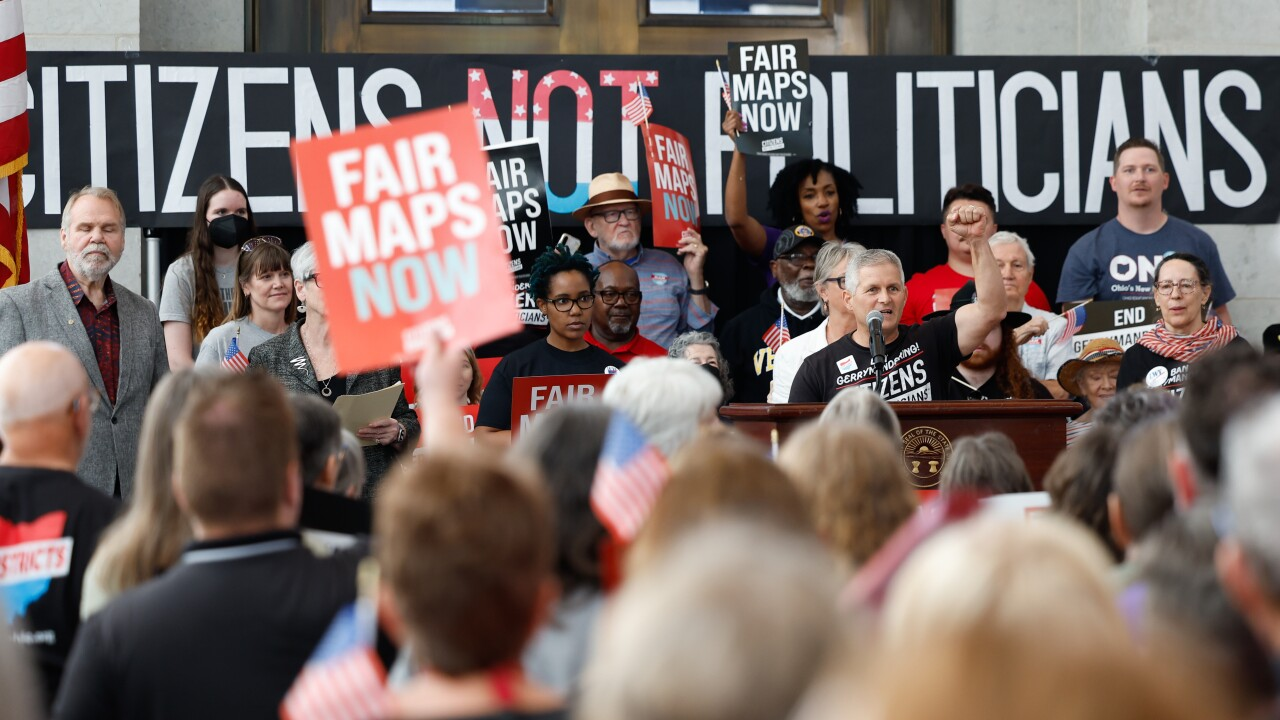
A July 1 rally of Citizens Not Politicians at the Ohio Statehouse. (Photo by Graham Stokes for Ohio Capital Journal. Only republish photo with original story.)
Advocates pushing an anti-gerrymandering amendment in Ohio to remove politicians from mapmaking in favor of a citizen commission said the state’s ballot board should be forced to start over on summary language for the November proposal.
Attorneys said the proposed amendment would ban partisan gerrymandering “by setting forth robust redistricting criteria to ensure fair maps, selection standards to ensure the new commission’s impartiality and accountability, and transparency measures to ensure public information and participation,” according to a merit brief filed Thursday.
But they say the summary language written by Ohio Secretary of State Frank LaRose and adopted by a majority of the Ohio Ballot Board on Aug. 16 “would have voters believe exactly the opposite.”
The Ohio Ballot Board decides what language voters will see on their ballots when they go to vote, but that summary language does not change what the proposed amendment would actually do. In a 3-2 vote, the Ohio Ballot Board approved summary language that supporters of the anti-gerrymandering amendment say is intentionally misleading and biased against the amendment. They have filed a lawsuit with the Ohio Supreme Court opposing the summary language.
The merit brief is part of that lawsuit filed by Citizens Not Politicians, the group who has led the charge for the anti-gerrymandering amendment. The lawsuit asks the state’s highest court to order changes to the summary language made by the ballot board, chaired by Ohio Sec. of State LaRose.
The proposed amendment signed by more than 535,000 verified Ohio voters would replace the current Ohio Redistricting Commission made up of seven politicians, including LaRose, with a 15-member citizens commission made up of Republicans, Democrats, and independents.
Citizens Not Politicians Attorney Don McTigue pointed to a change made by state Sen. Theresa Gavarone, R-Bowling Green, during the ballot board’s meeting, in which she changed the word “manipulate” to “gerrymander” when describing the methods of redrawing congressional and statehouse district lines within the amendment.
“Earlier this year, Attorney General Dave Yost certified that the Amendment’s summary was ‘fair and truthful,’” McTigue wrote. “That summary states, consistent with the amendment’s plain text, that the amendment would ‘ban partisan gerrymandering.’”
The brief emphasizes what the original complaint filed on Aug. 19 asserted, which is that the opinion of whether or not the proposed amendment “offers better policy than the existing system” should be left up to the voters in November.
“The Ballot Board’s job is to provide ballot language that gives voters the facts so that they can make up their own minds,” the brief states.
That language should follow constitutional rules dictating the language and the title, something the LaRose language doesn’t do, according to Citizens Not Politicians.
The Ohio Constitution states ballot language “shall properly identify the substance of the proposal to be voted upon,” and the language “shall not be held invalid unless it is such as to mislead, deceive or defraud the voters.”
The Ohio Revised Code says the secretary of state or the ballot board is required to “give a true and impartial statement of the measures in such language that the ballot title shall not be likely to create prejudice for or against the measure.”
The title of the redistricting amendment, as approved by the board majority, is “to create an appointed redistricting commission not elected by or subject to removal by the voters of the state.”
“The Ballot Board’s attempt to put a thumb on the scale against the amendment is a thumb in the eye of Ohioans who expect their representatives on the Board to carry out their mandatory duties impartially,” McTigue wrote.
The Ohio Attorney General has filed an answer to the complaint, but the filing has already received criticism from the Democratic members of the ballot board, who say they were not consulted on the legal document, nor have they been given outside counsel to speak on their behalf, despite the fact that the the two Democrats, state Sen. Paula Hicks-Hudson and state Rep. Terrence Upchurch, voted against the ballot board language.
Hicks-Hudson and Upchurch ended up filing a brief themselves on Wednesday night, in which they did not fight arguments that the ballot board “as a whole violated its constitutional duty,” and said the “chosen ballot title is inaccurate, biased, argumentative and misrepresents the proposed amendment’s procedures for removing commissioners who fail to comply with their duties.”
McTigue said the court “has never hesitated to strictly enforce the legal requirements for the text that appears on the ballot, in recognition of Ohioans’ century-old right to amend their constitution and laws through direct democracy.”
“The court should do the same here, by directing (the ballot board) to start over and adopt ballot language and a ballot title that are consistent with their clear legal duties.”
The Ohio Supreme Court was asked just last year to make changes to a ballot board-approved summary, in that case for the reproductive rights constitutional amendment that would eventually pass with 57% of the vote.
The coalition that sued took issue with ballot language that used the phrases “unborn child” and “reproductive medical treatment,” along with using the phrase “the citizens of the State of Ohio” rather than just “the State of Ohio” when speaking of the prohibitions against “indirectly burdening, penalizing or prohibiting abortion.”
In a similar way to the redistricting amendment author’s arguments that the LaRose language could mislead voters as to the intentions of the proposed amendment, the lawsuit against the reproductive rights amendment summary said it could mislead voters about the rights the amendment created, the restrictions in the amendment, discretion when it comes to fetal viability and state regulation of the amendment.
The Ohio Supreme Court said they agreed “that the ballot language approved by the ballot board misleads the average voter about whose actions the amendment restricts.”
“But the ballot language is not defective in any other respect,” the court wrote.
The court asked the ballot board only to change the phrase “citizens of the State of Ohio” to “State of Ohio,” and approved the rest.
Justice Michael O’Donnelly wrote in his concurring opinion that it was “unfortunate that advocacy seems to have infiltrated a process that is meant to be objective and neutral.”
Susan Tebben
Susan Tebben is an award-winning journalist with a decade of experience covering Ohio news, including courts and crime, Appalachian social issues, government, education, diversity and culture. She has worked for The Newark Advocate, The Glasgow (KY) Daily Times, The Athens Messenger, and WOUB Public Media. She has also had work featured on National Public Radio.
Ohio Capital Journal is part of States Newsroom, the nation’s largest state-focused nonprofit news organization.
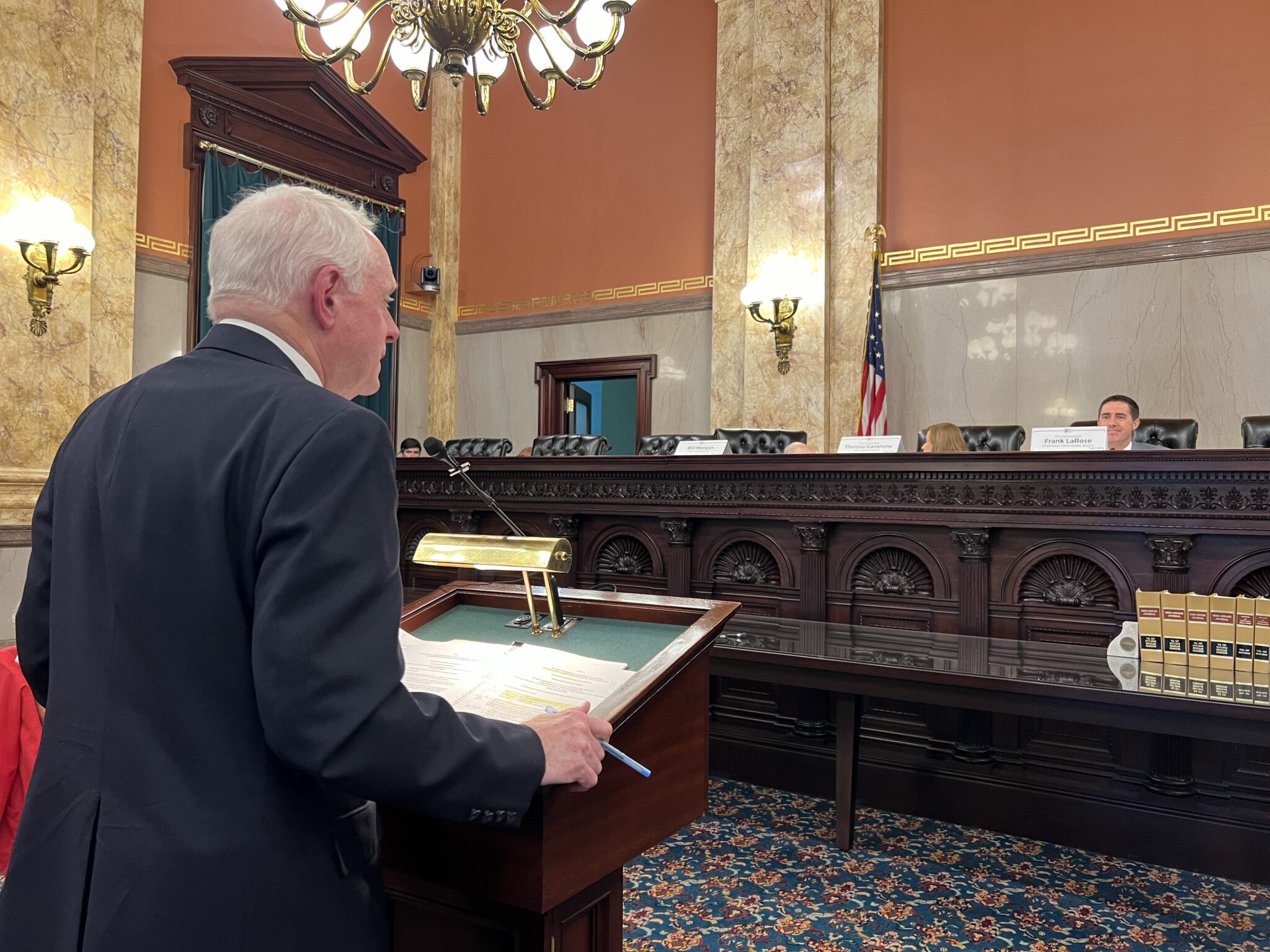
Attorney Don McTigue speaks before the Ohio Ballot Board on Friday, Aug. 16, to discuss summary language that will appear before voters in November on the redistricting reform amendment. (Photo by Susan Tebben, Ohio Capital Journal.)
The Ohio Ballot Board passed controversial language written by Secretary of State Frank LaRose on Friday as the ballot summary that will explain to voters November’s anti-gerrymandering amendment. Supporters of the amendment have called the language deceptive and unconstitutional and have said they would challenge it in court.
The board met on Friday morning to determine the summary that will appear on individual ballots, the final words Ohioans will see before they choose to accept or deny the measure.
The proposed amendment would remove Ohio politicians from the process of drawing Statehouse and congressional district maps, and instead create a citizen commission to draw maps made up of Republicans, Democrats, and independents.
The board was led by LaRose in passing his preferred ballot language for the amendment 3 to 2, with both Democratic members of the board, state Sen. Paula Hicks-Hudson and state Rep. Terrence Upchurch, voting against the approval. LaRose is one of the politicians who sits on the current Ohio Redistricting Commission, and one of the Republican members who repeatedly voted for maps that were declared to be unconstitutionally gerrymandered by a bipartisan majority on the Ohio Supreme Court before they were nevertheless forced on voters by a federal court in 2022 after time to draw constitutional maps had run out.
One amendment was made to the LaRose language Friday, brought by board member and Republican state Rep. Theresa Gavarone. That change takes a paragraph that says the commission will be “required to manipulate the boundaries of state legislative and congressional districts…” and changes it to say the commission will be “required to gerrymander” those districts, a change that elicited shocked scoffs from the crowd gathered at the board meeting.
The ballot measure seeks to create a 15-citizen redistricting commission to decide Statehouse and congressional voting districts throughout the state, which authors of the proposed amendment from the group Citizens Not Politicians say will be done in public meetings and include opportunities for public input as the process goes on.
Citizens Not Politicians submitted its own proposed summary for ballot board consideration, and it said commission members would be non-elected citizens who “who have demonstrated the absence of any disqualifying conflicts of interest and who have shown an ability to conduct the redistricting process with impartiality, integrity and fairness.”
Democrats attempted to approve the language provided by Citizens Not Politicians, but the motion was voted down 3 to 2, supported only by the Democratic members of the board.
Hicks-Hudson also tried to amend the LaRose-written language to replace it with the Citizens Not Politicians language, but that motion was also struck down.
“This is a dangerous proposal that threatens the integrity of the vote on Issue 1,” Hicks-Hudson said of the Secretary of State language.
With the title that says the amendment would “create an appointed redistricting commission not elected by or subject to removal by the voters of the state,” the language approved by the board speaks of the elimination of “the longstanding ability of Ohio citizens to hold their representatives accountable for establishing fair state legislative and congressional districts,” and the purpose to “repeal constitutional protections against gerrymandering approved by nearly three-quarters of Ohio electors participating in the statewide elections of 2015 and 2018.”
Attorney Don McTigue made the point that it’s impossible for citizens to hold their elected lawmakers responsible by voting in gerrymandered districts — which are by definition guaranteed to ensure the gerrymandered lawmakers’ victory.
“The problem is that the whole accountability argument only works when you have fair districts, not when you have the severely gerrymandered districts that you have in this state,” McTigue said during the public comment portion of the board meeting.
McTigue, who represents the creators and supporters of the ballot initiative, requested the use of the language Citizens Not Politicians submitted rather than the Secretary of State language, citing Ohio law dictating ballot language and title.
“The (SOS) language is stunning in it being false and misleading, and it is unabashed in terms of its prejudicial language,” McTigue said. “There’s no reasonable person who … after reading that language could conclude that it is an honest attempt to provide fair ballot language that allows voters to make an independent decision about the issue.”
He cited the 2015 and 2018 redistricting measures, in which the ballot board “distilled the most important aspects of the proposed redistricting changes to the Ohio Constitution.”
The language, which LaRose said in the ballot board meeting was written by him “with the input of my team,” was harshly criticized by the measure’s leaders and supporters leading up to the meeting as misleading and biased language that violated constitutional rules.
LaRose defended the language in his summary that said the amendment would “limit the right of Ohio citizens to freely express their opinions to members of the commission or to commission staff regarding the redistricting process or proposed redistricting plans,” saying the language might unduly shield members of the new commission from public scrutiny.
McTigue pushed back, saying context is important in reading the summary, which is why he didn’t support the Secretary of State language.
“I think that something can be misleading or deceptive if you don’t have the full context,” McTigue said.
The Secretary of State’s language was released Thursday, giving board members and McTigue little time to read through it, something that was discussed in the meeting.
“I think the record should be really clear that 24 hours isn’t necessarily a lot of time to deal with 900-some words that really, I’m not sure fit in to the confines of what the law requires and … making a really thoughtful evaluation of the language,” said Hicks-Hudson.
Gavarone said the 900 words in the LaRose language “accurately explain what this is,” and noted the details on the process of redistricting were not included in the Citizens Not Politicians proposed summary language.
LaRose also touched on the selection process for commission members in the amendment, saying the longest part of his summary language was explaining that process.
“The way that you end up on the current commission (the Ohio Redistricting Commission) is pretty straightforward,” LaRose said. “(The proposed process) is a bit of a Rube Goldberg device that involves a lot of twists and turns … it’s a complex process.”
He called the five-bullet summary proposed by the CNP “wholly inadequate” and said it could not “identify the substance” of the lengthy amendment.
Noted opponents of the ballot measure include Senate President Matt Huffman and Ohio Gov. Mike DeWine, both of whom made public cases against the measure. Huffman said the effort would bring about an onslaught of legal trouble for the state, and DeWine said the focus on proportionality in the rules of the redistricting process would cause more problems than supporters claim it would fix, and “Ohio would actually end up with a system that mandates, that compels map-drawers to produce gerrymandered districts,” he said at a recent press conference.
Supporters of the amendment have said they will appeal the decision of the Ohio Ballot Board in court, just as the supporters of the ballot measure on reproductive rights did to the Ohio Supreme Court after ballot board approval.
Indeed, immediately after the board meeting adjourned, Citizens Not Politicians pledged to “seek remedy” from the Ohio Supreme Court by filing a brief next week on the language, according to Jen Miller of the League of Women Voters of Ohio.
LaRose did not speak to reporters after the meeting.
Susan Tebben
Susan Tebben is an award-winning journalist with a decade of experience covering Ohio news, including courts and crime, Appalachian social issues, government, education, diversity and culture. She has worked for The Newark Advocate, The Glasgow (KY) Daily Times, The Athens Messenger, and WOUB Public Media. She has also had work featured on National Public Radio.
Ohio Capital Journal is part of States Newsroom, the nation’s largest state-focused nonprofit news organization.
The office of Ohio Secretary of State Frank LaRose has drafted ballot language for the Ohio Ballot Board to consider Friday that supporters of an anti-gerrymandering amendment say is deceptive and unconstitutional. The Ballot Board decides the text of proposed amendments that voters actually see on their ballots when they vote.
The anti-gerrymandering amendment before Ohio voters in November, according to the language drafted by LaRose’s office, would “eliminate the longstanding ability of Ohio citizens to hold their representatives accountable for establishing fair state legislative and congressional districts.”
The Citizens Not Politicians group that authored the ballot initiative and collected more than 535,000 necessary signatures from Ohio voters to get the measure on the ballot, has proposed their own language for the ballot as well, saying it would remove politicians from the redistricting process in favor of a citizen board.
The group is proposing a redistricting amendment that would replace Ohio’s politician-led redistricting commission with a citizen-led commission made up of Republicans, Democrats and independents. Currently, the Ohio Secretary of State is one of the politicians sitting on Ohio’s redistricting commission, along with the governor, the Ohio Auditor, two lawmakers from the majority party and two lawmakers from the minority party.
The language drafted by the Secretary of State’s Office claims in its proposed title that the amendment’s purpose is, “To create an appointed redistricting commission not elected by or subject to removal by the voters of the state.”
Moreover, the draft language says its purpose is to “repeal constitutional protections against gerrymandering approved by nearly three-quarters of Ohio electors participating in the statewide elections of 2015 and 2018.”
Backers say the amendment is actually intended to protect voters against gerrymandering by removing politicians who stand to benefit from the process, and to not allow them to continue drawing gerrymandered district maps.
After the 2015 and 2018 reforms were.passed by voters, Republican politicians on the Ohio Redistricting Commission including Ohio Secretary of State LaRose repeatedly voted for Statehouse and U.S. Congressional district maps that were declared unconstitutional gerrymanders by a bipartisan majority on the Ohio Supreme Court. Nevertheless, Ohio voters were forced to use the maps as the politicians refused to produce a maps that reflected voting preferences of Ohioans.
The Ohio Secretary of State’s Office further claims in its proposed language that the new amendment would also “limit the right of Ohio citizens to freely express their opinions to members of the commission or to commission staff regarding the redistricting process or proposed redistricting plans.”
It claims the amendment would “prohibit any citizen from filing a lawsuit challenging a redistricting plan in any court, except if the lawsuit challenges the proportionality standard applied by the commission, and then only before the Ohio Supreme Court,” and that new “taxpayer-funded costs” would be imposed by the amendment, with “an unlimited amount for legal expenses incurred by the commission in any related litigation.”
Ohio Gov. Mike DeWine recently publicly opposed the ballot measure because of its emphasis on proportionality, alleging there was no way the measure could work as written. In opposing the measure, he said whether or not it passes in November, he’s considering going to the legislature to adapt Iowa’s redistricting process for Ohio. Iowa’s process leaves lawmakers with final say over maps.
The proposed constitutional amendment penned by Citizens Not Politicians calls for a 15-person redistricting commission made up of citizens, rather than the Ohio Redistricting Commission that is currently made up entirely of elected officials.
The language proposed by Citizens Not Politicians to the ballot board states the proposed amendment would “require that the commission consist of 15 members who have demonstrated the absence of any disqualifying conflicts of interest and who have shown an ability to conduct the redistricting process with impartiality, integrity and fairness.”
The amendment would “provide that each redistricting plan shall contain single-member districts that are geographically contiguous, comply with federal law, closely correspond to statewide partisan preferences of Ohio voters and preserve communities,” according to the Citizens Not Politicians proposed language.
The current Ohio Redistricting Commission made up of politicians produced six different Statehouse maps and two congressional maps over the two years it did its work. Five of the Statehouse maps were ruled unconstitutional by the Ohio Supreme Court and neither of the congressional maps passed constitutional muster, according to the state’s highest court. The second of the congressional maps remains the state’s congressional district map, despite being found to be unduly partisan by the state supreme court.
Retired Republican Chief Justice of the Supreme Court of Ohio, Maureen O’Connor. (Poto by Graham Stokes for Ohio Capital Journal. Republish photo only with original article.)
Former Ohio Supreme Court Chief Justice Maureen O’Connor, a leader for Citizens Not Politicians, who has called for reforms to redistricting since she left the bench, said the Secretary of State’s proposed language violates the Ohio Constitution.
“The self-dealing politicians who have rigged the legislative maps now want to rig the Nov. 5 election by illegally manipulating the ballot language,” O’Connor said in a statement. “We will make our case for fair and accurate language before the Ballot Board and if necessary take it to court.”
O’Connor’s statement claims the language proposed by the Secretary of State’s Office violates an article of the Ohio Constitution that prohibits ballot language that “is such as to mislead, deceive, or defraud voters,” according to the law.
Ohio law also states ballot titles “shall give a true and impartial statement of the measures in such language that the ballot title shall not be likely to create prejudice for or against the measure.”
It’s not the first time even in the last year that ballot language has been criticized as a misleading representation of the proposed initiative. Last year’s reproductive rights ballot measure went through the same process, with language written by Ohio Secretary of State staff approved as the language to appear on the ballots.
The creators of the ballot measure sued, with the Ohio Supreme Court approving the ballot language, but sending it back to the board for small changes.
Despite the language, which critics said intentionally misrepresented the reproductive rights amendment, the measure passed with 57% of the vote last November.
State Secretary of State LaRose is the head of the Ohio Ballot Board that will consider the language on Friday. The board is also made up of Republican state Sen. Theresa Gavarone, Democratic state Sen. Paula Hicks-Hudson, Democratic state Rep. Terrence Upchurch and citizen-member William Morgan.
A spokesperson for the Secretary of State’s Office did not respond to request for comment on the language Thursday afternoon.
Susan Tebben
Susan Tebben is an award-winning journalist with a decade of experience covering Ohio news, including courts and crime, Appalachian social issues, government, education, diversity and culture. She has worked for The Newark Advocate, The Glasgow (KY) Daily Times, The Athens Messenger, and WOUB Public Media. She has also had work featured on National Public Radio.
Ohio Capital Journal is part of States Newsroom, the nation’s largest state-focused nonprofit news organization.
Ohio Gov. Mike DeWine stood in staunch opposition Wednesday to an anti-gerrymandering proposal heading to voters in November that would replace politicians with a citizen redistricting commission, but he stopped short of presenting a competing proposal this year.
DeWine held a press conference on Wednesday, not only to criticize the Citizens Not Politicians ballot initiative, but to acknowledge the process that’s currently in place in Ohio — a process that includes him — doesn’t work either.
“We need to end this writing and re-writing of our constitution, and we must defeat this misguided ballot initiative,” DeWine said.
Asked whether he thought it was possible the initiative headed to the ballot could work, despite his misgivings, the governor said, “No. No way in hell.”
DeWine instead presented his preference for an “Iowa plan,” where Ohio lawmakers would draw up a redistricting amendment proposal of their own early next year, based on the state of Iowa’s.
Iowa has a non-partisan legislative services agency draw maps for approval by lawmakers and the governor. If a map doesn’t get passed by the legislature and governor on its first two attempts, Iowa lawmakers are able to make amendments to the map plan as they see fit on the third attempt. This gives Iowa lawmakers final authority on maps.
In a response issued after DeWine’s news conference, Citizens Not Politicians leader and retired Republican Ohio Supreme Court Chief Justice Maureen O’Connor issued a statement saying that the “disinformation from the governor today is insulting to everyone in Ohio.”
Redistricting in Ohio
The governor was a member of the Ohio Redistricting Commission (as dictated by current state law regarding redistricting), so he saw firsthand the process over the two years that the commission adopted six Statehouse maps and two U.S. congressional maps.
All of the maps were challenged in court, with five of the Statehouse maps rejected by the Ohio Supreme Court, and both of the congressional maps ruled unconstitutionally partisan. The sixth map was not rejected by a state supreme court led by new Chief Justice Sharon Kennedy, rather than the previous swing vote on all the maps, now-retired Chief Justice Maureen O’Connor.
The process also saw two independent map-drawers, who were brought in at the behest of the court, but whose suggestions and draft maps were rejected by the commission at the last minute, in favor of a previous draft drawn up by Republican staffers.
“This was a decision that I have consciously made after having watched the turmoil, political partisanship that’s been going on for a long time in Ohio,” DeWine said on Wednesday as he decried the Citizens Not Politicians proposal.
The one thing DeWine said did need to happen in redistricting reform that matches up with the current ballot proposal is a removal of politics as part of the process.
“Ohio should have a constitutional provision that instructs the mapmakers that they can not consider past voting data, that the map-drawers know will lead to a pre-determined partisan outcome,” he said.
He said the proposal set to come before voters would need replaced once again after voters realized they were “unhappy,” and that the new process “will make things much worse.”
“If this ballot proposal were to be adopted, Ohio would actually end up with a system that mandates, that compels map-drawers to produce gerrymandered districts,” DeWine alleged.
The proposal headed for voters after the Ohio Ballot Board approves ballot language for it, would create a 15-person independent redistricting commission made up of citizens, and without elected officials, according to the proposal. The citizens would be chosen through a vetting process done by local judges, and public hearings would be a part of the process as maps are drafted, Citizens Not Politicians has stated.
The main problem with the proposal for DeWine is that proportionality “supersedes” all when it comes to drawing maps and determining Statehouse and congressional districts. Proportionality requires representation based on the voting trends in past elections.
The governor critiqued the initiative for having proportionality supersede things like communities of interests and township/county/municipality lines.
Ohio Gov. Mike DeWine points to a proposed Ohio voting district during a Wednesday press conference. At the press conference, he spoke out against the Citizens Not Politicians redistricting reform proposal, and brought up his own plan for reform after the November election. (Photo by Susan Tebben, Ohio Capital Journal.)
Using two examples of maps drawn with the simulation software Dave’s Redistricting App — one done by “Kevin” with a proportionality score of 100 out of 100, and another officially submitted by the Ohio Democrats — he endeavored to show possible problems with maps that focus solely on proportionality.
He mentioned the “snake on the lake” — a nickname for a northeast district based on its shape — comparing it to a district in one simulation that connected Sandusky and Lorain counties. He said another district in the proposals reminded him of an ice cream cone in its “scooping” out of parts of the area.
“This is what proportionality does if you adhere to it,” he said.
DeWine’s plan
Whether or not the Citizens Not Politicians initiative goes through, Ohio might see DeWine and the legislature attempting to rewrite the constitution again.
If the initiative doesn’t pass, DeWine was resolute in his plan to “work with the General Assembly to introduce a resolution in the next session.”
“We’ll vet that proposal, there’ll be hearings on it, we’ll hear from citizens on all sides,” DeWine said. “And I hope then, approve the resolution to place an initiative on the ballot for voters to approve the way the process should be.”
He said he will ask for passage of “a version of the Iowa ballot language that’s been in effect … for about 40 years now.”
The Iowa system has gone through its share of changes, but in the 1980 legislative session, state legislators established the current process, in which the Legislative Service Bureau, “a nonpartisan bill drafting agency of the General Assembly” is given the “primary responsibility for drawing proposed congressional and legislative districts, subject to legislative and gubernatorial approval,” according to a legislative guide to the process produced by the Iowa Legislative Services Agency, a combination of agencies including the LSB.
The plan requires a first redistricting plan to be submitted to the General Assembly, after which a “Temporary Redistricting Advisory Commission” holds at least three hearings in “different geographic regions of the state,” submitting a report after the hearings.
If that map fails to be approved by the legislature or the governor, specific reasons must be given via resolution or governor’s veto message. The GA then has 35 days to get a second plan to a vote. No public hearings are required for the second plan.
If there is need for a third plan, the process repeats, but this time “the third plan is subject to amendment in the same manner as any other bill,” meaning that Iowa lawmakers can make desired changes directly.
If no agreement can be made or if that plan is legally challenged, judicial intervention from the state supreme court begins.
The Iowa Constitution “provides that the Iowa Supreme Court will likely assume or be given the responsibility for establishing a valid redistricting plan,” according to the LSA.
As DeWine explained the Iowa process, he said the Legislative Service Commission in Ohio would be the non-partisan entity to start the process, but Ohio’s version would perhaps not follow the rest of the process, including the provision that states the Iowa Legislature has the formal passage power on maps.
As for enforcement measures to keep the redistricting leaders in check under the plan he’s proposing, DeWine said “none of that changes” from the process now.
The biggest part of the system that DeWine wants to see in Ohio is the map-drawing criteria.
“The Iowa criteria makes it impossible for someone legally following the constitution to use partisan politics,” the governor said.
He acknowledged Iowa’s smaller population and more compact counties, but said the “basic principle” works in both states.
“Do you want politics in it, or do you want politics prohibited from being in it?”
If an Ohio GA plan “deviates very much” from the Iowa system, DeWine said he “will not be in favor of it.”
Even if the ballot measure does pass in November, DeWine still wouldn’t rule out the possibility that he would push for the Iowa plan to be on the ballot at a later date.
“What I’m not going to say is ‘never, never, never’ will I ever do that, I’m not going to say it,” DeWine said. “What I hope happens is that we can defeat this in the fall … and I will push and I will do whatever I can to lead so that we end up with something that’s better than what we have now.”
He went further, saying even if the legislature does not bring about the plan he envisions, “I will do everything I can to get it on the ballot by initiative.”
Despite his fervor for the plan, DeWine said he would not be calling a special session for the legislature to work on the initiative now, to try to beat the Aug. 7 petition-filing date.
“I don’t have time to go to the ballot, number one; number two, I don’t know that at this late date if there’s support in the House to do that; three, the advantage that you have by waiting …is that we can go through a normal process where there are public hearings and things can be vetted,” DeWine told reporters on Wednesday.
The governor alleged that the Citizens Not Politicians amendment had not been properly vetted, saying if voters understood the proposal, they wouldn’t want it, even if they support proportionality as a lead method in redistricting. The proposal made the ballot with 535,005 valid Ohio voter signatures.
“The idea of proportionality sounds good, it sounds fair,” DeWine said. “However, we see how requiring a map-drawer to draw districts, each of which favors one political party … obliterates all other good government objectives.”
Reactions
The Citizens Not Politicians leaders were unsurprisingly against DeWine’s comments and his new plan.
“The disinformation from the governor today is insulting to everyone in Ohio, and especially insulting to the half-a-million Ohioans – Republicans, Democrats and Independents – who put the Citizens Not Politicians amendment on the November ballot,” said retired Chief Justice Maureen O’Connor, in a statement with Citizens Not Politicians.
O’Connor offered to sit down with the governor and “explain” the plan since, she said, “the governor demonstrated in his rambling and disjointed press conference today that he does not understand our amendment.”
Senate Minority Leader Nickie Antonio, D-Lakewood, who was on the Ohio Redistricting Commission with DeWine when they passed the most recent statehouse district map, said the governor’s proposal “appears to be another eleventh-hour attempt to subvert the will of the people and keep a stranglehold on the GOP artificial supermajority.”
House Minority Leader Allison Russo, D-Upper Arlington, also served on the commission with DeWine through a number of maps, and commented after the most recent map adoption that she agreed to the map solely to take the process out of the hands of the ORC.
On Wednesday, she called the DeWine’s press conference a “manufactured attempt to confuse and misdirect voters from the truth.”
“Republicans are desperate because they know their gerrymandered grip on power is coming to an end, so they’re once again attacking Ohioans’ fundamental freedoms and putting their own self-interest ahead of the interest of the people,” Russo said in a statement.
The governor wasn’t without his supporters in the effort, however. A spokesperson for Senate President Matt Huffman said the governor “is correct about proportionality, also known as ‘representational fairness,’ it is the textbook definition of gerrymandering.”
“It’s important to remember that the current system, approved by more than 70% of the voters, produced a unanimous bipartisan vote that approved maps for the General Assembly over the remainder of the decade,” spokesperson John Fortney said.
House Speaker Jason Stephens posted a statement on X after DeWine’s press conference, saying “I look forward to working with the governor, the Senate and the entire GOP Caucus to defeat Issue 1 in November.”
“Once Issue 1 is defeated, we will continue to work to ensure all Ohioans voices are heard and represented,” the statement read.
Susan Tebben
Susan Tebben is an award-winning journalist with a decade of experience covering Ohio news, including courts and crime, Appalachian social issues, government, education, diversity and culture. She has worked for The Newark Advocate, The Glasgow (KY) Daily Times, The Athens Messenger, and WOUB Public Media. She has also had work featured on National Public Radio.
Ohio Capital Journal is part of States Newsroom, the nation’s largest state-focused nonprofit news organization.
A proposed anti-gerrymandering amendment in Ohio that would remove politicians from the redistricting process in favor of a citizens commission has gathered enough signatures to proceed to voters on the November ballot.
The Ohio Secretary of State’s Office certified 535,005 signatures for the Citizens Not Politicians ballot initiative that would create an independent redistricting commission and replace the Ohio Redistricting Commission made up entirely of elected officials.
The coalition of voting rights groups and anti-gerrymandering advocates who made up Citizens Not Politicians submitted more than 731,000 signatures on July 1, well above the required 413,487. The Secretary of State’s Office reviewed the signatures for duplicate or invalid signatures, finalizing the total on Tuesday.
The office also said the initiative received signatures from 58 of the 88 counties, and at least 5% of the total vote cast for governor in the last gubernatorial election. Ohio law requires measures to have signatures in at least 44 counties.
“This certification is a historic step towards restoring fairness in Ohio’s electoral process,” retired Ohio Supreme Court Chief Justice Maureen O’Connor said in a CNP statement after the signatures were certified.
The former chief justice came on to the effort early in the process after leaving the Ohio Supreme Court due to age limits. As a member the state’s highest court, she was part of a majority that rejected six maps, both Ohio Statehouse and congressional, adopted by the Ohio Redistricting Commission, which includes the governor, auditor of state, and secretary of state, along with legislative leaders, all of whom are elected officials, as dictated by the current redistricting laws.
O’Connor told supporters at a rally when the signatures were submitted to the Secretary of State’s Office that the measure was “one of the most widely supported citizen-initiated constitutional amendments in Ohio’s history.”
According to CNP, the ballot board, which has not yet scheduled the meeting for the measure’s consideration, has until Aug. 22 to “write and adopt the language that will appear on the Nov. 5 ballot” based on constitutional requirements to “properly identify the substance of the proposal to be voted on.”
“We are confident that Ohio voters will see simple, accurate language when they go to the polls on Nov. 5 to vote for this amendment,” O’Connor said in the CNP statement.
In addition to creating a 15-member independent redistricting commission, the constitutional amendment would ban current or former politicians and party officials, along with lobbyists from having a seat on the commission, and “require the creation of fair and impartial districts, prohibiting any drawing of voting districts that discriminate against or favor any political party or individual politician,” according to the coalition.
Supporters also say the amendment would create a more transparent process than has been seen in past redistricting efforts.
Opponents of the measure include Ohio Senate President Matt Huffman, who took during a post-primary event by the Ohio Chamber of Commerce to make the case against the effort.
He argued the new process would provoke an “extraordinary” amount of legal challenges, and he also defended the current process.
“When allowed to work in the summer of 2023, (the redistricting process) did work,” Huffman said in March.
After ballot board approval, the initiative will then be included in the November ballot issues statewide.
SUSAN TEBBEN
Susan Tebben is an award-winning journalist with a decade of experience covering Ohio news, including courts and crime, Appalachian social issues, government, education, diversity and culture. She has worked for The Newark Advocate, The Glasgow (KY) Daily Times, The Athens Messenger, and WOUB Public Media. She has also had work featured on National Public Radio.
Ohio Capital Journal is part of States Newsroom, the nation’s largest state-focused nonprofit news organization.
Reporting more than 731,000 signatures submitted to the Ohio Secretary of State’s Office, Citizens Not Politicians said it cleared a massive hurdle in their plan to reform the state’s redistricting process by replacing politicians with a citizen commission.
The group hoping to get a citizen-led redistricting commission inserted as an amendment to the Ohio Constitution was required to collect 413,487 signatures by July 3 in order to qualify for the Nov. 5 general election. That number accounts for 10% of the total votes cast in the last gubernatorial election, a threshold state law requires for ballot initiatives.
Ohio also requires petitions to receive at least 5% of the vote in at least 44 counties. Citizens Not Politicians said it did this in 57 counties, while also collecting signatures in all 88 counties in the state.
During a rally celebrating the submission of the signatures on Monday, retired Republican Ohio Supreme Court Chief Justice Maureen O’Connor told a crowd of hundreds in the Statehouse atrium that the initiative received the third highest signature total the state has seen in more than a century. She said it was “one of the most widely supported citizen-initiated constitutional amendments in Ohio’s history.”
“Ladies and gentlemen, let me let you in on a little secret,” she told supporters who attended the rally. “This amendment will pass. We will prevail.”
The signatures will now be verified by the Secretary of State’s Office, to filter out possible duplicate or invalid voter signatures, before a final count will be released.
O’Connor joined in on the redistricting reform process after being chief justice of a supreme court that rejected six different maps adopted by the Ohio Redistricting Commission, a commission made up of elected officials.
The current seven-member Ohio Redistricting Commission includes the Ohio House Speaker and Ohio Senate President, along with the governor, secretary of state, auditor of state, and two minority party legislative leaders. If approved by the voters, the amendment would replace the politician commission with the Ohio Citizens Redistricting Commission, which would have 15 members, five matching the political party of the governor at the time, five from the party of the gubernatorial candidate who received the second-most votes in the most recent election, and five unaffiliated members.
The most recent map adopted by the current redistricting commission was cleared by the state’s highest court after O’Connor left due to age limits, and the head chair was taken up by Republican Chief Justice Sharon Kennedy.
The rally and the reason for it brought out all sorts, from education and nurses association members to bricklayers and religious leaders.
Maria Montanez is a part of the Ohio Organizing Collaborative’s Building Freedom Ohio, which works with residents who have been a part of the criminal justice system.
Montanez said she is a convicted felon, but one who served her time while also obtaining a Bachelor’s degree in business administration.
“When I got out of prison, I wasn’t given a fair chance,” Montanez said. “Even though I came out with an accolade and prepared myself to be a productive citizen within the community, I’m still looked at as a felon.”
She wants to see changes to collateral sanctions in Ohio, and thinks making changes to voting rules and making voting districts representative can help make that happen.
“There’s plenty of people that look like me, feel like me and are living the same civil debt that I am living today,” she said.
For Cleveland-area school nurse David Spanos, changing the way redistricting is done could help bring more funding to public schools, and lift fair partisan representation into reality, rather than map manipulations meant to help incumbents hold on to power.
“I don’t think Ohio would be a Republican state if it weren’t for gerrymandering,” Spanos said.
Cincinnati resident and salon owner Desirae Futel works hard to help her customers learn where and when to vote, and what their voice means when it comes to change in politics.
“Gerrymandering has long silenced communities like mine, but today, we stand to change that,” she told the crowd.
With the signatures now submitted, the campaign to get voters to the ballot in support of the measure begins. That strategy includes battling against those who oppose the new redistricting plan, according to O’Connor.
“They’re going to scheme and spread disinformation, and try and muddy the waters and confuse the voters,” she said.
But if the motivation encapsulated in the Statehouse atrium spreads to the rest of Ohio voters, Montanez said the votes will go their way.
“It’s in the numbers that we move this, it’s in the capacity, it’s not just one person,” she said.
SUSAN TEBBEN
Susan Tebben is an award-winning journalist with a decade of experience covering Ohio news, including courts and crime, Appalachian social issues, government, education, diversity and culture. She has worked for The Newark Advocate, The Glasgow (KY) Daily Times, The Athens Messenger, and WOUB Public Media. She has also had work featured on National Public Radio.
Ohio Capital Journal is part of States Newsroom, the nation’s largest state-focused nonprofit news organization.
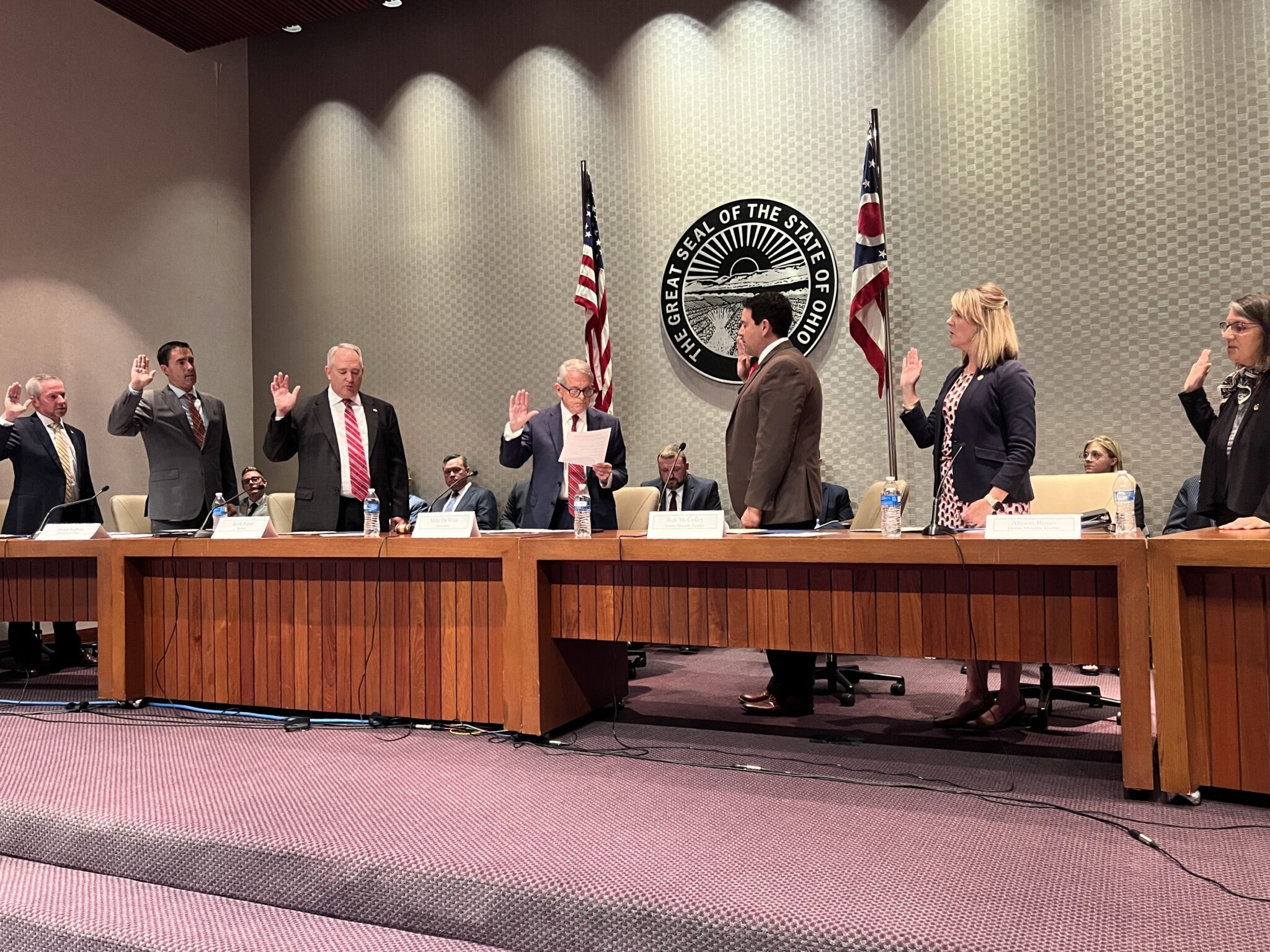
The members of the Ohio Redistricting Commission are sworn in by Gov. Mike DeWine on Wednesday. Left to right: State Rep. Jeff LaRe, Secretary of State Frank LaRose, Auditor of State Keith FSUSAN TEBBENaber, DeWine, Senate Majority Floor Leader Rob McColley, House Minority Leader Allison Russo and Senate Minority Leader Nickie Antonio. (Photo by Susan Tebben, OCJ.)
Signature collection continues for an anti-gerrymandering ballot measure in Ohio that would replace politicians on the redistricting commission with citizens. As the July deadline approaches, supporters are pointing to a new study showing how uncompetitive Statehouse races are.
The Brennan Center for Justice at NYU’s law school analyzed Ohio’s current maps alongside the results of the most recent primary election.
Authors of the study said the data “reveals one of the tangible ways Ohio’s gerrymandered maps undermine electoral competition, and how the districts leave millions of Ohio voters without a significant voice in the Ohio House elections slated for this November.”
“An overwhelming majority of Ohioans will cast ballots this November in legislative districts that were drawn to lock in general election outcomes, and few districts featured meaningful primary contests,” the Brennan Center report stated. “These are the predictable consequences of living in a gerrymandered state.”
One of the authors of the report, released Tuesday, is Yurij Rudensky, who spoke in support of the new ballot initiative proposed to hit voters in November. If it gets on the ballot and is passed by voters, the reforms would replace the current Ohio Redistricting Commission made up of elected officials with a citizen-run, judge-vetted commission to draw the next Statehouse and U.S. Congressional maps.
Rudensky spoke in a March panel, alongside former Ohio Supreme Court Chief Justice Maureen O’Connor and others, about the difference between the reforms passed in 2015 and 2018 and the proposed amendment that voters may see on their general election ballots.
At the March panel discussion, Rudensky hesitated to call the last two measures reforms because he argued no changes were made and the previous amendments merely demonstrated that “political insiders have no business being in the process.”
Since those amendments passed — reforms made through legislative negotiation before hitting the voters — the Ohio Redistricting Commission has been built on a Republican majority, with Gov. Mike DeWine, Senate President Matt Huffman, former House Speaker Bob Cupp, Secretary of State Frank LaRose and Auditor of State Keith Faber all standing on the commission during some or all of the proceedings over the two years it took for the group to pass six Statehouse maps and two congressional maps. State Rep. Jeff LaRe, R-Violet Twp., replaced Cupp and state Sen. Rob McColley, R-Napoleon, came in for Huffman toward the end of the two-year span.
The Statehouse maps were declared unconstitutionally gerrymandered five times by a bipartisan majority on the Ohio Supreme Court, but voters were forced by federal judges to use them for the 2022 Election.
In analyzing the current Ohio Statehouse maps, Rudensky and co-author Gina Feliz concluded that about 77% of the state’s population live in “districts where elections for state representatives are not in serious dispute.”
“That is, these districts are either uncontested, or they give one party a disproportionate advantage in the general election so that the district is uncompetitive, even if it’s formally contested,” the researchers wrote.
The report defines “uncompetitive” as districts where the partisan draw favors one party by 55% or more.
Source: Brennan Center analysis of Ohio Secretary of State’s Office Unofficial 2024 Primary Election Results.
Nearly half of the districts in the Ohio House didn’t have a primary contest in March to drive a November general election race, the Brennan Center research found, citing data from the Ohio Secretary of State.
“In all, there are 15 districts (out of 99 total) that will give voters no choice between Democratic and Republican candidates for state representative,” according to the study.
The report also recognized the low turnout in the state during the primary season, with an average of 18.8% of registered voters casting ballots in districts with competitive primaries.
Because of that, Rudensky and Feliz counted fewer than 450,000 voters who “all but decided who would serve as state representatives on behalf of more than 2.3 million registered voters and 3.5 million constituents.”
The report pointed to the proposed ballot initiative led by Citizens Not Politicians as a redistricting reform that could “center community needs and voter preferences rather than the interests of incumbents.”
Looking to a future that may have an independent redistricting commission, the voting rights group Common Cause put out its own report, a summary of a 2023 conference where members reflected on states who already have such a system in place, and those like Ohio that could see the change come in November.
“Unsurprisingly, all those who attended the conference believed in the possibilities of fair and representative maps and that independent redistricting commissions were the best strategy to achieve this goal,” Common Cause stated in the new report.
The “Roadmap for Fair Maps in 2030,” a summary of the 2023 National Citizen Redistricting Commissioners Conference, talked about the need to make redistricting a transparent process that is “responsive to community needs.” At the conference, the report said a “model commission” was organized for Ohio and neighbor state Indiana “to demonstrate how an alternative process based on community input and transparency can work.”
In a previous report, released shortly after the Ohio Redistricting Commission adopted the current Statehouse district maps, Common Cause gave the state a failing grade, calling the current map-drawing process and the results that came from it “unmitigated disasters.”
Ideally in redistricting, Common Cause members said the process should “ensure that commissions reflect the diversity of the jurisdiction” and engage community-based organizations and leaders to build resident trust and hold commissions accountable.
What should not be included in the process, according to the report, are legislature-appointed commissioners or any legislative role in the mapping process.
“Commission decisions on maps should be final, except for judicial review, with no approval from elected officials required,” the report stated.
The Citizens Not Politicians initiative was supported in the report as part of strategies to “increase fair representation in 2030,” the next time the process is set to start, though maps in Ohio would need to be redrawn in 2025 if the ballot measure passes in November.
Opposition to the initiative has been led by Huffman, who helped formulate the previous redistricting reforms. In an Ohio Chamber of Commerce event following the March primaries, he laid out his arguments against the initiative, saying litigation would pile up with the proposed system, and that “when allowed to work,” the current system did its job.
In order for the measure to appear on Ohio ballots in the general election, supporters must collect 413,487 valid state voter signatures by July 3.
SUSAN TEBBEN
Susan Tebben is an award-winning journalist with a decade of experience covering Ohio news, including courts and crime, Appalachian social issues, government, education, diversity and culture. She has worked for The Newark Advocate, The Glasgow (KY) Daily Times, The Athens Messenger, and WOUB Public Media. She has also had work featured on National Public Radio.
Ohio Capital Journal is part of States Newsroom, the nation’s largest state-focused nonprofit news organization.
The Republican members of the Ohio Redistricting Commission talk before a 2023 public hearing on Statehouse district maps. (Photo by Susan Tebben, Ohio Capital Journal.)
Business leaders from Ohio are standing in support of a proposed constitutional amendment that would change the way redistricting occurs in the state by removing politicians from the process in favor of a citizen commission.
“One crucial aspect of ensuring a robust representative democracy are legislative districts that ensure fair representation of the voting population,” an open letter from 67 Ohio business leaders stated. “The sad reality in Ohio is that political leaders of both parties have abused the system.”
The letter was released via the Leadership Now Project, a national group of business leaders, and organized by a senior advisor to the project, Ohio Business Roundtable co-founder Richard Stoff.
“Extreme gerrymandering reflects poorly on this great state of ours,” Stoff said in a statement announcing the letter, in conjunction with Citizens Not Politicians, the group leading the effort to get redistricting reform on the ballot.
Citizens Not Policians is working to get a proposed constitutional amendment on the November 2024 ballot that would eliminate the Ohio Redistricting Commission as it stands now, made up of seven elected officials including the Ohio governor, secretary of state, and auditor, as well as one Republican and one Democratic lawmaker from both the Ohio House and Ohio Senate.
Instead, if the amendment is approved by voters, a 15-member commission made up of public citizens would be empaneled to choose Ohio Statehouse and U.S. congressional voting districts.
The newest constitutional amendment on redistricting would “empower a truly independent citizen-led process to draw congressional and state legislative maps,” according to the letter.
“Building on successful best practices from other states, the Ohio proposal would ban gerrymandering, prohibit consideration of individual incumbents or candidates when drawing maps, and ensure an open and transparent redistricting process with extensive and meaningful public input,” the business leaders wrote.
As of Wednesday, individuals who signed the letter included former CEOs and leaders from the banking, energy, insurance, retail, small business and academic worlds. Recognizable names like Dr. Amy Acton, Jeni Britton, and Yvette McGee Brown appear alongside Doug Ulman of Pelotonia, former Procter & Gamble chair and CEO John Pepper, and Robert Schottenstein, chairman and CEO of M/I Homes.
Citizens Not Politicians and supporters of the proposed amendment are currently collecting signatures to bring the measure to the ballot box. The deadline to collect signatures for the 2024 General Election ballot is July 3.
SUSAN TEBBEN
Susan Tebben is an award-winning journalist with a decade of experience covering Ohio news, including courts and crime, Appalachian social issues, government, education, diversity and culture. She has worked for The Newark Advocate, The Glasgow (KY) Daily Times, The Athens Messenger, and WOUB Public Media. She has also had work featured on National Public Radio.