Batavia, Ohio – The Board of County Commissioners voted on Tuesday to end a State of Emergency that had been declared on March 18, 2020, due to the COVID-19 pandemic. The action was taken in concert with State of Ohio, which ended its State of Emergency on June 18.
The emergency declaration, along with a previous resolution delegating disaster functions in event of an absence of a quorum of the board, spelled out a succession of leadership and the authority of the county administrator in an emergency. It also exempted from the competitive bidding process purchases related to the emergency that were greater than $50,000 but less than $100,000, so long as no fewer than three informal estimates were obtained. The declaration also allowed the county to obtain state and federal funds.
Pam Haverkos, director of the Clermont County Emergency Management Agency, thanked the commissioners for their support throughout the pandemic.
“Clermont County has definitely proved that we are a really resilient community – and that’s a result of the relationships we have built, the collaborations amongst our public safety partners, public health department, healthcare providers, local government agencies, social service agencies, schools, non-profit organizations, faith-based organizations and residents,” Haverkos said.
“Response and recovery to a pandemic truly requires the ingenuity of the whole community,” she added.
Haverkos thanked Health Commissioner Julianne Nesbit and Clermont County Public Health for their tireless work, often done behind the scenes.
“They are the backbone of our response and recovery operations,” Haverkos said.
Clermont County held its first preparedness meeting on Jan. 31, 2020. The county officially opened its emergency operations center on March 16, 2020. Initially, the emergency operations team met daily and it gradually transitioned into weekly COVID Defense Team meetings.
In January, an emergency hotline number (732-8500) was activated to facilitate access to vaccines. The number has received almost 17,000 calls. It remains in service.
Public Health has administered 36,632 vaccinations. Combined with vaccinations from other providers, about 45 percent of the county’s residents have received at least one dose and 41 percent have completed their vaccines.
Vaccinations continue for those ages 12 and older.
“We can’t thank your staff enough and the whole health department for coordination from the very beginning all of the way through – daily updates and keeping everyone posted, most of all taking care of the citizens of Clermont County,” said Claire Corcoran, President, Board of County Commissioners. “What a tremendous, tremendous job all of you did.”
“Every communication meeting there for a while seemed like there was always new information, a new change of direction,” Commissioner David Painter said. “It really was a changing environment where you had to adapt. We realize how stressful that was.”
Commissioner Bonnie Batchler added: “You and your staff are always there in every emergency in Clermont County. From my heart, I thank you for what you have always done.”
Milford and West Chester, Ohio – Two Ohio school districts with some of the highest cumulative case rates for COVID-19 say as they remained in-person, their safety protocols only got better.
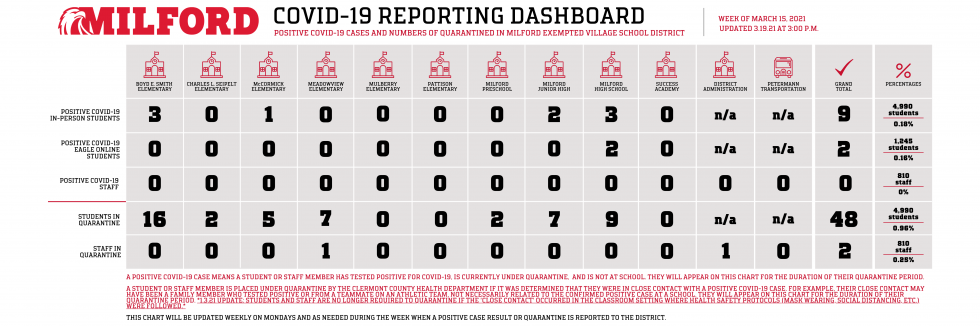
Milford Exempted Village School District in Clermont County has remained in-person since the fall, and has had to close twice due to staff absences.
“We simply had too many staff out sick or quarantined and couldn’t find the subs,” Wendy Planicka, director of communications and public relations for the district, told the OCJ. “We have shut down grade levels at a few of our elementary buildings as well, but not an entire elementary building.”
The school district, like many in the state, provides weekly counts of COVID-19 cases on their website, along with cumulative district-wide data.
Since Aug. 1, the district has reported 649 total cases in their district of 6,235 students and 810 staff members.
Currently 4,990 students are enrolled in-person, with 1,245 students enrolled in the district’s virtual program, Eagle Online.
Planicka said community spread has been the “number one cause of our cases,” followed by spread through athletics or non-school sponsored activities such as family parties.
“There have been two or three cases where we believe spread happened in an athletic setting — for example when football was in season last fall, at one point almost the entire football team was quarantined due to possible spread,” Planicka said.
The school implemented protocols that require an investigation into every positive case, including contact tracing in partnership with Clermont County Public Health and a minimum 10-day quarantine period for students and staff who test positive.
In schools, a mask requirement is in place, and custodians are to disinfect desk areas every evening, along with using an electrostatic sprayer “at least every 30 days” according to Milford’s protocol list.
Milford’s reopening plan was developed to make the return to school as safe as possible, but not to return the school to exactly as it was, according to the plan itself.
“School will not look the same as it did prior to March 2020,” the plan stated. “These changes may be temporary or they may be permanent. Time will tell.”
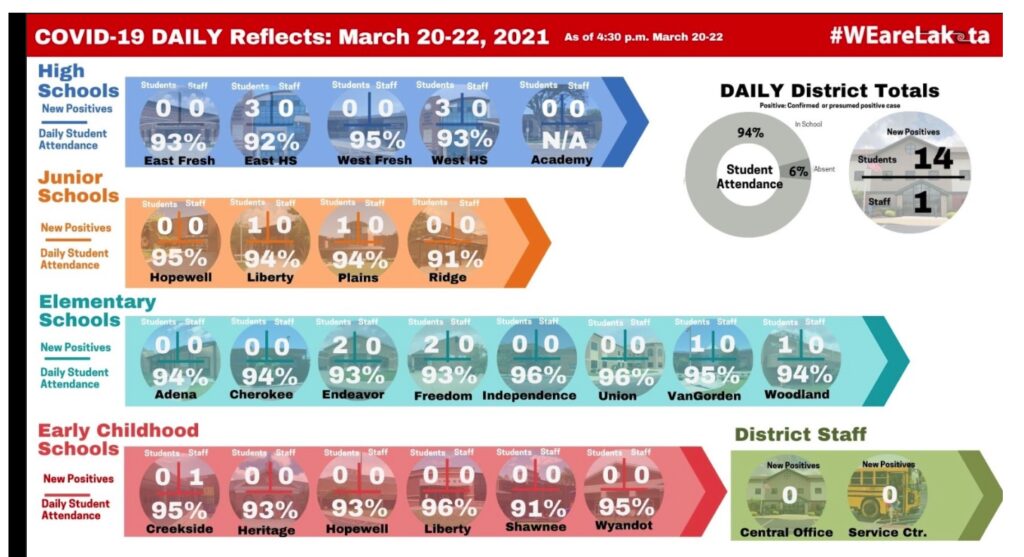
Butler County’s Lakota Local Schools had the highest number of cases since the pandemic counts began, with more than 700 total student cases, according to state data. The school is also home to 14,000 students, having reopened to in-person learning on August 17.
“Since then, our students have had the opportunity to attend school all day, every day,” said Betsy Fuller, community relations director for the district.
There is a virtual learning option at Lakota, being utilized by 3,000 students, according to Fuller.
In the five months that made up their first semester, the school reported 5,172 students in quarantine. The worst month for positive cases in students was December, with 221 of the 468 reported in that semester happening then.
“We traced many of the positive cases to holiday gatherings and celebrations happening outside of school between Halloween and Thanksgiving,” Fuller said. “It is also important to note that very few cases, if any, could actually be linked back to classroom spread.”
The district had guidelines in place as soon as it reopened, including requiring face coverings for all K-12 students, desk cleanings between classes, assigned seating at lunch, and block scheduling to avoid frequent class changes.
In the three months of the second semester so far, the district has reported 345 positive cases, but a 93% student attendance rate.
In February, the state implemented a vaccination program specifically for teachers and school personnel, making returning to school or already conducting in-person instruction a pre-requisite to districts receipt of vaccination doses.
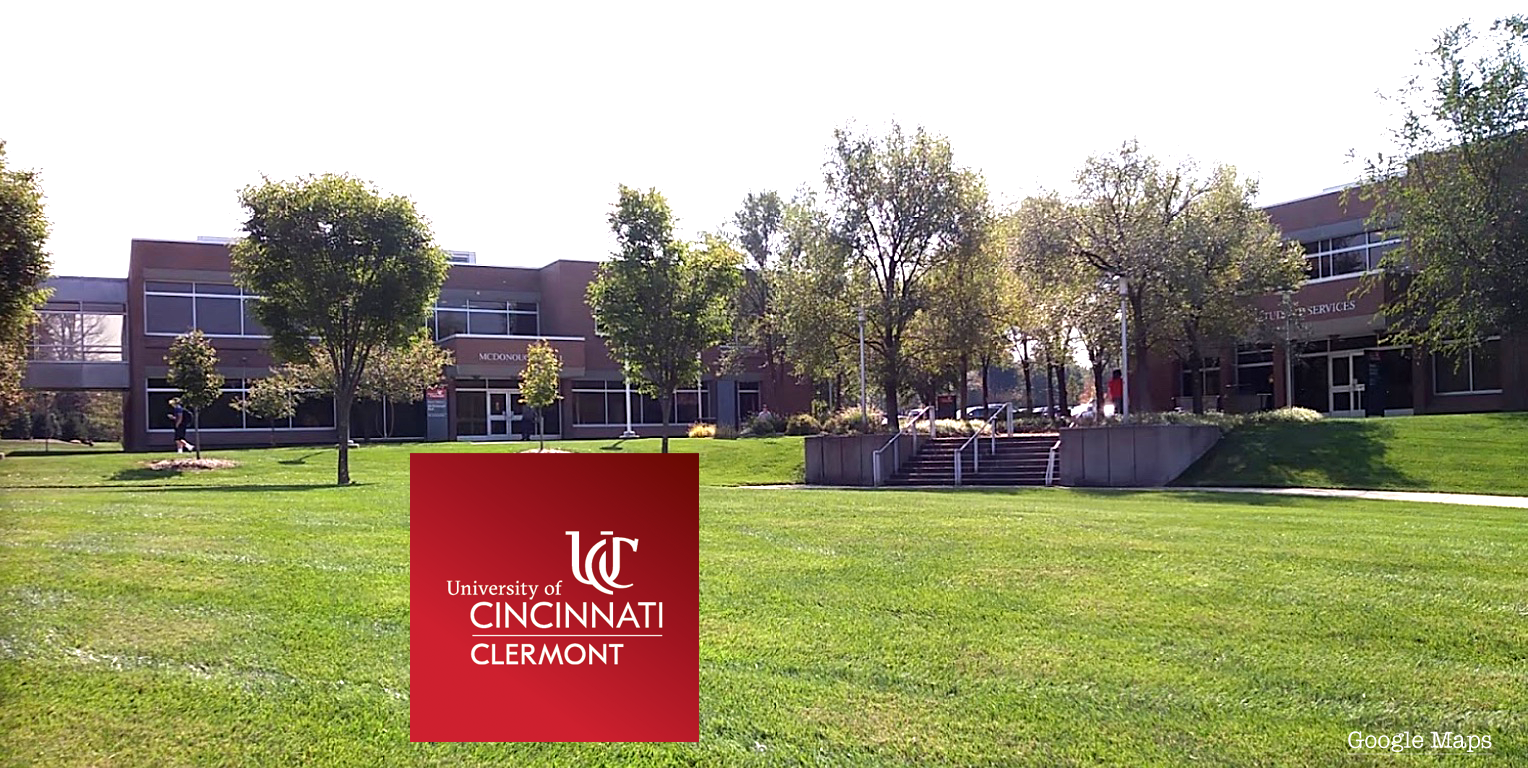
Loveland, Ohio – Clermont County Public Health and the University of Cincinnati Clermont College are partnering to open a new COVID-19 vaccination site at the Student Activities Center on the college’s Batavia campus.
The vaccination site will open on Saturday, March 13. Appointments must be scheduled. Walk-ins will not be accepted.
The new site will more than double the number of people who can be vaccinated in one day by the health department. Public Health has been vaccinating up to 300 people per day to date; the new site will accommodate 600 or more people per day.
Clermont County Health Commissioner Julianne Nesbit
The quantity of the vaccine that Public Health receives weekly has increased from about 200 doses during the first week of February to more than 1,200 doses during the first week of March.
“We’re looking forward to working with UC Clermont to get more of our residents vaccinated,” said Health Commissioner Julianne Nesbit. “Throughout this pandemic, we have relied on many of our community partners along the way, and this latest partnership will benefit the entire county. We’re grateful that UC has stepped up to provide the much-needed space.”
“We are excited to partner with Clermont County Public Health to provide the space for this critical service to the community,” said UC Clermont Dean Jeff Bauer. “The vaccination effort is crucial to guiding us out of the pandemic, and we are proud to be able to help.”
How to register
To register for an appointment, residents can use the new online scheduling site, which can be found at https://ccphohio.org/covid-19-vaccine-info/. Anyone without internet access can call 513-735-8500 for assistance with scheduling an appointment.
Currently, any Ohio resident aged 50 or older is eligible to be vaccinated. Other groups that are eligible include people with certain congenital medical conditions, law enforcement officers, childcare workers and funeral services employees. The full list of eligible people can be found online at www.coronavirus.ohio.gov/vaccine.
Under Ohio’s vaccine plan, older adults can receive the vaccine according to the following schedule.
January 18 – Ohioans 80 years of age and older January 25 – ages 75 and older and those with severe congenital or developmental disabilities February 1 – ages 70 and older February 8 – ages 65 and older.
Clermont County has several vaccine providers in the county where you can make an appointment.
Meijer pharmacy to register, text COVID to 75049 or visit https://clinic.meijer.com/ or call the pharmacy directly for assistance registering Miami Township Meijer – 513-576-5510 Eastgate Meijer – 513-943-5710
Mercy Health – Clermont Hospital call 1-866-624-0366 to schedule an appointment
Clermont County Public Health to get on the waiting list and be contacted when an appointment is available, visit: https://ccphohio.org/covid-19-vaccine-info/ For assistance signing up for the waiting list or questions about COVID-19, call the Clermont County COVID-19 hotline at 513-735-8500.
Loveland, Ohio – Clermont County residents who are 80 years of age and older can get the COVID-19 vaccine beginning Jan. 18 under the next phase of Ohio’s vaccine distribution plan.
Below is the press release just issued by Clermont County Public Health:
Ohio will be distributing 100,000 doses of vaccine statewide beginning Jan. 18. Clermont County vaccine providers will receive 1,900 of those doses. Clermont County Public Health will get 100 doses. The remaining 1800 doses will go to:
HealthSource of Ohio
Kroger pharmacies (nine locations)
Meijer pharmacies (two locations)
Mercy Health
“We are encouraged to begin protecting our most vulnerable population,” said Health Commissioner Julianne Nesbit. “But, we are urging everyone to show patience as the supply is limited. With only 1900 doses designated for our county next week, we know it will take time until everyone that wants the vaccine can get it.”
How do you get vaccinated if you’re eligible?
Clermont County Public Health – Visit https://bit.ly/CVD19Vax to be added to the waiting list. Residents without internet can call 513-735-8500.
HealthSource of Ohio – Register (beginning Jan. 16) online at www.healthsourceofohio.org or call 513-732-5081.
Kroger pharmacies – Beginning Jan. 16 visit www.kroger.com/ohiocovidvaccine or call the Kroger COVID helpline at 866-211-5320.
Meijer pharmacies – To register, text COVID to the number 75049 andreceive a link to register. Online registration is also available at https://clinic.meijer.com/. Individuals without internet access or texting capabilities can call the pharmacy.
Eastgate 513-943-5710
Miami Township 513-576-5510
Due to the high demand and limited supply of the vaccine and COVID-19 safety protocols, appointments will be required at each location.
Clermont County Public Health has information including a waiting list survey available on its website at http://bit.ly/CVD19Vax. If you or a loved one qualifies, you can fill out the survey, and Public Health will send you more information on how or where to go to get vaccinated. Since Jan. 11, more than 6,000 people have filled out the survey to be added to the waiting list.
“We’re here to support our public health partners however we can,” said Clermont County Emergency Management Agency Director Pam Haverkos. “We are launching a COVID-19 vaccine hotline to assist residents and caregivers who may have limited access to web-based resources. We want to ensure all residents have information on how and where to get registered for the vaccine.”
The COVID-19 vaccine hotline can be reached at 513-735-8500 and is available from 8:30 a.m. – 4:30 p.m. Monday – Friday. The hotline will not be operational on Monday, Jan. 18 due to the Martin Luther King Jr. holiday.
Loveland, Ohio – If you have tested positive for COVID-19 and are a resident of Clermont County, the health district would like to get more information from you.
Clermont County Public Health says that this helps their nurses identify disease trends, discover outbreaks of cases, and identify close contacts that need to be quarantined.
If you want to help, you should only fill out the survey if you have recently tested positive for COVID-19.
Once this survey is completed, they will call or email you with any questions. They will also send you a letter stating you have been placed in isolation by public health if we have not already sent you one.
The health department says the information in this survey is confidential and for public health use only.
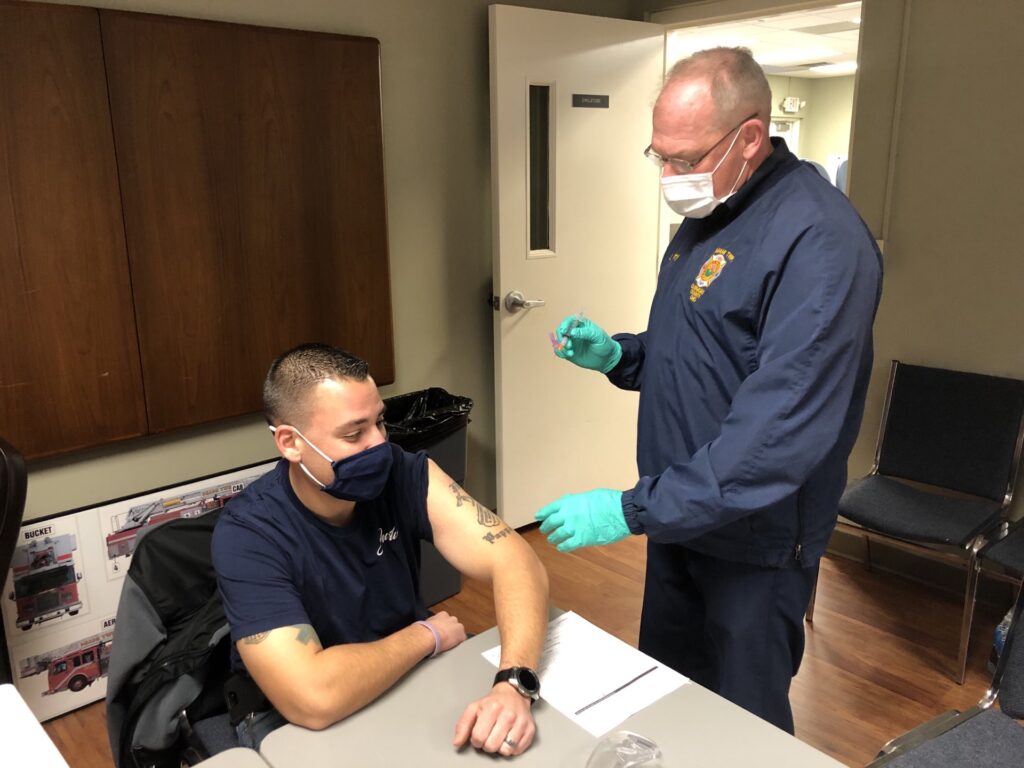
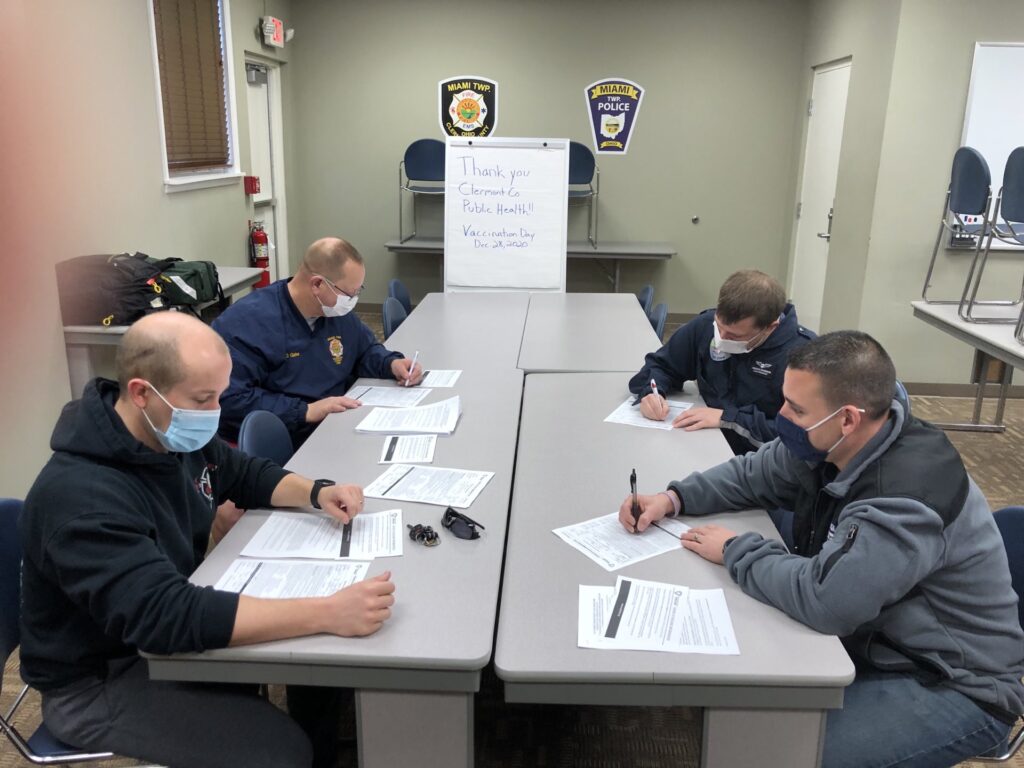
Miami Township’s first responders have begun receiving the vaccine (Photos from MiamiTwp FireEMS)
David Miller
by David Miller
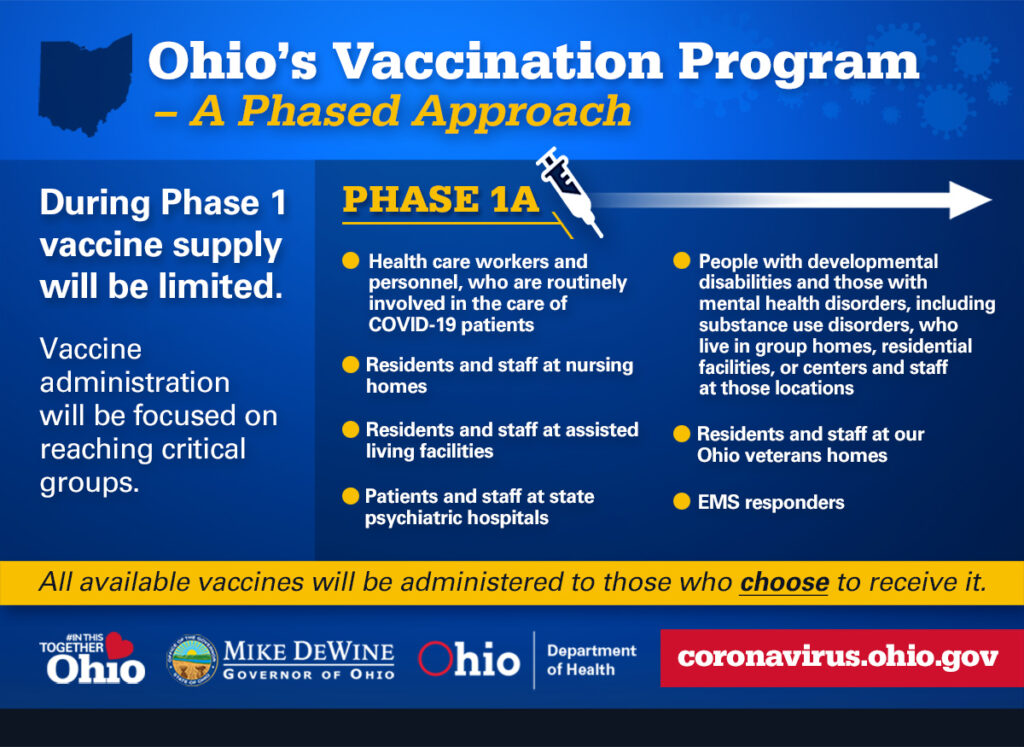
Loveland, Ohio – Becca Doris told Loveland Magazine yesterday that currently, Ohio is in Phase 1A of the COVID 19 vaccine distribution. She said Phase 1A prioritizes healthcare workers, EMS first responders, and individuals living in congregate care settings as well as the staff that works there. Doris is a Community Outreach Specialist for the Hamilton County Emergency Management & Homeland Security Agency (HCEMHSA).
Phase 1A
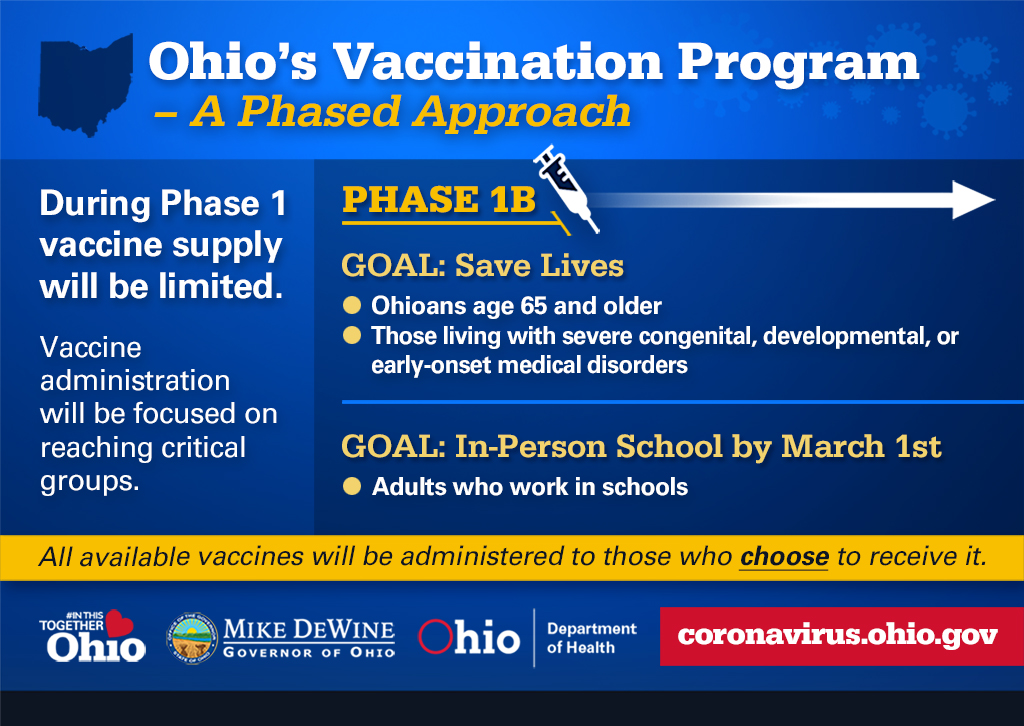
On December 23rd, Governor DeWine announced the next category of people eligible to be vaccinated during Phase 1B, which will include, “Ohioans age 65 and older, employees at schools that want to go back or remain educating in person, and people with severe congenital, developmental, or early-onset medical disorders that make them particularly vulnerable.”
Phase 1B
Doris said that there is no official start date for Phase 1B, though in his announcement the Governor estimated that the Phase 1B rollout would occur in mid-January.
The New York Times (NYT) reported on December 11 that Gov. Mike DeWine said he tentatively expected 561,000 doses of the two vaccines spread over several early shipments. State officials have now confirmed to the Times that 98,475 doses of vaccine had been received. The state announced that 11,700 people had gotten one dose as of Dec. 23.
According to a New York Times database of Wednesday morning, there have been at least 682,570 cases and 8,722 deaths in Ohio since the beginning of the pandemic, with 67.1 being the daily average death rate.
Hamilton County Health said on December 26, that they are in the early stages of COVID 19 vaccine distribution and, “doses will be available in limited supply for specific critical populations. Vaccines are not yet available for all Ohioans.” As of yesterday, 6,643 people have received the first dose of a vaccine in the County.
Clermont County Public Health said on Tuesday, “Yesterday was an exciting day and a great way to end the year. We gave out all of our first shipment of COVID-19 vaccine to our Fire and EMS jurisdictions who then vaccinated their staff members.” As of yesterday, 1,276 people have received the first dose of a vaccine in the County.
In Warren County, as of yesterday, 1,534 people have received the first dose of a vaccine.
The NYT reporting shows that 162.6 is the daily average of new cases in Warren County for the last 7 days and 1.4 deaths is the daily average, 402 new cases in Hamilton and 0.4 deaths are the daily average, and 150.4 in Clermont and 0.1 deaths is the daily average.
As of yesterday, Statewide, there have been 71,625 vaccinations started (0.61% of the Ohio population).
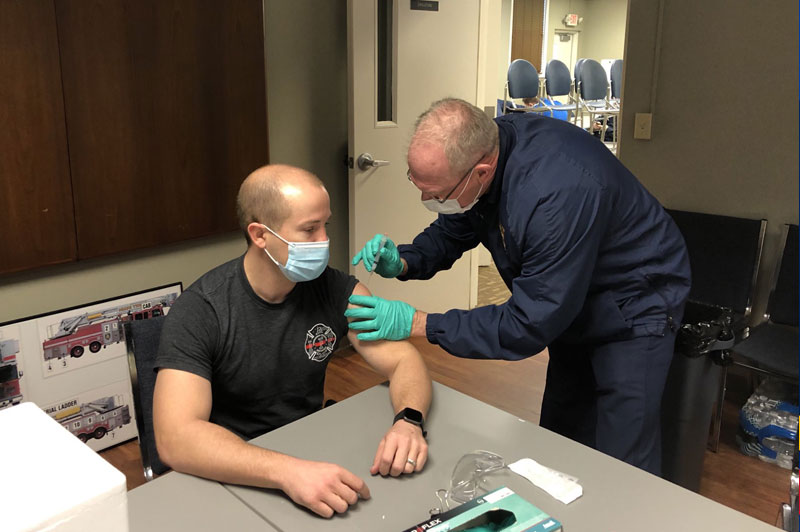
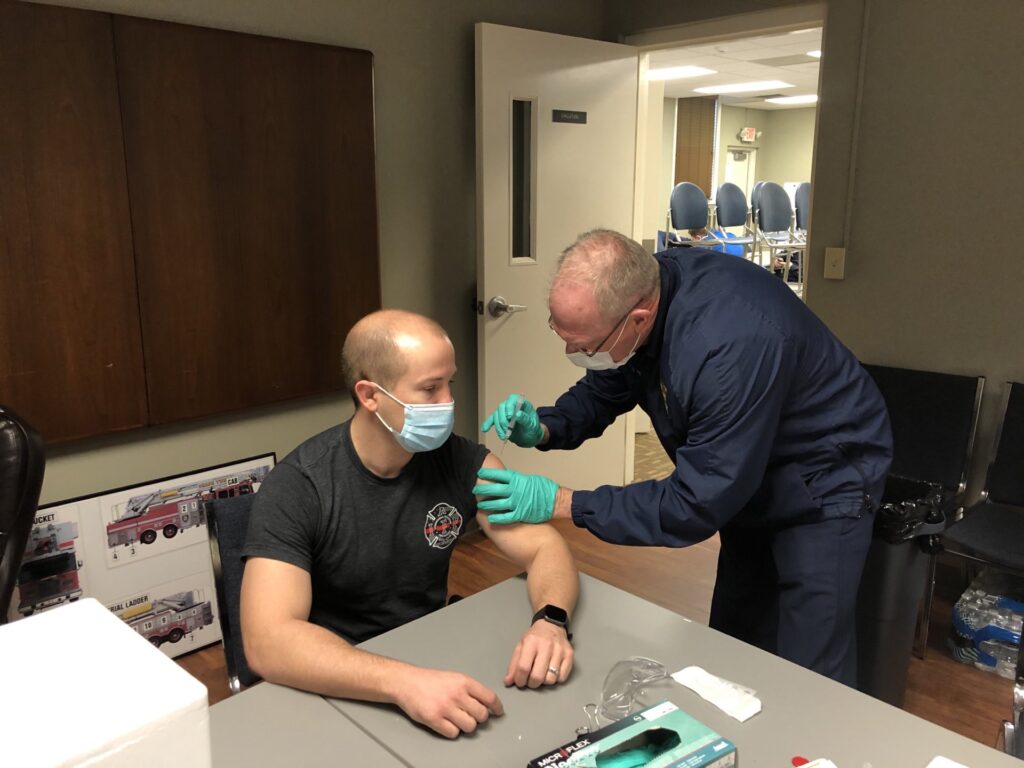
Miami Township’s first responders have begun receiving the vaccine. On Monday, 32 employees were vaccinated. (Photos from MiamiTwp FireEMS)
The Loveland-Symmes Fire Department’s first responders were to receive vaccinations on Tuesday or Wednesday of this week from the Hamilton County Health District according to Chief Ottto Huber.
Deputy Chief Michael Books said, “We will be receiving our vaccine in a series, so that not all members are vaccinated at once, since there is not enough vaccine to go around at first. It appears that we will be receiving the Moderna vaccine, but could be Pfizer on the day of vaccination.”
Books was asked to give an estimate of how many people the department has come in contact with who had or they suspected of having COVID 19 since the pandemic started. He responded, ” Unfortunately, I cannot give you a number of people that the department has come in contact with that are COVID related, due to HIPAA. However, our department as well as most departments treat every patient that we come in contact with as a potential COVID patient, for their protection as well as the crews.”
Earlier this month, the Trump administration said they planned to have 20 million doses of the vaccine distributed by New Years Eve. However, data provided by the CDC shows just over 11.4 million doses have been distributed and only 2.1 million people have received their first dose.
President-Elect Joe Biden said on Tuesday, “At the current pace, it’s gonna take years, not months, to vaccinate the American people.”
Vaccine recipients who receive the COVID-19 vaccine must get a second dose several weeks later to receive full protection. The recommended interval for Pfizer-BioNTech vaccine is 21 days. The recommended interval for Moderna vaccine is 28 days. These recommended intervals, with a standard four-day grace period, should be followed as closely as possible to receive full protection, according to the Centers for Disease Control and Prevention (CDC). If the intervals are exceeded, the second dose should be administered at the earliest opportunity. Doses would not need to be repeated due to a longer interval, meaning you do not have to start over, according to CDC guidance. Providers should exercise extra care in ensuring that a patient’s second dose is from the same manufacturer as the first dose, as they are not interchangeable.
The CDC has created COVID-19 vaccination record cards, which are included in the vaccine ancillary kits that ship with the vaccine. Vaccination record cards must be signed and completed by healthcare staff to include vaccine manufacturer, vaccine lot number, location of vaccination, and date. Providers should instruct patients to bring the card with them when they receive the second dose. Additionally, providers should encourage patients to use their smartphone to take a picture of their vaccination record card in case the patient misplaces the record card after receiving the first dose.
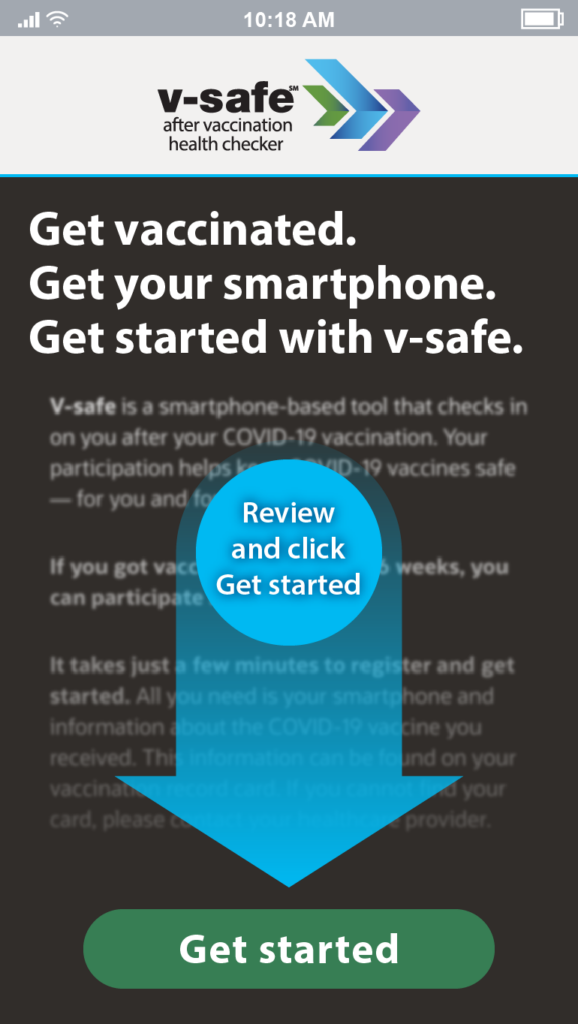
You should schedule your second dose appointment during the first vaccination. The CDC has asked providers to share information with vaccine recipients about the CDC’s V-safe smartphone-based post-vaccination tool that patients could choose to use for reminders and health check-ins.
At this time, in the Loveland area, we are a few months away from the vaccine being widely available. Hamilton County and officials statewide are currently developing plans for when the vaccine will be more readily available to the public and what the best process is for future eligible populations.
Where and When?
Doris said, “Right now, there are no public announcements on where and when residents can expect to get the vaccine as the information can change depending on multiple factors, including supply levels and if additional vaccines currently in development are approved for use by the FDA.”
As the COVID-19 vaccine becomes more widely available in Hamilton County, HCEMHSA will be sharing this information with the media and the public via the County’s weekly COVID-19 briefing, social media, and other platforms.
“Residents should know that there are actions they can take to make sure they get the latest COVID-19/vaccine information,” said Doris. “This includes signing up for COVID-19 alerts within our opt-in emergency notification system, Alert Hamilton County, which we have used at various times throughout the pandemic to communicate important information to the public. We are currently developing plans to utilize this system to communicate vaccine information as well.” Residents are encouraged to sign up for these alerts, as well as other alerts (tornado warning, flash flood warning, etc.) at https://alerthc.org/ to stay informed.
Additionally, residents can visit Hamilton County Public Health’s website at https://www.hamiltoncountyhealth.org/covid19/ for more information on COVID-19 and to take a vaccine priority survey that Hamilton County Public Health will use to prioritize vaccine distribution.
The Ohio Department of Health COVID-19 Vaccination Dashboard displays the most recent data reported to the Ohio Department of Health (ODH) regarding the number of individuals that have started and completed the COVID-19 vaccination series by various demographics and county of residence.
During the week of November 8-14, there was a 140 percent increase in the number of daily cases in Clermont County.
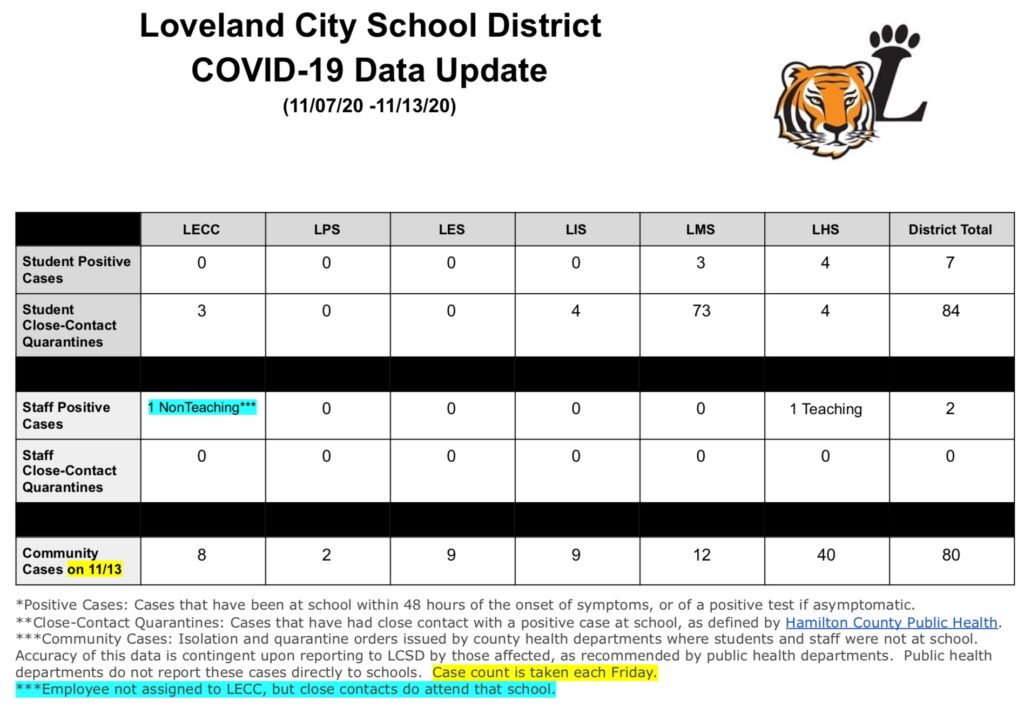
The Loveland City School District reported 16 new COVID 19 CASES since last Wednesday.
Batavia, Ohio – The number of new cases of COVID-19 in Ohio and Clermont County is increasing at an alarming rate according to a statement issued by the Clermont County health district today. The department reports a high of 186 new cases was reported in Clermont County on November 13 and the state of Ohio reported an all-time high of 8,071 new cases.
As of November 12, when the latest public health advisory system numbers were released, Clermont County had a rate of 410 new cases per 100,000 residents. For comparison, on October 1, the county’s rate was only 62 new cases per 100,000 residents. During the week of November 8-14, there was a 140 percent increase in the number of daily cases in Clermont County.
The exponential growth in the number of new cases in Clermont County has made it nearly impossible to keep up with disease investigation and contact tracing. “Up until this point, our goal has been to begin disease investigations within 24 hours of each new case being reported to us,” said Health Commissioner Julianne Nesbit.
Disease investigations take time and involve a public health staff member calling each individual who has tested positive and get details like where they may have been exposed, every location they have been in the previous few days, and every person they may have been in contact with.
After public health does their initial investigation, then they begin the process of contact tracing. That usually involves calling each person who was considered a close contact with the infected person and advising them to quarantine for 14 days from the date of exposure.
“We have hired additional contact tracers, but it’s still not enough to keep up with the demand,” said Nesbit. “Our staff is doing everything we possibly can to keep up with the new cases, we are physically and emotionally exhausted, but we are continuing to do this important work to the best of our ability to protect our community.”
“Our staff is doing everything we possibly can to keep up with the new cases, we are physically and emotionally exhausted
“We have hired additional contact tracers, but it’s still not enough to keep up with the demand,” said Nesbit. “Our staff is doing everything we possibly can to keep up with the new cases, we are physically and emotionally exhausted, but we are continuing to do this important work to the best of our ability to protect our community.”
In addition to hiring additional contact tracers, Clermont County Public Health (CCPH) has been using staff members from every other department to fill in the gaps and assist with contact tracing. CCPH also has a contract with the Ohio Department of Health for additional contact tracers that are being cross-trained to assist with disease investigations.
Public Health has switched from making phone calls in some situations to sending emails to provide information on quarantine to save time. Now, with this many new cases, they have also begun mailing letters to each person that tests positive to save time. Phone calls are still being made when CCPH is aware of situations where there are a large number of contacts and the potential for further spread of the disease.
The letters notify each person that tests positive what to do while they are in isolation and asks them to identify their contacts, who are advised to quarantine. “We are seeing so many new cases, we just cannot possibly keep up at this rate,” said Nesbit.
“Local hospitals are already being stressed,” said Nesbit. “While all hospitals have surge plans in place where they can add more beds and take in more patients, they are going to run out of healthy, experienced workers to care for the sick patients, if this trend continues.”
“We saw in the spring that we can flatten the curve, but we must be extra vigilant now, especially with the holidays coming up,” urged Nesbit.
ccc
The Loveland City School District reported 16 new COVID 19 CASES since last Wednesday.
• On 11/16/20, the district was notified that a student at the Loveland Early Childhood Center tested positive for COVID-19. This student was last at school on 11/12/20.
• On 11/16/20, the district was notified that a student at Loveland High School tested positive for COVID-19. This student was last at school on 11/09/20.
• On 11/16/20, the district was notified that a student at Loveland High School tested positive for COVID-19. This student was last at school on 11/13/20.
• On 11/16/20, the district was notified that a non-teaching staff member from Transportation and Loveland Primary School tested positive for COVID-19. This staff member was last at work / school on 11/12/20.
• On 11/13/20, the district was notified that a staff member at the Loveland Early Childhood Center tested positive for COVID-19. This staff member was last at school on 11/10/20.
• On 11/13/20, the district was notified that a Board of Education Central Office staff member tested positive for COVID-19. This staff member was last at work on 11/12/20.
• On 11/14/20, the district was notified that a staff member at Loveland High School tested positive for COVID-19. This staff member was last at school on 11/6/20.
• On 11/12/20, the district was notified that a student at Loveland High School tested positive for COVID-19. This student was last at school on 11/4/20.
• On 11/13/20, the district was notified that a student at Loveland Middle School tested positive for COVID-19. This student was last at school on 11/10/20.
• On 11/13/20, the district was notified that a student at Loveland High School tested positive for COVID-19. This student was last at school on 11/5/20.
• On 11/12/20, the district was notified that a student at Loveland High School tested positive for COVID-19. This student was last at school on 11/4/20.
• On 11/13/20, the district was notified that a student at Loveland Middle School tested positive for COVID-19. This student was last at school on 11/10/20.
• On 11/13/20, the district was notified that a student at Loveland High School tested positive for COVID-19. This student was last at school on 11/5/20.
• On 11/12/20, the district was notified that a student at Loveland Middle School tested positive for COVID-19. This student was last at school on 11/9/20.
• On 11/12/20, the district was notified that a student at Loveland High School tested positive for COVID-19. This student was last at school on 11/6/20.
• On 11/12/20, the district was notified that a staff member at Loveland High School tested positive for COVID-19. This staff member was last at school on 11/6/20.
The District does not publish quarantine data during the week, only on Fridays.
Right-Click on the image and open in a new tab to see a larger view.
What can you do to help?
Stay home if you are sick.
Quarantine yourself if you have been around someone who recently tested positive for COVID-19.
Wear a mask whenever you are in public.
Avoid large crowds.
Keep at least six feet of space between yourself and others.
Limit contact with people outside of your immediate household. If you are tested and receive a positive test result, you should:
Isolate yourself in your own home, away from others, as much as possible, for at least 10 days after your symptoms first appeared.
Notify each person you had direct contact with (defined as someone within six feet of you for a length of 15 minutes or longer within 24 hours) and ask them to quarantine in their house for 14 days after the potential exposure occurred. For more information or resources, visit the Ohio Department of Health’s coronavirus website at www.coronavirus.ohio.gov or Clermont County Public Health’s website at www.ccphohio.org.
Clermont County continued to allocate nearly $10 million in Coronavirus Aid, Relief and Economic Security (CARES) Act funding. Another nearly $10 million in CARES Act funding has been allocated for local municipalities and townships.
The Board of County Commissioners on Nov. 4 approved memorandums of understanding and agreements with a number of entities for use of CARES Act funding.
Clermont County Public Health: $542,000 primarily for expenses related to preparing for vaccinations and reimbursement of personnel;
Clermont County Park District: $75,000 for equipment, materials and supplies used to mitigate or respond to the pandemic;
Public and private schools: not to exceed $1 million for equipment, materials, supplies and other items used to mitigate or respond to the pandemic;
Public and private schools: not to exceed $60,000 for costs of business interruption and required closures due to the pandemic;
Clermont Senior Services: not to exceed $45,000 for equipment, materials, supplies and/or other items used to mitigate or respond to the pandemic;
YWCA of Greater Cincinnati: not to exceed $110,000 for costs of business interruption and additional costs caused by required closures arising from the pandemic, while serving Clermont County clients;
Funds already had been allocated for other uses, such as $1 million for a small business relief program. The county is continuing to identify pandemic-related expenses and work with social service agencies who may have costs tied to COVID-19 that would be covered by the CARES Act.
The county has until Nov. 20 to encumber expenses and the end of the year to spend these funds.
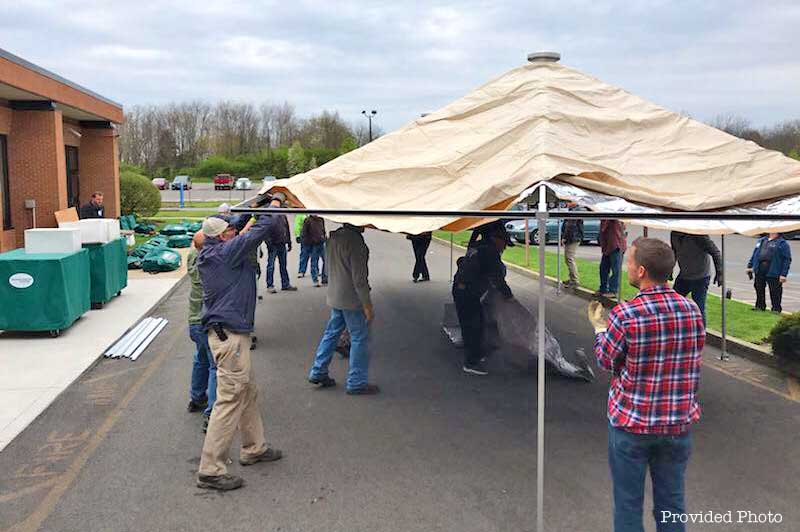
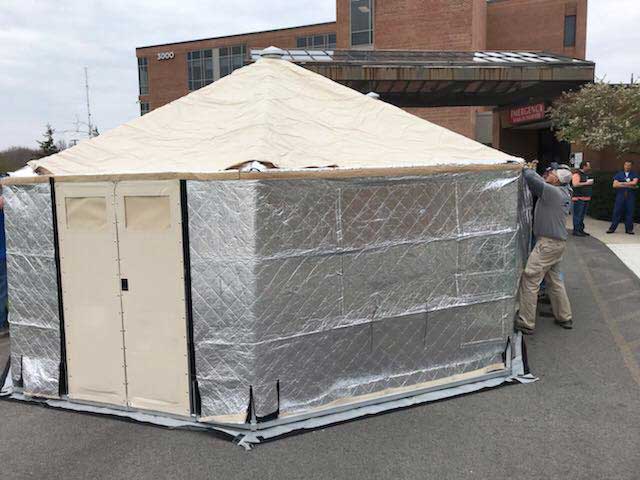
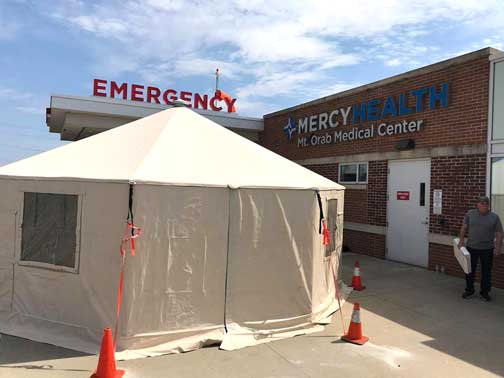
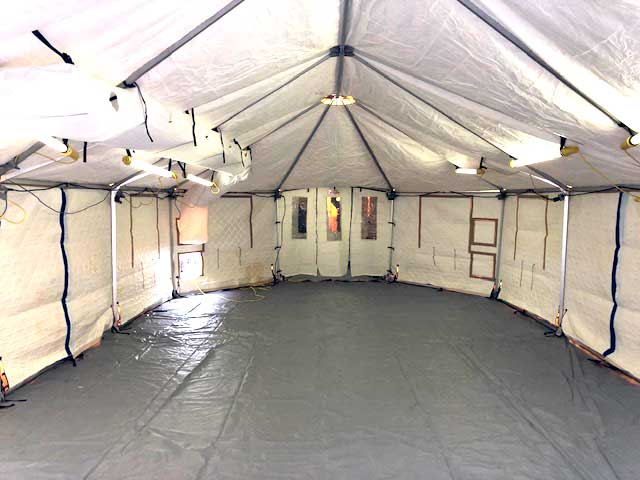
The Clermont County Engineer’s staff partnered with the Greater Cincinnati Health Collaborative, Clermont County Public Health, Mercy Hospital staff, and the Central Joint Fire-EMS District Saturday morning to construct “Alternative Care Centers” in Brown, Clermont, and Hamilton County.






 REQUEST APPOINTMENT