Loveland, Ohio, You may have heard our current president quoted for saying, “We are going to drill, baby, drill,” recently in the news or on social media. But what does all of this mean? Why is there so much excitement over this statement?
For starters, Donald Trump is not the one to coin the phrase “drill, baby, drill.” In fact, former Republican governor of the state of Maryland, Michael Steele, first used the phrase in 2008 to add enthusiasm to drilling from Alaska in order to reduce energy costs in America. The increasingly popular phrase is one passed down through the Republican party.
Our former president, Joe Biden, had called to reduce the drilling and mining in Alaska in hopes of helping the planet. Now that President Trump has been inaugurated, this is going to change.
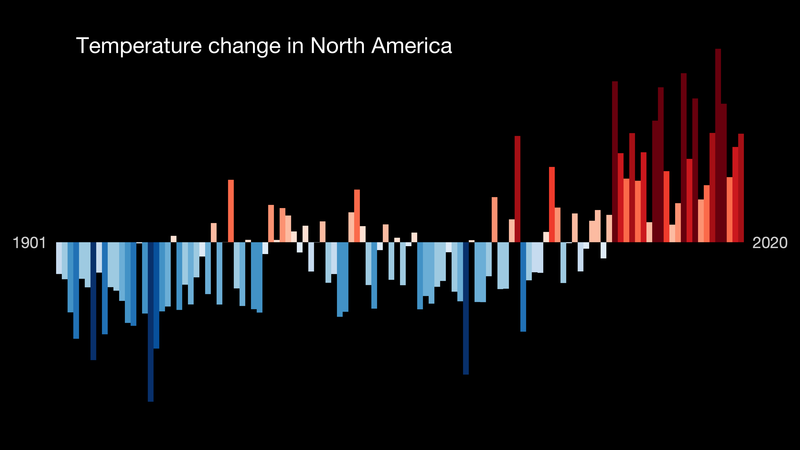
However, many are opposed to the idea of drilling because of the environmental degradation that is attached to it. Many scientists argue that we need to decrease more fossil fuel extractions, not increase them, so as not to increase the Greenhouse Effect anymore than it already has been. Drilling oil from Alaska is undoubtedly going to harm any and all ecosystems in the Arctic, possibly even leading to mass extinctions. Alongside that, the melting of our ice caps will increase, assisting in polluting our air and spreading respiratory diseases globally. There is a possibility for the damage done by Trump’s resumption of drilling oil from Alaska to have irreversible effects on our planet.
With that being said, there is merit in drilling oil in Alaska. Millions of jobs will be created with the drilling reenacted. Also, a large amount of American tax dollars go towards oil and drilling, and that money is eventually used for American services in infrastructure and transportation, giving more leeway for the government to reduce the cost of necessities. In simple terms, since Alaska is far more local than other foreign oil extraction sites, it costs less to transport this fuel to Americans, making gas and groceries cheaper in the US.
The argument of drilling in Alaska is quite polarizing, but that’s not to say there isn’t an agreement somewhere. Both former Vice President, Kamala Harris, and current President, Donald Trump, have agreed upon the fact that drilling, fracking, and mining should continue. However, that’s where the agreement ends. Donald Trump’s right-wing Project 2025 will drastically change the position that the Environmental Protection Agency has in America. If we are to look at Trump’s past, he rolled back over 100 environmental regulations in his first four years in office.
It’s important to note that gaining energy from renewable sources such as solar, wind, or geothermal is arguably more cost-effective over time and greener than mining and drilling. Many argue that in order to secure a healthier future, we must invest in renewable and cleaner energy sources, and others believe that the cost of these sources is unnecessarily high for a return on investment that will take many years to actualize.
President Trump’s right-wing phrase “drill, baby drill” comes with environmental consequences and economic benefits, no matter what, and there is validity on either side of the argument. The future of US energy policy depends on finding a way to meet in the middle, boosting our economy and environment, ensuring future generations a world where humanity and nature live in harmony.
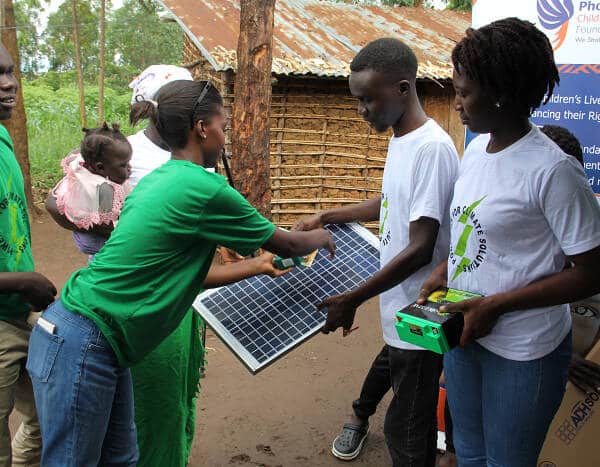
We’re building a movement that fights for a fairer future for all. We believe in the collective power of ordinary people taking action: we campaign and organize locally and globally to create a world powered by just and accessible renewable energy that will move us away from fossil fuels, for good. And we are doing this with the urgency the climate crisis demands of us. Are you ready to join us?
People are empowered, ordinary people have the tools and training to build a better future and know the pathways they can take to make that happen.
Communities are resilient, renewable energy is produced, consumed and owned within a community, creating jobs and local economic benefits.
Governments and institutions prioritize climate action, implementing policies that reduce emissions and support a transition to renewable energy.
Renewable energy becomes the dominant source of power, lessening the environmental impacts, providing more access to communities and reducing the overall cost to people.
Fossil fuels are kept in the ground to protect both people and the planet.
We are calling for a transformative energy transition that prioritizes people over corporate profit. This means creating local jobs and revenue for communities, lessening environmental impacts and offering more energy access to people in cities and rural areas.
Here’s how we get there:
Our strategy is twofold: resisting fossil fuel projects and its enablers, and advocating for a world powered by the sun, wind and people.
We campaign to keep fossil fuels in the ground and accelerate the renewable energy transition in an effort to tackle the climate crisis. We train and empower ordinary people to create local campaigns to ignite a renewable energy revolution. Get involved here!
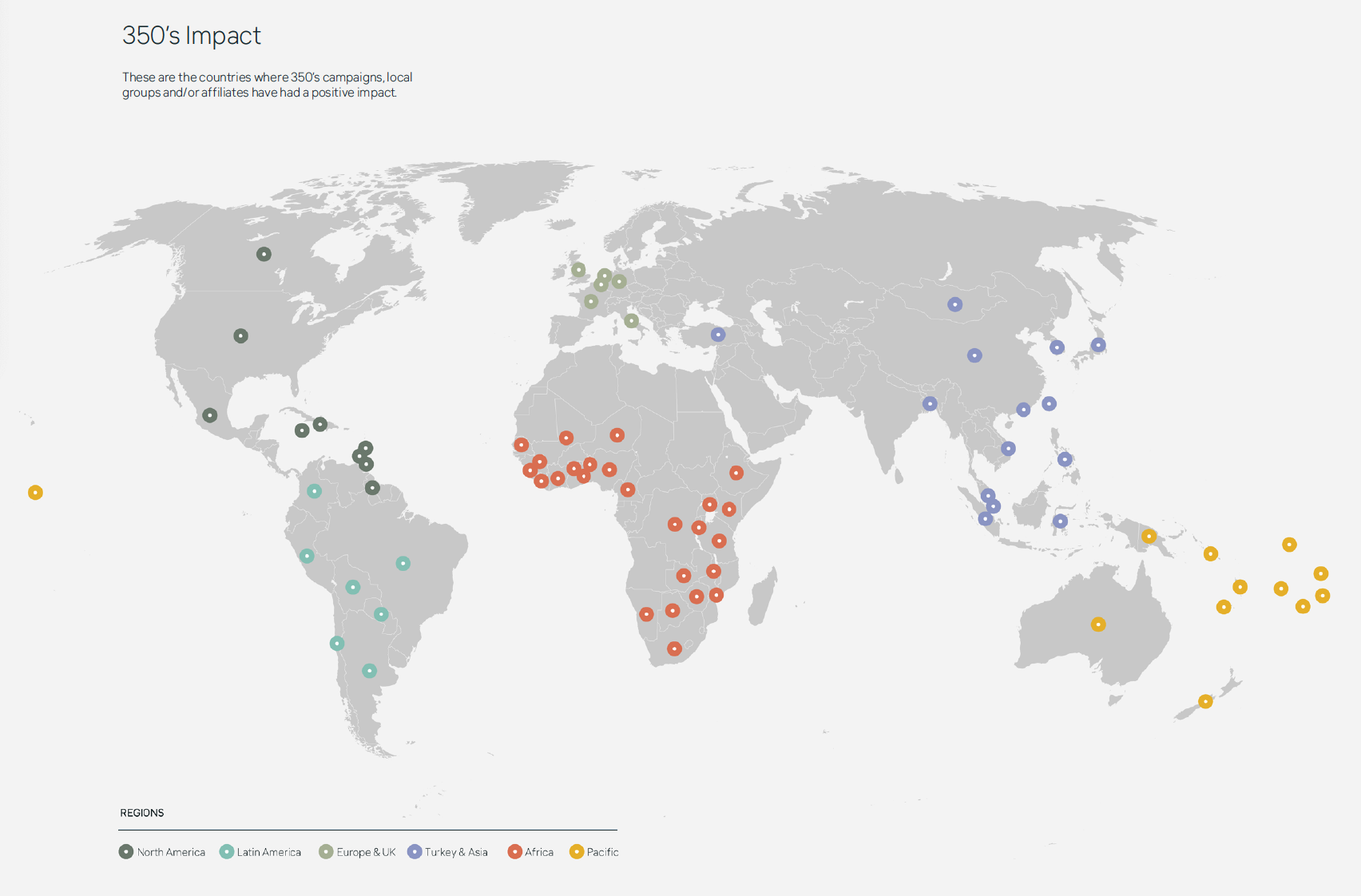
Our biggest strength is our global network, connecting local and national campaigns across the world to confront injustice, challenge our fossil-fueled economic systems and showcase a groundswell of support for renewable energy. See our network of local groups.
Together, we have achieved extraordinary things: training thousands of people to become climate leaders in their own communities, moving trillions of dollars away from the fossil fuel industry, stopping dirty coal, oil and gas projects – and much more! Learn more about our history and wins so far.
330+
campaigns and events led or supported worldwide last year
490+
active local groups all around the world
10,000+
activists provided with tools and trainings every year
Ours, 350, is a number. And a very important one. It is a reference to 350 parts per million (ppm) – the concentration of carbon dioxide (CO2) in the atmosphere considered the safe limit to avoid the worst impacts of climate change. We are currently at 423 ppm. Our name, 350.org, is a reminder that our fight to stop this number increasing further is more important than ever.
Our People
We are a team of smart, strategic and driven people spread all around the world. We believe that a diverse, equitable, inclusive, and collaborative team brings a variety of approaches to the work we do.
We work across languages and continents to form a powerful worldwide network, having justice, collaboration and respect at the forefront of all we do. Our work is grounded in the change we want to see.
President Biden has announced a new initiative to train young people in “high-demand skills for jobs in the clean energy economy.”
The American Climate Corps will put a new generation of Americans to work conserving our lands and waters, bolstering community resilience, advancing environmental justice, deploying clean energy, implementing energy efficient technologies, and tackling climate change. American Climate Corps members will gain the skills necessary to access good-paying jobs that are aligned with high-quality employment opportunities after they complete their paid training or service program.
Sign Up to learn about how you can join the American Climate Corps.
Loveland, Ohio – Notwithstanding climate change, global warming, and changing weather patterns, the City’s Fall Leaf Collection schedule will begin Monday, October 10. Fall colors have barely arrived.
The schedule has been out of sync with reality for years, but this one is a whopper.
Leaf collection is performed by a city crew using mechanical equipment similar to a vacuum cleaner. Residents are instructed to rake leaves to a place near the street or curb. City Hall says to not place leaf piles on the sidewalk, gutters, ditches, roads, or blocking fire hydrants.
After the initial scheduled collection date, residents may go to City Hall to receive a free voucher to drop-off a load of yard waste to Evans Landscaping. The City of Loveland has an agreement with Evans for a year-round residential yard waste drop-off program.
Schedule by Neighborhood
In each of the neighborhoods or streets listed below, a crew will be working the area on the dates shown and the crew will be making one pass on each street during the period of collection. The schedule calls for each neighborhood to have two collection periods. Residents are requested to have leaves at the curb prior to the beginning date of the scheduled pick-up period in the following neighborhoods:
October 10 (Monday) & October 31 (Monday)
East Main, Elm, Chestnut, Wall, Riverside, Park, Ohio, lower West Loveland, Harper, Shadycrest, Victory Circle, Wilson and Center
October 11 & 12 (Tuesday & Wednesday) & November 1-3 (Tuesday – Thursday)
Wakefield, Walker, Oak, Ash, Laurel, Williams, Maryknoll, Ruth, Venice, Elysian, Oriole, Lowell, Seyffer, Walnut, Paxton, Cedar, Robin, Second, Steeplechase, Huntington, Reserves, and Cedar Woods, White Pillars, Sanctuary at Miami Trails, White Pillars and Sugar Tree Subdivisions
October 13 (Thursday) & November 4 (Friday)
Lower Broadway, Third, Harrison, O’Bannon, E. Loveland Ave., Karl Brown Way, Union, Railroad, Maple, First, Fifth, Lyon, Sentry Hill, Brandywine, Hermitage Pointe, Butterworth Glen and Bares Creek Subdivisions
October 17-20 (Monday – Thursday) & November 7-9 (Monday – Wednesday)
Pheasant Hills, Pheasant Hills on the Lake, Claiborne I Subdivisions, and Hidden Creek
October 20 & 21 (Thursday & Friday) & November 10-11 (Thursday & Friday)
Fox Meadow Farm and Glen Lake Subdivisions, Lebanon Road, West Loveland Avenue from Lebanon to Loveland Madeira Road, Rich Road, Woodford Subdivision, and Kemper Road
October 24 – October 27 (Monday – Thursday) & November 14-16 (Monday – Wednesday)
Stoneybrook, Miamiview, Loveland Heights, Durango Drive, Claiborne II and Fox Chase Subdivisions
Human-caused climate change is accelerating – and Ohio’s cities and towns are going to have to pay big money to cope with it, a new report says. Source: Wikimedia Commons
Ohio’s cash-strapped cities and towns are going to need to find billions more a year to keep pace as challenges from climate change intensify over the coming decades, according to a new analysis.
Climate denialists have long ignored the overwhelming scientific consensus around global warming. That got a little harder last year when the International Panel on Climate Change last year analyzed 14,000 studiesand concluded that human activity is causing global warming and that we’re locked in to seeing it worsen over the next 30 years.
Of course, hot summers aren’t the only consequence of climate change. Increasing mean global temperatures have a lot of knock-on effects and cities — including those in Ohio — are having to deal with them.
“Communities across Ohio have been coping with increasing temperatures, flooding, erosion, and climate-related extreme weather events for years,” the report by the Ohio Environmental Council, Power a Clean Future Ohio, and Scioto Analysis that was issued Wednesday said.
It added “These climate damages are projected to only intensify in approaching decades, generating new costs associated with climate-driven disaster recovery and adaptation, as well as creating a major strain on already overstretched taxpayers and cash-strapped local governments. Unless we see drastic changes at every level of government to address carbon emissions in the next few years, these impacts will only continue to worsen — and the cost to address them will skyrocket.”
The report looked at the available literature on climate-related phenomena such as more-intense precipitation, worse algal blooms, and more and hotter days. Then it applied them to Ohio cities to estimate what adapting to the phenomena will cost annually by 2050.
The estimate: at least $1.8 billion to $5.9 billion per year in 2021 dollars.
“This represents a 26% to 82% increase of current spending levels for environment and housing programs for local governments in Ohio over a 2019 baseline, for just 10 of the 50 climate impacts identified in Ohio,” the report said. “Policymakers should know that these costs will not instantly appear in mid-century, but in most cases will start to accumulate this decade and steadily increase until they reach the projected midcentury estimates.”
Some of the increased expenses with which Ohio communities will have to contend if global temps rise by 2 to 3 degrees Celsius by 2100:
More air conditioners in schools, operating more cooling centers and paying for more electricity — Currently, the typical school district installs air conditioning when there are at least 32 school days when temperatures exceed 80 degrees F. By 2025, school districts across the state are expected to have 36 to 46 such school days per year, the report said, and the number will continue to increase from there.
By 2050, installing air conditioners where they’re needed in urban, poor districts in cities like Cincinnati, Columbus, Cleveland, Akron, Dayton and Toledo is expected to cost between $41 million and $200 million, the report said.
In addition to those costs, local governments will be called upon to open cooling centers for people without air conditioning more often and they’ll have to pay more for electricity to keep those and other government buildings cool. Wednesday’s report estimates that will result in tens of millions more in annual expenses for local governments.
Road repair — Extreme heat, rapid freeze-and-thaw cycles and more intense storms all damage roads. The report estimates that such additional maintenance will cost $170 million to $1 billion a year.
And that’s extra damage to roads that are already in bad shape.
“In 2021, Ohio’s roads received a ‘D’ rating from the American Society for Civil Engineers,” Wednesday’s report said. “The scorecard also notes that 17% of Ohio’s roads are in poor condition and the average Ohio motorist pays an extra $500 per-year in costs due to driving on damaged roads.”
According to the report, local governments are expected to need to spend more than $3.2 billion annually by 2030 just in order to catch up on deferred maintenance projects and begin to address future maintenance needs.
Protecting drinking water — Algal blooms introduce toxins into important Ohio sources of drinking water, particularly Lake Erie. Global warming exacerbates such blooms in at least two ways: It causes more intense storms that wash more fertilizer into the water, which, because it’s warmer, promotes more algae growth.
Lakefront cities such as Toledo, Sandusky, Lorain and Cleveland will have to pay $580 million to $2.2 billion more a year by 2050 to protect their water supplies, the report said.
Stormwater management — As anyone who’s lived through severe flooding can attest, it can cause huge amounts of damage, disruption and threaten people’s lives and health. The report estimates that Ohio municipalities will have to lay out an additional $140 million to $150 million per year by 2050 to upgrade their systems to deal with more, and more-intense, storms brought about by climate change.
The analysis lays out many other areas where costs are expected to increase — and it raises the question of who should pay them.
“Instead of relying on taxpayers to bear these costs, policymakers could consider alternative funding sources, such as holding accountable the corporations most responsible for causing and exacerbating climate change, and ensuring they pay their fair share of the costs of adaptation and resilience, just as many Ohio communities have held opioid manufacturers accountable for the costs of the opioid crisis,” it said.
Loveland Magazine is one of the 400 news outlets worldwide, with a combined audience of over 2 billion people “Covering Climate Now”, a global journalism initiative committed to bringing more and better coverage to the defining story of our time.
The initiative, was co-founded by The Nation and Columbia Journalism Review
Mihaela Manova is “Covering Climate Now” in Loveland, Ohio as an editor for Loveland Magazine
Today’s article talks about the cycles that surround us everyday and their direct effect on our lives, especially when Climate Change is involved. This article has been written by Alan Buis for the NASA official website.
By Alan Buis ( NASA’s Jet Propulsion Laboratory) on February 27, 2020
O
ur lives literally revolve around cycles: series of events that are repeated regularly in the same order. There are hundreds of different types of cycles in our world and in the universe. Some are natural, such as the change of the seasons, annual animal migrations or the circadian rhythms that govern our sleep patterns. Others are human-produced, like growing and harvesting crops, musical rhythms or economic cycles.
Cycles also play key roles in Earth’s short-term weather and long-term climate. A century ago, Serbian scientist Milutin Milankovitch hypothesized the long-term, collective effects of changes in Earth’s position relative to the Sun are a strong driver of Earth’s long-term climate, and are responsible for triggering the beginning and end of glaciation periods (Ice Ages).
Specifically, he examined how variations in three types of Earth orbital movements affect how much solar radiation (known as insolation) reaches the top of Earth’s atmosphere as well as where the insolation reaches. These cyclical orbital movements, which became known as the Milankovitch cycles, cause variations of up to 25 percent in the amount of incoming insolation at Earth’s mid-latitudes (the areas of our planet located between about 30 and 60 degrees north and south of the equator).
The Milankovitch cycles include:
The shape of Earth’s orbit, known as eccentricity;
The angle Earth’s axis is tilted with respect to Earth’s orbital plane, known as obliquity; and
The direction Earth’s axis of rotation is pointed, known as precession.
Let’s take a look at each (further reading on why Milankovitch cycles can’t explain Earth’s current warming here).
Credit: NASA/JPL-Caltech
Eccentricity – Earth’s annual pilgrimage around the Sun isn’t perfectly circular, but it’s pretty close. Over time, the pull of gravity from our solar system’s two largest gas giant planets, Jupiter and Saturn, causes the shape of Earth’s orbit to vary from nearly circular to slightly elliptical. Eccentricity measures how much the shape of Earth’s orbit departs from a perfect circle. These variations affect the distance between Earth and the Sun.
Eccentricity is the reason why our seasons are slightly different lengths, with summers in the Northern Hemisphere currently about 4.5 days longer than winters, and springs about three days longer than autumns. As eccentricity decreases, the length of our seasons gradually evens out.
The difference in the distance between Earth’s closest approach to the Sun (known as perihelion), which occurs on or about January 3 each year, and its farthest departure from the Sun (known as aphelion) on or about July 4, is currently about 5.1 million kilometers (about 3.2 million miles), a variation of 3.4 percent. That means each January, about 6.8 percent more incoming solar radiation reaches Earth than it does each July.
When Earth’s orbit is at its most elliptic, about 23 percent more incoming solar radiation reaches Earth at our planet’s closest approach to the Sun each year than does at its farthest departure from the Sun. Currently, Earth’s eccentricity is near its most elliptic and is very slowly decreasing, in a cycle that spans about 100,000 years.
The total change in global annual insolation due to the eccentricity cycle is very small. Because variations in Earth’s eccentricity are fairly small, they’re a relatively minor factor in annual seasonal climate variations.
Credit: NASA/JPL-Caltech
Obliquity – The angle Earth’s axis of rotation is tilted as it travels around the Sun is known as obliquity. Obliquity is why Earth has seasons. Over the last million years, it has varied between 22.1 and 24.5 degrees perpendicular to Earth’s orbital plane. The greater Earth’s axial tilt angle, the more extreme our seasons are, as each hemisphere receives more solar radiation during its summer, when the hemisphere is tilted toward the Sun, and less during winter, when it is tilted away. Larger tilt angles favor periods of deglaciation (the melting and retreat of glaciers and ice sheets). These effects aren’t uniform globally — higher latitudes receive a larger change in total solar radiation than areas closer to the equator.
Earth’s axis is currently tilted 23.4 degrees, or about half way between its extremes, and this angle is very slowly decreasing in a cycle that spans about 41,000 years. It was last at its maximum tilt about 10,700 years ago and will reach its minimum tilt about 9,800 years from now. As obliquity decreases, it gradually helps make our seasons milder, resulting in increasingly warmer winters, and cooler summers that gradually, over time, allow snow and ice at high latitudes to build up into large ice sheets. As ice cover increases, it reflects more of the Sun’s energy back into space, promoting even further cooling.
Credit: NASA/JPL-Caltech
Precession – As Earth rotates, it wobbles slightly upon its axis, like a slightly off-center spinning toy top. This wobble is due to tidal forces caused by the gravitational influences of the Sun and Moon that cause Earth to bulge at the equator, affecting its rotation. The trend in the direction of this wobble relative to the fixed positions of stars is known as axial precession. The cycle of axial precession spans about 25,771.5 years.
Axial precession makes seasonal contrasts more extreme in one hemisphere and less extreme in the other. Currently perihelion occurs during winter in the Northern Hemisphere and in summer in the Southern Hemisphere. This makes Southern Hemisphere summers hotter and moderates Northern Hemisphere seasonal variations. But in about 13,000 years, axial precession will cause these conditions to flip, with the Northern Hemisphere seeing more extremes in solar radiation and the Southern Hemisphere experiencing more moderate seasonal variations.
Axial precession also gradually changes the timing of the seasons, causing them to begin earlier over time, and gradually changes which star Earth’s axis points to at the North Pole (the North Star). Today Earth’s North Stars are Polaris and Polaris Australis, but a couple of thousand years ago, they were Kochab and Pherkad.
There’s also apsidal precession. Not only does Earth’s axis wobble, but Earth’s entire orbital ellipse also wobbles irregularly, primarily due to its interactions with Jupiter and Saturn. The cycle of apsidal precession spans about 112,000 years. Apsidal precession changes the orientation of Earth’s orbit relative to the elliptical plane.
The combined effects of axial and apsidal precession result in an overall precession cycle spanning about 23,000 years on average.
A Climate Time Machine
The small changes set in motion by Milankovitch cycles operate separately and together to influence Earth’s climate over very long timespans, leading to larger changes in our climate over tens of thousands to hundreds of thousands of years. Milankovitch combined the cycles to create a comprehensive mathematical model for calculating differences in solar radiation at various Earth latitudes along with corresponding surface temperatures. The model is sort of like a climate time machine: it can be run backward and forward to examine past and future climate conditions.
Milankovitch assumed changes in radiation at some latitudes and in some seasons are more important than others to the growth and retreat of ice sheets. In addition, it was his belief that obliquity was the most important of the three cycles for climate, because it affects the amount of insolation in Earth’s northern high-latitude regions during summer (the relative role of precession versus obliquity is still a matter of scientific study).
He calculated that Ice Ages occur approximately every 41,000 years. Subsequent research confirms that they did occur at 41,000-year intervals between one and three million years ago. But about 800,000 years ago, the cycle of Ice Ages lengthened to 100,000 years, matching Earth’s eccentricity cycle. While various theories have been proposed to explain this transition, scientists do not yet have a clear answer.
Milankovitch’s work was supported by other researchers of his time, and he authored numerous publications on his hypothesis. But it wasn’t until about 10 years after his death in 1958 that the global science community began to take serious notice of his theory. In 1976, a study in the journal Science by Hays et al. using deep-sea sediment cores found that Milankovitch cycles correspond with periods of major climate change over the past 450,000 years, with Ice Ages occurring when Earth was undergoing different stages of orbital variation.
Several other projects and studies have also upheld the validity of Milankovitch’s work, including research using data from ice cores in Greenland and Antarctica that has provided strong evidence of Milankovitch cycles going back many hundreds of thousands of years. In addition, his work has been embraced by the National Research Council of the U.S. National Academy of Sciences.
Scientific research to better understand the mechanisms that cause changes in Earth’s rotation and how specifically Milankovitch cycles combine to affect climate is ongoing. But the theory that they drive the timing of glacial-interglacial cycles is well accepted.