Ohio Gov. Mike DeWine on Friday signed into law a massive higher education overhaul to ban diversity efforts, regulate classroom discussion, and prohibit faculty strikes, among other things. The law will take effect in 90 days.
S.B. 1 will set rules around classroom discussion, create post-tenure reviews, put diversity scholarships at risk, create a retrenchment provision that block unions from negotiating on tenure, shorten university board of trustees terms from nine years down to six years, and require students take an American history course, among other things.
For classroom discussion, the bill will set rules around topics involving “controversial beliefs” such as climate policies, electoral politics, foreign policy, diversity and inclusion programs, immigration policy, marriage, or abortion. S.B. 1 would only affect Ohio’s public universities.
The bill moved quickly through the Statehouse. State Sen. Jerry Cirino, R-Kirtland, introduced S.B. 1, which passed the Ohio Senate in February and the Ohio House in March. Cirino introduced a nearly identical bill during the last General Assembly that went through several revisions, but the bill never made it the House floor and ultimately died.
Megan Henry is a reporter for the Ohio Capital Journal and has spent the past five years reporting in Ohio on various topics including education, healthcare, business and crime. She previously worked at The Columbus Dispatch, part of the USA Today Network.
Ohio Capital Journal is part of States Newsroom, the nation’s largest state-focused nonprofit news organization.
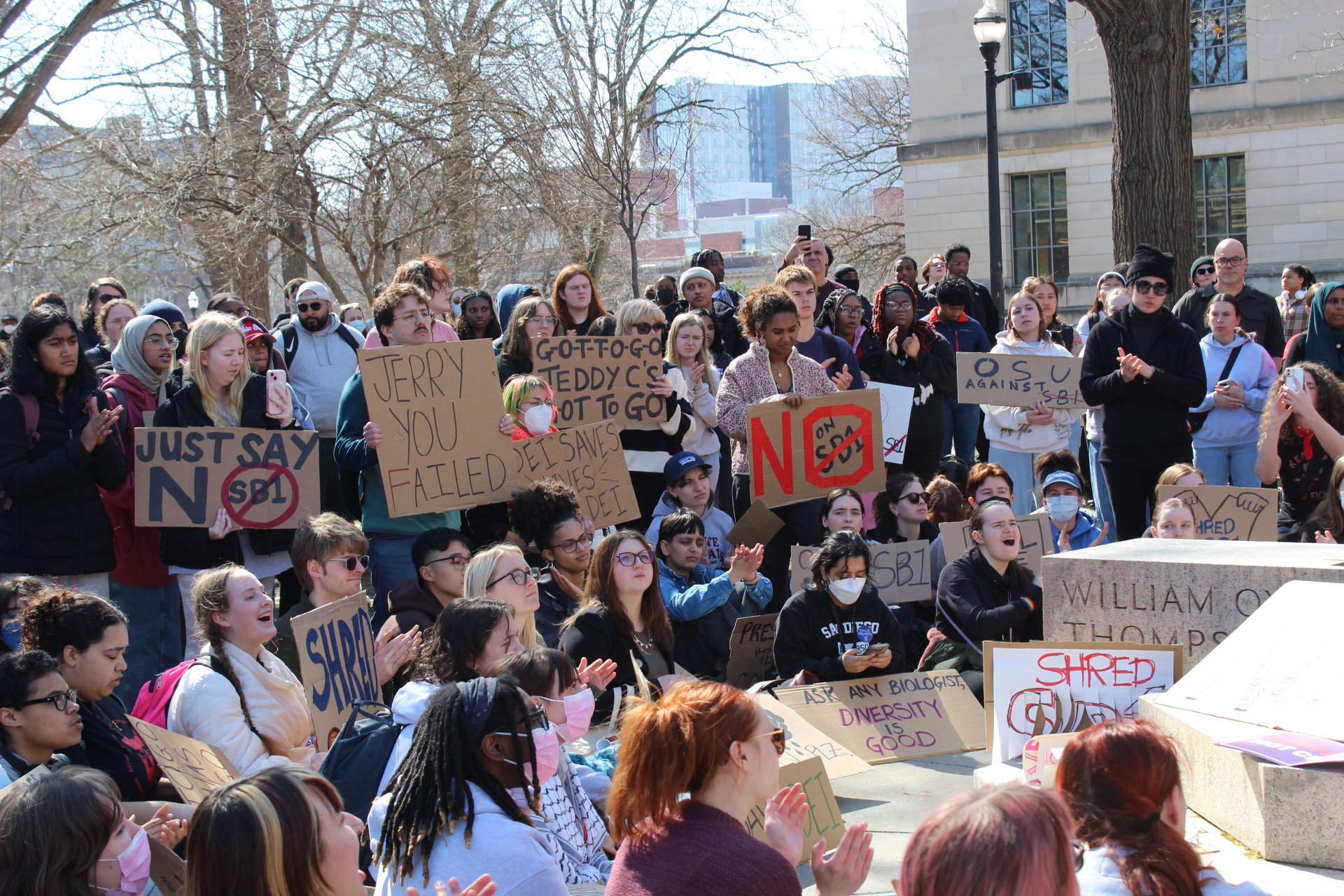
Ohio college students and protesters rally at the Statehouse on March 19, 2025, against Senate Bill 1, a higher education overhaul that bans diversity efforts and faculty strikes, and sets rules around classroom discussion, among other things. (Photo by David DeWitt, Ohio Capital Journal.)
A controversial bill to overhaul Ohio higher education, ban diversity and inclusion efforts, prohibit faculty from striking, and regulate classroom discussion is heading to Ohio Gov. Mike DeWine’s desk for his signature.
The Ohio Senate concurred with changes made to Senate Bill 1 by the Ohio House during Wednesday’s session. The vote was 20-11 with only two Republicans voting against it, state Sens. Louis W. Blessing III, of Colerain Township, and Thomas F. Patton, of Strongsville, voting against it. DeWine has previously said he would sign S.B. 1 into law.
DeWine will have 10 days to sign the bill into law or veto it once he receives it. If DeWine vetoes the bill, lawmakers would need a 3/5 vote from each chamber to override it.
GET THE MORNING HEADLINES.
S.B. 1 would set rules around classroom discussion, create post-tenure reviews, put diversity scholarships at risk, create a retrenchment provision that block unions from negotiating on tenure, shorten university board of trustees terms from nine years down to six years, and require students take an American history course, among other things.
For classroom discussion, the bill would set rules around topics involving “controversial beliefs” such as climate policies, electoral politics, foreign policy, diversity and inclusion programs, immigration policy, marriage, or abortion. S.B. 1 would only affect Ohio’s public universities.
State Sen. Jerry Cirino, R-Kirtland, introduced S.B. 1, which passed the Ohio Senate last month and the Ohio House last week.
“I am delighted, of course, as I always believed this is a great bill for the state of Ohio, for students and for higher education, so I’m delighted that we’ve been able to get past this next hurdle and send the bill to the governor’s desk,” Cirino said.
“We decided on a different approach than many, many of them would like,” Cirino said when asked about the bill’s overwhelming opposition. “But this isn’t about how many people show up to protest or to testify in hearings. A lot of those students that were showing up where, I believe, they were being paid or getting extra credit. And we don’t make policy here based on the number of people that show up to protest or testify.”
Senate President Rob McColley, R-Napoleon, said the passing of S.B. 1 is long overdue.
“It’s something that, frankly, should have been done sooner, but I’m happy we put the work in to get to where we are right now,” he said. “I do think it’s something that’s supported by Ohioans.”
Before voting to concur on S.B. 1, lawmakers debated the bill for about 35 minutes.
“Senate Bill 1 will enrich the learning experience of students at our public universities and colleges — places where our best and brightest will be able to learn without prejudice, speak their minds without being canceled, be honest about their positions without fear of faculty retaliation, and consider all sides of an issue and make up their own minds,” said Sen. Kristina Roegner, R-Hudson.
State Sen. Michele Reynolds, R-Canal Winchester, acknowledged that some people are afraid of what will happen if DEI on college campuses is ended through this bill, but said the time has come to remove DEI labels.
“This is not about censure or erasure,” she said. “It’s not about exclusion. It’s about inclusion that transcends labels, because DEI has become a system that sorts us. It sorts us by race, by gender and by identity, creating a culture where we are defined by our categories instead of our character, where we look at each other’s faces instead of listening to each other’s hearts.”
State Sen. Kyle Koehler, R-Springfield, said this bill ends the micromanaging of instruction in higher education.
“All Ohio college students and parents will now have a more comfortable feeling that their public institution of higher learning will foster an environment of open and free expression for everyone,” he said.
Senate Minority Leader Nickie Antonio, D-Lakewood, said not everyone is celebrating the concurrence of S.B. 1.
“Instead of tackling the real barriers to higher education — skyrocketing tuition costs and student debt — again, the majority are focused on dictating what’s taught in our colleges and universities and who teaches,” she said.
State Sent. Kent Smith, D-Euclid, said this bill will inhibit Ohio universities from attracting top-tier professors.
“If Senate Bill 1 becomes law, this legislation is the worst attack on academic freedom in Ohio in modern history,” Smith said.
Megan Henry is a reporter for the Ohio Capital Journal and has spent the past five years reporting in Ohio on various topics including education, healthcare, business and crime. She previously worked at The Columbus Dispatch, part of the USA Today Network.
Ohio Capital Journal is part of States Newsroom, the nation’s largest state-focused nonprofit news organization.
BECOME A LOVELAND MAGAZINE SUPERFAN BY DONATING NOW!
Editor’s note: Open and free local reporting is critical to having well-informed community. Loveland Magazine has published a free newspaper and website for the last 20 years for our community. If you would like us to continue, kindly contribute to this service. It would be greatly appreciated. Donations may be made to: Loveland Magazine, 243 Wall Street, Loveland, Ohio 45140. Or, donations can be made through PayPal using a credit card. (https://bit.ly/4j1ju3k) Advertisers do not nearly cover all of our expenses.
Ohio Democrats peppered Republican state Sen. Jerry Cirino with questions over his higher education overhaul bill this week. The bill would ban faculty strikes and diversity efforts on campus, as well as set rules around classroom discussion.
One Democratic lawmaker called the bill racist.
Cirino gave sponsor testimony on Senate Bill 1 Tuesday afternoon during the Ohio House Higher Education and Workforce Committee meeting.
State Sen. Jerry C. Cirino, R-Lake County. (Photo from Ohio Senate website.)
“S.B. 1 is about more speech, not less,” he said. “It is about creating an environment of continuous improvement. It is about the core value that students come first; they are the customers of these institutions.”
Senate Bill 1 would ban diversity and inclusion efforts, block faculty from striking, set rules around classroom discussion, put diversity scholarships at risk, shorten university board of trustees terms from nine years to six, and require students take an American history course, among other things.
Regarding classroom discussion, it would set rules around topics involving “controversial beliefs” such as climate policies, electoral politics, foreign policy, diversity and inclusion programs, immigration policy, marriage, or abortion.
S.B. 1, which only applies to public colleges, stipulates classroom discussion allows students to “reach their own conclusions about all controversial beliefs or policies and shall not seek to indoctrinate any social, political, or religious point of view.”
State Rep. Desiree Tims, D-Dayton. (Photo from Ballotpedia.)
“I think the bill is very racist,” state Rep. Desiree Tims, D-Dayton, said during Tuesday’s committee meeting.
Tims asked Cirino why he was interested in getting rid of diversity scholarships and Cirino responded by saying Ohio Attorney General Dave Yost addressed race-based scholarships last year.
“We have guidance from the attorney general that we cannot do those,” Cirino said. “Our institutions may not do those things based on race.”
In 2023, the U.S. Supreme Court ruled that Harvard and the University of North Carolina violated the Equal Protection clause of the 14th Amendment by using race as a factor in applications. The days after the ruling, Yost sent a letter to Ohio colleges and universities saying his office won’t legally protect someone at a college or university who uses race as a factor.
“How is it that you want diversity of thought, but not diversity of people at these public institutions that would bring that diversity?” state Rep. Joe Miller, D-Amherst, asked.
Cirino responded by saying diversity of thought and programs that promote diversity and inclusion are not comparable.
“You cannot discriminate against one group to make up for discrimination of another group,” Cirino said.
Miller also asked about whether limiting speech through legislation, such as this bill, is a slippery slope.
“There’s absolutely not one limitation of what can be talked about in the classroom,” Cirino said in his response. “What we say very specifically and explicitly in the bill is that there has to be an openness to looking at other opinions and welcoming diverse opinions as well.”
State Rep. Beryl Brown Piccolantonio, D-Gahanna, asked about the retrenchment and collective bargaining parts of the bill.
GET THE MORNING HEADLINES.
“We need to treat our institutions of higher learning a little bit more like a business,” Cirino said. “If we don’t help (university presidents and boards of trustees) with these management tools, we’re going to find a real disadvantage for the state of Ohio.”
Piccolantonio questioned if this bill is giving lawmakers more control over public universities.
“It is clearly not the legislature trying to step in and operate the college or university,” Cirino said. “It’s about empowering the boards of trustees, the governing board and the presidents.”
Piccolantonio also asked if Cirino would be open to making any changes to the bill and he said no, reminding committee members that this bill went through 11 revisions in the last General Assembly.
“This bill is matured and it’s ready to go,” Cirino said. In the version of the bill passed last month by the Ohio Senate, most of the changes made in the last General Assembly were rolled back.
More than 800 people submitted opponent testimony against the bill — significantly outweighing the amount of supporter testimony the bill has received. Several students have said they would leave Ohio if this bill passed.
When state Rep. Munira Abdullahi, D-Columbus, asked about so many students opposing the bill, Cirino said legislation is not developed based on how many people come to testify.
“If we started doing that, it would be a popularity contest, and we should all take a huge pay cut because we’re getting paid, in my view, to make policies sometimes, whether it’s popular or not, if we think it is the right thing to do and good for the state of Ohio,” Cirino said.
Abdullahi also asked why the bill would ban higher education faculty from striking.
“Simply because higher education, all postsecondary education, is absolutely critical to us in Ohio if we’re going to maintain a strong economy in the future and meet the workforce requirements that we need to meet in order to employ people and to provide the workers that our companies are looking for,” Cirino said.
Megan Henry is a reporter for the Ohio Capital Journal and has spent the past five years reporting in Ohio on various topics including education, healthcare, business and crime. She previously worked at The Columbus Dispatch, part of the USA Today Network.
Ohio Capital Journal is part of States Newsroom, the nation’s largest state-focused nonprofit news organization.


![[BREAKING] Ohio Gov. DeWine signs higher ed bill regulating classroom discussion and banning diversity efforts](https://lovelandmagazine.com/wp-content/uploads/2025/03/Gov.-Mike-DeWine-signs-ed-bill.jpg)