By Mihaela Manova is the Covering Climate Now Editor for Loveland Magazine and lives in Loveland
Calling all parents and teachers! On November 16, 2020, CMRubinWorld announced that Planet Classroom Network, a new addition to their website, will be organizing a six month World’s Fair of Learning on Youtube.
The goal for this virtual fair is to unite young students in learning from different mediums on YouTube, while also focusing on global climate change.
Planet Classroom is dedicated to “supporting youth well-being, unity, inclusivity, and addressing our planet’s global challenges” as told by the CMRubinWorld website.
The program will begin on January 4, 2021 and will be hosted on their YouTube channel. The program will feature over 20 global organizations such as Global Nomads, The Martha Graham Dance Company, and many more. For the full list, visit: https://www.cmrubinworld.com/planet-classroom/
“Research has shown us time and time again that the arts and social impact learning unites people across borders. The COVID-19 pandemic and the ensuing economic and societal consequences have amplified an already existing crisis of youth mental health,” said CMRubinWorld Co-Founder and CEO, Cathy Rubin.
“We came to the conclusion that the world’s youth needed their own Youtube channel where they can work with each other and seek sustainable solutions for their planet.”
The organizations that have partnered up with Planet Classroom will focus on artistic and creative aspects and opportunities. Director Eric Simon talked about his film What To Do About Climate Change?, which will air on the platform.
According to CmRubinWorld, Simon said, “explores avenues available for making progress” and will focus on the passion of protestors and activists battling climate change.
Likewise to Simon’s goals, other topics will be showcased throughout the six month program, including writing, watching documentaries, dance, and a platform for children to tell their stories.
About Planet Classroom Network
The Planet Classroom Network, organized by CMRubinWorld, brings together musicians, dancers, video game creators, filmmakers, learning innovators and emerging technologists from all over the world to entertain, educate and engage youth, and to provide a rich cultural experience at a time when art and learning institutions everywhere are not accessible.
The Planet Classroom Network is by youth for youth. Young people from around the world played a significant role in conceptualizing, creating, and producing the network’s vision and programming.
Loveland Magazine is one of the 400 news outlets worldwide, with a combined audience of over 2 billion people “Covering Climate Now”, a global journalism initiative committed to bringing more and better coverage to the defining story of our time.
The initiative, was co-founded by The Nation and Columbia Journalism Review
Mihaela Manova is “Covering Climate Now” in Loveland, Ohio as an editor for Loveland Magazine
In today’s (reposted) article from Covering Climate Now/Rethinking Schools, Bill Bigelow writes about the scarcity of climate change education in current textbooks.
I was a member of the committee of parents, teachers, students, and activists that pushed for the resolution. In drafting it, we knew that there were a couple of especially egregious texts in Portland classrooms, but until we sat down to formally evaluate 13 middle and high school science and social studies textbooks, we had no idea that every single one of the texts adopted in famously green and liberal Portland misleads young people about the climate crisis.
Few teachers put their faith in multinational behemoths like Pearson and Houghton Mifflin Harcourt. But our Climate Justice Committee needed more than hunches about how these corporations’ profit-first orientation would distort their coverage of climate change — we needed evidence.
Before our committee collected district-adopted textbooks to evaluate, we developed a rubric to evaluate their adequacy, inspired by the work of K. C. Busch at Stanford’s Center for Assessment, Learning, and Equity. Here’s what we came up with:
The text provides stories and examples that help students grasp the immediacy, systemic nature, and gravity of the climate crisis.
The text includes actions that people are taking to address the climate crisis, locally and worldwide.
The text emphasizes that all people are being affected by the climate crisis, but also highlights the inequitable effects of the crisis on certain groups (e.g., Indigenous peoples, people in poverty, Pacific Islanders, people in sub-Saharan Africa, people dependent on glaciers for drinking water and irrigation, etc.)
The text does not use conditional language that expresses doubt about the climate crisis (e.g., “Some scientists believe . . .” or “Human activities may change climate . . .”)
There are discussion and/or writing questions that provoke critical thinking.
Given our climate emergency, meeting these criteria seemed to us to be a reasonable cut score.
Thirteen retired teachers and members of our Portland Public Schools Climate Justice Committee gathered to evaluate the school district’s texts. The first thing we noticed is how difficult it was to find anything about climate change in many of the books. A typical social studies text, History Alive! Pursuing American Ideals, includes no mention of climate change, but offers breathless paeans to fossil fuels: “Oklahoma’s oil reserves are among the largest in the nation. Fossil fuels helped the United States become an industrial giant.” As one committee reviewer wrote, in this and other texts, “there is an opportunity to look at early U.S. history as prologue to the climate crisis, but this book is utterly silent.”
Contemporary Economics: not a word. The iconic Magruder’s American Government: 844 pages with no reference to global warming, climate change, greenhouse gases. One committee reviewer wrote: “How can a book about the U.S. government say nothing about the climate crisis — or environmental policy more broadly? This is egregious, unacceptable.” Despite a focus on industrialization, neither volume of the Advanced Placement text Sources of the Western Tradition includes anything about climate change — as if we can cleave fossil fuel-powered industrialization from its contemporary climate consequences.
Other texts acknowledge the existence, or at least the possibility, of climate change, but the texts’ language is drenched in doubt. Issues and Life Sciences describes global climate change in just one sentence, as a “potential threat to Earth’s biomes.” However, other “threats” to the Earth’s biomes — eight of them — are listed as actual, and climate change a mere potential threat.
The books are littered with conditional language. The high school text Biology: As greenhouse gas concentrations increase, global temperatures “may be affected,” and there might be “potential” for serious environmental problems. And: “Explain how burning of fossil fuels might lead to climate change.” AP World History informs students that the global rise in temperatures “might have serious consequences.”
A key component of Portland’s climate justice resolution is its insistence on student agency: “All Portland Public Schools students should develop confidence and passion when it comes to making a positive difference in society, and come to see themselves as activists and leaders for social and environmental justice — especially through seeing the diversity of people around the world who are fighting the root causes of climate change.” But not a single text our committee reviewed suggests that students or ordinary people can play a role in addressing this growing crisis — or that “frontline communities” are themselves responding to climate destabilization. In its one sentence on climate change, Pursuing American Ideals says that “environmentalists fear” problems like global warming. Similarly, Modern World History acknowledges that “environmentalists are especially concerned . . .” and that “Scientists also are worried about global warming . . .” These are both true, of course, but the resolution’s intent is to emphasize our students’ own role in making the world a better place, rather than assigning concern and action only to scientists and environmentalists.
All 13 of the books earned an F. Our committee is in the midst of sending letters to each publisher informing them that their book is out of compliance with Portland school district policy on climate education. We are also sending letters to teachers who may be using these books, alerting them to our findings and urging them to use alternatives, and to engage students in critical reading activities to dissect the problems with these texts’ ho-hum approach to climate change.
Do we expect to influence these corporations’ treatment of the climate crisis in their textbooks? No. The corporate giants that publish school textbooks have no interest in raising critical questions about the frenzied system of extraction and consumption at the root of climate change — a system from which they benefit. Our aim is to build an argument that we cannot look to conventional sources of curriculum to educate our students about the causes of climate change and the kind of fundamental social transformation needed to address the crisis.
For this, we need a grassroots approach to curriculum development — a partnership among educators, parents, environmental organizations, frontline communities, and our students. We need to demand time for teachers to collaborate, to write new curriculum, to share stories — to learn from one another and from the communities being hit by climate change first and the hardest. The climate crisis threatens life on Earth. Our students have a right to learn about this and to know that they can make a difference.
Loveland Magazine is one of the 400 news outlets worldwide, with a combined audience of over 2 billion people “Covering Climate Now”, a global journalism initiative committed to bringing more and better coverage to the defining story of our time.
The initiative, was co-founded by The Nation and Columbia Journalism Review
Mihaela Manova is “Covering Climate Now” in Loveland, Ohio as an editor for Loveland Magazine
In today’s Covering Climate Now newsletter, the source explains what the future could hold after Trump’s presidency and how the United States will return to battle climate change.
Donald Trump’s defeat in the US presidential election is the biggest development in the climate story in years, if only because it means that the story might not have a hellish ending after all. News columns and Zoom meetings are already abuzz with to-do lists and speculation about what the administration of president-elect Joe Biden will or will not be able to accomplish on climate change. But that is another story for another day.
Like the fall of the Berlin Wall or the Apollo 11 Moon landing, Trump’s impending departure from the most powerful office on earth is an event of epochal importance whose ramifications cannot be fully fathomed at this point, much less confidently forecast. Instead of trying to predict what will come next, this is a time to pause and reflect. Let’s recognize the magnitude of what America’s voters just did and ponder what lessons it holds for the challenges ahead.
Penn State University scientist Michael Mann spoke for many climate experts when he warned before the election that “a second term for Trump would be ‘game over’ for climate.” That was not partisan hyperbole but unsentimental physics and math. To avoid an apocalyptic future—one shaped by intensifying heat waves, droughts, wildfires, and storms—humanity must slash greenhouse gas emissions in half by 2030, scientists with the United Nations Intergovernmental Panel on Climate Change declared in a landmark 2018 report. That remains an immensely difficult challenge, requiring shifts in economic behavior at a scale and speed the scientists called “unprecedented” in human history. But the task would have become outright impossible, Mann explained, if the world’s biggest economy spent a second four years galloping in the wrong direction under a re-elected president Trump, with his pro-fossil fuels policies and rejection of the Paris Agreement.
That is the suicidal scenario humanity just avoided.
But make no mistake: Many more mountains remain to be climbed in order to preserve a livable climate. For example, three of the world’s four biggest economies—the European Union, Japan, and China—have recently pledged to reach net zero carbon emissions by 2050 or, in China’s case, 2060; citizens, public officials, and business leaders will have to push those countries’ governments to make that scientifically correct target a political reality. The US must match these net-zero efforts, starting during the Biden administration and despite all-but-certain opposition from Republicans and other fossil fuel loyalists in Congress, and sustain that progress for decades. Meanwhile, business and financial interests the world over must shift investment and loans away from the climate de-stabilizing status quo and towards clean energy, regenerative agriculture, and other foundations of a post-carbon economy. And all this and more must be accomplished even as the diminished yet still-formidable wealth and power of the fossil-fuel industry continues obstructing progress.
Removing Trump, then, is a necessary first step—but it is only a first step, a prerequisite to the difficult journey ahead. Where to turn next?
Good journalism is vital to answering that question, because the overall US election results, including congressional races, yield decidedly mixed signals about how committed America’s voters are to climate action.
Young activists—with their moral fervor; massive street protests; insistence on the intersectionality of racial, class, gender, and environmental justice; and pathbreaking policy reforms such as the Green New Deal—have upended climate politics in recent years. In the US, the Sunrise Movement and other groups mounted extensive campaigns to register and mobilize voters, especially other young people, to oppose Trump and vote champions of climate action into office. Post-election, activists have claimed considerable credit for the outcome. Observing that the candidate “with the strongest climate plan in history just won the White House with the most votes ever,” Varshini Prakash, the executive director of Sunrise, said that “a big part of the story is an unprecedented level of youth voter turnout, especially among young people of color.”
On the other hand, more than 71 million Americans, very nearly half of the electorate, voted to re-elect a president whose climate policies promised certain death for the world they know and love. They did so even though pre-election polling consistently found that sizable, bipartisan majorities of the American public supported clean energy and other forms of climate action. And while Rep. Alexandria Ocasio-Cortez is correct that Rep. Michael Levin, a fellow co-sponsor of the Green New Deal, kept his seat, quite a few other Green New Deal backers—including Sunrise-backed candidates Mike Siegel in Texas, Beth Doglio in Washington, and Marquita Bradshaw in Tennessee—were handily defeated.
Identifying the ways in which the climate crisis shaped political engagement this election cycle should be a top priority for newsrooms in the weeks ahead. There is no substitute for shoe-leather reporting that talks in-depth with as many voters as possible to understand how and why they voted as they did. Probing, open-minded interviews can drill down into individual races, comparing what political parties, candidates, activist groups and others claim they accomplished with what actual voters say as well as the final election tallies. Don’t put much stock in exit polls, which have increasingly been recognized as methodologically suspect. Better insights come from Pew Research Center analyses that match post-election voter surveys with official voting records. It takes months to produce such analyses, however; in the meantime, newsrooms should be cautious about drawing conclusions about what role climate change did or did not play in the 2020 US elections.
What’s clear is that the fall of Trump propels the climate story into a decisive new era. The world is about to see whether the US government will help humanity grasp a final opportunity to turn down the heat. For journalists on the climate beat, it’s an exciting, important time. There are indeed mountains still to climb in humanity’s quest for a livable climate future. Strong and steadfast journalism is essential to lighting the way.
Now, here’s your weekly sampling of the latest in climate news, from across the CCNow collaboration:
The Guardian examines the climate implications of Republicans possibly maintaining control of the Senate. Under the Biden administration “there will probably still be large-scale spending on green infrastructure, like renewable power, electric vehicles and transit. But any hopes for climate requirements for businesses, like a clean energy standard, would feel much farther off.”
Though a Republican Senate might prove intransigent on climate action, Biden could still use the “bully pulpit” of his office to advance his climate agenda, 350.org co-founder Jamie Henn argues in The Nation. A large majority of Americans favor climate action already, and Biden can use the presidential bully pulpit, Henn says, to keep climate in the spotlight and make opposition politically costly for Republicans.
The U.S. exited the Paris Climate Accord last week. InsideClimate News looks at what Biden, as president, will need to do to rejoin the international agreement. The task is trickier than it might seem—but critical. “If it’s backed up with ambitious domestic climate policies, a green recovery from the pandemic, support from Congress and a renewed push for international collaboration on various climate initiatives, the U.S. reentry could help reinvigorate worldwide efforts to transition to a net-zero carbon economy by 2050,” InsideClimate News explains.
From Bloomberg Green, a review of corporate campaign contributions reveals that a great majority of cash—even from companies that publicly tout their ambitious climate agendas—goes to lawmakers who vote against climate action. Of $68 million given to House and Senate members since 2018, nearly half went to candidates with a lifetime score of 10% or lower from the League of Conservation Voters (meaning the member has voted for environment-friendly legislation 10% or less of the time).
The YEARS Project has a series of strong, explainer-style videos with Rewiring America’s Saul Griffith, suggesting that Americans need not sacrifice their lifestyles to tackle the climate crisis. Powering the U.S. with renewable electricity could actually save families thousands of dollars every year, jump start a post-Covid economy, and create tens of millions of jobs. The key is to provide up-front financing that underwrites a shift of energy production from fossil fuels to electricity generated by solar, wind and other non-carbon sources, Griffith says. Videos here, here, and here.
Loveland Magazine is one of the 400 news outlets worldwide, with a combined audience of over 2 billion people “Covering Climate Now”, a global journalism initiative committed to bringing more and better coverage to the defining story of our time.
The initiative, was co-founded by The Nation and Columbia Journalism Review
Mihaela Manova is “Covering Climate Now” in Loveland, Ohio as an editor for Loveland Magazine
In today’s Covering Climate Now post, young activists are protesting and calling out world governments for the lack of climate change progress. Despite COVID-19 times, this is an effort to shift their attention to what has been happening in the world’s environment. Article written by Fiona Harvey for The Guardian.
Mock Cop26 set up in frustration at lack of progress due to coronavirus crisis
Young climate activists have begun a parallel process to the UN climate crisis talks, in frustration at the lack of progress they perceive in world governments’ efforts to address the emergency.
Crunch negotiations aimed at fulfilling the Paris climate agreement, called Cop26, were to be hosted by the UK this November, but have been delayed by the coronavirus crisis. Activists, participants and observers have told the Guardian they are concerned at a lack of progress so far.
The UK government has said little in public since the launch in February, before widespread lockdowns hit, other than to agree a postponement with the UN. The rescheduled Cop26 will take place next November, but the hosts face an uphill struggle to bring countries grappling with the Covid crisis to agree stiffer targets on greenhouse gas emissions.
While public progress on the postponed Cop26 has been meagre, young activists in Fridays for Future, the movement sparked by Greta Thunberg’s school strikes, are pushing ahead with their own online event this November, called Mock Cop26.
They are inviting young people to “fill the void of the postponed Cop26 with a big, inclusive online Mock Cop”. The event will be run by young climate activists, aiming to get between three and five delegates from as many countries as possible, with a focus on the global south – to contrast with what they see as the dominance of developed countries in the UN negotiations.
The two-week event will mimic the format of the real thing, with high-level opening statements by the youth delegates, keynotes and panels by global names, followed by a week of facilitated workshops and regional caucuses. The discussions will be framed around five conference themes: climate justice; education; health and mental health; green jobs; carbon reduction targets.
The event is planned to culminate in a statement to world leaders from the youth of the world, with demands for the achievements they want to see from the real Cop26 next year.
“We are so far quite disappointed in how [the UK’s hosting of Cop26] is shaping up,” said Joel Lev-Tov, coordinator of Fridays for Future. “[That is why we] have started to work on our own Mock Cop26 to address what we presume will be the failure of Cop26 … to show what Cop could look like if governments actually acted on the climate crisis.”
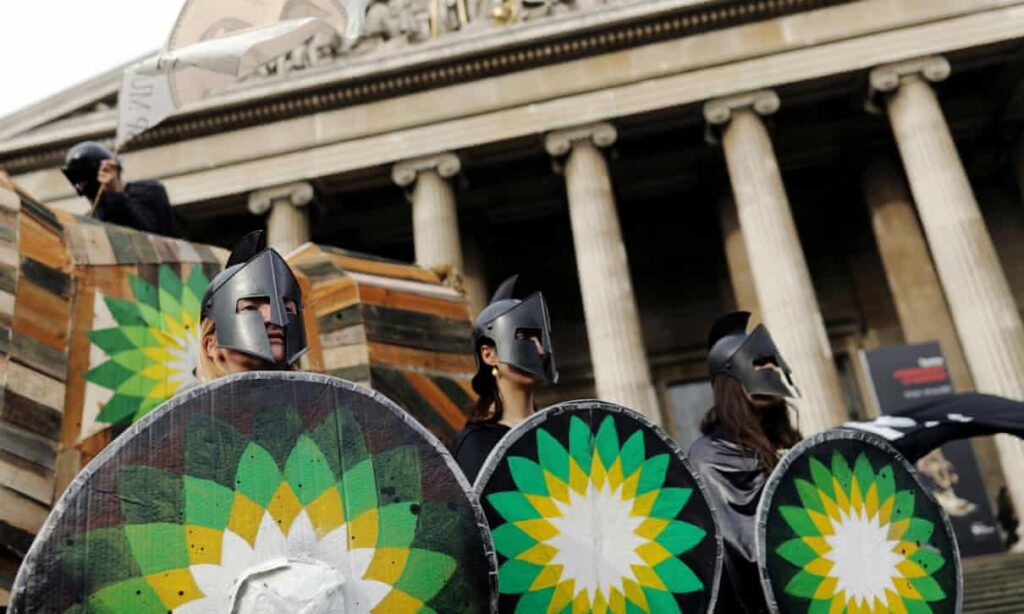
Climate change activists demonstrate against BP outside the British Museum in February 2020. Photograph: Simon Dawson/Reuters
The move to initiate a parallel young people’s conference came as developing countries and international observers told the Guardian they were concerned at the slow progress being made towards Cop26 by the UK hosts.
“We are behind, in our opinion,” said Carlos Fuller, of the Alliance of Small Island States, whose 44 member states are some of the world’s most at risk from climate breakdown. “We are very disappointed that we are so far behind. The UK needs to exercise its muscle more.”
Earlier this week, the UK’s top official in charge of the Cop26 summit admitted that formal negotiations had not yet started, as the face-to-face sessions supposed to take place earlier this year were delayed.
Greater leadership from the UK’s prime minister, Boris Johnson, is also vital, according to several leading experts. Johnson has said little in public about Cop26 or the climate crisis since the launch of Cop26 in February, which was overshadowed by the botched sacking of the ex-MP originally appointed to lead the conference, Claire O’Neill.
Mary Robinson, former president of Ireland and twice a UN envoy on climate issues, told the Guardian: “I have not seen the leadership necessary to deliver a successful Cop. It takes every ounce of influence and diplomatic muscle, and we are not seeing that yet.”
She contrasted the lack of movement with the activities of the French government in the two years before the Paris agreement was signed in December 2015. “They threw everything at it, every ambassador, every country was engaged.”
Mohamed Adow, director of PowerShift Africa, a developing country thinktank, added: “The UK has made some positive noises as COP president but it’s clear that Number 10 really needs to start making it a political priority. We need to see some real leadership from Boris Johnson. If he wants the ‘Global Britain’ brand to mean anything more than just a PR stunt, he needs to step up and lead from the front on climate.”
A further complication is the government’s stance on the Brexit withdrawal agreement. That the government has openly admitted its proposals will break international law has caused consternation among the climate community. Many fear that the willingness to flout international law will be used by opponents of the Paris agreement to discredit the summit’s hosts and foster discord.
Tom Burke, co-founder of the E3G thinktank, said: “The prime minister has destroyed his global credibility. [The decision to break international law] has cast a blight on our ability to influence other leaders on Cop26.”
“Countries at [the UK talks] use weaknesses that they perceive in other countries,” warned Robinson. “This is very unhelpful at a time when we have enough difficulties to cope with.”
One key sticking point, however, is that the UK has still not made a public commitment on a new plan for cutting its own emissions. Current commitments to cut emissions under the Paris agreement are too weak, and the treaty requires them to be ratcheted up. All nations are being asked to come forward this year with strengthened plans on curbing their emissions by 2030, preferably with a view to net-zero emissions by 2050, or soon after in the case of the developing world.
Despite urging other countries to meet the deadline, when questioned by MPs earlier this week, Alok Sharma, the UK’s business secretary and president of Cop26, would not commit to the UK producing a revised plan on its emissions this year.
Loveland Magazine is one of the 400 news outlets worldwide, with a combined audience of over 2 billion people “Covering Climate Now”, a global journalism initiative committed to bringing more and better coverage to the defining story of our time.
The initiative, was co-founded by The Nation and Columbia Journalism Review
Mihaela Manova is “Covering Climate Now” in Loveland, Ohio as an editor for Loveland Magazine
In today’s Covering Climate Now Post, Facebook re-evaluates and takes a new step in fact-checking climate change content. Article written by Sarah Frier for Bloomberg.
The initiative will give climate information a more similar treatment to Covid-19 and election content.
In the geographic heart of the tech industry Wednesday, it was hard to think of anything except the orange skies, dark and tinted by wildfire smoke. The image software on iPhones failed to capture the dystopian hue, or the feeling of being surrounded by it. Silicon Valley workers tweeted that it felt like night time, or a perpetual sunset, or a scene from “Blade Runner 2049.” It marked the fourth week of severe fire and ash in the Western U.S.
The conversation shifted from the already-apocalyptic pandemic to another global public health disaster: climate change. For those who don’t know, this is not what California is usually like. The first time I smelled smoke in my San Francisco apartment, in 2015, I imagined something nearby was on fire—not that it was happening miles north of the city. I turned on an air purifier, which I’d purchased for my partner’s allergies, never expecting it would be necessary for anything else.
The climate disaster is undeniable to those who have experienced its harms, and a political talking point for the rest. Facebook is full of misinformation on the topic, which, when noticed and reported by users, is sent to the company’s third-party fact-checkers. Over the summer, a nonprofit called C02 Coalition, which claimed that carbon dioxide created by humans was beneficial for the planet, was banned from advertising on Facebook after too many fact violations. The group successfully appealed its ban, and had the fact-checks labels on its posts removed.
Facebook said that it considered such posts to be opinions, ineligible for fact-checking, causing a miniature scandal when the checker, Climate Feedback, spoke out. “We don’t believe that articles in an opinion section should be immune from fact-checking,” Climate Feedback science editor Scott Johnson wrote in an email to Bloomberg.
Facebook also doesn’t take the additional step of removing misinformation on the climate, because the company has ruled that such posts don’t cause imminent harm to human health.
But, in the aggregate, they do. Facebook has recently re-evaluated its approach to climate misinformation, according to spokesman Andy Stone. The company is working on a climate information center, which will display information from scientific sources. Stone said Facebook isn’t ready to officially announce anything, but it’s easy to imagine what this might look like. Facebook has already devised centers for factual information about Covid-19, and about voting and the upcoming election, both of which it has promoted heavily on its site.
The info center approach would put less pressure on evaluating each individual post, in favor of directing users to what they need to know more about generally. It could plausibly be more effective than the fact-checking process, which sometimes takes days or weeks to complete, long after a claim has gone viral. Of course, it won’t help address individual disputed claims.
In the meantime, to get the general idea of what’s going on, anyone in Silicon Valley can look out the window.
Loveland Magazine is one of the 400 news outlets worldwide, with a combined audience of over 2 billion people “Covering Climate Now”, a global journalism initiative committed to bringing more and better coverage to the defining story of our time.
The initiative, was co-founded by The Nation and Columbia Journalism Review
Mihaela Manova is “Covering Climate Now” in Loveland, Ohio as an editor for Loveland Magazine
Today’s article talks about the cycles that surround us everyday and their direct effect on our lives, especially when Climate Change is involved. This article has been written by Alan Buis for the NASA official website.
By Alan Buis ( NASA’s Jet Propulsion Laboratory) on February 27, 2020
O
ur lives literally revolve around cycles: series of events that are repeated regularly in the same order. There are hundreds of different types of cycles in our world and in the universe. Some are natural, such as the change of the seasons, annual animal migrations or the circadian rhythms that govern our sleep patterns. Others are human-produced, like growing and harvesting crops, musical rhythms or economic cycles.
Cycles also play key roles in Earth’s short-term weather and long-term climate. A century ago, Serbian scientist Milutin Milankovitch hypothesized the long-term, collective effects of changes in Earth’s position relative to the Sun are a strong driver of Earth’s long-term climate, and are responsible for triggering the beginning and end of glaciation periods (Ice Ages).
Specifically, he examined how variations in three types of Earth orbital movements affect how much solar radiation (known as insolation) reaches the top of Earth’s atmosphere as well as where the insolation reaches. These cyclical orbital movements, which became known as the Milankovitch cycles, cause variations of up to 25 percent in the amount of incoming insolation at Earth’s mid-latitudes (the areas of our planet located between about 30 and 60 degrees north and south of the equator).
The Milankovitch cycles include:
The shape of Earth’s orbit, known as eccentricity;
The angle Earth’s axis is tilted with respect to Earth’s orbital plane, known as obliquity; and
The direction Earth’s axis of rotation is pointed, known as precession.
Let’s take a look at each (further reading on why Milankovitch cycles can’t explain Earth’s current warming here).
Credit: NASA/JPL-Caltech
Eccentricity – Earth’s annual pilgrimage around the Sun isn’t perfectly circular, but it’s pretty close. Over time, the pull of gravity from our solar system’s two largest gas giant planets, Jupiter and Saturn, causes the shape of Earth’s orbit to vary from nearly circular to slightly elliptical. Eccentricity measures how much the shape of Earth’s orbit departs from a perfect circle. These variations affect the distance between Earth and the Sun.
Eccentricity is the reason why our seasons are slightly different lengths, with summers in the Northern Hemisphere currently about 4.5 days longer than winters, and springs about three days longer than autumns. As eccentricity decreases, the length of our seasons gradually evens out.
The difference in the distance between Earth’s closest approach to the Sun (known as perihelion), which occurs on or about January 3 each year, and its farthest departure from the Sun (known as aphelion) on or about July 4, is currently about 5.1 million kilometers (about 3.2 million miles), a variation of 3.4 percent. That means each January, about 6.8 percent more incoming solar radiation reaches Earth than it does each July.
When Earth’s orbit is at its most elliptic, about 23 percent more incoming solar radiation reaches Earth at our planet’s closest approach to the Sun each year than does at its farthest departure from the Sun. Currently, Earth’s eccentricity is near its most elliptic and is very slowly decreasing, in a cycle that spans about 100,000 years.
The total change in global annual insolation due to the eccentricity cycle is very small. Because variations in Earth’s eccentricity are fairly small, they’re a relatively minor factor in annual seasonal climate variations.
Credit: NASA/JPL-Caltech
Obliquity – The angle Earth’s axis of rotation is tilted as it travels around the Sun is known as obliquity. Obliquity is why Earth has seasons. Over the last million years, it has varied between 22.1 and 24.5 degrees perpendicular to Earth’s orbital plane. The greater Earth’s axial tilt angle, the more extreme our seasons are, as each hemisphere receives more solar radiation during its summer, when the hemisphere is tilted toward the Sun, and less during winter, when it is tilted away. Larger tilt angles favor periods of deglaciation (the melting and retreat of glaciers and ice sheets). These effects aren’t uniform globally — higher latitudes receive a larger change in total solar radiation than areas closer to the equator.
Earth’s axis is currently tilted 23.4 degrees, or about half way between its extremes, and this angle is very slowly decreasing in a cycle that spans about 41,000 years. It was last at its maximum tilt about 10,700 years ago and will reach its minimum tilt about 9,800 years from now. As obliquity decreases, it gradually helps make our seasons milder, resulting in increasingly warmer winters, and cooler summers that gradually, over time, allow snow and ice at high latitudes to build up into large ice sheets. As ice cover increases, it reflects more of the Sun’s energy back into space, promoting even further cooling.
Credit: NASA/JPL-Caltech
Precession – As Earth rotates, it wobbles slightly upon its axis, like a slightly off-center spinning toy top. This wobble is due to tidal forces caused by the gravitational influences of the Sun and Moon that cause Earth to bulge at the equator, affecting its rotation. The trend in the direction of this wobble relative to the fixed positions of stars is known as axial precession. The cycle of axial precession spans about 25,771.5 years.
Axial precession makes seasonal contrasts more extreme in one hemisphere and less extreme in the other. Currently perihelion occurs during winter in the Northern Hemisphere and in summer in the Southern Hemisphere. This makes Southern Hemisphere summers hotter and moderates Northern Hemisphere seasonal variations. But in about 13,000 years, axial precession will cause these conditions to flip, with the Northern Hemisphere seeing more extremes in solar radiation and the Southern Hemisphere experiencing more moderate seasonal variations.
Axial precession also gradually changes the timing of the seasons, causing them to begin earlier over time, and gradually changes which star Earth’s axis points to at the North Pole (the North Star). Today Earth’s North Stars are Polaris and Polaris Australis, but a couple of thousand years ago, they were Kochab and Pherkad.
There’s also apsidal precession. Not only does Earth’s axis wobble, but Earth’s entire orbital ellipse also wobbles irregularly, primarily due to its interactions with Jupiter and Saturn. The cycle of apsidal precession spans about 112,000 years. Apsidal precession changes the orientation of Earth’s orbit relative to the elliptical plane.
The combined effects of axial and apsidal precession result in an overall precession cycle spanning about 23,000 years on average.
A Climate Time Machine
The small changes set in motion by Milankovitch cycles operate separately and together to influence Earth’s climate over very long timespans, leading to larger changes in our climate over tens of thousands to hundreds of thousands of years. Milankovitch combined the cycles to create a comprehensive mathematical model for calculating differences in solar radiation at various Earth latitudes along with corresponding surface temperatures. The model is sort of like a climate time machine: it can be run backward and forward to examine past and future climate conditions.
Milankovitch assumed changes in radiation at some latitudes and in some seasons are more important than others to the growth and retreat of ice sheets. In addition, it was his belief that obliquity was the most important of the three cycles for climate, because it affects the amount of insolation in Earth’s northern high-latitude regions during summer (the relative role of precession versus obliquity is still a matter of scientific study).
He calculated that Ice Ages occur approximately every 41,000 years. Subsequent research confirms that they did occur at 41,000-year intervals between one and three million years ago. But about 800,000 years ago, the cycle of Ice Ages lengthened to 100,000 years, matching Earth’s eccentricity cycle. While various theories have been proposed to explain this transition, scientists do not yet have a clear answer.
Milankovitch’s work was supported by other researchers of his time, and he authored numerous publications on his hypothesis. But it wasn’t until about 10 years after his death in 1958 that the global science community began to take serious notice of his theory. In 1976, a study in the journal Science by Hays et al. using deep-sea sediment cores found that Milankovitch cycles correspond with periods of major climate change over the past 450,000 years, with Ice Ages occurring when Earth was undergoing different stages of orbital variation.
Several other projects and studies have also upheld the validity of Milankovitch’s work, including research using data from ice cores in Greenland and Antarctica that has provided strong evidence of Milankovitch cycles going back many hundreds of thousands of years. In addition, his work has been embraced by the National Research Council of the U.S. National Academy of Sciences.
Scientific research to better understand the mechanisms that cause changes in Earth’s rotation and how specifically Milankovitch cycles combine to affect climate is ongoing. But the theory that they drive the timing of glacial-interglacial cycles is well accepted.