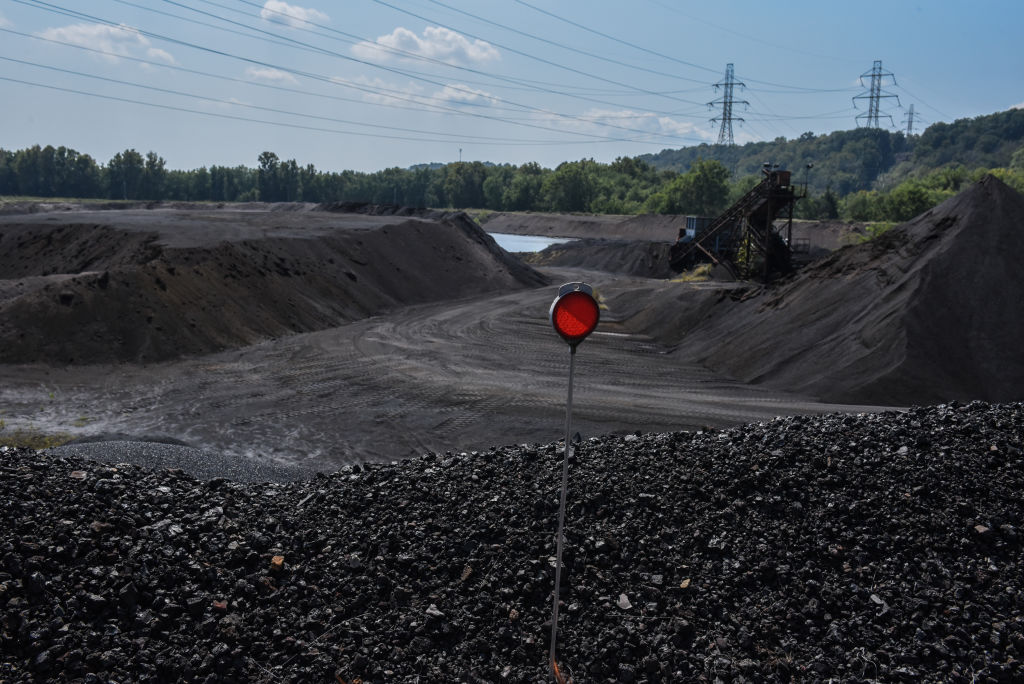
Another private equity group is in the process of buying a coal-fired generation plant along the Ohio River that is estimated to be the nation’s most deadly via pollution.
The prospective owners boast of a focus on helping fossil fuel plants make the transition to sustainability. But it’s unclear that anything will change at the 50-year-old facility.
Presently owned by Blackstone and ArcLight Capital Partners, the 2,600 megawatt Gavin plant in Cheshire is in the process of being purchased by two other private equity firms, Energy Capital Partners and Javelin. Because the plant is estimated to produce the deadliest emissions in the United States — and because it has a $40 million liability to clean up toxic coal ash — watchdogs are concerned about ongoing health threats. They’re also worried that taxpayers will have to pay for any cleanup.
Private equity groups have long been accused of the most ruthless moneymaking. They often buy assets in deals that quickly recoup their investments, then frequently sell off the most valuable parts of an enterprise, and then walk away either by selling or declaring bankruptcy. Whether people needlessly lose jobs or consumers lose choices is not a consideration, critics say.
Such firms are heavily invested in fossil fuel-powered electricity generation.
Earlier this month, Private Equity Climate Risks — a consortium of clean-energy advocates — published a scorecard. It said the annual emissions of private-equity owned fossil fuel plants exceed those of the global airline industry and is on a scale with the catastrophic Canadian wildfires of 2023.
Ohio’s Gavin Plant is a particular polluter.
A 2023 analysis by the Sierra Club looked at coal-plant emissions and weather patterns. It concluded that because it sends a plume of toxins over populous areas in the eastern United States, the Gavin plant is the deadliest in the country, killing an estimated 244 people a year.
Blackstone, one of its current owners, has ties to the Republican presidential ticket. CEO Stephen Schwarzman in May endorsed former President Donald Trump, and it’s the 10th-largest contributor to Ohio Sen. J.D. Vance’s PAC, Working for Ohio, according to OpenSecrets.com.
Blackstone in August disputed critics’ assertions that it was seeking political influence to avoid compensating for the harms caused by the plant. To the contrary, it said it had spent $1 billion on air quality improvements.
But now that it appears poised to be sold to yet another private-equity group, critics continue to worry that the Gavin Plant will keep on spewing toxins and that its $40 million coal-ash problem will go unaddressed.
“I think we’ve seen over the past several years how unpopular and deadly coal is,” said Alissa Jean Schafer, climate director of the Private Equity Stakeholder Project, a group critical of private equity practices. “You’ve certainly had a front-row seat to that in Ohio. Increasingly, coal is being seen as, A) a really bad investment, and B) a poisonous form of energy.”
Indeed, companies are retiring coal-fired power plants or converting them to cleaner natural gas even faster than the federal government estimates, the Institute for Energy Economics and Financial Analysis reported on Tuesday.
According to its research, 69,000 megawatts of coal generation will be retired or converted between 2025 and 2030 — nearly double the 36,000 megawatts estimated by the U.S. Energy Information Administration in September.
“Blackstone wasn’t completely able to ignore that, so Blackstone now is following the typical (private equity) playbook where they swooped in, took (the Gavin Plant), tried to see what profit they could get out of it, didn’t respond to any of the pressure to retire the plant or invest in a clean-energy transition,” Schafer said. “Now Blackstone is passing the buck to the next firm. We’ll see what (Energy Capital Partners) does with it.”
Schafer and her colleagues at the Private Equity Stakeholders Project said the sale of the Gavin Plant is under consideration by the Federal Energy Regulatory Commission, and details of the deal and its timeline for the deal to close are unknown.
On its website, Energy Capital Partners says it focuses on converting facilities to cleaner generation.
“Energy Capital Partners (ECP) is a leading credit and equity investor across energy transition infrastructure, with a focus on investing in electricity and sustainability infrastructure, providing reliable, affordable clean energy,” it says.
A photo of the coal ash pond at the James Gavin Power Plant in Cheshire, Ohio included in documents to the EPA.
However, the firm didn’t respond when asked whether it planned to convert or retire Gavin, or what might be done about the plant’s coal ash.
The scorecard published earlier this month by Private Equity Climate Risks said that ECP is invested in 14 energy companies and that 64% of them have fossil fuel generation. The consortium — which includes the Private Equity Stakeholders Project — gave ECP a grade of C when it comes to such things as transparency in disclosing emissions and political spending, having a clear plan to transition to clean energy, and plans to do its part to meet the global goal of limiting global warming to 1.5 degrees celsius by the end of the century.
One of the major critiques of private equity firms is that they use average people’s money to invest in things like fossil fuels that harm those same people. That’s so, the argument goes, because much of the money comes from institutional investors such as public pension funds.
According to data used in the Private Equity Climate Risks scorecard, at least six of Ohio’s public pensions are invested in private equity funds that support fossil fuels. By far the biggest investor is the State Teachers Retirement System at nearly $1.3 billion.
$812 million with Ares Management, which owns 14 fossil fuel companies that spew 55 million tons of carbon dioxide equivalents each year. The scorecard gave it a grade of C, when it comes to meeting climate and transparency goals.
$450 million with Apollo Global Management, which owns three fossil fuel companies that emit 3.5M tons of carbon dioxide equivalents. It received a grade of B.
$10 million with EnCap Investments. It’s invested in 34 fossil fuel companies that emit 92 million carbon dioxide equivalents a year. It received a D grade on the Private Equity Climate Risks scorecard.
Marty Schladen has been a reporter for decades, working in Indiana, Texas and other places before returning to his native Ohio to work at The Columbus Dispatch in 2017. He’s won state and national journalism awards for investigations into utility regulation, public corruption, the environment, prescription drug spending and other matters.
Ohio Capital Journal is part of States Newsroom, the nation’s largest state-focused nonprofit news organization.
Former House Speaker Larry Householder has again been indicted on charges related to his actions in a massive bribery and money laundering scandal.
The Glenford Republican is already serving a 20-year sentence in federal prison after being convicted last March of racketeering in a scheme in which Akron-based FirstEnergy paid more than $60 million to purchase a $1.3 billion, ratepayer-financed bailout.
The state charges concern some conduct Householder engaged in after he was arrested in July 2020. They also concern debts and other items that Householder admitted during his federal trial that he didn’t report to the Joint Legislative Ethics Commission as required.
The former speaker faces maximum sentences of from three to eight years on each of the 10 state charges from the Cuyahoga grand jury. And importantly, if he’s convicted of one of the counts — theft in office — he’s permanently disqualified from holding public office.
In a video accompanying the announcement of the indictment, Ohio Attorney General Dave Yost noted that Householder has served two different stints as speaker, and that if he’s successful in appealing his federal conviction, “he might well try for a third bite at the apple.”
Five of the 10 state counts Householder faces stem from his use of campaign funds to pay lawyers after his July 2020 arrest. In the video in which Yost appeared, Deputy Attorney General Carol O’Brien said Householder knew that was illegal when he did it.
Several other counts relate to Householder “not reporting significant credit card debts going back to at least 2016, as well as gifts from lobbyists and significant loans from individuals.”
Also indicted was Sam Randazzo, Gov. Mike DeWine’s pick to be Ohio’s top utility regulator. Jones and Dowling paid Randazzo $4.3 million mere weeks before DeWine nominated him to the commission in February 2019.
DeWine’s chief of staff, Laurel Dawson, knew of the payment, but an administration spokesman said she didn’t tell the governor until after the FBI searched Randazzo’s Columbus condo in 2020.
Randazzo was charged by federal authorities in relation to his role in the scandal in December.
Despite all the prosecutions and allegations of wrongdoing, the bailout law, House Bill 6, is still on the books. As a result, ratepayers have ponied up nearly a quarter-billion dollars to prop up two aging coal plants.
Despite the fact that Ohio ratepayers are shouldering that burden, one of the plants isn’t even in Ohio, but in Indiana instead.
MARTY SCHLADEN
Marty Schladen has been a reporter for decades, working in Indiana, Texas and other places before returning to his native Ohio to work at The Columbus Dispatch in 2017. He’s won state and national journalism awards for investigations into utility regulation, public corruption, the environment, prescription drug spending and other matters.
Ohio Capital Journal is part of States Newsroom, the nation’s largest state-focused nonprofit news organization.
A judge who oversees utility cases was involved in writing a coal and nuclear bailout now at the center of what prosecutors have described as the largest public corruption case in Ohio history, subpoenaed documents show.
That same judge, Greg Price, is presiding over multiple regulatory cases in which a government watchdog agency is trying to investigate that same corruption. His orders, spanning 18 months, have blocked investigations into a utility at the center of the scandal on multiple fronts.
One ruling barred the agency from deposing a witness who worked on a FirstEnergy Corp. audit — an audit that the company’s CEO said in a text message that former PUCO chairman Sam Randazzo helped conceal. Another allowed FirstEnergy to attest to regulators its own innocence, as opposed to hiring an independent auditor to review the company’s practices after it was accused in court documents of participating in a bribery scheme.
As an attorney examiner at the Public Utilities Commission of Ohio, Price hears cases involving disputes between utility companies, residential interests, industrial interests, and others. Examiners — essentially administrative judges — preside over PUCO case hearings, issue procedural orders like what evidence must be turned over between parties in a case, and influence the five-member commission on final orders.
The records show Price helped draft the legislative text, received regular updates about its legislative progress, formally reviewed HB 6 for the PUCO, and was briefed on its status as lawmakers launched efforts to repeal it after the FBI arrested the Ohio House speaker and four alleged co-conspirators.
The legislation, among other provisions, provided $1 billion from ratepayers to bail out two nuclear plants owned at the time by a FirstEnergy subsidiary; subsidized two coal plants jointly owned by several utility companies for an estimated $700 million from ratepayers; and allowed FirstEnergy to “decouple” its revenue from its energy sales, which its CEO said would “recession-proof” the company.
Prosecutors charged former House Speaker Larry Householder in July 2020 with using $60 million secretly provided by FirstEnergy to pass the bill, enriching himself personally and politically. FirstEnergy in 2021 entered into a deferred prosecution agreement with the DOJ, admitting to bribing not only Householder but former PUCO chairman Sam Randazzo. The company says it paid Randazzo $4.3 million for regulatory favors just before he was appointed.
Householder has pleaded not guilty and awaits trial. Randazzo has not been charged with a crime and has maintained his innocence. FirstEnergy paid a $230 million penalty and is cooperating with the investigation in an effort to avert a charge of honest services wire fraud.
Alongside the criminal probes, the PUCO has four open cases regarding FirstEnergy and House Bill 6. These have put Price in charge of answering questions about what kind of evidence FirstEnergy must turn over to outside investigators. Ashley Brown, a former PUCO commissioner and current executive director of the Harvard Electricity Policy Group, said this poses a conflict of interest for Price.
“It’s very, very strange to me that he would be both involved at the policy level and adjudicating those same policy issues later on,” Brown said. “If it were me, I’d recuse myself.”
In a brief phone call, Price declined to answer questions about the subpoenaed records or his role in the passage of HB 6. Matt Schilling, a PUCO spokesman, declined to answer written questions or make officials available for interviews, citing open PUCO cases and pending criminal investigations.
However, he defended Price’s apparent involvement in drafting HB 6.
“It is not unusual for the PUCO or its subject matter experts to be asked to review and share their expertise regarding legislation pertaining to public utility and commercial transportation law,” Schilling said.
Utility law is complex and requires specialized industry and legal knowledge to practice. But an administrative law judge like Price is supposed to be neutral and his actions transparent, said Neil Waggoner, an environmental advocate with the Sierra Club.
“The PUCO, especially under Randazzo’s tenure, showed itself to be neither of those things,” he said. “We need a full accounting of exactly what input and involvement PUCO commissioners and staff had in regard to HB 6 and repeal efforts, as well as an accounting for how that may or may not have impacted ongoing proceedings.”
Then-PUCO Chair Sam Randazzo testifies as an interested party regarding House Bill 6 on May 7, 2019. Source: Ohio Channel.
Requests denied
Householder was arrested July 21, 2020. The PUCO, somewhat inexplicably, didn’t launch any investigation into FirstEnergy until Sept. 15 of that year.
When it finally did, it rejected requests from the Ohio Consumers’ Counsel to hire an independent auditor to determine whether the company broke any laws in the passage of the bill. Instead of bringing in a disinterested investigator, Price ordered a FirstEnergy official to answer to the PUCO whether it did so. The FirstEnergy official denied wrongdoing at the time.
Randazzo resigned as chairman in November 2020 after the FBI raided his condo and FirstEnergy first disclosed the $4.3 million payment to him. The company said it identified the payment via an internal investigation ordered by its board of directors after Householder’s arrest.
In September 2021, Price presided over a hearing over whether FirstEnergy would have to turn over that same internal investigation to the Ohio Consumers’ Counsel, a state-funded watchdog agency that represents residential consumers’ interests before the PUCO. Price ordered the company to give it to the PUCO to review privately, before ruling whether it should be turned over.
“We’ve heard a lot about this internal investigation, but we are in no position to make any rulings as to whether or not it’s privileged sight unseen,” Price said.
After review, the PUCO found the report to be protected by attorney client privilege and ruled it didn’t need to be released.
Around that same time, Price ruled FirstEnergy didn’t need to provide the Ohio Consumers’ Counsel with the documents it gave federal regulators who sought to investigate the HB 6 episode. Price denied the request until the Federal Energy Regulatory Commission issued its audit.
“If and when a public audit is released by FERC, we can revisit this issue at that time,” he ruled in August 2021, according to a hearing transcript.
FERC’s audit, released earlier this month, found FirstEnergy improperly used $71 million to lobby for the passage of HB 6 and ordered the company to develop a plan to refund customers. The Ohio Consumers’ Counsel has since asked Price to honor his word. The matter awaits a ruling.
Larry Householder addresses reporters June 16 after lawmakers voted to expel him from the General Assembly. He has pleaded not guilty to a racketeering charge and awaits trial. Photo by Jake Zuckerman.
‘Burning’ an audit
Before utility companies can add extra fees to users’ bills, they need the PUCO’s permission.
FirstEnergy in 2017 got that permission to apply a “Distribution Modernization Rider” (DMR) fee to its customers. Over the objections of the Consumers’ Counsel, the PUCO denied a request to attach a refund mechanism to the charge. The commissioners called adding a refund mechanism “counterproductive.”
Two years, one lawsuit, and $458 million collected from customers later, the Ohio Supreme Court deemed the charge unlawful and cut it off. The judges found the PUCO allowed the charge without making sure FirstEnergy uses the money to modernize the grid (despite the name). However, state law prohibits the court from demanding refunds unless PUCO explicitly creates such a mechanism.
When the PUCO allowed the charge, it hired Oxford Advisors to serve as a third-party monitor and file a final report auditing the funds. Oxford, through PUCO staff, requested a delay on its deadline to file the report. The commissioners, with Randazzo at the helm one year into his chairmanship, instead determined the audit would be “moot” and dismissed the case on Feb. 26, 2020.
Less than two weeks later, FirstEnergy CEO Chuck Jones sent a text to another company executive (the text was later obtained by the Consumers’ Counsel via records request).
In the text, Jones said Randazzo “will get it done for us but cannot just jettison all process.” He lists several favorable regulatory decisions, including “burning the DMR final report has a lot of talk going on in the halls of PUCO about does he work there or for us?”
In December 2020 and under heavy public scrutiny, the PUCO ordered a different firm, Daymark Energy Advisors, to resurrect the audit and determine how FirstEnergy used the money.
Citing the text as an impetus, the Ohio Consumers’ Counsel asked the PUCO to issue a subpoena for any draft version of the final Oxford audit, and to compel an Oxford employee to testify about it.
Price, in a ruling earlier this month, denied the requests relating to that final audit. He said the Counsel’s reliance on the text message shows its “obvious interest in investigating potential wrongdoing” admitted to by FirstEnergy “rather than investigating what the Commission actually has jurisdiction over investigating, which is whether [FirstEnergy] improperly used DMR funds.”
He ordered the auditor to testify at a PUCO hearing, but only about an earlier filing — not the report that was allegedly covered up.
Daymark’s final audit, released in January, could not trace the outcome of the DMR money because FirstEnergy commingled it with revenue from all 11 of its utilities. The auditors said they were unable to determine both whether the money was spent on modernizing the grid and whether it was spent on HB 6 lobbying.
However, Price, defending the decision to reject the Ohio Consumers’ Counsel’s subpoena, said the second audit “appears to fully address whether [FirstEnergy] properly expended the DMR funds.”
The Consumers’ Counsel has since appealed the case to the five commissioners on the PUCO, emphasizing the “extraordinary” nature of the case. The Counsel asked the PUCO’s legal director — not Price — to certify the appeal and sent to the full commission to overrule Price.
“To paint issues pertaining to the use of DMR funds as outside the PUCO jurisdiction is just plain wrong,” the Ohio Consumers’ Counsel wrote.
‘Nicely done Greg’
The most explicit reference in the subpoenaed records of Price working on HB 6 comes in the window between when law enforcement arrested Householder and when they raided Randazzo’s condo.
After the arrests, a state legislative committee considered a repeal of the bill. A state representative asked in writing whether Randazzo helped write or review the decoupling language in HB 6.
“We did make suggestions to mitigate some of the more objectionable language that, as I recall, would have given the PUCO limited/no discretion,” Randazzo said in an email to Scott Elisar, his former law partner who he hired as PUCO’s policy director.
“Tammy and Greg Price were involved I think. I do recall saying that it should be removed because it was going to be confusing when blended with other issues as well as the difficulties people were having distinguishing between [FirstEnergy] and [FirstEnergy Solutions].”
Most of the records are less clear as to Price’s involvement. They show that starting on April 12, 2019, the day HB 6 was introduced, Price was regularly updated on the bill’s developments. When Randazzo sought help with his testimony before lawmakers in May 2019, PUCO’s legal director Angela Hawkins added Price to an email thread.
“Will make him available to assist if necessary on the below issue,” she saidon May 6, 2019.
On May 20, 2019, Randazzo thanked the head of the Ohio Air Quality Development Authority, Christina O’Keeffe, for a visit to discuss HB 6. Price and other staff are copied onto the email chain, though it’s not clear who attended.
When the bill passed the House on May 29, 2019, a legislative report from the governor’s office listed Price, Elisar and the PUCO’s Statehouse liaison as legislative and legal reviewers for the agency on the bill. A similar reportfrom when the bill passed the Senate listed the designation as well. Price was listed as a “required attendee” for the PUCO on a July 15, 2019 hearing and received a briefing on it afterward.
In late September 2020, another PUCO lawyer wrote a formal legal memoanalyzing legislation to repeal HB 6. The memo is addressed to Price and Randazzo.