

Tag: constitutional crisis

  • Ohio Supreme Court rejects GOP-drawn Statehouse district maps for the third time

    Ohio Supreme Court rejects GOP-drawn Statehouse district maps for the third time

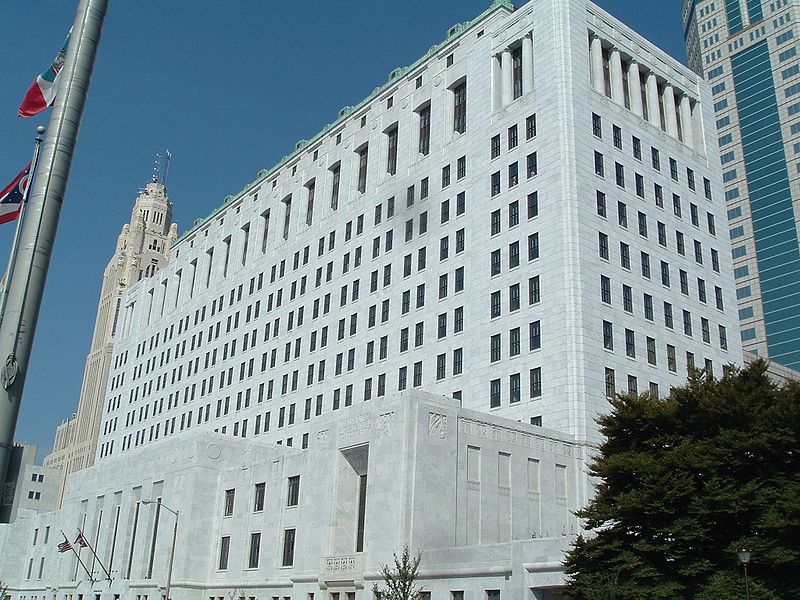
    Photo courtesy Wikimedia Commons..

    A bipartisan majority on the Ohio Supreme Court has for the third time rejected Statehouse district maps passed along partisan lines by Republicans on the Ohio Redistricting Commission.

    The most recent versions of legislative maps that had been approved by the ORC were struck down in a 4-3 decision Wednesday night by the state’s high court.

    A majority of the court justices said the map challengers had shown “beyond a reasonable doubt” that the most recent maps violated the constitution, particularly the provisions prohibiting partisan favoritism.

    “Substantial and compelling evidence shows beyond a reasonable doubt that the main goal of the individuals who drafted the second revised plan was to favor the Republican Party and disfavor the Democratic Party,” the majority wrote in its Wednesday opinion.

    The court sent the job back to the commission with a March 28 deadline to file an “entirely new” district plan for the General Assembly with the Ohio Secretary of State’s Office. A copy of the plan should then be sent to the court the next day.

    The breakdown of votes matched previous votes by the court striking down maps, with Chief Justice Maureen O’Connor, Justice Michael Donnelly, Justice Melody Stewart and Justice Jennifer Brunner forming the majority opinion. Justices Sharon Kennedy and Patrick Fischer dissented. Also dissenting was Justice Patrick DeWine, son of governor and commission member Mike DeWine.

    Justice DeWine recused himself from an issue in the case in which the commission members could be held in contempt of court for not filing new maps within the last deadline, but did not recuse himself from the entire case.

    The justices in the majority once again pointed to Senate President Matt Huffman and House Speaker Bob Cupp as controllers of the map-making process, saying the evidence in this case “is just as strong, if not stronger” than it was in previous map-making attempts.

    “The Democratic members of the commission had no opportunity to provide input in creating the second revised plan, and they had no meaningful opportunity to review and discuss it or to propose amendments once it was presented at the commission hearing on February 22, 2022,” the majority wrote.

    The court said they have “identified a flawed process” in all three of its rulings on the legislative maps, plans adopted after being the “product of just one political party.”

    “The evidence shows that the individuals who controlled the map-drawing process exercised that control with the overriding intent to maintain as much of an advantage as possible for members of their political party,” according to the ruling.

    With these new maps, the court agreed with arguments made by anti-gerrymandering groups who said a disproportionate number of so-called “Democratic-leaning” districts were actually toss-ups, with less than a 1% advantage for the Democrats.

    The newest plan had 19 House districts considered toss-ups, and seven Senate districts in the same toss-up range.

    “The result is that the 54 percent seat share for Republicans is a floor, while the 46 percent share for Democrats is a ceiling,” the court wrote (italics their own).

    That amount of toss-up districts, the court found, is “evidence of an intentionally biased map,” and is just one piece showing partisan lopsidedness on the part of the GOP.

    Justices also made a point to single out Huffman in saying he appears to have voted against a Democratic map proposal “based, at least in part, on a misunderstanding” of the constitutional provisions regulating redistricting in the state.

    Huffman called out the plan introduced by commission co-chair state Sen. Vernon Sykes and House Minority Leader Allison Russo because, according to him, the plan would have impacted the ability of Republican incumbents to keep their seats.

    “Making that observation demonstrates, beyond a reasonable doubt, that Senate President Huffman misunderstands the requirements of Article XI and the reasons for their adoption,” the majority stated. “Senator Huffman’s concern for protecting incumbents is not grounded in Article XI.”

    Kennedy and DeWine wrote their own dissent, that shamed the majority opinion for issuing a judgment “guaranteed to disrupt an impending election and bring Ohio to the brink of a constitutional crisis.”

    The Ohio Secretary of State, yet another member of the redistricting commission, has issued frequent warning about the lateness of the redistricting effort, though he has yet to go against the Republican majority vote.

    With the May 3 primary approaching quickly, Secretary Frank LaRose all but begged the General Assembly to approve extra money to speed up the delivery of absentee ballots to overseas and military Ohioans, and to extend the amount of time the county boards of elections have to send out the ballots, from 45 days before the election to 30.

    In previous court filings and public comments, LaRose said the primary likely couldn’t withstand another map delay.

    In shutting down the most recent map effort, the dissenting court justices say the majority of the court did much of what it did in previous rejections of redistricting maps by allegedly overriding the power of the constitution with its own interpretation.

    In previous dissents, Kennedy and DeWine accused the majority justices of “moving the goalposts” by putting requirements in the constitution where none could be found, but this time, they say, “the majority tears down those goalposts altogether.”

    “Through its actions today, the majority undermines the democratic process, depriving the voters of the constitutional amendment they enacted and leaving in its place only the majority’s policy preferences,” Kennedy and DeWine wrote. “In so doing, it threatens the very legitimacy of this court.”

    The majority of the court added a new level to the next steps in redistricting by ruling the map-drafting “should occur in public” and that the commissioners should “convene frequent meetings to demonstrate their bipartisan efforts to reach a constitutional plan within the time set by this court.”

    Dissenting justices say that the majority finding the most recent maps unconstitutional because this transparency method didn’t happen the first (or second) time “is ludicrous.”

    “Nothing in the constitution requires the seven commissioners to sit down together to draft the plan – effectively handing each one of them an unbridled veto power,” Kennedy and DeWine wrote in their dissent.

    The majority on the court also had a suggestion for the commission: “The commission should retain an independent map drawer — who answers to all commission members, not only to the Republican legislative leaders — to draft a plan through a transparent process.”

    After the Ohio Redistricting Commission passes a new plan, map challengers will once again have three days to object after the maps are submitted.

    The Secretary of State’s office declined to comment on the court ruling Wednesday night.

    The Ohio Supreme Court’s isn’t done: It is still considering court challenges to congressional maps passed earlier this month. The court also hasn’t said whether it will reschedule a contempt of court hearing it brought up after the ORC didn’t come up with legislative maps by its February 17 deadline.
  • Redistricting commission punts again, defies court order

    Redistricting commission punts again, defies court order

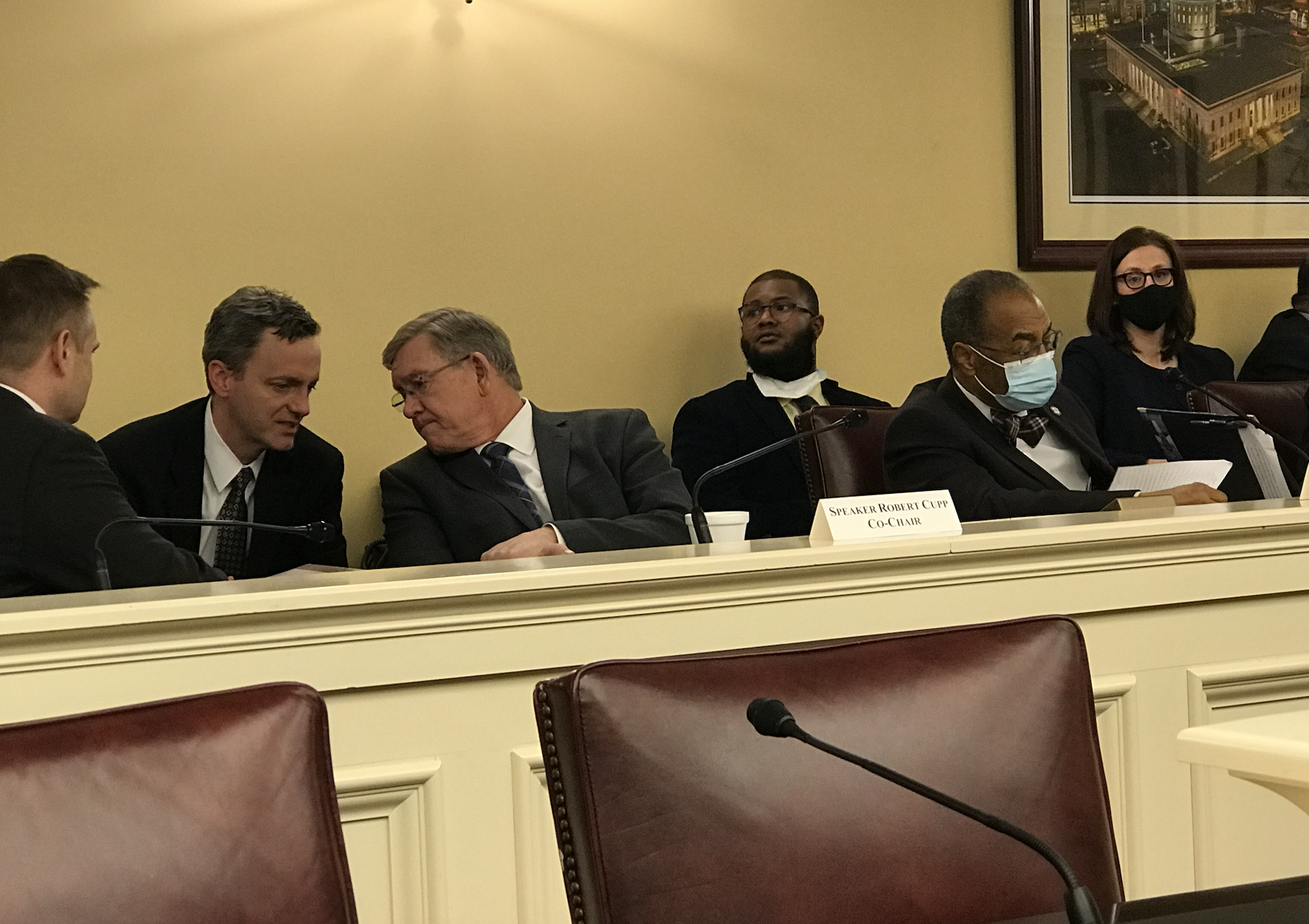
    The Ohio Redistricting Commission co-chairs, House Speaker Bob Cupp, second from left, and state Sen. Vernon Sykes, second from right, prepare to restart the Ohio Redistricting Commission meeting on Thursday after a recess. The ORC adjourned the meeting without sending a new legislative redistricting map to the Ohio Supreme Court, as they ordered it to do. (Photo: Susan Tebben, OCJ)

    BY: SUSAN TEBBEN –  Ohio Capital Journal


    Heated questioning and behind-the-scenes discussions between Ohio Redistricting commissioners led to a deadline-breaking decision to make no decision Thursday after the Ohio Supreme Court rejected two previous attempts at Statehouse maps as unconstitutional gerrymanders.

    The Ohio Redistricting Commission could now face contempt of court, and the state faces a constitutional crisis after the commission adjourned without adopting a legislative redistricting map to submit by their court-ordered Thursday midnight deadline.

    The GOP members of the commission, of which there are five, did not present a map during Thursday’s meeting. Senate President Matt Huffman, who did most of the talking for the majority party, said there was no reason to, because mapmakers had told commissioners that they could not comply with the supreme court’s directives and all the redistricting provisions of the constitution simultaneously.

    “Under these circumstances, I don’t believe the commission is able to ascertain a General Assembly district plan,” Huffman told the commission before they adjourned.

    Gov. Mike DeWine only spoke at one point during the meeting, which was as the impasse became clear, and a map did not appear to be forthcoming.

    He did not agree that the commission could leave without bringing a map before the court, and did not think that was what the commission should do anyway.

    “I don’t think we have the luxury of saying we’re just quitting,” DeWine said.

    After the meeting adjourned, DeWine doubled down on his opinion that the commission had an obligation, and a legal one at that, to produce some sort of map for the state’s high court to consider.

    I think it is a mistake for this commission to stop and basically say that we’re at an impasse. I don’t think that is an option that the law gives us.

    – Ohio Gov. Mike DeWine

    The commission was offered a map by the two Democrats on it with a 54-45 partisan breakdown, but GOP members voted down the measure along party lines after lengthy and tense criticism by Republicans, for the most part Senate President Matt Huffman.

    Taking the brunt of GOP criticism was House Minority Leader Allison Russo, who made the motion for the commission to accept the Democratic drawn maps.

    Huffman took the commission through the Democrats’ maps region by region, pointing out different GOP-incumbent districts that he said violated the constitutional provision prohibiting the favoring or disfavoring of one political party over another.

    He accused the Democratic caucus of racial gerrymandering in a few districts, specifically the Ohio Senate’s 25th District, made up mostly of Lake County, and House District 44, covering Ottawa and parts of Lucas County. Huffman accused the Democrats of gerrymandering by redrawing the districts and the communities therein to favor their candidates.

    Russo denied any existence of “packing and cracking,” the strategy of packing communities into a smaller area than necessary to benefit one party or another, or spreading a community out among a larger space than necessary to dilute its voting power.

    “What you’re asserting is just simply false,” Russo said.

    Throughout the meeting, she parried with Huffman and other Republicans, consistently asking the commission members to spell out specific constitutional violations in the Democratic maps.

    “If you have a map to propose that achieves this or suggestions to propose that address some of these concerns that you have, so far I have not yet seen a constitutional violation,” Russo said.

    When asked by Russo if the GOP had a map proposal to bring before the commission, Huffman hedged, saying he needed to finish his questions and “see how it goes.”

    He brought up the idea to “let the public decide” on the Democratic maps as he continued his dissection of the map, but said there were hours of testimony to refer to in lieu of more public hearings.

    “I’m not proposing additional public input,” Huffman said.

    What’s next?

    After the commission adjourned without doing as the Ohio Supreme Court asked, legislative leaders didn’t have a plan as to what would come next.

    “I don’t know; I don’t have a next step,” Huffman said.

    Cupp, a former Ohio Supreme Court justice himself, refused to speculate on what the courts might do, but said the commission will “try to keep working and if there’s some ideas that come forward on how to develop a legislative district map,” he said, the commission “would work very hard to do that.”

    Auditor Keith Faber made a motion to change the rules of the commission well into Thursday evening, after the commission went into a recess to discuss the Democrats’ presentation. The change, which was passed 6-1 with only Russo voting against the motion, allows the commission to reconvene at the request of three members of the commission. Those members do not have to be the co-chairs, and it does not have to be a bipartisan request.

    Co-chair state Sen. Vernon Sykes, D-Akron, confirmed that the court can not adopt the maps themselves, but as far as what happens next, he, too, was in the dark.

    He did, however, say it is possible the commission members could be held in contempt of court for failing to follow a court order.

    “I believe that is a possibility,” Sykes said.

    When asked if he would be okay with that happening as a consequence, he said he is “okay with us moving forward, whatever can be done to help us move forward.”

    When pressed on if that included contempt: “Including whatever we can do.”

    Constitutional scholars remain uncertain about the next steps of the process, mostly because the state hasn’t gone through it before.

    “This is a new process, and Ohio voters clearly wanted more collaboration and a more bipartisan process than we’ve seen so far,” said Mike Gentithes, associate professor who teaches constitutional law at the University of Akron.

    The University of Akron’s Seiberling Chair of Constitutional Law, Dr. Tracy Thomas, gave the outside perspective on the situation, saying it was “likely to end up in the courts for a while regardless of the outcome today.”

    Several states have invalidated maps because of partisan favoritism and sent them back for revisions without a solution for a stalemate.

    “In the absence of some constitutional mandate or overriding federal legislation, which we don’t really have, the line-drawing is part of the political process and subject to the usual majoritarian control,” Thomas told the OCJ.

    The Ohio Supreme Court is not likely to let this lack of action slide, in Gentithes’ opinion, and this could potentially lead to yet another overhaul of the process, since it seems the incentive to have 10-year maps with bipartisan agreement didn’t have the desired effect.

    “That might teach us how to restructure an amendment to actually have some teeth,” Gentithes said.

    The primary election is an entirely different bear, and Secretary of State Frank LaRose spent his short time speaking at the commission meeting impressing upon the commission the urgency of making decisions.

    “This challenge is not one that can be met with creativity, and grit and tenacity … instead this one is simply dictated by logistical deadlines,” LaRose said.

    Adding to the threat of legal trouble for the commission, without district lines, LaRose said the commission is in danger of missing a federal deadline to send absentee ballots to Ohio citizens who are overseas or in the military.

    “We are dangerously close to possibly violating federal law,” LaRose said.

    Cupp chuckled at a question about whether or not he accepted the idea of breaking federal law, saying, “I’m not okay with breaking any law.”

    The primary date is unlikely to change, in his mind, because of a lack of support for the idea in his chamber.

    “I don’t think in the House that there is a majority vote for moving the primary election at this time,” Cupp said. “Let alone, the two-thirds vote we would need for it to happen immediately.”

  • GOP lawmaker Rep. John Becker wants to see if DeWine can be criminally charged

    GOP lawmaker Rep. John Becker wants to see if DeWine can be criminally charged

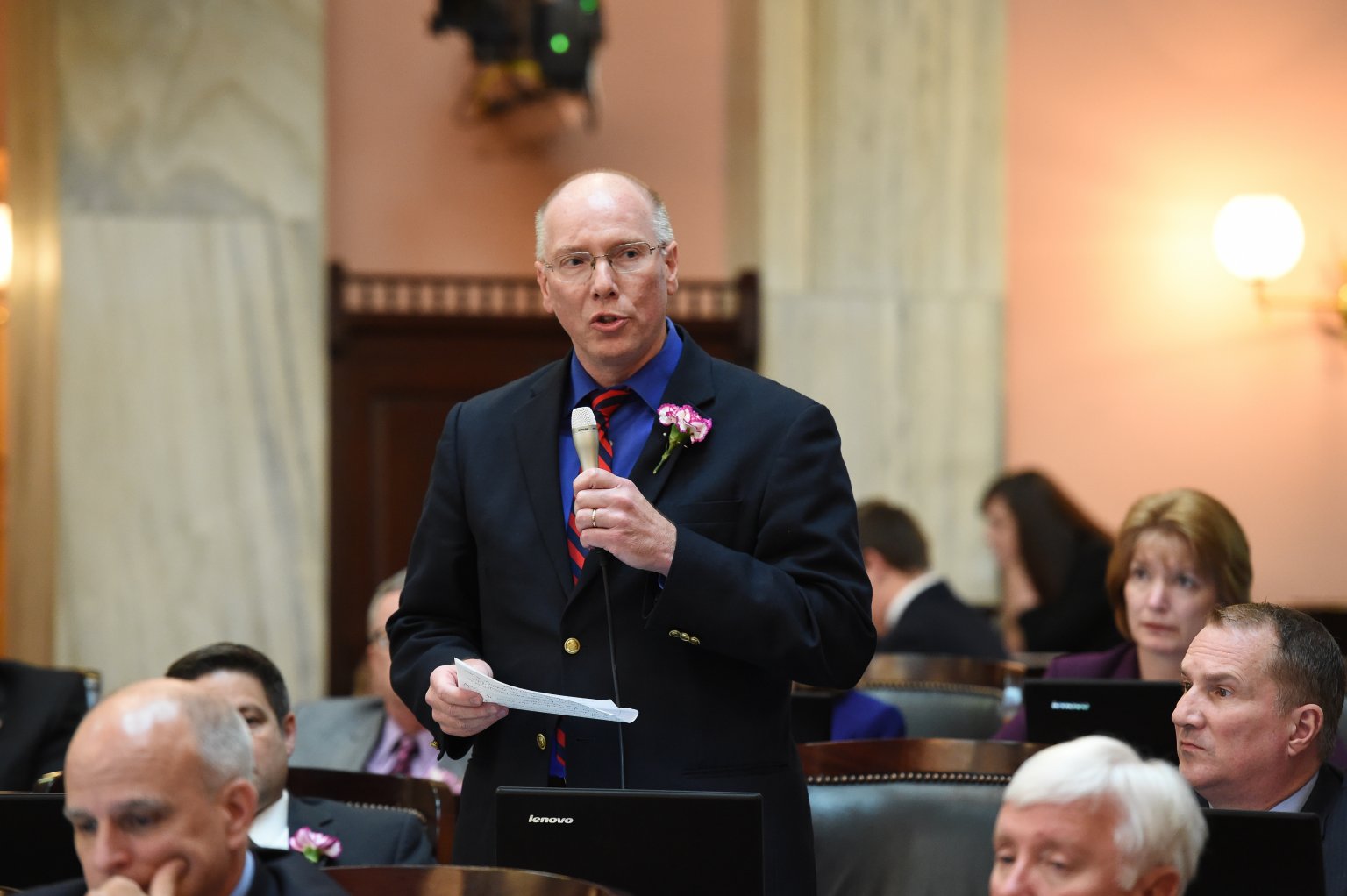
    State Rep. John Becker, R-Union Twp (Photo from Ohio House website)
    vvvv

    vvvv

    With his impeachment effort against the governor making little progress, state Rep. John Becker pulled up his email and brainstormed a late-night solution.

    It was almost 2 a.m. when Becker typed out a request to the Legislative Service Commission, a nonpartisan group that conducts law and policy research for lawmakers. 

    Becker is among the biggest critics of DeWine in the state legislature

    “I believe that Governor DeWine is in violation of (Ohio Revised Code) 2921.45,” Becker wrote in the Sept. 1 email. “What is the process for criminal charges to be filed? Can the (Attorney General) do that? Other options?”

    Still waiting for an answer, Becker sent another 2 a.m. request a few days later. He sought more “legislative history and legal case law” involving the 2921.45 section of code.

    The law states: “No public servant, under color of his office, employment, or authority, shall knowingly deprive, or conspire or attempt to deprive any person of a constitutional or statutory right.” Violators are guilty of a first-degree misdemeanor, punishable by up to 180 days in jail and a $1,000 fine. 

    Becker is among the biggest critics of DeWine in the state legislature and views the governor’s response to COVID-19 as amounting to a “constitutional crisis.” The decision to delay primary election voting, the temporary closure of some businesses, the mask mandate — to Becker, these are the instances of DeWine assuming “dictatorial powers” and violating Ohioans’ constitutional rights.

    Becker wants to see if DeWine can face criminal punishment for his pandemic response.

    “My goal is to get the state opened up and the abuse of power to come to an end,” Becker said to the Ohio Capital Journal.

    Impeachment and criminal charges?

    Throughout 2020, DeWine has relied on a separate section of state law which gives the Ohio Department of Health authority to make “special or standing orders … for preventing the spread of contagious or infectious diseases.” 

    On Aug. 24, Becker announced he had drafted articles of impeachment against DeWine. Three fellow Republican legislators immediately gave support for impeachment: Reps. Nino Vitale of Urbana, Candice Keller of Middletown and Paul Zeltwanger of Urbana.

    There have been a slew of lawsuits and legislative challenges to that authority. Becker sponsored one of the first bills seeking to limit the power of the state health director and many other Republican-sponsored bills have followed. DeWine has vowed to veto any such bill which interferes with the state’s pandemic response. 

    On Aug. 24, Becker announced he had drafted articles of impeachment against DeWine. Three fellow Republican legislators immediately gave support for impeachment: Reps. Nino Vitale of Urbana, Candice Keller of Middletown and Paul Zeltwanger of Urbana.

    “For my colleagues, it’s put up or shut up,” Becker said. 

    Becker claims there was support for impeachment from at least one Republican member who wound up not joining as a sponsor.  

    There was swift backlash from Ohio Republican leaders the day articles were drafted, which Becker thinks quashed any desire for others to join the effort.

    “Nobody wants to touch it,” Becker said. 

    Becker had planned to officially file the articles a week or so after drafting them, but instead is holding off. Once they are filed, no one else can sign on as a sponsor. He’s holding out hope that legislative sentiments may change before the end of 2020. 

    It would take a majority vote from the Ohio House of Representatives to impeach DeWine, then a two-thirds vote from the Ohio Senate to convict him. With only four representatives currently on board, they are 46 supporters short.

    Speaker of the House Bob Cupp, R-Lima, has come out against the impeachment effort, saying that policy disagreements do not rise to the level of removing the governor. 

    “For my colleagues, it’s put up or shut up,” Becker said.

    In a recent YouTube video, Becker acknowledged his colleagues believe the disagreements should be resolved legislatively rather through impeachment. 

    “Frankly I agree,” Becker said. “Legislation was the way to do it and we have tried that, and the governor has promised to veto everything that we’ve put out there attempting to roll back his power.”

    Beyond impeachment, Becker alleges the governor has committed a number of crimes. Among them: that DeWine illegally canceled and rescheduled the primary election.

    Hours before the polls were set to open Ohio Department of Health Director Dr. Amy Acton signed an order preventing the polling places from opening. DeWine and Acton feared holding an in-person election would lead to the virus spreading.

    Ohio primary election dates are set by the state legislature. Lawmakers unanimously approved a new primary election plan involving an all-mail vote conducted throughout all of April. Becker voted for that plan.

    Becker also alleges the mask mandates at churches, public places and businesses are in violation of Ohioans’ civil liberties.

    Becker also alleges the mask mandates at churches, public places and businesses are in violation of Ohioans’ civil liberties. 

    In May, the U.S. Supreme Court denied a request that it block a California law restricting crowd sizes at church services.

    Chief Justice John Roberts, an appointee of President George W. Bush, wrote in the majority opinion that the church restrictions were level with social distancing requirements at other public gatherings. Given the lack of treatment, cure, vaccine or sufficient knowledge about the new disease, he wrote, it’s too early to deem the restrictions unconstitutional.

    “Although California’s guidelines place restrictions on places of worship, the restrictions appear consistent with the Free Exercise Clause of the First Amendment,” he wrote.


    Tyler Buchanan

    Tyler Buchanan is an award-winning journalist who has covered Ohio politics and government for the past decade. A Bellevue native and graduate of Bowling Green State University, he most recently spent 6 1/2 years as a reporter and editor of The Athens Messenger and Vinton-Jackson Courier newspapers. He is a member of the BG News Alumni Society Board and was a 2019 fellow in the Kiplinger Program in Public Affairs Journalism.