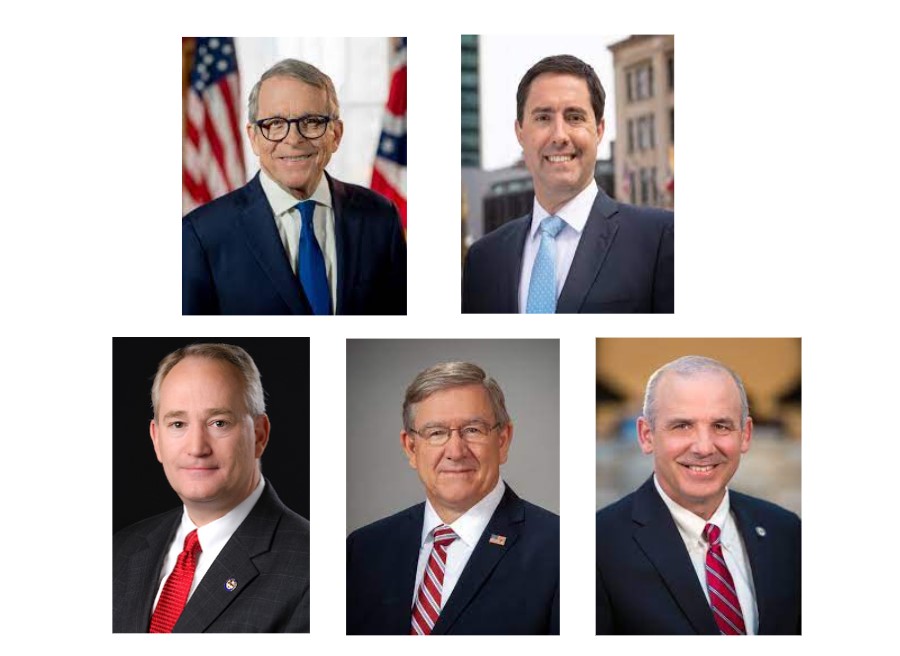
The Republican majority members of the Ohio Redistricting Commission. Top row from left, Ohio Gov. Mike DeWine and Secretary of State Frank LaRose. Bottom row from left Ohio Auditor Keith Faber, House Speaker Bob Cupp, and Senate President Matt Huffman. Official photos.
BY: SUSAN TEBBEN – Ohio Capital Journal
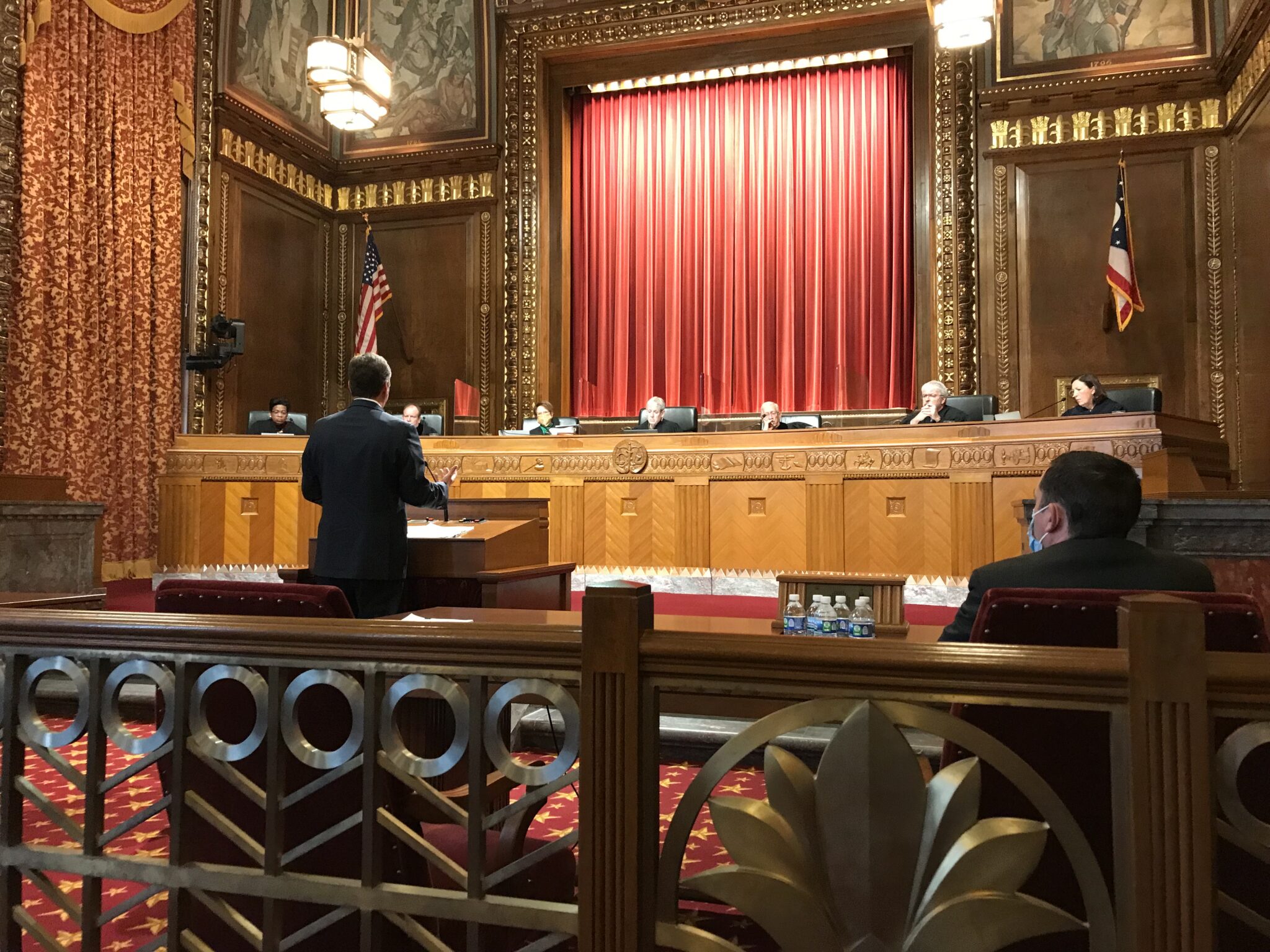
Anti-gerrymandering groups are again asking the Ohio Supreme Court to determine if the Ohio Redistricting Commission should be held in contempt, and to force the commission to meet by the end of the week to redraw legislative maps.
The ACLU, on behalf of several groups including the League of Women Voters of Ohio and the A. Philip Randolph Institution of Ohio and some individual Ohio voters, asked the court to yet again demand answers from the Ohio Redistricting Commission as to why they shouldn’t be held in contempt for making no moves to meet a deadline to draw “entirely new” legislative maps.
The fourth effort by the ORC was rejected by the Ohio Supreme Court on April 14, and found not to be an “entirely new map” they were ordered to create, but merely a tweak of the third attempt, which was also rejected as unduly partisan.
The commission has until May 6 to adopt and submit a map, but the groups say the urgency of the situation has “dramatically increased” because of a federal court’s decision to implement the third map found unconstitutional by the supreme court as the map to use during the 2022 election season. The U.S. District Court said they would order the use of the map, which was found to be unduly advantageous to Republicans, if no plan was adopted by May 28.
“Based on the commission’s conduct to date, this appears to be exactly what the commission is trying to do,” the ACLU wrote to the supreme court. “The Court should not allow the commission to intentionally avoid its constitutional obligations.”
GOP members of the commission argued that the court did not have the authority to hold them in contempt for several reasons, most important of which was the fact that the commission had passed a map by the court-ordered March 28 date. They said they conducted their legislative duties, and also were protected by the separation of powers doctrine from being held in contempt.
One member of the state supreme court, Justice Sharon Kennedy, has consistently sided with the Republican members in saying they should not be held in contempt and the court does not have the power to do so.
The Ohio Supreme Court rejected a previous request to hold the ORC in contempt at the same time they rejected the fourth map by the group.
The ACLU, however, argues in their most recent challenge for contempt that legislative immunity is not “unlimited” and separation of powers principles do not “constitute an insurmountable barrier to a contempt order against the majority of the commission.”
“In ordering (the ORC) to reconvene and to draft and adopt a constitutionally valid General Assembly-district plan, this Court is not ‘asserting control’ over purely legislative duties … but simply ensuring that the commission itself undertake those duties,” attorneys said in their Monday filing.
GOP members of the ORC told the court in the last debate over contempt that they could not be charged as individuals for something decided by the commission as a whole.
The ACLU called the argument an “improper attempt to evade responsibility” in their Monday filing. The argument also does not hold when it comes to calling a meeting of the commission, the court challengers said. Calling a meeting only requires three commission members, leaving five others “fully responsible for the defiance of the court’s order,” court documents stated.
Attorneys urged the court to force the commission to convene no later than Friday if they are held in contempt, as a way to “purge” their contempt charges.
The commission has not announced any plans to meet on or before the May 6 deadline. Democrats, including commission co-chair state Sen. Vernon Sykes, attempted to bring a meeting together on Monday, but ended up alone in front of the room where the ORC has met in the past, having had their offer rejected by every other member of the commission.
A representative with House Speaker and commission co-chair Bob Cupp said no meetings have been scheduled, and a spokesperson for Senate President Matt Huffman said meeting dates were up to the co-chairs.