Tag: coronavirus vaccine

  • Vaccine floods into Ohio but drop in new covid cases stalls

    Vaccine floods into Ohio but drop in new covid cases stalls

    By Marty Schladen and Ohio Capital Journal

    March 26, 2021

    Ohio got even more good news on the coronavirus vaccine Thursday. But even as doses are flooding into the state, what had been a steady drop in infections has turned into a plateau.

    Gov. Mike DeWine announced that next week — when all Ohio adults will be eligible to be vaccinated — the state will receive 571,000 doses, which he said was “by far and away the highest amount of doses we’ve received.” In fact, it more than quintuples the 100,000 doses a week that the state was receiving in early February.

    The surge has allowed the state to throw open vaccine eligibility to every Ohioan 16 and over starting Monday and it allowed DeWine on Thursday to announce 11 new mass vaccination sites:

    • Knights of Columbus, Lima, 2,500 doses a week
    • Lucas County Recreation Center, 5,000 doses a week
    • Dayton-Montgomery County Convention Center, 5,000 doses a week
    • Celeste Center, Columbus, 5,000 doses a week
    • Summit County Fairgrounds, 5,000 doses a week
    • Southern Park Mall, Mahoning County, 2,500 doses a week
    • Cintas Center, Cincinnati, 5,000 doses a week
    • Wilmington Airpark, 5,000 doses a week
    • Adena Medical Education Center, Ross County, 2,500 doses a week
    • Wayne Street Medical Campus, Marietta, 1,500 doses a week
    • Colony Square Mall, Muskingum County, 1,500 doses a week

    The state also is starting up two mobile vaccination clinics that will visit rural counties in April.

    In all, about a quarter of Ohio adults have now received at least a first dose of the vaccine. Yet progress toward DeWine’s benchmark to remove all remaining health orders has stalled and even gone backward a little since last week.

    DeWine has said once the state drops to 50 new cases a week per 100,000 Ohioans, all the orders come off. But after a long decline, the rate of cases went up from 144 last week to 147 this week.

    While the increase is slight, making it more concerning is that some neighboring states — such as Michigan — are now seeing rapid growth in the number of cases per 100,000.

    Part of that might be because people are tired of pandemic precautions, the weather’s getting nicer and vaccines are more widely available, so some people are abandoning caution. Another reason is that the faster-spreading UK variant of the virus is becoming more predominant.

    “That’s (the variant) we’re seeing the most of,” said Bruce Vanderhoff, chief medical officer for the Ohio Department of Health. “We’ve been expecting a growing presence of these variants.”

    Vaccine reluctance is surely also playing a role. 

    Even though they’ve been eligible to get a shot since January, the portion of Ohioans 80 and over getting at least a first dose only crossed 70% this week.

    “We’re hopeful that these numbers will continue to creep up, move up,” DeWine said of percentages for all age groups.

    Also, some institutions in Ohio haven’t responded to months of repeated offers of vaccines from the state. A frustrated DeWine said he was going to publish the names of 56 nursing homes and 168 assisted-living facilities that have failed to communicate with state officials about the vaccine.

    “I don’t know what else to do,” DeWine said. “I’m worried about the people in these nursing homes” and assisted care facilities.

    So despite the temptation to party like it’s March 2019, state officials are pleading for Ohioans to understand that the pandemic’s still here and still dangerous.

    “We’re in the final stages of this marathon,” Vanderhoff said. “So let’s keep masking and distancing even if you’ve had the chance to roll up your sleeve and get vaccinated.”
  • Ohio officials not tracking rate of vaccine refusals

    Ohio officials not tracking rate of vaccine refusals

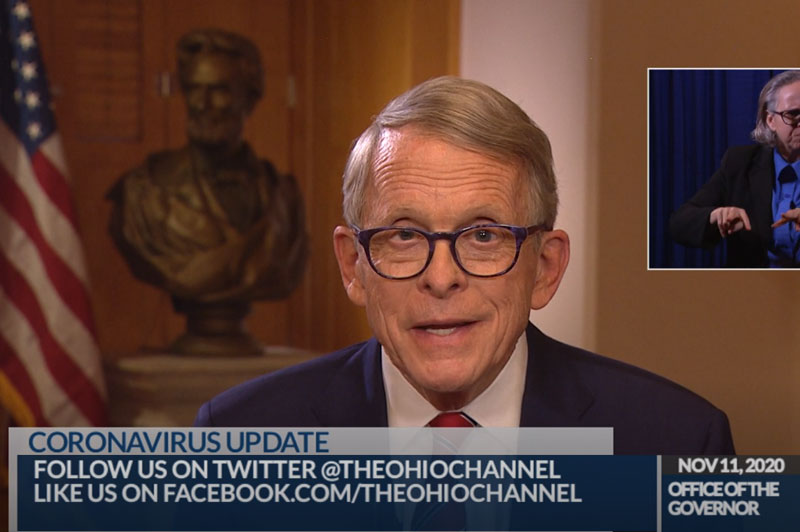
    Gov. Mike DeWine is pictured during his statewide address on Wednesday, Nov. 11. Photo courtesy Ohio Channel.

    By Marty Schladen and Ohio Capital Journal

    Columbus, Ohio – Ohio Gov. Mike DeWine got a lot of attention Wednesday when he said that 60% of nursing home workers who were offered a coronavirus vaccine refused to take it

    DeWine: 60% of Ohio nursing home workers are refusing vaccine

    But state health officials on Thursday said there’s no organized effort to track refusals among people they consider so critical that they’ve been given first crack at the scarce vaccines.

    In a press conference, DeWine implored people who are eligible for the vaccine to accept it, warning that it could be a long time before they get another chance. That argument might seem pretty compelling, given that a fast-spreading variant of the virus has popped up in two statesICU beds are filling and the two approved vaccines have trickled out at a rate far lower than the Trump administration promised.

    But DeWine lamented that many nursing home workers are passing on the vaccines anyway.

    “Our bigger concern is the amount of staff who are not taking it,” he said. “I don’t have data in front of me, but anecdotally, it looks like somewhere around 40% of staff at nursing homes are taking the vaccines and 60% are not taking it.”

    The statement went viral. A tweet about it generated more than 5 million impressions as of Thursday evening.

    Despite the obvious interest in how many people are refusing to be vaccinated, that’s not something the state is measuring.

    DeWine made his statement about nursing home workers “from some reports we have been hearing from our pharmacy partners,” Ohio Department of Health spokeswoman Melanie Amato said in an email Thursday. “It ranges in facilities, but this is a rough average. Remember the nursing home are largely being vaccinated by Walgreens/CVS as part of the federal program. We rely on them for the information. Same with hospitals. We track vaccines that have been given. We don’t track who would have refused.”

    Neither CVS nor Walgreens could immediately be reached for comment. While they are handling vaccinations in congregate settings such as nursing homes, they aren’t in charge of vaccinating hospital staff, paramedics and the like. Ohio health officials apparently aren’t tracking the rate at which those groups are refusing the vaccine, either.

    Dan Tierney, DeWine’s press secretary, said that despite the low level of nursing home workers agreeing to be vaccinated, the governor isn’t considering a mandate — at least for now.

    “On mandating the vaccine for these groups, we are still in the rollout of this phase, and our message to Ohioans is that if you are in group 1A, we urge you to take the vaccine now, because it may be months before there is another opportunity available to you,” he said. “We believe that increasing awareness will help increase the utilization rate. Ultimately, it is up to each health care provider to determine which workers they employ meets the criteria in group 1A to receive the vaccine in this phase.”

  • DeWine: 60% of Ohio nursing home workers are refusing vaccine

    DeWine: 60% of Ohio nursing home workers are refusing vaccine

    By Marty Schladen and Ohio Capital Journal

    As the coronavirus vaccine dribbles out far more slowly than promised, many of the people who can get it are refusing to do so.

    Gov. Mike DeWine on Wednesday said that a whopping 60% of nursing home workers who have been offered the vaccine have refused it. 

    The news comes amid disappointing vaccination numbers across Ohio, which was told by the Trump administration that it would receive more than 530,000 doses of the vaccines by the end of December. Just 94,000 so far have been administered.

    “I am not satisfied with where we are in Ohio,” DeWine said during a coronavirus press conference. “We’re not moving fast enough, but we’re going to get there.”

    He said he had a Wednesday morning conference call with CEOs of Ohio hospital systems and set a goal of getting the covid vaccine into people’s arms within 24 hours of when hospitals receive it. DeWine said the job of distributing the vaccine is more complex than many appreciate, but it’s vital to do it quickly.

    “There’s a moral imperative to get this out just as quickly as we can,” he said.

    But the numbers emerging from nursing homes might portend something just as bad.

    “Our bigger concern is the amount of staff who are not taking it,” DeWine said. “I don’t have data in front of me, but anecdotally, it looks like somewhere around 40% of staff at nursing homes are taking the vaccines and 60% are not taking it.”

    Those figures are disturbing not only because of what they might say about attitudes toward the vaccines among the larger population. They also mean that most staffers will be unprotected as they move between the outside world and nursing homes filled with vulnerable people — some of whom will not be able to take the vaccine for medical reasons.

    Even so, DeWine said he isn’t going to make anybody take it.

    “I’m not going to compel anybody to do it, but I’m urging people to take that vaccine,” he said. “It’s very important,” 

    It’s not clear why the governor isn’t imposing such a requirement. 

    All 50 states have laws requiring — with exemptions — that children be vaccinated before going to school. Also, many healthcare facilities require employees to be vaccinated.

    A DeWine spokesman didn’t immediately respond when asked why DeWine wouldn’t order Ohio nursing homes to follow suit.

    Ohio’s problems distributing the coronavirus vaccine come amid national problems producing and distributing the two vaccines that so far have received approval. With hospital beds filling, the country is falling far short of the Trump administration’s promises.

    The administration said that 20 million Americans would be vaccinated by the end of December, but so far, only 11.4 million doses have been sent to states and just 2.1 million people have received a first dose, the Washington Post reported Tuesday.

    At the current pace, it will take 10 years to vaccinate enough Americans to achieve herd immunity, NBC reported.

    Among those promising 20 million vaccinated Americans by the end of 2020 was U.S. Surgeon General Jerome Adams. He made the statement just 11 days ago in a press conference with DeWine.

    Adams dismissed reports that vaccine doses were coming to states at substantially lower levels than promised as blips that are to be expected in such a complex project. He also scoffed at the need to invoke the Defense Production Act to scale up production of approved vaccines, saying the manufacturers were operating at full capacity.

    Three days later, the New York Times reported that Pfizer, manufacturer of one of the vaccines, was close to a deal with the administration to use the Defense Production Act to obtain more of the materials to make it. Pfizer had been asking for such help since September, the story said.

  • Ohio celebrates the start of covid vaccinations, but it could have had a lot more

    Ohio celebrates the start of covid vaccinations, but it could have had a lot more

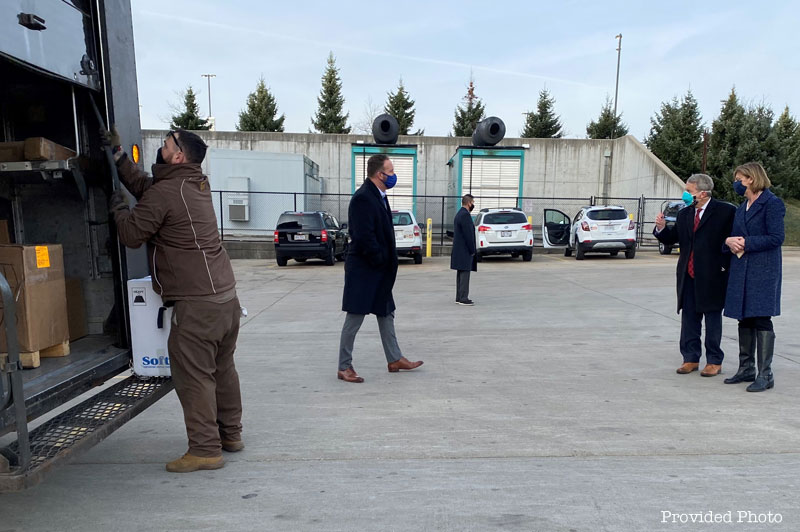
    Gov. Mike DeWine and Fran DeWine watched the first shipment of vaccines arriving at the Mercy Health Springfield Regional Medical Center.

    By Marty Schladen and Ohio Capital Journal

    Gov. Mike DeWine called Monday “a great day” in the annals of the Buckeye State as the first doses of coronavirus vaccine were injected into the arms of medical workers deemed to be at high risk.

    He and his wife, Fran, were on the Ohio State campus Monday morning as the first staffers at Wexner Medical Center got the first of two shots manufactured by Pfizer that together are expected to confer strong immunity to the disease. At the same time, first doses were being delivered to the University of Cincinnati Medical Center. 

    Additional doses are expected to be delivered in eight Ohio counties on Tuesday, and pharmacy chains CVS and Walgreens will start inoculating nursing home residents on Friday.

    Coming as it did on a day when the United States recorded its 300,000th coronavirus death, it’s undoubtedly good news that Ohioans are starting to be vaccinated.

    Adding to the good news it is if, as expected, a vaccine made by Moderna gets regulatory approval in the coming days, Ohio will be on track to deliver enough vaccines in December and January to immunize more than 600,000 people. 

    But that’s far from enough to achieve herd immunity that would allow Ohioans to go back to their pre-pandemic lives and it’s unclear when enough vaccine will be available to do that. 

    It didn’t have to be that way.

    “We don’t know in the months ahead how fast the vaccine is going to come to Ohio,” DeWine said, later adding, “It’s going to take awhile for us to get even close to the herd immunity people are talking about.”

    Making predictions difficult is whether any of the other drug makers who have been working with the federal government will see their vaccines approved, how quickly production can be scaled up, how effectively vaccines can be distributed and how many have been reserved for Americans.

    One failure by the Trump administration almost certainly delayed the day when enough Ohioans have been vaccinated that the virus will find it difficult to spread.

    The New York Times last week reported that Pfizer, a U.S. company, in the summer offered the federal government the chance to lock in hundreds of millions of dosesof its vaccine in addition to the 100 million it had already reserved. Pfizer said the government would only have to pay for the vaccine if it were proven to be effective.

    For some reason, the feds declined the deal. The European Union then locked in 200 million doses of the vaccine, which in November was shown to be 95% effective in clinical trials. 

    The Times reported that Pfizer now can’t guarantee the United States any more than the 100 million doses it initially locked in. Since it takes two doses of the vaccine to get its full effect, that’s enough to inoculate 50 million Americans, or about 15% of the population. Ohio is expecting enough of the Pfizer and Moderna vaccines by the end of January to inoculate about 11% of the state’s population. 

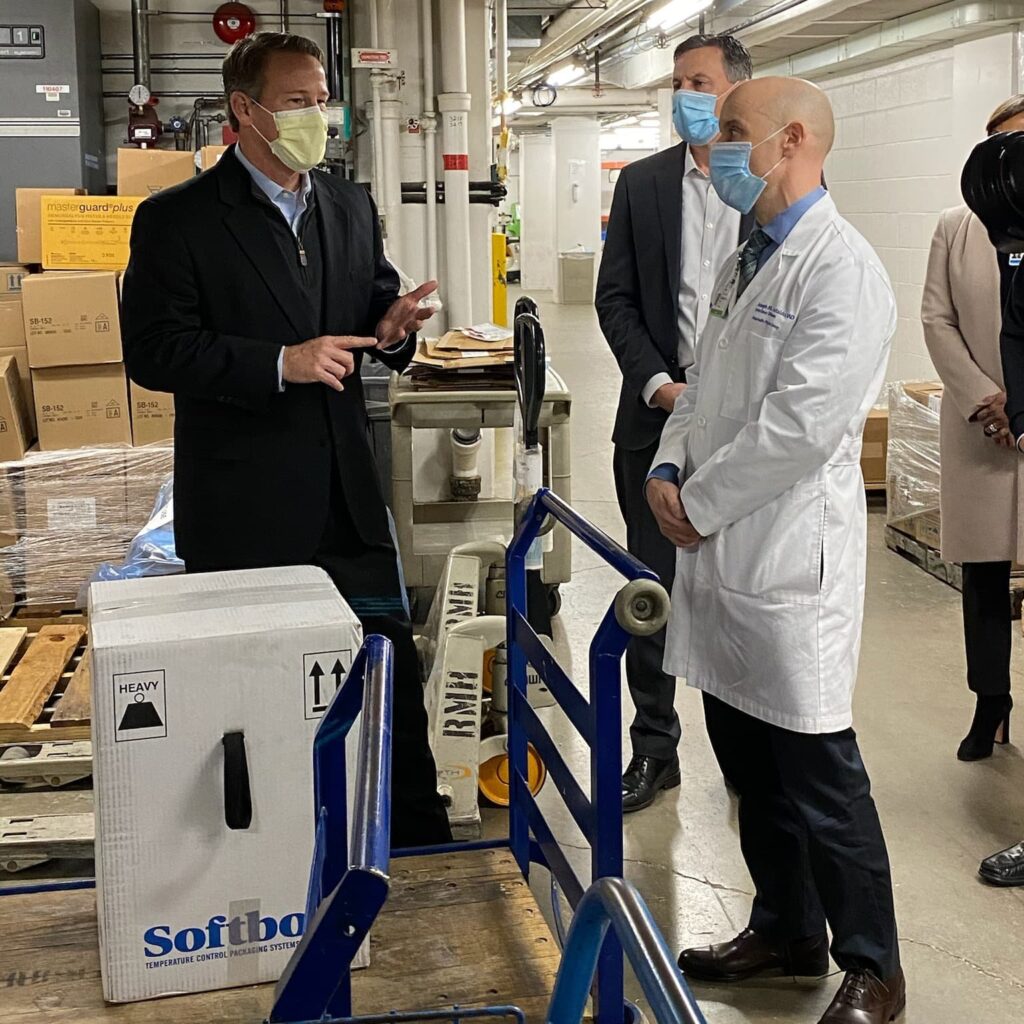
    Lt. Gov. John Husted discusses the COVID 19 vaccines that were arriving at OhioHealth Riverside Methodist Hospital.
    ,

    There are still questions about how much immunity one gets from catching covid and then recovering. But assuming that it’s durable, scientists estimate that 70% of the population will have to be vaccinated against or have recovered from a coronavirus infection for herd immunity to be achieved.

    U.S. Vice President Mike Pence and Ohio Gov. Mike DeWine greet one another onstage before President Donald Trump was to speak at a campaign rally at U.S. Bank Arena on August 1, 2019 in Cincinnati, Ohio. (Photo by Andrew Spear/Getty Images)

    In his coronavirus press briefings, DeWine has frequently praised Vice President Mike Pence for his openness and willingness to help governors with covid-related issues.

    But DeWine on Monday had no memory of Pence discussing why his administration didn’t take Pfizer up on an offer to supply vastly more of its vaccine to the most infected country in the world.

    “I don’t recall that,” DeWine said, adding that the governors were going to hold a virtual meeting with Pence later in the afternoon.

  • Ohio announces initial vaccine plan

    Ohio announces initial vaccine plan

    By Marty Schladen and Ohio Capital Journal

    If approvals go according to plan, Ohio will get more than a half-million doses of coronavirus vaccine between Dec. 15 and the end of the month, Gov. Mike DeWine said on Friday.

    While more than expected, the amount is far from adequate in a state with a population approaching 12 million.

    “The race has started and it’s started in a very robust way,” said Bruce Vanderhoff, medical director for the Ohio Department of Health.

    Even so, officials had to make some painful choices about who would be first in line for a first dose, to be followed by a booster either three or four weeks later, depending on the vaccine, DeWine said. 

    That means prisons and jails, where inmates and staff have been dying of covid since the start of the pandemic, will not be among the first to be vaccinated. Nor will service workers such as grocery store clerks, who potentially are exposed to the virus every day.

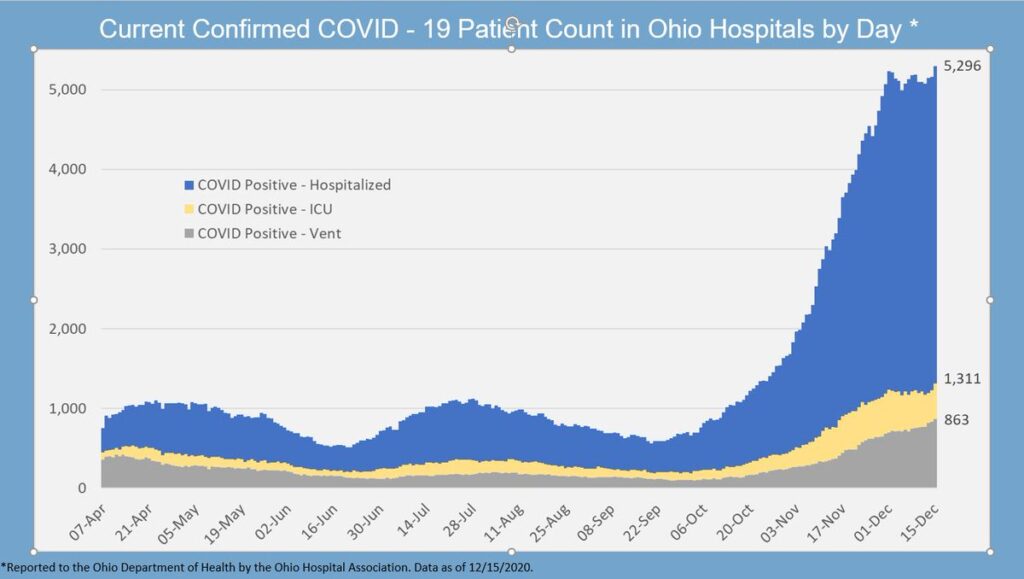
    “We have not gotten beyond (determining who will be in the first group) but the goal will be to save the most lives,” DeWine said on a day when more than 10,000 new coronavirus cases and 129 more deaths were reported.

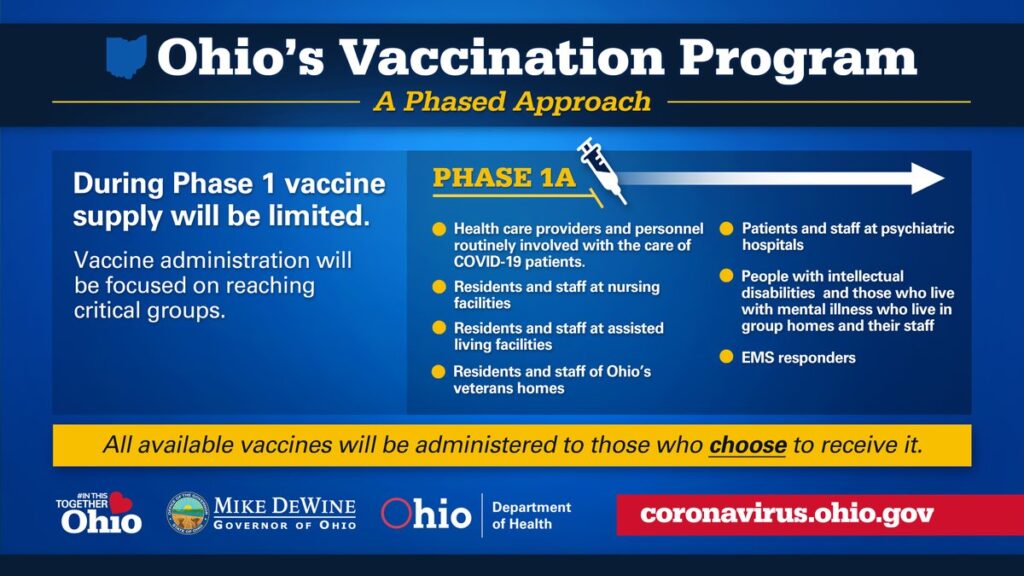
    Among those in the first group will be:

    • Health care workers and staff caring for covid patients
    • Emergency medical responders
    • People with underlying health conditions living close to each other and their caregivers. They include people and workers in nursing homes, assisted living centers, veterans homes and the like.

    DeWine stressed that the exact number of doses won’t be known until the week they’re due to arrive. He added that as initial rounds are doled out, they’ll be paired with boosters to be sent later.

    Joseph Gastaldo, director of infectious diseases at OhioHealth, said the vaccines awaited in Ohio are being made by Pfizer and Moderna. They still are awaiting final approval by independent panels of experts working under the auspices of the U.S. Food and Drug Administration and the Centers for Disease Control and Prevention. That approval is expected in the next two weeks.

    Approvals of other vaccines are hoped for, but there are a few factors that make it hard to predict when a big enough portion of the Ohio population will have been vaccinated to it difficult for the virus to spread.

    One is that about half of Ohioans are reluctant to get it, DeWine said. He said he hopes public information campaigns and news of the vaccines’ safety and efficacy will counteract the skepticism.

    Also, it’s unclear what other vaccines might be coming online, how quickly, or how fast production and distribution can be scaled up. Add those together and it’s uncertain when average folks can line up for a shot in the arm.

    “I don’t think anyone knows that,” DeWine said.