Tag: corruption

  • Former GOP Chair Borges chair sentenced to five years in massive corruption case

    Former GOP Chair Borges chair sentenced to five years in massive corruption case

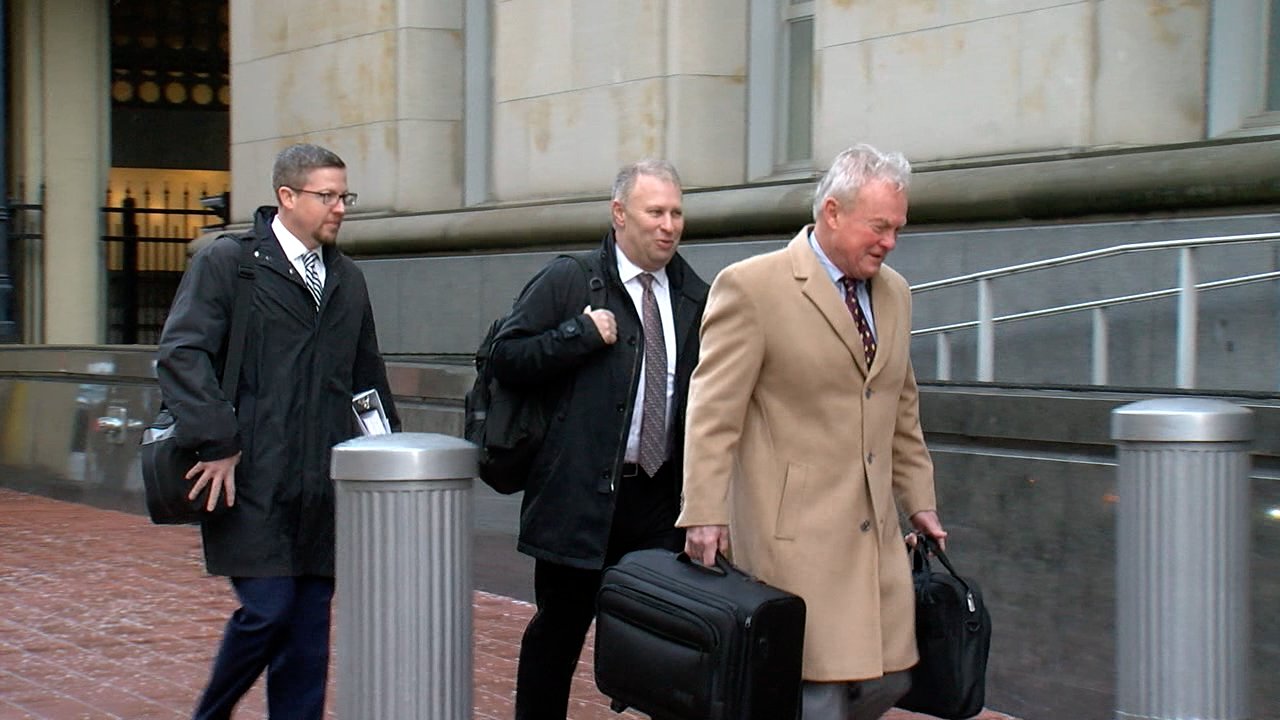
     Center, former Ohio Republican Party chair, and statehouse lobbyist, Matt Borges with his attorneys outside of the federal courthouse. Photo courtesy of WEWS.

    BY:  Ohio Capital Journal

    CINCINNATI — It was Matt Borges, the former chairman of the Ohio Republican Party, who was handcuffed by U.S. Marshals Friday after being sentenced to five years in prison for his participation in the biggest corruption scandal in state history.

    But federal prosecutors made clear that they were trying to send a message to other state leaders who played roles in the scandal and are now trying to pretend they didn’t.

    The sentencing of Borges, 51, follows the 20-year sentence U.S. District Judge Timothy Black meted out a day earlier to former Ohio House Speaker Larry Householder for masterminding the scheme. Akron-based FirstEnergy and other Ohio utilities ponied up more than $60 million between 2017 and 2020 to pass and protect a $1.3 billion ratepayer bailout that was mostly intended to benefit FirstEnergy.

    Borges received a lesser sentence because he was only involved in 2019, when FirstEnergy funneled $38 million into a dark-money group that funded an ugly, falsehood-strewn campaign to defeat a citizen-initiated repeal of the unpopular bailout. Because those voices were squelched — and because Ohio’s Republican legislature refuses to repeal the corrupt bailout — Ohioans continue to be harmed by the racketeering conspiracy, said Assistant U.S. Attorney Matthew Singer.

    The bulk of the subsidies — those going to two nuclear plants in Northern Ohio and a fee to “recession-proof” FirstEnergy — have been suspended. But Ohio ratepayers continue to pay hundreds of millions to prop two coal plants owned by AEP and other utilities, including one that’s in Indiana.

    The effort to gather enough voter signatures to put a repeal of the bailout — House Bill 6 — failed after Borges bribed a worker with the petition drive $15,000 for inside information and opened lines of communication with Republican officeholders.

    At the same time, teams of “blockers” harassed and allegedly assaulted petition gatherers and Householder’s minions flooded the airways with ads falsely claiming that the repeal effort was really China’s bid to take over the Ohio energy grid.

    The scheme Borges participated in was meant to “prevent Ohio voters from exercising their right to reject this corruption,” Singer said. “Ohioans never had the opportunity to vote up or down on this legislation.”

    Singer also pointed the finger at people only speaking out about Householder now and not earlier.

    “It’s interesting that some people are piling on (Householder) after the fact,” he said. “So many knew what was happening in real time and did nothing about it. Not only did they do nothing about it, they helped facilitate it.”

    Ohio Secretary of State Frank LaRose in a Tuesday appearance on Cincinnati’s 700WLW claimed that everybody who knew Householder knew he was “a crook” at the time the mammoth conspiracy was taking place. However, LaRose never spoke out against the deal at the time. And in text messages presented to the jury, FirstEnergy CEO Chuck Jones said that LaRose — who also heads up the Ohio Ballot Board — was giving him “private” updates about the signature-gathering effort.

    LaRose has refused to explain whether he was in communication with Jones or what he might have told him, but Singer, the prosecutor, seemed to refer to the state’s top elections official on Friday.

    Not only did Householder, Borges and their Republican allies squelch a citizen-initiated attempt to repeal the corrupt utility bailout, the gerrymandered legislature is now putting Issue 1 on the Aug. 8 ballot. It would make it virtually impossible for citizens to initiate amendments to the state Constitution. LaRose, a major supporter of the move, claims it will reduce corruption in Ohio.

    During Borges’ sentencing Friday, Singer decried the fact that many of the uncharged players in the racketeering scandal continue to thrive on Capitol Square. They include mega-lobbyist Robert Klaffkey, whom co-defendant Juan Cespedes testified slid a check for $400,000 in FirstEnergy dark money across a table to Householder during a 2018 meeting. Klaffkey denied sliding the check, but he didn’t deny being present.

    Singer said that it was remarkable that Klaffkey was “comfortable sitting in a room and sliding a $400,000 check to a public official.”

    Klaffkey is hardly alone.

    Megan Fitzmartin was paid hundreds of thousands as she aided Householder and co-defendant Jeffrey Longstreth in creating a Householder-friendly Republican majority in the state House. Now she’s policy director for the Republican supermajority in Ohio’s gerrymandered House.

    Corruption — and tolerance of it — corrodes our political foundation, Singer said.

    “Once corruption takes hold democracy itself becomes a charade,” he said.

    Cespedes and Longstreth are yet to be sentenced and U.S. Attorney Kenneth L. Parker on Thursday hinted that others might yet be charged in the scandal.


    Marty Schladen
    MARTY SCHLADEN

    Marty Schladen has been a reporter for decades, working in Indiana, Texas and other places before returning to his native Ohio to work at The Columbus Dispatch in 2017. He’s won state and national journalism awards for investigations into utility regulation, public corruption, the environment, prescription drug spending and other matters.

    MORE FROM AUTHOR

  • Ohioans spent $211 million subsidizing two coal plants over last two years

    Ohioans spent $211 million subsidizing two coal plants over last two years

    BY: JAKE ZUCKERMAN – Ohio Capital Journal

    Electric customers across Ohio collectively spent an estimated $211 million via add-on bill charges over the last two years to cover for losses from two coal-fired power plants that continue to bleed millions annually, according to new data from state regulators.

    The money to the Ohio Valley Electric Corp. (OVEC) — an entity comprised of several investor-owned utilities from multiple states that operates the plants — flows thanks to a 2019 state law now at the center of a criminal bribery prosecution.

    The Public Utilities Commission of Ohio began to allow three of the utilities that own and are contractually obligated to buy power from OVEC — American Electric Power (43% equity stake), Duke Energy (9%), and AES Ohio (4.9%) — to pass on their losses on OVEC to their customers, starting in the mid-2010s. The payments were originally only allowed through 2024. Through 2019, the three utilities’ customers were charged an estimated $159 million on OVEC.

    House Bill 6, a law passed in 2019 that’s now the focal point of what prosecutors have said is the largest political corruption investigation in state history, extended the subsidies through 2030 and spread the three utilities’ (AEP, Duke and AES) losses to electric customers of all Ohio utilities (not just those that own OVEC).

    In 2020, Ohio electric customers statewide paid $115 million to OVEC’s owners to cover their losses on the deal, according to data provided by a PUCO spokesman. In 2021, they paid about $97 million (July through December 2021 costs are estimates). Under the law, residential customers pay a maximum $1.50 per month to utilities to cover their OVEC losses. Industrial customers pay a maximum of $1,500.

    OVEC operates two 1950s-era coal plants in Cheshire, Ohio and Madison, Indiana, originally built to power the federal government’s uranium enrichment facilities near Portsmouth. That agreement ended in 2003. The utility companies that own OVEC last renegotiated their contract in 2011 extending its life through 2040.

    Technically, the OVEC plants could save utility customers money if OVEC could generate and sell electricity at below-market costs. However, a mix of market forces, environmental regulations and recently spending more than $1 billion on a “scrubber” system designed to limit emissions have left the plants selling electricity at costs well above those of PJM, an energy marketplace serving utilities in 13 states including Ohio.

    “[Our] analysis shows that at this time, the OVEC plants cost customers more than the cost of energy and capacity that could be bought on the PJM wholesale markets,” wrote London Economics International, a firm the PUCO commissioned to audit the subsidies, in December.

    A draft version of a 2020 PUCO-commissioned audit by the same firm found that “keeping the plants running does not seem to be in the best interests of the ratepayers.” The line was removed from the final version at the request of a PUCO staffer who asked the auditors to use a “milder tone and intensity of language,” according to emails obtained by the Ohio Consumers’ Counsel (OCC), which represents ratepayers in PUCO cases and has advocated ending the OVEC subsidies.

    In a 2018 bankruptcy filing, FirstEnergy disclosed losing $12 million per year due to its 4.85% equity stake in OVEC. As lawmakers considered HB 6, legislative analysts estimated Ohio utilities paid $94 million above wholesale market costs in 2018 alone to purchase OVEC-generated electricity.

    Along with the raw finances, Ohio consumers are subsidizing plants that have belched nearly 21 million tons of carbon dioxide, 21,000 tons of nitrogen oxide, and 12,000 tons of sulfur dioxide into the atmosphere since January 2020, plus smaller discharges of arsenic, lead, and mercury, according to data from the U.S. Environmental Protection Agency provided by the OCC.

    “Why the hell is this still in place?” said Neil Waggoner, an advocate with the Sierra Club’s Beyond Coal campaign. “I think that this is utility capture in practice. This is the utilities in this state having a death grip on the regulators and people in power to the point that they’re getting exactly what they want.”

     The Clifty Creek Power Plant, in Madison, Indiana, which is operated by OVEC. Photo taken by Rep. Casey Weinstein, D-Hudson, who visited the plant and has called for a repeal of state law forcing Ohio ratepayers to subsidize it.

    A sticky bailout

    FirstEnergy Corp. admitted in July to paying more than $60 million to an account controlled by the former House Speaker and his allies to ensure passage of HB 6. The prosecutors’ allegations have focused in court documents on an estimated $1.3 billion nuclear bailout and other non-coal related provisions of the sweeping bill that are favorable FirstEnergy. Former speaker Larry Householder, accused of using the money to engineer passage of the bill and shore up his own political aims, has pleaded not guilty. Two Householder allies involved in the alleged scheme have pleaded guilty to racketeering.

    State lawmakers in early 2021 passed legislation repealing the nuclear bailout and “decoupling” provision (a ratepayer-backed revenue guarantee for FirstEnergy). However, the OVEC bailout was left intact.

    There are bipartisan efforts in the House and Senate to repeal the OVEC bailout from state law, and the narrower PUCO-approved bailout that preceded them. Neither has come up for a vote and the sponsors are pessimistic on their chances.

    Sen. Mark Romanchuk, R-Ontario, perhaps the plants’ most prominent critic and co-sponsor of the Senate legislation, said he is in negotiations with the utilities that own the plants and is not giving up. He declined an interview.

    “Not sure where things will go but we’re not giving up,” Romanchuk said.

    House Democrats have called for a repeal of the OVEC subsidies, though they only control 34 of 99 seats in the chamber. Rep. Jeff Crossman, a Parma Democrat who recently announced plans to run for attorney general, said the OVEC charges should be repealed but as much is unlikely.

    He said OVEC’s sponsors contribute tens of thousands in campaign contributions per year, mostly to Republicans. AEP, through a middleman, contributed $700,000 to Generation Now, the account prosecutors say Householder used to engineer passage of HB 6 in the first place.

    “There’s probably not a will to undo the OVEC charges,” he said. “They donate gobs of cash to the right folks. There’s just no other reason to support these plants.”

    House Speaker Bob Cupp, R-Lima, said in October he doesn’t believe there’s support in the House Republican caucus to repeal the coal bailout.

    House Majority Leader Bill Seitz, R-Green Twp., has told several state media outlets the bailouts aren’t going anywhere. He did not respond to written questions about the uneconomic nature of the plants, or why ratepayers should cover their owners’ losses on them.

    “We’ve beat this [OVEC] horse to death. It’s not going to change,” Seitz said to Cleveland.com in October. “They’ve introduced God knows how many bills — none of them are going anywhere, in my humble opinion.”

    Michigan takes action

    AEP is by far OVEC’s largest shareholder, with a roughly 43% equity stake in the company, and the two share several executives.

    While repeal efforts in Ohio are at a lull, other states have signaled resistance to allowing utilities to continue to pass OVEC’s owners’ losses to customers.

    The Michigan Public Service Commission in a November order noted that OVEC’s costs exceed the market price of electricity by tens of millions. It warned that AEP’s local utility may not be able to pass on all its OVEC losses to customers that are “incurred because of imprudent” decisions.

    “The order today put I&M [an AEP unit] on notice that the Michigan share of these excess costs are unlikely to be permitted without additional evidence that continuing to purchase power from the units was in the best interest of its customers,” the Michigan regulators said in a news release.

    AEP spokesman Scott Blake said in an email the OVEC plants are “critical resources that help ensure the reliability of the grid and offer protection from increases in the costs of other fuels.” He said AEP Ohio customers for decades benefitted from OVEC’s power via affordable electricity and good jobs. OVEC, he argued, insulates customers from cost spikes caused by things like a surge in natural gas prices or a shortfall of renewable energy supply.

    “AEP Ohio customers benefited for decades from the power provided by OVEC in the form of affordable electricity and good jobs,” he said. “While there may be years where power from OVEC is more expensive than the market, as generation from natural gas and other sources becomes more expensive, customers could see refunds from OVEC in the future.”

    Fitch Ratings determined OVEC’s outlook is “stable” in February — just one step above “speculative.” However, its analysts found that repealing HB 6 wouldn’t necessarily harm OVEC’s prospects. The analysts reasoned that for one, in the event of a repeal, AEP, Duke and AES would still be able to pass on their OVEC losses to customers. For two, the “sponsoring” utilities have already contractually agreed to purchase the power OVEC generates, regardless of who eats the losses.

    Meanwhile, in a Virginia appeal of a public service commission rate case, Virginia Attorney General Mark Herring accused OVEC of charging an AEP utility in Virginia well beyond market costs for electricity. The case is ongoing.

  • “A Good American“

    “A Good American“

    “A Good American“ is a gripping docu-thriller about a groundbreaking surveillance program, the brilliant mastermind behind it and how a perfect alternative to mass surveillance was killed by NSA-management for money – three weeks prior to 9/11.

    Bill Binney was a brilliant cryptologist and long-time National Security Agency (NSA) analyst, since 1997 serving as Technical Director. Binney developed a sophisticated program named ThinThread for gathering data capable of providing clues, in real-time, of potential terrorist threats.


    Watch on YouTubeGoogle Play, Netflix, Vedu, and Amazon Prime.

    A Good American: Home


  • An Apology from Ryan Kulik

    An Apology from Ryan Kulik

    I feel like the time is now to make an apology.

    by Ryan Kulik,

    Recently I spoke to council and submitted my prepared statement to David Miller at Loveland Magazine. (Ryan Kulik: Political motivated amateurs have taken over) (Loveland Community Heartbeat PAC responds to Mr. Kulik) In the days that followed, it was brought to my attention that part of my spoken statement was not one hundred percent factual. I also reflected on my demeanor, and the words I chose in trying to get my larger point across to council, the audience, and anyone watching online. I accepted that I had misspoken on something in my remarks, and proceeded to apologize in the Facebook comment feed in Loveland Magazine. I had planned on making a public mea culpa when the opportunity presented itself. My conscience will not allow me to wait for that moment, I feel like the time is now to make an apology.

    Ryan Kulik

    I’m sorry.

    I am sorry for not having my facts correct when I was trying to ask council why our economic development was in limbo. When I spoke at public forum, I was incorrect when I said the former economic developer had brought a certain amount of money into our community. That was a misstatement. Intentional or not, when someone does not make their point clear, and correct, the larger narrative will always suffer.  I wanted to talk about something of great importance, positive economic growth, and my slip-up cost me the chance to move any meaningful conversation forward. I owe an apology to council for wasting their time, the community for having to double check my words, and to myself for not being professional.

    I am sorry for calling people amateurs. I can clearly see that I was the one playing amateur politics. My ego, coupled with my frustration are all excuses I give myself for trying to claim the mantle of professionalism. Those excuses do not portray the skill of a professional. I am just one Loveland resident who tried to make a personal point on growth and economic prosperity. By letting my ego work in concert with my frustration towards our council, I used baseless adjectives in describing the politically active in our community That means I sought the refuge of a political amateur.

    I owe an apology to council for wasting their time, the community for having to double check my words, and to myself for not being professional.

    I am sorry that my greater point was lost in the all the noise generated about my inarticulate comments to council. I do believe members of our council have been acting in a manner that has stalled the positive economic growth Loveland has been experiencing the last few years. I do think it is wrong for a local Chamber of Commerce to work in conjunction with a Political Action Committee who has openly advocated for the stalling of economic development projects. I do not believe we need an extra layer of bureaucracy added to the required rules for moving any new economic development forward. Extra bureaucracy has always been a hurdle many new businesses would prefer not to jump over. I believe Loveland is a desirable community, and new residential developments would expand the tax base. New residents can help ease the economic burden, and make it less likely that council will approach the residents of Loveland with a tax increase. I believe the city of Loveland needs a proper economic development consultant, whomever that person may be. I am sorry I was not able to engage our council, and our community on my vision for an economically prosperous Loveland.

    With words like amateur, illegal, and corruption being thrown around, Loveland politics has become a lot of noise and has lacked substantive debate. I added to the climate with my poor statement at public forum. I hope the people running for city council, the groups politically mobilized for the election, and the concerned residents like myself can come together and focus on the issues that make Loveland great. I know that is what I am going to do.


    We promise the best customer service, and beyond a doubt, the best selection of merchandise in the area Pizazz Studio is a whimsical gift shop in downtown Loveland.