Loveland Magazine is one of the 400 news outlets worldwide, with a combined audience of over 2 billion people “Covering Climate Now”, a global journalism initiative committed to bringing more and better coverage to the defining story of our time.
The initiative, was co-founded by The Nation and Columbia Journalism Review
Mihaela Manova is “Covering Climate Now” in Loveland, Ohio as an editor for Loveland Magazine
Today’s article is written by Piers Forster for The Conversation. Forster talks about climate from a scientific point of view, summarizing the key points of his findings during COVID-19. According to the website, “The Conversation is a nonprofit, independent news organization dedicated to unlocking the knowledge of experts for the public good.” Permission to repost: Covering Climate Now.
The planet had already warmed by around 1.2℃ since pre-industrial times when the World Health Organization officially declared a pandemic on March 11 2020. This began a sudden and unprecedented drop in human activity, as much of the world went into lockdown and factories stopped operating, cars kept their engines off and planes were grounded.
There have been many monumental changes since then, but for those of us who work as climate scientists this period has also brought some entirely new and sometimes unexpected insights.
Here are three things we have learned:
1. Climate science can operate in real time
The pandemic made us think on our feet about how to get around some of the difficulties of monitoring greenhouse gas emissions, and CO₂ in particular, in real time. When many lockdowns were beginning in March 2020, the next comprehensive Global Carbon Budget setting out the year’s emissions trends was not due until the end of the year. So climate scientists set about looking for other data that might indicate how CO₂ was changing.
We used information on lockdown as a mirror for global emissions. In other words, if we knew what the emissions were from various economic sectors or countries pre-pandemic, and we knew by how much activity had fallen, we could assume that their emissions had fallen by the same amount.
By May 2020, a landmark study combined government lockdown policies and activity data from around the world to predict a 7% fall in CO₂ emissions by the end of the year, a figure later confirmed by the Global Carbon Project. This was soon followed by research by my own team, which used Google and Apple mobility data to reflect changes in ten different pollutants, while a third study again tracked CO₂ emissions using data on fossil fuel combustion and cement production.
The latest Google mobility data shows that although daily activity hasn’t yet returned to pre-pandemic levels, it has recovered to some extent. This is reflected in our latest emissions estimate, which shows, following a limited bounce back after the first lockdown, a fairly steady growth in global emissions during the second half of 2020. This was followed by a second and smaller dip representing the second wave in late 2020/early 2021.
Meanwhile, as the pandemic progressed, the Carbon Monitorproject established methods for tracking CO₂ emissions in close to real time, giving us a valuable new way to do this kind of science.
2. No dramatic effect on climate change
In both the short and long term, the pandemic will have less effect on efforts to tackle climate change than many people had hoped.
Despite the clear and quiet skies, research I was involved in found that lockdown actually had a slight warming effect in spring 2020: as industry ground to a halt, air pollution dropped and so did the ability of aerosols, tiny particles produced by the burning of fossil fuels, to cool the planet by reflecting sunlight away from the Earth. The impact on global temperatures was short-lived and very small (just 0.03°C), but it was still bigger than anything caused by lockdown-related changes in ozone, CO₂ or aviation.
Looking further ahead to 2030, simple climate models have estimated that global temperatures will only be around 0.01°C lower as a result of COVID-19 than if countries followed the emissions pledges they already had in place at the height of the pandemic. These findings were later backed up by more complex model simulations.
3. This isn’t a plan for climate action
The temporary halt to normal life we have now seen with successive lockdowns is not only not enough to stop climate change, it is also not sustainable: like climate change, COVID-19 has hit the most vulnerable the hardest. We need to find ways to reduce emissions without the economic and social impacts of lockdowns, and find solutions that also promote health, welfare and equity. Widespread climate ambition and action by individuals, institutions and businesses is still vital, but it must be underpinned and supported by structural economic change.
Colleagues and I have estimated that investing just 1.2% of global GDP in economic recovery packages could mean the difference between keeping global temperature rise below 1.5°C, and a future where we are facing much more severe impacts – and higher costs.
Unfortunately, green investment is not being made at anything like the level needed. However, many more investments will be made over the next few months. It’s essential that strong climate action is integrated into future investments. The stakes may seem high, but the potential rewards are far higher.
Wuhan, the Chinese city that became widely known as a being one of the first hot spots for COVID-19. As the entire world observed this city for its increasing numbers of infected persons, they were also hoping for an immediate cure.
As COVID-19 spread to the rest of the world and soon came even to the Midwest, some seemed to forget about the city that got hit first. Here is what Wuhan has been doing since the outbreak in January.
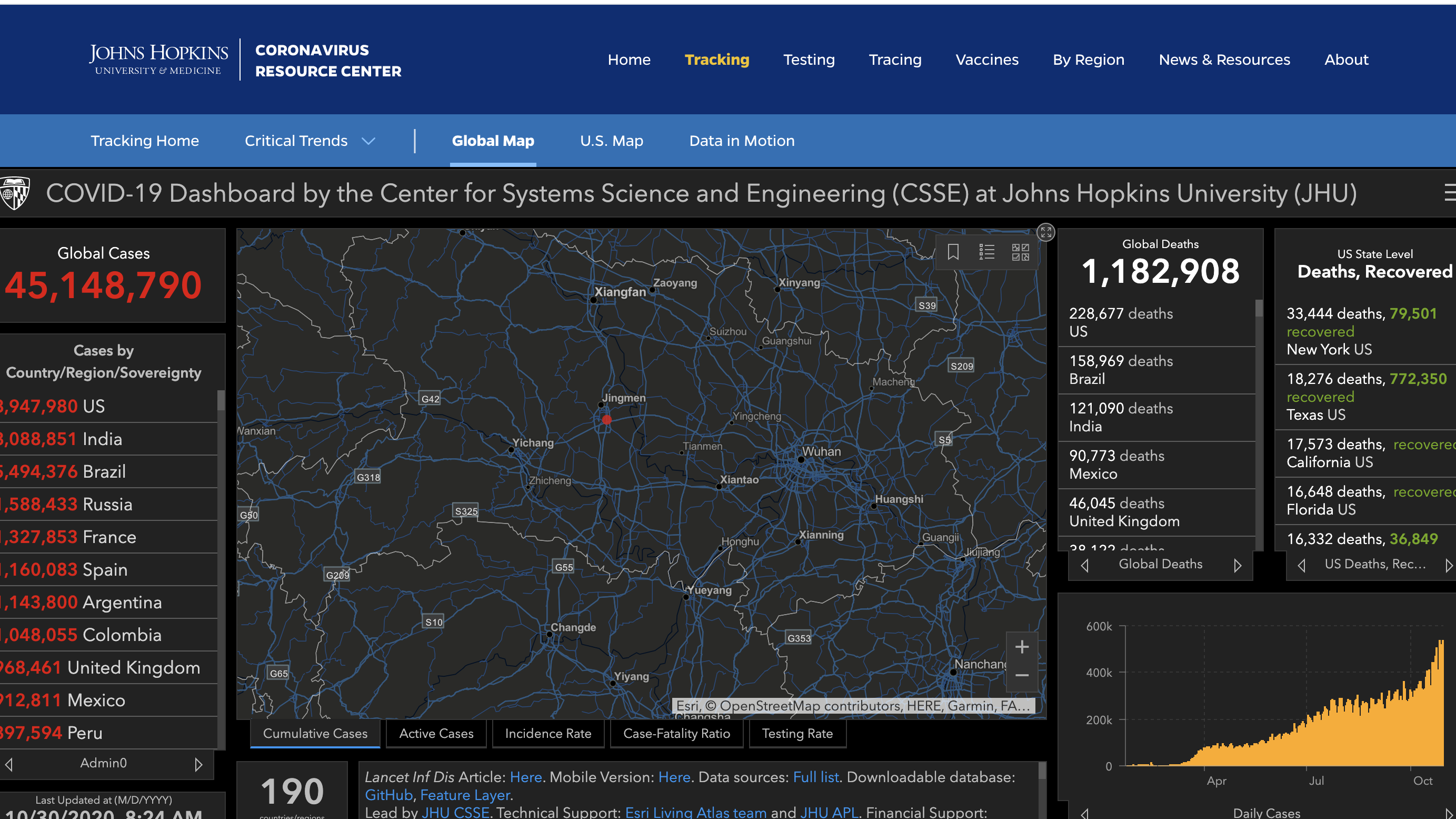
As of today, according to Johns Hopkins Coronavirus Resource Center, the map shows no red dots indicating a hot spot for COVID-19. The nearest one is in Hubei, China with 68,139 cases and 4,512 deaths.
A screenshot of the hot spot in Hubei, right next to a spotless Wuhan /Source: Johns Hopkins Coronavirus Resource Center
During the month of October, a reporter from CGTN by the name of Zhou Minxi returned to Wuhan, their home city for the holidays. In an article for the news source, Minxi recounted the events that started in January when the city was sealed off from the rest of China.
Going back to Wuhan on a train, Minxi saw that traveling precautions were only intended for foreign travelers, as there was “a loudspeaker asking foreign nationals to produce their nucleic acid test results upon arrival,” recounted Minxi.
“From that moment, it is clear that for the people in Wuhan, the only risks now come from outside China.” Minxi explained the ways Wuhan came to revitalize themselves, by testing 10 million people in two weeks and “bringing back peace of mind” to the citizens there.
Now, Wuhan is living in ways that most people miss, enjoying freedom and even throwing parties. BBC News reported in August that the Wuhan Maya Beach Water Park had gone viral, as many partygoers were seen packed in pools or on bright orange floaties.
The packed pools in Wuhan’s Maya Beach Water Park /Source: Getty Images
“It’s not a very 2020 image,” writes the BBC, as during those times, Europe and North America were experiencing troubling times with cases sky-rocketing.
An article fromBloomberg mentions the current party scene in Wuhan. Several signs warn that people should be wearing masks and staying distant, but now no one follows those rules.
The source explained, “No one sees the need. Wuhan has had just four confirmed cases of the novel coronavirus since May, when the city tested its entire population in the space of two weeks.”
Bloomberg explains that Wuhan sets an example for a “New China,” as the city now symbolizes “relative economic freedom but intense controls on speech” as President Xi Jinping wants to control the narrative and redefine the city. Bloomberg also mentions that people are scared of losing their jobs speaking against this control.
In February, Wuhan built two hospitals in two weeks to isolate coronavirus patients, an impressive feat that set an example to the world. These were called “instant hospitals,” as around 40+ makeshift hospitals were built in Wuhan to treat the patients.
As of March 2020, the curve of infected persons in Wuhan slowed and as most patients were treated, the hospitals were “sealed off and retired” as reported by NPR. The remaining patients were sent to the general hospitals to be treated.
The construction of these hospitals has said to be cost-effective and that “no one besides China has the resources or cost-effective labor to follow suit” said Raymond Pan, a design principal at HMC Architects who was interviewed by NPR.
As of today, the U.S election will decide on the next president, yet COVID-19 is still continuing to spread at record-breaking rates.
With Wuhan setting an example for disrupting the spread of the coronavirus, the U.S public is currently awaiting a vaccine in the future.
Loveland Magazine is one of the 400 news outlets worldwide, with a combined audience of over 2 billion people “Covering Climate Now”, a global journalism initiative committed to bringing more and better coverage to the defining story of our time.
The initiative, was co-founded by The Nation and Columbia Journalism Review
Mihaela Manova is “Covering Climate Now” in Loveland, Ohio as an editor for Loveland Magazine
In today’s Covering Climate Now Post, cities around the world are seeking Covid-19 spending to be made more “climate smart.” Article written by Andrew McCormick for The Nation.
This story is part of a collaboration between The Nation and InsideClimate News as part of Covering Climate Now, a global journalistic collaboration strengthening coverage of the climate story. The piece below focuses on cities; to read how green recovery spending can impact rural areas, click here.
Trillions of dollars are on the table, as governments around the world seek to dig out from the economic crater caused by the coronavirus. With time also running short to avoid the worst of the climate crisis, the growing consensus among world leaders is that Covid-19 recovery spending must be “climate-smart.”
“This terrible challenge that has caused so much suffering is an opportunity,” United Nations Secretary General António Guterres said yesterday in an interview with Covering Climate Now. “We can either rebuild as it was, which is a huge mistake, because of the fragilities of the world, or we can rebuild a more inclusive and more sustainable economy and society.” The secretary general’s comments echoed statements in favor of a “green” stimulus by the European Union, the International Monetary Fund, the International Energy Agency, and BlackRock, the world’s largest investments asset manager.
Climate-conscious stimulus spending creates more jobs per dollar invested than do expenditures on fossil fuel projects, according to an Oxford University study of more than 700 stimulus programs initiated after the 2008 global financial crisis. Nevertheless, with the exception of the EU, a majority of Covid-19 recovery spending to date by the world’s leading economies has reinforced the carbon-intensive status quo, propping up the very economic sectors and practices that have driven the climate crisis, including the fossil fuel and airline industries.
At the local level, however, leaders are calling for a better way.
In a recent letter coordinated by the C40 Cities Climate Leadership Group, dozens of mayors from the world’s biggest cities declared that the economic recovery “should not be a return to ‘business as usual,’ because [business as usual is] on track for 3 degrees Celsius or more of over-heating.” What’s more, mayors say, their cities have existing and “shovel-ready” projects that could put climate-smart stimulus spending to work right away, if only national governments or central banks provide it.
“Mayors are in a position to really define what a recovery from Covid-19 looks like,” David Miller, a former mayor of Toronto and C40’s director of international diplomacy, said in an interview. “It’s not just their voices advocating to the national governments; it’s their actions demonstrating what’s possible.”
Here are five leading examples.
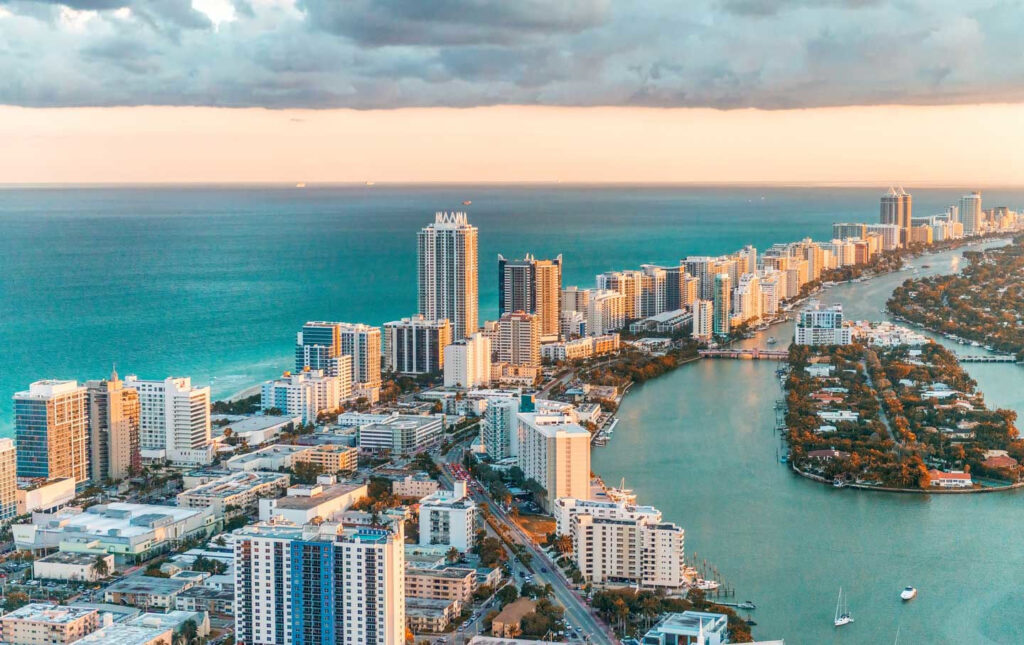
South Beach, Miami. (pisaphotography / Shutterstock)
IN MIAMI, A REPUBLICAN MAYOR EMBRACES CLIMATE-SMART STIMULUS SPENDING
Francis Suarez, Miami’s Republican mayor, has been consistently aggressive on climate. Dismissing the idea that taking climate change seriously makes him somehow less conservative, Suarez says the idea of a green stimulus is “music to my ears.”
In 2017, on the same day Suarez was elected, Miamians voted to authorize a $400 million “Miami Forever” bond that seeks to develop long-term resilience for the city, including against sea-level rise, flooding, and hurricane storm surge. That means building seawalls, installing stormwater pumps with valved outfalls (so water ejected from the city into water bodies is clean and doesn’t damage local ecosystems), and physically raising some city roads.
Flooding in the city is already routine, putting billions of dollars in property at risk and leaving many low-lying residents—nearly 60 percent of Miami-Dade county is less than six feet above sea level—anxiously looking for somewhere else to go. This past November, Suarez led Miami to declare a “climate change emergency.”
But $400 million isn’t nearly enough to prepare Miami for the full extent of what’s coming, Suarez said. And Covid-19 budget cuts have only complicated matters: Recently, the city weighed eliminating its chief resilience officer, for instance. “Miami Forever was sort of a down payment,” Suarez said. “It’s not going to solve all our problems. So, if we were to get a stimulus, we would be able to put the money to use right away.”
A green stimulus would also give a boost, Suarez said, to more ambitious, engineered solutions in the works. Large urban reservoirs, designed to trap and expel excess waters, are under construction along the inland Miami River, and along the ocean-side Biscayne Bay. The benefits are three-fold, Suarez said: elevating the sea wall, creating a buffer for the community in the form of a reservoir, and creating new public space. “And whenever you’re investing in public spaces, you get infinite return, because by their very nature they’re not going anywhere,” Suarez said.
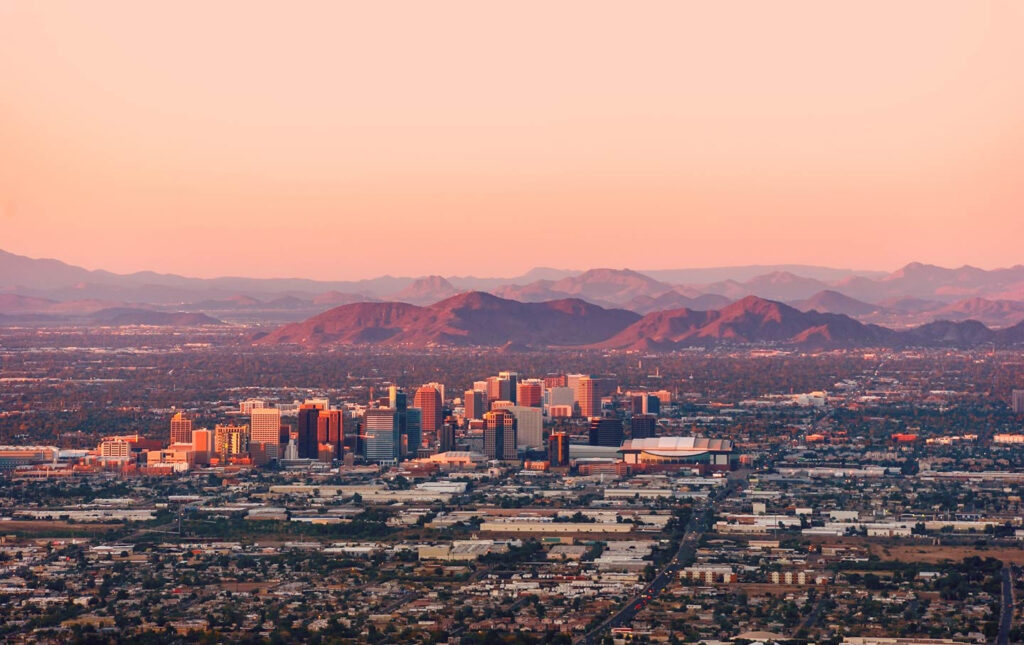
Phoenix (Dreamfarmer / Shutterstock)
REVIVING A BATTERED SOLAR INDUSTRY TO HELP COOL PHOENIX
Phoenix is hot. It’s among the fastest-warming cities in the United States, with temperatures topping 100 degrees on 103 days in 2019. This summer was the city’s hottest season ever. And for four years running, Phoenix has set records for heat-related deaths.
This June, Phoenix’s Street Transportation Department fast-tracked a “cool pavement” pilot program. Roads in eight neighborhoods are being outfitted with a special, water-based treatment that is lighter in color than traditional asphalt and reflects sunlight instead of absorbing it. If the cool pavement proves effective in mitigating the urban “heat island” effect—and is resilient to Phoenix’s high temperatures, persistent sunshine, and monsoon storms—officials hope to implement it far and wide in the city.
Meanwhile, however, the Covid-19 lockdown has shrunk potential sources of funding for climate-smart projects. With ridership way down on public transit, fare collection has fallen by more than 50 percent. To ensure that cooling projects and sustainable development continue to reach the city’s residents, Phoenix needs a green stimulus, said Mayor Kate Gallego.
Federal support, Gallego said, would aid the expansion of cooled bus stops, shaded walking paths, and elevated solar panels around the city. The solar panels would provide not only electricity but also badly needed shade in open areas, especially in lower-income neighborhoods where regular access to air conditioning is not guaranteed.
In 2019, Arizona was the state with the sixth most solar-related jobs—last year, the state produced enough solar energy to power three-quarters of a million homes—and nearly 90 percent of those jobs reside in the Phoenix metropolitan area. But the economic slowdown following the coronavirus hit the solar industry hard. Thousands of solar jobs were lost, and plans to expand solar deployment in Arizona were dramatically scaled back. Federal funding, especially for workforce training and development, could help the industry bounce back.
The government could also provide up-front loans to help people and businesses, particularly in low-income areas, adopt solar and other green technologies, such as more efficient windows, air conditioners and other appliances. “There are so many energy efficiency products that pay for themselves over time, but there are upfront [financial] barriers to some people taking advantage,” Gallego explained.
“There are beautiful and important ideas waiting to happen,” the mayor added. “If the federal government could lead the way, there are so many transformative projects that could happen, just when local government needs them most.”
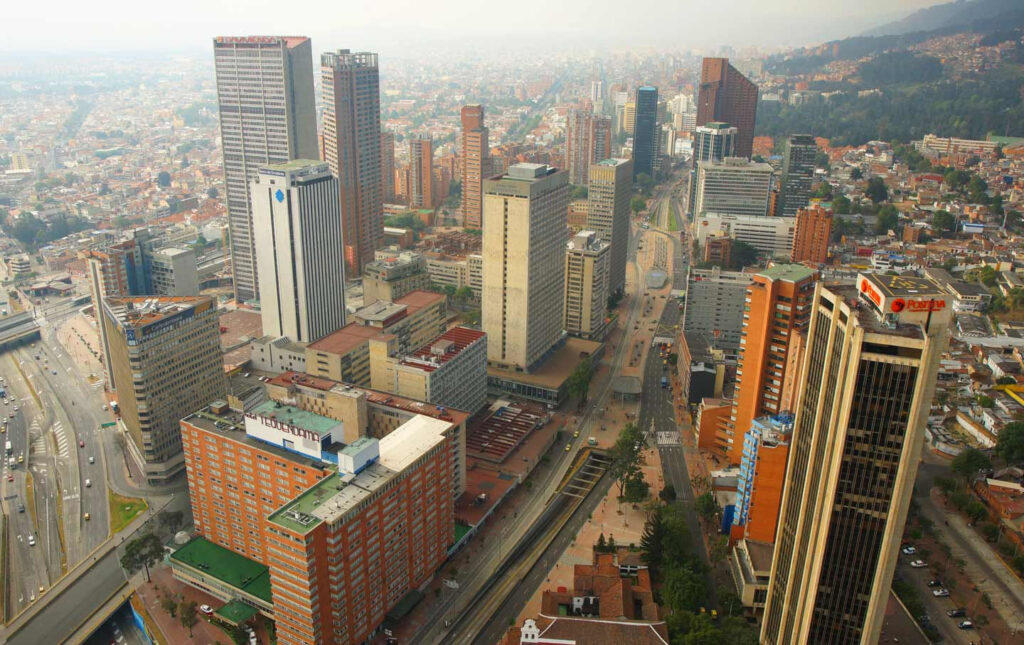
Bogotá, Colombia. (Alejo Miranda / Shutterstock)
BOGOTÁ’S MAYOR SAYS DEVELOPING NATIONS CAN BE SUSTAINABILITY LEADERS
In Colombia, the funds a city receives from the national government are more or less fixed in the constitution, based on the city’s population and relative wealth compared with other parts of the country. When it comes to a stimulus, then, it’s a matter less of lobbying for better support than of rebalancing priorities in Bogotá’s budget.
That’s fine for the new mayor, Claudia López Hernández, who already counted climate action among her foremost priorities in Bogotá. The coronavirus pandemic has caused a significant shortfall in tax collection, so this is a time for fearless and intelligent use of debt, López said. “This is a time to invest heavily and push. This moment [calls for] a Keynesian approach. If we start doing some neoliberal solution, we’ll only depress the economy.”
López, who began her four-year term this January, is the first member of Colombia’s center-left Green Party elected to Bogotá’s mayorship, generally viewed as the second-most-important elected position in the country after president. López is also the first woman—and the first gay woman—elected to the post. “We don’t want to just comply [with UN climate goals]. We want to be a world leader,” López said. “We want to be a big, developing city in a developing country leading not only in what we achieve but in how we achieve it.”
Equity and reconciliation are foremost on López’s mind, in a country that is recovering from a long and recent civil war. “What we do has to be sustainable in both climate change and social inclusion terms, otherwise it’s not really sustainable in the long-term,” López said. In the near-term, López plans to implement a universal basic income and invest heavily in education, especially post-secondary education, with a focus on skills that lead to green jobs in digital and knowledge-based economic sectors.
Before the pandemic hit, López’s government declared a general alarm for environmental pollution in the city, where air pollution levels often are more than twice as high as the World Health Organization recommends, contributing to thousands of deaths annually.
Cleaning up the air means changing how Bogotá gets around. Since March, the city has added 80 kilometers of new bikeways, adding to the 500-some already in place. By the end of her term, López hopes to add 300 kilometers more, taking space away from cars directly and giving it to bikers: “inverting the pyramid” of how transportation space is allocated in the city, López said, enough that 80 percent of commuters in the city will be able to get around by bike if they choose to. (López has set an example in this regard, biking seven kilometers from home to her inauguration ceremony in Bogotá’s Parque Simón Bolívar.) The city will also aim to replace its buses with lower-emissions models and push forward with a new, all-electric mass transit system.
All of these plans were already in the works, López said, but in the wake of Covid-19 she’s front-loading them and striking while the iron is hot. “We have no choice,” she explained. “Just like we have no choice to wear masks and social distance and invest to improve our health and testing systems, there is no point to discuss here. The way we produce, the way we live, the way we consume, it’s simply unsustainable for humanity. We need to act.”
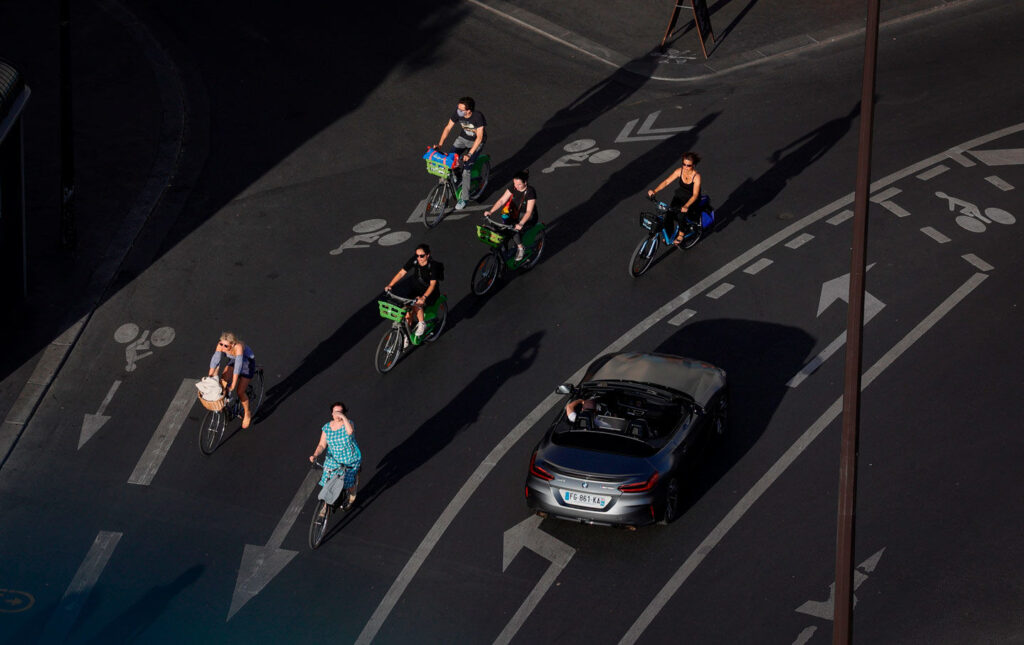
Paris (Thomas Samson / AFP via Getty Images)
PARIS CHAMPIONS “THE 15-MINUTE CITY” TO CUT BOTH STRESS AND EMISSIONS
Around the world, pandemic shutdowns prompted cities to reclaim streets from cars and preserve them for bikes and pedestrians. In Paris, that work had been underway for years. Since her inauguration in 2014, mayor Anne Hidalgo has eliminated thousands of on-street parking spots across Paris, barred high-polluting vehicles from entering the city, and banned cars from some streets entirely, including along the river Seine. Still, the lockdown this spring offered a calming, if uneasy, glimpse of what a green future could look like in the City of Light. “We could breath,” Hidalgo recently told Time magazine. “We could hear birds.”
Environmental pledges were central to Hidalgo’s campaign for reelection, which she won this June by a landslide. Hidalgo championed “the 15-minute city,” a planning concept in which neighborhoods function as villages unto themselves, where virtually all needs can be met with 15 minutes or less of walking or biking: stores, restaurants, fitness centers, schools, banks, work centers, and more. The need for cars, in turn, decreases.
The 15-minute city, or la Ville du quart d’heure, represents a shift away from the conventional zoning wisdom, which separates residential and commercial districts, that has dominated city development over the past century, said Carlos Moreno, an urban planning advisor to Hidalgo and professor at the Sorbonne.
It’s not just Paris that’s going green. France is in the midst of a “green wave,” with environmental party candidates winning mayoral elections in June in large cities across the country, including Marseilles, Lyon, Strasbourg, and Bordeaux. The election marked a decided shift, commentators said, toward public concern for climate action, driven perhaps in part by the unbearable heat of recent summers in Western Europe; Emmanuel Macron, the centrist president, has suggested a referendum to amend the country’s constitution to include language about fighting climate change.
With people’s movement necessarily constricted, the pandemic shutdown was a great time to pilot many aspects of the 15-minute city, including a further reclamation of public space from cars, Moreno said. Now, he added, the 15-minute city will prove key to Paris’s economic revitalization. As part of a “big bang of proximity,” as Hidalgo puts it, the city will move to reimagine work life, revolutionize child and elder care, revisit dated real estate practices, and ensure that cafés and cultural opportunities are more ubiquitous in all 20 arrondissements. In theory, this will help rekindle economic activity citywide, Moreno said—including in parts of the city that were underdeveloped and marginalized under France’s old economic status quo.
But to do all of this, while also ensuring that those devastated financially by the coronavirus shutdown don’t fall through society’s cracks, will take spending. “Automatically, we will have a deficit,” Moreno said. The 15-minute city is a Paris project, and not something that requires explicit support or approval from France’s central government. But the central government can, Moreno said, help the city stay afloat financially as it charts a way forward in this difficult time.
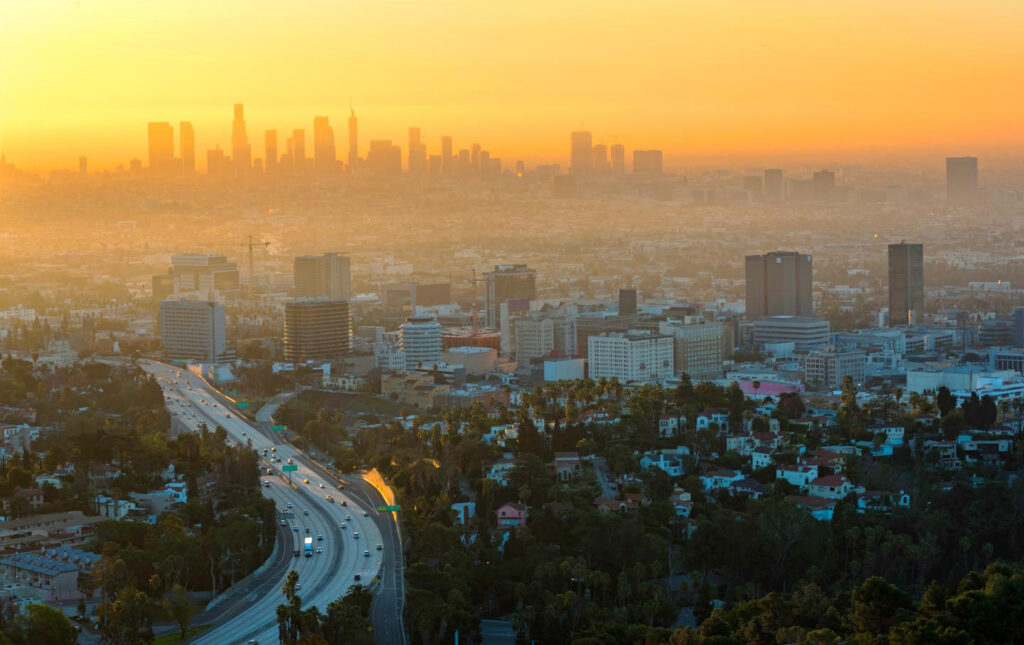
Los Angeles. (4kodiak / Getty Images)
IN LOS ANGELES, A GREEN STIMULUS WOULD “SUPERCHARGE” THE SHIFT TO EVS
In the car capital of the world, it’s little surprise that plans for tackling climate change would focus on how Angelenos move.
As a part of the city’s extensive and thorough Green New Deal, announced by Mayor Eric Garcetti in the spring of 2019, work is underway to electrify the city’s bus fleet and to get more car owners into electric vehicles; the goal is for a complete, citywide transition to zero-emissions vehicles by 2050. That requires installing more EV chargers. The city’s Green New Deal calls for increasing the number of chargers from 8,000 at present to 10,000 by 2022 and 28,000 by 2028.
That was the plan, at least. But the coronavirus lockdown is forecast to cost the city’s transit agency, which partially funds green initiatives, $1.8 billion—a quarter of all forecast revenues for 2020, according to Doug Mensman, Los Angeles’s director of transportation. That doesn’t mean that the city’s Green New Deal projects will be scrapped, but all could be delayed or deferred. “It may take up to two years to recover to pre-Covid levels of financial security, so federal funding is imperative to backfill that loss,” Mensman said.
The transition to low-emissions cars, in particular, is funded by Low Carbon Fuel Standard credits, which reward the sale and consumption of cleaner fuels. But that requires a robust marketplace. Here, too, the federal government can play a role, in part by telling car manufacturers that low-emissions vehicles are the way of the future, said Lauren Faber O’Connor, LA’s chief sustainability officer. The Trump administration has done the opposite, rolling back fuel emissions standards for gas-powered vehicles.
A crucial element of the city’s Green New Deal, O’Connor said, is that all the city’s residents reap the benefits of change. That includes ensuring that jobs created through the Green New Deal reach historically underemployed populations. “We’re building a new economy. We need to be very deliberate about ensuring that everyone has the ability to participate in it.” To help low-income residents access electric vehicles, the city’s EV car-share program, BlueLA, offers steeply subsidized rates to consumers who need them. BlueLA is another program that could benefit immediately from climate-smart stimulus spending, O’Connor said. “We want to help people in every way to make the right decision.”
Los Angeles is also working to get drivers out of their cars and instead to choose public transportation, walking, bike share systems, or micromobility systems, such as scooters. “It’s not rocket science. The solutions are there,” O’Connor said. “We know what we need to do, and the strategies are no-regrets, economically and from a health perspective. All signs point in this direction. We just need the federal government to embrace it.”