

Tag: covod 19

  • ‘5G towers,’ ‘magnetization’, other conspiracies flourish at hearing on vaccine bill

    ‘5G towers,’ ‘magnetization’, other conspiracies flourish at hearing on vaccine bill

    By Jake Zuckerman and Ohio Capital Journal edited by Loveland Magazine

    Columbus – A doctor warned that vaccinated people might be magnetized and pose a health risk to unvaccinated people around them.

    A pastor said vaccines contain ingredients like formaldehyde and fetal cells.

    A nurse sought to prove the truth of “magnetic vaccine crystals.”

    These statements — none of which are true — came during the Ohio House Health Committee’s review Tuesday of House Bill 248, a broad weakening of state vaccination laws. The five-hour hearing, limited to proponent testimony, devolved into a forum of fear-stoking, speculation, and conspiracy theorizing around the COVID-19 vaccines.

    Dr. Sherri Tenpenny, a board-certified physician from the Cleveland area, repeatedly raised unfounded claims of deaths, strokes and other “horrendous side effects” from the vaccine. The Center for Countering Digital Hate identified Tenpenny as one of a dozen of the most prolific anti-vaccination disinformers “who play leading roles in spreading digital misinformation about Covid vaccines.”

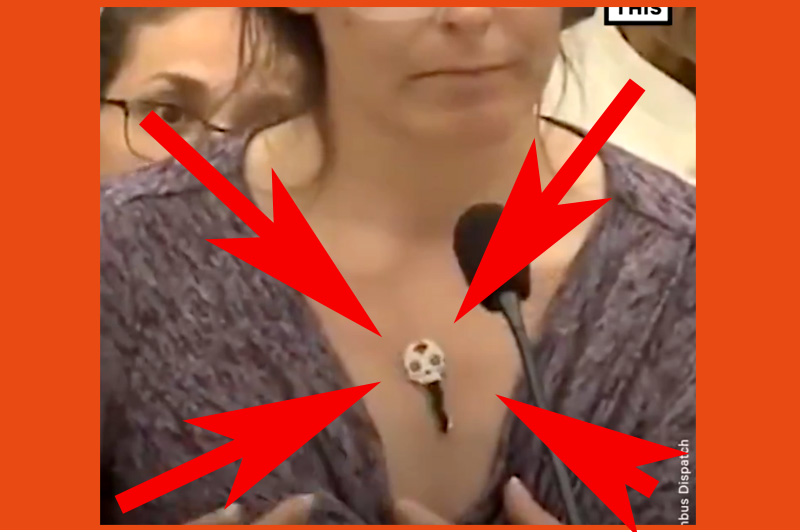
    At one point, Tenpenny made a claim to lawmakers, with no evidence behind it, that vaccinated people are somehow magnetized.

    “They can put a key on their forehead, it sticks. They can put spoons and forks all over them and they can stick, because now we think there’s a metal piece to that,” she said. “There’s been people who have long suspected that there was some sort of an interface, yet to be defined interface, between what’s being injected in these shots and all of the 5G towers.”

    Shortly thereafter, Tom Renz, a lawyer, testified in support of the bill as well. Renz has filed lawsuits in states around the U.S. crying foul of an array of government practices related to COVID-19 and vaccination.

    He filed one such case in Ohio, which he withdrew after U.S. District Judge James Carr called Renz’s arguments nearly “incomprehensible” and his supporting evidence “a jumble of alleged facts, conclusory and speculative assertions, personal and third-party allegations, opinions, and articles of dubious provenance and admissibility.”

    Renz, like several other witnesses, accused health officials of secretly profiting from vaccines while covering up their dangers.

    House Bill 248, co-sponsored by 16 House Republicans, would prohibit any of the following institutions from mandating, incentivizing, or “otherwise requesting” their employees, customers or students get vaccinated: businesses, hospitals, nursing homes, colleges, day-care centers, and insurers.

    It also:

    • Prohibits a person from mandating, requiring, or otherwise requesting that an individual receive a vaccine.
    • Compels public schools, which already accept exemptions for non-medical and medical reasons, to emphasize vaccine exemptions “in the same timing and manner, including text size and font, as it provides notice of the requirements.”
    • Blocks businesses from separating patrons by vaccination status or asking whether they’ve been vaccinated.

    Rep. Jennifer Gross, R-West Chester, the bill’s lead sponsor, has said she isn’t opposed to vaccination, but people should have the right to choose.

    “This is not a scientific bill,” she said last month. “This is a freedom bill.”

    Several public health experts have warned in interviews that the legislation will likely lead to sagging vaccination rates, and in turn, outbreaks of infectious disease.

    In the last two weeks, Gov. Mike DeWine, Ohio Department of Health Director Stephanie McCloud, and ODH Medical Director Dr. Bruce Vanderhoff declined to comment on the legislation.

    At a press call last week, a physician joined Vanderhoff for a largely unrelated press conference encouraging vaccination against COVID-19. When asked by a reporter about the bill, she didn’t share Vanderhoff’s reticence.

    “I’ll be very direct and say this bill threatens how we take care of children, and how we keep them healthy, and how we keep them alive,” said Dr. Patty Manning-Courtney, the chief of staff at Cincinnati Children’s Hospital.

    “To limit and restrict the ability to require vaccinations in schools or to check vaccination status, it’s almost unthinkable in a pediatric community to think that one of the best tools we have at prevention would be limited, restricted, or discussed in a way that is negative.”

    Similarly, a “vaccine coalition” of business groups along with the largest medical groups and associations in the state — including the Ohio Chamber of Commerce, the Ohio Hospital Association, the Ohio Children’s Hospital Association, Anthem, OhioHealth, and others — issued a public letter warning the legislation puts all children at risk.

    “At its core, this proposal would destroy our current public health framework that prevents outbreaks of potentially lethal diseases, threaten the stability of our economy as it recovers from a devastating pandemic, and jeopardize the way we live, learn, work and celebrate life,” the coalition wrote.

    An item that fully escaped the committee’s attention: during the hearing itself, the CDC published an early release of a report analyzing COVID-19 infections by age group and vaccination status.

    The researchers found occurrences of COVID-19 infection, hospitalization and death plummeted among Americans aged 65-and-up (about 82% of whom are vaccinated) compared to those aged 18-49 (about 42% of whom are vaccinated).

    The finding builds on mounting evidence of the COVID-19 vaccines’ safety and efficacy.

    The legislation drew immense support including more than 800 pieces of written testimony. The hearing room was virtually full, requiring two overflow rooms for supporters. At a lunch recess, a man stood outside the statehouse passing out faux vaccination cards with a vulgarity on the flip side.

    “Mandatory vaccines and masks are a joke … much like this card!” it states.

    In an interview after the hearing, House Health Chairman Scott Lipps, R-Franklin, said it’d be tough but possible to see the bill passed out of committee before lawmakers break for summer recess at the end of the month.

    He indicated looming amendments might narrow the bill, possibly restricting its focus solely to the flu or COVID-19 vaccine as opposed to its current form of all vaccinations.

    “If you could trim this bill down, you could pass it,” he said.

    During the hearing, Lipps tried to steer witness testimony and lawmakers’ inquiries toward the philosophical questions about the role of government in public health as opposed to litigating the safety and efficacy of vaccines. The attempts were largely unsuccessful with both proponents and opponents.

    He distanced himself from Tenpenny’s remarks.

    “I do believe Representative Gross requested Dr. Tenpenny to speak, and she got a little off balance, I think she got a little outside the lines of what we were intending or hoping to keep her in,” he said. “I hope that didn’t harm her credibility, but I think some committee members walked away with big questions.”

  • State report cards bill will be improved; testing bill passed through committee

    State report cards bill will be improved; testing bill passed through committee

    (Photo by Getty Images)

    By Susan Tebben and Ohio Capital Journal

    The Ohio Senate passed a bill to modify standardized testing, allowing different pathways for current juniors and seniors to graduate amid a pandemic school year.

    The bill also reinstated an emergency clause to the bill that the House removed in their initial vote on the measure.

    “If we pass this without the emergency clause, this will happen after the school year is over,” said state Sen. Andrew Brenner, R-Powell.

    The emergency clause allows the bill to take effect immediately after the governor signs the bill, rather than 90-days after, as is typical for bills without an emergency clause.

    Juniors and seniors will be able to take or retake high school end-of-course exams if they were unable to take them, and those scores can be used as a final grade, in a change to the House bill, Brenner said.

    Graduation will also be possible for those who earn the Ohio Means Jobs readiness seal, along with the minimum curriculum requirements. To receive the seal on a high school diploma, students “must demonstrate certain professional skills required for success in the workplace,” according to the Ohio Means Jobs site explaining the seal.

    That amendment was introduced by state Sen. Theresa Fedor, D-Toledo, as a way to make work done during the pandemic beneficial to students.

    “This change will help students who have already had to work, and many were considered essential workers during our pandemic, and they have already developed professional relationships and additional demonstration of soft skills like professionalism and critical thinking,” Fedor said during Wednesday’s Senate session.

    The bill now heads back to the House, which will consider the changes made by the Senate.


    Two bills hoping to make changes to Ohio’s education system, one immediately and one seeking long-term change, faced legislative questioning on Tuesday.

    The Ohio Senate Primary and Secondary Education Committee passed a bill that to alter the state’s standardized testing plan.

    Meanwhile, a bill introduced last week that would overhaul the state’s report card system was brought to the House Primary and Secondary Committee by its sponsors, with the acknowledgment that the bill would be subject to change.

    “We know this bill’s not perfect right, because it’s the beginning stages of a bill,” said cosponsor state Rep. Don Jones, R-Freeport.

    One criticism was a reduction in the number of gifted students in a district that would trigger that district to report information on their gifted program. The districts would only need to report the information if there is at least 20 students considered gifted within that district.

    “A lot of districts are smaller and may not have that many, and yet that seems to be an important measure and information for the parents of students in that district,” said state Rep. Mary Lightbody, D-Westerville.

    Jones said bill sponsors plan to meet with the Ohio Association for Gifted Children tomorrow to work on that element of the bill.

    The bill’s measurement of students will be delayed for the same reason sponsors of a state testing bill are trying to modify standardized testing across the state, being conducted in the pandemic-shortened school year.

    “For some schools, we don’t want to start measuring them right away because, let’s face it, we’ve got a learning gap that we’re going to have to try to fill in the 21-22 school year,” Jones told the committee.

    As state report card discussions went on, Senate Primary and Secondary Education Committee passed the bill that would change the state’s standardized testing plan, which typically informs state report cards.

    The bill, which extends the time allowed to take and report state and federally mandated standardized testing, was passed after it was amended to include the emergency clause the House did not approve as they passed the bill.

    One exception to the state testing extensions was for third-grade reading assessment. Sponsors of the bill said previously that the assessment couldn’t be moved because it determines progression to fourth grade.

    That bill now heads to the full Senate for a vote.

  • COVID-19 Update: Reopening of restaurants, bars, and personal care services

    COVID-19 Update: Reopening of restaurants, bars, and personal care services

    CURRENT OHIO DATA

    There are 22,131 confirmed and probable cases of COVID-19 in Ohio and 1,271 confirmed and probable COVID-19 deaths. A total of 4,140 people have been hospitalized, including 1,167 admissions to intensive care units. In-depth data can be accessed by visiting coronavirus.ohio.gov.

    Video of yesterday’s State House announcements, including versions with foreign language closed captioning, can be viewed on the Ohio Channel’s YouTube page.


    CURRENT LOCAL DATA

    Clermont County

    115 confirmed cases. 5 probable cases. 120 total cases. 2 confirmed deaths. 1 probable death. 27 Hospitalizations. 60 Recovered.

    Hamilton County

    1664** confirmed cases. 100 deaths. 323 Hospitalizations.

    **Includes Cincinnati, Norwood, and Springdale.

    Warren County

    191 cases. (46 new possible cases in last 14 days). 36 hospitalizations. (9 new hospitalizations in last 14 days). 13 total deaths (3 in the last 14 days).


    In Loveland City Council unanimously passed a resolution expanding the dates and times for the operation of the Designated Outdoor Refreshment Area (“DORA”) in downtown Loveland. The action authorized the City Manager to implement this expansion once the State relaxed the Stay at Home Order or allowed residents to leave their homes to engage in non-essential work or activities.

    On Thursday, City Manager Dave Kennedy used that authority and announced that the expansion of the DORA will begin Saturday, May 9, at noon and run until 11 PM. The DORA will remain in effect 7 days a week for 60 days.

    Within the DORA people can purchase alcoholic beverages in a designated cup from permitted establishments and carry the beverages outside within a defined Downtown area.

    Additional picnic tables have been placed in Nisbet Park. Visitors to Historic Downtown may also bring tables or chairs to use as long as they “maintain safe distancing guidelines which will also be posted in the downtown area.”

    The newly renovated restrooms in Nisbet Park are also open and will be sanitized daily by the City.

    In Columbus, Ohio Governor Mike DeWine, Lt. Governor Jon Husted, and Dr. Amy Acton, MD, MPH, announced Thursday the next phase of the Responsible RestartOhio plan as it relates to restaurants, bars, and personal care services.

    As part of yesterday’s announcement, Governor DeWine reminded Ohioans that COVID-19 is still “incredibly dangerous” and stressed the importance of continuing to exercise safe health habits as different sectors of the economy begin to reopen.

    “Reopening Ohio is a risk, but it’s also a risk if you don’t move forward. We’re on a dangerous road that has never been traveled before in Ohio and the danger is that we relax and stop taking precautions,” said DeWine. “All of us collectively control this. I ask you to take calculated risks and make good judgments. Continue social distancing, washing your hands, and wearing face coverings. If you aren’t concerned with what happens to you, do it for others.”

    RESTAURANTS/BARS

    Restaurants and bars in Ohio will be permitted to reopen as follows:

    • Outdoor dining: May 15
    • Dine-in service: May 21

    DeWine’s Restaurant Advisory Group created a detailed list of guidelines and best practices for restaurant and bar owners to follow. The full list of mandatory and recommended best practices can be found at coronaviurs.ohio.gov.

    PERSONAL CARE SERVICES

    Personal care services such as hair salons, barbershops, day spas, nail salons, and tanning facilities may reopen on May 15.

    DeWine’s Personal Services Advisory Group created a detailed list of guidelines and best practices for personal care service providers to follow. The full list of mandatory and recommended best practices can be found at coronaviurs.ohio.gov.

    CURRENT OHIO DATA

    There are 22,131 confirmed and probable cases of COVID-19 in Ohio and 1,271 confirmed and probable COVID-19 deaths. A total of 4,140 people have been hospitalized, including 1,167 admissions to intensive care units. In-depth data can be accessed by visiting coronavirus.ohio.gov.

    Video of yesterday’s announcements, including versions with foreign language closed captioning, can be viewed on the Ohio Channel’s YouTube page.