Tag: CRT

  • Teaching about race is good, actually. States need to stop banning it.

    Teaching about race is good, actually. States need to stop banning it.

    Getty Images

    by Ian Wright

    In this back to school season, millions of American students are returning to classrooms where the wrong course, lesson, or textbook can lead to deep trouble. Why? Because for the last several years, conservative activists and lawmakers have been waging a crusade against “critical race theory,” or CRT.

    Critical race theory is an academic concept acknowledging that racism isn’t simply the result of individual prejudice but is also embedded in our institutions through laws, regulations, and rules.

    As school districts have emphasized, it’s a higher education concept rarely taught in K-12 schools. But cynical activists have used CRT as a catch-all term to target a broad range of diversity, equity, and inclusion initiatives — and seemingly any discussion about race and racism in the classroom.

    Since January 2021, 44 states have “introduced bills or taken other steps that would restrict teaching critical race theory or limit how teachers can discuss racism and sexism,” according to Education Weekly. And as of this writing, UCLA has identified 807 anti-CRT “bills, resolutions, executive orders, opinion letters, statements, and other measures” since September 2020.

    ________________

    IN OHIO

    Bills that would have prohibited discussion of certain topics related to race and sex, forbid schools from awarding credit for student service learning with advocacy groups, and ban “any textbook, instructional material, or academic curriculum that promotes any divisive or inherently racist concept” all failed to pass during the 2021 and 2022 sessions.

    ________________

    Critics claim — falsely — that CRT teaches that all white people are oppressors, while Black people are simply oppressed victims. Many opponents claim it teaches white students to “hate their own race,” or to feel guilty about events that happened before they were born.

    In reality, CRT gives students of every race the tools to understand how our institutions treat people of different races unequally — and how we can make those systems fairer. That’s learning students of every race would be better off with.

    But instead, this barrage of draconian legislation is having a chilling effect on speech in the classroom.

    In 2022, Florida passed the “Stop W.O.K.E. Act,” which prohibits teaching that could lead to a student feeling “discomfort” because of their race, sex, or nationality. But the law’s vague language makes it difficult for educators to determine what they can or cannot teach, ultimately restricting classroom instruction. In my home state of Texas, SB3 similarly restricts these classroom discussions.

    Running afoul of these laws can get teachers and school administrators in trouble. As a result of this hostile environment, the RAND Corporation found that two-thirds of K-12 school teachers have decided “to limit instruction about political and social issues in the classroom.”

    Notably, this self-censorship extends beyond states with such policies: 55 percent of teachers without state or local restrictions on CRT have still decided to limit classroom discussions of race and history.

    As a student, I find this distressing.

    My high school history classes gave me a much richer understanding of race in our history, especially the discussions we had at the height of the Black Lives Matter protests. And in college, I’ve gotten to learn about racial inequalities in everything from housing and real estate to health care, politics, education, and immigration policy.

    As a person of color, I can’t imagine where I’d be without this understanding. Neither white students nor students of color will benefit from laws designed to censor their understanding of history, critical thinking, and open dialogue in the classroom.

    The fight against CRT is a fight against the principles of education that encourage us to question, learn, and grow. Rather than shielding students from uncomfortable truths, which they can certainly handle, we should seek to equip them with the knowledge to navigate the world, think critically about our history and institutions, and push for a more inclusive country.

    This column was originally published at OtherWords.org.


    Ian Wright
    Ian Wright

    Ian Wright is a Henry A. Wallace Fellow at the Institute for Policy Studies and a student at Rice University from Dallas, Texas.

    MORE FROM AUTHOR


  • Jean Schmidt’s newest ‘divisive concepts’ bill enters Ohio House

    Jean Schmidt’s newest ‘divisive concepts’ bill enters Ohio House

    Prohibits all Ohio schools from “teaching or providing training that promotes or endorses divisive or inherently racist concepts.”

    BY: SUSAN TEBBEN –  Ohio Capital Journal

    The newest bill to regulate school curriculums and keep out what legislators see as “divisive concepts” entered the Ohio House on Tuesday.

    State Reps. Jean Schmidt, R-Loveland, and Mike Loychik, R-Bazetta, brought House Bill 616 to the State and Local Committee, which prohibits all Ohio schools from “teaching or providing training that promotes or endorses divisive or inherently racist concepts.”

    Though the co-sponsors said they want to deputize the State Board of Education with making decisions about what those concepts would be, the bill includes “critical race theory,” a misnomer used by conservatives to refer to the teaching of race in American history, and name the “1619 Project,” a New York Times project that laid out the chronology of slavery and racism, as concepts that would be prohibited under the bill.

    “Diversity, equity and inclusion learning outcomes” (DEI) are also named as “divisive or inherently racist concepts” under the bill. When asked to explain DEI and why it’s being prohibited, Loychik connected DEI to “critical race theory,” saying the two are connected based on research he and Schmidt had made.

    “The word ‘critical race theory’ was not very well accepted at that point in time, so it was re-developed into DEI – diversity, equity and inclusion – and based off our research, like I said before, it’s very, very similar to the teachings under critical race theory,” Loychik told the committee.

    DEI trainings have been used in schools to train employees about learning disparities that can happen in education.

    The well-known conservative public policy think tank The Heritage Foundation connects CRT and DEI, saying diversity trainings “pressure employees to become activists or to discuss controversial topics in the workplace.”

    Part of the bill prohibits teaching kindergartners about topics related to gender.

    “It ensures that sexual orientation and gender ideology are not taught in kindergarten through third grade,” Loychik said. “Starting in fourth grade it must be age appropriate.”

    Loychik has made his feelings on gender in schools clear through posts on his Twitter, in which he said “the left thinks a 6-year-old should be able to change their gender but an 18-year-old shouldn’t be able to buy a firearm,” and asks for support not to allow “teaching transgenderism or allowing teachers to discuss their sex life with kindergarteners.”

    Under the newest bill, the State Board of Education would also be required to “establish a procedure by which individuals may file complaints against a teacher, school, administrator, or school district superintendent alleging a violation of the bill’s prohibitions and to adopt rules to govern the implementation of and monitor compliance with the bill’s provisions,” according to Legislative Service Commission analysis of the bill.

    Democratic committee members pushed back on the bill’s language, decrying it as “censorship” and questioning the vague language used, and the state board of education’s role in defining the off-limits topics in school curricula.

    “That’s the responsibility of legislators to define these terms,” said state Rep. Mike Skindell, D-Lakewood.

    The co-sponsors said they would be willing to consider amendments to the bill, but said the focus of the bill is on curriculum, not disciplinary regulations or hallway disagreements.

    Loychik said the school district’s role would be to address disciplinary problems, and “hall monitors” could deal with school-day disagreements regarding “divisive concepts.”

    Schmidt said “invited guests,” such as state legislators, would be allowed to “talk about what they want to talk about,” because it’s not a part of the curriculum, answering a question from state Rep. Tavia Galonski, D-Akron.

    “There is a lot to discuss in the schools, and by no means would any kind of prohibition or any type of censorship be the answer for it,” Galonski said.

    Education groups like Honesty for Ohio Education have criticized the bill as a “nationally coordinated educational gag order.”

    This is the third “divisive concepts” bill to come through the Ohio legislature, with the last bill receiving heavy criticism after one of the co-sponsors said equal time should be given on both sides of Holocaust lessons. Neither bill has passed through the General Assembly.

  • Ohio HB 616: This type of legislation and mentality must be met head-on and forcefully resisted and debunked

    Ohio HB 616: This type of legislation and mentality must be met head-on and forcefully resisted and debunked

    Aaron West

    by Aaron West

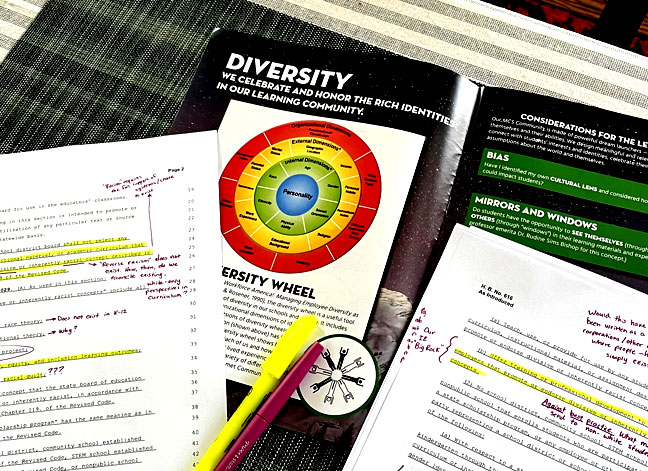
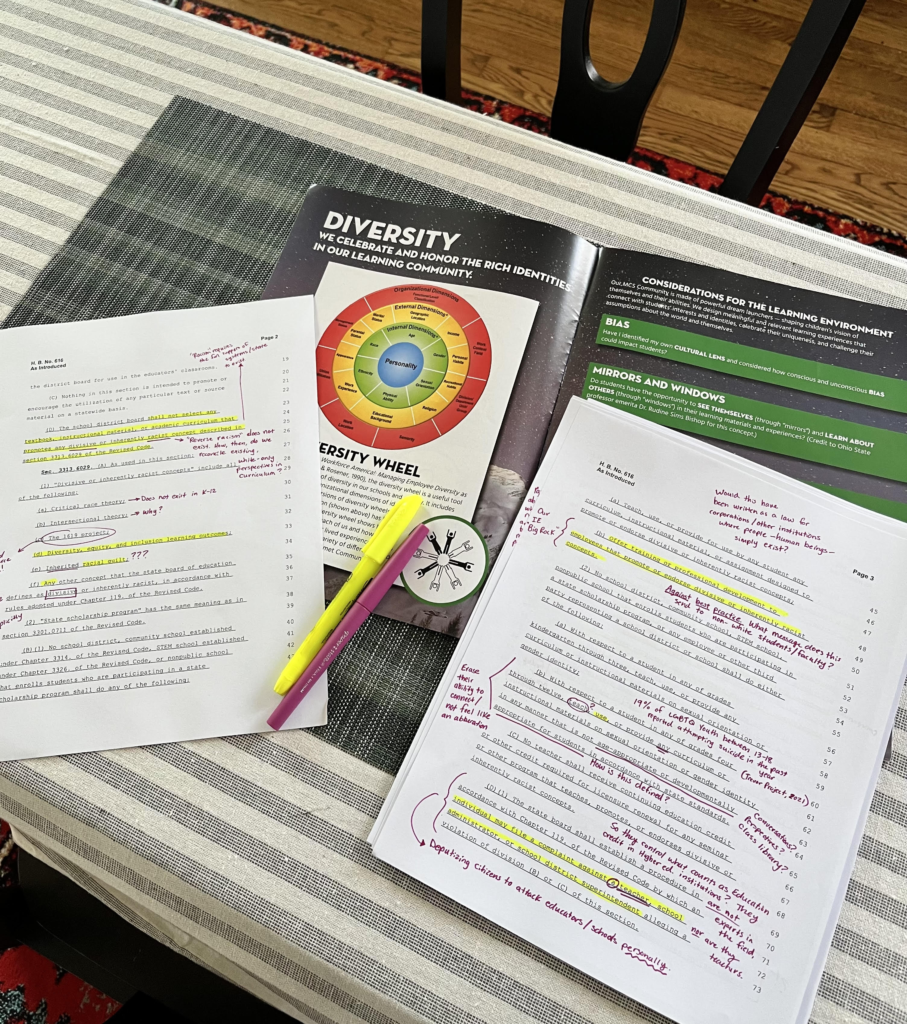
    At the beginning of each school year, I teach my students how to annotate. I want them to pay close attention to what they read, and I encourage them to ask questions about it. Today, I had to practice what I teach. I grabbed a highlighter and every teacher’s friend (a felt-tipped pen) all because of one proposed bill: Ohio HB 616.

    If you aren’t familiar, this bill copies and pastes direct lines from both Florida’s recently-passed ‘Don’t Say Gay’ bill and a litany of other bills passed by certain legislatures attacking Critical Race Theory (which doesn’t exist in K-12 classrooms), “divisive” concepts, and anything that might make anyone feel “guilty.” 

    I have read all 18 pages of this bill and placed here for you two particular ones next to an open copy of my district’s Inclusion guide. I want to show you, firsthand, just how antithetical this is to the field of education. Culturally-responsive education that acknowledges students’ identities is best practice—and we will be at risk of losing our licenses and funding for it should this bill—or any similar form of it—pass. We will be targeted and discharged for doing what is actually right by the professional standards in our field.

    We will be targeted and discharged for doing what is actually right by the professional standards in our field.

    In this bill, you’ll find vague language that isn’t defined; the enabling of any citizen to personally report teachers, administrators, and superintendents for discipline; the threat of punishment for including diversity/equity/inclusion training for staff or students; and consequences for using any curriculum (including my own classroom library) that includes any “divisive” or “racist” (here meaning “non-white”) perspectives or concepts.

    Most personal to me, this bill needlessly includes language whose intention is to further alienate and marginalize LGBTQ+ youth. For the first twenty-six years of my life, I was afraid to admit that I was gay. Had my experience in school (and elsewhere) been different, more representative, that may have been different. I may have been healthier and felt like there was a place for me, my identity—as I was.

    I don’t know if this bill will make it through a committee or whether it will ultimately be passed, but here’s what I do know.

    • 19% of LGBTQ+ youth ages 13-18 reported attempting suicide at least once in 2021 (The Trevor Project)

    • Some form of this bill, and more of the like, will continue to crop up—in Ohio and elsewhere across the U.S.

    • This type of legislation, and really, these mentalities, must be met head-on and forcefully resisted and debunked.

    • We must continue to vote en masse. In every election—locally and otherwise. Vote for people who will not make a culture war of the most vulnerable lived experiences. Vote for your teachers, your medical professionals, your neighbors who are Black or gay or some other “divisive” subset. Inclusion at the elected level is an antidote to the misguided assumption that this is desirable or even acceptable to most.

    • It’s important to remember that one of the noblest goals of quality public education is to make space for all; it is about more seats at the proverbial table. This bill seeks to send a chilling reminder that—still, in 2022—so many must raise their voices as though to ask permission to simply exist or belong.

    If you live in Ohio, you can make your voice heard on this bill by contacting the following:

    House Speaker Robert Cupp (R): (614) 466-9624

    Caucus Minority Leader Allison Russo (D): (614) 466-8012

    Other Ohio House Representatives

    Rep. Jean Schmidt (R-Loveland) Co-introduced HB 616 with Rep. Mike Loychik

    Rep. Mike Loychik (R-Bazetta) Co-introduced HB 616 with Rep. Jean Schmidt

  • Robert Hess: Something very disturbing occurring in Loveland School Board election

    Robert Hess: Something very disturbing occurring in Loveland School Board election

    by Robert Hess

    Something very disturbing is occurring in the elections for our Loveland (and possibly others) school board: The politicization of the board and the candidates. In the past, most people running for school boards truly had the interests of the students and the community at heart. Republican, Democrat, Conservative, or Liberal was not an issue. Even when the candidates may have been using the office as a springboard to future political venues. 

    This 2021 race is featuring a block of candidates running to achieve a political purpose. They appear to be running as a block to further their political ideals, regardless of what the ideals really have to do with education and the enhancement of our school district.

    One key issue this block keeps bringing up is Critical Race Theory (CRT) in the curriculum.

    First of all, Critical Race Theory is not a part of the curriculum and is not taught in the school system. (A point that several of the candidates who are not part of the “block” have stated.)

    Secondly, to be part of the curriculum it would have to be approved and instituted at the State level. That has not and is not being done. Yet, members of the block state unequivocally that whether it is here or not, it is coming. Is this a scare tactic? Is it possibly a tactic to unite certain people to vote for them to make sure Critical Race Theory never happens?

    Also, I ask, what is Critical Race Theory? Most people have either no idea or only a vague understanding based upon what rumors they have heard. Why are certain people afraid of elements of CRT. I have tried to study CRT and admit I still do not really know what it is. And if it goes toward teaching the truth, is that a problem. Should we cleanse our education system of the truths we do not want to believe or do not like? Isn’t that a bit scary? (Sounds a little like The Scopes Monkey Trial or Banned in Boston.) Many people are using CRT as a way to unite certain elements and scare those who do not understand what is and is not part of our local and state curriculum and what Critical Race Theory really means.

    Finally, do we really want block voting; i.e. Voting on issues that may not be in the best interest of students and education, but instead benefits a political point of view. Perhaps blocking good issues. Haven’t recent politics caused enough problems in our society without bringing it into the schools?

    Let us make sure that we get and keep politics out of the classroom and leave education to those who truly understand what and how to do it, with our oversight and assistance. Sure, a previous school board almost made some big mistakes. But they were in the best interest of the students and we, the voters, prevented them from implementing those mistakes. Most of those people, both board and administrators, are now gone. Let us make sure that we are trying to improve and broaden the education of our students so that they might avoid the pitfalls that our older generations have set up for them.

    Please vote responsibly, with understanding, and beware of the political tyranny that could be brought to our school system by political blocks attempting to take over our school system.

    Robert Hess lives in the Claiborne West Neighborhood in Loveland.