Tag: Cupp-Patterson plan

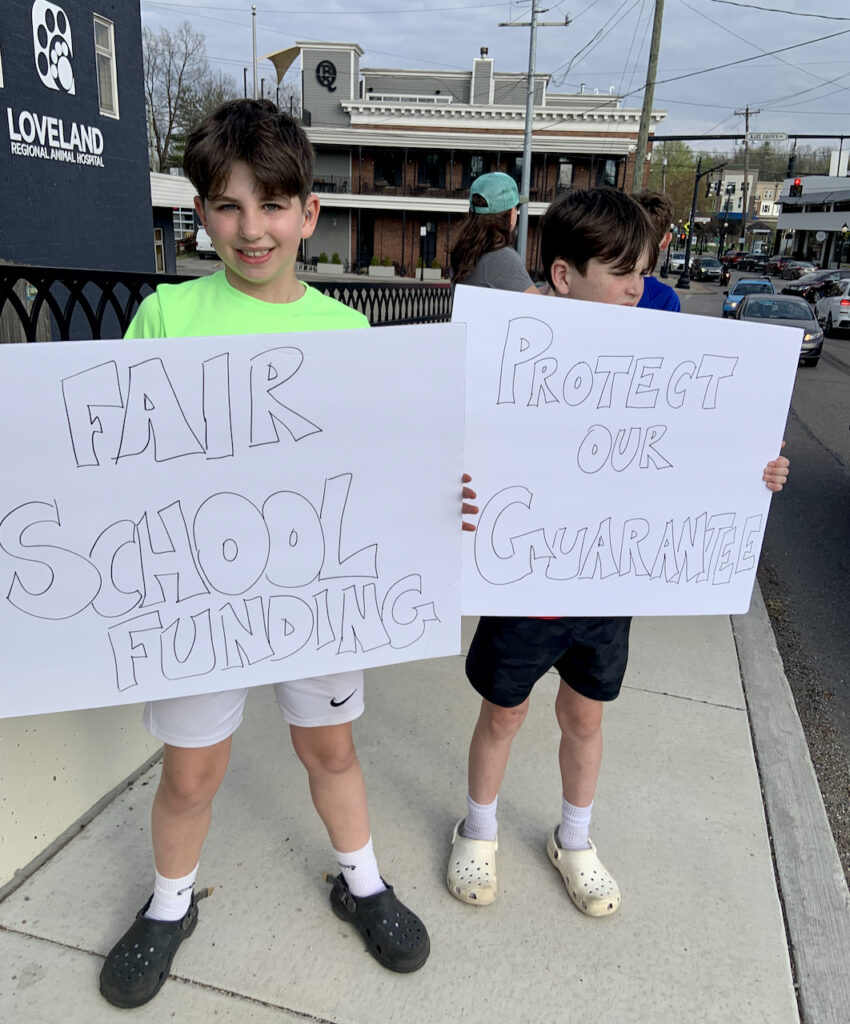
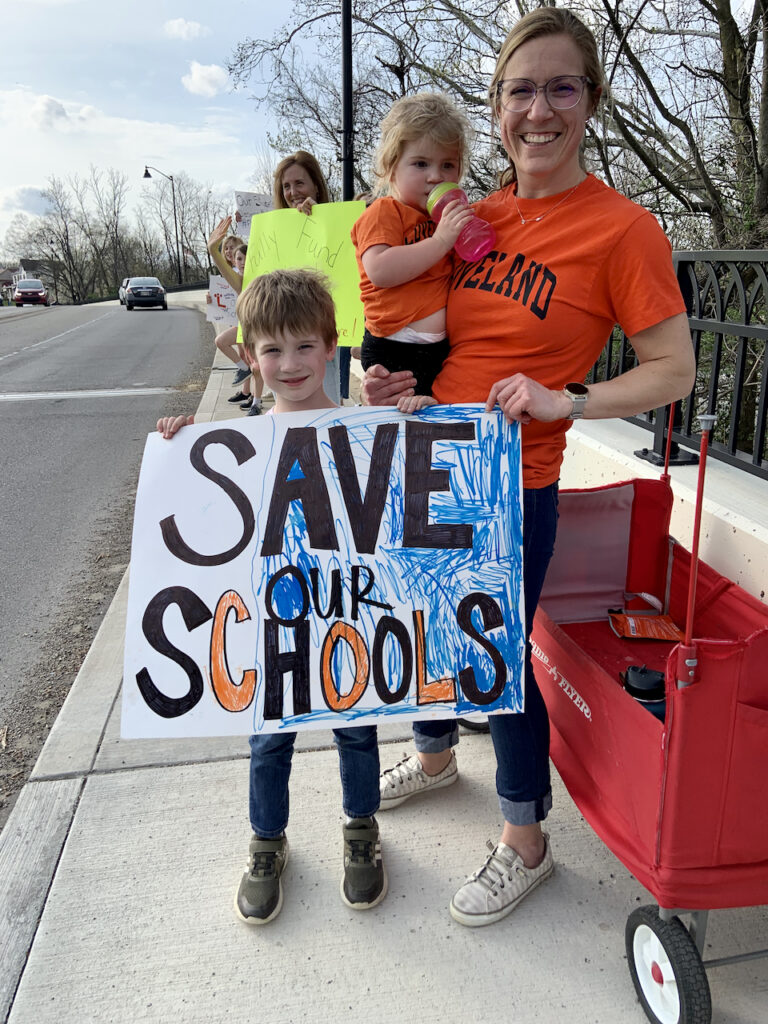
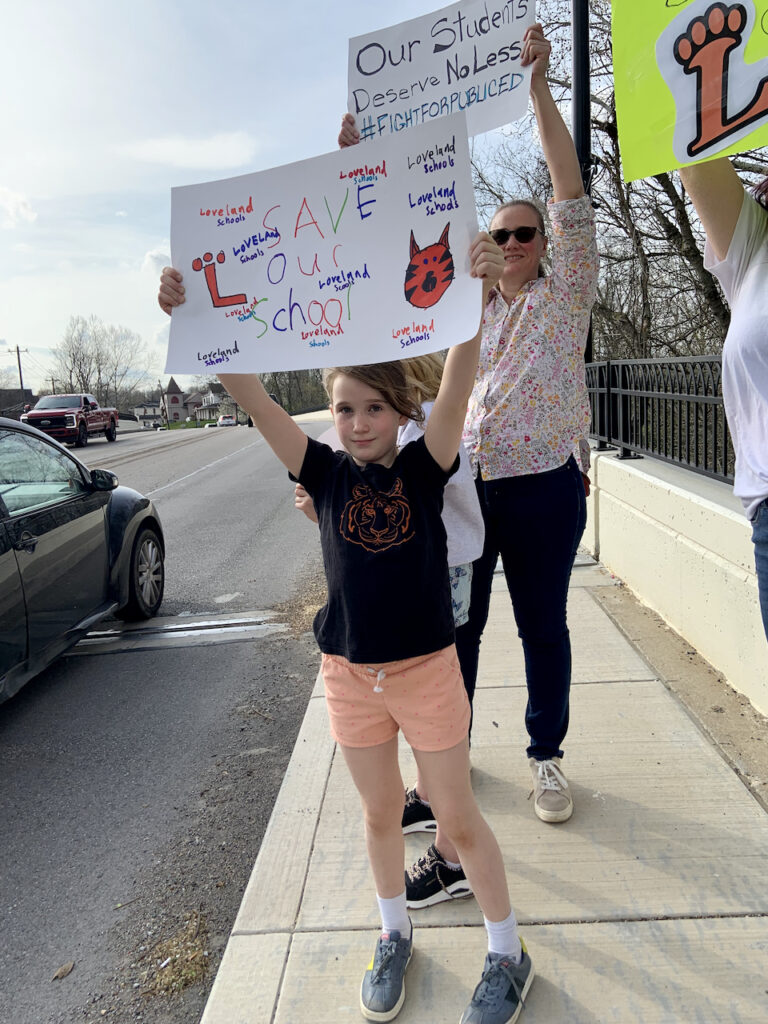
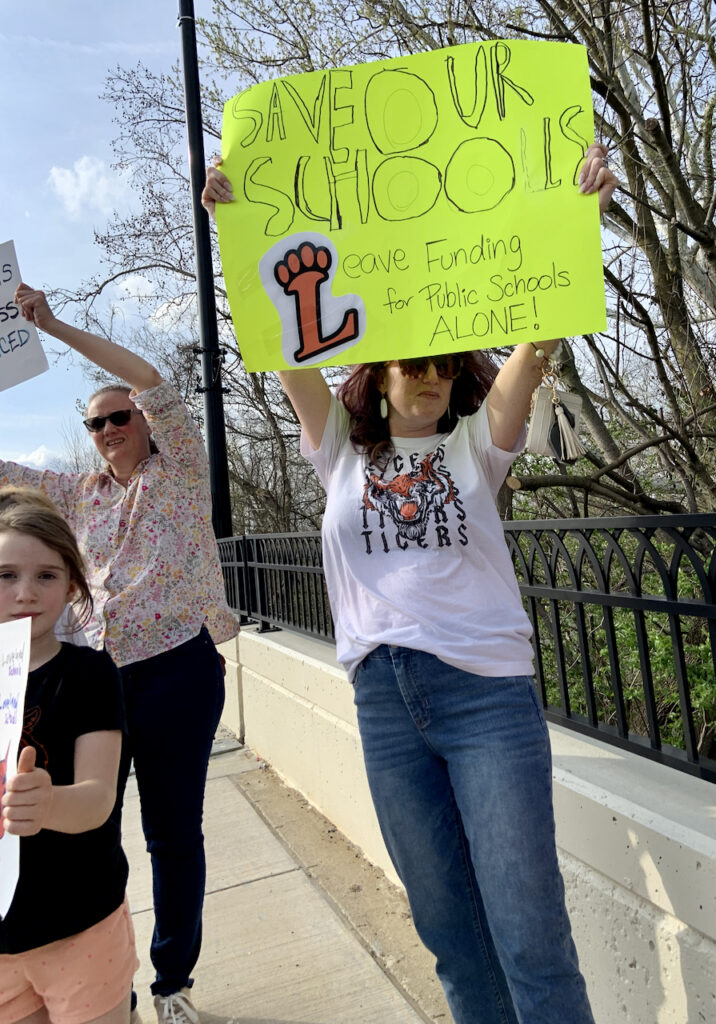
  • [VIDEO] Loveland parents and children rally on Col. Thomas Paxton bridge for fair school funding

    [VIDEO] Loveland parents and children rally on Col. Thomas Paxton bridge for fair school funding

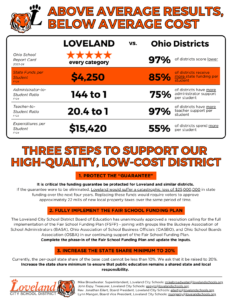
    Loveland, Ohio – Becca Moates and Cindy Daumeyer were on Loveland’s Col. Thomas Paxton bridge Wednesday evening along with many supports to send a message to Ohio Governor Mike DeWine and State legislators. The message was to urge the lawmakers to fully fund Ohio’s Fair School Funding Plan (FSFP) for public schools. They say that if the plan isn’t fully funded, the Loveland City School District may lose $2.5 million over the next five years. The FSFP is commonly referred to as the Cupp-Patterson plan. Backers are urging the full completion of its phase-in.

    Scott DiMauro, president of the Ohio Education Association, pointed out the potential effect on public schools, which he said serve 95% of Ohio students. He told the Public News Service in late March, “The governor has proposed a budget that would cut public schools by over $100 million, while at the same time increasing funding for vouchers for private schools and charter schools by $500 million. We know that is just absolutely unfair.”

    Becca Moates said on March 18 in a guest column published in Loveland Magazine, “The current budget proposal from Governor DeWine leads to lost funds for Loveland schools which will undoubtedly lead to additional revenue requests from the school district. Let’s continue to build the unity we have as community members to support the students who are the heart of our vibrant community.”

    In 2021, Governor DeWine signed the Fair School Funding Plan, which was supposed to be implemented three phases to support public school funding in Ohio. Over 90% of children in the State attend public schools. Only 66.67% of the planned funding levels have been implemented. The phase-in was set to reach full funding by fiscal year 2027. Once fully phased in, the FSFP is supposed to provide constitutionally appropriate funding levels for traditional school districts, Career Tech Centers, and Education Service Centers.

    Moates also said in her column, “It is time for our legislators to hear from all of us. We need Governor DeWine to endorse a bill that benefits our schools. We need to come together. Write letters, call legislators, and call the Governor.”

    DiMauro said that he worries such major shifts in funding could lead to larger class sizes and reduced services in public schools, placing additional burdens on local taxpayers to fill the gaps. He emphasized now is the time for Ohioans who are concerned about the issue and how it might affect their communities to contact their representatives in Columbus.
    Provided by Loveland Schools

    Who To Contact

    Download the list or click below PDF to enlarge.

    What to Say?

    Here are Moates’ suggestions for what to include in your phone calls, emails, and letters to state lawmakers:

    • Your name
    • Your role (parent, student, staff member, community member) in the Loveland City School District.
    • Your story (explain why you support Loveland City Schools, your family’s experience with Loveland City Schools, and why you are concerned about funding cuts for our district. Make it clear that decisions about funding impact children and communities.)
    • Your request (for example: protect the “guarantee” because reducing it would hurt funding for our district, fully implement the Fair School Funding Plan with updated inputs, and increase the state share minimum to 20%)
    • Your appreciation (thank them for their work in Columbus and their attention to this issue that is important to you and our community.)

    We suggest you write an email message to lawmaker, then use that message as a script for a phone call. The message can then be printed and mailed to lawmakers for an additional contact point.

    Read the Loveland District’s Lobbying Request.

    [pdf-embedder url=”https://lovelandmagazine.com/wp-content/uploads/2025/03/Loveland-State-Legislators-136th-General-Assembly-2025.pdf” title=”Loveland State Legislators – 136th General Assembly 2025″]

    _______________

  • Debate intensifies over major cuts to Ohio’s Fair School Funding Plan

    Debate intensifies over major cuts to Ohio’s Fair School Funding Plan

    The Cupp-Patterson plan was originally offered as a bill in the Ohio Legislature, but instead was written into the state budget with a six-year implementation schedule. Full funding of $2 million, and full implementation, must be part of each state budgeting process. (Adobe Stock)

    author Farah Siddiqi, Producer

    Public News Service


    At the Ohio Statehouse, proposed budget cuts to the Fair School Funding Plan have sparked debate among lawmakers and educators.

    Also known as the Cupp-Patterson plan, it is in its fourth year of a six-year implementation, designed to address disparities in school funding across the state. Backers are urging the full completion of its phase-in.

    Rep. Matt Huffman, R-Lima, Speaker of the House, has suggested in recent weeks reducing the state’s public education budget by at least $650 million, challenging the state’s ability to continue the current funding model.

    “Implementing of the Cupp-Patterson Plan that many believe is a fait accompli that we decided four years ago — that in this budget we’re going to do that — in my estimation, is a fantasy,” Huffman stated.

    Critics of the proposed cuts argued reducing funding could exacerbate inequities, particularly in under-resourced districts. Huffman contended offering scholarships toward Ed-Choice vouchers for private schooling offers families more educational choices and can lead to taxpayer savings.

    Scott DiMauro, president of the Ohio Education Association, pointed out the potential effect on public schools, which he said serve 95% of Ohio students.

    “The governor has proposed a budget that would cut public schools by over $100 million, while at the same time increasing funding for vouchers for private schools and charter schools by $500 million,” DiMauro stressed. “We know that is just absolutely unfair.”

    DiMauro worries such major shifts in funding could lead to larger class sizes and reduced services in public schools, placing additional burdens on local taxpayers to fill the gaps.

    He emphasized now is the time for Ohioans who are concerned about the issue and how it might affect their communities to contact their representatives in Columbus.

  • Trump order prioritizes school choice and vouchers, which Ohio has been expanding for decades

    Trump order prioritizes school choice and vouchers, which Ohio has been expanding for decades

    Getty Images

    By:  Ohio Capital Journal

    An executive order signed by President Donald Trump directs an emphasis on school choice and private school voucher programs when it comes to education funding, something that’s been happening in Ohio for several decades now.

    While it’s unclear how much power the executive order will have with spending decisions decided by Congress, the executive order directs to the U.S. Department of Education to prioritize “school choice” programs in grant funding, and requires the U.S. Department of Health and Human Services to guide states on block grants that can be used for private schools.

    The executive order also directs the U.S. Department of Education to release guidance on using federal funding formulas for private school scholarship programs, and for military families in particular to be given information on scholarships.

    It’s not yet clear how this will affect individual states, but Ohio has already vastly expanded its private school voucher programs over the last two decades, and recently passed near-universal levels eligibility.

    Ohio House Speaker Matt Huffman began 2025 by saying the six-year phase-in of the public school funding model in Ohio was “unsustainable,” which received massive pushback from public school supporters, especially after the lawmakers poured nearly $1 billion into private school scholarships last year.

    Huffman called the future of the current funding model – also called the Fair School Funding Plan or the Cupp-Patterson plan – a “fantasy,” but has seemingly softened his stance for now after hearing from members of his own party.

    A spokesperson for Huffman and the House Majority Caucus did not respond to a request for comment on the executive order.

    GET THE MORNING HEADLINES.


    The president and CEO of EdChoice, Ohio’s private voucher program, praised the order in a statement, saying prioritizing and expanding such programs “is a crucial step toward empowering families and giving them greater control over their children’s education.”

    “This initiative reflects a commitment to funding students not systems and to ensuring the proper role of the federal government in education,” EdChoice President and CEO Robert Enlow said in the Wednesday statement. “It recognizes both the appropriate role of the federal government on education and the fact that education is primarily a state function.”

    Public school advocates feel the same way about a federal push for private school funding expansion as they do about state-level funding increases, for which a lawsuit was filed in Franklin County Common Pleas Court to eliminate the private school voucher program.

    The lawsuit argues that funding for private schools is coming out of the coffers of the public school system, something the state is constitutionally obligated to fund properly.

    “Diverting public money to unaccountable and ineffective private schools is a failed strategy that runs counter to public opinion,” Ohio Federation of Teachers head Melissa Cropper told the Capital Journal.

    2024 survey done by All4Ed, Lake Research Partners and the Tarrance Group, found a majority of American voters support public education, and an increase in funding to improve public schools. This included 58% of Republicans surveyed. Only 34% of GOP voters polled said funding for voucher programs should be increased.

    “Voters view public schools, including their local public school, more favorably than charter, private or religious schools,” the study stated.

    Cropper called the move by the Trump administration “a strategy straight of Project 2025,” the playbook written and supported by right-wing Heritage Foundation members, some of whom have become players in the Trump administration, including the White House budget office.

    “Regardless of what politicians do, Ohio educators and school staff will continue fighting for the resources that our students deserve,” Cropper said.

    YOU MAKE OUR WORK POSSIBLE.

    _______________
    Susan Tebben
    Susan Tebben

    Susan Tebben is an award-winning journalist with a decade of experience covering Ohio news, including courts and crime, Appalachian social issues, government, education, diversity and culture. She has worked for The Newark Advocate, The Glasgow (KY) Daily Times, The Athens Messenger, and WOUB Public Media. She has also had work featured on National Public Radio.

    Ohio Capital Journal is part of States Newsroom, the nation’s largest state-focused nonprofit news organization.

    MORE FROM AUTHOR

  • Advocates, legislators want more from governor’s education budget

    Advocates, legislators want more from governor’s education budget

    Students in a classroom. Getty Images

    By Susan Tebben and Ohio Capital Journal

    With no changes planned for the state education funding formula included in Gov. Mike DeWine’s proposed budget, education advocates and some state legislators are left wanting more.

    “The devil is always in the details,” said Scott DiMauro, head of the Ohio Education Association, in a statement after the release of the budget. “Education spending must be a top priority in Ohio to ensure our students, educators and communities receive the resources they need to succeed.”

    Scott DiMauro

    DeWine’s budget proposal brings funding back to pre-pandemic levels and includes a jump in non-academic wraparound services, but saves the bulk of changes to education funding for the legislature to figure out.

    The OEA said they were encouraged by an expansion to broadband access and mental health services as part of the support for schools.

    “However, OEA is disheartened to see the same amount of general revenue fund money is going into the state’s foundation formula as in (fiscal year) 18,” the association wrote in their statement.

    Another of Ohio’s biggest teachers unions, the Ohio Federation of Teachers, agreed that DeWine “chose to punt” on overhauling the school funding system without acknowledging the Cupp-Patterson plan, some of which went into the capital budget last year, but for the most part stays in limbo as the General Assembly begins anew.

    Melissa Cropper

    “Additionally, the governor’s budget maintains the disastrous local funding deductions for charter and private schools that have been draining public school budgets,” said OFT President Melissa Cropper in a statement.

    The non-profit Ohio Children’s Alliance praised the “key investments for Ohio’s children and families” that the governor carried over from the previous biennial budget, and said they were pleased to see more money go toward student wellness and youth services.

    “With the unprecedented challenges COVID-19 has caused to communities and providers, targeting investments in telehealth and the child and family services workforce are critical parts of a comprehensive solution,” said Mark Mecum, CEO of the OCA.

    State Sen. Teresa Fedor

    State Sen. Teresa Fedor, D-Toledo, called the governor’s proposal “shortsighted” when it comes to education and support for children.

    “We should be fixing our unconstitutional funding formula — not continuing to siphon more public school dollars to private education,” Fedor said after the budget proposal was released.

    With the school funding now in the legislature’s hands, House Minority Leader Emila Strong Sykes, D-Akron, said it would be a primary issue as the House Democrats begin their work, including “fully and fairly funding our public schools.”

    “We look forward to digging into the details of the governor’s proposal to see how it makes sense long-term without one time money and that it delivers on the promise of opportunity for all Ohioans,” Sykes wrote.