

Tag: dark-money

  • Ohio utility regulator front and center in massive bailout scandal

    Ohio utility regulator front and center in massive bailout scandal

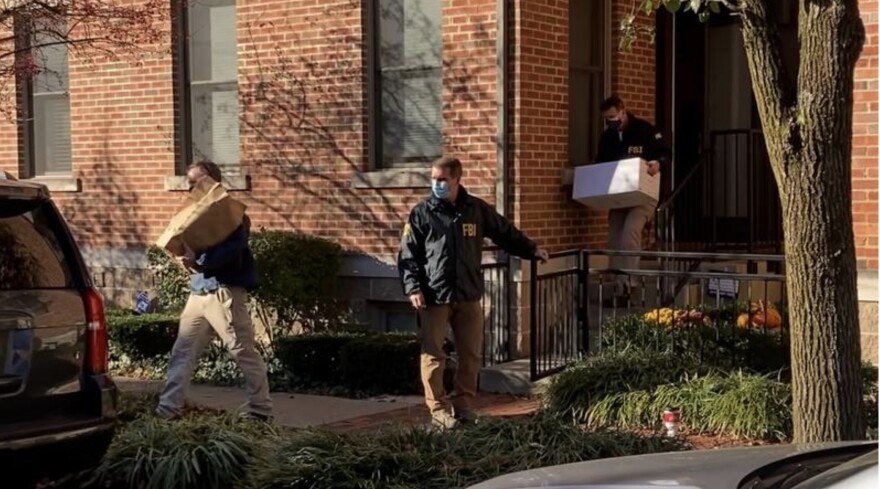
    FBI agents remove boxes of materials from PUCO Chairman Sam Randazzo’s condo in Columbus Nov. 17, 2020. Photo courtesy of Daniel Konik/Statehouse News Bureau.

    BY: MARTY SCHLADEN – Ohio Capital Journal

    CINCINNATI — Ohio’s utility regulator is at the center of a massive bribery and money laundering scandal that has been the focus of a trial here since late last month. In 2019, its chairman and a very recent senior official played a central role in writing corrupt bailout legislation that would give more than $1 billion in subsidies to companies the Public Utilities Commission of Ohio was supposed to be regulating.

    But did their role in the process violate any PUCO rules? The answer is unclear.

    When it comes to being a consumer watchdog, the PUCO doesn’t have the best track record. 

    Since 2008, it has granted more than $1 billion in electric rate increases that were later declared illegal by the Ohio Supreme Court. But, thanks to the way the increases — or “riders” — were written, there’s no way to force utilities to return those ill-gotten gains to ratepayers.

    In at least one of those instances, a regulator might have known the rate hike was illegal when he voted to grant it.

    In June of 2019 — as Akron-based FirstEnergy was funneling millions through dark-money groups to pass the bailout that is the subject of the trial here — the Supreme Court struck down an increase that had already paid the company a non-refundable $460 million. Asim Haque, who months earlier was chairman of the PUCO, sent a FirstEnergy executive a text suggesting that Haque knew the increase was illegal when he voted for it. Haque then said he was just kidding.

    Then, just last month, the PUCO approved an increase of more than 50% in fixed rates for Columbia Gas without making the company go through a formal process to show that it needs the money. That means that after five years throughout much of Ohio, it likely will cost nearly $60 a month just to have gas service  — regardless of whether you live in a 500 square-foot apartment or if you live in a mansion on a five-acre lot. Any payments for gas itself will be in addition to that amount.

    It doesn’t appear that Columbia owner NiSource needed the money. Last year, before the PUCO allowed the rate hike, NiSource’s profits came in $217 million — or 41% — higher than expected. Then, a month after the increase was granted, NiSource announced it was increasing its profit forecast for 2023.

    In a press release, the company boasted of “strong regulatory execution” — including by winning the fixed-rate increase from the PUCO.

    And then there’s House Bill 6, the 2019 law that is the subject of the trial in federal court here that has been ongoing since Jan. 23.

    Former Ohio House Speaker Larry Householder and former Ohio Republican Party Chairman Matt Borges are on trial for their participation in what prosecutors say is likely the biggest bribery and money laundering scandal in Ohio history. They allege that $61 million that mostly came from FirstEnergy was used to make Householder speaker in 2019, and then to pass and protect the $1.3 billion bailout. Most of that money was intended to prop up FirstEnergy’s failing nuclear and coal plants.

    No current or former PUCO employees have been charged in the scandal. But, to put it charitably, the conduct of at least two of them was puzzling — given that the agency’s mission is to protect ratepayers who don’t have a choice about buying the utilities’ products.

    In January 2019, Householder won the speakership and was beginning his push for a FirstEnergy bailout. At the same time,  FirstEnergy lobbyist Ty Pine sent PUCO senior advisor Pat Tully’s resume to Jeff Longstreth, Householder’s right-hand man, according to testimony in the trial. Within weeks, Tully had moved from his PUCO job to one as senior advisor for energy policy in the House Republican Caucus.

    Sam Randazzo, a former FirstEnergy consultant, was confirmed as Gov. Mike DeWine’s nominee to chair the utility commission in April 2019. When he nominated Randazzo, DeWine brushed off warnings that his nominee had “opaque and undisclosed” ties to FirstEnergy.

    In the Householder trial, Tully testified that while Randazzo was still a nominee, he met with Tully, Householder and Rep. Nino Vitale R-Urbana. From there, Tully worked with Randazzo to help draft the utility bailout, HB 6, and to reconcile it with draft legislation submitted by FirstEnergy. The bill secured final passage in July 2019 — months after Randazzo had taken the helm at the utility commission.

    In other words, Ohio’s top utility regulator helped write a law that gave a billion-dollar bailout to a company he was supposed to be regulating on the ratepayers’ behalf. And he was heading an agency that over the previous decade had awarded electric utilities more than $1 billion in illegal, non-refundable rate hikes.

    Randazzo would later resign after the FBI in 2020 raided his Columbus condo. And in a deferred prosecution agreement, FirstEnergy admitted that it paid him $4.3 million just before he became PUCO chairman.

    But does the PUCO have any rules against the role Randazzo played in drafting HB 6? 

    Asked if the agency had a policy prohibiting a commissioner from helping write legislation affecting a utility he or she is supposed to be regulating, spokesman Matt Schilling initially seemed to say that it did not.

    “The PUCO is a state agency and will always be responsive to requests for information or technical assistance to the Ohio General Assembly on matters related to utilities and commercial transportation,” Schilling said in an email last week.

    But in answer to a follow-up, Schilling seemed to say something different. He was asked if that means PUCO believes there was nothing inherently improper about its chairman helping to draft legislation creating subsidies for utilities the agency regulates.

    “No, I never stated anything like that,” Schilling replied. “The PUCO does not comment on ongoing proceedings or court cases.”

    So what about commission employees doing as Tully did when he had a FirstEnergy lobbyist passing out his resume? After all, you might pull punches as a regulator if you’re hoping to land a job with one of the companies you’re supposed to be regulating.

    Schilling’s response might not be very reassuring. He cited a law that “prohibits Commission employees from seeking employment with utilities regulated by the Commission.”

    But Schilling also sent along agency guidance that contains a pretty big loophole.

    “Although this law prohibits Commission employees from soliciting Commission-regulated utilities for employment, it does not prevent employees from considering employment opportunities with these utilities in instances in which the utility approaches the employee,” it said.

    It seems that, after the fact, it might be difficult for the PUCO to figure out who approached whom when an employee jumps ship for a well-paid utility job. And its protections against conflicts of interest during the hiring process don’t seem ironclad.

    “However, if you are contacted by a utility concerning a possible job offer, you must immediately advise your supervisor of the contact so that your supervisor can limit your duties to matters which do not involve the utility in question while any discussions are taking place,” the guidance said.

    In Tully’s case, he didn’t end up directly on FirstEnergy’s payroll. But he did help write a law that the company paid more than $60 million for.
  • Fate of former Ohio House speaker could hinge on whether he took an “official act”

    Fate of former Ohio House speaker could hinge on whether he took an “official act”

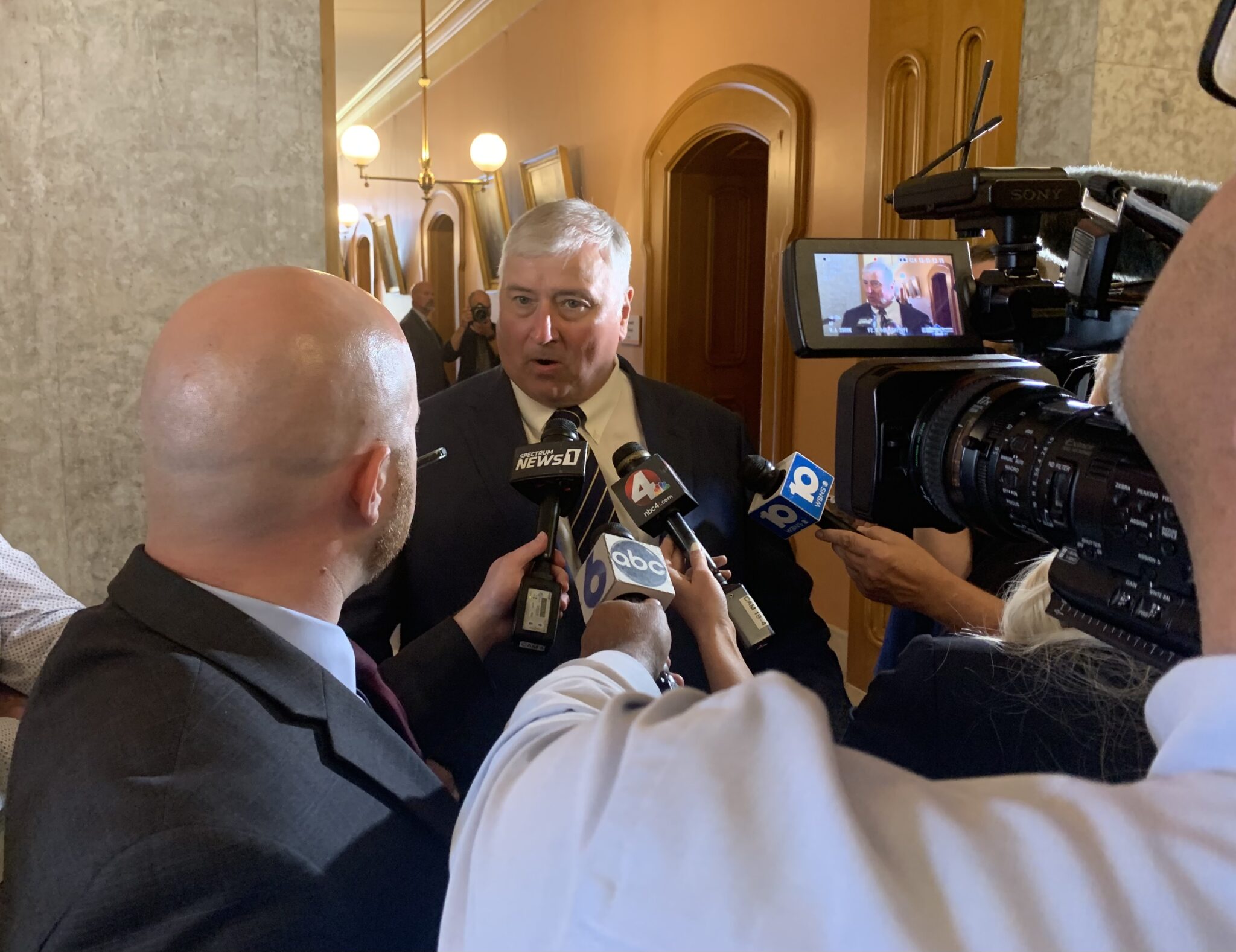
    Larry Householder addresses reporters after lawmakers voted to expel him from the General Assembly. He has pleaded not guilty to a racketeering charge and awaits trial. Photo by Jake Zuckerman, OCJ.

    BY: MARTY SCHLADEN – Ohio Capital Journal

    It appears that federal prosecutors have a mountain of evidence they want to present to the jury in their racketeering case against former Ohio House Speaker Larry Householder and former Ohio GOP Chairman Matt Borges. 

    They have emails, text messages, wiretap transcripts, and the testimony of undercover agents and confidential informants. They have so much material that U.S. District Judge Timothy Black said prosecutors and defense attorneys labored mightily before the trial even started to agree on what could be presented to the jury. The process was meant to avoid bogging down what’s already expected to be a six-week ordeal.

    But all that evidence could miss the mark if none of it shows that Householder undertook an “official act” in exchange for all the millions Akron-based FirstEnergy funneled into 501(c)(4) dark money groups to support the effort to elect friendly Republicans who would vote to make Householder speaker. The U.S. Supreme Court overturned a public corruption conviction on that basis just six years ago.

    Householder is accused of masterminding a conspiracy to use $61 million from FirstEnergy and other utilities to make himself speaker and in return ramming through a $1.3 billion ratepayer bailout of failing nuclear and coal plants. His trial began last week, but after two days of testimony it was delayed — first because of weather and then because a juror was diagnosed with COVID.

    But last week, FBI Special Agent Blane Wetzel testified about conduct that made both Householder and FirstEnergy look pretty bad.

    Householder is accused of using about $500,000 from the dark money groups to pay off credit card debt, settle a lawsuit, and repair a Florida home. Meanwhile, FirstEnergy was losing so much money on its nuclear and coal plants that in 2016 it started the process that would send the subsidiary that owned them into bankruptcy.

    But even as the company and Householder were swimming in red ink, he and the company’s CEO flew to Washington, D.C., on private jets in January 2017 for three days of dinners and drinks at some of the city’s swankiest bars and restaurants, Wetzel said. 

    Within two weeks, FirstEnergy money was flowing into Householder-controlled dark-money accounts. In November of 2018, enough Householder-friendly Republicans were elected — many with the help of money from those accounts — to make him speaker the following January. Less than six months later, on May 28, 2019, the House passed its first version of the billion-dollar bailout, House Bill 6. The body passed a final version on July 23, 2019 and Gov. Mike DeWine signed it the same day.

    When former U.S. Attorney David M. DeVillers announced Householder’s arrest almost exactly a year later, he called the scheme with FirstEnergy “likely the largest bribery and money-laundering scheme ever in the state of Ohio.”

    But did Householder undertake an official act in exchange for money corruptly received from FirstEnergy and other Ohio utilities? The answer might not be as straightforward as you think.

    For their part, Householder’s attorneys are arguing that their client was merely raising money like any effective politician would and that he only wanted to subsidize the power plants to save Ohio jobs and the tax bases of school districts.

    In addition, the Supreme Court in 2016 threw out the conviction of former Virginia Gov. Bob McDonnell even though he and his wife took more than $170,000 worth of loans and gifts from a businessman in exchange for hosting him at functions, recommending his product to state agencies, and trying to persuade state universities to study it.

    At issue was whether any of those were “official acts.”

    In that case, Jonnie Williams, CEO of Star Scientific, supported the Virginia Republican’s successful 2009 campaign. Once in office, the gifts really started to flow — including $20,000 worth of designer clothing for McDonnell’s wife, Maureen McDonnell, and a Rolex watch that Maureen gave Bob for Christmas.

    Williams was peddling a compound found in tobacco as a nutritional supplement called Anatabloc. In 2011, the McDonnells hosted an event at the Governor’s Mansion that Williams testified was intended to launch the product. He wanted scientists at the state’s universities to research it, but neither he nor the McDonnells could interest them in the supplement.

    The governor also told the state secretary of administration and the director of the Virginia Department of Human Resources that it would be a good idea for all state employees to take Anatabloc like he was. The officials apparently didn’t take the hint. 

    Investigators caught wind of the McDonnells’ arrangement with Williams and charged them with numerous crimes related to bribery.

    In 2014, they were convicted in federal court and Bob and Maureen were sentenced to two and one year in prison, respectively. They appealed, but the 4th U.S. Circuit Court of Appeals in Richmond upheld the conviction.

    However, when the case made it north to the U.S. Supreme Court, in Washington, D.C., it was overturned. Unanimously.

    Chief Justice John Roberts, the author of the ruling, said that the court took up the case expressly “to clarify the meaning of ‘official act.’” 

    In his trial, “Governor McDonnell had requested the court to further instruct the jury that the ‘fact that an activity is a routine activity, or a ‘settled practice,’ of an office-holder does not alone make it an ‘official act,’ and that ‘merely arranging a meeting, attending an event, hosting a reception, or making a speech are not, standing alone, ‘official acts,’ even if they are settled practices of the official,’ because they ‘are not decisions on matters pending before the government.’” Roberts wrote.

    Instead, McDonnell’s lawyers argued, an official act must be intended to “influence a specific official decision the government actually makes — such as awarding a contract, hiring a government employee, issuing a license, passing a law, or implementing a regulation.”

    In overturning the convictions, the high court agreed, ruling that the McDonnells could still be prosecuted, but the “Government must identify a ‘question, matter, cause, suit, proceeding or controversy’ that ‘may at any time be pending’ or ‘may by law be brought’ before a public official. Second, the Government must prove that the public official made a decision or took an action ‘on’ that question, matter, cause, suit, proceeding, or controversy, or agreed to do so.”

    How much comfort Householder should take from the ruling is uncertain, however. Roberts ended the ruling with what seems to be a warning to politicians thinking of doing shady stuff.

    “There is no doubt that this case is distasteful; it may be worse than that,” he wrote. “But our concern is not with tawdry tales of Ferraris, Rolexes, and ball gowns. It is instead with the broader legal implications of the Government’s boundless interpretation of the federal bribery statute. A more limited interpretation of the term ‘official act’ leaves ample room for prosecuting corruption, while comporting with the text of the statute and the precedent of this Court.”

  • Never needed? Senate president predicts little opposition to nuclear bailout repeal

    Never needed? Senate president predicts little opposition to nuclear bailout repeal

    By Marty Schladen and Ohio Capital Journal

    A billion-dollar nuclear subsidy was the subject of an intense fight in 2019 and great controversy since. But the president of the Ohio Senate this week predicted that a repeal will make it through the House, Senate and that Gov. Mike DeWine will sign it.

    The reason: The company that owns the nuclear reactors no longer wants the money, he said. And that raises serious questions about whether the subsidies were needed in the first place.

    The subsidy was the product of House Bill 6. The legislation was passed in 2019 after a nasty fight which led to federal criminal charges against then-House Speaker Larry Householder, four associates and a dark-money group. 

    Prosecutors said $61 million from Akron-based First Energy and associated groups was used in the corrupt effort to pass the bailout. Two of Householder’s associates and the dark money group have pleaded guilty, FirstEnergy’s CEO was fired and Gov. Mike DeWine’s appointee to chair the Public Utility Commission of Ohio has resigned as part of the scandal. 

    Despite intense calls for a full repeal of HB 6, it remains in place — although a Franklin County Judge has temporarily stopped collection of the money by the owner of the nuclear plants, FirstEnergy successor Energy Harbor.

    DeWine and others have said they want a repeal, but they want to continue to subsidize the Northern Ohio nuclear plants for environmental reasons.

    “We were for nuclear power,” he said Tuesday, referring to his initial support for HB 6. “Nuclear power was the only way in this state, today, that we can have very much non-carbon production. It’s the only way we can do it.”

    But early this month, Sens. Jerry C. Cirino, R-Kirtland, and Michael Rulli, R-Salem, introduced legislation, Senate Bill 44, to get rid of the subsidies. On Wednesday it received a hearing by the Senate Energy and Public Utilities Committee.

    Despite the governor’s statements, Senate President Matt Huffman, R-Lima, said he expects the repeal legislation to become law.  

    “I think that provision will likely get passed out of the Senate and I think it will pass out of the House and get signed by the governor,” Huffman told the governing board of the Ohio Consumers’ Counsel, the state’s official utility watchdog. “When I say the House and the governor, I’m not speaking for them, nor have I spoken to them about this. But if a large company that got a subsidy in a dubious way… says ‘We don’t want it,’ that seems to me to be a pretty easy call.”

    Energy Harbor, the owner of the plants, didn’t respond to requests for comment on Wednesday. But Huffman was apparently referring to a December 2019 ruling by the Federal Energy Regulatory Commission and Energy Harbor’s response to it. 

    The ruling said, in essence, that the company that would become Energy Harbor would have to cut its prices if it was going to sell its subsidized nuclear energy onto the massive grid that serves all or part of 13 states, including Ohio. 

    It would “threaten the competitiveness” of the long-term, or “capacity,” marketplace if companies like Energy Harbor could sell subsidized power on the same basis as power that wasn’t subsidized. So Energy Harbor and the others have to discount it according to a formula, the ruling said.

    Recent developments appear to be a sharp reversal from 2019.

    As proponents pushed HB 6, they threatened that closure of the Ohio nuclear plants was imminent if they didn’t get a bailout — and quickly. But Huffman’s statements on Tuesday indicate that Energy Harbor has no plans to shutter the plants even now that it isn’t getting the money. 

    “I don’t want the nuclear power plants to close,” he said. “However, it’s been made clear to me that the plants will not close if this subsidy is removed. In fact, they’re better off because of machinations at another level. In fact, these subsidies will likely harm these power plants.”

    There’s other evidence that Energy Harbor’s pre-bankruptcy predecessor, FirstEnergy Solutions, might not have been as broke as it claimed in 2019. 

    Shortly after emerging from bankruptcy in early 2020, it did an $800 million stock buyback. Such buybacks typically raise stock values, in this case enriching shareholders just months after pleading poverty and winning a $1 billion bailout from Ohio ratepayers.

    The federal ruling also raises questions about whether it was wise even to start the bailout fight, which has caused so much damage in Ohio. On June 29, 2018, more than a year before DeWine signed HB 6 into law, FERC issued a ruling strongly foreshadowing what it later did: effectively erase the subsidies bailout supporters had gained if they wanted to sell power into the long-term market.