Tag: Dave Yost

  • Former Ohio speaker, GOP chair found guilty of racketeering

    Former Ohio speaker, GOP chair found guilty of racketeering

    Former Ohio House Speaker Larry Householder gives the thumbs up as he enters the courthouse where he is expected to testify Wednesday, March 1, 2023. Photo from WEWS.

    BY: MARTY SCHLADEN – MARCH 9, 2023 2:03 PM Ohio Capital Journal

    CINCINNATI — After more than nine hours of deliberation, a jury on Thursday found former Ohio House Speaker Larry Householder and state Republican Chairman Matt Borges guilty of felony racketeering charges in connection with a billion-dollar utility bailout that was passed in 2019.

    Both men face maximum sentences of 20 years in what prosecutors said was likely biggest bribery and money laundering scandal in Ohio history. U.S. District Judge Timothy Black will schedule a sentencing hearing.

    After the verdict, one of Householder’s attorneys, Steven Bradley, confirmed what observers have suspected almost from the start of testimony.

    “Of course we’re going to appeal the verdict,” he told reporters minutes after the jury left the courtroom. Householder stood off to the side in a blue business suit, clutching a camouflage trucker cap.

    He affirmed that he would continue to fight the charges.

     Convicted felon Larry Householder outside the federal courthouse in Cincinnati where a jury found him guilty of racketeering. Photo by Marty Schladen, Ohio Capital Journal.

    “This is just the first step in the process,” Householder said. “Stay tuned.”

    As part of the racketeering scheme, Akron-based FirstEnergy and other utilities paid tens of millions into an effort to elect friendly lawmakers in 2018 who would vote to make Householder speaker the following year. Immediately after taking the speaker’s gavel, Householder worked furiously to pass a $1.3 billion bailout, the vast majority of which benefited FirstEnergy subsidiary FirstEnergy Services.

    The company was being dragged down by losses from its nuclear and coal plants and executives were seeking a bailout. While it got more than $1 billion out of the deal, Householder got political power as well as more than $500,000 personally, jurors found. Borges played a smaller role, but he paid a $15,000 bribe to help defeat an attempt to repeal the bailout and he received more than $100,000 in funds that originated with FirstEnergy, prosecutors said.

    The verdict could have far-reaching implications for the use of “dark money” — funds paid into 501(c)(4) organizations that don’t have to reveal the sources of their funding. In the wake of the 2010 U.S. Supreme Court decision Citizens United v FEC, the use of such funds has become ubiquitous in state and national politics.

    Thursday’s verdict might start to start to draw some boundaries around such expenditures.

    In the case of the Ohio bailout, a financially strapped Householder found common cause with a financially ailing FirstEnergy. After paying billions to prop up a subsidiary with failing and nuclear and coal plants, the parent corporation in 2016 decided to send the subsidiary into bankruptcy. They wanted a ratepayer subsidy for the failing nuclear and coal plants so they could be sold off after the subsidiary emerged from bankruptcy.

    FirstEnergy’s top executives were seeking a bailout at the same time a financially strapped Householder was seeking a return to the Ohio speakership. Their relationship grew in luxurious settings that belied the financial problems besetting both.

    Householder attended a World Series game in November 2016 in the FirstEnergy box in Cleveland with CEO Chuck Jones. Two months later, Householder flew to Donald Trump’s inauguration aboard FirstEnergy’s private jet and stayed in the same $500-a-night hotel as Jones. Prosecutors showed the jury photos of Householder’s son and a FirstEnergy executive in the back of a limousine just outside a fancy steakhouse dinner.

    Within weeks of the inauguration, Householder’s underling set up Generation Now, a 501(c)(4) dark money group into which FirstEnergy almost immediately started pouring what would become tens of millions of dollars.

    The money was used to fund support staff for candidates who would vote to make Householder speaker and to finance attack ads against their opponents.

    When opponents started gathering signatures to repeal the bailout law, House Bill 6, FirstEnergy poured $36 million into an effort to block it. Householder took control of the push to block the repeal, while Borges assisted — both by pressuring Attorney General Dave Yost and by paying $15,000 for inside information about the petition campaign.

     Center, former Ohio Republican Party chair, and statehouse lobbyist, Matt Borges with his attorneys outside of the federal courthouse. Photo courtesy of WEWS.

    That money was used to finance a torrent of misleading, anti-China ads and a petition-blocking effort that in some cases devolved into outright battery, witnesses testified.

    And because it was dark money, the public couldn’t know that it was FirstEnergy that was financing the gargantuan fight to pass and protect a much larger bailout from which it benefited — until federal law enforcement stepped in. During the trial, investigators from the FBI described how they used accountants, informants, subpoenas and wiretaps to unravel the tangle of dark money groups and political-action committees that were used to obscure the origins of the funds that were used in the scheme.

    “Today was a victory for the people of Ohio,” U.S. Attorney Kenneth L. Parker said on the steps of the Potter Stewart U.S. Courthouse shortly after the verdict. Parker declined to answer whether further indictments can be expected in the case — including for Jones and other FirstEnergy executives who paid the money that the jury on Thursday determined to be bribes.

    Also unknown is whether Gov. Mike DeWine’s first appointee to chair the Public Utilities Commission of Ohio, Sam Randazzo, will be charged. Randazzo took $4.3 million from FirstEnergy shortly before being nominated to the post and once nominated, he helped write the bailout law, House Bill 6. He resigned shortly after the FBI searched his Columbus condo in 2020.

    The verdict might be sending shock waves around Capitol Square and other power centers because defense attorneys for Householder and Borges argued that the conduct described by prosecutors was perfectly legal — politics as usual.

    In a statement, Parker offered a different take.

    “As presented by the trial team, Larry Householder illegally sold the statehouse, and thus he ultimately betrayed the great people of Ohio he was elected to serve,” the U.S. attorney said. “Matt Borges was a willing co-conspirator, who paid bribe money for insider information to assist Householder. Through its verdict today, the jury reaffirmed that the illegal acts committed by both men will not be tolerated and that they should be held accountable.”

    Outside the courthouse, Householder said that he will go back to his Perry County farm to plant a garden and fish with his kids while federal authorities complete a pre-sentence report and a sentencing hearing is scheduled.

    That his attorneys plan to appeal has been suspected almost since testimony began on Jan. 23. On Feb. 1, they undertook the risky gambit of accusing Judge Black of being biased against their client in open court.

    They also took a risk by placing Householder on the stand to testify in his own behalf. During cross examination, Assistant U.S. Attorney Emily Glatfelter confronted Householder with numerous inconsistencies and apparent falsehoods.

    Householder was asked just after the verdict if he thought the decision to testify was a mistake. He said it wasn’t

    “I waited two-and-a-half years to tell my story,” he said. “I wanted the opportunity to speak.”

  • Docs dispute AG’s claim that Ohio law allows 10-year-olds to get abortions

    Docs dispute AG’s claim that Ohio law allows 10-year-olds to get abortions

    Ohio Attorney General Dave Yost. (Photo by Justin Merriman/Getty Images)

    BY: MARTY SCHLADEN – Ohio Capital Journal

    A defiant Dave Yost on Wednesday told News 5 in Cleveland “I never apologize for speaking the truth” when asked if he should apologize for an interview he did on Fox News a night earlier.

    That was when he raised doubts with host Jesse Watters that a 10-year-old Ohio rape victim had actually been forced to go to Indiana for an abortion as a consequence of a highly restrictive abortion law that Yost had supported.

    Less than 24 hours later, Yost’s doubts were proven to be unfounded when The Columbus Dispatch reported that a 27-year-old man had been arrested on charges of raping the child. But in addition to expressing unfounded doubts, Yost appears to have made at least two serious factual errors in that three-minute Fox interview.

    First was his insistence that the Ohio Bureau of Criminal Investigation hadn’t processed a rape kit in the case, and that cast serious doubt on whether the incident ever happened. Turns out that the state’s own Child and Adolescent Sexual Abuse Protocol lays out many circumstances under which a child victim wouldn’t have a rape exam.

    But much more significantly, Yost also claimed that if a 10-year-old gets pregnant in Ohio, she can still get an abortion under exceptions regarding the health of the mother.

    “Ohio’s heartbeat law has a medical emergency exception,” Yost told Watters. “It’s broader than just the life of the mother. This young girl — if she exists and if this horrible thing actually happened to her, it breaks my heart to think about it — she did not have to leave Ohio to find treatment.”

    That statement was quickly amplified on social media. But two Ohio OB-GYNs — doctors who are required to follow the new law — disputed that analysis on Thursday.

    The dispute appears to hinge on who knows more about the risks of pregnancy — Yost, or doctors who care for pregnant patients.

    One instance under which the law says abortions are allowed after six weeks is if there’s a “medically diagnosed condition that so complicates the pregnancy of the woman as to directly or indirectly cause the substantial and irreversible impairment of a major bodily function.”

    That sheds little light on how old mothers have to be under the law to face such risks, said Jason Sayat, a Columbus OB-GYN.

    “It states specifically ‘medically diagnosed condition’ and as far as I can tell, adolescent pregnancy is not a medically diagnosed condition that’s listed,” he said.

    Maria Phillis, a Northeast Ohio OB-GYN who is also a council chair with the American College of Obstetricians and Gynecologists, explained that the law makes two types of exceptions for the health of the mother.

    One is an emergency: an imminent threat of death or severe, lasting health problems for the mother. Phillis said such a situation could include “somebody who’s imminently bleeding out on the table, or having a stroke or cardiac arrest — things that are like, imminently if I don’t do something right now, somebody’s going to suffer death or severe consequences.”

    The other exception is if there’s a medically diagnosed condition that can “cause the substantial and irreversible impairment of a major bodily function.”

    Both Phillis and Sayat said such a situation can arise with very young mothers — and with a lot older ones, too. 

    “Pregnancy itself overall is a risk for anyone who enters it,” Phillis said. “It completely alters the broad physiology of the body. It alters the heart function… It alters kidney function. It alters a number of different body systems and folks that have preexisting disease or complications are at a higher risk of bad outcomes.”

    The youngest mothers are at higher risk for early births, restricted fetal growth, and a condition known as preeclampsia. They’re also at higher risk for postpartum depression — although the Ohio law expressly says it “does not include (an exception for) a condition related to the woman’s mental health.”

    Pregnant girls face those risks, but Phillis and Sayat said other groups of expectant women face elevated danger as well.

    “There are risks like that associated with any number of things,” Phillis said. “Just being African American puts you at risk for some of those same things. Just being obese puts you at risk for some of those things. Just being above 35 puts you at risk for some of those things.” 

    She added that being very young “certainly is a higher-risk pregnancy than for someone who is older and more mature, but it’s a little harder to say that this specific thing — her age — is going to put her at a higher risk than other conditions, say chronic hypertension, chronic diabetes. It’s hard to really put that together.”

    So are the dangers faced by very young mothers greater than those faced by other groups?

    “It’s really hard to compare,” Phillis said. “Most studies, when they look at different risk groups, are taking one thing at a time. Compiling risks, it’s always difficult to say… I would not feel comfortable doing a direct comparison. We’re really not set up to say who has the most risky pregnancy.”

    Despite making the claims he did on Fox, Yost’s office didn’t answer Thursday when asked to explain how the risks faced by pregnant girls who are very young are legally distinguishable from those faced by other women. He also refused, as has Gov. Mike DeWine, to say at what age he believes adolescents should be required to have their rapists’ babies. 

    Sayat, the Columbus OB-GYN, said laws like the one DeWine and Yost support are too blunt of instruments to govern doctors’ work.

    “That’s why we practice the medicine that we do,” he said. “If it was clear-cut and pregnancies were black and white, we wouldn’t have to do the training that we do or be prepared for all the different types of scenarios and emergencies we do.”

    Meanwhile, Indiana Attorney General Todd Rokita pushed Yost’s criticisms of Caitlin Bernard — the Indianapolis OB-GYN who first disclosed the 10-year-old’s abortion — to another level Thursday. Rokita said he was investigating Bernard with an eye toward taking her license or filing criminal charges, but was vague about what rules or laws she might have broken. 

    Also Thursday, Sen. James Lankford, R-Okla., blocked a bill that would have protected women’s and girls’ rights to cross state lines to get an abortion, as the Ohio 10-year-old did.

    Phillis, the OB-GYN from Northeast Ohio, said such things are driving colleagues out of the profession and limiting options for pregnant women and girls.

    “I really worry about my patients,” she said. “It’s a dangerous time to be alive in Ohio.” 

    Follow Marty Schladen on Twitter.

  • Ohio Republicans’ attempted erasure of a 10-year-old rape victim is incredibly sick and disturbed

    Ohio Republicans’ attempted erasure of a 10-year-old rape victim is incredibly sick and disturbed

     Left to right: Republican Ohio Gov. Mike DeWine, Republican Ohio Attorney General Dave Yost, and Republican U.S. Congressman Jim Jordan. Official photos.
    Ohio Capital Journal Editor-in-Chief David DeWitt

    A Guest Column by David Dewitt

    The first and most important thing to recognize right now is that a heinous, violent crime was committed on a 10-year-old Ohio child, and thankfully justice has now found the alleged perpetrator.

    Columbus man was indicted Wednesday in a case that made national and international headlines about 10-year-old girl who had to travel to Indiana for an abortion after Ohio’s abortion ban went into effect following the U.S. Supreme Court overturning Roe v. Wade.

    The story is horrifying and tragic. She has experienced enormous trauma. My heart breaks for her, and I’m very grateful to all the hard-working professionals out there providing her and her family assistance in what must be a truly awful time.

    Republican Ohio Gov. Mike DeWine and his spokesman responded to the story by ignoring questions about whether children should be forced to have their rapists’ babies. Then DeWine allies contacted members of the press, asking how sure they were that the case of the pregnant 10-year-old even happened.

    The Washington Post, the conservative Daily Caller and other media outlets published stories saying that the case was unverified. The Wall Street Journal Editorial page suggested the story was a “fanciful tale.” The National Review’s Michael Brendan Dougherty referred to the case as “a fictive abortion and a fictive rape.”

    Republican Ohio Attorney General Dave Yost went on Fox News Monday to raise further doubts. He said he works closely with law enforcement authorities and he’d gotten “not a whisper” about the case.

    Hamilton County Republican Party Chair Alex Triantafilou on Twitter called the case, “A garbage lie that a simple google search confirms is debunked.”

    State Rep. Brian Stewart tweeted the Washington Post story saying he “wouldn’t trust an abortionist to tell me whether the sky is blue.”

    Ohio U.S. Rep. Jim Jordan tweeted, “Another lie. Anyone surprised?

    None of them had the patience to verify for themselves with certainty the truth of the matter before going public on a massive, self-serving scale.

    The propaganda erasing this 10-year-old’s existence was so swift it spread out over right-wing social media like a blanket. Those advocating the truth of her story — privately already confirmed for some of us, and crushing to hear about — were subjected to wild-eyed mockery and ridicule.

    It’s incredibly disturbing that the default position of so many sick and twisted people — including Ohio’s most prominent Republican elected officials — is to very vocally and very publicly question whether the rape and impregnation of a 10-year-old child ever happened.

    DeWine, Yost, and other Ohio Republicans hurt a traumatized child once by forcing her to flee the state in order to receive health care; then they hurt her again by peddling propaganda erasing her; now they’re hurting her a third time by refusing to acknowledge and apologize for their actions.

    This case was never implausible. In 2020, the most recent year for which statistics are available, 52 girls aged 14 and younger had abortions in Ohio, according to the state department of health. A review of just the city of Columbus’ police log since March 15 uncovered 59 reports of sexual assaults of girls 15 and younger that, based on the information available, could have resulted in pregnancy.

    Nevertheless, the wheels and integrity of local journalism spun and uncovered the truth, with the Columbus Dispatch breaking the news of confirmation of the case.

    But after the confirmation broke Wednesday, DeWine’s spokesman, Dan Tierney, again refused to comment on whether child rape victims should be forced to carry their pregnancies to term.

    Ten-year-olds who become pregnant are by definition rape victims. But Ohio’s abortion law signed by DeWine doesn’t make exceptions for rape and incest.

    Yost’s office didn’t respond Wednesday when asked whether he believes child rape victims should be forced to carry pregnancies, nor whether it was important to believe stories about sexual violence. Instead he put out a statement applauding the arrest.

    Yost offered no correction, no apology, and showed no contrition for going on national television to try to erase the lived experience of a child rape victim.

    They behave on a base level so repugnant and removed from the general good-heartedness of most Ohioans it’s almost unfathomable.

    “Apologize for what? Questioning a newspaper story?” Yost, Ohio’s top law enforcement officer, said about a case in his own county.

    DeWine, Yost, and other Ohio Republicans hurt a traumatized child once by forcing her to flee the state in order to receive health care; then they hurt her again by peddling propaganda erasing her; now they’re hurting her a third time by refusing to acknowledge and apologize for their actions.

    These powerful Ohio Republican politicians have thoroughly and completely shed themselves of any sense of shame or conscience.

    They’re disgusting and disgraceful; callous, careless and cruel.

    This is a matter of basic human decency, good faith and sensitivity on the most fundamental level of society.

    If they are willing to try to erase the traumatic story of a 10-year-old rape victim, whose pain and suffering will they not try to ignore and erase?

    They behave on a base level so repugnant and removed from the general good-heartedness of most Ohioans it’s almost unfathomable.

    I honestly don’t know how they sleep at night, or look at themselves in the mirror in the morning.

  • Ohio AG Yost joins another national lawsuit, this time to overturn LGBTQ protections

    Ohio AG Yost joins another national lawsuit, this time to overturn LGBTQ protections

    Ohio Attorney General Dave Yost. (Photo by Justin Merriman/Getty Images)

    The state should be more focused on economic recovery than on lawsuits “fighting for the right to discriminate.”

    Equality Ohio

    BY: SUSAN TEBBEN and Ohio Capital Journal

    Joining 19 other state attorneys general, Ohio’s Dave Yost has jumped in on a lawsuit demanding that sexual orientation and gender identity not be included in discrimination protections.

    The complaint, filed in U.S. District Court for the Eastern District of Tennessee, argues “administrative agencies,” in this case the Biden administration, don’t have the power to change laws, but also challenges a recent U.S. Supreme Court ruling saying employers could not fire employees based on their sexual orientation or gender identity.

    “This case is not about the wisdom of the administration’s policy,” Yost said in a statement. “It is about power.”

    State Sen. Nickie Antonio, D-Lakewood, sent a letter to Yost on Tuesday expressing her disappointment in his decision.

    State Sen. Nickie Antonio

    “It is the Attorney General’s duty as the state’s chief legal officer to protect our children and families, not to attack and malign hardworking Ohioans who happen to be from the LGBTQ community,” Antonio said in a statement.

    LGBTQ policy organization Equality Ohio said the state should be more focused on economic recovery than on lawsuits “fighting for the right to discriminate.”

    “AG Yost’s decision to participate in this misguided lawsuit against LGBTQ+ people pushes Ohio down the wrong path,” said Maria Bruno, public policy director for Equality Ohio.

    The Biden administration directed federal agencies through an executive order to review existing regulations, policies, and other directives for consistency with the U.S. Supreme Court decision.

    The lawsuit accuses the U.S. Department of Education and the Equal Employment Opportunity Commission of “flouting procedural requirements in their rush to overreach” by interpreting federal antidiscrimination law “far beyond what the statutory text, regulatory requirements, judicial precedent and the Constitution permit.”

    The attorneys general said guidance from the DOE and EEOC “concerns issues of enormous importance to the states,” according to court documents.

    “The guidance purports to resolve highly controversial and localized issues such as whether employers and schools may maintain sex-separated showers and locker rooms, whether schools must allow biological males (transgender females) to compete on female athletic teams and whether individuals may be compelled to use another person’s preferred pronouns,” the lawsuit states.

    With regard to the Supreme Court decision, the states say the court “narrowly held” that terminating an employee for being LGBTQ constituted sex discrimination, and the court “declined to consider whether employer conduct other than terminating an employee simply because the employee is homosexual or transgender — for example, ‘sex-segregated bathrooms, locker rooms and dress codes’” — would constitute discrimination.

    The states of Tennessee, Alabama, Alaska, Arizona, Arkansas, Georgia, Idaho, Indiana, Kansas, Kentucky, Louisiana, Mississippi, Missouri, Montana, Nebraska, Oklahoma, South Carolina, South Dakota and West Virginia are also represented in the lawsuit.

    Ohio’s legislature has brought its own movements — or lack thereof — on LGBTQ issues in the past few years. In June, the Ohio House pushed through a ban on transgender female athletes competing on the side that matches their gender identity. The Senate later rejected the addition, but the bill targeting the same goal remains up for consideration.

    A bill to add sexual orientation and gender identity to protected classes in the state, the Ohio Fairness Act, has been introduced multiple times, and has not made it past committee hearings.

  • Republican AGs object to U.S. Department of Education proposal on teaching about racism

    Republican AGs object to U.S. Department of Education proposal on teaching about racism

    By Ariana Figueroa and Ohio Capital Journal

    Washington — More than two dozen Republican attorneys general including Ohio’s Dave Yost are voicing their disapproval over the Department of Education’s proposed priorities for teaching K-12 students about American history and civics education because they would include references to systemic racism and how the history of slavery has shaped the U.S.

    The state attorneys general argue in a May 19 letter to Education Secretary Miguel Cardona that public schools should not be given grant funds to teach about critical race theory, “including any projects that characterize the United States as irredeemably racist or founded on principles of racism (as opposed to principles of equality) or that purport to ascribe character traits, values, privileges, status, or beliefs, or that assign fault, blame, or bias, to a particular race or to an individual because of his or her race.”

    Critical race theory says that racism is systematic and embedded in policies and the legal system. Scholars who study the issue focus on understanding how racism has shaped U.S. laws and how those actions have affected Black communities and communities of color.

    “Though the Department does not overtly refer to (Critical Race Theory) in its priorities, it is prioritizing teaching this highly controversial ideology through the vehicle of this grant program,” the AGs wrote. “This is hardly what Congress intended when it authorized this program.”

    The attorneys general also warn against approving grants for teachings of the Pulitzer Prize-winning 1619 project from the New York Times Magazine.

    The Department of Education did not respond to requests for comment.

    The attorneys general who signed the letter include Mark Brnovich of Arizona, Christopher Carr of Georgia, Lawrence Wasden of Idaho, Derek Schmidt of Kansas, Jeff Landry of Louisiana, Eric Schmitt of Missouri, Austin Knudsen of Montana and Dave Yost of Ohio, among others.

  • Ohio Republicans slammed over coronavirus enforcementBy Marty Schladen – July 13, 2020

    Ohio Republicans slammed over coronavirus enforcementBy Marty Schladen – July 13, 2020

    Columbus, OhioThe coronavirus is raging in Ohio, but the state’s Republican leaders seem disinclined to enforce rules intended to protect against it. (How does Hamilton County avoid Level 4 Alert)

    Attorney General Dave Yost won’t say whether he’ll support enforcement of new orders to wear masks in the state’s hardest-hit counties. And the official who issued them, Gov. Mike DeWine, has made several statements indicating that he doesn’t want to see anybody punished for not following measures intended to slow the spread of the deadly disease.

    Mike Samet the Public Information Officer for Hamilton County Public Health told Loveland Magazine on Friday that from an enforcement perspective, as a county agency, the Health Department is not able to issue citations. “Nobody wants to be the mask police. This is education over enforcement, he said. Samet added that he wants people to understand why masks are important now, not punish them for non-compliance.

    Ohio set a record for new cases Friday — 1,525 — after seeing them trend sharply upward over the past few weeks. The case count was nearly triple the three-week average of 531.

    Gov. Mike DeWine, has made several statements indicating that he doesn’t want to see anybody punished for not following measures intended to slow the spread of the deadly disease.

    The news comes as six other states — Alabama, Idaho, Missouri, Montana, Oregon and Texas — set new single-day records of their own on Thursday. It also was the sixth day out of the past 10 in which the United States set one-day records for new cases of the coronavirus, which now has killed more than 3,000 in Ohio and more than 130,000 nationwide.

    Also last week, a New York Times data analysis showed that the disease in the United States is taking on a disturbing racial dimension, with Blacks and Latinos around three times as likely as whites to get the new coronavirus.

    The World Health Organization and the U.S. Centers for Disease Control both have said that widespread mask wearing would reduce the spread of the disease. One study indicated that if 80% of people wore them, the spread would plummet to one twelfth what it would be if nobody did.

    Yet Yost, the state’s top law-enforcement officer, last week didn’t respond to questions about whether he supports enforcement of last week’s orders that people in Ohio’s 12 hardest-hit counties must wear masks inside public buildings.

    In late March, Yost ordered that many abortions be halted in Ohio, arguing that the move was intended to conserve healthcare resources in the face of the coronavirus pandemic.

    In June, he urged a municipal court to drop charges against a couple accused of opening their Cambridge-area restaurant in defiance of an earlier, DeWine-issued health order that it remain closed.

    Then earlier this week, Yost said that the Columbus city government doesn’t have the power to enforce mask orders in state buildings — places where many Republican lawmakers have refused to wear them.

    On Monday, a spokeswoman for Yost explained that the attorney general can’t have any official involvement in cases relating to health orders unless asked by local prosecutors. “We don’t have the authority,” the spokeswoman, Bethany McCorkle, said in a text message.

    She added, however, that Yost has worn a mask since before there was a health order and encourages others to do the same.

    The attorney general and his staff haven’t responded to subsequent questions about the order DeWine issued on Wednesday evening requiring masks in the worst-hit counties.

    David Pepper (Photo from Ballotpedia)

    Ohio Democrats are already up in arms about Republican legislative leaders’ refusal to share details about the spread of coronavirus in the Statehouse and surrounding office towers. David Pepper, the party chairman, on Friday slammed the attorney general for his apparent reluctance to support the enforcement of mask orders.

    “As far as Dave Yost is concerned, refusing to enforce health orders is just one more example that the Ohio GOP has become the party of Donald Trump, Nino Vitale and John Becker,” Pepper said in a text message. “Sadly Ohio COVID cases are spiking because of it.”

    “Even though initially it appeared that Mike DeWine was being guided by scientists and public health experts, it seems that politics and the desires of the business community are driving more of the governor’s decision making now,” party chairman David Pepper said.

    President Donald Trump has repeatedly downplayed the pandemic, floated unproven cures for it and refused to appear in public wearing a mask. Among his other statements, Ohio Rep. Nino Vitale, R-Urbana, last Tuesday took to Facebook to urge Ohioans to stop even getting tested for coronavirus. And Ohio Rep. John Becker, R-Union Township, has introduced legislation that would strip state officials of the power to enforce any health order.

    Meanwhile, in the absence of much support from his party, DeWine has said he doesn’t plan to use his authority under his mask order to arrest people for not following it.

    Ohio Governor Mike DeWine

    “We’re not talking about throwing people in jail,” DeWine said during a press conference Thursday. “This is a law to advise people what to do.”

    DeWine has enjoyed overwhelming, bipartisan support over his handling of the coronavirus. But at least for Ohio’s top Democrat, patience might be wearing thin.

    “Even though initially it appeared that Mike DeWine was being guided by scientists and public health experts, it seems that politics and the desires of the business community are driving more of the governor’s decision making now,” Pepper said. “Even with fewer cases, even West Virginia and Kentucky are being more proactive in addressing the pandemic.”


    The Ohio Capital Journal is a hard-hitting, independent, nonprofit news organization dedicated to connecting Ohioans to their state government and its impact on their lives. The Capital Journal combines Ohio state government coverage with relentless investigative journalism, deep dives into the consequences of policy, political insight and principled commentary.

  • Ohio Attorney General Dave Yost, law enforcement officers honor 799 killed in the line of duty

    Ohio Attorney General Dave Yost, law enforcement officers honor 799 killed in the line of duty

    London, Ohio – Ohio Attorney General Dave Yost, members of the Ohio Peace Officer Training Commission and law enforcement officers from across the state gathered on May 2 for the annual Ohio Peace Officers’ Memorial Ceremony to honor the 799 Ohio peace officers who have died in the line of duty since 1823.

    “Public safety doesn’t happen by accident, it depends on the vigilance, actions and courage of real people who wear a badge,” Yost said. “We honor those who made this choice, and paid the ultimate price for it.”

    Among those honored today are four officers who died in 2018:


    Eric J. Joering

    Officer Eric J. Joering | Westerville Division of Police

    On Feb. 10, 2018, Officer Eric J. Joering, 39, and Officer Anthony P. Morelli were dispatched to a home on a domestic-violence call. After they were let in, a man opened fire. Both officers were hit and fired at the shooter, wounding him. Joering died at the scene. Joering, who served as a K9 officer with Sam, a Belgian Malinois, had served Westerville since 2001 as a training officer, firearm trainer, and a street cop. Joering is survived by his wife and three young daughters. Sam retired from the Westerville Police Division and resides with the family. Click here for more information about Officer Joering.   


    Anthony P. Morelli

    Officer Anthony P. Morelli | Westerville Division of Police

    On Feb. 10, 2018, Officer Anthony “Tony” Pasquale Morelli, 54, and Officer Eric J. Joering, were dispatched to a home on a domestic-violence call. After they were let in, a man opened fire. Both officers were hit and fired at the shooter, wounding him. Morelli died at The Ohio State University’s Wexner Medical Center. Morelli began his career with the Westerville Division of Police in 1988 and was proud to protect Westerville, where he also lived. In his 30 years with the police division, he was voted officer of the year in 2003 and 2012, was honored with a Medal of Valor and received many other awards. Morelli is survived by his wife, daughter and son-in-law, son, his parents and many loving family members and friends in Westerville and Massillon. Click here for more information about Officer Morelli.


    Mathew J. Mazany

    Officer Mathew J. Mazany | Mentor Police Department

    On June 24, 2018, Officer Mathew J. Mazany, 41, arrived to assist a Mentor Police Officer who had pulled over a person wanted in another jurisdiction. As he approached the vehicle, he was struck by another vehicle. Officer Mazany served the Mentor Police Department for 14 years, was honored with the department’s Exceptional Service Award and received many accolades from Mentor residents for his professionalism and compassion. Mazany is survived by his wife and son, father, and many loving family members and friends. Click here for more information about Officer Mazany.


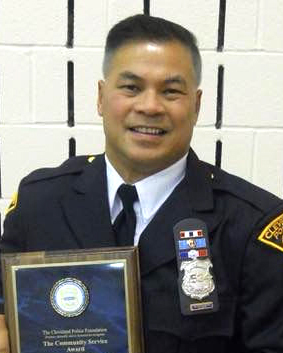
    Vu X. Nguyen

    Officer Vu X. Nguyen | Cleveland Division of Police

    On July 2, 2019, Officer Vu X. Nguyen, 50, collapsed in 90-degree heat during a canine-officer training exercise. He passed away on July 6 at Cleveland Clinic. A 20-year veteran of the Cleveland Police Department, Officer Nguyen was a popular officer, with commendations in his file including a Medal of Heroism and a special thanks from the FBI’s Joint Terrorism Task Force. He is survived by his wife and two children, and, as one of 14 siblings, a large extended family across the country. Click here for more information about Officer Nguyen.


    Also honored today were four officers who were nominated for historical induction to the memorial after their departments discovered that the officers had made the ultimate sacrifice for their communities in the past.

    • Deputy Sheriff George W. Rockwell | Logan County Sheriff’s Office
    • Chief Deputy Martin L. Myers | Tuscarawas County Sheriff’s Office
    • Officer Clark Teeple | Napolean Police Department
    • Special Officer Joseph B. Mumford | East Liverpool Police Department

    Click here for more information about these officers.

    A moment of silence was held for Colerain Township Police Officer Dale Woods and Clermont County Sheriff’s Deputy William Brewer, who gave their lives in the line of duty earlier this year. In keeping with Ohio Peace Officers’ Memorial Ceremony tradition, Officer Woods and Deputy Brewer will receive full honors during the 2020 ceremony.

    Law enforcement agencies from Butler, Cuyahoga, Fayette, Franklin, Hamilton, Lake, Lucas, Madison, Montgomery, Richland, Shelby and Summit counties were among those that participated in the ceremony.


  • Great Oaks Career Campuses qualify for Auditor of State Award with Distinction

    Great Oaks Career Campuses qualify for Auditor of State Award with Distinction

    Columbus, Ohio – A recent financial audit of Great Oaks Career Campuses (Hamilton County) by Auditor of State Dave Yost’s office has returned a clean audit report. The joint vocational school district’sexcellent record keeping has qualifieditfor the Auditor of State Award with Distinction.

    “Accurate bookkeeping enables school districts to focus on their chief duty – education,” Auditor Yost said. “Great Oaks’ clean audit demonstrates its commitment to both its students and taxpayers.”

    The Auditor of State Award with Distinction is presented to local governments and school districts upon the completion of a financial audit. Entities that receive the award meet the following criteria of a “clean” audit report:

    • The entity must file timely financial reports with the Auditor of State’s office in the form of a CAFR (Comprehensive Annual Financial Report);
    • The audit report does not contain any findings for recovery, material citations, material weaknesses, significant deficiencies, Single Audit findings or questioned costs;
    • The entity’s management letter contains no comments related to:

    o   Ethics referrals

    o   Questioned costs less than $10,000

    o   Lack of timely report submission

    o   Reconciliation

    o   Failure to obtain a timely Single Audit

    o   Findings for recovery less than $100

    o   Public meetings or public records

    • No other financial or other concerns exist that involve eligible entity.