Tag: Daylight Saving Time

  • Daylight Savings Time Started Today. Here’s the Forgotten Guy You Have to Blame (or Maybe Thank)

    Daylight Savings Time Started Today. Here’s the Forgotten Guy You Have to Blame (or Maybe Thank)

    Did you know the U.S. already made daylight saving time permanent once? It didn’t stick.

    EXPERT OPINION BY BILL MURPHY JR., FOUNDER OF UNDERSTANDABLY AND CONTRIBUTING EDITOR, INC. @BILLMURPHYJR

    Tell me if this story sounds familiar: A New York City real estate developer ran for office as a Republican, got elected, and did things that profoundly affect every American today. Only his name wasn’t Donald Trump.

    But, here we are, fully 107 years later, and despite some starts and stops we’re still following Calder’s clock rules, and despite that a majority of Americans think we should just pick one system – permanent daylight savings time seems to be the most popular idea – and stick with it.

    Instead, I’m talking about William M. Calder. To be fair, Trump does come into this story eventually, but not until much later.

    Calder starts it out, because it was he who represented New York state in the U.S. Senate from 1917 to 1923, and who championed the idea of adopting daylight savings time in the U.S.

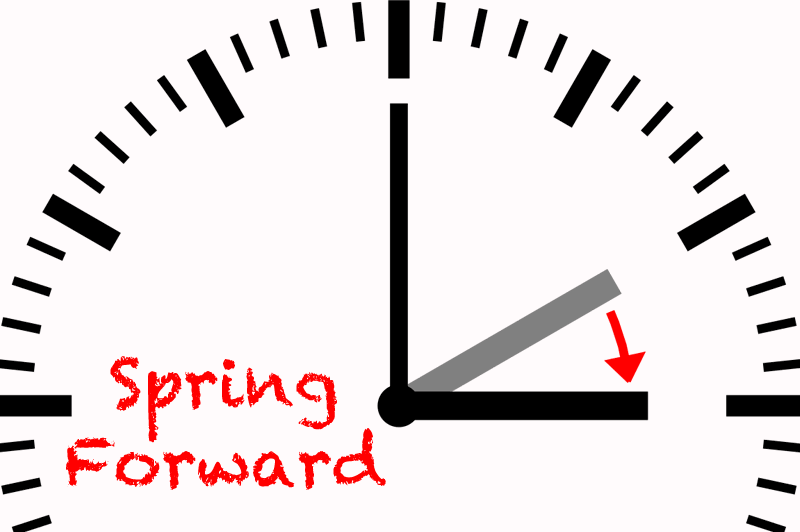
    The latest installment of our twice-a-year ritual – spring ahead, fall back – is today. Clocks moved ahead from 2 a.m. to 3 a.m.

    Read on at Inc.com

  • Springing Forward begins Sunday, March 9

    Springing Forward begins Sunday, March 9

    Loveland, Ohio – Daylight saving time means setting clocks forward by one hour in spring. Daylight saving time begins annually on the second Sunday in March and ends on the first Sunday in November.

    When we set our clocks forward one hour at 2 AM on March 9, we lose one hour of sleep and effectively pushing the sunrise later in the morning.

  • Loveland, Ohio starts Daylight Saving Time on Sunday March 10 at 2 AM local time

    Loveland, Ohio starts Daylight Saving Time on Sunday March 10 at 2 AM local time

    Loveland, Ohio – Loveland, Ohio starts Daylight Saving Time on
    Sunday March 10 at 2 AM local time.

    Set your clocks forward 1 hour in the spring at the start of DST.

  • Ohio lawmakers want to make daylight saving time permanent

    Ohio lawmakers want to make daylight saving time permanent

    Getty Image

    The Ohio House State and Local Government Committee passed a resolution Tuesday that urges Congress to enact the Sunshine Uniformity Act of 2023, which would permanently switch Ohio to Daylight Saving Time.

    BY:  Ohio Capital Journal

    The clocks will fall back this weekend, but Ohio lawmakers are urging Congress to get rid of the time change and make daylight saving time permanent.

    The Ohio House State and Local Government Committee passed a resolution Tuesday that urges Congress to enact the Sunshine Uniformity Act of 2023, which would permanently switch Ohio to daylight saving time.

    House Concurrent Resolution 7, which now goes to the House floor, would not immediately change Ohio clocks. Only federal law could make that change. State Reps. Rodney Creech, R-West Alexandria, and Bob Peterson, R-Sabina introduced the resolution in May.

    “We simply no longer need the biannual tradition of changing our clocks,”  Creech said in his testimony.

    State Reps. Latyna Humprhey, D-Columbus, and Daniel Troy, D-Willowick, voted against the resolution.

    Clocks are set for daylight saving time from March to November. Permanent daylight savings would bump the sunrise and sunset back an hour, leading to darker mornings and lighter nights. The proposed resolution would push the sunrise back until almost 9 a.m. and the sunset until after 6 p.m. on the shortest day of the year.

    Ohioans simply don’t want to change their clocks, he said when speaking to the Ohio House State and Local Government Committee in May.

    “Switching to daylight saving time would increase the hours of sunlight in the evenings year round and could help combat some mental health issues from the darker winter evenings we currently have on standard time,” Creech said. “…When you’ve been at work all day, the last thing you want to do is open that door to go outside and it’s dark out,” Creech said. “It gives a little more daylight at the end of the day.”

    Young students walking to school or waiting for the bus in the morning in the dark is a concern with making daylight saving time permanent. But Peterson addressed that issue in his sponsor testimony and suggested school districts adjust their start times during the winter months.

    Rep. Marilyn John, R-Richland County, said she was one of the first students on the school bus in the morning.

    “It was dark every morning I got on the school bus, so from a safety standpoint I made it all the way through school and we had no issues,” she said.

    Standard Time

    President of Save Standard Time Jay Pea wants to make standard time permanent, what he refers to as God’s time.

    He argues standard time would not improve people’s health and safety, but it would also benefit schoolchildren, farmers and commuters.

    “(Daylight saving time) would deprive morning light needed by farmers, construction workers, and other outdoor laborers,” Pea wrote in his testimony. “It would disrupt worship for those who pray daily at sunrise. It would increase the need for morning heat and evening air conditioning in homes.”

    History of daylight savings

    Daylight saving time started in the United States as a way to save fuel during World War I and a year-round Daylight Saving Time policy was adopted during World War II.

    The Uniform Time Act in 1966 requires the country use daylight saving time, but gives states the option to opt out and remain on standard time year-round. Arizona, Hawaii and five U.S. territories have already adopted permanent standard time.

    The United States previously tried year-round daylight saving time in 1974 as a way to reduce the country’s energy consumption during the energy crisis, but the switch only lasted eight months before going back to standard time in the fall.

    Follow OCJ Reporter Megan Henry on Twitter.


    Megan Henry
    MEGAN HENRY

    Megan Henry is a reporter for the Ohio Capital Journal and has spent the past five years reporting in Ohio on various topics including education, healthcare, business and crime. She previously worked at The Columbus Dispatch, part of the USA Today Network.

    MORE FROM AUTHOR

  • Ohio House Committee passes resolution urging Congress to make daylight saving time permanent

    Ohio House Committee passes resolution urging Congress to make daylight saving time permanent

    State Rep. Rodney Creech

    Columbus, Ohio – The House State and Local Government Committee yesterday passed House Concurrent Resolution 7, announced State Reps. Rodney Creech (R-West Alexandria) and Bob Peterson (R-Sabina), sponsors of the resolution.

    H.C.R 7 will urge Congress to enact the Sunshine Uniformity Act of 2023, permanently transitioning the state to Daylight Saving Time.

    “Switching to daylight saving time would increase the hours of sunlight in the evenings year-round and could help combat some mental health issues from the darker winter evenings we currently have on standard time,” said Creech. “I’m thankful for the support from committee members on this resolution.

    Under the Uniform Time Act of 1966, states have the freedom to change to standard time, but not daylight-saving time. This specific change requires a change to federal law to transition to perpetual daylight-saving time.

    “Research has shown an increase in automobile accidents the Monday after shifting to daylight saving time due to sleep deprivation,” said Peterson. “The most common cause of death in children under 15 is unintentional injury, and the most common cause of unintentional injury is car accidents. If permanent daylight saving time is one way to reduce car accidents and increase our children’s safety, it certainly deserves our consideration.”

    H.C.R. 7 now moves to the House floor for a vote.

    _______________

    From Wikipedia, the free encyclopedia

    Benjamin Franklin published the proverb “early to bed and early to rise makes a man healthy, wealthy, and wise”, and published a letter in the Journal de Paris during his time as an American envoy to France (1776–1785) suggesting that Parisians economize on candles by rising earlier to use morning sunlight. This 1784 satire proposed taxing window shutters, rationing candles, and waking the public by ringing church bells and firing cannons at sunrise.

    It is a common myth in the United States that DST was first implemented for the benefit of farmers. In reality, farmers have been one of the strongest lobbying groups against DST since it was first implemented. The factors that influence farming schedules, such as morning dew and dairy cattle‘s readiness to be milked, are ultimately dictated by the sun, so the time change introduces unnecessary challenges.

    DST was first implemented in the US with the Standard Time Act of 1918, a wartime measure for seven months during World War I in the interest of adding more daylight hours to conserve energy resources. Year-round DST, or “War Time“, was implemented again during World War II. After the war, local jurisdictions were free to choose if and when to observe DST until the Uniform Time Act which standardized DST in 1966. Permanent daylight saving time was enacted for the winter of 1974, but there were complaints of children going to school in the dark and working people commuting and starting their work day in pitch darkness during the winter months, and it was repealed a year later.

  • Daylight Saving Time Starts March 13

    Daylight Saving Time Starts March 13

    Loveland, Ohio – When local standard time is about to reach Sunday, March 13, at 2 AM clocks are turned forward 1 hour to Sunday, March 13, at 3 AM local daylight time instead.

    Sunrise and sunset will be 1 hour later on Mar 13. There will be more light in the evening.

  • “Dawling… don’t forget!

    “Dawling… don’t forget!

    Daylight saving time in Ohio ends at 2 AM on Sunday, November 7th.

    Turn your clocks back one hour before you go to bed Saturday night.

  • Spring ahead Dawling

    Spring ahead Dawling

    Loveland, Ohio – Here are some useful dates for Loveland area residents:

    Daylight Saving Time 2021

    • begins Sunday, March 14
    • set your clocks AHEAD 1 hour to Spring Ahead

    When local standard time is about to reach Sunday, March 14, 2 AM clocks are turned forward 1 hour to 3 AM local daylight time instead.

    Sunrise and sunset will be about 1 hour later on Mar 14, 2021 than the day before. There will be more light in the evening.

    Spring 2021

    • begins Saturday, March 20 (in 13 days)

    From the Old Farmer’s Almanac

    THE MARCH EQUINOX

    In the Northern Hemisphere, the March equinox (aka spring equinox or vernal equinox) occurs when the Sun crosses the equator line, heading north in the sky. This event marks the start of spring in the northern half of the globe. After this date, the Northern Hemisphere begins to be tilted more toward the Sun, resulting in increasing daylight hours and warming temperatures. (In the Southern Hemisphere, it’s the opposite: the March equinox marks the start of autumn, as the Southern Hemisphere begins to be tilted away from the Sun.)

    Spring Break for Loveland Schools

    Begins Monday, March 29 through Friday, April 2

    Last Day of school before break is March 26

    First day of school after break is April 5

  • “Dawling… don’t forget!

    “Dawling… don’t forget!

    Daylight saving time 2020 in Ohio ends at 2:00 AM on Sunday, November 1.

  • Nov 5 – Daylight Saving Time Ends

    Nov 5 – Daylight Saving Time Ends

    When local daylight time is about to reach Sunday, November 5, 2 AM clocks are turned backward 1 hour to 1 AM local standard time instead.

    Sunrise and sunset will be about 1 hour earlier on Nov 5, than the day before. There will be more light in the morning.

     
    via GIPHY