Tag: DEI

  • Beyond the backlash: What evidence shows about the economic impact of DEI

    Beyond the backlash: What evidence shows about the economic impact of DEI

    Photo of Rodney Coates by Miami University

    by Rodney Coates,

    Few issues in the U.S. today are as controversial as diversity, equity and inclusion – commonly referred to as DEI.

    Although the term didn’t come into common usage until the 21st century, DEI is best understood as the latest stage in a long American project. Its egalitarian principles are seen in America’s founding documents, and its roots lie in landmark 20th-century efforts such as the 1964 Civil Rights Act and affirmative action policies, as well as movements for racial justice, gender equitydisability rightsveterans and immigrants.

    These movements sought to expand who gets to participate in economic, educational and civic life. DEI programs, in many ways, are their legacy.

    Critics argue that DEI is antidemocratic, that it fosters ideological conformity and that it leads to discriminatory initiatives, which they say disadvantage white people and undermine meritocracy. Those defending DEI argue just the opposite: that it encourages critical thinking and promotes democracy − and that attacks on DEI amount to a retreat from long-standing civil rights law.

    Yet missing from much of the debate is a crucial question: What are the tangible costs and benefits of DEI? Who benefits, who doesn’t, and what are the broader effects on society and the economy?

    As a sociologist, I believe any productive conversation about DEI should be rooted in evidence, not ideology. So let’s look at the research.

    Who gains from DEI?

    In the corporate world, DEI initiatives are intended to promote diversity, and research consistently shows that diversity is good for business. Companies with more diverse teams tend to perform better across several key metrics, including revenueprofitability and worker satisfaction.

    Businesses with diverse workforces also have an edge in innovationrecruitment and competitiveness, research shows. The general trend holds for many types of diversity, including agerace and ethnicity, and gender.

    A focus on diversity can also offer profit opportunities for businesses seeking new markets. Two-thirds of American consumers consider diversity when making their shopping choices, a 2021 survey found. So-called “inclusive consumers” tend to be female, younger and more ethnically and racially diverse. Ignoring their values can be costly: When Target backed away from its DEI efforts, the resulting backlash contributed to a sales decline.

    But DEI goes beyond corporate policy. At its core, it’s about expanding access to opportunities for groups historically excluded from full participation in American life. From this broader perspective, many 20th-century reforms can be seen as part of the DEI arc.

    Consider higher education. Many elite U.S. universities refused to admit women until well into the 1960s and 1970s. Columbia, the last Ivy League university to go co-ed, started admitting women in 1982. Since the advent of affirmative action, women haven’t just closed the gender gap in higher education – they outpace men in college completion across all racial groups. DEI policies have particularly benefited women, especially white women, by expanding workforce access.

    Similarly, the push to desegregate American universities was followed by an explosion in the number of Black college students – a number that has increased by 125% since the 1970s, twice the national rate. With college gates open to more people than ever, overall enrollment at U.S. colleges has quadrupled since 1965. While there are many reasons for this, expanding opportunity no doubt plays a role. And a better-educated population has had significant implications for productivity and economic growth.

    The 1965 Immigration Act also exemplifies DEI’s impact. It abolished racial and national quotas, enabling the immigration of more diverse populations, including from AsiaAfricasouthern and eastern Europe and Latin America. Many of these immigrants were highly educated, and their presence has boosted U.S. productivity and innovation.

    Ultimately, the U.S. economy is more profitable and productive as a result of immigrants.

    What does DEI cost?

    While DEI generates returns for many businesses and institutions, it does come with costs. In 2020, corporate America spent an estimated US$7.5 billion on DEI programs. And in 2023, the federal government spent more than $100 million on DEI, including $38.7 million by the Department of Health and Human Services and another $86.5 million by the Department of Defense.

    The government will no doubt be spending less on DEI in 2025. One of President Donald Trump’s first acts in his second term was to sign an executive order banning DEI practices in federal agencies – one of several anti-DEI executive orders currently facing legal challengesMore than 30 states have also introduced or enacted bills to limit or entirely restrict DEI in recent years. Central to many of these policies is the belief that diversity lowers standards, replacing meritocracy with mediocrity.

    But a large body of research disputes this claim. For example, a 2023 McKinsey & Company report found that companies with higher levels of gender and ethnic diversity will likely financially outperform those with the least diversity by at least 39%. Similarly, concerns that DEI in science and technology education leads to lowering standards aren’t backed up by scholarship. Instead, scholars are increasingly pointing out that disparities in performance are linked to built-in biases in courses themselves.

    That said, legal concerns about DEI are rising. The Equal Employment Opportunity Commission and Department of Justice have recently warned employers that some DEI programs may violate Title VII of the Civil Rights Act of 1964. Anecdotal evidence suggests that reverse discrimination claims, particularly from white men, are increasing, and legal experts expect the Supreme Court to lower the burden of proof needed by complainants for such cases.

    The issue remains legally unsettled. But while the cases work their way through the courts, women and people of color will continue to shoulder much of the unpaid volunteer work that powers corporate DEI initiatives. This pattern raises important equity concerns within DEI itself.

    What lies ahead for DEI?

    People’s fears of DEI are partly rooted in demographic anxiety. Since the U.S. Census Bureau projected in 2008 that non-Hispanic white people would become a minority in the U.S by the year 2042, nationwide news coverage has amplified white fears of displacement.

    Research indicates many white men experience this change as a crisis of identity and masculinity, particularly amid economic shifts such as the decline of blue-collar work. This perception aligns with research showing that white Americans are more likely to believe DEI policies disadvantage white men than white women.

    At the same time, in spite of DEI initiatives, women and people of color are most likely to be underemployed and living in poverty regardless of how much education they attain. The gender wage gap remains stark: In 2023, women working full time earned a median weekly salary of $1,005 compared with $1,202 for men − just 83.6% of what men earned. Over a 40-year career, that adds up to hundreds of thousands of dollars in lost earnings. For Black and Latina women, the disparities are even worse, with one source estimating lifetime losses at $976,800 and $1.2 million, respectively.

    Racism, too, carries an economic toll. A 2020 analysis from Citi found that systemic racism has cost the U.S. economy $16 trillion since 2000. The same analysis found that addressing these disparities could have boosted Black wages by $2.7 trillion, added up to $113 billion in lifetime earnings through higher college enrollment, and generated $13 trillion in business revenue, creating 6.1 million jobs annually.

    In a moment of backlash and uncertainty, I believe DEI remains a vital if imperfect tool in the American experiment of inclusion. Rather than abandon it, the challenge now, from my perspective, is how to refine it: grounding efforts not in slogans or fear, but in fairness and evidence.


    Rodney Coates is a Professor at Miami University in Oxford, Ohio.

    Rodney Coates has research and teaching expertise in critical pedagogy, critical race theory, race and ethnic relations, stratification, human rights and social justice, educational sociology, political processes, urban sociology, political sociology, and public sociology.

    Teaching, Research, and Other Activities

    Rodney D. Coates is a public sociologist engaged in critical race, social justice, social movements, social policy, and practice. For Coates, being a public sociologist means that the work he does must have an impact in the wider communities — both within and external to the university.

    He has conducted bias training for school districts and municipalities, police, and universities. He works with local communities, corporations, and Miami University to establish pathways to progress for under-represented students in such fields as STEM, business, and law.

    At Miami University he was the driving force for the creation of the Miami-Cincinnati Scholars program which provides full scholarships for underrepresented students going into STEM.

    As a public intellectual he is frequently featured in both national and local press to include NBC and NPR. He is a published poet, essayist, and editorialist. His sunset photos have been featured as the covers of several books, multiple exhibits. These photos have also been the basis for the HOPE endowed scholarship at Miami University for underrepresented students.

    He has developed and taught a wide assortment of courses such as Introduction to Critical Race and Ethnic StudiesIntroduction to Social JusticeCritical Race and Post-Colonial StructuresCivil Rights and Social Movements, and Human Rights and Social Movements. His course on globalization, social justice, and human rights, which links universities from around the globe (to include the United Kingdom, Moscow, Milano, Italy, Spain, British Columbia) has received several awards and been featured in published articles.

    Coates developed a summer bridge program for scholar-athletes in their freshman year. This course, treating the athletes as if they were honors students, sets the expectations and curriculum to challenge them to perform way above what they believe they could ever accomplish. Increasing gpa and graduation rates have increased each year the program has been offered.

    His books have won awards and charted new territory. He and co-authors are revising their SAGE-published The Matrix of Race: Social Construction, Intersectionality, and Inequality, having sold over 4,000 copies in its first four years since publication. It is currently being revised for the 3rd edition, slated for publication in January 2025. Coates has a record of scholarship that spans three decades and includes numerous published peer-reviewed articles, books, book chapters, and collections.

    Coates is a recipient of the 2021 College of Arts and Science’s Distinguished Educator Award. His award presentation, “Critical Race Theory and the Search for Truth,” is available for viewing.

    Education

    • Ph.D., Sociology, University of Chicago

  • Ohio private college presidents ask to get rid of proposed changes to Governor’s Merit Scholarship

    Ohio private college presidents ask to get rid of proposed changes to Governor’s Merit Scholarship

    Getty Images

    By:  Ohio Capital Journel

    Ohio private college presidents slammed proposed requirements for participating in the Governor’s Merit Scholarship that were added to the House’s version of the two-year operating budget during testimony in the Senate Higher Education Committee.

    The committee had four hearings on the budget, which Senate lawmakers are currently working on. The Ohio House passed the budget last month and Ohio Gov. Mike DeWine must sign the budget by June 30.

    GET THE MORNING HEADLINES.


    Todd Jones, president and general counsel of the Association of Independent Colleges and Universities of Ohio (AICUO), spoke out against provisions the Ohio House added to the budget regarding new requirements for private colleges if they want to continue to participate in the Governor’s Merit Scholarship, which gives the top 5% of each high school graduating class a $5,000 scholarship each year to go to an Ohio college or university.

    Under the new changes made in the House, private colleges would also have to accept the top 10% of Ohio’s graduating class and comply with parts of Senate Bill 1 — Ohio’s new higher education law that bans diversity and inclusion efforts and regulates classroom discussion, among other things.

    “I want to be clear that our concerns are not about DEI and SB 1,” Jones said. “Our concerns are about the very nature of our institutions and what it means to be a private, nonprofit institution. … When the state dictates our missions, board structures, curriculum, hiring practices, workloads, and public engagement, the autonomy that defines nonprofit institutions disappears.”

    Tiffin University President Lillian Schumacher said the S.B. 1 mandates would increase operational costs without improving educational outcomes.

    “For many institutions, these new burdens could lead to closures, reduced financial aid, higher tuition, and a reduction in critical educational services for students,” she said in her testimony.

    Forcing private colleges and universities to accept the top 10% of Ohio’s graduating class would create challenges for those institutions, Chancellor of the Ohio Department of Higher Education Mike Duffey said.

    “Public universities have the infrastructure with branch campuses, large-scale facilities, and state funding to absorb enrollment increases,” Jones said. “Independent institutions operate on much smaller scales.”

    Eight AICUO institutions function out of a single academic building, he said.

    “Imposing this mandate without providing financial or logistical support places an impractical burden on private colleges,” Jones said.

    Being able to welcome an additional influx of students depends on various factors including the students’ major, housing and financial needs, University of Findlay President Kathy Fell said.

    “I know we all agree that students will not benefit from this opportunity if approbate supports and resources for success are not available,” she said in her testimony.

    Aultman College President Jean Paddock said the 10% acceptance mandate would not be possible in healthcare programs that are limited to a capped number of seats.

    “With a nursing shortage well documented, sending our best and brightest who want to enter the healthcare field to other states is the opposite of what we want,” Paddock said in her testimony.

    The Governor’s Merit Scholarship was enacted through the last state budget two years ago and 76% of the state’s 6,250 eligible students from the class of 2024 accepted the scholarship. The acceptance rate was 100% in Hocking, Holmes, Putnam, Adams, Monroe, Noble, and Vinton counties, Duffey said.

    In the second year of the scholarship, 87% of Ohio students accepted the scholarship and 11 rural counties had a 100% acceptance rate, Duffey said.

    Ohio Sen. Jane Timken, R-Jackson Township, said she has received several inquiries from private colleges and universities with concerns about the Governor’s Merit Scholarship requirements being linked to compliance with parts of S.B. 1.

    “Clearly we would lose some students if they weren’t able to access those funds,” Duffey said.

    The budget currently allocates $47 million for fiscal year 2026 and $70 million for fiscal year 2027 for the Governor’s Merit Scholarship.

    Follow Capital Journal Reporter Megan Henry on Bluesky.

    EDITOR’S NOTE:

    These Loveland High School seniors earned a Governor’s Merit Scholarship. Only the top 5% of Ohio high school students are eligible for this scholarship, worth up to $5,000 toward tuition at an Ohio college or university.

    • Olivia Bast
    • McKenzie Dunlap
    • Chloe Finkler
    • Luis Garcia Saucedo
    • Daniel Gomez Carrillo
    • Jacob Hentz
    • Alyse Knapschaefer
    • Mackenzie Liu
    • Carter Lucas
    • CJ Margraf
    • Isaiah Marx
    • Jonas Moore
    • Tyler Roberts
    • Benjamin Tibbs
    • Sophia Yurovski

    Megan Henry
    Megan Henry

    Megan Henry is a reporter for the Ohio Capital Journal and has spent the past five years reporting in Ohio on various topics including education, healthcare, business and crime. She previously worked at The Columbus Dispatch, part of the USA Today Network.

    Ohio Capital Journal is part of States Newsroom, the nation’s largest state-focused nonprofit news organization.

    MORE FROM AUTHOR

  • Ohio House lawmakers introduce companion bill that would ban DEI in K-12 schools

    Ohio House lawmakers introduce companion bill that would ban DEI in K-12 schools

     (Photo by Michael Loccisano/Getty Images)

    By:  Ohio Capital Journal

    Ohio House Republicans are trying to ban diversity and inclusion in K-12 schools.

    House Reps. Beth Lear, R-Galena, and Josh Williams, R-Sylvania Township, recently introduced House Bill 155. This is a companion bill to Ohio Senate Bill 113, which has had two hearings so far in the Senate Education Committee.

    GET THE MORNING HEADLINES.


    Both bills would require every local board of education in the state to adopt a policy that would end any current diversity and inclusion offices or departments and ban any diversity, equity, and inclusion orientation or training. It would also prevent the creation of any new such offices or departments and using DEI in job descriptions.

    Lear and Williams recently gave sponsor testimony on their bill to the Ohio House Education Committee.

    “The increasing incorporation of DEI programs has shifted the focus from educational fundamentals to ideological indoctrination,” Lear said. “These initiatives prioritize identity over ability, promote racial preferences over fairness, and undermine the principle of equal opportunity for all students.”

    The pair of Republican lawmakers argued banning DEI would cause less division among students.

    “Through legislation like this, we hope to cultivate an educational environment that promotes unity and harmony among students, focusing on our commonalities rather than differences,” Williams said. “By treating all of our students and staff the same, we can allow our educators to focus on core academic subjects and ensure high-quality outcomes for every student in Ohio.”

    Education committee members — on both sides of the aisle — peppered the lawmakers with questions for about 40 minutes.

    “DEI is toxic,” said state Rep. Kevin Ritter, R-Marietta. “The sooner it’s out of our schools, the better. With that in mind, prohibition without consequences is meaningless.”

    Lear said they plan on adding enforcement measures to the bill in the coming weeks through an amendment.

    Some of the Democratic lawmakers pointed out how the bill doesn’t define DEI.

    “How is a school supposed to figure out what that means?” state Rep. Phil Robinson, Jr., D-Solon, asked.

    Williams said he wouldn’t give a narrow definition of DEI.

    “The easiest way to answer that is to teach the subjects you are supposed to teach,” Williams said when Robinson pressed him on the question. “You don’t need to infuse DEI into the curriculum.”

    State Rep. Sean Brennan, D-Parma, continued to ask for a definition of DEI.

    “If we don’t define what DEI is, how can we expect teachers to not mistakenly break the law?” he asked.

    Williams said it would ultimately be up to the individual school boards to come up with a policy.

    “We’re not trying to make a cookie-cutter system,” he said.

    This bill comes as two federal lawsuits by the ACLU and the National Education Association are challenging the Trump administration’s attempt to ban DEI programs in K-12 schools.

    “How do you craft legislation when it’s a little bit unclear right now from the federal government where things stand?” asked state Rep. Beryl Brown Piccolantonio, D-Gahanna.

    Williams, who is a lawyer, said he knows lawsuits can take a while and is “not willing to allow school districts to continue to indoctrinate children for the next four to six years while those lawsuits pend, just because somebody wanted to file a lawsuit.”

    Follow Capital Journal Reporter Megan Henry on Bluesky.


    Megan Henry
    Megan Henry

    Megan Henry is a reporter for the Ohio Capital Journal and has spent the past five years reporting in Ohio on various topics including education, healthcare, business and crime. She previously worked at The Columbus Dispatch, part of the USA Today Network.

    Ohio Capital Journal is part of States Newsroom, the nation’s largest state-focused nonprofit news organization.

    MORE FROM AUTHOR

  • Students, faculty are asking Ohio Gov. Mike DeWine to veto massive higher ed overhaul bill

    Students, faculty are asking Ohio Gov. Mike DeWine to veto massive higher ed overhaul bill

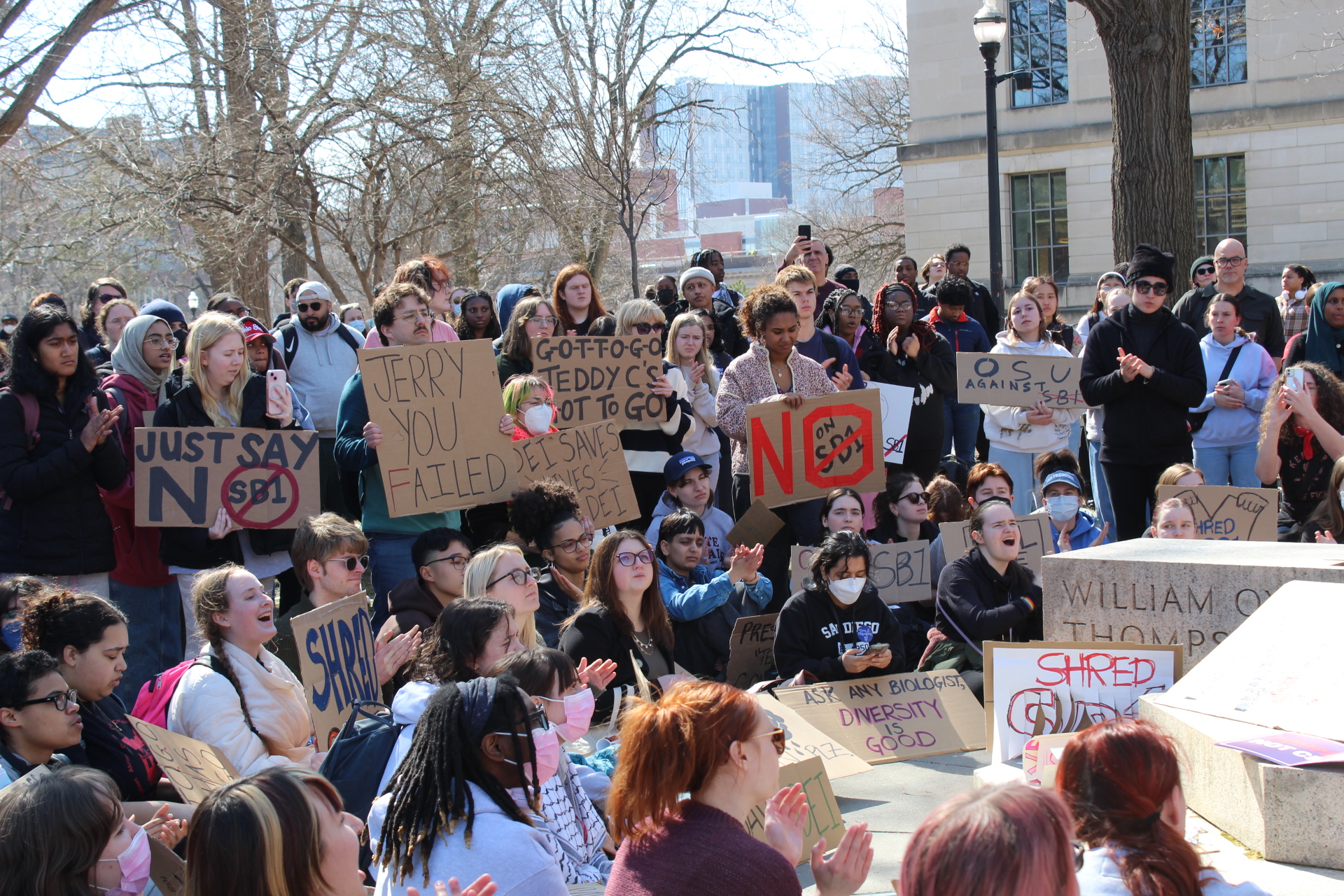
    Hundreds of students protested against Senate Bill 1 on Ohio State’s campus on March 4, 2025. (Photo by Megan Henry, Ohio Capital Journal).

    By:  Ohio Capital Journal

    Ohio college students, faculty and staff are calling on Gov. Mike DeWine to veto a massive higher education bill that would ban diversity and inclusion on campus and prevent faculty from striking.

    Lawmakers concurred with tweaks made to Senate Bill 1 during Wednesday’s Senate session, sending the bill to DeWine’s desk for his signature. DeWine received the bill Wednesday and has 10 days to sign the bill into law or veto it. If DeWine vetoes the bill, lawmakers would need a 3/5 vote from each chamber to override it.

    DeWine, however, has previously said he would sign the bill.

    GET THE MORNING HEADLINES.


    S.B. 1 would set rules around classroom discussion, create post-tenure reviews, put diversity scholarships at risk, create a retrenchment provision that blocks unions from negotiating on tenure, shorten university board of trustees terms from nine years down to six years, and require students take an American history course, among other things.

    For classroom discussion, the bill would set rules around topics involving “controversial beliefs” such as climate policies, electoral politics, foreign policy, diversity and inclusion programs, immigration policy, marriage, or abortion, and forbid “indoctrination,” though that remains undefined. S.B. 1 would only affect Ohio’s public universities.

    “Republicans showed us they’d rather gamble with our economic future than solve real problems in our state,” Ohio Democratic Party Chair Elizabeth Walters said in a statement. “Instead of growing our state, Republicans are driving students, young adults, and business away from Ohio. We’re urging Governor DeWine to do the right thing and veto this legislation.”

    The Ohio Senate Democratic Caucus sent a letter to DeWine urging him to veto S.B. 1.

    “This legislation is a misguided attempt by overreaching legislators to impose their ideological beliefs on our public universities,” the letter said. “The bill undermines academic freedom, attacks collective bargaining rights, and jeopardizes the future of higher education in our state.”

    The Ohio House Minority Caucus also sent a letter to DeWine asking him to veto the bill. 

    “You have an opportunity to protect the future of Ohio’s institutions of higher education, and your legacy as Ohio’s governor, by vetoing this bill and requiring the legislature to negate terms that are more amenable to the will of Ohioans,” the letter read.

    The ACLU of Ohio wants DeWine to veto S.B. 1 and protect free speech on campus.

    “By dismantling DEI structures, Senate Bill 1 sends a clear, harmful message to students that their unique backgrounds, experiences, and perspectives are not welcome in Ohio,” ACLU of Ohio Policy Director Jocelyn Rosnick said in a statement.

    Anticipating S.B. 1 would pass during Wednesday’s Senate session, members of the Ohio Legislative Black Caucus urged DeWine to veto S.B. 1 during a press conference earlier that day.

    “This is one of the worst government overhauls that I’ve seen to date,” said state Rep. Terrence Upchurch, D-Cleveland. “It will not only limit our First Amendment right to free speech, ban strikes and collective bargaining rights for professors, it threatens opportunities for our students, undermines workforce development and disproportionately harms black and minority communities.”

    State Rep. Desiree Tims, D-Dayton, said S.B. 1 is toxic, racist and a threat to free speech and academic freedom.

    “Since when is diversity, equity and inclusion a bad thing?” she asked. “Why is this necessary? The only answer is, so that we can move backwards, pre-civil rights … progress that this country and this nation has stood for. … Senate Bill 1 turns the ugly page back in history, somewhere we do not want to go, where we should not go.”

    Ohio University Journalism School Director Eddith Dashiell talked about how the university’s journalism school did not give out 12 race-based scholarships totaling $46,000 last year after the U.S. Supreme Court ruled against race-conscious admissions in 2023.

    “The diversity scholarships weren’t designed to discriminate against white students,” she said. “The diversity scholarships were designed to encourage more students of color to come to little old, white Athens, Ohio and get a quality education.”

    S.B. 1 will be detrimental to Ohio’s higher education, Dashiell said.

    “If it hadn’t been for an extra effort at Ohio University to diversify the faculty, I would still be in Tennessee,” she said. “We also urge that Governor DeWine veto this bill because it’s going to hurt our students. It’s going to hurt those who will benefit from diversity programs and benefit from these diversity scholarships.”

    Ohio State University’s Chair of the Undergraduate Black Caucus Jessica Asante-Tutu said this bill runs the risk of forcing Ohioans to move out of state.

    “Students learn best in environments that encourage exchanges, where ideas flow freely and where differences are respected,” she said. “This bill stifles all of that.”

    As an Olentangy Liberty High School student in Delaware County, Michelle Huang said S.B. 1 hangs over her head as she thinks about applying for colleges this fall.

    “The threat of this bill passing is a deterrent from us attending Ohio State in the first place,” she said. “What DEI is actually doing is actually promoting more discourse and promoting more intellectual diversity.”

    Follow Capital Journal Reporter Megan Henry on Bluesky.

    YOU MAKE OUR WORK POSSIBLE.

    _______________
    Megan Henry
    Megan Henry

    Megan Henry is a reporter for the Ohio Capital Journal and has spent the past five years reporting in Ohio on various topics including education, healthcare, business and crime. She previously worked at The Columbus Dispatch, part of the USA Today Network.

    Ohio Capital Journal is part of States Newsroom, the nation’s largest state-focused nonprofit news organization.

    MORE FROM AUTHOR

  • Ohio higher ed overhaul to ban diversity efforts and regulate classroom discussion heads to governor

    Ohio higher ed overhaul to ban diversity efforts and regulate classroom discussion heads to governor

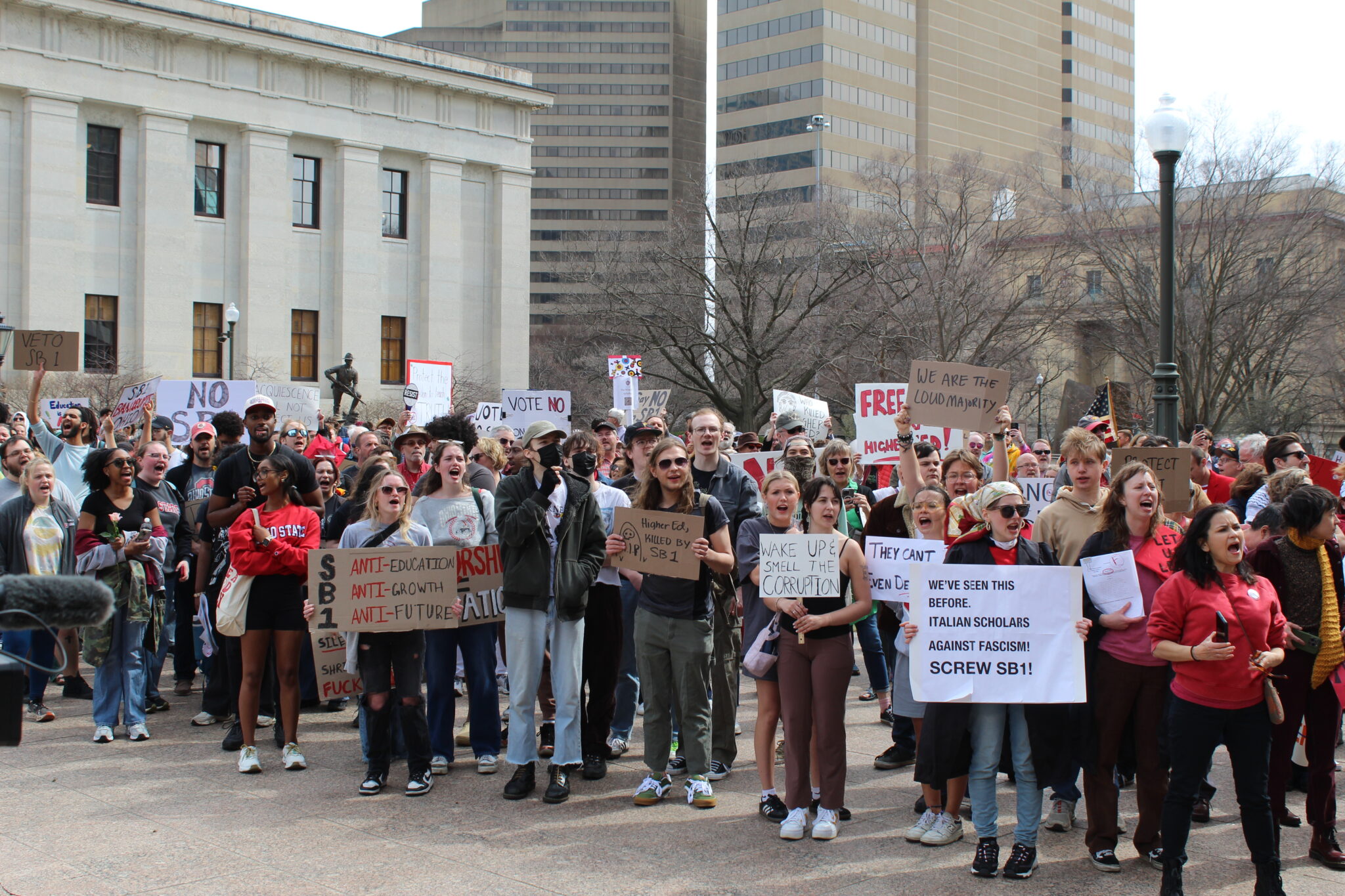
    Ohio college students and protesters rally at the Statehouse on March 19, 2025, against Senate Bill 1, a higher education overhaul that bans diversity efforts and faculty strikes, and sets rules around classroom discussion, among other things. (Photo by David DeWitt, Ohio Capital Journal.)

    By:  Ohio Capital Journal

    A controversial bill to overhaul Ohio higher education, ban diversity and inclusion efforts, prohibit faculty from striking, and regulate classroom discussion is heading to Ohio Gov. Mike DeWine’s desk for his signature.

    The Ohio Senate concurred with changes made to Senate Bill 1 by the Ohio House during Wednesday’s session. The vote was 20-11 with only two Republicans voting against it, state Sens. Louis W. Blessing III, of Colerain Township, and Thomas F. Patton, of Strongsville, voting against it. DeWine has previously said he would sign S.B. 1 into law.

    DeWine will have 10 days to sign the bill into law or veto it once he receives it. If DeWine vetoes the bill, lawmakers would need a 3/5 vote from each chamber to override it.

    GET THE MORNING HEADLINES.


    S.B. 1 would set rules around classroom discussion, create post-tenure reviews, put diversity scholarships at risk, create a retrenchment provision that block unions from negotiating on tenure, shorten university board of trustees terms from nine years down to six years, and require students take an American history course, among other things.

    For classroom discussion, the bill would set rules around topics involving “controversial beliefs” such as climate policies, electoral politics, foreign policy, diversity and inclusion programs, immigration policy, marriage, or abortion. S.B. 1 would only affect Ohio’s public universities.

    State Sen. Jerry Cirino, R-Kirtland, introduced S.B. 1, which passed the Ohio Senate last month and the Ohio House last week.

    “I am delighted, of course, as I always believed this is a great bill for the state of Ohio, for students and for higher education, so I’m delighted that we’ve been able to get past this next hurdle and send the bill to the governor’s desk,” Cirino said.

    S.B. 1 has received significant pushback. More than 1,500 people have submitted opponent testimony against the bill. Hundreds of students around the state have protested against the bill. Students and faculty have said they would leave Ohio if the bill becomes law.

    “We decided on a different approach than many, many of them would like,” Cirino said when asked about the bill’s overwhelming opposition. “But this isn’t about how many people show up to protest or to testify in hearings. A lot of those students that were showing up where, I believe, they were being paid or getting extra credit. And we don’t make policy here based on the number of people that show up to protest or testify.”

    Senate President Rob McColley, R-Napoleon, said the passing of S.B. 1 is long overdue.

    “It’s something that, frankly, should have been done sooner, but I’m happy we put the work in to get to where we are right now,” he said. “I do think it’s something that’s supported by Ohioans.”

    Before voting to concur on S.B. 1, lawmakers debated the bill for about 35 minutes.

    “Senate Bill 1 will enrich the learning experience of students at our public universities and colleges — places where our best and brightest will be able to learn without prejudice, speak their minds without being canceled, be honest about their positions without fear of faculty retaliation, and consider all sides of an issue and make up their own minds,” said Sen. Kristina Roegner, R-Hudson.

    State Sen. Michele Reynolds, R-Canal Winchester, acknowledged that some people are afraid of what will happen if DEI on college campuses is ended through this bill, but said the time has come to remove DEI labels.

    “This is not about censure or erasure,” she said. “It’s not about exclusion. It’s about inclusion that transcends labels, because DEI has become a system that sorts us. It sorts us by race, by gender and by identity, creating a culture where we are defined by our categories instead of our character, where we look at each other’s faces instead of listening to each other’s hearts.”

    State Sen. Kyle Koehler, R-Springfield, said this bill ends the micromanaging of instruction in higher education.

    “All Ohio college students and parents will now have a more comfortable feeling that their public institution of higher learning will foster an environment of open and free expression for everyone,” he said.

    Senate Minority Leader Nickie Antonio, D-Lakewood, said not everyone is celebrating the concurrence of S.B. 1.

    “Instead of tackling the real barriers to higher education — skyrocketing tuition costs and student debt — again, the majority are focused on dictating what’s taught in our colleges and universities and who teaches,” she said.

    State Sent. Kent Smith, D-Euclid, said this bill will inhibit Ohio universities from attracting top-tier professors.

    “If Senate Bill 1 becomes law, this legislation is the worst attack on academic freedom in Ohio in modern history,” Smith said.

    Follow Capital Journal Reporter Megan Henry on Bluesky.

    YOU MAKE OUR WORK POSSIBLE.

    ____________
    Megan Henry
    Megan Henry

    Megan Henry is a reporter for the Ohio Capital Journal and has spent the past five years reporting in Ohio on various topics including education, healthcare, business and crime. She previously worked at The Columbus Dispatch, part of the USA Today Network.

    Ohio Capital Journal is part of States Newsroom, the nation’s largest state-focused nonprofit news organization.

    MORE FROM AUTHOR

    _____________

    BECOME A LOVELAND MAGAZINE SUPERFAN BY DONATING NOW!

    Editor’s note: Open and free local reporting is critical to having well-informed community. Loveland Magazine has published a free newspaper and website for the last 20 years for our community. If you would like us to continue, kindly contribute to this service. It would be greatly appreciated. Donations may be made to: Loveland Magazine, 243 Wall Street, Loveland, Ohio 45140. Or, donations can be made through PayPal using a credit card. (https://bit.ly/4j1ju3k) Advertisers do not nearly cover all of our expenses.

  • Did politics kill Women’s History Month at Ohio University?

    Did politics kill Women’s History Month at Ohio University?

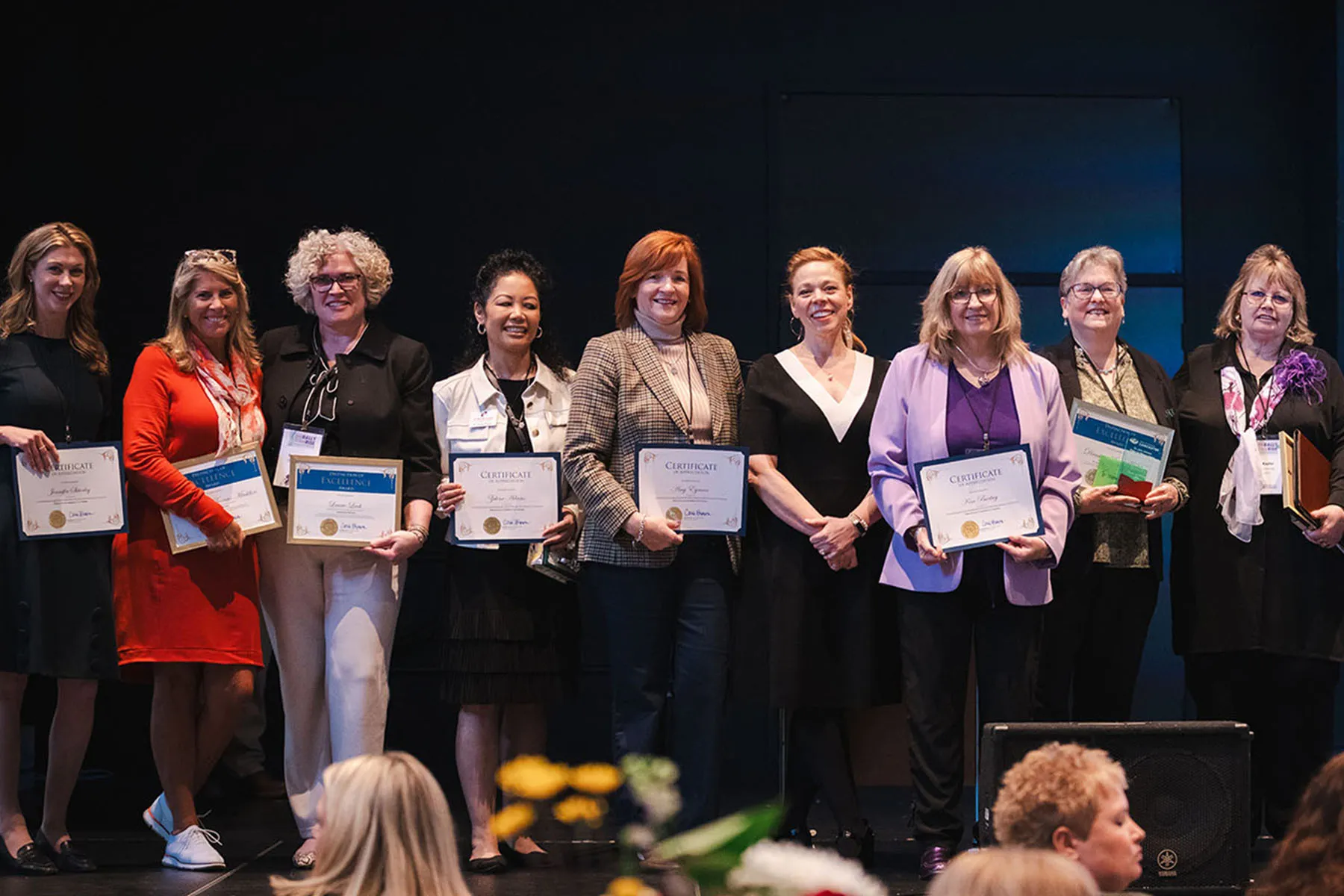
    Honorees at the We Rally & We Rise Women’s Conference pose for a group photo in Lancaster, Ohio, on March 21, 2025. Kim Barlag, third from right in a purple suit, helped organize the independent event after Ohio University canceled its longtime Women’s History Month celebration following new federal guidance on anti-discrimination policies. (Megan Cardenas/OH Creative Studios for We Rally We Rise)

    Amanda Becker

    Read Amanda Becker’s Loveland connection in her Bio below.

    This story was originally reported by Amanda Becker of The 19th. Meet Amanda and read more of her reporting on gender, politics and policy.

    Lancaster, Ohio –  Kim Barlag knew she couldn’t let women be canceled.

    For nearly two decades, Ohio University’s Lancaster campus hosted an annual conference to “promote and advance gender equity by recognizing the past, present, and future achievements of women from diverse ages and backgrounds.” Known as Celebrate Women, it featured awards honoring women in leadership, panels on business and civic engagement and service opportunities. The plan for this year was to collect food and school supplies for university students facing financial hardship.

    Celebrate Women became a much-anticipated Women’s History Month tradition in this central Ohio city of 40,000, just 30 miles southeast of Columbus, the state capital. But then, on the eve of its 19th year, politics intervened.

    On March 6, two weeks and a day before the event, Ohio University announced that the conference had been “placed on hold … in light of recent guidance from the Department of Education’s Office for Civil Rights,” which threatened to withhold federal funding to institutions that do not conform to the Trump administration’s notion of anti-discrimination. The university’s decision followed the cancellation of a reunion for Black alumni, another regular occurrence in previous years.

    When she heard the news about the women’s conference, Barlag, herself an alumnus and the president of the Chamber of Commerce in nearby Pickering, cycled through a series of emotions: disappointment, sadness, anger, resolve.

    “I guess I should have seen it coming after that happened, but I was still surprised,” she told The 19th. “I was pretty devastated. I shed a few tears. Then I thought: Action makes people feel better. How can we save this event? We needed to act fast.”

    She called and emailed other women leaders in the area — including some who, like her, had been scheduled to participate in Celebrate Women panels — to gauge their interest in reviving the conference as a non-university event. Their response, Barlag said, was “gung ho.” The plans for the new event came together quicker than Pam Kaylor, a communications professor who organized Celebrate Women for the university, was able to notify participants of the previous one’s cancellation.

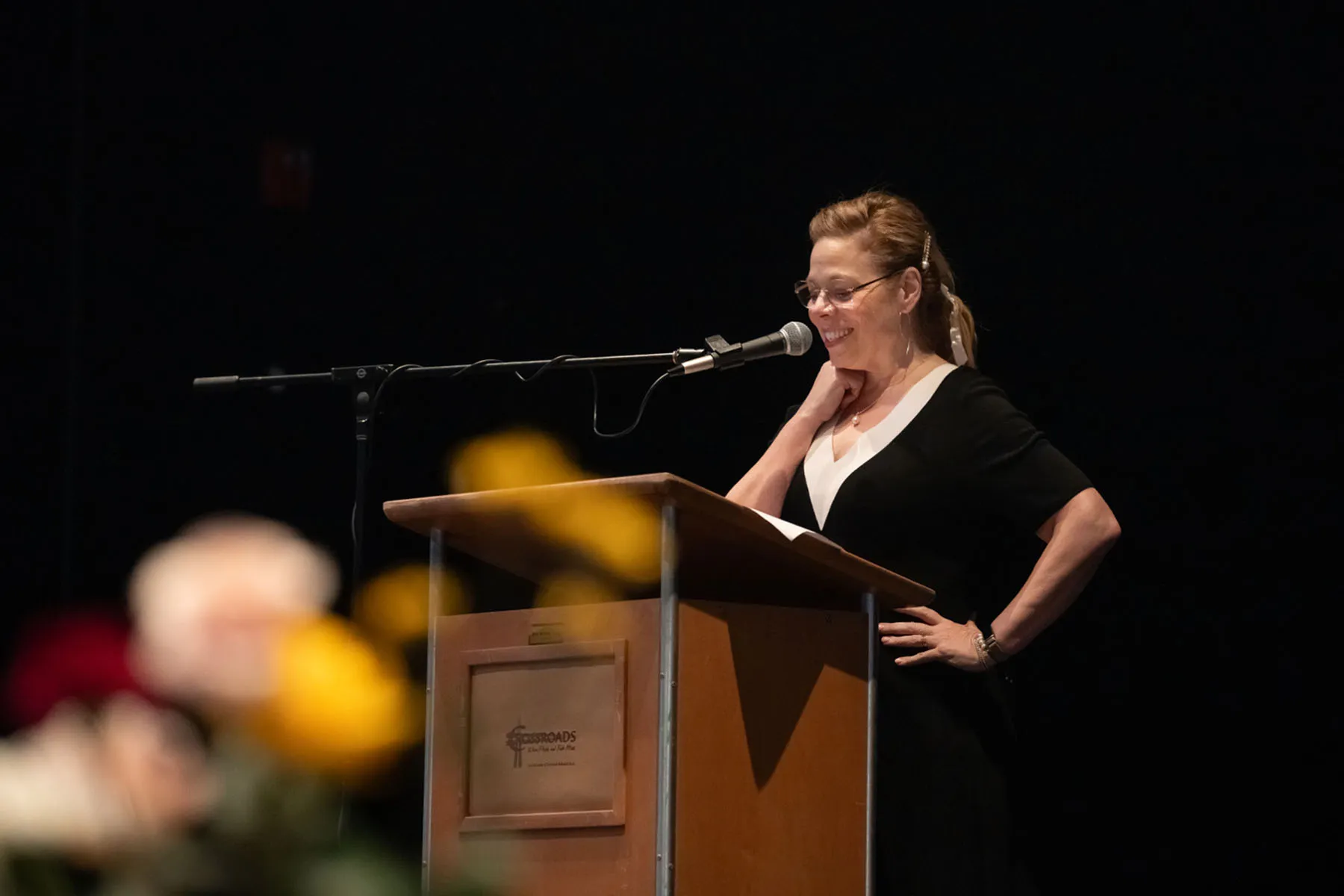
    The independent event had a new name, We Rally & We Rise Women’s Conference, and it brought together some 300 women at the Crossroads Event Center in Lancaster last week. Many Celebrate Women sponsors shifted their support and some new sponsors signed on, angry about the cancellation — Barlag took to calling it “mad money.” Organizers handed out branded tote bags and notebooks. The event raised money for local nonprofit organizations. Speakers shared strategies to conquer anxiety and impostor syndrome. The boxed lunches were made by a nonprofit caterer that employs survivors of sex trafficking. The writing on the back of attendees’ name tags captured the vibe: “Welcome All BABS!!! BAD ASS BITCHES. Yes, you read that correctly.”

    As Barlag opened the conference, the audience’s enthusiastic response “set me off my game there for a minute” because “it was so powerful and inspiring,” she later said.

    “The energy was great — people were grateful to have a conference to attend, to be together, a show of force in support,” she added.

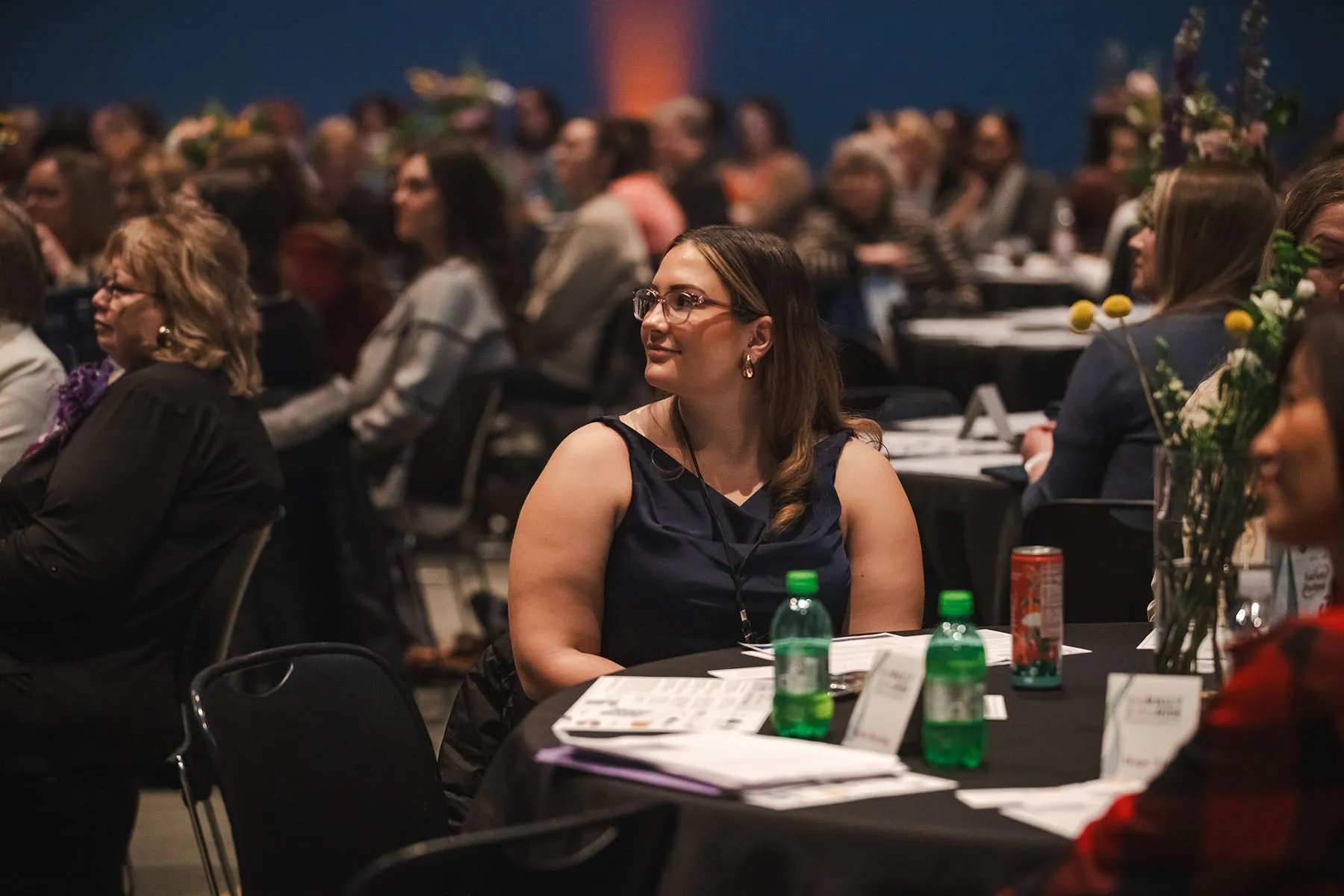
    A woman seated at a table smiles as she listens to speakers during the We Rally & We Rise Women’s Conference.
    A woman listens during the We Rally & We Rise Women’s Conference in Lancaster, Ohio, on March 21, 2025. Hundreds gathered at the independently organized event after the university-backed celebration was canceled. (Megan Cardenas/OH Creative Studios for We Rally We Rise)


    Lancaster may be close to the state’s capital, but it’s the county seat in an agricultural region of pig and cattle farms. Lancaster itself is known for its glassware — the hometown company, Anchor Hocking, is named for the Hocking River, which snakes through the city. Once one of the world’s largest manufacturers of glassware, Anchor Hocking went through a merger, then a bankruptcy. Like in so many small cities and towns, Lancaster’s historic downtown became a symbol of economic decline in the post-industrial Rust Belt. In recent years, though, Lancaster’s population began to tick up again.

    Fairfield County is a Republican stronghold in presidential elections. President Lyndon Johnson, in 1968, is the only Democrat who has won there since 1944. Republican President Donald Trump’s America-first economic message resonated with voters who have watched Lancaster struggle, then rebound. In 2024, close to 62 percent of the county’s voters cast ballots for Trump and Vice President JD Vance, who was then one of the U.S. senators for Ohio. The state, a one-time presidential bellwether that has in recent cycles grown more conservative, backed Trump over Democratic Vice President Kamala Harris by 55-to-44 percent.

    In this slice of Trump Country, personal interpretations of the reasons for the cancellation of Celebrate Women are a sort of political Rorschach test. Some left-leaning voters believe it was the inevitable result of Trump’s assault on diversity, equity and inclusion, or DEI, a broad concept that his administration has deployed to challenge and threaten institutions deemed too liberal. Some conservative-leaning voters believe the cancellation to be an overly cautious move by the university — and potentially a way to make the new administration look bad.

    One thing on which women on both sides agree is that they should not be silenced.

    “There is dissent about how we came to this place,” Fairfield County Auditor Carri Brown, an elected Republican, acknowledged during her opening remarks. But “when we’re told we cannot celebrate women, we’ll respond by saying, ‘Yes we can’ … and we’ll rally and we’ll rise!”

    When she described diversity as “not a bad word” but a “blessing,” the crowd applauded and some rose to their feet. “I have a very strong faith in America,” Brown said.

    Fairfield County Auditor Carri Brown delivers opening remarks on stage at the We Rally & We Rise Women’s Conference.
    Fairfield County Auditor Carri Brown delivers opening remarks during the We Rally & We Rise Women’s Conference.
    (Megan Cardenas/OH Creative Studios for We Rally We Rise)


    Ohio University’s decision to cancel the Celebrate Women event is the latest skirmish between conservative politicians and the elite institutions of higher education that they have long charged with being hostile to their political viewpoints, with so-called DEI efforts at colleges and universities now front and center to their case.

    A February 14 “dear colleague” letter from the civil rights office of Trump’s Department of Education to colleges and universities alleged an “embrace of pervasive and repugnant race-based preferences and other forms of racial discrimination” at the expense of White students. It noted that federal law “prohibits covered entities from using race in decisions pertaining to admissions, hiring, promotion, compensation, financial aid, scholarships, prizes, administrative support, discipline, housing, graduation ceremonies, and all other aspects of student, academic, and campus life.” Noncompliance would risk the federal funding that nearly all colleges and universities receive.

    Though the letter made no direct mention of gender, it put university administrators on alert as they sought to identify any programming that could jeopardize their funding. When the Department of Education, which Trump now seeks to dismantle, launched investigations against more than 50 education institutions, it included two in Ohio: the University of Cincinnati and the Ohio State University.

    Judith Cosgray, a librarian and leader of an arts nonprofit who has attended Celebrate Women on and off for the past 15 years, described its cancellation as a balloon deflating when its attendees most needed a lift.

    “I understand that they’re afraid of losing their funding, I understand that, but sometimes you’ve got to stand up, too,” Cosgray said in between conference sessions.

    In addition to the various executive orders and directives that Trump has made about DEI, the Ohio legislature, where Republicans hold a veto-proof majority in part due to unconstitutional gerrymandering, recently approved a higher education bill that bans DEI training, scholarships and offices, and contains admonitions about teaching “controversial” topics. It is expected to be sent to GOP Gov. Mike DeWine for his signature as early as this week.

    A spokesperson for DeWine did not respond to a request to comment on whether he will sign the anti-DEI legislation or if, by his estimation, events like Celebrate Women would fall under its purview. The office of GOP state House Speaker Matt Huffman likewise did not respond to the same question by publication time.

    Mike DeWine speaks to the press at the Republican National Convention.
    Ohio governor Mike DeWine speaks to the press on the first day of the Republican National Convention on July 15, 2024 in Milwaukee, Wisconsin.
    (Andrew Harnik/Getty Images)


    Celebrate Women isn’t the only recent example of how the assault on DEI across public life has led to a seeming prohibition on celebrating the accomplishments of women, with many actions taken during March, the month specifically earmarked to remember such events.

    Information about the first woman to pass Marine infantry training was among some 26,000 photos and online posts marked for deletion as part of a DEI purge at the Defense Department, the Associated Press reported. A page about Golden Girls actor Bea Arthur, one of the first to serve in the Marine Corps Women’s Reserve, also disappeared. There are reports that Arlington National Cemetery scrubbed its website of references related to notable women veterans.

    It isn’t limited to women. A Defense Department webpage that described the military service of Black civil rights icon and baseball player Jackie Robinson disappeared — and then reappeared. Information about the Tuskegee Airmen, the first Black military pilots who served in World War II, when the U.S. military was still segregated, has also vanished. Outcry over the removal of webpages about the Navajo Code Talkers who served during the same war led to their restoration. “History is not DEI,” Pentagon spokesperson Sean Parnell said as the department scrambled to respond.

    Tabitha Stover, a financial adviser who describes herself as liberal, attended Celebrate Women for the first time last year. Despite spending most of her life in Lancaster, she didn’t know anyone at the event, but found the group kind and inviting. She was disappointed to hear this year’s conference would not move forward, then heartened when We Rally & We Rise took its place. She has vacillated about who was to blame, but described it as an event that brings people together instead of driving them apart.

    Stover shared a table with a group of colleagues from the area branch of a national nonprofit organization focused on youth mentorship. Several of them are friends of hers on Facebook; she knows the women have what she called “very different” politics from one another.

    “And yet we’re all here sitting at the same table,” Stover said.

  • Ohio House Republicans pass higher education overhaul to ban diversity efforts and faculty strikes

    Ohio House Republicans pass higher education overhaul to ban diversity efforts and faculty strikes

    The bill also sets rules around classroom discussion and puts scholarships at risk. It now goes back to the Ohio Senate.

    By:  Ohio Capital Journal

    This story will be updated.

    Ohio House Republican lawmakers voted to pass a massive higher education overhaul bill Wednesday that would ban diversity and inclusion efforts and prevent faculty from striking.

    State Sen. Jerry Cirino, R-Kirtland, introduced S.B. 1, which passed the Ohio Senate last month.

    Now that it’s been passed by the House, it now heads back to the Ohio Senate for concurrence with changes made to the bill by the House.

    Ohio Senate President Rob McColley, R-Napoleon, said Wednesday the Senate will concur with House changes at a later date.

    After the Senate concurs with the House changes, the bill will go to Ohio Gov. Mike DeWine’s desk and DeWine will have 10 days to sign the bill into law or veto it once he receives it. If DeWine vetoes the bill, lawmakers would need three-fifths vote from each chamber to override it.

    In addition to the bans on diversity efforts and faculty strikes, S.B. 1 would also set rules around classroom discussion, create post-tenure reviews, put diversity scholarships at risk, create a retrenchment provision that block unions from negotiating on tenure, shorten university board of trustees terms from nine years down to six years, and require students take an American history course, among other things.

    For classroom discussion, the bill would set rules around topics involving “controversial beliefs” such as climate policies, electoral politics, foreign policy, diversity and inclusion programs, immigration policy, marriage, or abortion. S.B. 1 would only affect Ohio’s public universities.

    The Ohio House Higher Education Committee voted the bill out of committee Wednesday morning with a 9-4 party-line vote after listening to people testify in support of the bill.

    The committee also approved amendments to S.B. 1 that would require universities to stop accepting funds for scholarships with diversity and inclusion requirements four years after the bill becomes law.

    Another amendment requires the Chancellor of Higher Education to do a diversity study of students enrolled in universities based on race, ethnicity, and biological sex and submit the report to lawmakers within six years.

    Outside of the Ohio Statehouse, a mass of college students and protesters rallied against the bill, saying it would destroy freedom of thought and expression on university campuses and push students out-of-state.

    Follow Capital Journal Reporter Megan Henry on Bluesky.

    GET THE MORNING HEADLINES.

    YOU MAKE OUR WORK POSSIBLE.

    _______________
    Megan Henry
    Megan Henry

    Megan Henry is a reporter for the Ohio Capital Journal and has spent the past five years reporting in Ohio on various topics including education, healthcare, business and crime. She previously worked at The Columbus Dispatch, part of the USA Today Network.

    Ohio Capital Journal is part of States Newsroom, the nation’s largest state-focused nonprofit news organization.

    MORE FROM AUTHOR

  • Ohio GOP lawmaker again proposes to overhaul higher ed, ban diversity efforts and labor strikes

    Ohio GOP lawmaker again proposes to overhaul higher ed, ban diversity efforts and labor strikes

     Ohio State Sen. Jerry Cirino, R-Kirtland, introduced Senate Bill 1 on Jan. 22, 2025. (Photo by Megan Henry, Ohio Capital Journal).

    Cirino’s proposed overhaul failed to move forward under previous Ohio House Speaker Jason Stephens, but has new potential life under Speaker Matt Huffman

    By:  Ohio Capital Journal

    A Republican state senator has reintroduced a controversial proposal to massively overhaul higher education in Ohio, including a ban on diversity and inclusion efforts as well as a ban on labor strikes by faculty and staff.

    Kirtland Republican state Sen. Jerry Cirino’s proposed Senate Bill 1 — the Advance Ohio Higher Education Act — was introduced during a press conference Wednesday and is similar to the bill Cirino introduced during the last General Assembly, with some additions.

    “It’s called Senate Bill 1 for a reason,” Cirino said. “It is our top priority, and we’re going to move this along quickly. … We’ve already had a lot of hearings on Senate Bill 83.”

    He said the bill is going to be on a fast track and Senate Higher Education Committee Chair Kristina Roegner said hearings on the bill will likely start next week.

    “We are promoting more speech, not less speech, as some of our opponents have said, more discussion and debate on all topics, less indoctrination, institutional support by trustee actions and policy moves that we’re requiring the trustees to make, to support an environment of diversity of thought,” Cirino claimed.

    S.B. 1 includes “virtually everything from Senate Bill 83,” said Cirino, who is the vice chair of the Ohio Senate Higher Education Committee.

    GET THE MORNING HEADLINES.


    Cirino’s former higher education bill, Senate Bill 83, was unable to make it across the finish line during the previous General Assembly. It passed in the Senate and in the House committee, but former Ohio House Speaker Jason Stephens, R-Kitt Hill, never brought it to the House floor for a vote. The previous bill underwent 11 revisions.

    Cirino made good on his promise to reintroduce a similar bill in January and the bill could have an easier time in the House now that Matt Huffman, R-Lima, is the House Speaker.  Lawmakers in the Ohio House plan on introducing a companion bill.

    What is in S.B. 1?

    S.B. 1 has yet to be posted online, but Cirino said the bill includes a post-tenure review, annual performance reviews of faculty, a retrenchment provision that would block unions from negotiating on tenure and public syllabuses. The bill would prohibit political and ideological litmus tests in hiring, promotion, and admissions decisions.

    A big change with S.B. 1 is banning diversity, equity and inclusion courses in addition to the trainings. The former bill would have banned mandatory diversity, equity and inclusion training unless it is required to comply with state and federal law, professional licensure requirements or receiving accreditation or grants.

    “(DEI) has become institutionalized discrimination paid for by the taxpayers,” Cirino said.

    Ohio House Rep. Bob Young, R-Dayton, said the focus of the bill shouldn’t be the DEI ban.

    “Let’s truly focus on why we’re here and who we are in higher education, and that is to educate a workforce to compete globally and grow Ohio and jobs and families and attract more people to come in,” Young said.

    The on faculty and staff’s ability to strike is back in the bill, something Cirino claimed was not an anti-labor issue.

    “When a student signs up for instruction for a semester, they pay in advance, or they can’t go into the class,” Cirino said. “That represents a contract between the students and the institution, and because there are public institutions, therefore a contract with the state, they have to deliver that instruction and trade for the dollars per pen.”

    Youngstown State University workers went on strike for a few days in 2020 over pay disputes, and Wright State University went on strike for almost three weeks in January 2019 over pay disputes and health care.

    “The threat of (a strike) is what is used, and the students are being used as pawns in order to get better working hours, a better dental plan, or whatever the case may be,” Cirino said. “If we value higher education the way we do, we should also value the fact that that contract needs to be fulfilled, and nothing except force majeure should ever get in the way of students getting what they have paid in advance for.”

    S.B. 1 would shorten university board of trustees terms from nine years down to six years.

    “It’s been difficult to find trustees willing to make nine year commitments and the governor agrees with this,” Cirino said. “We’re talking about not just changing their terms, but also requiring new trustee training programs that would be adjudicated through the Chancellor’s Office.”

    Requiring students to take an American history course is also back in the bill.

    “I have become more and more convinced of that necessity over time now, since we first wrote the bill, as I’ve talked with more and more young people who have no clue about so many important things about our history and our founding documents and so on,” Cirino said.

    Opposition to S.B. 1

    Cirino acknowledged there will be lots of opposition with S.B. 1, just as there was with his previous bill.

    “Senate Bill 1 is a misguided attempt to micromanage higher education in Ohio, imposing unnecessary restrictions on our universities, faculty, and students,” state Sen. Casey Weinstein, D-Hudson, said in a statement.

    More than a dozen students from the Ohio Student Association protested S.B. 1 with chants of “When Black studies are under attack, what do we do? Stand up, fight,” and “Higher ed will be dead,” among others.

    “The students that were out here protesting are probably getting extra credit for being here,” Cirino said. “I don’t believe that they have studied the bill and all the implications of this legislation and the impact on higher education in Ohio. I believe that they were asked to be here by their professors.”

     Brielle Shorter, a 20-year-old Ohio State University student, protests against Senate Bill 1 on Jan. 22, 2025. (Photo by Megan Henry, Ohio Capital Journal). 

    Brielle Shorter, a 20-year-old Ohio State University student, was among the students who protested against the bill Wednesday.

    “No, we are not here for extra credit,” she said. “That’s not how this works. I believe that this bill is being pushed very fast and very rapidly.”

    Pranav Jani, president of the Ohio State University chapter of the American Association of University Professors and an English professor, said Cirino’s quip about students protesting for extra credit is “one of the most insulting things I’ve ever heard said about students.”

    “It shows how out of touch he is with what happens in the classroom,” Jani said.

    If this bill is signed into law, Shorter — who is from Cincinnati and wants to be a psychiatrist — said she would go out-of-state to continue her education.

    “I fear that I can no longer call Ohio my home,” Shorter said. “It feels like students are being pushed out, and it feels like I might be one of them.”

    Many college students have said they would move out of Ohio if this bill was signed into law, but Cirino called that “a red herring” during Wednesday’s press conference.

    Education organizations were quick to oppose S.B. 1.

    “(S.B. 1) uses culture war politics to attack workers’ rights and turn campuses into hostile environments for people of color, immigrants, and other marginalized communities,” Ohio Federation of Teachers President Melissa Cropper said in a statement.

    Ohio Conference of the American Association of University Professors Executive Director Sara Kilpatrick hopes Cirino will listen to the students’ concerns with this bill.

    “He’s not interested in hearing opposing views, which shows that this bill isn’t about intellectual diversity, but is actually about pushing a partisan agenda,” Kilpatrick said in a statement.

    Follow OCJ Reporter Megan Henry on Bluesky.

    YOU MAKE OUR WORK POSSIBLE.

    ________________
    Megan Henry
    Megan Henry

    Megan Henry is a reporter for the Ohio Capital Journal and has spent the past five years reporting in Ohio on various topics including education, healthcare, business and crime. She previously worked at The Columbus Dispatch, part of the USA Today Network.

    Ohio Capital Journal is part of States Newsroom, the nation’s largest state-focused nonprofit news organization.

    MORE FROM AUTHOR

  • Assault on DEI: Critics use simplistic terms to attack the programs, but they are key to uprooting workplace bias

    Assault on DEI: Critics use simplistic terms to attack the programs, but they are key to uprooting workplace bias

    FG Trade Latin/Gerry Images

    by The Conversation
    (Written by M. Cristina Alcalde, Vice President for Transformative and Inclusive Excellence at Miami University)

    ________________

    Prominent politicians have recently increased their attacks on workplace programs that promote diversity, equity and inclusion, or DEI. They claim that initiatives that seek to be inclusive are divisive and lack merit.

    President-elect Donald Trump has vowed to ban DEI from federal offices. And Vice President-elect JD Vance, an Ohio senator, in June 2024 introduced the “Dismantle DEI Act” to eliminate all DEI programs from the federal government. He argued, in part, that DEI “breeds hatred and racial division.”

    DEI critics are increasingly using the term “diversity hire” as an insult. As a scholar focused on gender and exclusion, I recognize that these attacks are often rooted in anti-Black racism.

    For example, despite Kamala Harris’ achievements as vice president and California attorney general, some Republicans targeted her as a “DEI hire” during her recent presidential run. And after the Francis Scott Key bridge collapse in Baltimore in March 2024, Utah State Representative Phil Lyman blamed Wes Moore, Maryland’s first Black governor, for prioritizing DEI over security.

    The DEI backlash has hit corporate America, too. Companies like spirits-maker Brown-Forman and the farm equipment manufacturer John Deere have reversed the DEI commitments they made following the 2020 murder of George Floyd by a white police officer.

    I believe all these attacks, both political and corporate, promote a distorted and incomplete story about DEI.

    The empirical evidence is clear

    There is no one-size-fits-all approach to advancing DEI initiatives. The common goal is to create spaces within an institution where everyone feels valued and respected and can thrive.

    2020 Gallup poll found that 24% of Black and Latino employees have experienced discrimination at work, compared with 15% of white employees.

    DEI efforts to identify and solve such issues include surveys, employee interviews and comparing practices across different organizations. They also entail assessments of systems, policies and research, and developing initiatives to address areas that need improvement.

    Employee and student surveys, for example, can measure the sense of belonging within an organization and help leaders identify areas in need of improvement.

    Evidence suggests that successfully implementing DEI is central to professional and societal well-being and success in a multicultural society.

    Maryland Governor Wes Moore speaks outdoors in front of a lectern.
    After the Francis Scott Key bridge collapse in Baltimore in March 2024, a Republican lawmaker from Utah blamed Maryland Gov. Wes Moore, center, for prioritizing diversity over security. AP Photo/Mark Schiefelbein


    Recent research by the author Melinda Epler, for example, shows a clear connection between employees’ sense of safety, belonging and satisfaction and how much their employer prioritizes DEI. Scientists also find that diversity is key to creative, productive and efficient scientific teams.

    And other research indicates that employees are more innovative and work harder when teams are made up of people with different experiences. This is why many employers value employees who can solve problems while working with people who have diverse backgrounds in terms of race, gender, religion, age and other factors.

    The outcome can be lucrative for companies: On U.S. and global executive staffs, studies show, efforts to improve DEI result in increased profits. Companies with at least one woman on their board, for example, financially outperform those with only men on their boards.

    Diversity standards

    Despite the many ways leaders of an organization can work to cultivate an inclusive and respectful culture, DEI critics tend to portray this work in simplistic terms.

    For example, two Stanford University academics misrepresented DEI efforts recently. In an August 2024 op-ed in The New York Times, they presented DEI as mainly consisting of one-time trainings that divide groups into oppressors and the oppressed.

    Narrowly defining DEI in such simplistic ways ignores the bridge-building involved in DEI efforts and makes it easier to repeat the single story that DEI has failed.

    In her 2009 TED Talk on the danger of the “single story,” novelist Chimamanda Adichie said single stories, or narratives that only present one perspective, are based on stereotypes and incomplete information. They result in false assumptions and generalizations.

    “To create a single story is to show a people as one thing, as only one thing, over and over again,” Adichie said. “And that is what they become.”

    Adichie’s warnings about the single story sheds light on the effects of attacks on DEI. Reducing DEI to simplistic “us vs. them” approaches or to a focus on “oppressor vs. oppressed” misses much of the work.

    Yet the more societal problems Republicans in power blame DEI for – from racism to inflation – the more believable the story of DEI failure becomes. The absence of quick, easy solutions for historical racial and socioeconomic inequities are presented as further proof of DEI’s failure.

    Teaching a fuller story

    DEI is not easy to do well. But as a DEI practitioner and scholar, I find working to create inclusive spaces through curiosity, learning and dialogue can be transformative.

    The more institutions do to support welcoming, supportive spaces – where people’s differences are respected – the healthier and more successful everyone is as individuals and organizations.

    In 2022, my team in the Office of Transformational and Inclusive Excellence developed a Religious Observances and Inclusive Scheduling calendar. We did so to recognize religious pluralism in our university community.

    A group of people form a circle with their clenched fists.
    Research shows that employees are more innovative and work harder when teams are made up of people with different experiences. FG Trade Latin/Gerry Images


    We followed up with educational posters in 2023. The next year, we launched an educational video series featuring students discussing their religious practices. We partnered with the university’s communications office and athletics office to create and show these videos at university athletic events, such as football and basketball games.

    In January 2024, the office I lead at Miami University partnered with several other departments to launch what we called a Constructive Dialogue Initiative. The goal of this new project is to provide all students with concrete skills and opportunities to communicate across social and cultural differences and to decrease polarization. Students first engage with short online modules from the Constructive Dialogue Institute. They then apply strategies learned online to facilitate in-person, peer-to-peer dialogues.

    Our pilot program showed very positive results. Among the nearly 100 student leaders who participated, 78% felt less polarized.

    This work is important for universities, where research shows retention and graduation rates are tied to students’ sense of belonging.

    Collaboration and communication across differences are central to successful DEI efforts.

    This is why we launched the DEI in Leadership Certificate in 2022. That same year, the project won an international Telly Award, which recognizes excellence in video.

    Those who have participated in the certificate have included leaders and employees in the health, legal, human resources, criminal justice and nonprofit sectors across the U.S.

    The narrow, single story of DEI failure promoted by critics makes it very difficult to recognize the value of these efforts.

    Simplistic single stories can be appealing. They do not reflect reality, though. The fuller story presents a much more useful way to advance shared goals — as a society that is deserving of systems in which everyone can be included and valued.

  • Jean Schmidt’s newest ‘divisive concepts’ bill enters Ohio House

    Jean Schmidt’s newest ‘divisive concepts’ bill enters Ohio House

    Prohibits all Ohio schools from “teaching or providing training that promotes or endorses divisive or inherently racist concepts.”

    BY: SUSAN TEBBEN –  Ohio Capital Journal

    The newest bill to regulate school curriculums and keep out what legislators see as “divisive concepts” entered the Ohio House on Tuesday.

    State Reps. Jean Schmidt, R-Loveland, and Mike Loychik, R-Bazetta, brought House Bill 616 to the State and Local Committee, which prohibits all Ohio schools from “teaching or providing training that promotes or endorses divisive or inherently racist concepts.”

    Though the co-sponsors said they want to deputize the State Board of Education with making decisions about what those concepts would be, the bill includes “critical race theory,” a misnomer used by conservatives to refer to the teaching of race in American history, and name the “1619 Project,” a New York Times project that laid out the chronology of slavery and racism, as concepts that would be prohibited under the bill.

    “Diversity, equity and inclusion learning outcomes” (DEI) are also named as “divisive or inherently racist concepts” under the bill. When asked to explain DEI and why it’s being prohibited, Loychik connected DEI to “critical race theory,” saying the two are connected based on research he and Schmidt had made.

    “The word ‘critical race theory’ was not very well accepted at that point in time, so it was re-developed into DEI – diversity, equity and inclusion – and based off our research, like I said before, it’s very, very similar to the teachings under critical race theory,” Loychik told the committee.

    DEI trainings have been used in schools to train employees about learning disparities that can happen in education.

    The well-known conservative public policy think tank The Heritage Foundation connects CRT and DEI, saying diversity trainings “pressure employees to become activists or to discuss controversial topics in the workplace.”

    Part of the bill prohibits teaching kindergartners about topics related to gender.

    “It ensures that sexual orientation and gender ideology are not taught in kindergarten through third grade,” Loychik said. “Starting in fourth grade it must be age appropriate.”

    Loychik has made his feelings on gender in schools clear through posts on his Twitter, in which he said “the left thinks a 6-year-old should be able to change their gender but an 18-year-old shouldn’t be able to buy a firearm,” and asks for support not to allow “teaching transgenderism or allowing teachers to discuss their sex life with kindergarteners.”

    Under the newest bill, the State Board of Education would also be required to “establish a procedure by which individuals may file complaints against a teacher, school, administrator, or school district superintendent alleging a violation of the bill’s prohibitions and to adopt rules to govern the implementation of and monitor compliance with the bill’s provisions,” according to Legislative Service Commission analysis of the bill.

    Democratic committee members pushed back on the bill’s language, decrying it as “censorship” and questioning the vague language used, and the state board of education’s role in defining the off-limits topics in school curricula.

    “That’s the responsibility of legislators to define these terms,” said state Rep. Mike Skindell, D-Lakewood.

    The co-sponsors said they would be willing to consider amendments to the bill, but said the focus of the bill is on curriculum, not disciplinary regulations or hallway disagreements.

    Loychik said the school district’s role would be to address disciplinary problems, and “hall monitors” could deal with school-day disagreements regarding “divisive concepts.”

    Schmidt said “invited guests,” such as state legislators, would be allowed to “talk about what they want to talk about,” because it’s not a part of the curriculum, answering a question from state Rep. Tavia Galonski, D-Akron.

    “There is a lot to discuss in the schools, and by no means would any kind of prohibition or any type of censorship be the answer for it,” Galonski said.

    Education groups like Honesty for Ohio Education have criticized the bill as a “nationally coordinated educational gag order.”

    This is the third “divisive concepts” bill to come through the Ohio legislature, with the last bill receiving heavy criticism after one of the co-sponsors said equal time should be given on both sides of Holocaust lessons. Neither bill has passed through the General Assembly.