Tag: Department of Education

  • Ohio Republicans celebrate Trump’s executive order to get rid of the Department of Education

    Ohio Republicans celebrate Trump’s executive order to get rid of the Department of Education

    The executive order does not automatically close the Department of Education since eliminating a federal agency requires congressional approval.

    By:  Ohio Capital Journal

    Ohio Republicans praised President Donald Trump’s executive order to dismantle the U.S. Department of Education.

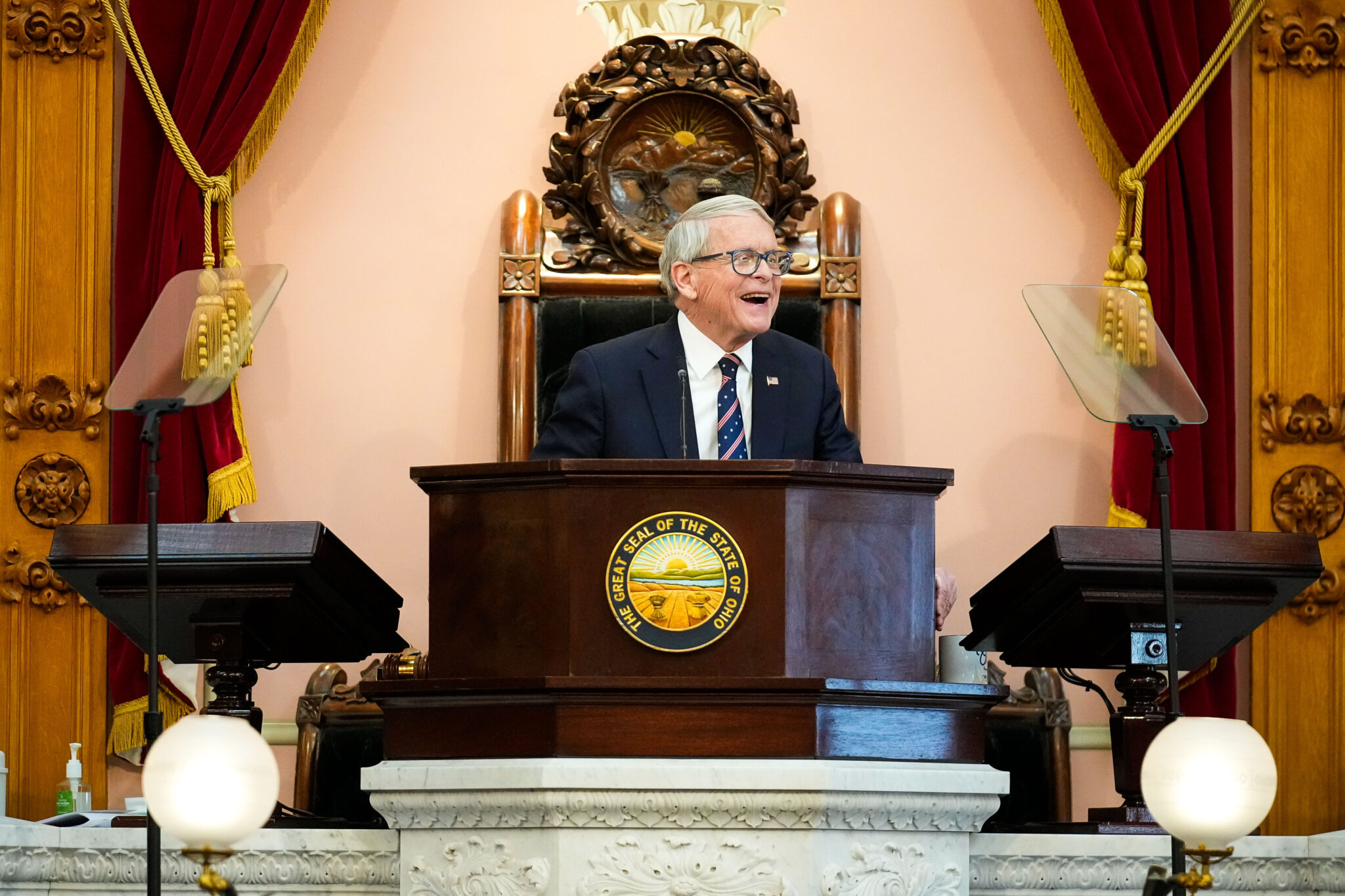
    Ohio Gov. Mike DeWine joined other Republican governors in attending Trump’s signing of the executive order Thursday afternoon at the White House. The executive order does not automatically close the department since eliminating a federal agency requires congressional approval.

    “I joined President Trump and several fellow governors at the White House in support of the president’s proposal to return education back to the states,” DeWine said in a statement posted on X, formerly known as Twitter. “By giving states more authority over education, we will have the flexibility to focus our effort on tailoring an educational experience that is best for our children and meets Ohio’s needs, rather than trying to chase federal priorities.”

    The Ohio Department of Education and Workforce said the department agrees with DeWine’s statement, said ODEW spokesperson Lacey Snoke.

    DEW agrees with Governor DeWine’s statement following yesterday’s announcement.

    GET THE MORNING HEADLINES.


    Ohio Senate President Rob McColley, R-Napoleon, said Trump’s executive order is long overdue.


    “Education policy belongs in the states and the federal government’s ‘one size fits all’ meddling has hurt our country for decades,” McColley said in a statement. “President Trump’s order will allow our 50 laboratories of democracy to deliver innovative solutions that meet each state’s unique needs.”

    The Department of Education was established as a cabinet-level agency by Congress in 1979 under President Jimmy Carter and it doesn’t determine what is taught in schools. Instead, learning standards are set at the state level and curriculum is adopted by local school boards.

    The department allocates Title I funds, which are federal funds given to school districts with a high percentage of low-income students, and administers the Individuals with Disabilities Education Act (IDEA), a law guaranteeing a free public education for children with disabilities.

    Ohio school districts on average receive about 10% of their revenue from the federal government, Ohio Education Association President Scott DiMauro said. About 90% of Ohio students attended public school during the 2023-24 school year, according to the Ohio Department of Education and Workforce.

    “Every single student in Ohio will pay the price for the move to dismantle the U.S. Department of Education,” DiMauro said in a statement. “Any measures to stop the vital work of Department employees to serve Ohio’s students or to reduce federal education funding will cause terrible harm to our students, our state, and our future.”

    About 16% of Ohio public school students had a disability during the 2023-24 school year, according to the Ohio education department.

    “Anyone who cares for a child who has struggled in school because of a disability or had to advocate for access to school services or opportunities should be concerned with the actions of the federal and state governments, regardless of political affiliation or how one voted in the last election,” Policy Matters Ohio Executive Director Hannah Halbert said in a statement.

    Abolishing the Department of Education will mean chaos and uncertainty for Ohio schools, Ohio Federation of Teachers President Melissa Cropper said.

    “The need for federal funding and support for public education will be even more critical if our upcoming state budget cuts school funding, as Governor DeWine’s own budget proposal does with $103 million in cuts to public school districts,” she said in a statement.

    The department announced earlier this month that about half of its staff was going to be laid off as part of the department’s “final mission.”

    Follow Capital Journal Reporter Megan Henry on Bluesky.

    YOU MAKE OUR WORK POSSIBLE.

    _______________
    Megan Henry
    Megan Henry

    Megan Henry is a reporter for the Ohio Capital Journal and has spent the past five years reporting in Ohio on various topics including education, healthcare, business and crime. She previously worked at The Columbus Dispatch, part of the USA Today Network.

    Ohio Capital Journal is part of States Newsroom, the nation’s largest state-focused nonprofit news organization.

    MORE FROM AUTHOR

  • American Federation of Teachers members respond to Trump’s Executive Order to eliminate the Federal role in education

    American Federation of Teachers members respond to Trump’s Executive Order to eliminate the Federal role in education

    A Press Release sent to Loveland Magazine today from the American Federation of Teachers:

    Washington, DC – American Federation of Teachers members from across the country discuss their concerns about the impact of Donald Trump’s executive order today to eliminate the US Department of Education.

    They want to know, if Trump succeeds, who will support the millions of students living in poverty, living with disabilities or relying on financial aid to go to college or pursue a trade.

    AFT members believe states and local school boards should continue to control education but, like most of the public, they embrace a federal role in education and oppose abolishing the department. This move isn’t only unpopular but illegal, said AFT President Randi Weingarten.

     “As Republican governors at the White House celebrate the dismantling of a federal role in education, our members across the country are worried about the impact this will have on their students,” Weingarten said. “No one likes bureaucracy, and everyone’s in favor of more efficiency, so let’s find ways to accomplish that. But this isn’t efficiency, it’s evisceration.”

    Please contact press@aft.org if you would like to speak with Weingarten, the following AFT members or others about the impact of Trump’s decision:

    Bethany Letiecq, president of George Mason University-AAUP and professor in George Mason’s College of Education and Human Development:

    “This administration is creating absolute chaos and fear. The Department of Education is vital, not only for meeting the needs of children living in poverty and with disabilities, but also for those who need financial support to get to college.

    “I’m a George Mason University professor who works with teachers who serve a diverse array of students and their families. What am I supposed to say about the future of public education and who will be included?”

    Christina Chuderski, elementary school teacher in Lee County, Fla.:

    “As a Florida teacher in Title I schools for 23 years and a parent of two special needs kids, I’ve seen how vital the Department of Education is to the lives of children. Dismantling it would be a disaster, stripping protections from our most vulnerable students while pushing ineffective voucher schemes that leave many kids behind. We cannot let politicians, unelected billionaires and bureaucrats gut the system that gives every child a fighting chance.”

    Heather Stambaugh, social studies teacher in Ohio and president of Greenon Federation of Teachers, Local 4370:

    “Closing the Department of Education will not only create chaos but will put in jeopardy critical funding for students with disabilities and Title I support systems. Our more rural district uses these funds to ensure we can provide Title I teachers and support programs, including tutors, to our struggling readers. If the plan for federal dollars being funneled to states delays the process and puts districts in financial restraints, that will delay crucial interventions.”

    Sharon Snowton, retired bilingual educator who taught at Cedar Hill Independent School District, Texas:

    “I know eliminating the Department of Education will hurt Texas children by cutting services that support our students by $3.66 billion. These much-needed services include our resources for our Title I schools, speech services, life skills, before- and after-school programs, and bilingual education. These actions will hurt our students in rural communities, our military families, our Native American students, and our students with disabilities. So thank you, Gov. Abbott, for going along with the Trump administration’s misinformation campaign and choosing to harm our Texas students. It really says a lot.”

    Jennifer Graves, special education teacher in New Haven, Conn., and executive vice president of New Haven Federation of Teachers, Local 933:

    “Our schools are already grossly underfunded in Connecticut. We are really, really struggling already and constantly working in a deficit model to support not only general education students, but especially our most vulnerable populations—our multilingual learners and our students with disabilities. The majority of our students go to Title I schools. They all receive free breakfast and lunches. It would be absolutely devastating to lose this.

    “And as a parent here in New Haven County, my son receives a Pell Grant to go to Connecticut State University. So knowing that teachers don’t make the salaries that we so well deserve, I would not be able to afford to pick up a college tuition right now to send my son to a four-year school. So from parents to students to educators to other school professionals, it would really be devastating for student growth, for opportunities in the world and just for public education as a whole.”

    Ternesha Burroughs, high school math teacher and Education Minnesota-OSSEO member:

    “Losing federal funding means losing vital programs for students with disabilities, from wheelchair access to job-skills training. Without these supports, people may have to quit work to care for their kids, and older students may lose opportunities to learn job skills. How will they function in society without these programs? We need to protect federal funding to keep these supports in place.”

    Robert Castleberry, Ed.D., fifth-grade teacher in Kansas and AFT-Kansas secretary:

    “We will lose counselors, social workers, behavior specialists—people who ensure safety and stability for students who need it most. Without these special needs supports, we aren’t setting students up for success. We are setting them up for failure. And that failure won’t be theirs—it will be ours.”

    Michael Brix, instructor at Peoria (Ill.) Public Schools’ Woodruff Career & Technical Center and member of the Peoria Federation of Teachers, AFT Local 780:

    Brix says that Trump’s push to dismantle the Education Department raises questions about whether state governments will receive the money they were expecting from the federal government and whether they are even staffed to handle distribution of the funds.

    “Over the last 10 years we have seen a nice growth in the number of CTE students, which we need in the workforce. Our job as CTE instructors is to prepare the students to hit the workforce running after high school graduation. I hope this change by the government doesn’t set educators back years while our states are working to try and figure out how to distribute all those funds. I am very nervous for us.”

    Rodney Fresh, high school social studies teacher from Detroit and treasurer of the Detroit Federation of Teachers:

    “I just want to put a face on it. Because I had a student that had an internship from a CTE program, and her internship was put on hold because the funding was put on hold. We have students taking speech online because there aren’t enough speech teachers. The playing field is already unlevel. Now you’re just going to put a crater in the middle of the playing field, and it’s just morally irresponsible.”

    Bill Schwandt, elementary special education paraprofessional and president of the Bloomington (Minn.) Federation of Paraprofessionals:

    “Fifteen years ago, the governor slashed education funding in Minnesota. Our schools are still struggling to recover. Any cuts in federal funding now would erase our recovery and harm students’ learning for years, if not decades.”

  • Student loan repayment pause extended by White House amid legal battles over relief plan

    Student loan repayment pause extended by White House amid legal battles over relief plan

    BY: ARIANA FIGUEROA – Ohio Capital Journal

    The Department of Education announced on Tuesday it is extending the pandemic-era pause on federal student loan repayments until June 30 while legal challenges to the administration’s student debt relief program are fought over in the courts.

    The agency said if the student debt relief program has not been put in place by June 30, and if litigation is still tied up in the courts, student loan payments will begin 60 days after that.

    “Payments will resume 60 days after the Department is permitted to implement the program or the litigation is resolved, which will give the Supreme Court an opportunity to resolve the case during its current Term,” the department said in a statement.  “If the program has not been implemented and the litigation has not been resolved by June 30, 2023 — payments will resume 60 days after that.”

    Earlier the administration had said the pandemic-era pause would expire on New Year’s Eve. Two lawsuits blocking the Biden plan, including one brought by six GOP-led states, have been appealed by the Justice Department, but it’s unclear how long the legal process could take.

    “We’re extending the payment pause because it would be deeply unfair to ask borrowers to pay a debt that they wouldn’t have to pay, were it not for the baseless lawsuits brought by Republican officials and special interests,” U.S. Secretary of Education Miguel Cardona said in a statement.

    President Joe Biden, in a Tuesday tweet, said the extension will give “the Supreme Court time to hear the case in its current term.”

    “I’m confident that our student debt relief plan is legal,” he said on Twitter.

    Before the announcement, more than 200 advocacy groups had urged Biden to extend the pause.

    In a Monday letter, the groups argued that if student loan repayments restart, it would be a financial setback for borrowers, especially at a time of record high inflation.

    “We, the undersigned 225 organizations, urge you to immediately extend the payment pause until your Administration is able to fully implement debt relief for all eligible borrowers and to continue to use every legal authority at your disposal to make this relief real,” according to the letter.

    “We cannot allow these blatantly political lawsuits to throw millions of borrowers into financial catastrophe,” the letter said. “Throwing millions of borrowers back into repayment as the state of debt relief remains uncertain is a recipe for disaster and will result in widespread confusion and set borrowers up for failure.”

    Most of the organizations that signed onto the letter include labor groups like the AFL-CIO, legal organizations like the ACLU and NAACP, and debt cancellation advocacy groups such as the Debt Collective and Student Debt Crisis Center.

    Multiple extensions

    The Trump administration implemented the pause on student loan repayments due to the coronavirus pandemic and the Biden administration has extended it multiple times.

    A federal appeals court issued a nationwide injunction that barred the Biden administration from carrying out its student debt relief plan following the challenge by the six GOP-led states — Nebraska, Missouri, Arkansas, Iowa, Kansas and South Carolina.

    The Biden administration has asked the U.S. Supreme Court to vacate the nationwide injunction.

    “The Eighth Circuit’s erroneous injunction leaves millions of economically vulnerable borrowers in limbo, uncertain about the size of their debt and unable to make financial decisions with an accurate understanding of their future repayment obligations,” Solicitor General Elizabeth Prelogar wrote in the filing to the U.S. Supreme Court.

    In late August, Biden announced he would cancel up to $20,000 in federal student loan debt for Pell Grant borrowers and up to $10,000 for all other borrowers with an income of less than $125,000 for an individual and $250,000 for a household.

    The program would only apply to current borrowers, not future ones, and income levels for the 2020 and 2021 tax years would be considered. Student loan borrowers who have private student loans would not be eligible.

    The attorneys general from the states that launched the legal challenge argued that the loan relief program threatens those states’ future tax revenues and that the plan overrode congressional authority.

    ​​More than 43 million Americans have student loan debt, and the Federal Reserve estimates that the total U.S. student loan debt is more than $1.76 trillion.

    The three-panel judge from the 8th Circuit Court of Appeals in St. Louis put the injunction in place “until further order of this court or the Supreme Court of the United States.”

    Those judges are Bobby E. Shepherd and Ralph R. Erickson, both President George W. Bush appointees, and L. Steven Grasz, a President Donald Trump appointee.

    Following the decision, White House press secretary Karine Jean-Pierre said the White House believes it has the legal authority to carry out the program.

    “The Administration will continue to fight these baseless lawsuits by Republican officials and special interests and will never stop fighting to support working and middle class Americans,” she said in a statement.

    26 million applicants

    More than 26 million student loan borrowers have applied for the program, and 16 million have been accepted, according to the Department of Education.

    The nonpartisan Congressional Budget Office found that the program would add $400 billion to the national deficit over the span of 30 years. The agency found that the pause on federal student loan repayments has cost $20 billion from September to December 2022.

    Adam Looney, a senior fellow at the Brookings Institute — a left-leaning think tank — said while the cost seems high, for borrowers who qualify it comes out to a monthly average savings of about $59.

    Looney previously was a senior economist for public finance and tax policy with former President Barack Obama’s Council of Economic Advisers, and was an economist at the Federal Reserve Board.

    “It’s like a tax cut,” Looney said of student loan borrowers who would qualify for debt relief.

    Second lawsuit

    The Biden administration stopped accepting applications for student debt relief following a second decision from a federal judge in Texas who separately ruled the program was unlawful.

    In Fort Worth, U.S. District Judge Mark Pittman, an appointee of former President Donald Trump, ruled that the program was an “unconstitutional exercise of Congress’s legislative power.” He ruled in favor of two borrowers, backed by a conservative advocacy group, who brought the challenge.

    The Department of Justice has already filed an appeal to that ruling.

    Pittman wrote in his opinion that “[w]hether the Program constitutes good public policy is not the role of this Court to determine.”

    Sabrina Calazans, the outreach director at the Student Debt Crisis Center, said prior to Tuesday’s announcement that the Biden administration should resume its pause on student loan repayment. The center also signed onto the letter to the White House from the more than 200 organizations.

    “We’re advocating for an extension to the payment pause until student debt cancellation is applied to borrowers’ accounts,” she said. “We believe that borrowers should be able to get their debt canceled and not have to make any payments until that happens because they’ve been promised this relief.”

    Calazans, who has student loan debt herself — federal and private loans — and is a first-generation college student, said the pause on repayments has been a lifeline for her and her family. The pause did not include private loans, which she has, so she’s had to continue those payments throughout the pandemic.

    “Folks were struggling before the pandemic started,” she said of student loan debt. “This was already a crisis that people were dealing with beforehand, so this has been around for a long time, not just recently.”

    Calazans said those student loan borrowers who applied to the Department of Education for debt relief are starting to get emails that their applications for student debt cancellation were approved, but the lawsuits are blocking it.

    “Folks are excited about the prospect of having their debt canceled — whether it’s all of it or a portion of it — and now that hope that they had is now suddenly stopped for now because of the blocking of this plan,” she said. “Borrowers are in this limbo.”

    Emails sent out

    The Department of Education has sent out emails to student loan borrowers who applied, and were approved for the debt relief program with the subject line: “Your Student Loan Debt Relief Application Has Been Approved.”

    However, the body of the email reads: “Unfortunately, a number of lawsuits have been filed challenging the program, which have blocked our ability to discharge your debt at present.”

    “We believe strongly that the lawsuits are meritless, and the Department of Justice has appealed on our behalf,” according to the email. “We will keep your application information and will continue our review of your eligibility if and when we prevail in court. We will update you when there are new developments.”


  • Biden to wipe out $10,000 in student loan debt for many borrowers

    Biden to wipe out $10,000 in student loan debt for many borrowers

    BY: ARIANA FIGUEROA – Ohio Capital Journal

    WASHINGTON — President Joe Biden announced Wednesday that he will cancel up to $20,000 in federal student loan debt for Pell Grant borrowers and up to $10,000 for all other borrowers with an income of less than $125,000 for an individual and $250,000 for a household.

    Biden also announced his administration is extending a pause on student loan repayments until Dec. 31. The decision comes one week before the expiration of a pause of student loan repayments put in place at the beginning of the coronavirus pandemic.

    “Here’s the deal, the cost of education beyond high school has gone up exponentially,” Biden said at the White House.

    Biden stressed that the people who would benefit the most are low-income and middle class families and individuals.

    “No high income household, will benefit from this action, period,” Biden said.

    Biden said that many Americans with student loan debt have put off starting families because of the cost and have been unable to qualify for mortgages to buy a home because of the student loan debt they carry.

    “All this means is an entire generation is now saddled with unsustainable debt,” Biden said.

    Despite numerous reports in recent weeks that Biden would take action on student loans, the White House had remained silent, but on Wednesday the president tweeted out his decision, prior to his remarks.

    “In keeping with my campaign promise, my Administration is announcing a plan to give working and middle class families breathing room as they prepare to resume federal student loan payments in January 2023,” Biden wrote on Twitter.

    Following the announcement, the Department of Education said it will release an application in the weeks ahead that will allow millions of borrowers to claim this new relief.

    “[S]tudent loan debt has hindered their ability to achieve their dreams — including buying a home, starting a business, or providing for their family,” U.S. Secretary of Education Miguel Cardona said in a statement. “Getting an education should set us free; not strap us down!”

    The cancellation of student debt will only apply to current borrowers, not future ones, and income levels for the 2020 and 2021 tax years will be considered, a senior administration official said during a Wednesday call with reporters.

    The Department of Education estimates that about 8 million borrowers will automatically receive relief because the agency already has those borrowers’ income information on file. That means those borrowers do not have to submit applications.

    Borrowers who received Pell Grants, who will benefit from the most relief, are among the students who had the lowest household incomes while in college. They will also be subject to the $125,000 and $250,000 income caps.

    New rule on loans

    The Biden administration is also directing the Department of Education to propose a rule to help current and future borrowers with their loan repayments.

    The rule would eliminate monthly interest  payments on loans, “so that unlike other existing income-driven repayment plans, no borrower’s loan balance will grow as long as they make their monthly payments — even when that monthly payment is $0 because their income is low,” according to the department website.

    The proposed rule would also forgive loan balances “after 10 years of payments, instead of 20 years, for borrowers with loan balances of $12,000 or less.” It would also require “borrowers to pay no more than 5% of their discretionary income monthly on undergraduate loans.”

    “Middle class borrowers struggle with high monthly payments and ballooning balances that make it harder for them to build wealth,” a senior administration official said.

    While many Democrats and progressive advocates were pleased with the announcement, it falls short of the student debt relief campaign platform that Biden ran on.

    In a Medium post during the 2020 presidential election, Biden said under his administration he would “forgive all undergraduate tuition-related federal student debt from two- and four-year public colleges and universities for debt-holders earning up to $125,000, with appropriate phase-outs to avoid a cliff.”

    He also promised he would “immediately cancel a minimum of $10,000 of student debt per person,” but this recent student debt announcement comes two years into his administration and only after continual pressure from congressional Democrats and advocates.

    Some congressional Democrats have urged the White House to cancel up to $50,000 worth of student loans, arguing that because about 92%  of that debt is held by the Department of Education, the administration has the authority to cancel those loans through executive action.

    More than 43 million Americans have student loan debt, and the Federal Reserve estimates that the total U.S. student loan debt is more than $1.75 trillion.

    A Penn Wharton budget model released Tuesday found that a one-time loan forgiveness of $10,000 would mostly benefit borrowers in the four lowest quintiles of incomes.

    Earlier this month, more than 100 Senate and House Democrats urged the Biden administration to extend the pause on repayment of student loans beyond the Aug. 31 deadline. The lawmakers argued that due to inflation and the ongoing coronavirus pandemic, student loan borrowers should get an extension on pausing their loan payments. They did not give another deadline for repayments to begin in their letter to the president.

    Democrats praise Biden

    Democrats did welcome the President’s announcement.

    “By delivering historic targeted student debt relief to millions of borrowers, more working families will be able to meet their kitchen table needs as they continue to recover from the challenges of the pandemic,” House Speaker Nancy Pelosi said in a statement. “Importantly, this action will help those most in need, easing a financial burden disproportionately harming women and people of color.”

    She has previously said that the president does not have the authority to cancel student loans and that the process needs to be done through Congress. She did not mention her previous comments in the statement.

    Biden also had said earlier, while in the White House, that he would only cancel up to $10,000 in student loan debt, and only if Congress passes legislation to do so. Administration officials did not address the shift in policy.

    While the Democrat-controlled House likely could pass legislation canceling some portion of student loan debt, the evenly divided Senate would need all 50 Democrats on board along with an additional 10 Republicans to get a bill to the president’s desk.

    House Education and Labor Committee Chairman Bobby Scott, a Virginia Democrat, said that while the student loan cancellation will provide relief for borrowers, it doesn’t solve the “underlying problems that caused the student debt crisis in the first place,” such as high tuition costs.

    “Without reversing the chronic underinvestment in higher education that has driven up tuition costs, and without fixing our student loan system that has made student loans more expensive to take out and harder to pay off, students will continue to take on more debt and borrowers will continue to face rising debt levels,” Scott said.

    Republicans critical

    GOP lawmakers sharply criticized the cancellation move.

    “At a time of skyrocketing inflation, declining wages, and a national recession, Washington has again turned its back on hardworking Americans in Iowa and across this country,” Iowa Gov. Kim Reynolds, a Republican, said in a statement. “President Biden isn’t canceling student debt, he’s shifting the costs to the taxpayer and to those who worked to pay off their loans in full.”

    Senate Minority Leader Mitch McConnell, a Kentucky Republican, said in a statement the move was a “slap in the face to every family who sacrificed to save for college, every graduate who paid their debt, and every American who chose a certain career path or volunteered to serve in our Armed Forces in order to avoid taking on debt.”

    Overall in Kentucky, there are about 600,000 student loan borrowers who have an average balance for federal and private student loans of $30,794.  

    In March 2020, President Donald Trump issued an emergency pause on student loan repayments, which has now been extended several times by both administrations. The pandemic is still ongoing, and the U.S. has surpassed 1 million COVID-19 deaths.

  • Pause on federal student loan repayments extended by Biden through Aug. 31

    Pause on federal student loan repayments extended by Biden through Aug. 31

    BY: ARIANA FIGUEROA – Ohio Capital Journal

    The Biden administration Wednesday announced its plans to extend the pause on federal student loan repayments until the end of August.

    “I recognized in recently extending the COVID-19 national emergency, we are still recovering from the pandemic and the unprecedented economic disruption it caused,” President Joe Biden said in a statement. 

    “If loan payments were to resume on schedule in May, analysis of recent data from the Federal Reserve suggests that millions of student loan borrowers would face significant economic hardship, and delinquencies and defaults could threaten Americans’ financial stability.”

    The White House will extend the deadline for student borrowers to pause on federal loan repayments, interest, and collections until Aug. 31. The announcement also provides a “fresh start” on loan repayments by removing any prior defaults to allow those borrowers to re-enter repayment in good standing.

    The current pause would have ended on May 1.

    “The Department of Education is committed to ensuring that student loan borrowers have a smooth transition back to repayment,” U.S. Secretary of Education Miguel Cardona said in a statement. 

    “This additional extension will allow borrowers to gain more financial security as the economy continues to improve and as the nation continues to recover from the COVID-19 pandemic.”

    Cristina Tzintzún Ramirez, the president of NextGen America, an organization that mobilizes young voters, released a statement calling the announcement “another short-term fix to a crisis that demands a long-term solution.”

    “Young voters feel frustrated with President Biden’s failure to fulfill his promise on student debt cancellation,” Tzintzún Ramirez said. “While borrowers surely appreciate the help paying rent and making ends meet, what they really need is a debt cancellation that will allow them to buy a house and build a future.”

    During Biden’s campaign for the presidency, he pledged to cancel student loan debt during a town hall in Miami.

    “I’m going to eliminate your student debt if you come from a family (making less) than $125,000 and went to a public university,” he said, according to Black Enterprise.

    Biden has since called on Congress to pass legislation to cancel up to $10,000 of student debt, but many congressional Democrats argue that Biden could reduce debt through an executive order. They’ve pushed him to cancel up to $50,000 in student loan debt.

    The Federal Reserve estimates that the total U.S. student loan debt is more than $1.75 trillion. The Department of Education owns about 92% of that student loan debt.

    Democrats push for debt cancellation

    A handful of U.S. Senate and House Democrats released a joint statement that said they welcomed the extension, but stressed the need to cancel student loan debt.

    “While the extension is welcome, a looming restart of student loan payments in September underscores the importance of swift executive action on meaningful student debt cancellation,” they wrote. “We continue to implore the President to use his clear legal authority to cancel student debt, which will help narrow the racial wealth gap, boost our economic recovery, and demonstrate that this government is fighting for the people.”

    Those lawmakers include Sens. Elizabeth Warren of Massachusetts, Chuck Schumer of New York, Alex Padilla of California and Raphael Warnock of Georgia, as well as Reps. Ayanna Pressley of Massachusetts, Ilhan Omar of Minnesota, Pramila Jayapal of Washington, and James E. Clyburn of South Carolina.

    The chair of the House Education and Labor committee, Rep. Bobby Scott, released a statement in which he did not call for the cancellation of student debt, but praised the administration for its decision to continue the pause.

    “By extending the pause on student loan repayments, collections, and interest accrual, the Biden-Harris Administration has demonstrated that it remains committed to helping borrowers get back on their feet,” the Virginia Democrat said.

  • Trump Administration rescinds guidance amid objections from disability advocates

    Trump Administration rescinds guidance amid objections from disability advocates

    Disability advocates denounced the move to abandon the guidance.

    Guidance issued during the Obama administration, which was aimed at ensuring that minorities and students with disabilities weren’t unfairly disciplined, is no more.

    The U.S. Department of Justice and the Department of Education indicated in late December that a 2014 “Dear Colleague” letter informing schools of their responsibilities when meting out discipline has officially been rescinded.

    The move came just days after a federal school safety panel chaired by Secretary of Education Betsy DeVos recommendedabandoning the guidance.

    Read the full article from the Disability Scoop


  • New options available for Ohio’s High School Equivalence Test

    New options available for Ohio’s High School Equivalence Test

    Ohioans now have three testing options for earning a certificate of high school equivalence. The Ohio Department of Education approved GED, HiSET and TASC as the official testing companies for adult learners to use to earn the certificate of high school equivalence, generally considered to be the equivalent of a high school diploma.

    All previously awarded Ohio High School Equivalence Diplomas still are considered valid.

    “For individuals who haven’t earned a high school diploma, earning the certificate of high school equivalence can be a life-changing event,” said Paolo DeMaria, superintendent of public instruction. “A high school diploma or its equivalent often is a minimum requirement for applying for many jobs or for being promoted. It also is needed to enroll in most colleges and advanced training programs. We are proud to provide more testing choices for individuals seeking better futures.”

    Nearly 11 percent of adults over the age of 18 in Ohio have not completed a high school diploma or an equivalent.

    Many Ohioans require additional learning support prior to taking the tests. The state’s Aspire workforce readiness programs, funded by the Ohio Department of Higher Education, provide free classes for adults desiring to take the equivalence tests. Information about the Aspire programs can be found here or by calling 833-8ASPIRE.

    “Having these high school equivalence options and the free classes offered through the Aspire program can really give those individuals who haven’t earned a high school diploma a jump start on a successful future,” said Ohio Department of Higher Education Chancellor John Carey. “The Aspire classes and the testing options not only put these students on a pathway to continued education, but they also provide motivation by showing them that they have what it takes to succeed.”

    Individuals who are 16 and older who have withdrawn from school (if ages 16-18) and have not previously earned a high school or honors diploma are eligible to take a high school equivalence test. (Students ages 16 or 17 require parental consent.) Students must register online for the test of their choice and submit all required documentation to the Ohio High School Equivalence Office.

    “Ohio’s new options for the high school equivalence test will empower more Ohioans to earn a certificate of high school equivalence,” said Director Ryan Burgess of the Governor’s Office of Workforce Transformation. “Whether their next step is to pursue employment or continuing education, individuals who earn this certificate will be better prepared for success in a rapidly changing economy.”

    All previously awarded Ohio High School Equivalence Diplomas still are considered valid.

    The Ohio High School Equivalence Office at the Department of Education provides guidance and assistance to test takers, preparation centers and testing centers. More information about Ohio High School Equivalence can be found on the Department’s website by clicking here.

    Adult learners also may qualify for Ohio’s Adult Diploma and 22+ Adult High School Diploma programs. More information about these programs can be found by clicking here.