Tag: Department of Government Efficiency

  • House budget document will hurt Ohioans

    House budget document will hurt Ohioans

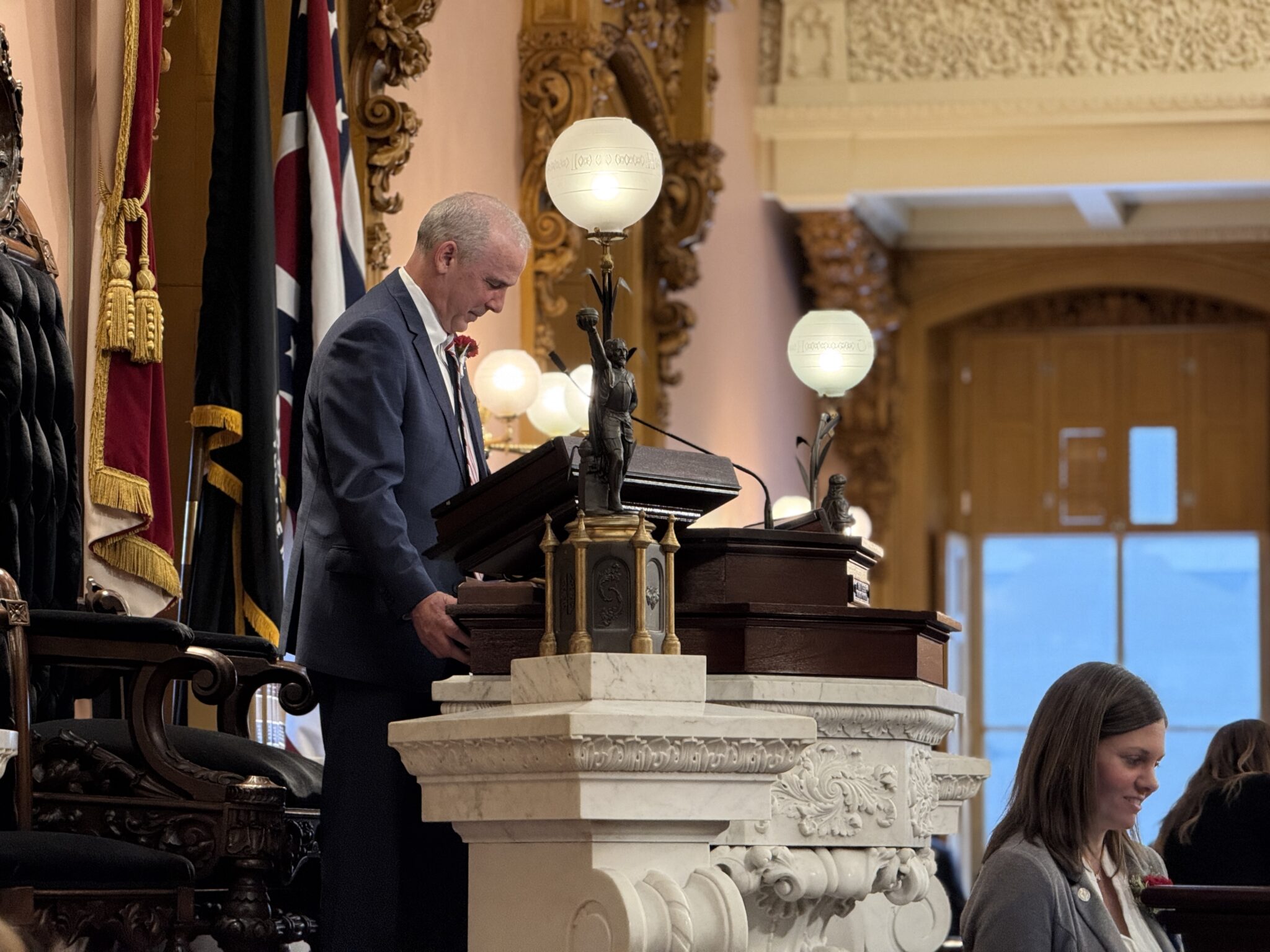
    Ohio House Speaker Matt Huffman. (Photo by Morgan Trau, WEWS.)

    by Marilou Johanek – Ohio Capital Journal

    Just as Elon Musk’s so-called Department of Government Efficiency (DOGE) was never really about improving government efficiency – quite the opposite, in fact – the 5,000-plus page biennial budget rewrite the Ohio House slapped together and sent to the Ohio Senate was never really about improving the common good of everyday Ohioans.

    It was about advancing the hard-right priorities of powerful politicians who answer to big money – not constituents in gerrymandered voting districts.   

    Yet even for the supremely arrogant kingpin of state government, Ohio House Speaker Matt Huffman, the budget bill passed out of the General Assembly’s lower chamber on April 9 was beyond the pale in cruelty and cunning.

    It is the Ohio version of Project 2025 with all the unsparing, exacting hallmarks of the Trumpian blueprint, recklessly destroying federal institutions and agencies that, however imperfectly, protect, serve and promote the welfare of we, the people.

    But that’s the MAGA nihilistic way and Ohio Republicans are doing their part in tearing down what made Ohio great. Huffman, the Lima Republican who runs the state under the one party rule he rigged with unconstitutional redistricting, is in the catbird seat calling the shots. The speaker (and former Ohio Senate president) lords over the GOP supermajority in the Ohio House while his political protégé, Ohio Senate President Rob McColley, accommodates the boss.

    Huffman, who once said the quiet part out loud about GOP gerrymandering (“We can kind of do what we want”), now has a straight runway to enact his blueprint on Ohioans whether they like it or not. I suspect his budget proposal will survive, largely intact, with the House caucus he controls and the one he led with an iron fist for four years in the Senate.

    Local public schools, public libraries, clean drinking initiatives, lead poisoning prevention, pediatric cancer funding, home visits for new mothers, food assistance programs and health care coverage for the poor are all on the chopping block in Huffman’s House Bill 96.

    What wasn’t on his slash-and-burn budget list were government handouts (taxpayer-funded vouchers) to upper-income private school families. But doling out unlimited government subsidies to the affluent, whose darlings are already attending and affording elite high schools and religious institutions, is Huffman’s thing.

    He is on a crusade to shower hundreds of millions of public education dollars on unaccountable private and predominantly religious schools – despite clear prohibitions against such a diversion of public money in the Ohio Constitution.

    “No religious or other sect, or sects, shall ever have any exclusive right to, or control of, any part of the school funds of this state,” the state constitution reads.

    But Huffman has defied the state constitution before with impunity (on gerrymandering) and did so again by ramrodding his universal voucher bonanza through the legislature for everyone, regardless of income. Never mind that the giant state giveaway – to offset private school costs for the well-off – blew a $1 billion dollar hole in the general revenue budget its first year.

    Never mind that public schools in the state, forever cash-strapped and dependent on tapped out property owners, labored under an unequal, inadequate school funding formula (ruled unconstitutional by the Ohio Supreme Court) for 26 years before a bipartisan coalition agreed to a phased-in funding solution over six years. The final two-year phase was expected to be fully funded in the current biennial budget negotiations.

    Not under Huffman. Not in a state where the Republican lock on power is absolute and the Statehouse heavyweight has free, unchecked rein to flout the law and grossly defund the public schools that educate the vast majority of Ohio students (approximately 1.6 million) while greatly expanding appropriations for private school tuitions, homeschooling expenses and even unchartered, nonpublic schools with deeply held religious beliefs that are virtually unregulated by the state!

    Funding for the “thorough and efficient system of common schools” state government is constitutionally obligated to secure – and that would have been secured under the Fair School Funding Plan from 2021 – shrank by over $400 million. House Republicans added insult to injury by robbing fiscally prudent school districts of surplus revenue for future planning to give uneven, one-time property tax relief in some districts and not others. They also ensured that property tax owners will face more school levies from local districts forced to deplete that surplus operating revenue. Sound policymaking (or genuine property tax relief) this is not.

    But it is a gut punch to public schools, just as a $100 million reduction in funding to Ohio’s public libraries is, or cutting over $22 million from the Help Me Grow program is for in-home visits to newborn babies to mitigate the state’s infant mortality problem. But Matt Huffman’s Ohio-centric Project 2025 is also a kick in the teeth to democratic self-governance.

    Last budget go-around Republican lawmakers stripped the Ohio Board of Education of most of its power and gave it to the governor. This two-year budget proposes cutting all 11 elected members of the board and shrinking the gubernatorial appointments from nine to five. This is Matt Huffman removing voters entirely from state education policy as he engineers total opaque privatization of Ohio schools.

    How is silencing the electorate improving the common good?


    Marilou Johanek

    Marilou Johanek is a veteran Ohio print and broadcast journalist who has covered state and national politics as a longtime newspaper editorial writer and columnist.

    MORE FROM AUTHOR

  • Fired-up crowd jeers Ohio senators, representative for not standing up to Trump and Musk

    Fired-up crowd jeers Ohio senators, representative for not standing up to Trump and Musk

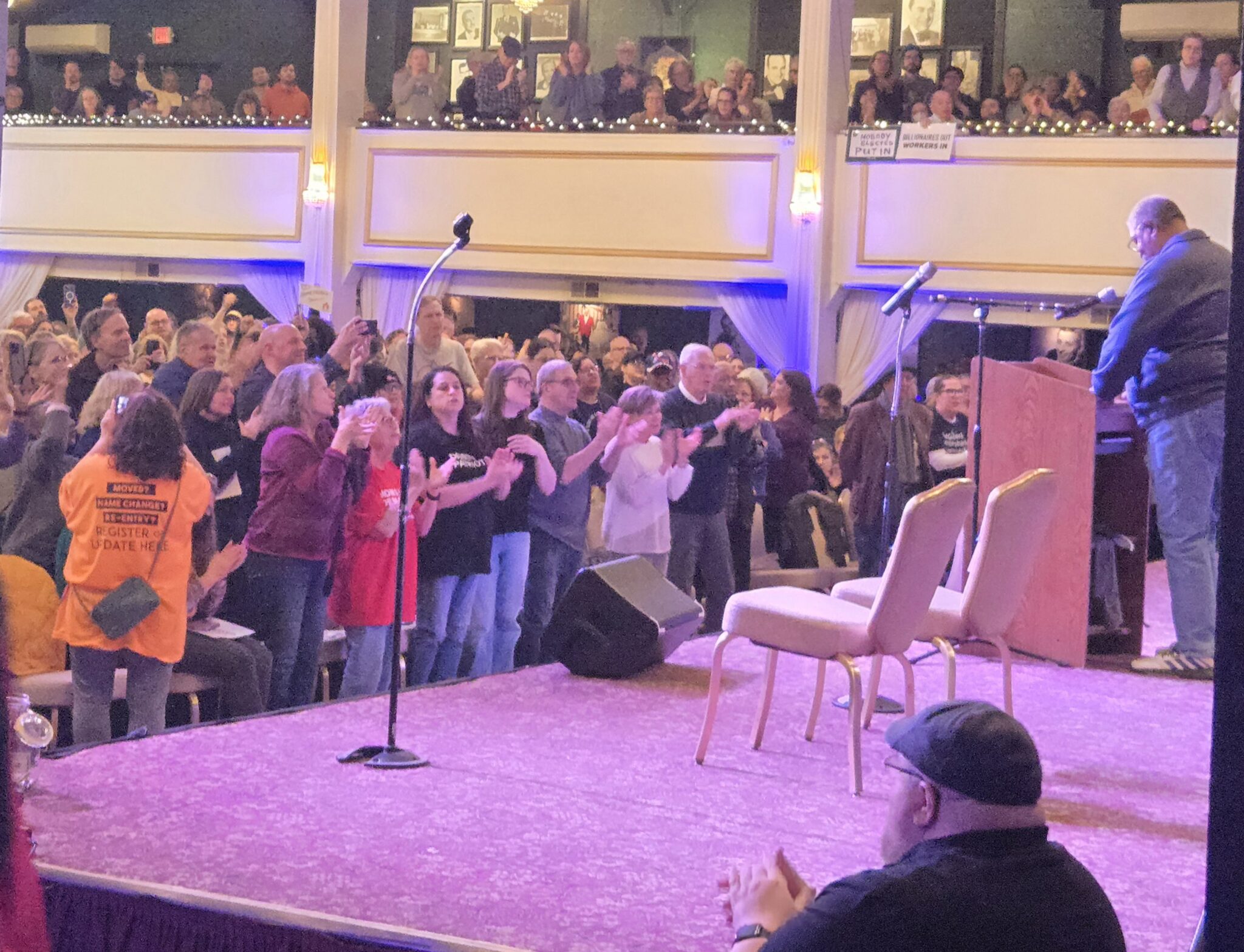
    The audience at a packed Valley Dale Ball chants “Do Your Job” to empty chairs meant for U.S. Sens. Bernie Moreno and Jon Husted, both Ohio Republicans. (Photo by Marty Schladen, Ohio Capital Journal.)

    By:  Ohio Capital Journal

    An enthusiastic crowd of about 1,400 Ohioans on Saturday packed the Valley Dale Ballroom to say their federal officials aren’t representing them — and that they’re not standing up to President Donald Trump as he allows the world’s richest man to slash federal programs.

    The event, staged by Indivisible Central Ohio,  was facetiously called a town hall.

    Chairs were placed on the stage for U.S. Sens. Bernie Moreno and Jon Husted, both Republicans. They sat empty, and organizers said the senators’ offices didn’t even bother to say they wouldn’t be coming.

    Instead, organizers asked the questions they would have put to the senators to the AI program Chat GPT. The program said that the massive layoffs and cuts to federal programs would cost Ohio jobs, harm university research and stunt the biomedical sector.

    Mia Lewis, an organizer, urged the crowd to turn out regularly to protest what’s happening.

    “This is an unprecedented moment in our country. This shit is not normal,” she said of an administration that regularly attacks the judiciary, and allows an unelected, unconfirmed Elon Musk hack wildly at the federal government. “Just two people standing on a highway is not the same thing as 50 people being there every day.”

    Members of the audience held signs that said things like “Nobody elected Putin,” “Nobody elected Musk,” and other things that aren’t publishable by a general-audiences news organization.

    Moreno and Husted weren’t the only ones to be mocked for their absence. Joyce Beatty, a Democrat and longtime congresswoman from Columbus, begged off, citing a “prior commitment.” An unfortunate constituent was regularly heckled as she tried to read in first person a letter Beatty had sent.

    When the constituent read a passage implying Beatty was present, a man yelled out, “You’re not here!” The crowd laughed.

    Arnold Scott summed up the general tenor.

    “As an ex-federal employee and a union member, I’m mad as hell,” he said. “How about these billionaires pay their taxes? When they cut employees at the various agencies, actually what they’re doing is cutting the services that the taxpayers are paying for. When they cut the VA, they’re cutting veterans. You stand there and say you support the veterans, but then you cut the veterans. When you cut them, that translates into it taking longer for them to receive the services that they’re entitled to.”

    Scott said an Ohio federal worker lost her job and complained to one of the Ohio senators. “What do you want me to do?” Scott claimed the senator responded.

    Then Scott turned to the two empty chairs and said, “Mr. Senator, what we want you to do… we want you to do your job.”

    That brought the crowd to its feet to chant “Do your job!”

    Musk’s “Department of Government Efficiency” is cutting resources the VAthe National Institutes of Health, the Food and Drug Administration, the Social Security Administration, the Park Service and much more.

    Catherine Duffy told the crowd that buried in that list is a cut that is deeply damaging to Ohio’s poor and its farmers. Musk’s supposed agency axed $1 billion nationally for overstressed food banks to buy directly from farmers.

    “Every dollar we don’t have is produce we don’t grow,” Duffy said.

    YOU MAKE OUR WORK POSSIBLE.

    _______________
    Marty Schladen
    Marty Schladen

    Marty Schladen has been a reporter for decades, working in Indiana, Texas and other places before returning to his native Ohio to work at The Columbus Dispatch in 2017. He’s won state and national journalism awards for investigations into utility regulation, public corruption, the environment, prescription drug spending and other matters.

    Ohio Capital Journal is part of States Newsroom, the nation’s largest state-focused nonprofit news organization.

    MORE FROM AUTHOR

  • Ohio businesses were promised funding for solar but worry the Trump administration won’t pay

    Ohio businesses were promised funding for solar but worry the Trump administration won’t pay

    Jael Malenke (left) and Kevin Ely, standing next to their solar array. They’re supposed to get reimbursed for half of the system’s cost, but that funding is in limbo after USDA halted payments pending review. (Photo by Nick Evans, Ohio Capital Journal.)

    By  Ohio Capital Journal

    Wooly Pig Farm Brewery sits on a gentle rise above Highway 36 and the Tuscarawas River in Fresno, Ohio. It takes its name from the Mangalitsa pigs covered in coats of thick curly wool, that roam the pastures nearby. Kevin Ely and Jael Malenke are the husband-and-wife team that run the brewery — Ely handles the beer and Malenke manages the business. They met in Utah and moved back to the area in 2014 when a farmstead near Malenke’s childhood home went up for sale.

    Ely is a tinkerer. Two work gloves stick out of one coat pocket and the fat carpenter pencil in his chest pocket has left graphite stains where it’s rubbed against the jacket. He’s constantly looking for ways to make the brewery more efficient and even does talks for other brewers looking to streamline their operations.

     Kevin Ely and Jael Malenke with a few of the Mangalista pigs they raise at the Wooly Pig Farm Brewery. (Photo by Nick Evans, Ohio Capital Journal.) 

    From his experience at other breweries, he said, “solar comes last.” There are too many other strategies to reduce energy consumption that are simpler and cheaper. That could be reducing water use or rigging up a cheap DIY system that takes advantage of the steam generated by the brewing process.

    “You can reduce your energy consumption by like, 5, 10, 15, sometimes 20, 25%,” he said.

    “But we’ve done those things,” Malenke cut in.

    So that’s why they were so interested in the Rural Energy for America Program. The initiative, administered by the U.S. Department of Agriculture, offers loan financing or grant funding for farmers and rural businesses that invest in renewable energy projects to improve their energy efficiency.

    At Wooly Pig, that’s a roughly $300,000 solar array on a hill above the brewery. In all, the roughly 100 kilowatt system includes more than 200 panels.

    “They’re ranged in a double row on each of these six arrays — sets of arrays,” Malenke said as half a dozen pigs rooted around in the grass or played with their dogs. “They’re all high enough that we can have sheep grazing underneath them,” she added.

    Under their REAP agreement, Ely and Malenke are expecting federal officials to cover $143,000 of the total investment. “That’s more than we pay in payroll here,” Malenke said, “and that includes what we take home.” But they’re currently in limbo, following the Elon Musk-linked Department of Government Efficiency’s efforts at the USDA.

    For Ely and Malenke, as well as others expecting REAP funding, those dollars are “indefinitely suspended,” and subject to review by USDA Secretary Brooke Rollins.

    “I welcome DOGE’s efforts at USDA because we know that its work makes us better, stronger, faster and more efficient,” Rollins said on her first day in office. “I will expect full access and transparency to DOGE in the days and weeks to come.”

     Jael Malenke and Kevin Ely in the Wooly Pig Farm Brewery tap room. (Photo by Nick Evans, Ohio Capital Journal.) 

    The stakes for the brewery

    Ely and Malenke have apps on their cellphones that monitor the amount of energy their array generates in real time.

    “I’m probably looking, depending on the day, between four and six times a day,” Malenke said with a grin.

    “Yeah, I might be doing — well, I might be eight or 10,” Ely said.

    He’s tracking it closely because he’s looking for ways to stretch that power past sunset. They don’t have a battery system, so Ely said he’s working on running a boiler during the day and then using a heat exchanger to make use of that hot water in the evening.

    Malenke said the brewery spends between $1,500 and $2,500 a month on power. The new solar array is designed to cover half of that, and with a few tweaks here or there, Ely is hoping they can push that to 60%.

    GET THE MORNING HEADLINES.

    Saving about $12,000 a year on energy costs would make a big difference for their business.

    “I mean, that’s pay raises for our employees,” Ely said.

    But losing out on the REAP reimbursement would be a major setback.

    “And that’s it,” Ely explained. “The thing is, is that we probably wouldn’t have built — we would not have built an array for this price. We would have built something half as big or maybe we would have done it ourselves.”

    Although working with a reputable contractor was more expensive, they went forward because it would leave them with a better built and longer lasting system while allowing them to focus on doing their actual jobs.

    “There was very little risk associated with this project,” Ely said.

    “We thought it was a risk-free project,” Malenke cut in.

    “If we knew there was significant risk …” Ely broke off. “I mean, there was no evidence of it being risky.”

     Rich Mushrush, owner of Gemstone Gas & Welding Supplies. (Photo by Nick Evans, Ohio Capital Journal.) 

    Gemstone Gas & Welding Supply

    About half an hour from Wooly Pig in New Philadelphia, Rich Mushrush runs Gemstone Gas and Welding Supplies. In addition to gear for welders, they pump their own gases, “oxygen, argon, nitrogen, CO2, all the mixes,” he said, before his phone started ringing. He’s been calling around, twisting arms, to get a mechanic out to fix the muffler on a delivery truck.

    “We pride ourselves on service,” he explained after securing a visit. “That’s how we kind of get over with the big companies. They can’t do what we do.”

    Mushrush qualified for the REAP program and construction on his solar array started this week. Based on the project plans, he thinks the system will save him about $1,000 on his electric bill each month. If that back of the envelope math holds, the system would pay for itself in about two and a half years. But without the federal subsidy, Mushrush explained, that timeline stretches to more like 12 or 13 years.

    “I thought s—, I might be dead by then,” he chuckled. “I’m 65 years old.”

    Mushrush is frustrated about the financial pinch he’ll feel if the REAP funding doesn’t come through. “It’s a stinger to me,” he acknowledged, “and a lot of other small businesses — farmers.”

    But his biggest objection is a moral one. If the federal government has decided the program is too generous, he argued, there’s nothing wrong with dialing it back going forward. “But the ones that are already in it,” he argued, “I think they should be grandfathered.”

    “I just go from a commonsense standpoint,” Mushrush said. “How can they renege or back-claw on you, on a contract that is signed, sealed and delivered?

    Broader picture

    Both Wooly Pig and Gemstone worked with Paradise Energy Solutions to install their solar arrays, and company CEO Dale Good said their stories aren’t unique. The company operates in eight states and Good said Ohio is getting hit particularly hard by the suspension of REAP funding.

    In an average year, he said, they handle around 40 or so solar projects with REAP contracts, and USDA’s funding halt has affected nearly three quarters of their projects.

    In a written statement, a USDA spokesperson blamed the funding delay on the Biden administration for “exploit(ing) Congressional intent” by misusing funds from the Inflation Reduction Act and Infrastructure and Jobs Act.

    REAP has been around since 2014, preceding both of those pieces of legislation. And far from exceeding congressional intent, the Inflation Reduction Act specifically appropriated additional funding for the program.

    The spokesperson went on to suggest that with a flurry of last-minute funding decisions, the Biden administration was “making promises they knew the department would not be able to keep.”

    But for the Wooly Pig project at least, they submitted their initial application in September 2023 and got notice of their award more than a year ago in February 2024. Gemstone’s application went in last June and got approved in September.

    “Fortunately,” the USDA spokesperson continued, “President Trump is taking strong action to rein in reckless spending, cut needless regulations and make the entire federal government more effective at serving the American people, including our farmers.”

    “As part of this effort,” the spokesperson added, “Secretary Rollins is carefully reviewing this funding and will provide updates as soon as they are made available.”

    For what it’s worth, Rollins has released some of the previously frozen funding. Late last month she cleared $20 million for a trio of conservation programs, but no word yet on REAP funding.

    And at the end of the day, everything might work out fine.  Wooly Pig has had their array up and running for about two weeks, but they need proof of it running for a month to make their final submission to release the funds they’ve been awarded. With the Gemstone array still under construction, Mushrush is a few months behind them.

    But Ely and Malenke are nervous and already working on contingency plans if the funding doesn’t come through.

    “Because, I mean, even if it does,” Ely said, “maybe it’s going to be, like, a lot longer down the road.”

    “Our safety net — our cushion is gone,” he added. “So, right now, like nothing else seriously bad can happen.”

    “Yeah, that’s our other plan,” Malenke laughed. “Have no more bad things happen.”

    YOU MAKE OUR WORK POSSIBLE.

    Follow Ohio Capital Journal Reporter Nick Evans on X or on Bluesky.


    Nick Evans
    Nick Evans

    Nick Evans has spent the past seven years reporting for NPR member stations in Florida and Ohio. He got his start in Tallahassee, covering issues like redistricting, same sex marriage and medical marijuana. Since arriving in Columbus in 2018, he has covered everything from city council to football. His work on Ohio politics and local policing have been featured numerous times on NPR.

    Ohio Capital Journal is part of States Newsroom, the nation’s largest state-focused nonprofit news organization.

    MORE FROM AUTHOR