Tag: DeWine

  • Ohio families with transgender children relieved DeWine vetoed HB 68, worry about potential override

    Ohio families with transgender children relieved DeWine vetoed HB 68, worry about potential override

    A transgender Pride flag is covered with the words “Hands Off Trans Youth.” (Photo by Greg LaRose/Louisiana Illuminator/States Newsroom)

    The Ohio House will be in session next Wednesday and the Senate’s next scheduled session is Jan. 24.

    BY:  Ohio Capital Journal

    The Burkle family huddled together to watch last week’s press conference where Ohio Gov. Mike DeWine vetoed a controversial bill that would have banned gender-affirming care for transgender youth.

    “It was a brief sigh of relief,” mom Alicia Burkle said. “We were crying and hugging.”

    Their 10-year-old daughter Astrid has socially transitioned, but has not yet started puberty blockers.

    Ohio House Bill 68 would prevent transgender athletes from playing women’s sports and would ban transgender youth from accessing gender-affirming care, including puberty blockers and hormone therapy. DeWine said during last week’s press conference his focus was on the health care component of the bill.

    The Burkles figured they had a couple of weeks before the lawmakers returned from winter break, but the Ohio House announced they will have session next Wednesday, Jan. 10. The Ohio Senate’s next schedule session is Jan. 24.

    “It’s just so hurtful and it’s exhausting,” Burkle said.

    The Ohio Capital Journal talked to three families with transgender children who were relieved DeWine vetoed HB 68, but are now concerned the legislature could override his veto.

    “We do know that this was a math problem also and that the veto was not necessarily the end,” said Nick Zingarelli, the father of a transgender teenager.

    A three-fifths vote of the members of the House and Senate is necessary to override the governor’s veto — meaning 60 representatives and 20 senators.

    HB 68 passed in December with 24 votes in the Senate and 62 votes in the House. State Sen. Nathan Manning was the lone Republican senator to vote against the bill in December. Republican state Reps. Jamie Callender and Brett Hillyer voted against the bill when it originally passed the House with 64 votes in June.

    Ohio House Speaker Jason Stephens, R-Kitts Hill, said last week he was disappointed in DeWine’s veto.

    “We will certainly discuss as a caucus and take the appropriate next steps,” Stephens said in a statement.

    Burkle family

    When the Ohio House and Senate passed HB 68 on Dec. 13, the Burkles launched into action mode by asking their doctor what next steps they can take as well as emailing and calling DeWine. Astrid even sent DeWine some handwritten letters.

    “We really didn’t get to truly enjoy the holiday because we were just so anxious about what was going to happen,” Alicia Burkle said.

    Astrid is not currently on puberty blockers and wouldn’t be covered under the grandfather clause that would allow doctors who already started treatment on patients to continue.

    “We don’t know that she would be (on puberty blockers) before the bill were to take effect, if it were to pass,” Alicia Burkle said.

    DeWine said he would pursue administrative rules banning gender-affirming surgery on minors, collecting data, and combating clinics that might pop up to try to perform ideologically-driven care. No Ohio children’s hospital currently performs gender-affirming surgery on those under 18.

    “Those are all really reasonable concessions,” Burkle said.

    The Cleveland-area family doesn’t want to move out-of-state, and hopes it doesn’t get to that point.

    “It’s certainly one of the options that we’re keeping open if that’s what we’re forced to do,” Burkle said.

    The Scagliones

    While Kat Scaglione was impressed with DeWine’s veto, she said it feels like sitting in limbo waiting to see what happens next.

    “What if this override happens?” she asked. “It feels like we’ve almost backpedaled and we’re back to where we started.”

    She has a 14-year-old transgender daughter, a 13-year-old cisgender son, and a 10-year-old transgender daughter.

    Amity, 14, is past the point of being able to get puberty blockers and is waiting on hormone treatment.

    “I am supposed to be worrying about the next test I have to study for,” Amity said. “Not whether my rights are going to disappear. …  It’s very scary to have that thought looming over your head, like all the time.”

    Kat said waiting on the governor’s decision overshadowed the holiday season.

    “My kids were sitting there writing Christmas lists and writing letters to send to the governor and to the representatives,” she said. “It didn’t feel like much of a holiday this year.”

    Zingarelli family

    The Zingarelli family celebrated DeWine’s veto.

    “It was we’re going to take the next few days just to savor this victory, because it was a huge victory,” father Nick Zingarelli said.

    His 14-year-old daughter is treated by Cincinnati Children’s Hospital Medical Center, so she would be able to continue receiving care under the grandfather clause but he wants to make sure all Ohio kids would have access to this kind of care.

    He hopes DeWine’s veto will give other Republican lawmakers pause.

    “I would hope that they would listen to the elected leader from their own party, and then consider that and say, ‘Am I on the wrong side of this issue?’ … We’re not gonna roll over on this battle. If they win in the legislature, we will see them in court,” he said.

    Follow OCJ Reporter Megan Henry on X.

    ___________

    Megan Henry
    MEGAN HENRY

    Megan Henry is a reporter for the Ohio Capital Journal and has spent the past five years reporting in Ohio on various topics including education, healthcare, business and crime. She previously worked at The Columbus Dispatch, part of the USA Today Network.

    MORE FROM AUTHOR

  • Gov. DeWine calls on legislators to modify recreational marijuana law before it goes into effect

    Gov. DeWine calls on legislators to modify recreational marijuana law before it goes into effect

    BY:  Ohio Capital Journal

    Ohio Gov. Mike DeWine says he accepts that Ohioans have voted to legalize recreational marijuana, but is calling on legislators to make changes to the law before it goes into effect on Dec. 7.

    “My recommendation to the General Assembly is that they take action to make sure that both rights are protected,” DeWine said Thursday morning to a group of reporters during his first remarks about Tuesday’s election.

    “People have a right to smoke it. People have a right to consume it. But also that everybody else’s who doesn’t choose to do so is also protected with their rights as well.”

    Leading up to the election, DeWine was a vocal critic of Issue 2, which legalizes and regulates the cultivation, manufacturing, testing and the sale of marijuana to Ohioans 21 and up.

    “We respect what the people have done,” DeWine said. “What the people have clearly told us is they want legal marijuana in Ohio. We are going to see that they have that. We’re also going to live up to our responsibility to all the people in the state of Ohio, whether they voted for it or voted against it.”

    In doing so, he wants to make sure various protections are in place, starting with Ohio’s children.

    “One goal will be to make sure that they are protected from advertising in regard to marijuana,” DeWine said. “We want to do everything within our power to reduce the number of inadvertent consumption of gummy bears, cookies and other products that have marijuana.”

    Last year, a 10-year-old Upper Arlington elementary student mistakenly brought her dad’s edible marijuana gummies to school and shared with them other students during lunch, thinking they were leftover Easter candy. After eating the gummies, the students became nauseous, experienced hallucinations and had elevated heart rates, so they were all taken to a local hospital for treatment.

    “We have every responsibility to do everything we can to keep those (emergency room visits) numbers down as much as we can,” DeWine said.

    BUCKEYE LAKE, Ohio — AUGUST 17: A worker holds a tray of green apple marijuana edibles that will be packaged for medical sale, August 17, 2023, at the PharmaCann, Inc.’s cultivation and processing facility in Buckeye Lake, Ohio. (Photo by Graham Stokes for Ohio Capital Journal)
     BUCKEYE LAKE, Ohio — AUGUST 17: A worker holds a tray of green apple marijuana edibles that will be packaged for medical sale, August 17, 2023, at the PharmaCann, Inc.’s cultivation and processing facility in Buckeye Lake, Ohio. (Photo by Graham Stokes for Ohio Capital Journal. Republish photo only with original story.) 

    He said he also feels obligated to protect adults who don’t want to inhale or smell marijuana when they are walking around.

    “They make a choice not to use marijuana, they should be protected from being in a place where they have to deal with that,” he said.

    DeWine also wants to reduce the number of drivers under the influence of marijuana. This was an issue the opposition group Protect Ohio Workers and Families harped on throughout election season — predicting Ohio would see an additional 48 fatal vehicle crashes and 2,298 more injury crashes if Issue 2 passed.

    Issue 2 is a citizen initiative, meaning Ohio lawmakers can make changes to the law — something DeWine hopes can happen by Dec. 7.

    “I would hope … that when Dec. 7 comes and goes that we will be able to inform the people of the state exactly how this program will roll out,” he said. “I think it would be good if that was all done by the 7th so that we’re not in a situation of taking something away from people.”

    DeWine said he has a Monday morning meeting scheduled with Ohio House Speaker Jason Stephens, R-Kitts Hill, and Ohio Senate President Matt Huffman — two republicans who were quick to hint at making changes to Issue 2 after the race was called.

    “Now is the time for the legislature to lead on how best to allocate tax revenues while responsibly regulating the industry,” Stephens said in a statement.

    Huffman said lawmakers may clarify language “regarding  limits for THC and tax rates as well as other parts of the statute.”

    Follow OCJ Reporter Megan Henry on Twitter.

    Reporter Nick Evans contributed to this story. 


    Megan Henry
    MEGAN HENRY

    Megan Henry is a reporter for the Ohio Capital Journal and has spent the past five years reporting in Ohio on various topics including education, healthcare, business and crime. She previously worked at The Columbus Dispatch, part of the USA Today Network.

    MORE FROM AUTHOR


  • Despite reports of harm, DeWine refuses comment on abortion ban law

    Despite reports of harm, DeWine refuses comment on abortion ban law

    BY: MARTY SCHLADEN – Ohio Capital Journal

    With Gov. Mike DeWine’s blessing, Ohio is in court, fighting to reimpose strict abortion regulations under a law he signed in 2019. But he’s refusing to publicly comment on the numerous stories of suffering it caused during the 11 weeks it was enforced.

    The law DeWine signed, Senate Bill 23, bans abortion after fetal cardiac activity can be detected. That’s about five or six weeks into a pregnancy — a point so early that many women and girls don’t yet know they’re pregnant.

    The law makes no exceptions for rape and incest. It includes some protections for the life and health of the mother, but doctors — who can be charged with felonies under the law — say they’re too vague to be workable.

    SB 23 was unenforceable until June 24 because it violated the 1973 U.S.  Supreme Court decision in Roe v Wade. But then the U.S. Supreme Court conservative majority handed down its decision in Dobbs v Jackson Women’s Health, overturning Roe and its protections of the right to an abortion.

    Almost immediately, SB 23 went into effect and just a week later, the Indianapolis Star reported that the law had forced a 10-year-old rape victim from Columbus to travel there for an abortion. The incident made for international news, but DeWine refused to comment on it, other than to say child rape is “gut wrenching.”

    After that, more horror stories came in the form of sworn affidavits filed by doctors and other workers in Ohio abortion clinics. 

    They included two more minors who had been impregnated by rapists and cancer patients who couldn’t get abortions needed for treatment because their doctors were afraid of being charged with crimes and losing their medical licenses. 

    Other women were diagnosed with fetal abnormalities so severe that their pregnancies couldn’t be successful. Under SB 23 they had to leave Ohio for abortions if they didn’t want to carry those fetuses for months.

    On Sept. 14, enforcement of SB 23 was paused when a Cincinnati judge granted a temporary restraining order against it and then later issued a preliminary injunction. The case is expected to make its way to the Ohio Supreme Court, on which DeWine’s son, Pat, sits as a justice.

    In the face of news of medical and emotional problems caused by SB 23, Gov. DeWine has been steadfastly silent. 

    “Our office has no new comments on the issue or the ongoing litigation at this time,” Press Secretary Dan Tierney said in an email Monday. He said something similar 10 days earlier.

    Also, some of the governor’s recent conduct might be seen partly as an attempt to avoid questions about the impact the abortion law he signed is having on some women and girls. 

    He has refused to debate his Democratic challenger in the Nov. 8 election, Nan Whaley. Also in recent weeks, DeWine has made few appearances in central Ohio, where he’d be likely to face the Capitol press corps.

    At the same time, he may be quietly signaling his support for even more sweeping abortion measures.

    After the Dobbs decision, state Rep. Jean Schmidt, R-Cincinnati, introduced a bill that would ban abortions at any point in a pregnancy with only narrow exceptions to protect the life and health of the mother. She said she had the governor’s support.

    DeWine apparently hasn’t spoken publicly about the measure, House Bill 598. But a spokesman didn’t dispute Schmidt’s claims.

    Follow Marty Schladen on Twitter.

  • Buckeye Institute, DeWine, defend ending pandemic unemployment assistance

    Buckeye Institute, DeWine, defend ending pandemic unemployment assistance

    BY: SUSAN TEBBEN – Ohio Capital Journal

    Getty Images

    A think-tank in favor of Gov. Mike DeWine’s decision to end supplemental unemployment assistance despite a continued pandemic impacting the economy is yet again pushing the Ohio Supreme Court to support the decision. The governor himself is also weighing in.

    The federal supplemental assistance from The CARES Act expired on Sept. 4, 2021 though DeWine ended it in Ohio on June 26, 2021.

    In a court filing this week by attorney (and former state Senate president) Larry Obhof, the Buckeye Institute called the early ending of additional Federal Pandemic Unemployment Compensation (FPUC) “sound economic policy.”

    The group argued in their second push for the court to land on the side of DeWine that “neither state nor federal law compels Ohio to continue participating” in the unemployment program.

    “Federal law clearly indicates that states are free to participate and, if they so choose, to withdraw from the program as well,” the institute wrote in the Jan. 10 court filing.

    Ohio residents Candy Bowling, Shawnee Huff and David Willis sued the DeWine administration in September to get the additional $300 monthly unemployment benefits reinstated, which they say are needed to help with household expenses such as rent, food and medical expenses since they were laid off due to the pandemic, according to their lawsuit.

    What’s still up to the court to decide is whether the governor, not the state as a whole, was required to continue participating in the program. Obhof says in court documents that he is not.

    “Because the Governor acted lawfully, the courts may not substitute their judgment for his policy decision,” he wrote.

    The group argues, as DeWine did when he decided to cut the benefits, that the additional payments were “delaying employees’ return to work,” and ending the support brought more employees back, though businesses across the nation are still struggling to get back to full staffing.

    “The Governor’s decision to end the additional FPUC payments was not a magic talisman for Ohio’s economy, but it was sound economic policy,” the institute wrote.

    DeWine filed his own brief arguing a lower court’s ruling saying the governor shouldn’t have ended the assistance “rests on a misreading of a state law” requiring the director of the Ohio Department of Job and Family Services to adopt rules and regulations necessary to “secure to this state and its citizens the advantages” of federal statutes, in this case including the CARES Act funds.

    “No state law – ‘long-standing’ or otherwise – compelled Ohio to participate in the program here at issue,” DeWine’s brief stated. “Because nothing compelled the governor to participate in the program, the governor’s withdrawal did not contradict any policy mandate from the legislature.”

    DeWine’s son, Supreme Court Justice Patrick DeWine, recused himself from this case “to avoid any appearance of impropriety that might result from my father’s public involvement in this matter,” according to court documents.

    In supporting the governor, the Buckeye Institute interpreted the additional unemployment benefits as a negative for the economy because Goldman Sachs economists cited in their brief estimated the median recipient of the benefits received “roughly 90% of their prior wage,” though it did not specify what the median wage for those beneficiaries was or whether it was enough to support Ohioans in essential ways.

    The Buckeye Institute brief joined other Ohio groups who supported governor’s decision. In August of last year, the Ohio Chamber of Commerce, the Ohio Business Roundtable, the Ohio Restaurant Association, the Ohio Hotel and Lodging Association, the Ohio Grocers Association and the Ohio Trucking Association filed their own brief saying the FPUC benefits “will result in a scenario where many individuals will make more in unemployment than when working,” calling the staffing issues for businesses an “artificially created labor shortage.”

    The groups levied their support once again in a Jan. 7 filing, which also included the Ohio Manufacturers’ Association, the Ohio Council of Retail Merchants and the Ohio Farm Bureau Federation.

    In this filing, they made a matching argument with the Buckeye Institute that the governor is allowed to “exercise discretion regarding Ohio’s participation in federal programs.”

    The state Supreme Court denied two attempts in the case to speed up the process of deciding the case, but has not set other deadlines in the case, including whether or not they will have an oral argument to hear from attorneys on both sides.

  • DeWine signs budget, blocks erasure of COVID-19 health violations

    DeWine signs budget, blocks erasure of COVID-19 health violations

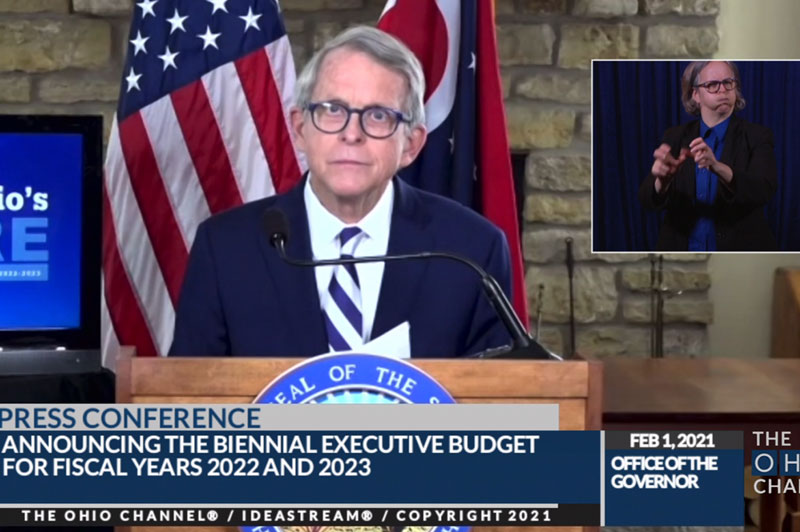
    Gov. Mike DeWine outlined his state budget proposal for fiscal years 2022 and 2023 in a February press conference.

    By Tyler Buchanan and Ohio Capital Journal

    Gov. Mike DeWine signed the $74 billion, two-year state budget into law, keeping in place nearly all of its signature policy positions and spending priorities while once again nixing an effort by Republican lawmakers to counter his administration’s methods of handling the deadly COVID-19 pandemic.

    The governor also vetoed an attempt by Republican lawmakers to give their party’s legislative leaders sole power to intervene in any potential redistricting lawsuits. The governor wrote in his veto message that this removal came at the request of Attorney General Dave Yost; voter rights groups and Democrats had also urged for the veto of this provision.

    As governor, DeWine has the power to issue “line-item vetoes” blocking specific provisions of the budget while signing his approval to the rest.

    In total, DeWine issued 14 such line-item vetoes among the more than 2,400-page budget bill. Lawmakers have the power to override any of these vetoes.

    Among the vetoes: A provision to vacate public health violations from businesses that were issued over the course of the pandemic. The budget item would have expunged all COVID-19 health violations, ended disciplinary actions in progress and ordered the state to repay any fines collected. Bars and restaurants which had their liquor licenses revoked — in some cases due to flagrant and repeated violations of the public health orders — would’ve had it reinstated.

    Gov. Mike DeWine signed the $74 billion, two-year state budget on Wednesday evening. Photo courtesy the governor’s office.

    In his veto statement, DeWine wrote that “Ohio law should not reward businesses and individuals that violated orders and rules adopted to protect Ohioans from the spread of COVID-19 by excusing their actions.”

    DeWine vetoed a provision which would have changed the state’s contracting process for a Medicaid managed care system.

    DeWine also vetoed provisions related to Medicaid program rates; an exemption of private schools from College Credit Plus laws; and quality controls of community schools.

    Unanswered veto requests

    While voter rights organizations scored a victory with the veto of the redistricting lawsuits provision, they were unsuccessful in pushing for vetoes of several other budget items condemned as being “anti-democratic.”

    This includes the budget eliminating the Citizen’s Education Fund and instituting a prohibition on elections officials collaborating with any “nongovernmental” entity for voter education purposes.

    There were other veto wishes that went unfulfilled. Democrats in the Ohio Senate wanted to see the governor remove the elimination of a cap on the number of EdChoice income-based vouchers awarded in Ohio and an income tax credit for private school tuition.

    Democrats in the Ohio House of Representatives, meanwhile, joined the Ohio Environmental Council in sharing concerns about budget language they fear would lead to oil and gas drilling in public park lands.

    Reproductive rights groups wanted to see DeWine take out provisions threatening the future of two Ohio abortion clinics. Innovation Ohio, a left-leaning policy group, was among the organizations drawing attention to the budget’s “medical practitioner conscience clause” allowing medical professionals to refuse treatment of patients if doing so would violate their personal moral or religious beliefs. Advocates believe this could lead to LGBTQ+ Ohioans being refused treatment.

    Policy Matters Ohio, a left-leaning think tank, called on the governor to remove proposed tax cuts that research has shown will largely benefit the state’s wealthiest earners.

    However, DeWine championed the 3% income tax cut in a news release announcing the budget signing.

    The Ohio Capital Journal will continue to provide coverage on the two-year state budget and the governor’s vetoes.

  • A year into pandemic, DeWine says Ohio on the right path to lift restrictions but can’t ease up yet

    A year into pandemic, DeWine says Ohio on the right path to lift restrictions but can’t ease up yet

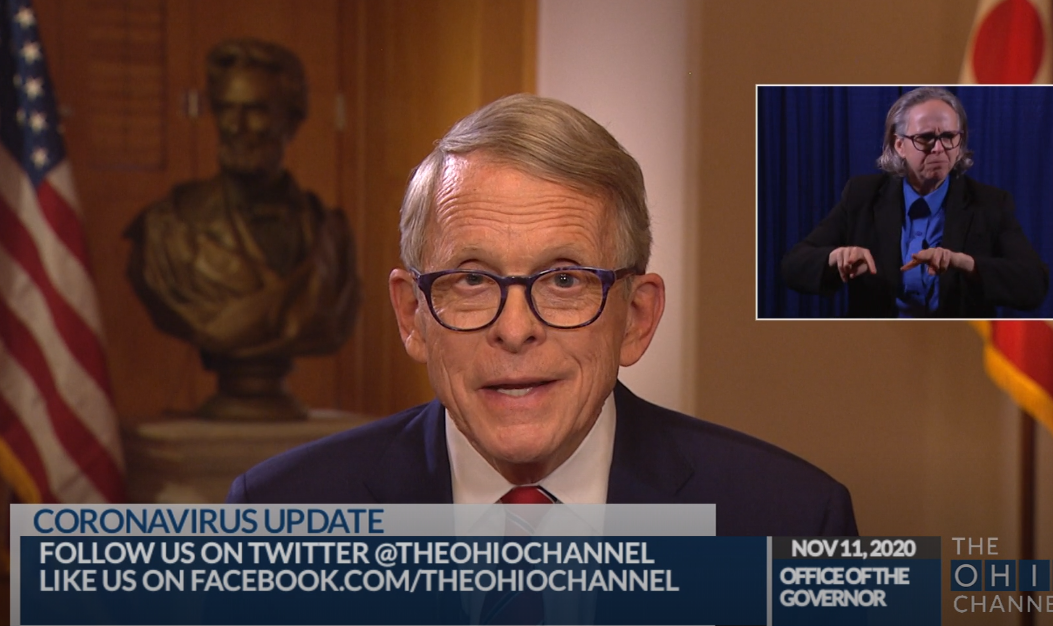
    Gov. Mike DeWine is pictured during a statewide address. Photo courtesy Ohio Channel.

    By Marty Schladen and Ohio Capital Journal

    A year ago Wednesday, the coronavirus pandemic officially started in Ohio when the decision was made to cancel The Arnold sports festival. 

    On Thursday, Gov. Mike DeWine gave a primetime address to tell Ohioans that a return to normal is in sight — so long as they don’t become complacent.

    “No marathoner pulls out on purpose at the 25th mile marker,” DeWine said.

    The governor made some news during the speech. He announced that he would lift all remaining health orders once the number of coronavirus cases drops to 50 per 100,000 Ohioans.

    That might seem distant, with Wednesday’s rate standing at 179 per 100,000. But DeWine noted that the rate has been falling rapidly, from 445 on Feb. 23 and 731 on Dec. 3.

    “Ohio is on the right path to get us to 50,” DeWine said.

    However, such drops can’t be counted on to continue. Federal health officials reported this week that daily numbers appear to be hitting a plateau at levels that might seem low after the past several months, but were perceived as quite high last summer.

    Also concerning is that at least six worrisome variants of the virus are struggling to gain a foothold. Some are more transmissible, others more lethal and still others less susceptible to the three vaccines that have been approved in the United States.

    DeWine’s unusual primetime speech was to mark the one-year anniversary of Ohio’s fight against the disease.

    “None of us then fully understood the battle ahead,” he said. “This has been a tough year. Many of you have lost a parent. grandparent, sibling, spouse. Some of you have even lost a child. Some of you have lost your job. Some of you have lost your business.”

    It also was to announce the metrics by which he’ll decide to lift remaining health orders.

    But it also seemed a repudiation of two other Republican governors’ announcements in recent days that they were lifting all of their orders — including ones requiring mask wearing in indoor public spaces. Texas Gov. Greg Abbott and Mississippi Gov. Tate Reeves both made such announcements on Tuesday, prompting widespread condemnation from public health experts and from President Joe Biden.

    Anthony Fauci, the leading communicable disease expert in the country, said the daily number of new cases needs to be one-sixth of what it is now before ending mask mandates should be considered.

    DeWine didn’t mention other states, but he made it clear that Ohio’s mask mandate would remain in place for the time being. As he touted the rapidly growing number of vaccines coming into Ohio, he said, “We have one battle-tested tool that has worked so well and that is the mask.”

    The governor also appealed to Ohioans’ community spirit — a spirit that critics have said is lacking in Abbott and Reeves’ approach to the pandemic.

    “It’s been a difficult year,” DeWine said. “But we did what Ohioans always do. We rallied together. We sacrificed. We showed the world our Ohio grit. Our communities have come together.”

  • [POLL] Do you feel safe sending your child back to school in light of the “Red” Alert?

    [POLL] Do you feel safe sending your child back to school in light of the “Red” Alert?

    “The Public Health Advisory Alert System is a color-coded system designed to supplement existing statewide orders through a data-driven framework to assess the degree of the virus’ spread and to engage and empower individuals, businesses, communities, local governments, and others in their response and actions.”

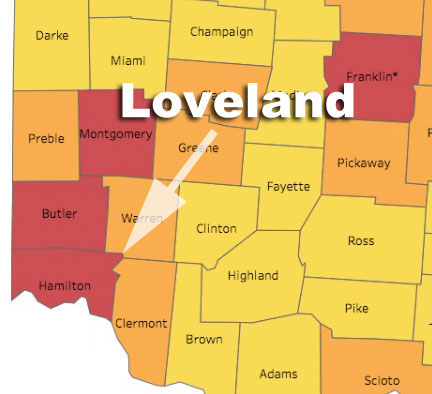
    Loveland, Ohio – Today beginning at 6 PM all of Hamilton County which includes parts of the Loveland School District is under an order of the Ohio Department of Health that mandates the wearing of face coverings in public.

    Loveland High School, the Intermediate and Middle School Campus, and the Primary and Elementary Campus are all within the RED alert area. There are approximately 4,000 students that attend these schools.

    The Early Childhood Center is in Clermont County which is in the Orange Alert area.

    Loveland Schools are currently scheduled to resume classes on August 26, 48 days from now.

    Loveland is in three counties. The Little Miami River is the East/West dividing line between Hamilton County and Clermont County, A smaller part of Loveland is in Warren county. Hamilton County is in the RED in Ohio’s Public Health Emergency Alert system. Clermont and Warren are both currently ORANGE.

    Also, Governor Dewine tweeted on July 7, “As the #COVID19 pandemic has progressed more younger Ohioans are being diagnosed with #COVID19. We are seeing young people who are getting very sick. There is also the concern that they are passing it on to those who are at risk.” He released this graphic to emphasize that point.


    [poll id=”5″]


    Read the Health Order

    Director’s Order for Facial Coverings in Butler, Cuyahoga, Franklin, Hamilton, Huron, Montgomery, and Trumbull Counties in Level 3 Public Health Advisory

  • Pediatric practices to start new interventions to prevent repeat child abuse

    Pediatric practices to start new interventions to prevent repeat child abuse

    AG DeWine, OCHA, Ohio AAP announce third phase of Ohio children’s hospitals’ collaboration

    Columbus, Ohio —Today Ohio Attorney General Mike DeWine and the Ohio Children’s Hospital Association (OCHA) announced a new collaboration to further spread interventions and findings to reduce the occurrence of child abuse in infants six months and younger by enlisting pediatric practices.

    Eight large pediatric practices across Ohio, representing more than 30,000 patients and families and recruited through a partnership with the Ohio Chapter of the American Academy of Pediatrics, will be joining children’s and community hospitals in implementing proven interventions to identify potential signs of abuse and prevent further abuse in Ohio’s youngest and most vulnerable children.

    Ohio Attorney General Mike DeWine funded the Timely Recognition of Abusive Injuries (TRAIN) Collaborative with a $1 million grant from settlement funds to OCHA in 2015. The purpose of TRAIN is to prevent repeat child abuse in the most vulnerable population, infants six months and younger.

    The TRAIN Collaborative analyzed what the medical community refers to as “sentinel injuries.” Sentinel injuries are minor injuries known to the medical provider that should prompt concern that the child is being abused. Unfortunately, sentinel injuries are often missed by medical providers placing the infant at risk for further abuse. The TRAIN Collaborative identified the specific injuries that should be suspect and developed a specific process – or “bundle of care” that reduces repeat instances of child abuse.  If a medical provider discovers a sentinel injury, they use the prescribed “bundle,” to assist in the identification of abuse and to ensure the infant receives appropriate follow-up care. The “bundle” includes a skeletal survey of the infant, psychosocial assessment of the caregivers and pediatric consultation.

    In 2016, children’s hospitals in Ohio determined that one in 10 Ohio children seen for child abuse has been seen previously with a sentinel injury.

    In 2016, children’s hospitals in Ohio determined that one in 10 Ohio children seen for child abuse has been seen previously with a sentinel injury and less than one in three receives the necessary physical examination and follow-up. They worked together to create and test the “bundle” within their own hospitals, and then spread the process to 19 community hospitals across the state. This third phase will teach eight pediatric practices about the “bundle” and help them implement it within their practice.

    Sentinel injuries are often missed by medical providers placing the infant at risk for further abuse.

    “We have some of the best minds in pediatric healthcare in the country right here in Ohio. I am proud that we could bring these minds together to identify a proven process to help children who are too young to understand their injuries or even to speak for themselves,” said DeWine. “Spreading this important process to more pediatricians throughout Ohio will mean more children are spared from further abuse – and that has been my goal with this program from day one.”

    The learning here in Ohio has been spread beyond the state’s borders, as leaders from TRAIN have been asked to present their findings at national conferences, including the Court Appointed Special Advocate/Guardian Ad Litem conference.

    “Attorney General DeWine has always been a strong advocate for Ohio’s children, and this initiative would not have been possible without his commitment and support. We are grateful to be able to take our learning into a third phase to spread this valuable process even further in our state and beyond,” said Nick Lashutka, President and CEO of OCHA.

    More information about TRAIN is available at www.ohiochildrenshospitals.org.