

Tag: diversity and inclusion programs

  • Ohio college students, educators disappointed in Gov. DeWine for signing higher ed overhaul

    Ohio college students, educators disappointed in Gov. DeWine for signing higher ed overhaul

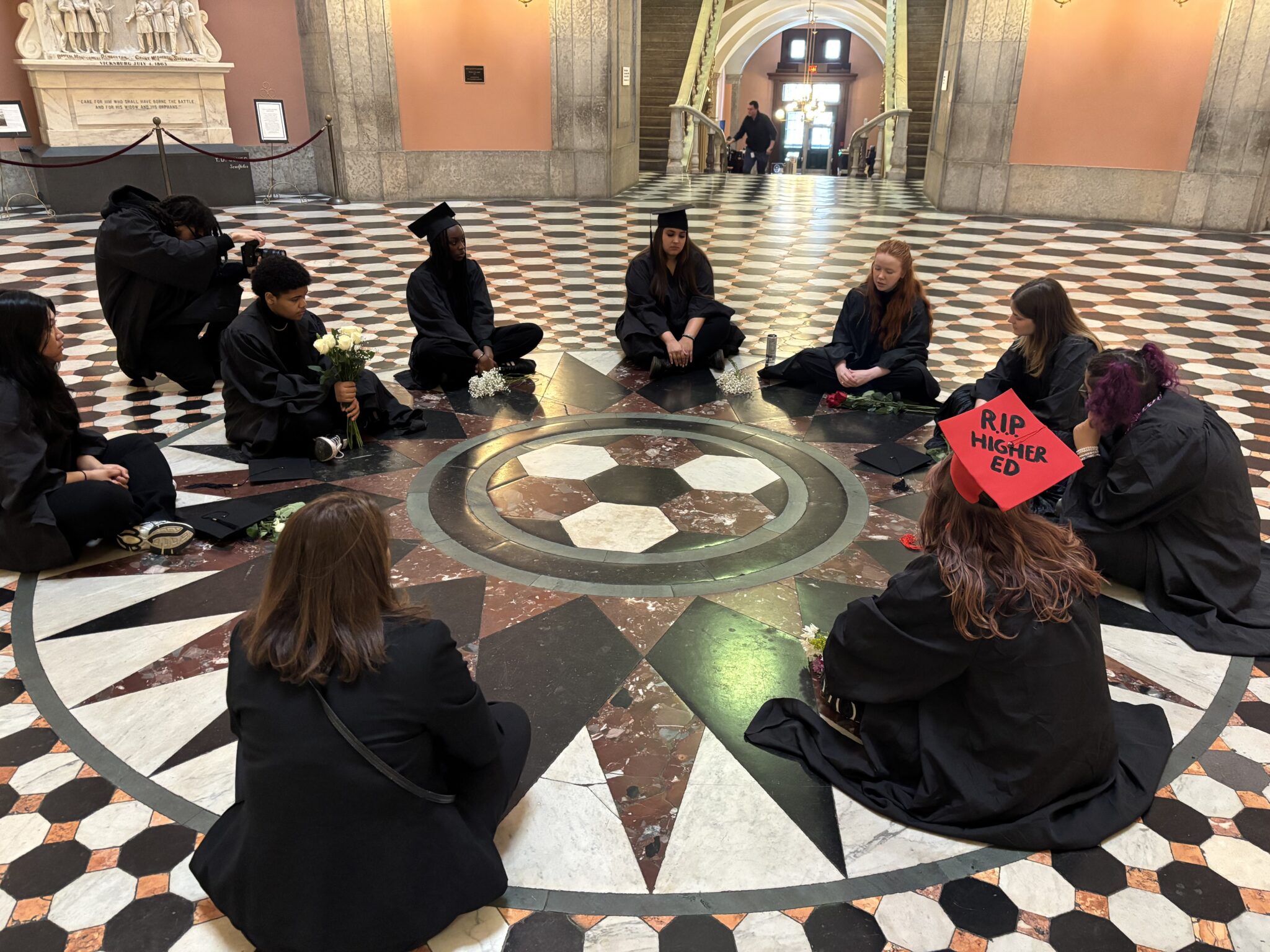
     Members of the Ohio Student Association held a mock funeral for the death of higher education on March 31

    Photo by Megan Henry, Ohio Capital Journal

    The Ohio Student Association organized the mock funeral, which took place Monday afternoon in the Ohio Statehouse Rotunda, days after DeWine signed Senate Bill

    By:  Ohio Capital Journal

    Students donning black graduation robes held a mock funeral for the death of higher education after Ohio Gov. Mike DeWine signed a bill into law that will overhaul the state’s public universities.

    The Ohio Student Association organized the event, which took place Monday afternoon in the Statehouse Rotunda, days after DeWine signed Ohio Senate Bill 1.

    S.B. 1 will ban diversity efforts, prohibit faculty strikes, regulate classroom discussion of “controversial” topics, create post-tenure reviews, put diversity scholarships at risk, create a retrenchment provision that block unions from negotiating on tenure, shorten university board of trustees terms from nine years down to six years, and require students take an American history course, among other things.

    GET THE MORNING HEADLINES.


    For classroom discussion, the bill will set rules around topics involving “controversial beliefs” such as climate policies, electoral politics, foreign policy, diversity and inclusion programs, immigration policy, marriage, or abortion. It prohibits professors from “indoctrination,” and while it doesn’t define that, it allows complaints to be filed against professors for review by the Chancellor of the Ohio Department of Higher Education. S.B. 1 will only affect Ohio’s public universities and community colleges.

    “It was really surprising, the quickness that it was signed,” said Ohio State University junior Brielle Shorter. “I think signing it at such a time was really interesting as well, but it was truly heartbreaking.”

    DeWine got the bill Wednesday — the same day the Ohio Senate concurred with changes to the bill made by the Ohio House — and he signed it Friday.

    “As a Black student on campus, our spaces have already been slowly getting demolished,” Shorter said. “I believe that with this bill there’s going to be more changes like that.”

    Ohio State recently closed its Office of Diversity and Inclusion and the Office of Student Life’s Center for Belonging and Social Change in response to the U.S. Department of Education’s Dear Colleague letter that threatened to rescind federal funds for schools that use race-conscious practices in admissions, programming, training, hiring, scholarships, and other aspects of student life.

    Shorter said she has seen Ohio high school students post on social media how they are no longer interested in attending Ohio universities and instead plan to go to school out of state.

    Scott DiMauro, president of the Ohio Education Association, said it is unfortunate DeWine signed S.B. 1 into law.

    “It’s disappointing to see that he did that, even though the overwhelming amount of opposition that was expressed on the bill from faculty and from students and from concerned citizens was strongly against it,” he said. “I think it’s unfortunate to see collective bargaining rights of people who work in higher education diminished.”

    Pranav Jani, president of Ohio State’s American Association of University Professors chapter, said they will fight the impact of the bill as it becomes law.

    “We know that we stand with thousands of educators, students, and parents, who are disgusted by this naked display of governmental repression of higher education,” he said in a statement.

    State Sen. Jerry Cirino, R-Kirtland, introduced S.B. 1, which took just over two months to pass both chambers and be signed into law.

    “I believe this is monumentally significant legislation that will allow Ohio’s public universities and community colleges to deal with looming enrollment challenges and usher in a renaissance of academic excellence,” Cirino said in a statement.

    Follow Capital Journal Reporter Megan Henry on Bluesky.


    Megan Henry
    Megan Henry

    Megan Henry is a reporter for the Ohio Capital Journal and has spent the past five years reporting in Ohio on various topics including education, healthcare, business and crime. She previously worked at The Columbus Dispatch, part of the USA Today Network.

    Ohio Capital Journal is part of States Newsroom, the nation’s largest state-focused nonprofit news organization.

    MORE FROM AUTHOR

  • ‘The bill is very racist.’ Ohio House Democrats question Republican senator on his higher ed bill

    ‘The bill is very racist.’ Ohio House Democrats question Republican senator on his higher ed bill

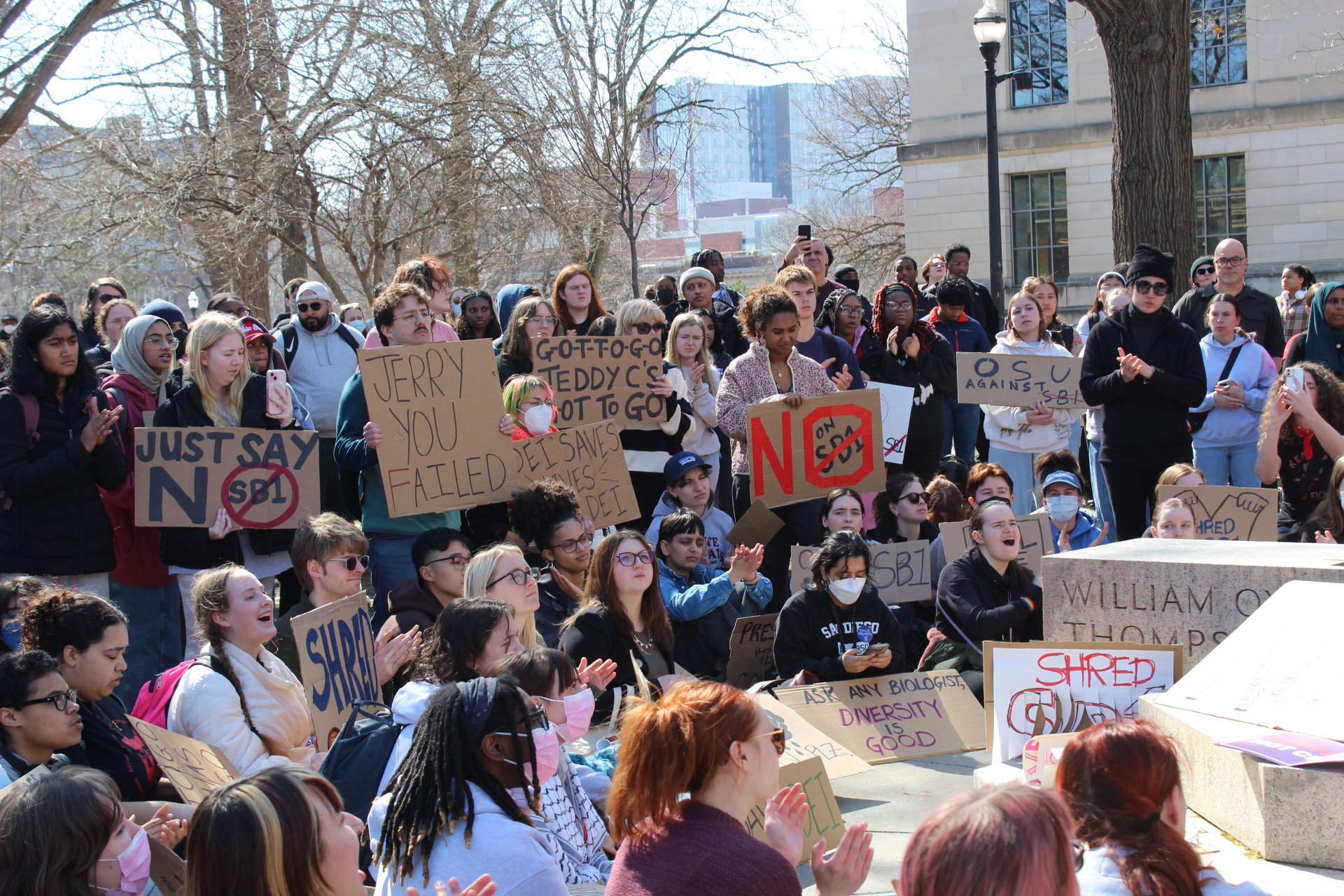
     Hundreds of students protested against Senate Bill 1 on Ohio State’s campus on March 4, 2025. (Photo by Megan Henry, Ohio Capital Journal).

    By:  Ohio Capital Journal

    Ohio Democrats peppered Republican state Sen. Jerry Cirino with questions over his higher education overhaul bill this week. The bill would ban faculty strikes and diversity efforts on campus, as well as set rules around classroom discussion.

    One Democratic lawmaker called the bill racist.

    Cirino gave sponsor testimony on Senate Bill 1 Tuesday afternoon during the Ohio House Higher Education and Workforce Committee meeting.

     State Sen. Jerry C. Cirino, R-Lake County. (Photo from Ohio Senate website.) 

    “S.B. 1 is about more speech, not less,” he said. “It is about creating an environment of continuous improvement. It is about the core value that students come first; they are the customers of these institutions.”

    Senate Bill 1 would ban diversity and inclusion efforts, block faculty from striking, set rules around classroom discussion, put diversity scholarships at risk, shorten university board of trustees terms from nine years to six, and require students take an American history course, among other things.

    Regarding classroom discussion, it would set rules around topics involving “controversial beliefs” such as climate policies, electoral politics, foreign policy, diversity and inclusion programs, immigration policy, marriage, or abortion.

    S.B. 1, which only applies to public colleges, stipulates classroom discussion allows students to “reach their own conclusions about all controversial beliefs or policies and shall not seek to indoctrinate any social, political, or religious point of view.”

     State Rep. Desiree Tims, D-Dayton. (Photo from Ballotpedia.) 

    “I think the bill is very racist,” state Rep. Desiree Tims, D-Dayton, said during Tuesday’s committee meeting.

    The Ohio Senate passed S.B. 1 last month and hundreds of students, faculty and staff protested S.B.1 at Ohio State University as Cirino gave his sponsor testimony Tuesday afternoon.

    Tims asked Cirino why he was interested in getting rid of diversity scholarships and Cirino responded by saying Ohio Attorney General Dave Yost addressed race-based scholarships last year.

    “We have guidance from the attorney general that we cannot do those,” Cirino said. “Our institutions may not do those things based on race.”

    In 2023, the U.S. Supreme Court ruled that Harvard and the University of North Carolina violated the Equal Protection clause of the 14th Amendment by using race as a factor in applications. The days after the ruling, Yost sent a letter to Ohio colleges and universities saying his office won’t legally protect someone at a college or university who uses race as a factor.

    “How is it that you want diversity of thought, but not diversity of people at these public institutions that would bring that diversity?” state Rep. Joe Miller, D-Amherst, asked.

    Cirino responded by saying diversity of thought and programs that promote diversity and inclusion are not comparable.

    “You cannot discriminate against one group to make up for discrimination of another group,” Cirino said.

    Miller also asked about whether limiting speech through legislation, such as this bill, is a slippery slope.

    “There’s absolutely not one limitation of what can be talked about in the classroom,” Cirino said in his response. “What we say very specifically and explicitly in the bill is that there has to be an openness to looking at other opinions and welcoming diverse opinions as well.”

    State Rep. Beryl Brown Piccolantonio, D-Gahanna, asked about the retrenchment and collective bargaining parts of the bill.

    GET THE MORNING HEADLINES.


    “We need to treat our institutions of higher learning a little bit more like a business,” Cirino said. “If we don’t help (university presidents and boards of trustees) with these management tools, we’re going to find a real disadvantage for the state of Ohio.”

    Piccolantonio questioned if this bill is giving lawmakers more control over public universities.

    “It is clearly not the legislature trying to step in and operate the college or university,” Cirino said. “It’s about empowering the boards of trustees, the governing board and the presidents.”

    Piccolantonio also asked if Cirino would be open to making any changes to the bill and he said no, reminding committee members that this bill went through 11 revisions in the last General Assembly.

    “This bill is matured and it’s ready to go,” Cirino said. In the version of the bill passed last month by the Ohio Senate, most of the changes made in the last General Assembly were rolled back.

    More than 800 people submitted opponent testimony against the bill — significantly outweighing the amount of supporter testimony the bill has received. Several students have said they would leave Ohio if this bill passed.

    When state Rep. Munira Abdullahi, D-Columbus, asked about so many students opposing the bill, Cirino said legislation is not developed based on how many people come to testify.

    “If we started doing that, it would be a popularity contest, and we should all take a huge pay cut because we’re getting paid, in my view, to make policies sometimes, whether it’s popular or not, if we think it is the right thing to do and good for the state of Ohio,” Cirino said.

    Abdullahi also asked why the bill would ban higher education faculty from striking.

    “Simply because higher education, all postsecondary education, is absolutely critical to us in Ohio if we’re going to maintain a strong economy in the future and meet the workforce requirements that we need to meet in order to employ people and to provide the workers that our companies are looking for,” Cirino said.

    Follow Capital Journal Reporter Megan Henry on Bluesky.
    YOU MAKE OUR WORK POSSIBLE.

    ________________
    Megan Henry
    Megan Henry

    Megan Henry is a reporter for the Ohio Capital Journal and has spent the past five years reporting in Ohio on various topics including education, healthcare, business and crime. She previously worked at The Columbus Dispatch, part of the USA Today Network.

    Ohio Capital Journal is part of States Newsroom, the nation’s largest state-focused nonprofit news organization.

    MORE FROM AUTHOR