Tag: diversity scholarships

  • Opponents of new Ohio higher education law don’t have enough signatures to get a referendum

    Opponents of new Ohio higher education law don’t have enough signatures to get a referendum

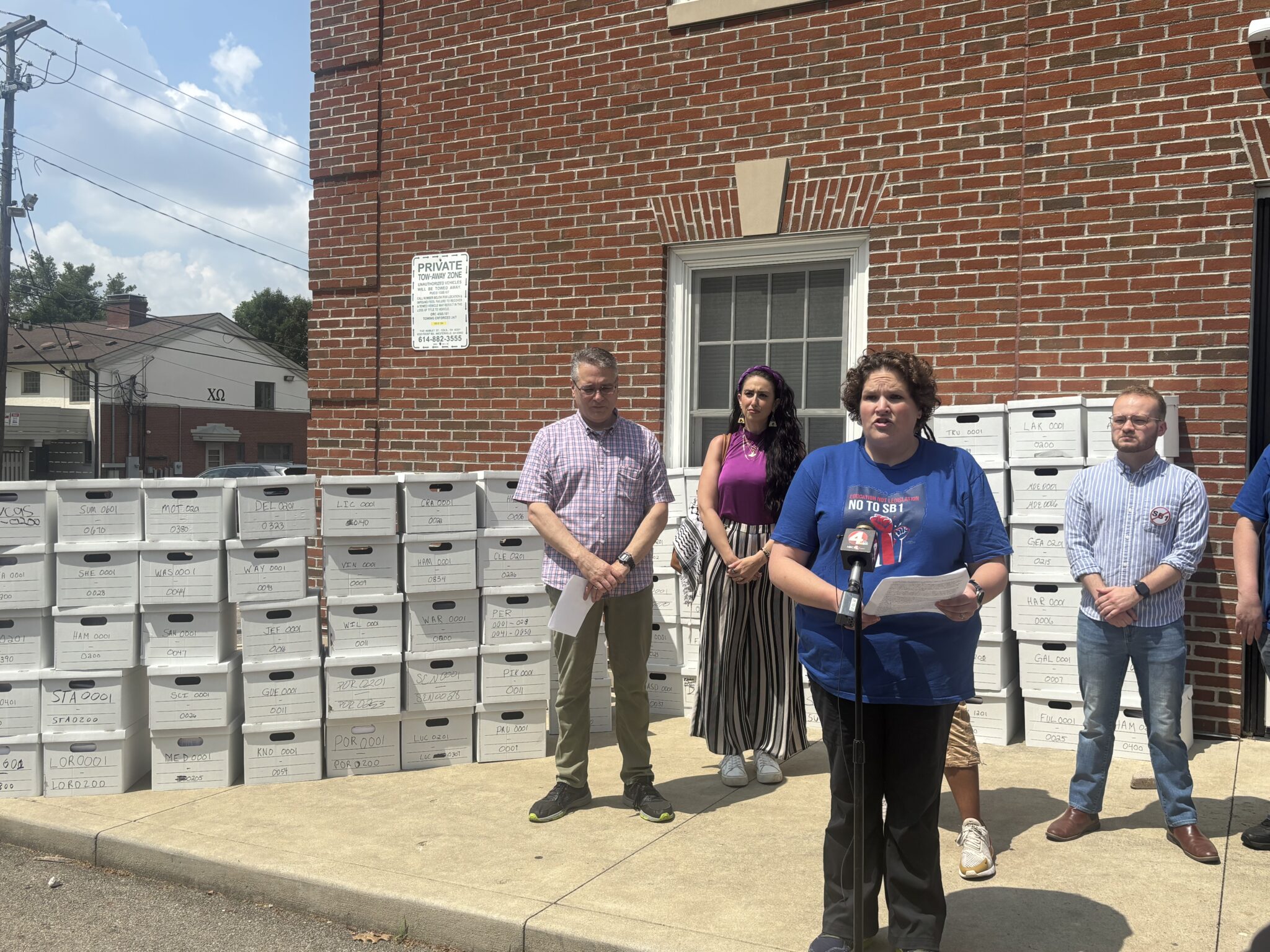
    Amanda Fehlbaum, one of three Youngstown State University faculty members who tried to get referendum on the Nov. 4 ballot to stop Senate Bill 1, spoke at a press conference on June 26. (Photo by Megan Henry, Ohio Capital Journal).

    By:  Ohio Capital Journal

    Opponents of Ohio Republican lawmakers’ higher education overhaul that bans diversity efforts and faculty strikes, and sets rules around classroom discussion, have failed to collect enough signatures to put a referendum on the ballot this year to block it.

    Members of the Youngstown State University’s chapter of the Ohio Education Association tried to get a referendum on the Nov. 4 ballot to stop Ohio Senate Bill 1, but said they ultimately ran out of time.

    GET THE MORNING HEADLINES.


    “Over the course of the last few days, we were collecting over 4,000 signatures a day, and that momentum was only increasing,” said Youngstown State’s Ohio Education Association President Mark Vopat. “It was only because we ran out of time that we weren’t able to get the required signatures. … I believe that if we’d had just a little bit more time, we could have gotten those numbers.”

    They needed to collect about 248,092 signatures from at least 44 of Ohio’s 88 counties — 6% of the total vote cast for governor during the last gubernatorial election.

    Instead, they collected nearly 195,000 signatures and met the signature requirements in at least 33 counties, said Amanda Fehlbaum, a Youngstown State faculty member who helped champion efforts to get a referendum.

    The plan was to submit the collected signatures to Ohio Secretary of State Frank LaRose on Thursday for him to verify the signatures. This was the deadline to submit signatures since the law goes into effect Friday.

    The new law creates post-tenure reviews, puts diversity scholarships at risk, sets rules around classroom discussion, and creates a retrenchment provision that blocks unions from negotiating on tenure, among other things. The law affects Ohio’s public universities and community colleges.

    “One thing is clear in all of this, the people do not want politicians making decisions about higher education,” Fehlbaum said. “The people do not like this legislation.”

    S.B. 1 quickly passed through the legislature earlier this year and Ohio Gov. Mike DeWine signed the bill into law on March 28.

    Fehlbaum said she thought another group “with infrastructure and funding” would come forward to challenge S.B. 1 after DeWine signed it into law, but that never happened so they decided to go the referendum route.

    Vopat and Fehlbaum along with fellow Youngstown State faculty member Cryshanna Jackson Leftwich started the referendum process in mid-April and Ohio Attorney General Dave Yost and the Ohio Secretary of State’s office gave them approval to start collecting signatures May 5.

    “I do think we could have pulled this off had we not wasted two weeks waiting on another group or groups to come forward,” Fehlbaum said.

    Vopat agrees they would have been able to get enough signatures if they had started the referendum process immediately after DeWine signed the bill into law.

    “That might have also given us the extra time we needed,” he said.

    The three Youngstown State faculty members said they are figuring out next steps and considering efforts to potentially try to get on the ballot in 2026.

    “This is not the end for us,” Jackson Leftwich said. “I want people to know that we’re going to use this momentum.”

    More than 1,700 people volunteered to collect signatures across the state. They ended up raising more than $43,000 in small dollar donations with $1,000 being their largest donation, Fehlbaum said.

    “I cannot underscore how much we did not have money,” she said. “We did not have paid consultants. We did not have paid petitioners. None of us are getting paid. …  There’s no dark money here.”

    But they said it ultimately came down to a lack of time, not a shortage of money.

    “I would love to take these boxes of petitions and put them on Jerry Cirino’s front door as a visible symbol of how detested this legislation is by the people,” Fehlbaum said. “We’re instead going to spend some of our remaining campaign funds on a shredding service so that information voters shared with us will not be mishandled.”

    Cirino is the Republican Ohio state senator who introduced S.B. 1.

    Some of Ohio’s public universities have started making decisions because of the new law. Ohio University announced it will close the Pride Center, the Women’s Center, and the Multicultural Center.

    The University of Toledo is suspending nine undergraduate programs. Kent State University is closing its LGBTQ+ Center, Women’s Center, and Student Multicultural Center.

    Referendums are rare and the last one that passed in Ohio was when voters overturned an anti-collective bargaining law in 2011.

    Follow Capital Journal Reporter Megan Henry on Bluesky.c


    Megan Henry
    Megan Henry

    Megan Henry is a reporter for the Ohio Capital Journal and has spent the past five years reporting in Ohio on various topics including education, healthcare, business and crime. She previously worked at The Columbus Dispatch, part of the USA Today Network.

    Ohio Capital Journal is part of States Newsroom, the nation’s largest state-focused nonprofit news organization.

    MORE FROM AUTHOR

  • Ohio college students, educators disappointed in Gov. DeWine for signing higher ed overhaul

    Ohio college students, educators disappointed in Gov. DeWine for signing higher ed overhaul

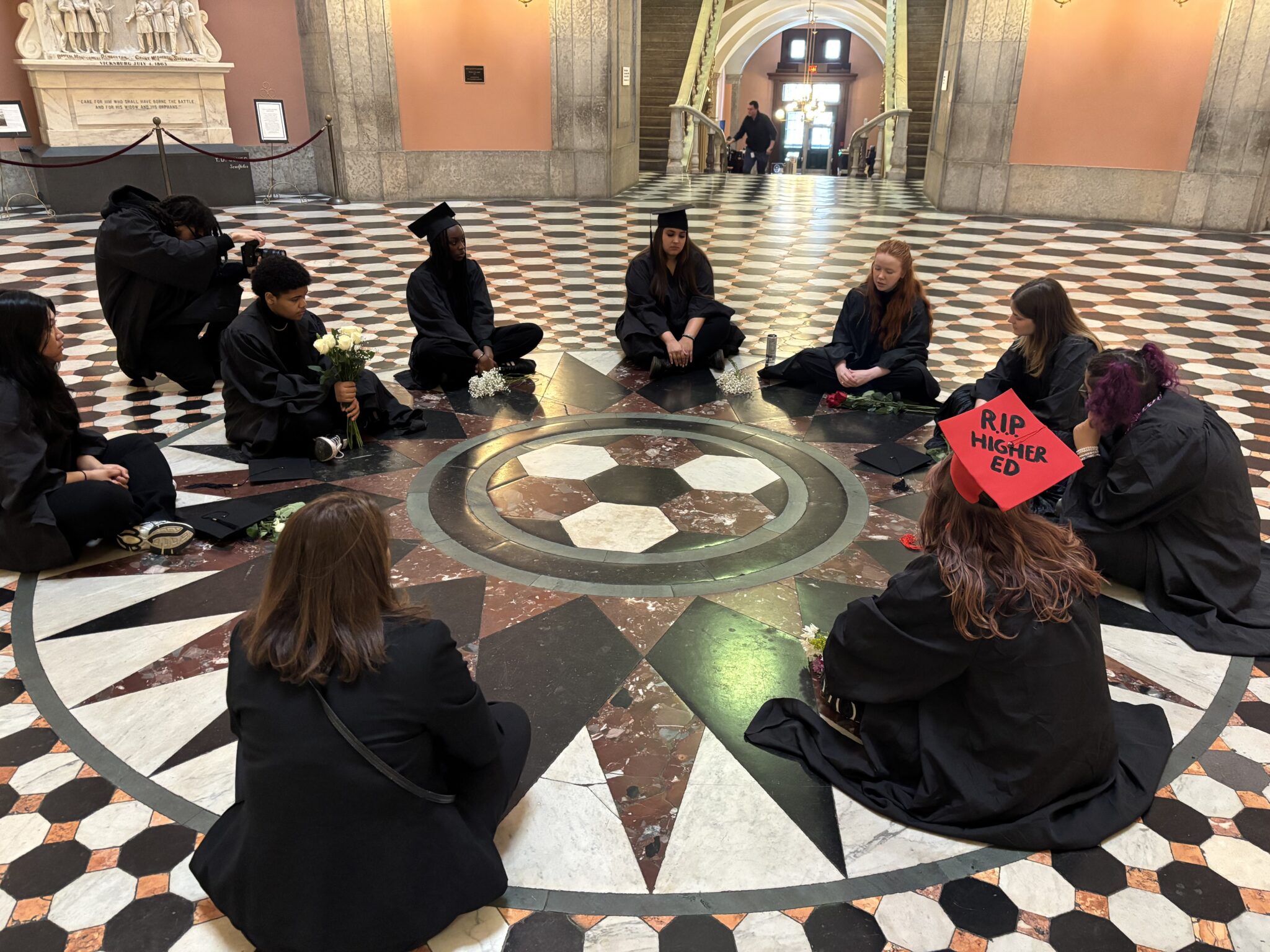
     Members of the Ohio Student Association held a mock funeral for the death of higher education on March 31

    Photo by Megan Henry, Ohio Capital Journal

    The Ohio Student Association organized the mock funeral, which took place Monday afternoon in the Ohio Statehouse Rotunda, days after DeWine signed Senate Bill

    By:  Ohio Capital Journal

    Students donning black graduation robes held a mock funeral for the death of higher education after Ohio Gov. Mike DeWine signed a bill into law that will overhaul the state’s public universities.

    The Ohio Student Association organized the event, which took place Monday afternoon in the Statehouse Rotunda, days after DeWine signed Ohio Senate Bill 1.

    S.B. 1 will ban diversity efforts, prohibit faculty strikes, regulate classroom discussion of “controversial” topics, create post-tenure reviews, put diversity scholarships at risk, create a retrenchment provision that block unions from negotiating on tenure, shorten university board of trustees terms from nine years down to six years, and require students take an American history course, among other things.

    GET THE MORNING HEADLINES.


    For classroom discussion, the bill will set rules around topics involving “controversial beliefs” such as climate policies, electoral politics, foreign policy, diversity and inclusion programs, immigration policy, marriage, or abortion. It prohibits professors from “indoctrination,” and while it doesn’t define that, it allows complaints to be filed against professors for review by the Chancellor of the Ohio Department of Higher Education. S.B. 1 will only affect Ohio’s public universities and community colleges.

    “It was really surprising, the quickness that it was signed,” said Ohio State University junior Brielle Shorter. “I think signing it at such a time was really interesting as well, but it was truly heartbreaking.”

    DeWine got the bill Wednesday — the same day the Ohio Senate concurred with changes to the bill made by the Ohio House — and he signed it Friday.

    “As a Black student on campus, our spaces have already been slowly getting demolished,” Shorter said. “I believe that with this bill there’s going to be more changes like that.”

    Ohio State recently closed its Office of Diversity and Inclusion and the Office of Student Life’s Center for Belonging and Social Change in response to the U.S. Department of Education’s Dear Colleague letter that threatened to rescind federal funds for schools that use race-conscious practices in admissions, programming, training, hiring, scholarships, and other aspects of student life.

    Shorter said she has seen Ohio high school students post on social media how they are no longer interested in attending Ohio universities and instead plan to go to school out of state.

    Scott DiMauro, president of the Ohio Education Association, said it is unfortunate DeWine signed S.B. 1 into law.

    “It’s disappointing to see that he did that, even though the overwhelming amount of opposition that was expressed on the bill from faculty and from students and from concerned citizens was strongly against it,” he said. “I think it’s unfortunate to see collective bargaining rights of people who work in higher education diminished.”

    Pranav Jani, president of Ohio State’s American Association of University Professors chapter, said they will fight the impact of the bill as it becomes law.

    “We know that we stand with thousands of educators, students, and parents, who are disgusted by this naked display of governmental repression of higher education,” he said in a statement.

    State Sen. Jerry Cirino, R-Kirtland, introduced S.B. 1, which took just over two months to pass both chambers and be signed into law.

    “I believe this is monumentally significant legislation that will allow Ohio’s public universities and community colleges to deal with looming enrollment challenges and usher in a renaissance of academic excellence,” Cirino said in a statement.

    Follow Capital Journal Reporter Megan Henry on Bluesky.


    Megan Henry
    Megan Henry

    Megan Henry is a reporter for the Ohio Capital Journal and has spent the past five years reporting in Ohio on various topics including education, healthcare, business and crime. She previously worked at The Columbus Dispatch, part of the USA Today Network.

    Ohio Capital Journal is part of States Newsroom, the nation’s largest state-focused nonprofit news organization.

    MORE FROM AUTHOR

  • [BREAKING] Ohio Gov. DeWine signs higher ed bill regulating classroom discussion and banning diversity efforts

    [BREAKING] Ohio Gov. DeWine signs higher ed bill regulating classroom discussion and banning diversity efforts

    By:  Ohio Capital Journal

    Ohio Gov. Mike DeWine on Friday signed into law a massive higher education overhaul to ban diversity efforts, regulate classroom discussion, and prohibit faculty strikes, among other things. The law will take effect in 90 days.

    S.B. 1 will set rules around classroom discussion, create post-tenure reviews, put diversity scholarships at risk, create a retrenchment provision that block unions from negotiating on tenure, shorten university board of trustees terms from nine years down to six years, and require students take an American history course, among other things.

    For classroom discussion, the bill will set rules around topics involving “controversial beliefs” such as climate policies, electoral politics, foreign policy, diversity and inclusion programs, immigration policy, marriage, or abortion. S.B. 1 would only affect Ohio’s public universities.

    The bill moved quickly through the Statehouse. State Sen. Jerry Cirino, R-Kirtland, introduced S.B. 1, which passed the Ohio Senate in February and the Ohio House in March. Cirino introduced a nearly identical bill during the last General Assembly that went through several revisions, but the bill never made it the House floor and ultimately died.

    The bill received overwhelming opposition from college students and professors. More than 1,500 people have submitted opponent testimony against the bill. Hundreds of students around the state have protested against the bill. Students and faculty have said they would leave Ohio if the bill becomes law.

    Follow Capital Journal Reporter Megan Henry on Bluesky.


    Megan Henry
    Megan Henry

    Megan Henry is a reporter for the Ohio Capital Journal and has spent the past five years reporting in Ohio on various topics including education, healthcare, business and crime. She previously worked at The Columbus Dispatch, part of the USA Today Network.

    Ohio Capital Journal is part of States Newsroom, the nation’s largest state-focused nonprofit news organization.

    MORE FROM AUTHOR

  • Students, faculty are asking Ohio Gov. Mike DeWine to veto massive higher ed overhaul bill

    Students, faculty are asking Ohio Gov. Mike DeWine to veto massive higher ed overhaul bill

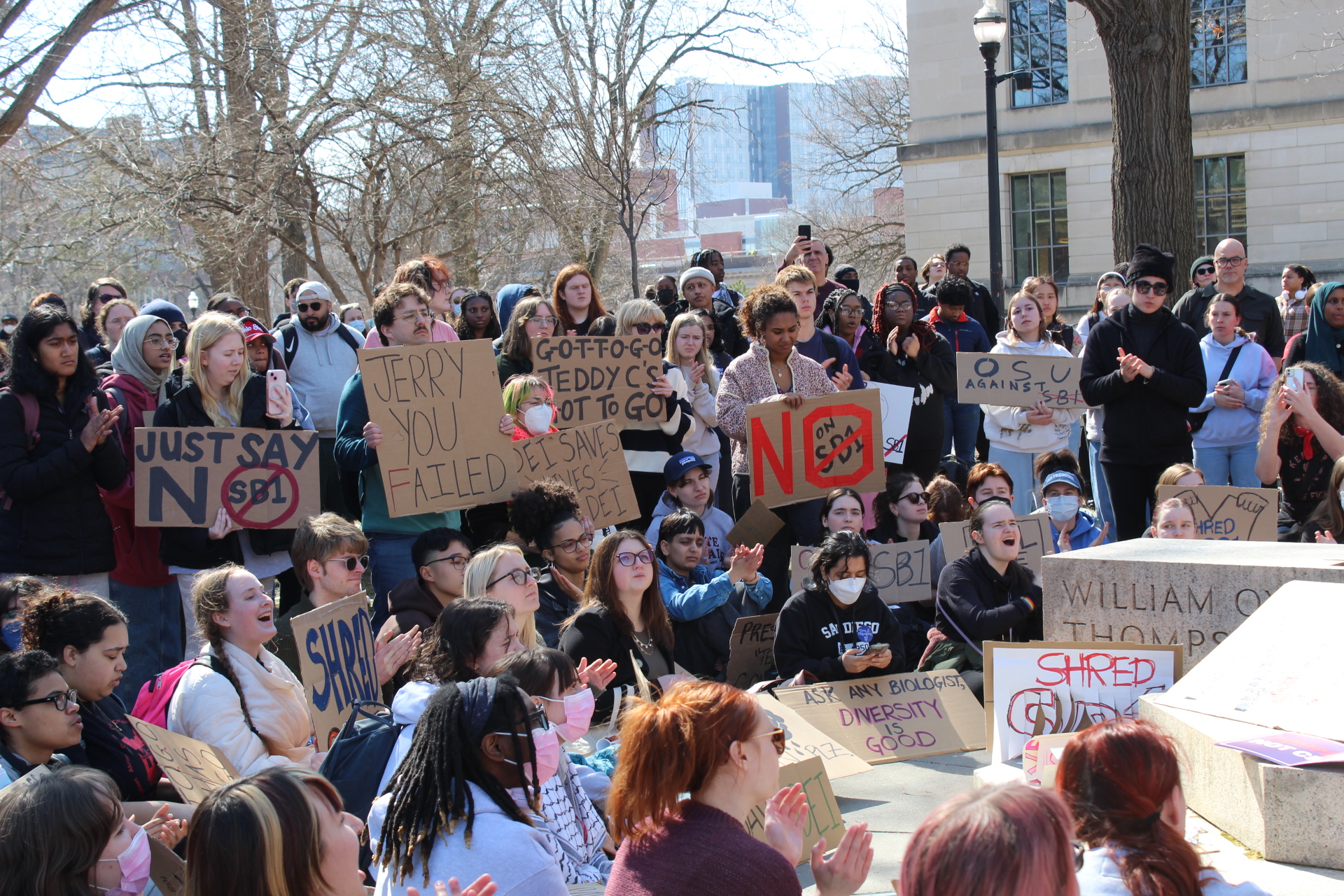
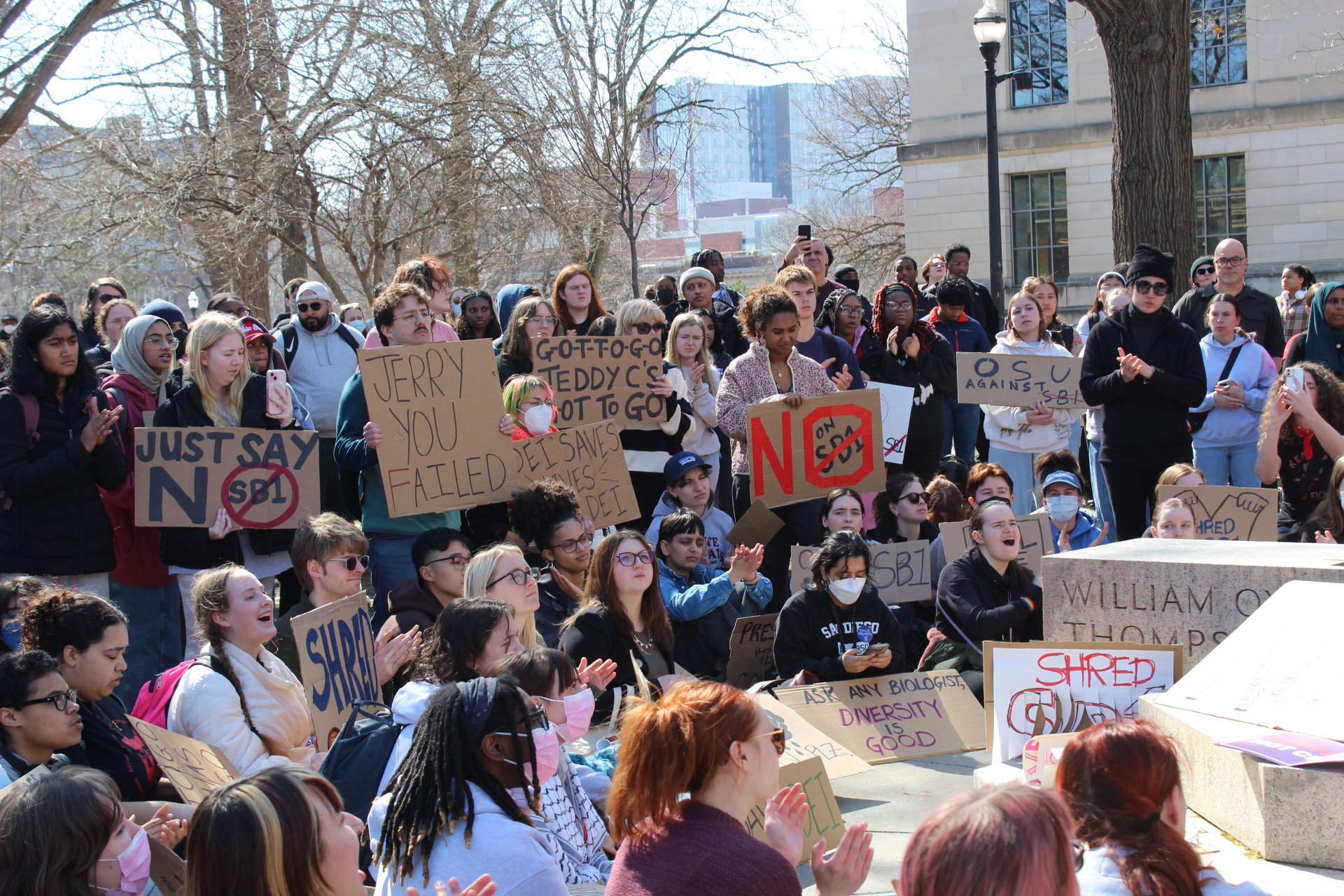
    Hundreds of students protested against Senate Bill 1 on Ohio State’s campus on March 4, 2025. (Photo by Megan Henry, Ohio Capital Journal).

    By:  Ohio Capital Journal

    Ohio college students, faculty and staff are calling on Gov. Mike DeWine to veto a massive higher education bill that would ban diversity and inclusion on campus and prevent faculty from striking.

    Lawmakers concurred with tweaks made to Senate Bill 1 during Wednesday’s Senate session, sending the bill to DeWine’s desk for his signature. DeWine received the bill Wednesday and has 10 days to sign the bill into law or veto it. If DeWine vetoes the bill, lawmakers would need a 3/5 vote from each chamber to override it.

    DeWine, however, has previously said he would sign the bill.

    GET THE MORNING HEADLINES.


    S.B. 1 would set rules around classroom discussion, create post-tenure reviews, put diversity scholarships at risk, create a retrenchment provision that blocks unions from negotiating on tenure, shorten university board of trustees terms from nine years down to six years, and require students take an American history course, among other things.

    For classroom discussion, the bill would set rules around topics involving “controversial beliefs” such as climate policies, electoral politics, foreign policy, diversity and inclusion programs, immigration policy, marriage, or abortion, and forbid “indoctrination,” though that remains undefined. S.B. 1 would only affect Ohio’s public universities.

    “Republicans showed us they’d rather gamble with our economic future than solve real problems in our state,” Ohio Democratic Party Chair Elizabeth Walters said in a statement. “Instead of growing our state, Republicans are driving students, young adults, and business away from Ohio. We’re urging Governor DeWine to do the right thing and veto this legislation.”

    The Ohio Senate Democratic Caucus sent a letter to DeWine urging him to veto S.B. 1.

    “This legislation is a misguided attempt by overreaching legislators to impose their ideological beliefs on our public universities,” the letter said. “The bill undermines academic freedom, attacks collective bargaining rights, and jeopardizes the future of higher education in our state.”

    The Ohio House Minority Caucus also sent a letter to DeWine asking him to veto the bill. 

    “You have an opportunity to protect the future of Ohio’s institutions of higher education, and your legacy as Ohio’s governor, by vetoing this bill and requiring the legislature to negate terms that are more amenable to the will of Ohioans,” the letter read.

    The ACLU of Ohio wants DeWine to veto S.B. 1 and protect free speech on campus.

    “By dismantling DEI structures, Senate Bill 1 sends a clear, harmful message to students that their unique backgrounds, experiences, and perspectives are not welcome in Ohio,” ACLU of Ohio Policy Director Jocelyn Rosnick said in a statement.

    Anticipating S.B. 1 would pass during Wednesday’s Senate session, members of the Ohio Legislative Black Caucus urged DeWine to veto S.B. 1 during a press conference earlier that day.

    “This is one of the worst government overhauls that I’ve seen to date,” said state Rep. Terrence Upchurch, D-Cleveland. “It will not only limit our First Amendment right to free speech, ban strikes and collective bargaining rights for professors, it threatens opportunities for our students, undermines workforce development and disproportionately harms black and minority communities.”

    State Rep. Desiree Tims, D-Dayton, said S.B. 1 is toxic, racist and a threat to free speech and academic freedom.

    “Since when is diversity, equity and inclusion a bad thing?” she asked. “Why is this necessary? The only answer is, so that we can move backwards, pre-civil rights … progress that this country and this nation has stood for. … Senate Bill 1 turns the ugly page back in history, somewhere we do not want to go, where we should not go.”

    Ohio University Journalism School Director Eddith Dashiell talked about how the university’s journalism school did not give out 12 race-based scholarships totaling $46,000 last year after the U.S. Supreme Court ruled against race-conscious admissions in 2023.

    “The diversity scholarships weren’t designed to discriminate against white students,” she said. “The diversity scholarships were designed to encourage more students of color to come to little old, white Athens, Ohio and get a quality education.”

    S.B. 1 will be detrimental to Ohio’s higher education, Dashiell said.

    “If it hadn’t been for an extra effort at Ohio University to diversify the faculty, I would still be in Tennessee,” she said. “We also urge that Governor DeWine veto this bill because it’s going to hurt our students. It’s going to hurt those who will benefit from diversity programs and benefit from these diversity scholarships.”

    Ohio State University’s Chair of the Undergraduate Black Caucus Jessica Asante-Tutu said this bill runs the risk of forcing Ohioans to move out of state.

    “Students learn best in environments that encourage exchanges, where ideas flow freely and where differences are respected,” she said. “This bill stifles all of that.”

    As an Olentangy Liberty High School student in Delaware County, Michelle Huang said S.B. 1 hangs over her head as she thinks about applying for colleges this fall.

    “The threat of this bill passing is a deterrent from us attending Ohio State in the first place,” she said. “What DEI is actually doing is actually promoting more discourse and promoting more intellectual diversity.”

    Follow Capital Journal Reporter Megan Henry on Bluesky.

    YOU MAKE OUR WORK POSSIBLE.

    _______________
    Megan Henry
    Megan Henry

    Megan Henry is a reporter for the Ohio Capital Journal and has spent the past five years reporting in Ohio on various topics including education, healthcare, business and crime. She previously worked at The Columbus Dispatch, part of the USA Today Network.

    Ohio Capital Journal is part of States Newsroom, the nation’s largest state-focused nonprofit news organization.

    MORE FROM AUTHOR

  • Ohio higher ed overhaul to ban diversity efforts and regulate classroom discussion heads to governor

    Ohio higher ed overhaul to ban diversity efforts and regulate classroom discussion heads to governor

    Ohio college students and protesters rally at the Statehouse on March 19, 2025, against Senate Bill 1, a higher education overhaul that bans diversity efforts and faculty strikes, and sets rules around classroom discussion, among other things. (Photo by David DeWitt, Ohio Capital Journal.)

    By:  Ohio Capital Journal

    A controversial bill to overhaul Ohio higher education, ban diversity and inclusion efforts, prohibit faculty from striking, and regulate classroom discussion is heading to Ohio Gov. Mike DeWine’s desk for his signature.

    The Ohio Senate concurred with changes made to Senate Bill 1 by the Ohio House during Wednesday’s session. The vote was 20-11 with only two Republicans voting against it, state Sens. Louis W. Blessing III, of Colerain Township, and Thomas F. Patton, of Strongsville, voting against it. DeWine has previously said he would sign S.B. 1 into law.

    DeWine will have 10 days to sign the bill into law or veto it once he receives it. If DeWine vetoes the bill, lawmakers would need a 3/5 vote from each chamber to override it.

    GET THE MORNING HEADLINES.


    S.B. 1 would set rules around classroom discussion, create post-tenure reviews, put diversity scholarships at risk, create a retrenchment provision that block unions from negotiating on tenure, shorten university board of trustees terms from nine years down to six years, and require students take an American history course, among other things.

    For classroom discussion, the bill would set rules around topics involving “controversial beliefs” such as climate policies, electoral politics, foreign policy, diversity and inclusion programs, immigration policy, marriage, or abortion. S.B. 1 would only affect Ohio’s public universities.

    State Sen. Jerry Cirino, R-Kirtland, introduced S.B. 1, which passed the Ohio Senate last month and the Ohio House last week.

    “I am delighted, of course, as I always believed this is a great bill for the state of Ohio, for students and for higher education, so I’m delighted that we’ve been able to get past this next hurdle and send the bill to the governor’s desk,” Cirino said.

    S.B. 1 has received significant pushback. More than 1,500 people have submitted opponent testimony against the bill. Hundreds of students around the state have protested against the bill. Students and faculty have said they would leave Ohio if the bill becomes law.

    “We decided on a different approach than many, many of them would like,” Cirino said when asked about the bill’s overwhelming opposition. “But this isn’t about how many people show up to protest or to testify in hearings. A lot of those students that were showing up where, I believe, they were being paid or getting extra credit. And we don’t make policy here based on the number of people that show up to protest or testify.”

    Senate President Rob McColley, R-Napoleon, said the passing of S.B. 1 is long overdue.

    “It’s something that, frankly, should have been done sooner, but I’m happy we put the work in to get to where we are right now,” he said. “I do think it’s something that’s supported by Ohioans.”

    Before voting to concur on S.B. 1, lawmakers debated the bill for about 35 minutes.

    “Senate Bill 1 will enrich the learning experience of students at our public universities and colleges — places where our best and brightest will be able to learn without prejudice, speak their minds without being canceled, be honest about their positions without fear of faculty retaliation, and consider all sides of an issue and make up their own minds,” said Sen. Kristina Roegner, R-Hudson.

    State Sen. Michele Reynolds, R-Canal Winchester, acknowledged that some people are afraid of what will happen if DEI on college campuses is ended through this bill, but said the time has come to remove DEI labels.

    “This is not about censure or erasure,” she said. “It’s not about exclusion. It’s about inclusion that transcends labels, because DEI has become a system that sorts us. It sorts us by race, by gender and by identity, creating a culture where we are defined by our categories instead of our character, where we look at each other’s faces instead of listening to each other’s hearts.”

    State Sen. Kyle Koehler, R-Springfield, said this bill ends the micromanaging of instruction in higher education.

    “All Ohio college students and parents will now have a more comfortable feeling that their public institution of higher learning will foster an environment of open and free expression for everyone,” he said.

    Senate Minority Leader Nickie Antonio, D-Lakewood, said not everyone is celebrating the concurrence of S.B. 1.

    “Instead of tackling the real barriers to higher education — skyrocketing tuition costs and student debt — again, the majority are focused on dictating what’s taught in our colleges and universities and who teaches,” she said.

    State Sent. Kent Smith, D-Euclid, said this bill will inhibit Ohio universities from attracting top-tier professors.

    “If Senate Bill 1 becomes law, this legislation is the worst attack on academic freedom in Ohio in modern history,” Smith said.

    Follow Capital Journal Reporter Megan Henry on Bluesky.

    YOU MAKE OUR WORK POSSIBLE.

    ____________
    Megan Henry
    Megan Henry

    Megan Henry is a reporter for the Ohio Capital Journal and has spent the past five years reporting in Ohio on various topics including education, healthcare, business and crime. She previously worked at The Columbus Dispatch, part of the USA Today Network.

    Ohio Capital Journal is part of States Newsroom, the nation’s largest state-focused nonprofit news organization.

    MORE FROM AUTHOR

    _____________

    BECOME A LOVELAND MAGAZINE SUPERFAN BY DONATING NOW!

    Editor’s note: Open and free local reporting is critical to having well-informed community. Loveland Magazine has published a free newspaper and website for the last 20 years for our community. If you would like us to continue, kindly contribute to this service. It would be greatly appreciated. Donations may be made to: Loveland Magazine, 243 Wall Street, Loveland, Ohio 45140. Or, donations can be made through PayPal using a credit card. (https://bit.ly/4j1ju3k) Advertisers do not nearly cover all of our expenses.

  • ‘The bill is very racist.’ Ohio House Democrats question Republican senator on his higher ed bill

    ‘The bill is very racist.’ Ohio House Democrats question Republican senator on his higher ed bill

     Hundreds of students protested against Senate Bill 1 on Ohio State’s campus on March 4, 2025. (Photo by Megan Henry, Ohio Capital Journal).

    By:  Ohio Capital Journal

    Ohio Democrats peppered Republican state Sen. Jerry Cirino with questions over his higher education overhaul bill this week. The bill would ban faculty strikes and diversity efforts on campus, as well as set rules around classroom discussion.

    One Democratic lawmaker called the bill racist.

    Cirino gave sponsor testimony on Senate Bill 1 Tuesday afternoon during the Ohio House Higher Education and Workforce Committee meeting.

     State Sen. Jerry C. Cirino, R-Lake County. (Photo from Ohio Senate website.) 

    “S.B. 1 is about more speech, not less,” he said. “It is about creating an environment of continuous improvement. It is about the core value that students come first; they are the customers of these institutions.”

    Senate Bill 1 would ban diversity and inclusion efforts, block faculty from striking, set rules around classroom discussion, put diversity scholarships at risk, shorten university board of trustees terms from nine years to six, and require students take an American history course, among other things.

    Regarding classroom discussion, it would set rules around topics involving “controversial beliefs” such as climate policies, electoral politics, foreign policy, diversity and inclusion programs, immigration policy, marriage, or abortion.

    S.B. 1, which only applies to public colleges, stipulates classroom discussion allows students to “reach their own conclusions about all controversial beliefs or policies and shall not seek to indoctrinate any social, political, or religious point of view.”

     State Rep. Desiree Tims, D-Dayton. (Photo from Ballotpedia.) 

    “I think the bill is very racist,” state Rep. Desiree Tims, D-Dayton, said during Tuesday’s committee meeting.

    The Ohio Senate passed S.B. 1 last month and hundreds of students, faculty and staff protested S.B.1 at Ohio State University as Cirino gave his sponsor testimony Tuesday afternoon.

    Tims asked Cirino why he was interested in getting rid of diversity scholarships and Cirino responded by saying Ohio Attorney General Dave Yost addressed race-based scholarships last year.

    “We have guidance from the attorney general that we cannot do those,” Cirino said. “Our institutions may not do those things based on race.”

    In 2023, the U.S. Supreme Court ruled that Harvard and the University of North Carolina violated the Equal Protection clause of the 14th Amendment by using race as a factor in applications. The days after the ruling, Yost sent a letter to Ohio colleges and universities saying his office won’t legally protect someone at a college or university who uses race as a factor.

    “How is it that you want diversity of thought, but not diversity of people at these public institutions that would bring that diversity?” state Rep. Joe Miller, D-Amherst, asked.

    Cirino responded by saying diversity of thought and programs that promote diversity and inclusion are not comparable.

    “You cannot discriminate against one group to make up for discrimination of another group,” Cirino said.

    Miller also asked about whether limiting speech through legislation, such as this bill, is a slippery slope.

    “There’s absolutely not one limitation of what can be talked about in the classroom,” Cirino said in his response. “What we say very specifically and explicitly in the bill is that there has to be an openness to looking at other opinions and welcoming diverse opinions as well.”

    State Rep. Beryl Brown Piccolantonio, D-Gahanna, asked about the retrenchment and collective bargaining parts of the bill.

    GET THE MORNING HEADLINES.


    “We need to treat our institutions of higher learning a little bit more like a business,” Cirino said. “If we don’t help (university presidents and boards of trustees) with these management tools, we’re going to find a real disadvantage for the state of Ohio.”

    Piccolantonio questioned if this bill is giving lawmakers more control over public universities.

    “It is clearly not the legislature trying to step in and operate the college or university,” Cirino said. “It’s about empowering the boards of trustees, the governing board and the presidents.”

    Piccolantonio also asked if Cirino would be open to making any changes to the bill and he said no, reminding committee members that this bill went through 11 revisions in the last General Assembly.

    “This bill is matured and it’s ready to go,” Cirino said. In the version of the bill passed last month by the Ohio Senate, most of the changes made in the last General Assembly were rolled back.

    More than 800 people submitted opponent testimony against the bill — significantly outweighing the amount of supporter testimony the bill has received. Several students have said they would leave Ohio if this bill passed.

    When state Rep. Munira Abdullahi, D-Columbus, asked about so many students opposing the bill, Cirino said legislation is not developed based on how many people come to testify.

    “If we started doing that, it would be a popularity contest, and we should all take a huge pay cut because we’re getting paid, in my view, to make policies sometimes, whether it’s popular or not, if we think it is the right thing to do and good for the state of Ohio,” Cirino said.

    Abdullahi also asked why the bill would ban higher education faculty from striking.

    “Simply because higher education, all postsecondary education, is absolutely critical to us in Ohio if we’re going to maintain a strong economy in the future and meet the workforce requirements that we need to meet in order to employ people and to provide the workers that our companies are looking for,” Cirino said.

    Follow Capital Journal Reporter Megan Henry on Bluesky.

    YOU MAKE OUR WORK POSSIBLE.

    ________________
    Megan Henry
    Megan Henry

    Megan Henry is a reporter for the Ohio Capital Journal and has spent the past five years reporting in Ohio on various topics including education, healthcare, business and crime. She previously worked at The Columbus Dispatch, part of the USA Today Network.

    Ohio Capital Journal is part of States Newsroom, the nation’s largest state-focused nonprofit news organization.

    MORE FROM AUTHOR

  • Ohio Senate passes higher ed overhaul bill less than a day after eight hours of opponent testimony

    Ohio Senate passes higher ed overhaul bill less than a day after eight hours of opponent testimony

    Brielle Shorter, a 20-year-old Ohio State University student, protests against Senate Bill 1 on Jan. 22, 2025. (Photo by Megan Henry, Ohio Capital Journal).

    Senate Bill 1 was passed by a 21-11 vote. All nine democrats and two republicans — Bill Blessing and Tom Patton — voted against the bill.

    By:  Ohio Capital Journal

    The Ohio Senate passed a controversial higher education bill that would overhaul the state’s public universities during Wednesday’s session. This came one day after more than 800 Ohioans submitted testimony against it. Fourteen people provided supporter testimony. The sponsor of the bill called those numbers “irrelevant.”

    Ohio Senate Bill 1 was passed by a 21-11 vote. All nine democrats and two republicans — Bill Blessing and Tom Patton — voted against the bill, which will go to the Ohio House for consideration.

    _____________

    For Background:

    Senate Bill 1 will ban diversity and inclusion efforts, prevent faculty from striking, set rules around classroom discussion, put diversity scholarships at risk, shorten university board of trustees terms from nine years down to six years, and require students take an American history course, among other things.

    Regarding classroom discussion, it would set rules around topics involving “controversial beliefs” such as climate policies, electoral politics, foreign policy, diversity and inclusion programs, immigration policy, marriage, or abortion.

    More than 800 people submit testimony against Ohio’s massive higher education overhaul bill

    _____________

    State Sen. Jerry Cirino, R-Kirtland, introduced S.B. 1 less than a month ago.

    “This is needed reform to enhance and make higher education in Ohio better,” Cirino said. “We have to constantly be moving the goal line here for us to be better, to respond to the changes demographically and in the workforce demands for the jobs that our graduates are taking.”

    Protester opposing S.B. 1 erupted in chants moments after the bill passed, shouting, among other things, “Who killed higher ed? The Ohio Senate did! Who killed higher ed? Senator Cirino did!”

    The protesters continued their chants with the names of different lawmakers as they exited the Senate chamber.

    GET THE MORNING HEADLINES.

    When asked why this bill was fast-tracked through the Senate, Senate President Rob McColley, R-Napoleon, said the Senate passed a nearly identical bill that Cirino put forward during the last General Assembly.

    “Everybody’s minds are pretty much made up as to what we should do in this regard, so we didn’t see the reason to delay this process any further,” he said.

    What is in Senate Bill 1?

    S.B. 1 would ban diversity and inclusion efforts, prevent faculty from striking, set rules around classroom discussion, put diversity scholarships at risk, shorten university board of trustees terms from nine years down to six years, and require students take an American history course, among other things.

    Regarding classroom discussion, it would set rules around topics involving “controversial beliefs” such as climate policies, electoral politics, foreign policy, diversity and inclusion programs, immigration policy, marriage, or abortion.

    The bill stipulates classroom discussion allows students to “reach their own conclusions about all controversial beliefs or policies and shall not seek to indoctrinate any social, political, or religious point of view.”

    “A lot of it is related to making sure that diversity of thought is practiced as a policy in our universities and community colleges,” Cirino said.

    S.B. 1 would affect Ohio’s public universities and community colleges, not private universities.

    Senate Democrats tried to make several amendments to S.B. 1 during Wednesday’s Senate Session, but none of the amendments were adopted.

    Less than 24 hours before Wednesday’s Senate vote, more than 800 people submitted testimony opposing S.B. 1 during Tuesday’s Ohio Senate Higher Education Committee meeting which lasted more than eight hours.

    But when asked about the number of opponents his bill received, Cirino said “the sheer numbers are irrelevant.”

    Fourteen people submitted supporter testimony on S.B. 1 at a previous committee meeting.

    “I wouldn’t view that as a scientific measure of the general support statewide or opposition statewide, to what this actually is,” McColley said when asked about the overwhelming opposition to S.B. 1.

    Senate discussion

     COLUMBUS, Ohio — JUNE 15: State Sen. Jerry Cirino, R-Kirtland, speaks during the Ohio Senate session, June 15, 2023, at the Statehouse in Columbus, Ohio. (Photo by Graham Stokes for Ohio Capital Journal) 

    There was two hours of discussion about the bill during Wednesday’s Senate session before the vote took place. All nine Senate democrats spoke against the bill while four Republicans voiced their support of the bill.

    “Students are going to leave the state and go somewhere else where their abilities to learn and express free speech aren’t subject to this law,” said state Sen. Bill DeMora, D-Columbus. “This bill is the worst bill.”

    The quality of education suffers when legislators gain the authority to control what is taught in universities, said state Sen. Casey Weinstein, D-Hudson.

    “This bill invites political interference into academic matters,” he said.

    Minority Senate Leader Nickie J. Antonio, D-Lakewood, said S.B. 1 is a detriment to Ohio’s higher education.

    “The premise of the bill is that somehow public universities are bastions of liberalism trying to indoctrinate our children,” she said.  “I think it will make the state of Ohio universities not favorable to students, especially students with diverse backgrounds that are looking for places to be their full, complete selves.”

    State Sen. Kristina Roegner, R-Hudson, spoke in favor of the bill.

    “We want Ohio’s colleges and universities to be places where students reach their full intellectual potential, where research and critical thinking are promoted, where free speech is encouraged and where innovation is nurtured and performance is rewarded to be the best, we must be a meritocracy,” she said.

    Many college students and faculty have said they would leave Ohio if S.B. 1 passed, but Cirino said he doesn’t believe there is going to be a mass migration out of the state.

    “I believe that the better we enhance higher education in Ohio, the more attractive we’re going to be to students of all types,” he said. “I would never participate in anything that destroyed higher ed.”

    Follow Capital Journal Reporter Megan Henry on Bluesky.

    YOU MAKE OUR WORK POSSIBLE.

    _______________
    Megan Henry
    Megan Henry

    Megan Henry is a reporter for the Ohio Capital Journal and has spent the past five years reporting in Ohio on various topics including education, healthcare, business and crime. She previously worked at The Columbus Dispatch, part of the USA Today Network.

    Ohio Capital Journal is part of States Newsroom, the nation’s largest state-focused nonprofit news organization.

    MORE FROM AUTHOR

  • 12 race-based scholarships worth $46,000 weren’t awarded to Ohio University journalism students

    12 race-based scholarships worth $46,000 weren’t awarded to Ohio University journalism students

    That’s only a fraction of $450,000 worth of scholarship money at OU that’s under review after advice from Ohio Attorney General Dave Yost.

    BY:  Ohio Capital Journal

    Twelve race-based scholarships totaling $46,000 weren’t given out at Ohio University’s E.W. Scripps School of Journalism’s awards banquet this week, said Journalism School Director Eddith Dashiell.

    And that’s only a fraction of the 130 gift agreements that represent $450,000 worth of scholarship money under review by the university after comments Ohio Attorney General Dave Yost made about race-based scholarships after the U.S. Supreme Court ruled against race-conscious admissions.

    “I’m disappointed that the university chose this route,” Dashiell said to the Ohio Capital Journal. “It would have been a clear, very easy way to demonstrate their true commitment to diversity and by cowardly cowering to one person’s opinion about how to interpret the U.S. Supreme Court’s decision has resulted in at least 12 of our students not getting scholarships they need.”

    Ohio University’s scholarship review is ongoing, university spokesperson Dan Pittman said in an email.

    “It would be premature for us to speculate on any potential outcomes, including the scope of impacted scholarships and/or gift agreements,” Pittman said.

    Dashiell said it’s misleading for a university to say the scholarships are still under review at the tail end of spring semester.

    “To me, when the university says their official position is the scholarships are still under review, that is code for they haven’t been given out,” she said. “Scholarship season is over. … The decision has already been made.”

    The Capital Journal reported in March that at least seven Ohio public universities — including OU — are reviewing scholarships. The other universities include Cleveland State University, Kent State University, the University of Akron, the University of Toledo, Youngstown State University and Ohio State University. Bowling Green State University is also reviewing race-based scholarships.

    Cleveland State University said the scholarships in questions remain under review and Bowling Green said it “continues to evaluate next steps.” The rest of the universities did not respond by the Capital Journal’s deadline.

    Dave Yost’s remarks

     Ohio Attorney General Dave Yost. (Photo by Morgan Trau, WEWS.) 

    The day after the Supreme Court decision, Yost sent a letter to Ohio colleges and universities saying his office won’t legally protect someone at a college or university who uses race as a factor.

    Race-based scholarships came up on a January call Yost had with universities — even though scholarships were not mentioned in the Supreme Court decision.

    “What was said in response to a question was after the recent Supreme Court decision, scholarships will need to be looked at to ensure compliance with the law,” Yost’s spokesperson Bethany McCorkle said in a Febuary email. “… Race-based scholarships discriminate on the basis of race in awarding benefits. Therefore, it would follow that such programs are unconstitutional.”

    Not long after that phone call, university faculty and staff across the state got wind that diversity scholarships were under review.

    “A public institution of higher education is … supposed to follow the law,” Dashiell said. “(OU is) following one man’s opinion of what the law is.”

    12 missing scholarships

    Dashiell compared this year’s list of journalism scholarships to last year’s list and noticed 12 scholarships were missing.

    “They aren’t there,” she said. “That’s more than under review. They made a decision. They deleted them.”

    OU’s journalism school is made up of 84% white students, Dashiell said.

    “The diversity scholarships weren’t created to keep white students from getting any money,” she said. “They were designed to help encourage African American students to come to a little bitty town called Athens, Ohio. … To say that these 12 scholarships somehow according to the Ohio Attorney General’s Office, somehow that these scholarships discriminate against whites, is so blatantly racist, I don’t even know how to explain that.”

    Dashiell apologized to the donors whose scholarships weren’t awarded in her speech during Tuesday’s awards banquet.

    “On behalf of the E. W. Scripps School of Journalism: To our donors, please accept our deepest apology for our inability to share your generosity with our students for next academic year,” she said.

    Some of the donors whose scholarships weren’t awarded include Pulitzer Prize winning journalist and columnist Clarence Page and former Washington Post ombudsman Andrew Alexander.

    Dashiell is worried how else the Supreme Court decision is going to be interpreted.

    “If it’s diversity scholarships this year, what are they going to pause next year?” she asked. How are they going to stretch the U.S. Supreme Court decision again?”

    Follow OCJ Reporter Megan Henry on X.


    Megan Henry
    MEGAN HENRY

    Megan Henry is a reporter for the Ohio Capital Journal and has spent the past five years reporting in Ohio on various topics including education, healthcare, business and crime. She previously worked at The Columbus Dispatch, part of the USA Today Network.

    Ohio Capital Journal is part of States Newsroom, the nation’s largest state-focused nonprofit news organization.

    MORE FROM AUTHOR