Tag: diversity

  • Ohio college students, educators disappointed in Gov. DeWine for signing higher ed overhaul

    Ohio college students, educators disappointed in Gov. DeWine for signing higher ed overhaul

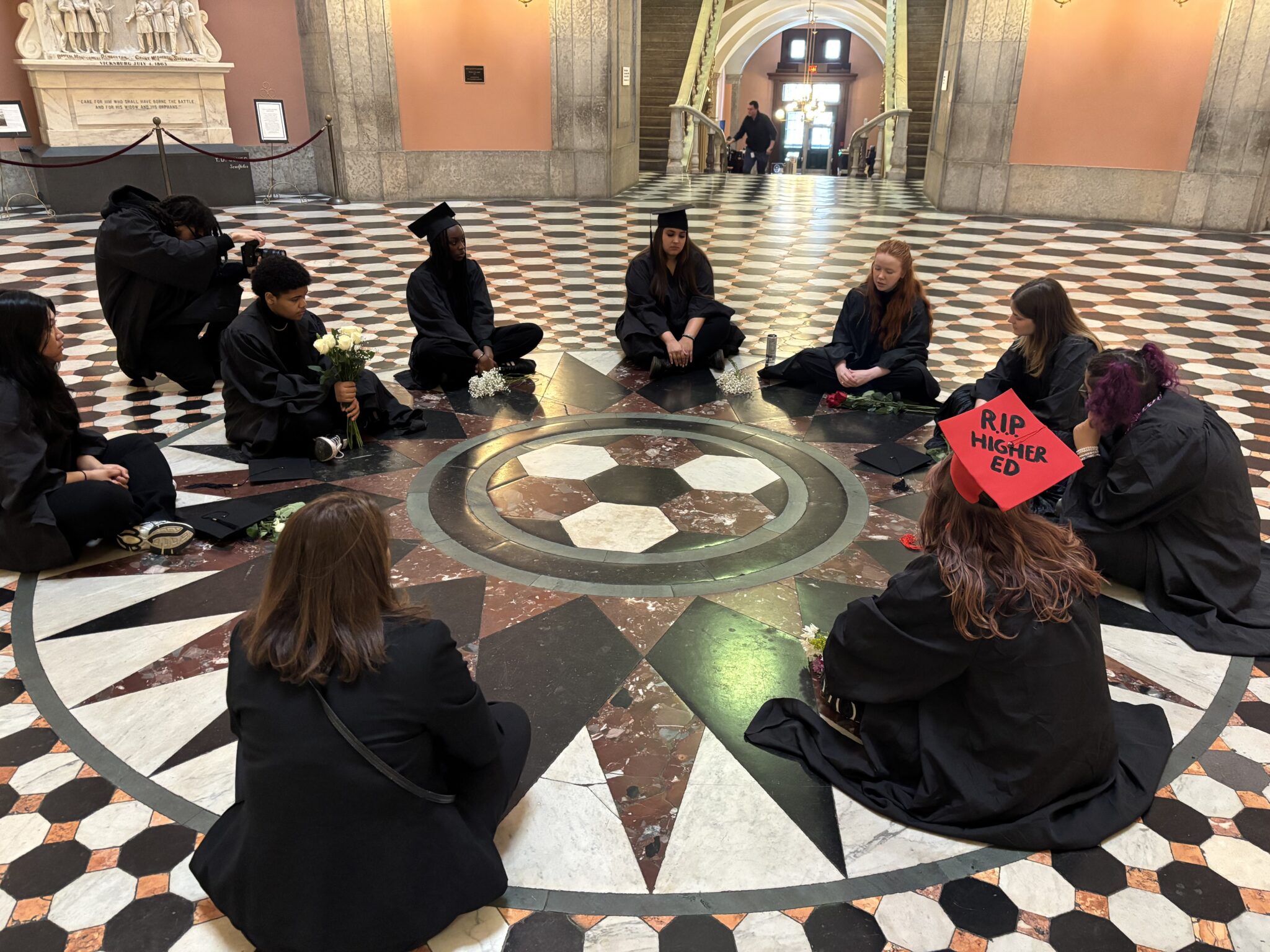
     Members of the Ohio Student Association held a mock funeral for the death of higher education on March 31

    Photo by Megan Henry, Ohio Capital Journal

    The Ohio Student Association organized the mock funeral, which took place Monday afternoon in the Ohio Statehouse Rotunda, days after DeWine signed Senate Bill

    By:  Ohio Capital Journal

    Students donning black graduation robes held a mock funeral for the death of higher education after Ohio Gov. Mike DeWine signed a bill into law that will overhaul the state’s public universities.

    The Ohio Student Association organized the event, which took place Monday afternoon in the Statehouse Rotunda, days after DeWine signed Ohio Senate Bill 1.

    S.B. 1 will ban diversity efforts, prohibit faculty strikes, regulate classroom discussion of “controversial” topics, create post-tenure reviews, put diversity scholarships at risk, create a retrenchment provision that block unions from negotiating on tenure, shorten university board of trustees terms from nine years down to six years, and require students take an American history course, among other things.

    GET THE MORNING HEADLINES.


    For classroom discussion, the bill will set rules around topics involving “controversial beliefs” such as climate policies, electoral politics, foreign policy, diversity and inclusion programs, immigration policy, marriage, or abortion. It prohibits professors from “indoctrination,” and while it doesn’t define that, it allows complaints to be filed against professors for review by the Chancellor of the Ohio Department of Higher Education. S.B. 1 will only affect Ohio’s public universities and community colleges.

    “It was really surprising, the quickness that it was signed,” said Ohio State University junior Brielle Shorter. “I think signing it at such a time was really interesting as well, but it was truly heartbreaking.”

    DeWine got the bill Wednesday — the same day the Ohio Senate concurred with changes to the bill made by the Ohio House — and he signed it Friday.

    “As a Black student on campus, our spaces have already been slowly getting demolished,” Shorter said. “I believe that with this bill there’s going to be more changes like that.”

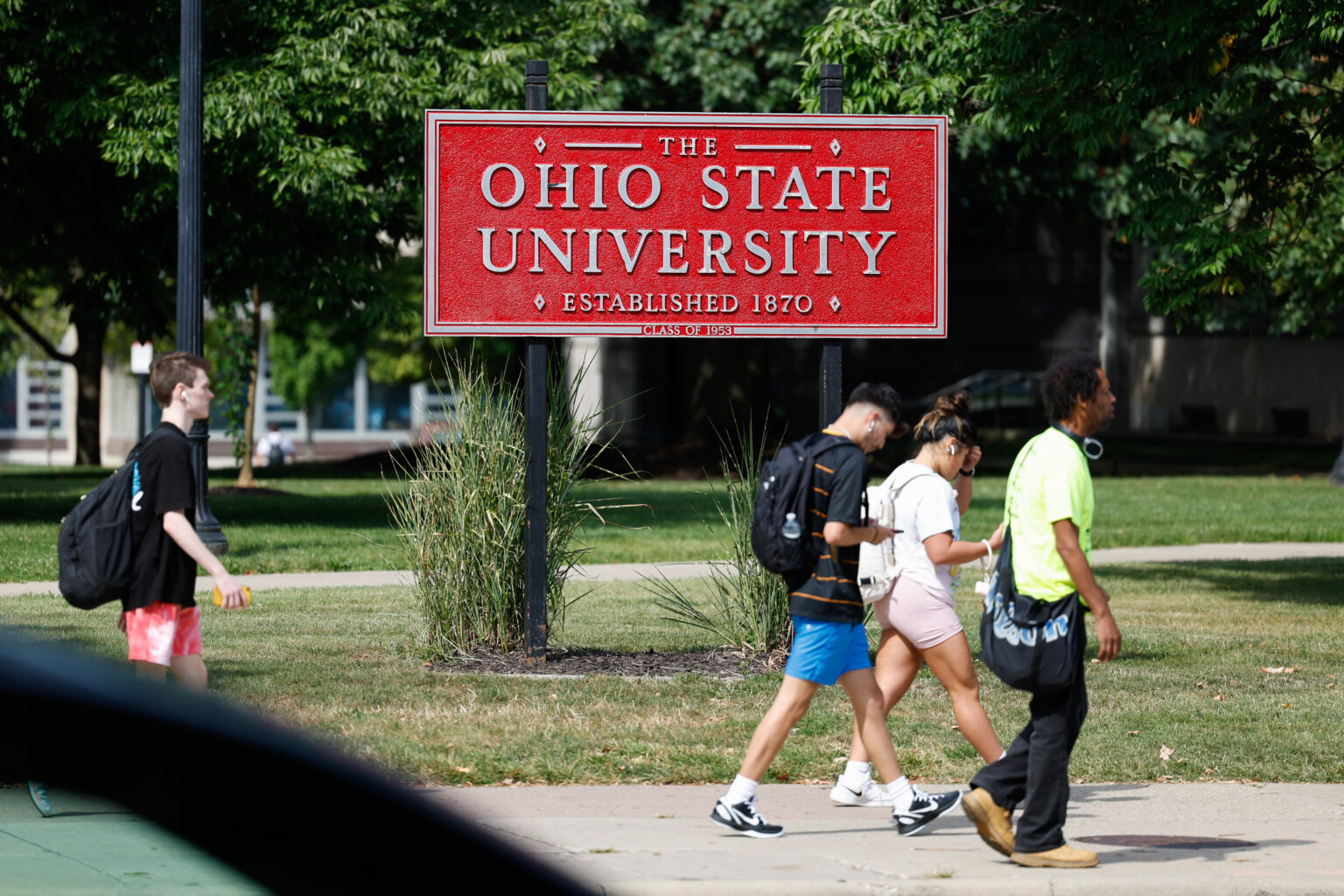
    Ohio State recently closed its Office of Diversity and Inclusion and the Office of Student Life’s Center for Belonging and Social Change in response to the U.S. Department of Education’s Dear Colleague letter that threatened to rescind federal funds for schools that use race-conscious practices in admissions, programming, training, hiring, scholarships, and other aspects of student life.

    Shorter said she has seen Ohio high school students post on social media how they are no longer interested in attending Ohio universities and instead plan to go to school out of state.

    Scott DiMauro, president of the Ohio Education Association, said it is unfortunate DeWine signed S.B. 1 into law.

    “It’s disappointing to see that he did that, even though the overwhelming amount of opposition that was expressed on the bill from faculty and from students and from concerned citizens was strongly against it,” he said. “I think it’s unfortunate to see collective bargaining rights of people who work in higher education diminished.”

    Pranav Jani, president of Ohio State’s American Association of University Professors chapter, said they will fight the impact of the bill as it becomes law.

    “We know that we stand with thousands of educators, students, and parents, who are disgusted by this naked display of governmental repression of higher education,” he said in a statement.

    State Sen. Jerry Cirino, R-Kirtland, introduced S.B. 1, which took just over two months to pass both chambers and be signed into law.

    “I believe this is monumentally significant legislation that will allow Ohio’s public universities and community colleges to deal with looming enrollment challenges and usher in a renaissance of academic excellence,” Cirino said in a statement.

    Follow Capital Journal Reporter Megan Henry on Bluesky.


    Megan Henry
    Megan Henry

    Megan Henry is a reporter for the Ohio Capital Journal and has spent the past five years reporting in Ohio on various topics including education, healthcare, business and crime. She previously worked at The Columbus Dispatch, part of the USA Today Network.

    Ohio Capital Journal is part of States Newsroom, the nation’s largest state-focused nonprofit news organization.

    MORE FROM AUTHOR

  • Ohio higher ed overhaul to ban diversity efforts and regulate classroom discussion heads to governor

    Ohio higher ed overhaul to ban diversity efforts and regulate classroom discussion heads to governor

    Ohio college students and protesters rally at the Statehouse on March 19, 2025, against Senate Bill 1, a higher education overhaul that bans diversity efforts and faculty strikes, and sets rules around classroom discussion, among other things. (Photo by David DeWitt, Ohio Capital Journal.)

    By:  Ohio Capital Journal

    A controversial bill to overhaul Ohio higher education, ban diversity and inclusion efforts, prohibit faculty from striking, and regulate classroom discussion is heading to Ohio Gov. Mike DeWine’s desk for his signature.

    The Ohio Senate concurred with changes made to Senate Bill 1 by the Ohio House during Wednesday’s session. The vote was 20-11 with only two Republicans voting against it, state Sens. Louis W. Blessing III, of Colerain Township, and Thomas F. Patton, of Strongsville, voting against it. DeWine has previously said he would sign S.B. 1 into law.

    DeWine will have 10 days to sign the bill into law or veto it once he receives it. If DeWine vetoes the bill, lawmakers would need a 3/5 vote from each chamber to override it.

    GET THE MORNING HEADLINES.


    S.B. 1 would set rules around classroom discussion, create post-tenure reviews, put diversity scholarships at risk, create a retrenchment provision that block unions from negotiating on tenure, shorten university board of trustees terms from nine years down to six years, and require students take an American history course, among other things.

    For classroom discussion, the bill would set rules around topics involving “controversial beliefs” such as climate policies, electoral politics, foreign policy, diversity and inclusion programs, immigration policy, marriage, or abortion. S.B. 1 would only affect Ohio’s public universities.

    State Sen. Jerry Cirino, R-Kirtland, introduced S.B. 1, which passed the Ohio Senate last month and the Ohio House last week.

    “I am delighted, of course, as I always believed this is a great bill for the state of Ohio, for students and for higher education, so I’m delighted that we’ve been able to get past this next hurdle and send the bill to the governor’s desk,” Cirino said.

    S.B. 1 has received significant pushback. More than 1,500 people have submitted opponent testimony against the bill. Hundreds of students around the state have protested against the bill. Students and faculty have said they would leave Ohio if the bill becomes law.

    “We decided on a different approach than many, many of them would like,” Cirino said when asked about the bill’s overwhelming opposition. “But this isn’t about how many people show up to protest or to testify in hearings. A lot of those students that were showing up where, I believe, they were being paid or getting extra credit. And we don’t make policy here based on the number of people that show up to protest or testify.”

    Senate President Rob McColley, R-Napoleon, said the passing of S.B. 1 is long overdue.

    “It’s something that, frankly, should have been done sooner, but I’m happy we put the work in to get to where we are right now,” he said. “I do think it’s something that’s supported by Ohioans.”

    Before voting to concur on S.B. 1, lawmakers debated the bill for about 35 minutes.

    “Senate Bill 1 will enrich the learning experience of students at our public universities and colleges — places where our best and brightest will be able to learn without prejudice, speak their minds without being canceled, be honest about their positions without fear of faculty retaliation, and consider all sides of an issue and make up their own minds,” said Sen. Kristina Roegner, R-Hudson.

    State Sen. Michele Reynolds, R-Canal Winchester, acknowledged that some people are afraid of what will happen if DEI on college campuses is ended through this bill, but said the time has come to remove DEI labels.

    “This is not about censure or erasure,” she said. “It’s not about exclusion. It’s about inclusion that transcends labels, because DEI has become a system that sorts us. It sorts us by race, by gender and by identity, creating a culture where we are defined by our categories instead of our character, where we look at each other’s faces instead of listening to each other’s hearts.”

    State Sen. Kyle Koehler, R-Springfield, said this bill ends the micromanaging of instruction in higher education.

    “All Ohio college students and parents will now have a more comfortable feeling that their public institution of higher learning will foster an environment of open and free expression for everyone,” he said.

    Senate Minority Leader Nickie Antonio, D-Lakewood, said not everyone is celebrating the concurrence of S.B. 1.

    “Instead of tackling the real barriers to higher education — skyrocketing tuition costs and student debt — again, the majority are focused on dictating what’s taught in our colleges and universities and who teaches,” she said.

    State Sent. Kent Smith, D-Euclid, said this bill will inhibit Ohio universities from attracting top-tier professors.

    “If Senate Bill 1 becomes law, this legislation is the worst attack on academic freedom in Ohio in modern history,” Smith said.

    Follow Capital Journal Reporter Megan Henry on Bluesky.

    YOU MAKE OUR WORK POSSIBLE.

    ____________
    Megan Henry
    Megan Henry

    Megan Henry is a reporter for the Ohio Capital Journal and has spent the past five years reporting in Ohio on various topics including education, healthcare, business and crime. She previously worked at The Columbus Dispatch, part of the USA Today Network.

    Ohio Capital Journal is part of States Newsroom, the nation’s largest state-focused nonprofit news organization.

    MORE FROM AUTHOR

    _____________

    BECOME A LOVELAND MAGAZINE SUPERFAN BY DONATING NOW!

    Editor’s note: Open and free local reporting is critical to having well-informed community. Loveland Magazine has published a free newspaper and website for the last 20 years for our community. If you would like us to continue, kindly contribute to this service. It would be greatly appreciated. Donations may be made to: Loveland Magazine, 243 Wall Street, Loveland, Ohio 45140. Or, donations can be made through PayPal using a credit card. (https://bit.ly/4j1ju3k) Advertisers do not nearly cover all of our expenses.

  • Ohio Republican state senator wants to ban diversity and inclusion efforts in public schools

    Ohio Republican state senator wants to ban diversity and inclusion efforts in public schools

    By:  Ohio Capital Journal

    A new bill proposed by an Ohio Republican lawmaker would ban diversity and inclusion efforts in Ohio K-12 public schools.

    State Sen. Andrew Brenner, R-Delaware, recently introduced Ohio Senate Bill 113 which would require every local board of education in the state to adopt a policy that would end any current diversity and inclusion offices or departments and ban any diversity, equity, and inclusion orientation or training. It would also prevent the creation of any new such offices or departments and using DEI in job descriptions.

    Under the bill, each board of education would be required to create a complaint process for an alleged violation of the policy and the board would investigate the complaint with a hearing.

    GET THE MORNING HEADLINES.

    Ohio teacher unions were quick to critique the bill.

    “This is another petty attempt from this legislature to sidestep local control and micromanage every aspect of how public schools operate,” Ohio Federation of Teachers President Melissa Cropper said in an email. “It is objectively a good thing for students of all races when school districts make an effort to hire a diverse teaching staff.”

    Ohio Education Association President Scott DiMauro said S.B. 113 is a distraction.

    “Ohio’s General Assembly should be focused on the real issues facing Ohioans and our schools — fully and adequately funding public schools and seeking solutions to help alleviate the economic challenges faced by families and communities,” he said in an email.

    Honesty for Ohio Education Executive Director Christina Collins said this is another example of Ohio lawmakers are going after school curriculum and programming.

    “This bill uses the vilified acronym ‘DEI’ without offering a definition to advance an agenda that harms our public education system,” she said in an email.

    S.B. 113 is not the only bill Ohio lawmakers have introduced that would ban diversity and inclusion efforts in education. Senate Bill 1 would, among other things, ban diversity, equity, and inclusion efforts at Ohio’s public universities. The Senate passed the bill earlier this month and is waiting to be heard in the House.

    S.B. 113 comes as President Donald Trump’s executive orders attempt to get rid of diversity and inclusion efforts across federal agencies.

    On Feb. 14, the U.S. Department of Education sent a Dear Colleague letter to schools nationwide threatening to rescind federal funds for schools that use race-conscious practices in admissions, programming, training, hiring, scholarships, and other aspects of student life.

    This would apply to all preschool, elementary, secondary, postsecondary educational institutions and state educational agencies that receive financial assistance. Institutions have until Friday to comply or else they face the “potential loss of federal funding.”

    Follow Capital Journal Reporter Megan Henry on Bluesky.
    YOU MAKE OUR WORK POSSIBLE.

    __________
    Megan Henry
    Megan Henry

    Megan Henry is a reporter for the Ohio Capital Journal and has spent the past five years reporting in Ohio on various topics including education, healthcare, business and crime. She previously worked at The Columbus Dispatch, part of the USA Today Network.

    Ohio Capital Journal is part of States Newsroom, the nation’s largest state-focused nonprofit news organization.

    MORE FROM AUTHOR


  • Teaching about race is good, actually. States need to stop banning it.

    Teaching about race is good, actually. States need to stop banning it.

    Getty Images

    by Ian Wright

    In this back to school season, millions of American students are returning to classrooms where the wrong course, lesson, or textbook can lead to deep trouble. Why? Because for the last several years, conservative activists and lawmakers have been waging a crusade against “critical race theory,” or CRT.

    Critical race theory is an academic concept acknowledging that racism isn’t simply the result of individual prejudice but is also embedded in our institutions through laws, regulations, and rules.

    As school districts have emphasized, it’s a higher education concept rarely taught in K-12 schools. But cynical activists have used CRT as a catch-all term to target a broad range of diversity, equity, and inclusion initiatives — and seemingly any discussion about race and racism in the classroom.

    Since January 2021, 44 states have “introduced bills or taken other steps that would restrict teaching critical race theory or limit how teachers can discuss racism and sexism,” according to Education Weekly. And as of this writing, UCLA has identified 807 anti-CRT “bills, resolutions, executive orders, opinion letters, statements, and other measures” since September 2020.

    ________________

    IN OHIO

    Bills that would have prohibited discussion of certain topics related to race and sex, forbid schools from awarding credit for student service learning with advocacy groups, and ban “any textbook, instructional material, or academic curriculum that promotes any divisive or inherently racist concept” all failed to pass during the 2021 and 2022 sessions.

    ________________

    Critics claim — falsely — that CRT teaches that all white people are oppressors, while Black people are simply oppressed victims. Many opponents claim it teaches white students to “hate their own race,” or to feel guilty about events that happened before they were born.

    In reality, CRT gives students of every race the tools to understand how our institutions treat people of different races unequally — and how we can make those systems fairer. That’s learning students of every race would be better off with.

    But instead, this barrage of draconian legislation is having a chilling effect on speech in the classroom.

    In 2022, Florida passed the “Stop W.O.K.E. Act,” which prohibits teaching that could lead to a student feeling “discomfort” because of their race, sex, or nationality. But the law’s vague language makes it difficult for educators to determine what they can or cannot teach, ultimately restricting classroom instruction. In my home state of Texas, SB3 similarly restricts these classroom discussions.

    Running afoul of these laws can get teachers and school administrators in trouble. As a result of this hostile environment, the RAND Corporation found that two-thirds of K-12 school teachers have decided “to limit instruction about political and social issues in the classroom.”

    Notably, this self-censorship extends beyond states with such policies: 55 percent of teachers without state or local restrictions on CRT have still decided to limit classroom discussions of race and history.

    As a student, I find this distressing.

    My high school history classes gave me a much richer understanding of race in our history, especially the discussions we had at the height of the Black Lives Matter protests. And in college, I’ve gotten to learn about racial inequalities in everything from housing and real estate to health care, politics, education, and immigration policy.

    As a person of color, I can’t imagine where I’d be without this understanding. Neither white students nor students of color will benefit from laws designed to censor their understanding of history, critical thinking, and open dialogue in the classroom.

    The fight against CRT is a fight against the principles of education that encourage us to question, learn, and grow. Rather than shielding students from uncomfortable truths, which they can certainly handle, we should seek to equip them with the knowledge to navigate the world, think critically about our history and institutions, and push for a more inclusive country.

    This column was originally published at OtherWords.org.


    Ian Wright
    Ian Wright

    Ian Wright is a Henry A. Wallace Fellow at the Institute for Policy Studies and a student at Rice University from Dallas, Texas.

    MORE FROM AUTHOR


  • More Ohio universities added to Senate bill that would create ‘intellectual diversity’ centers

    More Ohio universities added to Senate bill that would create ‘intellectual diversity’ centers

    Miami University, Cleveland State University, and the University of Cincinnati were added to Senate Bill 117, which was voted out of the Senate

    BY:  Ohio Capital Journal

    The Ohio Senate passed a bill Wednesday that would create “intellectual diversity” centers at Ohio State University, the University of Toledo, Miami University, Cleveland State University, and the University of Cincinnati.

    The party line vote came after an amendment was added during the Senate session that tacks on Miami, Cleveland State, and Cincinnati to Senate Bill 117. The bill now moves to the House for committee consideration.

    SB 117 would create the Salmon P. Chase Center for Civics, Culture, and Society at Ohio State University’s College of Public Affairs and the Institute of American Constitutional Thought and Leadership at the University of Toledo’s College of Law. It would also now create centers for civics, culture and society at Miami, Cleveland State and Cincinnati.

    “The (Ohio State) center will educate students by means of free, open and rigorous intellectual inquiry, to seek truth, equip students with the skills they need to reach their own informed conclusions in matters of social and political importance,” said Sen. Jerry Cirino, R-Kirtland, one of the bill’s sponsors.

    SB 117 amendment

    Many Senate Democrats slammed SB 117 and the amendment during Wednesday’s session.

    “SB 117 is forcing the installation of conservative think-tanks at our public universities across the state of Ohio and they are using taxpayer money to do it,” said state Sen. Bill DeMora, D-Columbus.

    “The amendment is atrocious,” said Sen. Catherine Ingram, D-Cincinnati.

    Miami and Cleveland State were not aware of the potential amendment adding them to the bill before Wednesday afternoon’s Senate Session.

    “They had absolutely no idea,” Senate Minority Leader Nickie Antonio, D-Lakewood, told reporters when she reached out to her alma mater Cleveland State. “They did not ask for it … and are very concerned about this being imposed on them.”

    State Sen. Kent Smith, D-Euclid, did something similar with his alma maters Miami and Cleveland State, and both institutions of higher education said this was the first time they were hearing about the amendment.

    “Committees are the best forums for thoroughly studying bills,” he said.

    Senate President Matt Huffman said making the amendment on the Senate floor was not ideal.

    “Certainly that’s not the best way to do these things,” he said to reporters. “I don’t like substantive floor amendments. We’re at a lengthy legislative break. Secondly, the House in their negotiations of essentially, at least for the moment, have rejected the concept of this higher education reform that we want to have. And so what we really want to do is tee these things up.”

    The amendments also clarified that both these centers are “independent academic units in their respective universities,” Cirino said.

     COLUMBUS, Ohio — JUNE 15: Senate Majority Floor Leader Rob McColley, R-Napoleon, speaks during the Ohio Senate session, June 15, 2023, at the Statehouse in Columbus, Ohio. (Photo by Graham Stokes for Ohio Capital Journal) 

    He introduced the bill in May along with Sen. Rob McColley, R-Napoleon — arguing that university faculty are predominantly liberal.

    But McColley insisted Wednesday that SB 117 is not a conservative takeover of higher education.

    “There is not a single letter, there is not a single word, there is not a single phrase that requires this to teach conservative principles,” he said. “The University of Toledo Law is supportive of this. The Ohio State University does not oppose this either.”

    But Ohio State already has more than 70 centers, and many students and professors at both universities have spoken out against SB 117.

    State Sen. Andrew Brenner, R-Delaware, said college students do want these centers, but are afraid to speak out.

    “If they speak out, they are afraid it might impact their academic career,” he claimed.

    The bill would give UT $1 million in fiscal year 2024 and $2 million in fiscal year 2025 for the Institute, and Ohio State $5 million in fiscal years 2024 and 2025 for the Center.

    The bill’s amendment would each give Miami, Cleveland, and Cincinnati $2 million each fiscal year to support the centers, Cirino said.

    State budget

    SB 117 is one of the bills that the Senate added to their version of the state budget, which is currently in conference committee.

    McColley clarified that what’s in the proposed budget when it comes to SB 117 doesn’t include the three new universities that were added to the bill through Wednesday’s amendment.

    The Ohio House has pushed back on the higher education bills being added to the budget.

    “We’re maybe not going to get 117 in the budget,” Huffman said. “You don’t know what the deal is until there’s a deal. So we’re just putting 117 forward as a bill.”

    Senate Bill 83, also introduced by Cirino and which would overhaul higher education, was added to the budget by the Senate.

    Among other things, SB 83 would ban university staff and employees from striking, college students would be forced to take certain American history courses, professor tenure would be based around “bias,” and mandatory diversity, equity and inclusion training would be prohibited, with only specific exemptions.

    “The House are not fans of 83,” Huffman said. “I think we’ve offered a pretty good higher education package that they rejected.”

    While the constitutional deadline for Ohio Gov. Mike DeWine to sign the budget is Friday, it seems unclear at this point if that is actually going to happen.

    “I’m optimistic and I think we’ll see what happens on Friday,” Huffmann said.

    Lee Strang

     Professor Lee Strang is the John W. Stoepler Professor of Law & Values at the University of Toledo Law School. (Photo from University of Toledo website.) 

    UT Law Professor Lee Strang first got the idea for the Institute of American Constitutional Thought and Leadership in 2019 after visiting the Georgetown Center for the Constitution and Princeton University’s James Madison Program.

    He has also helped lawmakers get Issue 1 on the ballot in a special Aug. 8 election, which would make it harder for voters to amend the state constitution.

    Lawmakers have insisted Issue 1 is not about abortion, but Ohio Secretary of State Frank LaRose recently said it is “100%” because of efforts to legalize abortion.

    Strang has closely aligned himself with groups trying to stop an abortion rights amendment and has shown support for banning abortion care.

    Follow OCJ Reporter Megan Henry on Twitter.


    Megan Henry
    MEGAN HENRY

    Megan Henry is a reporter for the Ohio Capital Journal and has spent the last five years reporting on various topics including education, healthcare, business and crime at The Columbus Dispatch, part of the USA Today Network.

    MORE FROM AUTHOR

  • Jean Schmidt’s newest ‘divisive concepts’ bill enters Ohio House

    Jean Schmidt’s newest ‘divisive concepts’ bill enters Ohio House

    Prohibits all Ohio schools from “teaching or providing training that promotes or endorses divisive or inherently racist concepts.”

    BY: SUSAN TEBBEN –  Ohio Capital Journal

    The newest bill to regulate school curriculums and keep out what legislators see as “divisive concepts” entered the Ohio House on Tuesday.

    State Reps. Jean Schmidt, R-Loveland, and Mike Loychik, R-Bazetta, brought House Bill 616 to the State and Local Committee, which prohibits all Ohio schools from “teaching or providing training that promotes or endorses divisive or inherently racist concepts.”

    Though the co-sponsors said they want to deputize the State Board of Education with making decisions about what those concepts would be, the bill includes “critical race theory,” a misnomer used by conservatives to refer to the teaching of race in American history, and name the “1619 Project,” a New York Times project that laid out the chronology of slavery and racism, as concepts that would be prohibited under the bill.

    “Diversity, equity and inclusion learning outcomes” (DEI) are also named as “divisive or inherently racist concepts” under the bill. When asked to explain DEI and why it’s being prohibited, Loychik connected DEI to “critical race theory,” saying the two are connected based on research he and Schmidt had made.

    “The word ‘critical race theory’ was not very well accepted at that point in time, so it was re-developed into DEI – diversity, equity and inclusion – and based off our research, like I said before, it’s very, very similar to the teachings under critical race theory,” Loychik told the committee.

    DEI trainings have been used in schools to train employees about learning disparities that can happen in education.

    The well-known conservative public policy think tank The Heritage Foundation connects CRT and DEI, saying diversity trainings “pressure employees to become activists or to discuss controversial topics in the workplace.”

    Part of the bill prohibits teaching kindergartners about topics related to gender.

    “It ensures that sexual orientation and gender ideology are not taught in kindergarten through third grade,” Loychik said. “Starting in fourth grade it must be age appropriate.”

    Loychik has made his feelings on gender in schools clear through posts on his Twitter, in which he said “the left thinks a 6-year-old should be able to change their gender but an 18-year-old shouldn’t be able to buy a firearm,” and asks for support not to allow “teaching transgenderism or allowing teachers to discuss their sex life with kindergarteners.”

    Under the newest bill, the State Board of Education would also be required to “establish a procedure by which individuals may file complaints against a teacher, school, administrator, or school district superintendent alleging a violation of the bill’s prohibitions and to adopt rules to govern the implementation of and monitor compliance with the bill’s provisions,” according to Legislative Service Commission analysis of the bill.

    Democratic committee members pushed back on the bill’s language, decrying it as “censorship” and questioning the vague language used, and the state board of education’s role in defining the off-limits topics in school curricula.

    “That’s the responsibility of legislators to define these terms,” said state Rep. Mike Skindell, D-Lakewood.

    The co-sponsors said they would be willing to consider amendments to the bill, but said the focus of the bill is on curriculum, not disciplinary regulations or hallway disagreements.

    Loychik said the school district’s role would be to address disciplinary problems, and “hall monitors” could deal with school-day disagreements regarding “divisive concepts.”

    Schmidt said “invited guests,” such as state legislators, would be allowed to “talk about what they want to talk about,” because it’s not a part of the curriculum, answering a question from state Rep. Tavia Galonski, D-Akron.

    “There is a lot to discuss in the schools, and by no means would any kind of prohibition or any type of censorship be the answer for it,” Galonski said.

    Education groups like Honesty for Ohio Education have criticized the bill as a “nationally coordinated educational gag order.”

    This is the third “divisive concepts” bill to come through the Ohio legislature, with the last bill receiving heavy criticism after one of the co-sponsors said equal time should be given on both sides of Holocaust lessons. Neither bill has passed through the General Assembly.

  • A Diversity Story: by Leah Marcus

    A Diversity Story: by Leah Marcus

    “When we speak we are afraid our words will not be heard nor welcomed, but when we are silent we are still afraid. So is it better to speak?” – Audre Lorde

    I am in sixth grade. My hands, gripping the edge of my desk in a quiet rage. Knuckles white. I. Hate. It. Here. My skin crawls. There isn’t a place in the world I want to exist. Everyone listens to me say this. But no one hears me. I am ignored.

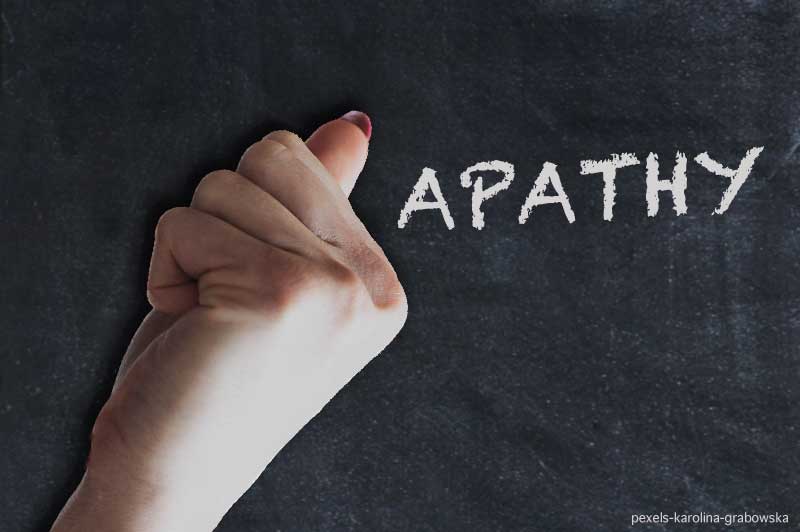
    Mrs. S. wrote the word “Apathy” on the board. 

    “That feeling. That word, murdered 11 million people. 6 million Jews. 1.5 million Jewish Children. Look at it.”

    We stare for a minute. Silent.

    I hear a soft laugh. Is that my snicker? Another. Uncomfortable shifting in desk chairs. Whoever it was, Brandon has the loudest giggle, and he receives the teacher’s corrective glare.

    She darkens the room and pulls down the screen. A slide of a naked, emaciated, woman, dead appears. My eyes glance over at the word. Apathy.

    The next slide. A gas chamber. Dead bodies slumped over each other. 

    Next, the entrance to Birkenau. 

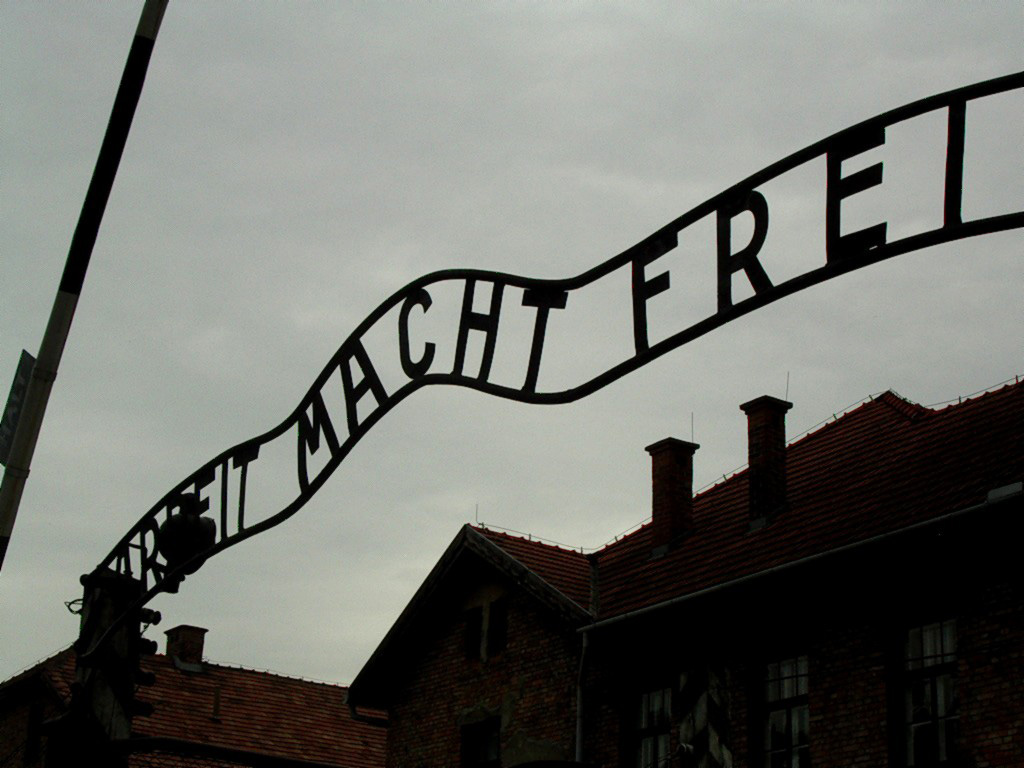
    Next, Auschwitz. “Arbeit Macht Frei” Apathy. 

    The deceitful message at the entrance to Auschwitz- translated means “Work sets you free”.

    Another slide. 

    “This is Babi Yar”. Mrs. S. delivers the information with a cold, flat, statement. The class gasps. All of us. Collectively. Gasping at the sight – a photograph of a mass grave holding the dead and starved bodies of 33,771 Jews, murdered over 2 days. Marci looks down at her paper and reads the quote that was to accompany the slide, number 18, “There is no gravestone that stands on Babi Yar; Only coarse earth heaped roughly on the gash.” One of the boys groans, “Ugh…Gash.”

    Apathy.

    I silently rode home with my father. I will never look at my Grandmother the same. “What did she see in Germany?” 

    Apathy. 

    I visited Majdanek, Sobibor, Auschwitz, Treblinka, Birkenau when I was 17. I am numb, the feeling of existing nowhere. I think I have died, but I am only numb. Every day, I want to die. Instead I am numb. Now I can survive.

    And I promise to share these words, as I stand under the gallows of Auschwitz:

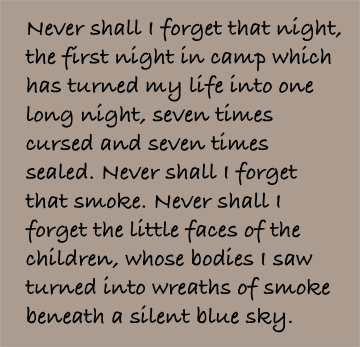
    “Never shall I forget that night, the first night in camp which has turned my life into one long night, seven times cursed and seven times sealed. Never shall I forget that smoke. Never shall I forget the little faces of the children, whose bodies I saw turned into wreaths of smoke beneath a silent blue sky.

    Never shall I forget those flames which consumed my faith forever.

    Never shall I forget that nocturnal silence which deprived me, for all eternity, of the desire to live. Never shall I forget those moments which murdered my God and my soul, and turned my dreams to dust. Never shall I forget these things, even if I am consigned to live as long as God Himself. Never.” (Elie Wiesel)

    “It doesn’t feel right.”

    “Let it go.”

    “Ok, I’ll move on.”

    That conversation has dominated my life for 34 years. Apathy. I define it. My stomach rumbles every day, I never feel good. I sit with my husband at dinner and watch the news. This isn’t how it is supposed to be. All that I have seen and heard. I am numb and dead inside, as I was in Majdenak choking on the stench on rotten leather shoes. Trophies saved by Nazis to commemorate 80,000 murders. 

    “Never Again. What does that mean?”

    He stares back at me. My question emerges from my apathetic silence.

    This image has an empty alt attribute; its file name is never-again-1-1.jpg

    “When we say never again, doesn’t that mean we’re supposed to do something? What does `never again’ mean to you?”

    He quietly speaks of his dreams for peace. Eradicating poverty. Housing for the poor. Healthcare. College. Employment. 

    “What about you?”

    “I can’t live here anymore. Not the way it is. When I said never again, I meant I would stop a train carrying cattle cars of Jews with my body, with my strength, with my power. I don’t have power. I don’t want to live that way anymore. I don’t want to live here anymore.”

    “Like Loveland? You don’t want to live in Loveland anymore?”

    “No. I can’t live in the world as it is anymore. I have to change it. It’s unbearable.” I cry. I can’t stop. I feel the quiet rage of my youth. But my hands lie flat on the table, my knuckles pink. I don’t think I can exist here. I look to my husband and children. But they exist here.

    I pick up books and learn. I register voters. I learn how to organize large groups of people to fight for a common cause, not because of politics, but because it aligns with their self-interests. I learn about my privilege. I learn about systemic racism. I make so many mistakes. I am corrected aggressively. Kindly. Ignored. I cry. I laugh. I am successful. I learn as I go. Things change. 

    One day, I press play. My daughter is watching over my shoulder. We watch George Floyd die. She has closed her eyes. I restart the video.

    “Open them. Open your eyes. We have to see.”

    I think, “There is no gravestone that stands on Babi Yar; Only coarse earth heaped roughly on the gash.”

    We exist in a world like this – coarse earth heaped roughly on the gash. I don’t want this world to exist as long as I live in it.

    We hug at the end of the video.

    When my husband finishes work, I greet him by stating simply, “Never Again.”

    He knows what it means.

    I step in front of the train and put my hand up. 

    With a short meeting and trusted friends, the Loveland  Diversity Advisory Board is formed.

    John comments only occasionally, but when he does, I put the “mature administrator” hat on immediately and respond with a question, “Help me understand…” or “I’m not sure I am following what you mean…could you say more about that?” Inevitably, John replies with a co-opted statement about the thread and relates it back to Critical Race Theory or Reparations, or School Funding and School Policy. Clearly, he is looking to push buttons and searching for a “gotcha moment”.

    I don’t want this world to exist as long as I live in it. My stomach rumbles. Looking down, I see that my hands are clutching the edge of my desk. My knuckles are white. 

    He writes, “Critical Race theory has no place in American Schools. The tenets of Critical Race Theory are based in the destructive ideal of inherent racism and will teach our children to judge and self segregate based solely on skin color….It promotes the dismantling of American Society thru (sic) Marxist anti American rhetoric.”

    It takes my breath away to see it in writing. “Marxist anti-American Rhetoric”. In the rambling online blogs of the Poway Synagogue shooter, references to Jews and their control of the media, the banks, and his description of hatred for Jews and their role in “cultural Marxism”. This phrase has repeatedly created a rationale for violence against leftists, against Jewish people, and against anyone associated with either. 

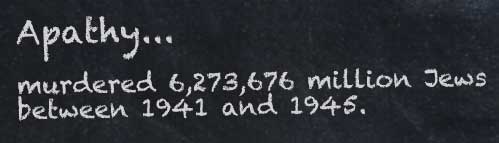
    My alarm is sounded. Bully. Microassault. Dog Whistle.  “There is no gravestone that stands on Babi Yar; Only coarse earth heaped roughly on the gash.” Apathy murdered 6,273,676 million Jews between 1941 and 1945.  

    Never Again.

    I step in front of the train.

    Stop.

    You’re either driving the train. Or you’re stopping it.

    The more people that stand in front of this train, the faster it will stop.

    We must always take sides. Neutrality helps the oppressor, never the victim. Silence encourages the tormentor, never the tormented. –Elie Wiesel Z”L, Buna, Buchenwald, Auschwitz Survivor (1928 – 2016)


    This Guest Column by Leah Marcus is presented by Loveland Magazine in collaboration with the Loveland Diversity Advisory Board. Contact them if you’ve a story to share.


  • Taking Lessons From Our Past: The Story of Everett and The Importance of DEI

    Taking Lessons From Our Past: The Story of Everett and The Importance of DEI

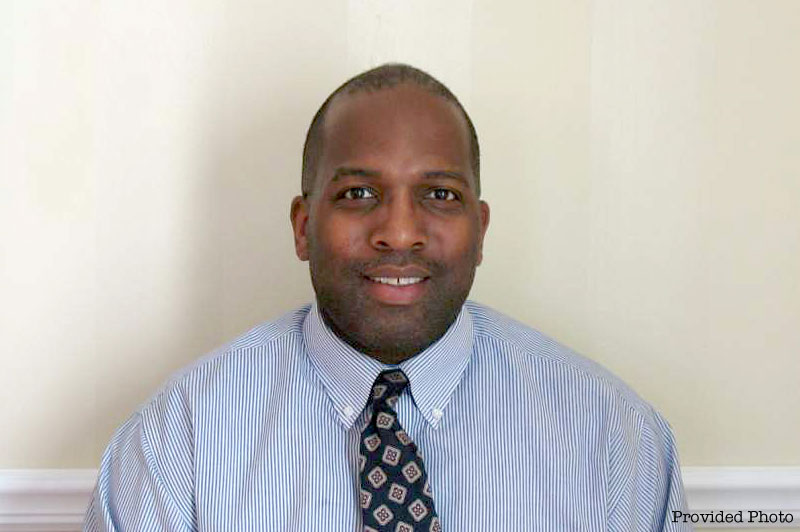
    John Coburn is a Loveland Resident, a lifelong educator, and a founding member of the Loveland Diversity Advisory Board.

    by John Coburn

     In 1954 my father-in-law Everett enlisted in the US. Army stationed in Alaska. The base was a rugged area far removed from big cities like Anchorage, Fairbanks, or his hometown of St. Louis. Everett quickly found himself the odd man out; it became clear the men in the company were not accepting of Black folks. Fortunately, he was blessed with the gift of gab, enabling him to hold his own without fear of repercussion. 

    Everett met a young man in his platoon named Ken. Ken, being Jewish and from New York, also struggled with the new environment and described Alaska as “living in a foreign land.” Friendly and outgoing, Everett became like a brother to Ken. Eventually the two forged a friendship with Ken dubbing his new pal “Duke.” While Ken and Duke were an unlikely duo–it seemed incredulous that a Jewish man and a Black man could become friends and work together– the truth was Everett knew no strangers, and he never left anyone behind.

    Everett’s strong sense of family instilled in him the importance of acceptance toward all people, regardless of their differences. As such, he helped Ken fit in with the rest of the company by reinforcing to Ken that he was special. By helping Ken to develop a sense of self-worth and demonstrating that he was a crucial member of the team, Duke enabled  Ken to develop a sense of belonging. That was a favor Ken never forgot and after the tour in Alaska ended, Everett and Ken remained lifelong friends. Over the next 60 years, they continued to stay in touch via yearly phone calls. When Everett died in 2020, Ken remembered his friend’s kindness, stating he would never have made it out of basic training without his friend Duke.

    By the 1970s, Everett was named the first Black employee at the St. Louis Corvette plant,  working in security for General Motors. (Technically, he was the second Black employee, but GM didn’t know this; Everett’s cousin Bob who got him the job was the first, but Bob passed as white.) 

    The interview process was brutal and Everett was openly mocked for having taken college courses at the local business school. While cruel and demeaning, unfortunately the interview was only a small glimpse of what was to come. 

    GM was a toxic workplace during those days and fellow workers desperately tried to get Everett fired or intimidate him into quitting by placing nooses and tools in his locker.  If you possessed company materials, you were subject to disciplinary action so those would be planted as well. Employees would drive to his home and sit in front of his house during the day, Everett recognizing the cars because of his position in security. He would come home after work crying tears of frustration. This pernicious behavior was against everything he believed and stood for. He’d initially believed his vivacious personality coupled with his gift of unconditional acceptance and love for others would help him navigate life’s challenges. He was starting to think it would not. Fortunately, his wife supported and encouraged him to continue to push forward. Eventually, Everett was the first black foreman at GM, receiving Quality awards for the work.

    In the years since, I’ve taken Everett’s experiences to heart and they’ve shaped the way I live and the way I approach my career as an educator. At one point, I accepted a job in the city next to my hometown as an assistant principal. The principal was indifferent to the idea of Diversity, Equity, and Inclusion and its impact on the school environment. It was obvious: both the school environment and the surrounding community were incredibly toxic. Students that were deemed different were overly disciplined and behind academically. It was clear no one felt a sense of belonging or importance, not the students in the school or the members of the community surrounding it. And with no leader to inspire these feelings, things would only continue to get worse. 

    With the help of another teacher, I instituted plans to help students academically. I continued my work with students and parents providing social-emotional support while addressing underlying social-emotional needs. I started an ACT Prep program to help improve the students’ college acceptance.

    In the spring, the community experienced a mass shooting that killed local government officials and police officers because of a community conflict. Those students that felt a sense of belonging began to seek social and emotional support. Despite the community upheaval, many students followed the academic plan and graduated with their classmates. The community has started to heal, and many community members have made it their mission to speak up and be more inclusive of others in their community.

    I share these stories about my father-in-law’s and my experiences to illustrate that everyone wants to belong. The need for belonging is an innate sense of the human condition. If we cannot develop relationships and feel a sense of acceptance, we become isolated, withdrawn, and want to quit. A feeling of belonging, and having people around you who foster that feeling, is an essential component to success. 

    That said, because of Covid-19 and social injustice, many students don’t have that sense of belonging. They may feel excluded at school or in society in general. This, as we’ve seen, is neither conducive to a healthy self-esteem or academic success. The question is, how can we help our students feel like they belong? 

    Taking inspiration from Everett, as I have done, has been instrumental. We can ask ourselves: 

    As teachers, are we accepting of students and not hypercritical? Everett welcomed all people. He did not put people down, and he was not overly judgmental. No matter what others said, he never judged anyone. 

    As educators, do we allow students the opportunity to restart?  Everett always gave everyone a fresh start. Once his nephew forged his signature on a document, and he received free service on his car. Everett forgave him. 

    Are we empathetic toward students? Everett displayed grace toward people even when people were unkind to him. 

     Finally, is our climate and culture inclusive, accepting, and inviting? It was not until the final years of working at GM that Everett felt a sense of belonging. Toward the end of life, Everett developed dementia. He recalled the names of most of his family and not much else. However, he remembered in detail his experiences at GM.

    Though it has only recently been given a formal title, Diversity, Equity, and Inclusion is a concept that has always been important. And while there will always be outliers like Everett who persevere despite the odds, there are far more Kens, who need the camaraderie and encouragement of others to succeed. As educators, caregivers, and members of the community, we are uniquely poised to provide this encouragement and well-crafted DEI programming is the most impactful way to do it. It need not be a political or divisive issue–the fact is that when everyone feels they belong, everyone wins.

    Regardless, I’ll continue to advocate for DEI not only because I’ve seen that it works, but also because I know that Everett wouldn’t have wanted it any other way. 

    This Guest Column by John Coburn is presented by Loveland Magazine in collaboration with the Loveland Diversity Advisory Board. Contact them if you’ve a story to share.

  • Loveland City Schools adopt Statement on Diversity

    Loveland City Schools adopt Statement on Diversity

    “This resolution is the first step toward ensuring a safe and inclusive learning environment for all students while fostering cultural awareness and understanding.” – Loveland Diversity Advisory Board

    by David Miller

    Loveland, Ohio – At their meeting on April 20, the Loveland City Board of Education voted unanimously to adopt a statement on diversity, equity, and inclusion. The statement will be placed into the Board Manual and distributed to school administrators and all staff. After staff discussions, it will be “pushed out into classrooms” according to Superintendent, Bradley Neavin.

    Board member Eileen Washburn  said before the vote, “I very much appreciate the work that was done. I hope it will be embraced and people really read it and act on it.” (read resolution below)

    Speaking of the student experience Neavin said, “This goes well beyond the walls of the schools. This prepares students to go out into a broader world and to have a broader world view.”

    The writing of the resolution was a collaboration between district leadership and the Loveland Diversity Advisory Board (DAB). “This resolution is the first step toward ensuring a safe and inclusive learning environment for all students while fostering cultural awareness and understanding,” said a statement issued by DAB after the approval.

    Below is the discussion of the Board while adopting the diversity, equity, and inclusion policy:


    Loveland City Schools Statement on Diversity, Equity, and Inclusion

    A comprehensive education in a free society develops persons who can think critically, engage in self-reflection, understand all cultures, live compassionately with others, and use their reflection and experiences to make sound judgments. As the great equalizer, education in a pluralistic society must strive to present varied events, activities and perceptions reflected in history, literature and other sources of humanity’s thought and expression. Therefore, the Loveland City School District commits unwavering support to diversity, equity, and inclusion of culture, thought, ideas and experiences.

    LCSD seeks to ensure the growth of every individual in our sphere of influence by:

    • Creating a safe & inclusive learning environment that provides equitable access for all members of the school community regardless of race, religion, ethnicity, gender identification or expression, sexual orientation, ability, language, family structure or economic status.
    • Providing access to materials and experiences which express diversity of perspective, broaden students’ worldviews, and better equip them to live, thrive, and contribute positively to a diverse world.
    • Engaging in culturally competent practices that target core areas: value of diversity, cultural awareness, understanding the dynamics of cultural interactions, and taking cultural knowledge and adapting it to diversity and learning.

    The Loveland City Schools commit to the development of critical thinkers by offering the opportunity to understand, study, and embrace difference as the fabric of our Democracy, a Democracy free from hatred, alienation, or division.


  • There weren’t enough napkins to clean up the tears when my Loveland school-children were called N——s!

    There weren’t enough napkins to clean up the tears when my Loveland school-children were called N——s!

    A true story by a Loveland resident presented by Loveland Magazine in collaboration with the Loveland Diversity Advisory Board. Contact them if you’ve a story to share.

    The family in this story has chosen to remain anonymous for fear of retaliation against their children.

    Part I of 2

    We arrived at school bright and early, just as my sons had requested. It was their last day of 2nd and 4th grade and the anticipation they felt for the occasion was palpable. The dew collected on the toes of their sneakers as they ran to line up, the unmistakable scent of spring perfuming the air. It would be the kind of summer children dream about, with lazy mornings, afternoon trips to the park, and visits to the local Whippy Dip where the cones melted and dripped down their small arms onto the picnic tables. We never got enough napkins. It was going to be the kind of summer they’d look back on years from now with a hint of nostalgia, remembering the carefree innocence of childhood. 

    The school day went by without a hitch; games were played, awards were dispersed, maybe there was a hint of sorrow from the teachers as they retreated back to their now-empty classrooms. But on the faces of my sons and their friends after the final bell had rung, I saw nothing but pure elation. As they played on the front lawn of the school, one last farewell before loading them up, a car slowed to a cruise on Loveland-Madeira. It was all decked out, congratulatory chalk paint on the windows; apparently the driver and his passengers were recently graduated seniors.

    The passenger leaned out of his open window as the car passed my sons and me. 

    “Have a good summer,” he shouted. My sons smiled back, visibly excited a ‘cool’ older kid was acknowledging them.

    But his sentence didn’t end there. 

    I wish his sentence had ended there. 

    “Have a good summer, you N——s!

     My heart dropped. I felt as though I’d been punched in the stomach. And then instinct kicked in.

    “Get in the car, boys,” I frantically stammered.

    “But mom–what did he say?”

    “I said GET IN THE CAR. NOW.” 

    “What did he call us mom? Why did he say that?” 

    I met the puzzled gaze of my younger son who had no idea what had just transpired. 

    My older son looked equally befuddled. This wasn’t the first time he’d encountered that vile term. He knew what it meant. The confusion on his face told me he just hadn’t heard the slur over all the commotion. 

    And here I was, flushed, sweating, and doing everything I could to keep from melting into a puddle of tears in front of them.

    There weren’t enough napkins to clean up the mess.

    With a single word, our perfect day was shattered.

    I tried to see the car’s plate number, but they’d sped away too quickly. I called the school to report the transgression, but, being the last day of school, I never heard back. I met with a police officer, but unfortunately his hands were tied; with what little information we had there was no feasible way to determine the identity of the culprits. As a last ditch effort, I tried doing my own reconnaissance work on a local moms’ group page on social media where my post was promptly removed after group members began chastising me. This isn’t the place for this, I was scolded. Well, where was the place? In the midst of a travesty, I’d turned to my community and in turn I was brushed off and chided.

    That night, instead of eating ice cream that dribbled down their chins and staying up past bedtime, my sons, my husband, and I had to have “the talk.” This is the talk that all parents of Black children, boys in particular, dread. We’d had conversations before but this time they’d been called out. This time it was personal. 

    We had to explain what they were called. What it meant. Where it originated. We had to explain that not everyone saw them as an equal. That prejudice exists.That stereotypes, to some people, are the stuff of truth. We had to sit down, the first night of summer, at the end of what began as a day full of promise, to explain racism to our elementary school-aged children. We had to explain that there are people who hate them for no reason other than the color of their skin. We had to explain that sometimes, inexplicably, people will respond differently to things they do, even if those things are exactly the same as those their Caucasian friends are doing. We had to explain injustice, an intrinsically unfriendly concept, in the most child-friendly way possible. 

    We were determined not to let racism win. This would not ruin our summer; it would not ruin our family. And ultimately, we have triumphed. This event and others like them, as upsetting, maddening and sorrowful as they are, have only served as teachable moments and life lessons. We turn the negativity into chances to fortify our familial bond and bolster our pride. 

    But make no mistake, there have been tears. There have been lots of tears. 

    And there are never enough tissues.

    With this horrifying experience behind them, this family hoped the worst was over.

    In Part II of this Diversity Story, we see that the trouble was only beginning. 

    Stay tuned for Part 2


    Read our first installment of a true story by a Loveland resident presented by Loveland Magazine in collaboration with the Loveland Diversity Advisory Board

    I felt the tears welling behind my eyes and willed them…


    For more information on talking to your kids about race and racism:

    Teaching and talking to kids

    Its never too early talk children about race

    Parenting/talking to your kids about racism

    For engaging story times on diversity (including race) for young learners, join the Loveland Diversity Advisory Board and the Cincinnati Hamilton County Library the 2nd Monday of every month for Bedtime Book Talks.

    Support for those feeling fearful, vulnerable, or uncomfortable upon reading these accounts:

    https://brenebrown.com/podcast/brene-with-aiko-bethea-on-inclusivity-at-work-the-heart-of-hard-conversations/