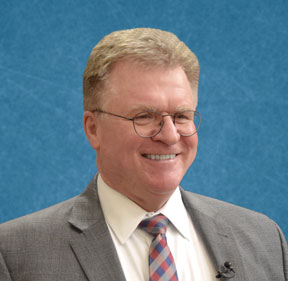
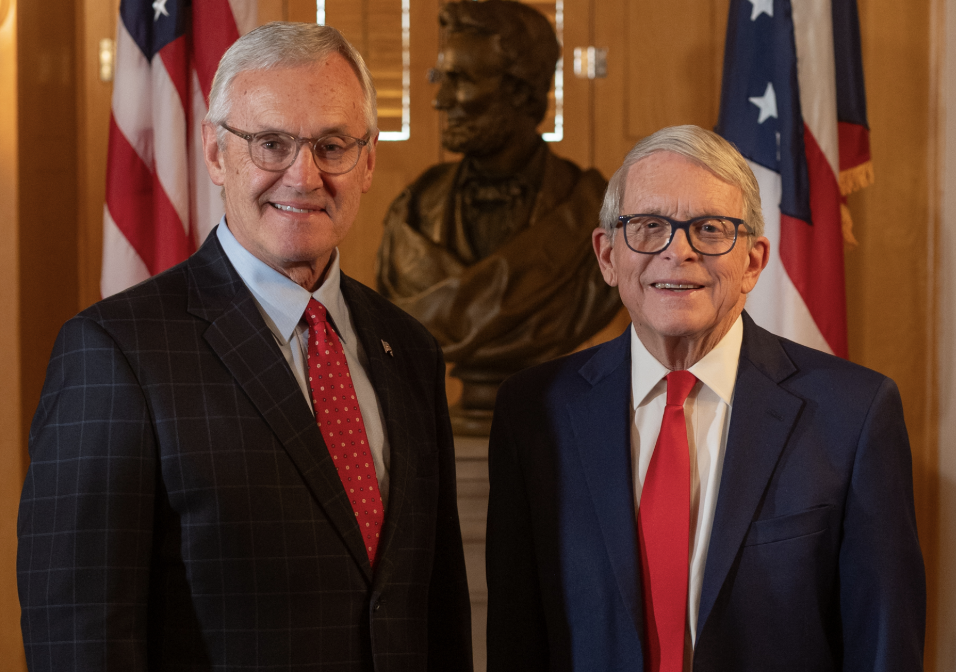
Former Ohio State football coach and Youngstown State University President Jim Tressel, left, who Ohio Republican Gov. Mike DeWine, right, has just selected to serve as the state’s next lieutenant governor. (Photo provided by Ohio governor’s office.)
Ohio Republican Gov. Mike DeWine announced his selection Monday morning of former Ohio State football coach Jim Tressel to serve as his lieutenant governor.
If confirmed by the Ohio House and Ohio Senate, Tressel will replace former Lt. Gov. Jon Husted, whom DeWine appointed to the U.S. Senate last month.
“Jim Tressel knows Ohio, he shares Ohio’s values, and is a born leader,” DeWine said in a release.
Tressel most recently served as the president of Youngstown State University before retiring in 2023. Tressel also served 15 years as the head coach of Youngstown State University’s football team before becoming head football coach of the Ohio State Buckeyes for 10 seasons.
DeWine said that Tressel’s background in education, workforce development, and economic development played a large role in his decision to ask him to take on the lieutenant governor role.
“Jim has spent a great deal of time working with and leading young people, and he will be involved directly with education and workforce development during the remaining two years of my administration,” DeWine said.
Tressel called it a humbling moment.
“I believe in our governor and what he believes in,” Tressel said. “I promised for the next 699 days to have a singleness of purpose and singleness of focus, which is to serve the needs that the governor outlines.”
The selection of Tressel comes as Ohio’s 2026 Election picture becomes more clear.
Last week, Republican Ohio Treasurer Robert Sprague announced his candidacy for Ohio Secretary of State in 2026, ending speculation he might seek the governor’s seat next while throwing his support behind potential 2026 Ohio governor candidate Vivek Ramaswamy.
Sprague enters a primary for Secretary of State against former Ohio state Sen. Niraj Antani, of Miami Township. Current Republican state Sen. Theresa Gavarone, of Bowling Green, is also reportedly considering a run for Secretary of State. On the Democratic side, Warren County oncologist Bryan Hambley has announced his candidacy.
Current Ohio Republican Secretary of State Frank LaRose has announced he will run for Ohio auditor in 2026, while current Republican Ohio Auditor Keith Faber has announced his bid for Ohio attorney general. No Democratic candidates have emerged yet for Ohio auditor or Ohio attorney general in 2026.
Current Ohio Republican Attorney General Dave Yost will run for Ohio governor in 2026. Ramaswamy is widely expected to officially announce his candidacy for Ohio governor too sometime soon.
If confirmed as lieutenant governor, Tressel will be in a natural political position to decide whether he wants to join the primary to succeed DeWine as governor as well.
On the Democratic side, former Ohio Health Department director Dr. Amy Acton is the only candidate so far to declare her candidacy for Ohio governor in 2026.
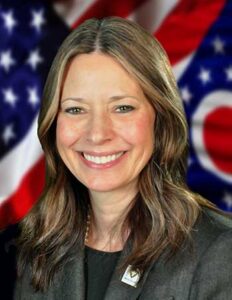
Former Ohio Health Department Director Dr. Amy Acton announced on Tuesday that she is running for Ohio governor in 2026.
“Today, I filed papers to run for Governor because I refuse to look away from Ohioans who are struggling while self-serving politicians and special interests take our state in the wrong direction,” she said in a statement. “It’s time to give power back to the people and our communities. It’s time for a change.”
Acton is running as a Democrat while Ohio has become increasingly more Republican in recent years. Ohio Supreme Court Judge Jennifer Brunner is the only Democrat in statewide office in Ohio. Acton first hinted at a run for governor during the summer at the Democratic National Convention.
“I’m a doctor, not a politician,” Acton said in her statement. “I solve problems by bringing people together regardless of party to find solutions. So unlike most of our leaders I know the answer to moving our state forward isn’t giving politicians more power, it’s giving people more freedom.”
Ohio Gov. Mike DeWine is term-limited. On the Republican side, Ohio Attorney General Dave Yost plans on running for governor. Former Republican Presidential Candidate Vivek Ramaswamy is also a potential GOP contender. Lt. Gov. Jon Husted has also expressed interest in running for governor, but he currently appears to be the front-runner to be appointed to fill J.D. Vance’s soon-to-be-open U.S. Senate seat. DeWine has yet to announce his pick, a task he must do before the Jan. 20 inauguration.
For the Democrats, there is speculation about whether Ohio Minority Leader Allison Russo, D-Upper Arlington, will also run for governor.
GET THE MORNING HEADLINES.
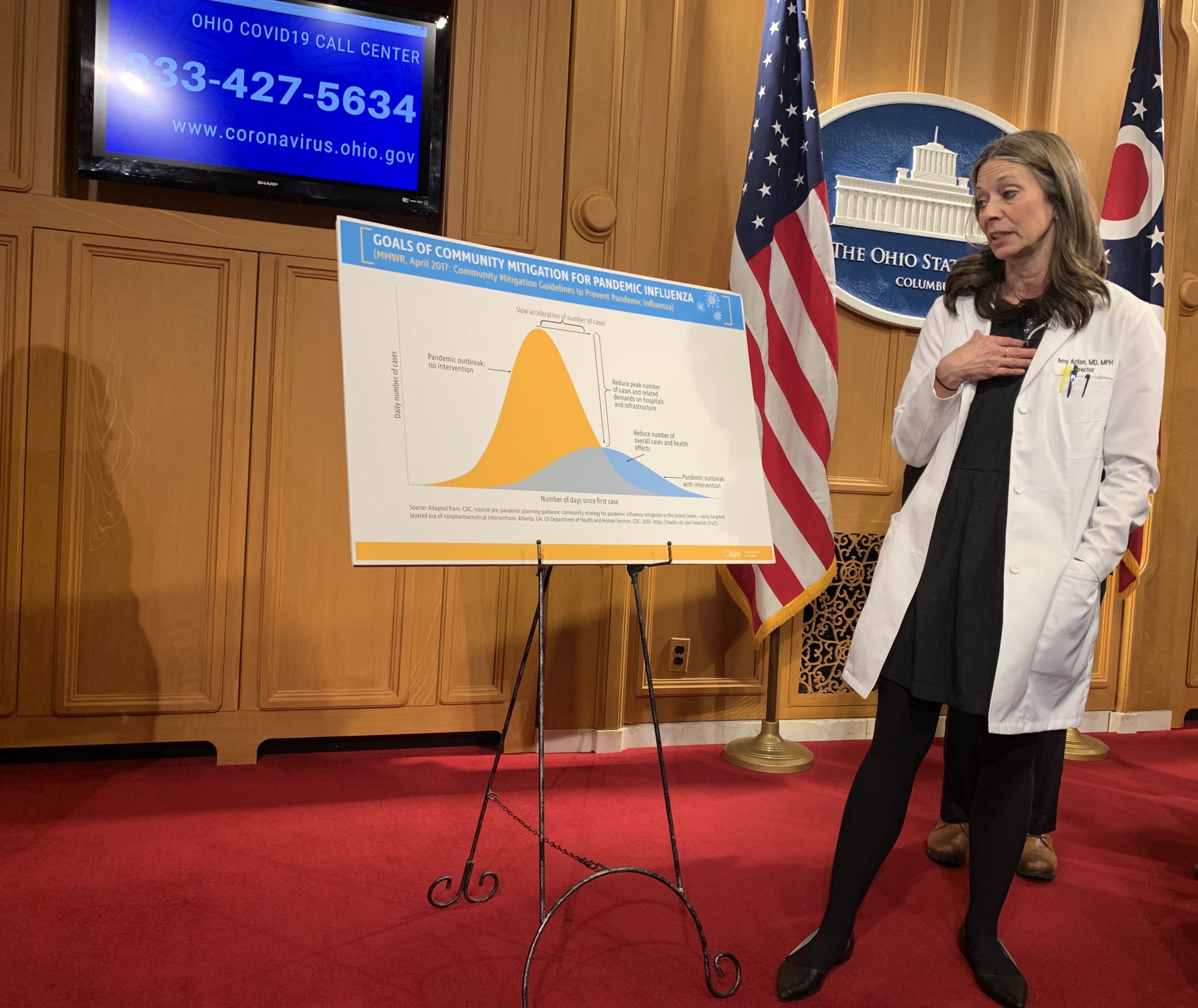
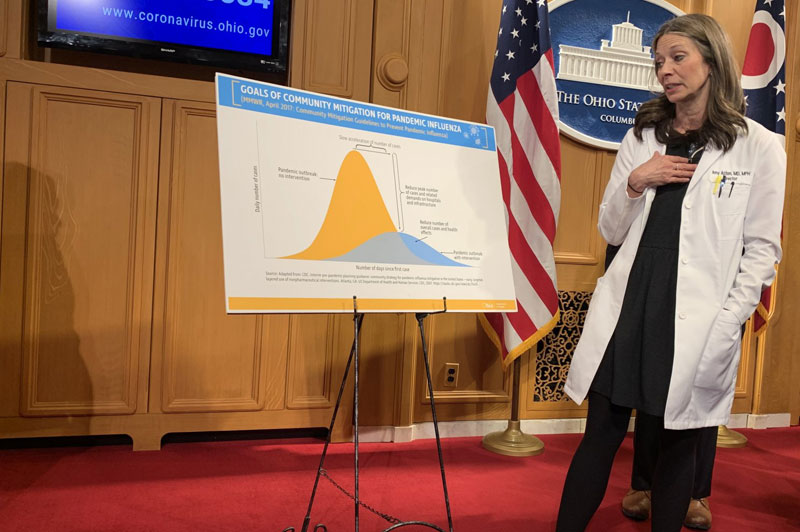
DeWine appointed Acton to be ODH director in 2019 and she quickly became a household name in Ohio during the early days of the COVID-19 pandemic. She accompanied DeWine during his daily afternoon press conferences in the spring of 2020, donning her white lab coat, and helped translate complex medical terminology into plain English.
She received a mix of praise and criticism during this time, and protesters even showed up to her Bexley house. Acton resigned as ODH Director in June 2020 — months after Ohio’s first confirmed COVID-19 case.
After her time on DeWine’s cabinet, she went back to work at the Columbus Foundation and helped found the Center for HumanKindness.
“My entire career I’ve been listening to Ohioans … and I’ve developed a deep connection with people across our state,” Acton said in her statement. “People share their struggles with me and how hard they work to keep up with the cost of groceries, childcare, healthcare, and other expenses. They feel left behind and like no one cares.”
Acton grew up in Youngstown — experiencing homelessness at one point.
“I remember what it was like to feel hungry, worry about where I would sleep, and how I would stay warm,” Acton said. “At times I felt invisible–and I know that so many Ohioans feel the same way.”
She went on to earn a medical degree from what was formerly called the Northeastern Ohio University College of Medicine and received a master’s degree in public health from Ohio State University.
“I believe we can build an Ohio where our people have a little breathing room–an Ohio where your zip code doesn’t determine success,” Acton said. “An Ohio that empowers local communities, not politicians. An Ohio with good-paying jobs, safe neighborhoods and thriving businesses where people can raise their families, age with dignity, and lead a happy and healthy life.”
Acton lives in Bexley with her husband Eric, who is a teacher and coach in Bexley City Schools. Together they have six children.
Megan Henry is a reporter for the Ohio Capital Journal and has spent the past five years reporting in Ohio on various topics including education, healthcare, business and crime. She previously worked at The Columbus Dispatch, part of the USA Today Network.
Ohio Capital Journal is part of States Newsroom, the nation’s largest state-focused nonprofit news organization.
Dr. Amy Acton, the former state health director who led Ohio’s pandemic response in its early months, announced Tuesday she will not enter the race to fill Republican Rob Portman’s seat in the U.S. Senate.
Acton was considered to be a potential leading candidate for the Democratic Party primary.
In a provided statement, Acton called it a “tremendous honor” to be considered for the race, but ultimately decided against committing t o a campaign.
“While I am not entering the race for U.S. Senate, I recognize there is a genuine longing for a fresh approach to leadership that is honest, collaborative, and empowering,” Acton wrote.
Acton was a little-known member of Gov. Mike DeWine’s cabinet until being thrust into the spotlight as the novel coronavirus spread throughout the country early last year.
She became a regular presence alongside DeWine at the daily coronavirus press conferences, using her experience as a former public health professor to clearly — and sometimes cleverly — describe the new virus to the general public.
Among the many health orders signed by Acton in those initial weeks were the shutdown of school buildings (Ohio was the first state in the U.S. to do so) and the postponement of the March primary election.
Acton was lauded throughout the state and in many national publications for taking aggressive steps to mitigate the spread of COVID-19. A Facebook fan club page grew to more than 100,000 members and Acton was even depicted on a bobblehead.
Within weeks, though, Acton begun facing an onslaught of criticism from those who argued the continued shutdown of certain businesses were devastating Ohio workers and owners.
A state senator posted to Facebook he would not let Acton, who is Jewish, turn Ohio into Nazi Germany. Another lawmaker repeatedly referred to her as a “dictator” and a “globalist.” Protestors gathered at Acton’s house on numerous occasions, with some bringing weapons and one man carrying an anti-Semitic sign.
Acton announced her sudden resignation as state health director in June. She stayed on for a few months as a paid, behind-the-scenes advisor to the governor on health issues.
By August, she was out of state government entirely. Acton returned to the Columbus Foundation, where she had worked previously before becoming state health director. She has rarely appeared in public or given interviews about the pandemic since then.
Portman surprised many by announcing in January he would not seek reelection to the U.S. Senate next year.
Acton was quickly viewed as a possible Democratic contender for the seat. Within weeks, she confirmed plans to step down from the Columbus Foundation in order to consider joining the race.
The 314 Action Fund, a political action committee dedicated to supporting scientists as political candidates, planned to spend millions of dollars backing an Acton campaign. The group commissioned a poll which found that two-thirds of Ohio Democrats viewed Acton favorably. Respondents gave her a slight edge over U.S. Rep. Tim Ryan, D-Niles, who is reported to be planning a run for the seat.
In the end, Acton decided against embarking on a career in elected politics. In the statement, she described there being a new hope felt in Ohio as the state emerges from a deadly pandemic that has killed more than 18,700 residents to date.
“The opportunity for repairing and reimagining is at hand: a rebirth for ourselves, our relationships, and for the institutions of our civil society,” Acton wrote. “What happens next isn’t the sole province of our elected officials. It is up to all of us. We must co-create an Ohio that ensures the enduring cultural values of kindness and justice for all.”
Republicans campaigning to replace Portman so far include former state party chair Jane Timken, former state treasurer Josh Mandel and entrepreneur Bernie Moreno.
A number of other Ohio politicians are believed to be eyeing the seat, including U.S. Rep. Steve Stivers, R-Upper Arlington; state Sen. Matt Dolan, R-Chagrin Falls; Republican author and venture capitalist J.D. Vance; and House Minority Leader Emilia Strong Sykes, D-Akron.
A year of Gov. Mike DeWine defending the president’s pandemic response and supporting his reelection effort was undone by a brief acknowledgment of reality on cable TV.
To President Donald Trump, one comment is all it takes for someone to go from political ally to persona non grata.
On Sunday, DeWine said on CNN that Trump has a right to legally challenge the 2020 election result, but should begin working toward a transition for President-elect Joe Biden. That clip was aired Monday morning on Fox News, a network Trump frequently watches at the White House, leading the president to target DeWine’s own reelection hopes in 2022:
Who will be running for Governor of the Great State of Ohio? Will be hotly contested!
This tweet to the president’s 89 million followers bookends a year in which DeWine has consistently praised Trump and frequently dodged questions related to the president’s handling of the pandemic.
DeWine’s office issued this statement in response to the president’s tweet: “I have always had a great working relationship with the President. I am proud to have served as President Trump’s Campaign Co-Chairman in Ohio where we won by the largest margin of any swing state in the country. And I intend to run a winning campaign for governor in 2022.”
DeWine served as an honorary co-chair to Trump’s campaign in Ohio and recorded a video in support of Trump for the 2020 Republican National Convention. His lieutenant governor, Jon Husted, spoke at a Trump rally in September in favor of the president’s reelection — though the crowd of Trump supporters booed Husted for promoting mask-wearing to prevent COVID-19 spread.
While DeWine has emphasized the need for masks and social distancing, Trump has often undercut this public health message by hosting large campaign rallies and downplaying the effectiveness of face coverings.
DeWine has sidestepped questions from reporters about these contradicting messages, instead choosing to praise the White House for its conference calls with governors and for its work in helping develop a vaccine.
I just got off the phone with @VP Pence. I am grateful for the Administration’s help as we continue to fight COVID-19. pic.twitter.com/cmJvSDlICm
The president’s suggestion of a Republican primary comes as DeWine faces increasingly sharp attacks from seemingly all sides regarding his handling of the COVID-19 pandemic. Democratic leaders, who have generally been supportive of the Republican governor and the Ohio Department of Health, want him to take more aggressive steps to slow the spread as Ohio sees record numbers of infections and hospitalizations.
Republican legislators have dialed up their own criticism of their party’s leader, insisting DeWine should refrain from issuing any further health orders such as business shutdowns.
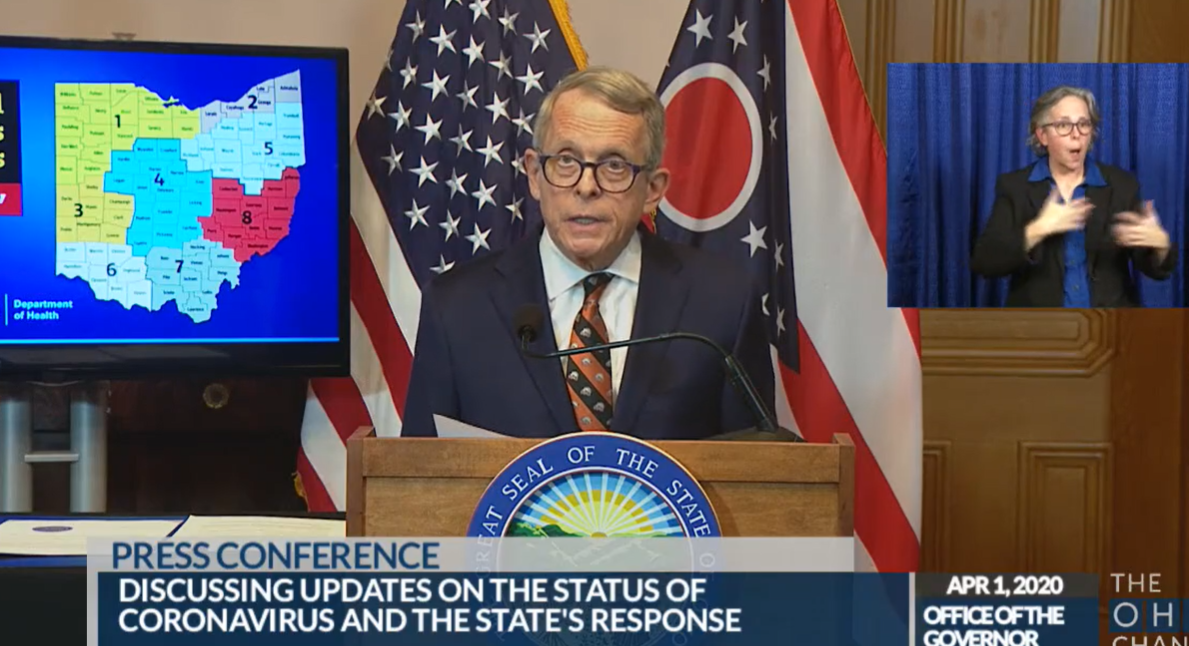
DeWine earned very high marks from the general public early in the pandemic for his aggressive response in partnership with then-Ohio Department of Health Director Dr. Amy Acton. That support led to widespread cooperation in the early weeks as the two enacted business closures and a stay-at-home order.
Support for DeWine has gradually waned in the months since, though a Great Lakes poll in September found a majority of Ohioans still viewed DeWine’s coronavirus response favorably.
Hours after Trump’s tweet, DeWine did receive a compliment from President-elect Joe Biden at a Monday afternoon press conference. Biden referred to DeWine as a leader in having “stepped up” to issue a mask mandate in Ohio.
Outside of the electoral ramifications of Trump’s tweet, the public sentiment over the Ohio pandemic approach may impact DeWine’s ability to amass future cooperation for any health orders still to come.
DeWine has hinted that orders pertaining to bars, restaurants and social gatherings could come as soon as this week.
The governor spent early Monday in West Virginia speaking to TV stations which broadcast to the southern and eastern portions of Ohio. DeWine has offered region-specific messages to Ohioans about the virus spike and how residents can slow the spread in their areas.
With this year’s election now over, some Ohio Republicans have begun turning their attention to 2022. Among them is Jim Renacci, a former Congressman from Medina County and fervent Trump supporter who ran for governor against DeWine in 2017. Renacci quit the Republican primary to instead campaign for U.S. Senate against Democratic incumbent Sherrod Brown, who defeated Renacci in the 2018 General Election.
State Rep. Jena Powell, R-Arcanum, has offered a similar view.
“The solution today is taking away (DeWine’s) emergency powers,” Powell wrote on Facebook after the governor’s statewide address on Nov. 11. “The solution in two years is to not re-elect Mike DeWine.”
Powell shared Trump’s tweet in agreement.
“Even President Donald J. Trump knows Governor Mike DeWine is doing a terrible job,” she posted. “Ohio needs conservative leadership that actually represent the people first.”
Some Ohio Democrats see the Trump tweet as a political lesson.
Columbus, Ohio – Gov. Mike DeWine hired an attorney to lead the Ohio Department of Health on Thursday, a position that has remained vacant for the past five months of the pandemic.
Stephanie McCloud, who currently runs the Ohio Bureau of Workers’ Compensation, will take over a position that has been filled on only an interim basis since Dr. Amy Acton stepped down in June.
She will now oversee the quickly worsening COVID-19 pandemic, as measured by spiking case counts, rising positivity rates, a swelling active hospitalization count, and an ever-ascending death toll.
McCloud’s hire is a pivot from the physicians who previously held the post like Acton or Dr. Joan Duwve, who was set to replace Acton but quit the job in September before she officially started. DeWine has said in the past he specifically wanted a medical doctor to fill the post.
“When I was elected governor, I knew that I wanted a Director of Health with a strong public health background, someone who had a passion for public health, and someone who could talk to Ohio citizens in a candid way about health issues,” DeWine said in June.
An about page on the BWC website lists McCloud’s backgrounds in insurance administration and the law, but nothing specifically relating to public health or infectious disease control.
A 1993 state law requires the ODH director to be either a physician or a person who has had “significant experience in the public health profession.”
Dan Tierney, a DeWine spokesman, said McCloud’s work at BWC, which consists in part of evaluating claims of work-related health care claims and finding ways to prevent workplace health issues, meets the terms of the statute.
He also emphasized DeWine’s related announcement of hiring a new chief medical officer, Dr. Bruce Vanderhoff, and related moves from lower-profile COVID-19 response staff.
“There’s multiple people who need to lead on this,” he said.
McCloud has valuable experience in management but nothing as it relates to public health, according to Micah Berman, a professor of public Health Law at Ohio State University.
“To me, this is indicative of the lack of respect — or understanding — of public health as a field of expertise,” he said. “The Director of Health should have expertise in public health — not just in health care or another health related field.”
The position has proven difficult to fill since Acton left. Acton had been the public face of Ohio’s public COVID-19 response to the newly emergent coronavirus, which included delaying a primary election, closing schools and businesses, and beginning to phase in a mask mandate.
However, Acton faced tremendous public backlash. Protesters gathered and called her out by name in rallies in front of the Capitol and outside her Franklin County home. Some of them carried guns. At least two people hoisted anti-Semitic signs at both locations.
Even after she stepped down, businesses and individuals challenging various COVID-19 health orders have named Acton as a defendant and issued summons seeking to drag her back into the fights. She described to The New Yorker hearing a conservative talk radio host in Ohio say if his key adviser quit during a crisis, he’d want to punch him in the face.
In September, DeWine announced that Duwve would fill in where Acton left off. However, just hours after DeWine announced her hiring, Duwve declined the job.
Duwve cited harassment of Acton as a reason for turning it down.
Announcing Duwve’s hire, DeWine boasted of her “extensive experience in public health” in both government service and academia.
The medical community has started to shine light on increasing backlash against public health officials navigating pandemics with no fixed playbook.
An August viewpoint article with the Journal of American Medicine cited Acton and dog-whistle anti-Semitic remarks thrown her way by a state politician in its argument for more cover for health officials from political leaders.
“The present harassment of health officials for proposing or taking steps to protect communities from COVID-19 is extraordinary in its scope and nature, use of social media, and danger to the ongoing pandemic response,” it states. “It reflects misunderstanding of the pandemic, biases in human risk perception, and a general decline in public civility.”
Columbus, Ohio – Gov. Mike DeWine acknowledges that whoever takes over as state health director may face a torrent of criticism just as Dr. Amy Acton did earlier this year.
That’s not a challenge unique to Ohio, the governor also said, vowing the state would continue searching for a permanent replacement to lead the department of health.
DeWine faced his own scrutiny about the hiring process from reporters at Tuesday’s (September 15 )press conference, the first held since the governor saw his appointed replacement step aside within hours of the hire being made public.
The governor announced on Sept. 10 that Dr. Joan Duwve, an Ohio native, would soon take over as the new state health director. Duwve had been serving as director of public health in South Carolina.
That evening, DeWine later said, he learned that Duwve planned to withdraw from consideration, citing “personal reasons.”
In a statement reported by the Associated Press, Duwve said she had learned about harassment faced by Acton and her family only after having accepted the position. In learning about that, she described making the quick decision to step aside.
Acton was the target of protests held outside her house in Franklin County, with some of the criticism leveled against her fueled by anti-Semitism.
“My family is off limits. I withdrew my name from consideration to protect my family from similar treatment,” Duwve said in her statement.
On Tuesday, DeWine contended that he and members of his team had in fact discussed the Acton harassment issue with Duwve prior to the appointment.
Nevertheless, the governor said his office has moved on and will continue searching for a replacement. The Ohio Department of Health has been led by interim director Lance Himes since the day Acton resigned on June 11. For a time, Acton remained employed as a chief health advisor to DeWine before leaving government entirely in early August.
Dr. Amy Acton addresses reporters at a news conference earlier this year. Capital Journal photo by Jake Zuckerman
There are currently two open leadership positions: for state health director (heading the department of health) and for state medical director.
DeWine said he did not want Ohioans to be worried about the delays in securing a permanent replacement to those posts. He said the department has many other hardworking professionals, and that the Ohio government continues to seek advice and resources from health experts throughout the state.
Does Ohio’s difficulty in finding a replacement reflect poorly on the state? No, said DeWine.
“I don’t think Ohio’s unique,” he said, referencing public protests against health officials elsewhere in America during the coronavirus pandemic.
“We know these are issues that can be divisive,” he continued. “I’ve tried to do everything I can so that we are not divided as a state, because I think we need to be together and fight this battle together.
“I know we’re getting tired,” he later said, “but we have to continue to rally. We have to continue to fight this.”
Tyler Buchanan is an award-winning journalist who has covered Ohio politics and government for the past decade. A Bellevue native and graduate of Bowling Green State University, he most recently spent 6 1/2 years as a reporter and editor of The Athens Messenger and Vinton-Jackson Courier newspapers. He is a member of the BG News Alumni Society Board and was a 2019 fellow in the Kiplinger Program in Public Affairs Journalism.
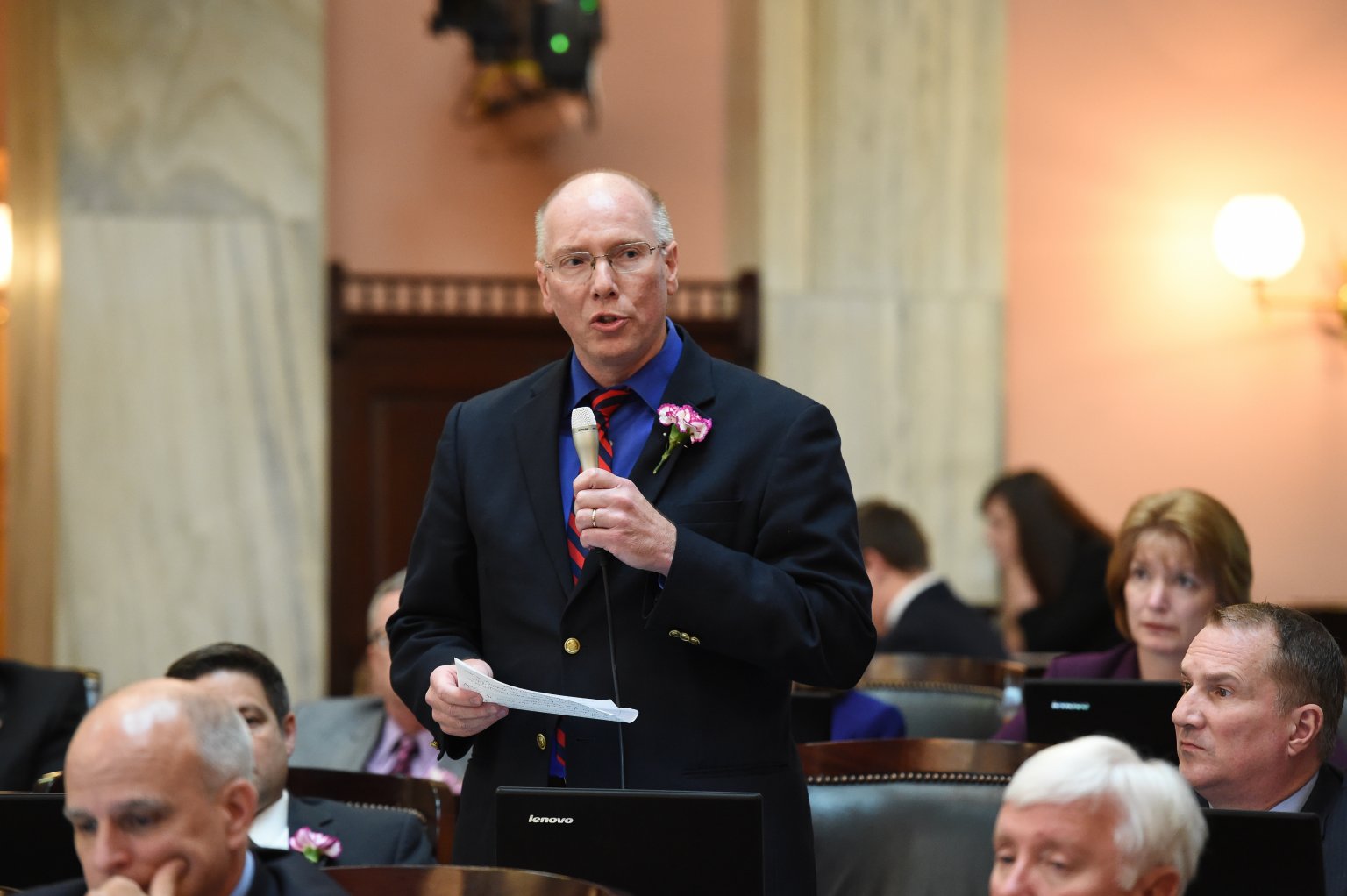
With his impeachment effort against the governor making little progress, state Rep. John Becker pulled up his email and brainstormed a late-night solution.
It was almost 2 a.m. when Becker typed out a request to the Legislative Service Commission, a nonpartisan group that conducts law and policy research for lawmakers.
Becker is among the biggest critics of DeWine in the state legislature
“I believe that Governor DeWine is in violation of (Ohio Revised Code) 2921.45,” Becker wrote in the Sept. 1 email. “What is the process for criminal charges to be filed? Can the (Attorney General) do that? Other options?”
Still waiting for an answer, Becker sent another 2 a.m. request a few days later. He sought more “legislative history and legal case law” involving the 2921.45 section of code.
The law states: “No public servant, under color of his office, employment, or authority, shall knowingly deprive, or conspire or attempt to deprive any person of a constitutional or statutory right.” Violators are guilty of a first-degree misdemeanor, punishable by up to 180 days in jail and a $1,000 fine.
Becker is among the biggest critics of DeWine in the state legislature and views the governor’s response to COVID-19 as amounting to a “constitutional crisis.” The decision to delay primary election voting, the temporary closure of some businesses, the mask mandate — to Becker, these are the instances of DeWine assuming “dictatorial powers” and violating Ohioans’ constitutional rights.
Becker wants to see if DeWine can face criminal punishment for his pandemic response.
“My goal is to get the state opened up and the abuse of power to come to an end,” Becker said to the Ohio Capital Journal.
Impeachment and criminal charges?
Throughout 2020, DeWine has relied on a separate section of state law which gives the Ohio Department of Health authority to make “special or standing orders … for preventing the spread of contagious or infectious diseases.”
On Aug. 24, Becker announced he had drafted articles of impeachment against DeWine. Three fellow Republican legislators immediately gave support for impeachment: Reps. Nino Vitale of Urbana, Candice Keller of Middletown and Paul Zeltwanger of Urbana.
There have been a slew of lawsuits and legislative challenges to that authority. Becker sponsored one of the first bills seeking to limit the power of the state health director and many other Republican-sponsored bills have followed. DeWine has vowed to veto any such bill which interferes with the state’s pandemic response.
On Aug. 24, Becker announced he had drafted articles of impeachment against DeWine. Three fellow Republican legislators immediately gave support for impeachment: Reps. Nino Vitale of Urbana, Candice Keller of Middletown and Paul Zeltwanger of Urbana.
“For my colleagues, it’s put up or shut up,” Becker said.
Becker claims there was support for impeachment from at least one Republican member who wound up not joining as a sponsor.
There was swift backlash from Ohio Republican leaders the day articles were drafted, which Becker thinks quashed any desire for others to join the effort.
“Nobody wants to touch it,” Becker said.
Becker had planned to officially file the articles a week or so after drafting them, but instead is holding off. Once they are filed, no one else can sign on as a sponsor. He’s holding out hope that legislative sentiments may change before the end of 2020.
It would take a majority vote from the Ohio House of Representatives to impeach DeWine, then a two-thirds vote from the Ohio Senate to convict him. With only four representatives currently on board, they are 46 supporters short.
Speaker of the House Bob Cupp, R-Lima, has come out against the impeachment effort, saying that policy disagreements do not rise to the level of removing the governor.
“For my colleagues, it’s put up or shut up,” Becker said.
In a recent YouTube video, Becker acknowledged his colleagues believe the disagreements should be resolved legislatively rather through impeachment.
“Frankly I agree,” Becker said. “Legislation was the way to do it and we have tried that, and the governor has promised to veto everything that we’ve put out there attempting to roll back his power.”
Beyond impeachment, Becker alleges the governor has committed a number of crimes. Among them: that DeWine illegally canceled and rescheduled the primary election.
Hours before the polls were set to open Ohio Department of Health Director Dr. Amy Acton signed an order preventing the polling places from opening. DeWine and Acton feared holding an in-person election would lead to the virus spreading.
Ohio primary election dates are set by the state legislature. Lawmakers unanimously approved a new primary election plan involving an all-mail vote conducted throughout all of April. Becker voted for that plan.
Becker also alleges the mask mandates at churches, public places and businesses are in violation of Ohioans’ civil liberties.
Becker also alleges the mask mandates at churches, public places and businesses are in violation of Ohioans’ civil liberties.
Chief Justice John Roberts, an appointee of President George W. Bush, wrote in the majority opinion that the church restrictions were level with social distancing requirements at other public gatherings. Given the lack of treatment, cure, vaccine or sufficient knowledge about the new disease, he wrote, it’s too early to deem the restrictions unconstitutional.
“Although California’s guidelines place restrictions on places of worship, the restrictions appear consistent with the Free Exercise Clause of the First Amendment,” he wrote.
Tyler Buchanan is an award-winning journalist who has covered Ohio politics and government for the past decade. A Bellevue native and graduate of Bowling Green State University, he most recently spent 6 1/2 years as a reporter and editor of The Athens Messenger and Vinton-Jackson Courier newspapers. He is a member of the BG News Alumni Society Board and was a 2019 fellow in the Kiplinger Program in Public Affairs Journalism.
This article provided to Loveland Magazine was edited by David Miller and is by by Eye on Ohio, the nonprofit, nonpartisan Ohio Center for Journalism. Please join their free mailing list as this helps us provide more public service reporting.
In early March, just as Ohioans were learning about the first cases of novel coronavirus in the state, Anna Bondar’s grandfather fell at his Cleveland home.
Luckily, the 92-year old, who lives with dementia, wasn’t injured badly.
The tight-knit family started to discuss the possibility of a nursing home, though they had serious reservations.
Their tough choice was made even more difficult by mounting fears about the coronavirus. In nearly four months, COVID-19 has infected more than 31,191 people statewide and has proven particularly deadly for residents of long-term care facilities in Ohio.
Seventy percent of the reported deaths in Ohio due to COVID-19 complications have been in long-term care facilities, which is among the highest in the country.
Nationally the portion of COVID-19-related deaths in long-term care facilities has hovered just over 40%, though the amount of testing done in nursing homes varies significantly by state.
Every day, families like Bondar’s are making what can feel like an impossible choice – whether to send a loved one to a nursing home where they will receive around-the-clock specialized care but face a greater risk of contracting COVID-19, or to care for that person at home where risk of transmission is lower but providing care can be more challenging.
Even before the pandemic, sorting through the myriad of quality ratings and measures was daunting enough. Then, COVID-19 deaths started to soar.
Now, families and seniors agonize over what could be life or death choice using confusing numbers on infection “hotspots” and without the ability to visit nursing homes to observe how the staff cares for residents – which is the number one recommendation of most advocates.
Dr. Amy Acton, director of the Department of Health
State officials, including Dr. Amy Acton, the former director of the Department of Health, have emphasized that “congregate” settings like nursing homes are at highest risk of infection. Staff, who often travel between facilities, need to be in close contact with residents to provide care. And residents, who are primarily older and have multiple medical conditions, are more susceptible to COVID-19-related complications.
“All of this makes it high risk. At the same time, it’s really necessary for many patients to be there,” said Dr. Steven Schwartz, a geriatric physician at the Cleveland Clinic who travels to nursing homes as part of the Clinic’s Center for Connected Care.
Ohio National Guardmembers will begin testing all staff members and any residents who likely were exposed to COVID-19 in the state’s nursing homes, Gov. Mike DeWine announced May 27. What are being called Congregate Care Unified Response Teams will focus on facilities where confirmed or assumed positive cases are reported in hopes of reducing the number of COVID-19 cases and deaths in Ohio’s nursing homes, which as of May 27 was 5,324 resident cases and more than 1,442 deaths.
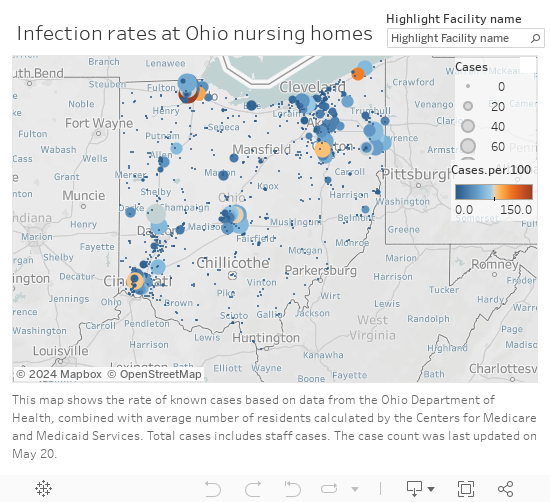
Infection rates in Ohio Nursing Homes
Making an educated decision
Last month, state officials began to release the numbers of reported infections and deaths in long-term care facilities, which include nursing homes, rehabilitation centers, and assisted living centers.
But it’s unclear how much the numbers – which are reported weekly and are also tracked cumulatively – matter for families currently trying to choose a facility.
The state, on its coronavirus website, says the infection and death numbers shouldn’t replace a thoughtful conversation with a nursing facility about infection control practices and that “residents and family members should understand that the presence of COVID-19 at a facility is [in] no way an indicator of a facility that isn’t following proper procedures.”
Yet many in the health care industry say infection information should be considered, along with other factors, when deciding which site to choose.
“If you see a nursing home with a large outbreak, that’s something to worry about. If you see a nursing home with a small outbreak, I’m not sure it means anything but bad luck.”
“If you see a nursing home with a large outbreak, that’s something to worry about. If you see a nursing home with a small outbreak, I’m not sure it means anything but bad luck,” said Dr. James Campbell, department chair of geriatric medicine at MetroHealth.
The infection information provided by the state can be useful, for instance, if a family is choosing between two similar facilities, said Nate Cyrill, a Long Term Care Ombudsman for Cuyahoga, Geauga, Lake, Lorain and Medina counties.
Since information on the virus changes rapidly, most families still rely on the quality measures that were available before COVID-19, including existing state and federal online guides Cyril said.
One of the commonly-used ranking systems, maintained by the Centers for Medicare and Medicaid Services, assigns ratings – from 1 to 5 “stars” – to facilities based on performance on quality measures, staffing and inspections.
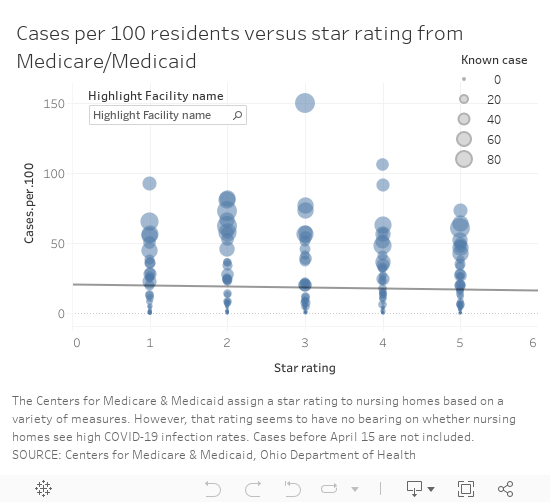
The number of “stars” Ohio’s nursing homes received, however, does not appear to have a correlation to the number of infections reported to the state, based on a comparison of the publicly available information. The analysis did not include assisted living facilities.
Cases vs. Star rating
“You want to look for a nursing home that’s four of five stars preferably but even that doesn’t tell you the whole story,” Steven Schwartz said.
There are numerous 1-star rated facilities that have reported few infections, like Whetstone Gardens and Care Center in Columbus, which has reported 9 cases or 8 per 100 residents.
Salem North Healthcare Center
Salem North Healthcare Center in northern Columbiana County had 51 patients test positive for the virus as of May 20, as well as five staff, according to the state. It is rated a 5-star facility, the highest rating from CMS.
It’s one of four 5-star facilities with an infection rate over 50 casesper 100 residents, based on Medicare’s calculation of each facility’s average number of residents. (The rate does not include infections among staff because the number of staff in each facility was not available.)
Since April, the focus on high numbers of reported infections, often referred to as clusters, in long-term care facilities has intensified. In some cases, those numbers are a reflection of the level of testing, said Fred Stratmann, general counsel and chief compliance officer for CommuniCare Health Services. It doesn’t mean all of the residents with a positive test had symptoms of COVID-19. The state infection numbers also don’t show the residents who have recovered from the virus, he said.
CommuniCare, which operates close to 90 health care facilities in seven states has been proactive about testing, Stratmann said. When COVID-19 cases started to appear at the North Salem facility, the company enlisted the state’s “strike team” to proactively test all of the residents. It has since re-tested all of the residents who were initially negative and purchased 3,000 testing kits to supplement what the state could provide.
“We wanted to be certain of the extent of COVID in this center in order to be able to properly treat it and to fight back against it,” Stratmann said. The facility does that by isolating any COVID-19-postive patients in a separate unit with its own dedicated staff and by admitting new residents to an observation unit for 14 days to make sure they have no symptoms of infection, he said.
Restrictions on visits make choices harder
The most effective way to scout out a facility typically is to visit it, preferably unannounced, said Dr. James Campbell, department chair of geriatric medicine at MetroHealth. However, because visitors aren’t permitted in nursing homes right now, the next best thing is to ask detailed questions about care, any COVID-19 cases and infection control measures, he said.
Campbell also suggested turning to hospital staff, who work with nursing homes regularly, for advice. Social workers can place five people in a week, while most individuals face that decision, at most, only a few times in their lives, he said.
Cyrill said his agency can also provide information that can’t be found online for families trying to choose between facilities.
Cyrill said his agency can also provide information that can’t be found online for families trying to choose between facilities.
The agency, along with other similar independent agencies across the state, investigates complaints in long-term care, skilled nursing, group homes and rehabilitation facilities and can share what are called “verified complaints” that aren’t otherwise available publicly.
Most of the complaints investigated in relation to COVID-19, Cyrill said, have been related to visitation or the ability of families to get information on a loved one’s condition.
It’s been harder, though, for Cyrill and his colleagues to investigate complaints with COVID-19 restrictions in place.
It’s been harder, though, for Cyrill and his colleagues to investigate complaints with COVID-19 restrictions in place.
Under normal circumstances, an ombudsperson would go to the facility and talk to patients and could do so without announcing the visit in advance. Since visits are restricted for infection control reasons, they have to work through staff to speak to residents or to ask questions, which isn’t optimal. And they aren’t able to make direct observations.
“It makes our job much more challenging,” Cyrill said.
At the North Salem facility, which has had about a dozen new residents admitted or transfered from other facilities, the staff has given “virtual tours” over the phone to family members or prospective residents who were in the hospital, Stratmann said. The company also invested in technology that won’t replace face-to-face visits but enables more family contact and the ability and for staff to help keep residents’ spirits up by making videos of activities, like dancing and singing, to keep them connected with the local community.
In addition, Stratmann said they walk families through the infection control procedures and share techniques they have implemented to improve health outcomes for patients with COVID-19 including, when appropriate:
Treating residents with anticoagulant medications to reduce the risk of blood clots and strokes, which has been a factor in some COVID-19-related fatalities.
Practicing “proning” or positioning residents, while awake, flat on their belly and chest to reduce the buildup of fluid in lung tissue and reduce the risk of Acute Respiratory Distress Syndrome, which has been associated with many COVID-19 fatalities.
The idea of putting their beloved grandfather in a nursing home was gut-wrenching
Choosing home
For Bondar’s family, the idea of putting their beloved grandfather in a nursing home was gut-wrenching, especially as visitation was curtailed to limit the virus’ spread. He speaks Russian, his native language, and would not have been able to communicate well with the staff caring for him.
“It felt like admitting him [to a facility] would be like saying goodbye,” Bondar said. “Like leaving him to die.”
Bondar’s family ultimately decided to care for her grandfather at home, in his Mayfield Heights senior highrise, where they could limit his exposure to the virus.
Before his fall, an aide visited for about eight hours a week. After the Ohio’s “stay at home” order was put in place March 23, Bondar and her mother were able to work from home and pitch in with care.
The advice of the Clinic’s Steven Schwartz led them to a hospice program, which helped the family find additional aides, including one who speaks Russian, as well as a hospital bed for safer sleeping and a wheelchair.
The home care route isn’t the easiest but Bondar said the family feels like they have more contact and control over the quality of care.
The home care route isn’t the easiest but Bondar said the family feels like they have more contact and control over the quality of care.
“We’ll do this as long as we can manage it,” Bondar said.
Anecdotally, it is a choice more families are making: the decision to use home care or even pull family members out of nursing homes out of fear or because they miss them and can’t visit, Steven Schwartz said.
“Sometimes it’s appropriate. But sometimes, even given everything, it may be safer to have your family member there to get stronger and get the necessary care,” said Steven Schwartz. “I would really try to balance the benefit of going to a nursing home versus the risk.”
Patients with dementia or Alzehimer’s may be unsafe going back home.
Patients with dementia or Alzehimer’s may be unsafe going back home, he said, and families may need to decide if a nursing home really is the safer place.
One of the first orders Ohio put in place to prevent the spread of COVID-19 was to halt in-person visitation in more than 900 nursing and long-term care facilities. The state is not yet ready to lift those restrictions and resume visits in those settings, Gov. Mike DeWine said, but on June 8 will start allowing outdoor visits at assisted living facilities care centers for individuals with disabilities.
“We are not to nursing homes yet and I know that causes anguish for a lot of people who are watching this but we’re trying to do this so that we don’t increase the COVID inside the nursing homes or the assisted living or the immediate care facilities,” DeWine said during a May 28 briefing.
Decisions made harder
Figuring out what kind of care might be best for a patient has become more challenging, too.
Previously, nurses and social workers would visit clients in their homes to assess how they functioned – whether they could independently bathe, cook and grocery shop, said Theresa Foster, a nurse and licensed social worker at Western Reserve Area Office on Aging.
They relied on conversations with clients and family and also observations of the environment in the home and possible risks, said Foster, who runs the agency’s resource center.
Those assessments were used to determine whether a person could safely remain at home with community support or whether they needed facility-level care and what resources, whether subsidized or private, existed to pay for the services.
Now, those assessments are done by phone and can be done successfully, but it is more difficult, Foster said.
At UH’s hospitals, medical staff use a scoring system to determine the best place for a patient being discharged, said Dr. Sean Cannone, UH’s medical director for population health.
Patients are assessed on their ability to perform daily tasks and on their cognitive abilities.
“We’re trying as much as we can to get patients home if at all possible,” he said. The goal is to provide patients with resources so they can receive care in whichever setting they prefer.
The goal is to provide patients with resources so they can receive care in whichever setting they prefer.
“We want to respond to what people really want for their own care,” Cannone said.
The shift started before COVID-19 cases surfaced but has accelerated as more families worry about potential exposure to the virus in congregate living situations.
As technology has advanced, the capabilities of what can be done in a patient’s home has also increased. In March, UH introduced a new patient management system, Massimo SafetyNet, for remote monitoring.
When patients are released from the emergency room or from a COVID-19 floor, providers now put a bluetooth sensor on their wrist — it looks like an Apple Watch — that streams data about a patient’s vitals to a central monitoring center, said Jonathan Sague, UH’s vice president of clinical operations. That way, providers can make sure a patient is safe at home.
Douglas Beach is the chief executive officer at Western Reserve Area Office on Aging
Douglas Beach, chief executive officer at Western Reserve Area Office on Aging, has had firsthand experience weighing care decisions amid COVID-19 worries. His mother is rehabilitating in a nursing home after a six-week hospital stay related to a heart condition.
Not being able to visit her in the hospital or the facility has been hard, Beach said. He and his brother, who is a doctor, had to make all of the arrangements by phone, including figuring the best way to transport her that would have the lowest risk of exposure to the virus.
“Home and community-based services is what I do,” Beach said. Part of his mission is to advocate for the setting that allows for any person, whether they are older adults or live with a disability, to be as independent as possible .
But for his mother, a nursing facility was the right choice because she needed 24-hour care that her family could not provide at home.
Beach said nursing homes have had to deal with an unprecedented set of circumstances: a new virus, initial unknowns about transmission and populations at extremely high risk for complications.
Nursing homes will continue to play a vital role and will remain the best option for people who need more care than can be safely provided at home, Beach said.
For the more than 9,500 clients his agency serves in Cuyahoga, Geauga, Lake, Lorain and Medina counties, delivering care at home, with health aides, nurses and community and family supports, has proven a low risk. As of mid-May only 35 clients had tested positive for the virus, he said. That is roughly 0.3% of clients, though not all clients are tested.
Managing COVID-19
Cuyahoga County nursing homes have been paired with one of the area’s three largest hospital systems during the pandemic, Campbell said. The hospitals help the facilities both prepare for and respond to COVID-19 cases.
“The goal is when you have one patient in a nursing home with COVID is to make sure you don’t end up with 30 patients with COVID,” Campbell said.
UH developed what is being called a playbook for local nursing homes. The playbook gives facilities a plan for how to respond if there’s a COVID-19 outbreak on-site, said Sague, who works as a firefighter and medic on the weekends.
“It can be pretty startling and pretty alarming if they’re not ready for it,” Sague said.
The playbook gives guidelines on screening, triaging, determining exposure, testing and isolating those who test positive, as well as how to get personal protective equipment, increase staffing and to eventually reopen safely, Sague said.
Once a case is identified at a facility, what is known as an intercept team is dispatched — either virtually or in person — to help a nursing home handle it, he said.
Patrick Schwartz, director of strategic communications for LeadingAge Ohio, a long-term care trade association, said access to testing and safety equipment has been a consistent problem for Ohio’s nursing homes.
But in the past month or so, the state has made “a definite shift” and started prioritizing testing at nursing homes, which is helping, he said.
Patrick Schwartz said he hoped the expanded testing would enable facilities to test their entire population— of residents and staff — so they can better limit the spread of the virus.
Throughout Ohio, populations that have received mass testing — health care workers, first responders, those incarcerated and those in nursing homes — have had higher numbers of positive cases. Many people with COVID-19 are asymptomatic, so it is unknown if they have the virus until they are tested.
“Since this pandemic first reared its head, it was clear to long-term care providers that the front lines would be in long-term care,” Patrick Schwartz said. The populations at those congregate living facilities, many of whom are older and have multiple medical conditions, are among the most vulnerable for complications from COVID-19, he said.
In Cuyahoga County, and elsewhere, local health departments have deployed limited testing resources to nursing homes quickly in hopes of limiting spread in and between facilities and given guidance to homes about how to isolate patients and trace exposures between facilities to limit the spread of infection.
Cuyahoga County Health Commissioner Terry Allan said nursing homes try to guard against outbreaks but have varying degrees of resources. The assistance from the National Guard will allow more residents and staff at facilities in Northeast Ohio to be tested, he said.
Support for this project was provided by the Center for Community Solutions.
Questions to ask:
How can family members stay in touch with residents while visiting is restricted?
Does staff facilitate video visits? Is window visiting allowed?
How often will the facility provide updates on a resident’s condition?
How much COVID-19 testing is being done? Is the facility proactively testing patients or only those with symptoms?
Are private rooms available?
Do staffing ratios allow for residents to be taken outside?
Are residents currently restricted to rooms?
Are separate units and staffs used for COVID-19-positive patients and COVID-19-negative patients?
How does the facility work to limit COVID-19 complications?
Columbus, Ohio – Ohio Governor Mike DeWine, Lt. Governor Jon Husted, and Director of the Ohio Department of Health Dr. Amy Acton, made several announcements yesterday regarding Ohio’s plan to restart Ohio’s economy during the ongoing COVID-19 pandemic.
HEALTHCARE
Beginning May 1, 2020, all medically necessary procedures that do not require an overnight stay in a healthcare facility or do not require inpatient hospital admission and minimize the use of personal protective equipment may move forward. This includes regular doctor visits, well-care checks, well-baby visits, out-patient surgeries, imaging procedures, and diagnostic tests. Dental services and veterinary services may also proceed if a safe environment can be established.
Healthcare providers and facilities that plan to resume providing these services must adhere to infection control practices, have sufficient PPE, and talk with patients about the risk of contracting COVID-19.
Surgeries and procedures that, if not performed, would cause a threat to a patient’s life, a threat of the spread of cancer or the permanent dysfunction of a limb or organ, the presence of severe symptoms causing an inability to perform activities of daily living, and/or the risk of rapidly worsening symptoms have always been permitted even if an overnight stay is necessary.
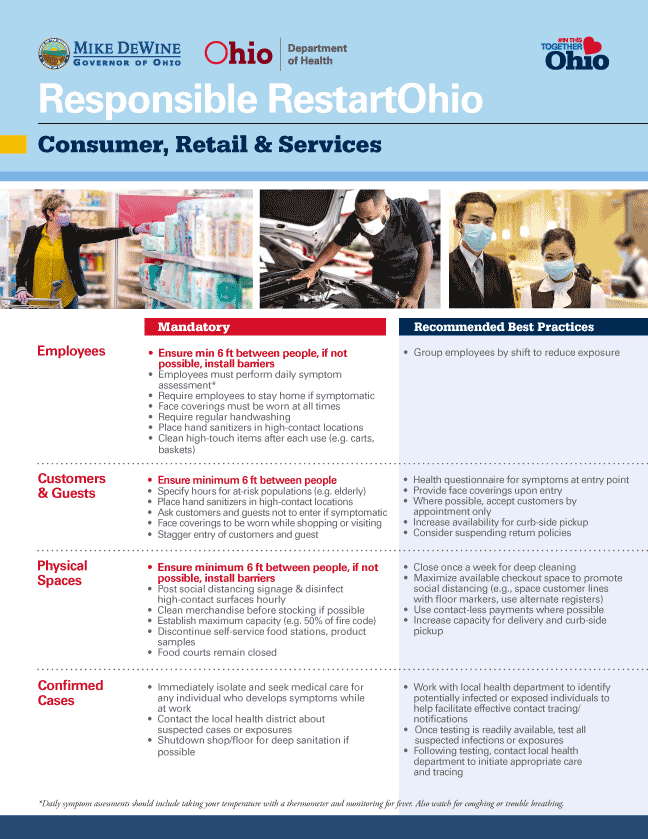
“RESPONSIBLE RESTART OHIO”
The “guiding principles” of the Responsible RestartOhio plan are protecting the health of employees, customers, and their families, supporting community efforts to control the spread of COVID-19, and responsibly getting Ohio back to work.
“We put this plan together based on all the information we have about how dangerous COVID-19 still is right now, balanced with the fact that it’s also dangerous to have people not working,” said Governor DeWine. “COVID-19 is still out there. It’s still killing people. We’re asking Ohioans to be reasonable and rational. Please don’t take huge chances, and please use common sense when you go out and where you go out.”
Manufacturing, Distribution, and Construction Businesses
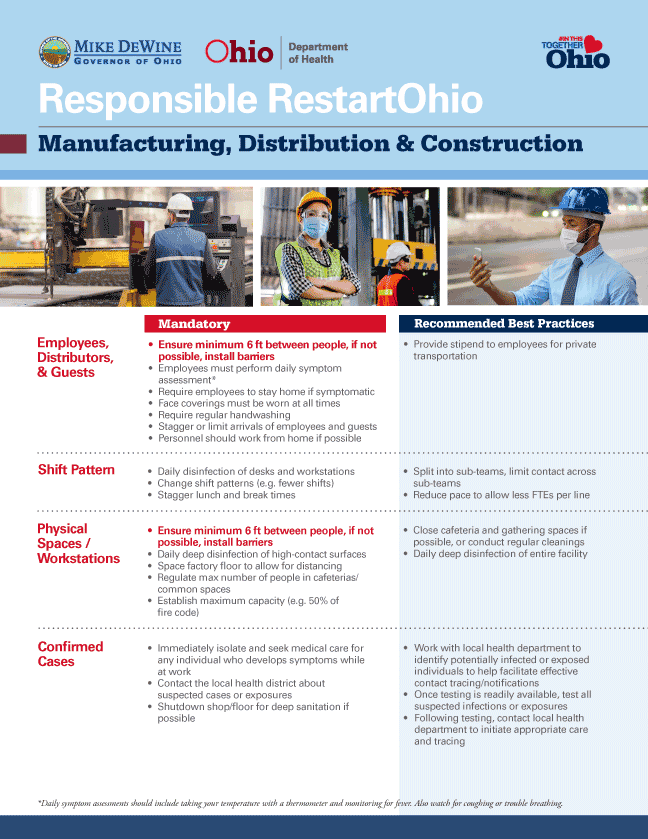
Beginning on May 4, 2020, manufacturing, distribution, and construction businesses may reopen if these businesses can meet mandatory safety requirements (see graphic below) for customers and employees. The full Responsible RestartOhio plan for manufacturing, distribution, and construction can be found at coronavirus.ohio.gov/ResponsibleRestartOhio.
General Office Environments
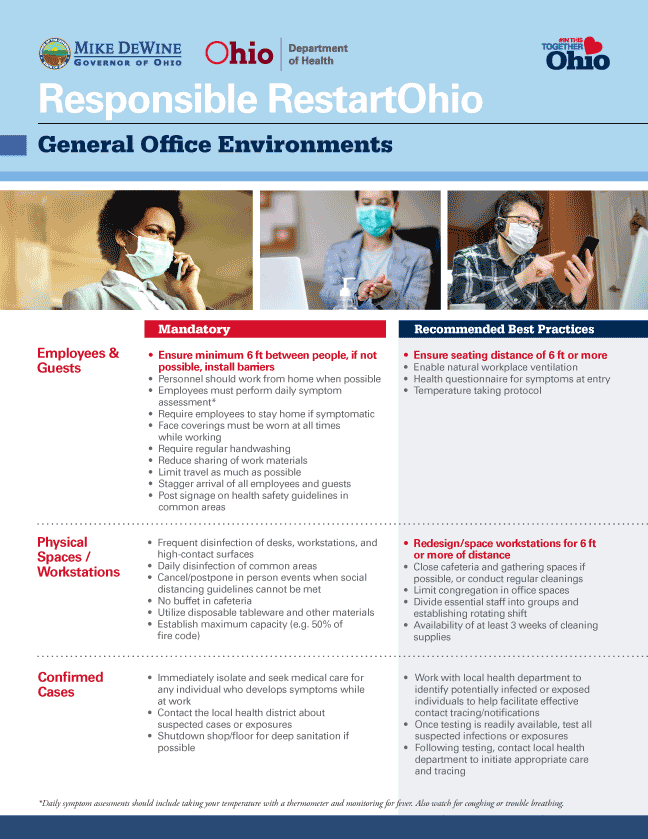
Beginning on May 4, 2020, general office environments may reopen if these businesses can meet mandatory safety requirements (see graphic below) for customers and employees. The full Responsible RestartOhio plan for general office environments can be found at coronavirus.ohio.gov/ResponsibleRestartOhio.
CONSUMER, RETAIL, and SERVICES
Beginning on May 12, 2020, consumer, retail and services, may reopen if these businesses can meet mandatory safety requirements for customers and employees. (see graphic below) The full Responsible RestartOhio plan for consumer, retail, and services can be found at coronavirus.ohio.gov/ResponsibleRestartOhio.
ALL BUSINESSES
The general safe business practices that all businesses must follow as they reopen are:
Requiring face coverings for all employees, and recommending them for clients and customers at all times
Conducting daily health assessments or self-evaluations of employees to determine if they should work
Maintaining good hygiene at all times such as hand washing and social distancing
Cleaning and sanitizing workplaces throughout the day and at the close of business or between shifts
Limiting capacity to meet social distancing guidelines
“I have an obligation as the Governor of Ohio to get people back to work and keep them safe. Opening everything up at once would not be consistent with the obligation to keep people safe,” said Governor DeWine. “Our Responsible RestartOhio plan is the best guarantee that Ohioans will feel safe going to stores and employees will feel safe going to work. I’m optimistic about our future, but we can’t be reckless.”
CONTINUED CLOSURES
The following types of establishments are ordered to remain closed due to their increased risk of potential COVID-19 exposure:
Schools and daycares
Dine-in restaurants and bars (carry-out is still permitted)
Personal appearance and beauty businesses
Older adult daycare serveries and senior centers
Adult day support or vocational rehabilitation services in group settings
Because the danger of COVID-19 still exists, Ohio’s Stay at Home order will remain in effect to encourage Ohioans to continue making reasonable, rational decisions about leaving home.
Although anyone is susceptible to getting sick with COVID-19, those who are 65 or older are encouraged to be especially careful, as are those with high-risk conditions such as chronic lung disease, moderate to severe asthma, heart conditions, diabetes, chronic kidney disease, or liver disease, as well as those who are immunocompromised or obese.
Large gatherings of more than 10 people are still prohibited.
There are 16,325 confirmed and probable cases of COVID-19 in Ohio and 753 confirmed and probable COVID-19 deaths. A total of 3,232 people have been hospitalized, including 978 admissions to intensive care units. In-depth data can be accessed by visiting coronavirus.ohio.gov.
Video of yesterday’s full update of the Statehouse briefing, including versions with foreign language closed captioning, can be viewed on the Ohio Channel’s YouTube page.
Ohio’s new stay at home order goes into effect at midnight tonight.
Columbus, Ohio –Ohio Governor Mike DeWine, Lt. Governor Jon Husted, and Dr. Amy Acton, MD, MPH, provided the following updates on Ohio’s response to the COVID-19 pandemic this afternoon.
HOSPITAL CAPACITY
The announcement said that Ohio must double its hospital capacity due to the oncoming COVID-19 surge, Ohio has developed a plan to expand healthcare services at alternative sites in addition to the traditional medical care facilities. Representatives from health care systems, local governments, county emergency management agencies, state agencies, the Ohio National Guard, among others, examined buildings across the state that could support large numbers of patients.
The following sites have been selected based on considerations such as distance to an existing hospital, conditions safe for patients and health care professionals, and space to meet the region’s expected needs, including the Duke Energy Convention Center in downtown Cincinnati.
Seagate Convention Center, Lucas County
Case Western University’s Health Education Campus, Cuyahoga County
Dayton Convention Center, Montgomery County
Covelli Convention Center, Mahoning County
Duke Energy Convention Center, Hamilton County
Greater Columbus Convention Center, Franklin County
These facilities would be used for the mildly ill, while the sickest patients will be housed in traditional hospitals.
Assessments of other sites will continue if needed.
The press release from the Governor’s office said that health care regions in southern and southeastern Ohio have determined the existing hospital facilities in their areas will, with additional equipment, be capable to handle a surge in patients without going to an off-site location.
OHIO NATIONAL GUARD TO ASSIST FEDERAL PRISON
Governor DeWine announced that he has authorized the Ohio National Guard to assist federal authorities in the Elkton Federal Correctional Institution in Columbiana County where seven inmates have tested positive for COVID-19, and three inmates have died from the disease.
“To be clear, this is not a state facility, it is a federal prison – but, this prison is in Ohio. Ohio citizens work there, and their families live here,” said Governor DeWine. “As we’ve said for weeks, we’re all in this together, and providing state help for this federal prison is the right thing to do.”
The Ohio National Guard’s mission will be focused on providing medical assistance. They will not be armed, nor will they be providing security.
The guardsmen and women will assist in the prison’s infirmary with non-COVID-19 cases and with patients who are showing symptoms of the disease. These soldiers, who all work in the medical field, will have N-95 respirators for protection while they work to augment the current prison medical staff. They will treat those they can and triage others with serious symptoms for hospital care.
The guard also stands ready to help with transporting the seriously ill patients to the hospital in the event of a surge of sick inmates. In addition to staff, the guard will bring equipment and ambulances with them as well.
Governor DeWine also requested that the Federal Bureau of Prisons and U.S. Department of Justice cease accepting new inmates at the facility.
DISPUTE RESOLUTION
Lt. Governor Husted announced that the administration’s Dispute Resolution Commission, which was initially announced last week, is now prepared to receive submissions from essential businesses as well as county health departments.
The panel, which includes Ohio Department of Commerce Director Sheryl Maxfield, Development Services Agency Director Lydia Mihalik, and Public Utilities Commission of Ohio Chairman Sam Randazzo, will specifically seek to resolve disputes when two county health departments disagree on whether a type of business should or should not be deemed essential during the state of emergency. The purpose of the commission is to provide clarity and ensure that similarly-situated businesses are treated fairly, regardless of which side of a county line they operate.
Ohio’s new stay at home order goes into effect at midnight tonight. You can find the full order at coronavirus.ohio.gov.
Retailers will be required to determine a maximum number of customers allowed in the store to account for proper physical distancing. That number must also be displayed at the businesses’ entrances.
REMINDER – SNOWBIRDS MUST SELF-QUARANTINE
Governor DeWine today reminded “snowbirds” that they must quarantine for 14 days once they arrive in Ohio.
“I know that many of our Ohio snowbirds will soon be returning from places like Florida, and we want to make sure that you remain healthy and that those around you remain healthy,” said Governor DeWine.
In addition to those returning after spending winter elsewhere, anyone who has traveled outside of Ohio for any other reason must also self-quarantine for 14 days upon their return. This order excludes truckers, healthcare workers, other workers providing essential services, and those who live on the state border.
CURRENT OHIO DATA
There are 4,450 confirmed cases of COVID-19 in Ohio and 142 deaths. A total of 1,214 people have been hospitalized, including 371 admissions to intensive care units. In-depth data can be accessed by visiting coronavirus.ohio.gov.
4,450 – Confirmed Cases in Ohio
371 – Number of ICU admissions
1,214 – Number of Hospitalizations in Ohio
142 – Number of Deaths
<1–101 – Age Range
54 – Median Age
48%* – Sex – Males
52%* – Sex – Females
LAST UPDATED: 04/06/20 (UPDATED DAILY AT 2 P.M.) *<1% SEX NOT REPORTED
In Clermont County there are 27 cases, 4 hospitalizations, and 1 death.
In Hamilton County there are 394 cases, 66 hospitalizations, and 9 deaths.
In Warren County there are 37 cases, 5 hospitalizations, and 0 deaths.
In Butler County there are 75 cases, 29 hospitalizations, and 2 deaths.
Video of today’s full update, including versions with foreign language closed captioning, can be viewed on the Ohio Channel’s YouTube page.
For more information on Ohio’s response to COVID-19, visit coronavirus.ohio.gov or call 1-833-4-ASK-ODH.






 Those assessments were used to determine whether a person could safely remain at home with community support or whether they needed facility-level care and what resources, whether subsidized or private, existed to pay for the services.