Ohio health officials are urging caution again this winter. But entering our third holiday season with COVID-19, the nature of those warnings is a bit different.
Three at once
As Ohio Department of Health Director Dr. Bruce Vanderhoff explained, this year the threat is multiple respiratory viruses at once.
“Unlike the last two winters, it’s not just about COVID,” he said. “But the combination of COVID, influenza, and RSV, especially for those whose health is more vulnerable or who have not been adequately vaccinated against flu and COVID-19.”
RSV, or respiratory syncytial virus, often feels like a common cold for adults and otherwise healthy children. But for infants, the elderly or immunocompromised people it can be dangerous. According to the CDC, RSV is the most common cause of bronchitis and pneumonia among kids 12 months old and younger.
Unlike COVID-19 and flu, RSV has no vaccine.
Precautions and metrics
As ever, Vanderhoff’s chief precautionary recommendations are for people feeling ill to stay home and for everyone to wash their hands regularly. In situations where people must leave the house, officials recommend wearing an N95 mask.
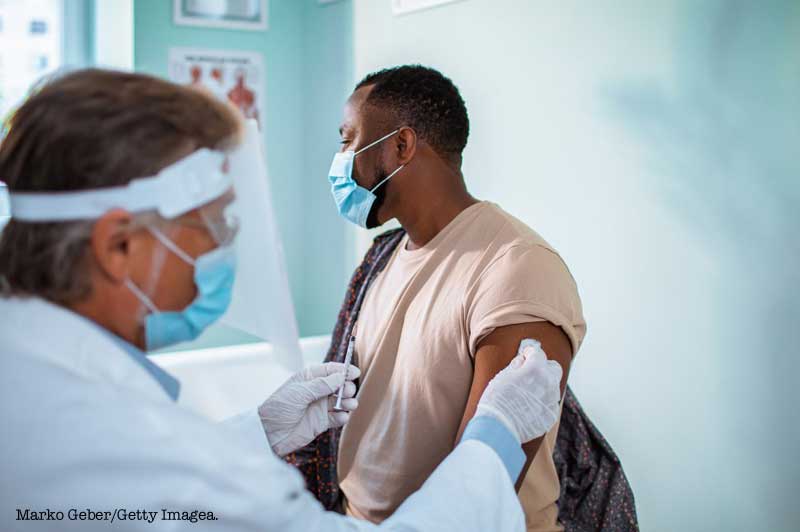
He also urged those who haven’t gotten vaccinated for the flu or COVID-19 to do so.
“Vaccination is the safest and most dependable way to assure that you’re maximizing that cellular immunity I talked about,” Vanderhoff explained. “It gives your immune system its best opportunity to confront and beat the virus.”
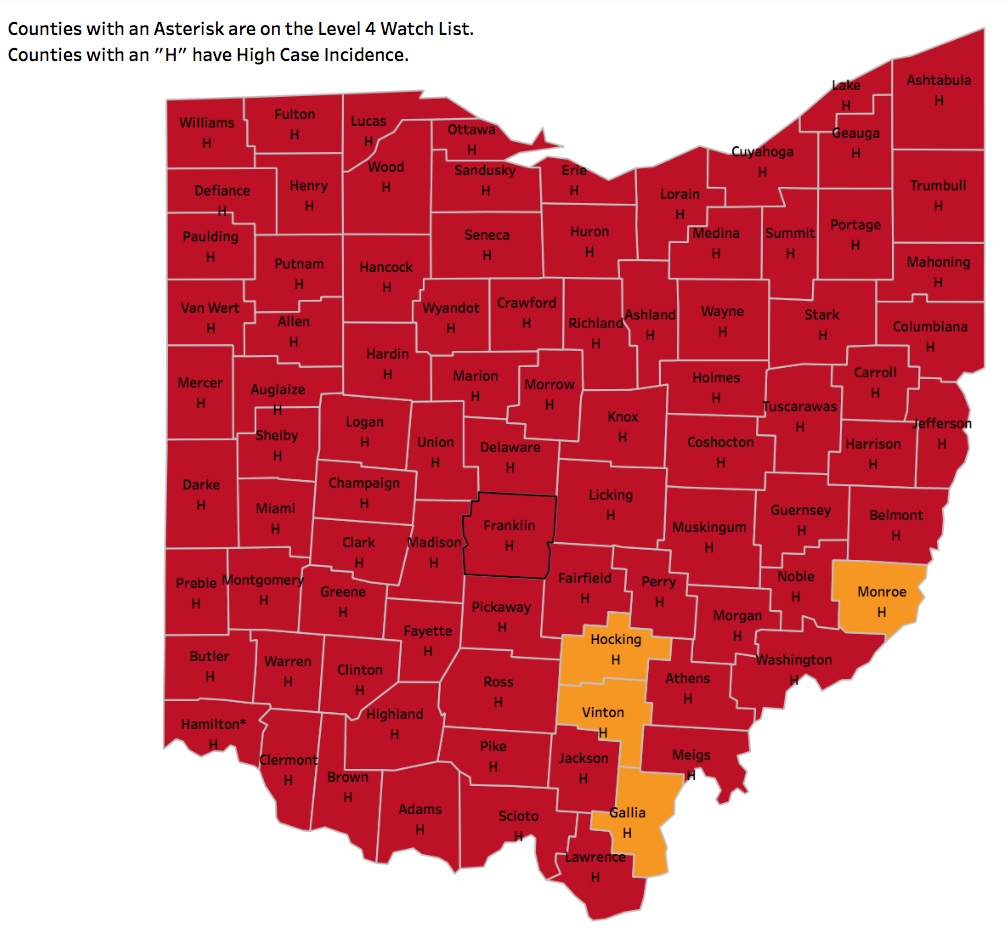
According to the CDC, the COVID-19 community level — a statistic based on number of hospital admissions and number of cases per 100k population — is low in many Ohio counties. Twelve rank as ‘high’ based on those metrics.
Dr. Joe Gastaldo, OhioHealth medical director for infectious diseases, said people should be especially cautious in those counties.
“In those scenarios, regardless of vaccination status, the recommendation is to wear a mask,” he said. “If you’re not feeling well wear a mask. I think specifically if you have an at-risk condition, or are immunocompromised, I would advise you as an infectious disease doctor to wear a mask indoors in public.”
The CDC’s more familiar community transmission metric, based on cases per 100k population and percentage of positive tests, remains high throughout the state. All but nine of the Ohio’s 88 counties rank high for community transmission and none are low.
As for RSV and the flu, Vanderhoff noted this year both started earlier and rose more rapidly than in past years. Both viruses have receded from their peak, he explained, but remain dangerous for some populations.
On Tuesday, the state reported 744 new positive cases within the previous 24 hours, a daily total that hadn’t been seen since May.
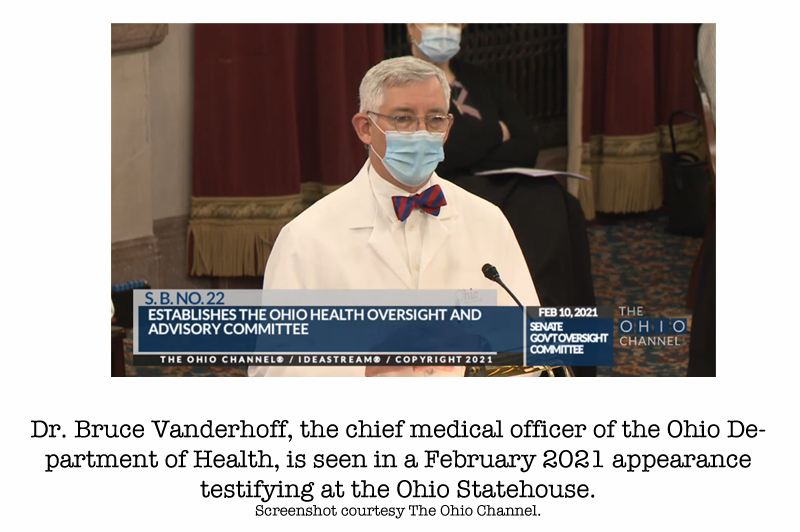
Dr. Bruce Vanderhoff acknowledges that as the public face of the Ohio Department of Health he is repeating himself a lot these days.
Dr. Bruce Vanderhoff
But the message is important enough to continue repeating in simple terms, ODH’s chief medical officer said Wednesday.
“It really comes down to, are you vaccinated and safe or are you unvaccinated and vulnerable?”
Ohio once again finds itself at a crossroads. After months of declining rates of new cases, hospitalizations and deaths, Ohio is now seeing increases thanks mostly to a new “Delta variant” that officials say is even more contagious.
I think it is absolutely the case that we are now looking at a pandemic of the unvaccinated.
– Dr. Bruce Vanderhoff, Ohio Department of Health
Vaccination rates here have all but stalled, concerning those like Vanderhoff who fear the state will slip back into a public health crisis as schools look to return to class next month.
“I think it is absolutely the case that we are now looking at a pandemic of the unvaccinated,” he told reporters .
Vanderhoff was joined by two pediatricians, including Dr. Patty Manning-Courtney, the chief of staff at Cincinnati Children’s Hospital. The recent rise in cases has them worried not just of the Delta variant, but what else could be on the horizon.
Patricia Manning-Courtney, MD
Manning-Courtney said her hope is Ohioans will get vaccinated before the state experiences an even worse variant that could significantly impact the youth population. She fears a scenario of Ohio learning “the hard way” that vaccines are necessary for public health.
The latest surge
The state’s COVID-19 numbers declined throughout the spring, leading Gov. Mike DeWine and ODH to rescind the swath of public health mandates.
There was reason for optimism: The two-week average was down to just 17.6 cases per 100,000 residents as of July 7.
But since then, that average has more than doubled to 37.8.
On Tuesday, the state reported 744 new positive cases within the previous 24 hours, a daily total that hadn’t been seen since May. The state is recording a greater proportion of cases and hospitalizations among younger people, according to ODH data.
“It appears that this surge is being driven by yet another variant, the Delta variant,” Vanderhoff said, “which is, as I’ve shared before, even more contagious than the (alpha) variant that preceded it.”
The Delta variant is now present in more than one-third of all new cases in Ohio and is on its way to being the dominant variant of COVID-19, Vanderhoff said.
‘Captains of the ship of their own health’
President Biden recently said COVID-19 vaccine misinformation is costing Americans lives. (Photo by Alex Wong/Getty Images)
Unlike a year ago, when mitigation tactics like distancing and face masks were seen as the most effective ways to protect oneself from the virus, a proven vaccine is now available for Ohioans.
But it remains difficult to convince a majority of residents here to get vaccinated.
A vast number of Ohioans received shots when they were first made available, with a boost in vaccinations this spring with the widening of eligibility and the announcement of a Vax-A-Million sweepstakes. (Franklin County is among the places still experimenting with vaccine incentives; those who get their first dose at Columbus-area clinics receive a $100 Visa gift card.)
On the whole, the statewide vaccination rate has stagnated. More than 5.3 million Ohioans have completed their vaccination doses, but that still reflects just 45.5% of the total population.
DeWine had said his lottery idea was meant to target those who were not anti-vaccine, but needed some kind of boost to schedule their appointment.
Now, after months of availability, Vanderhoff and others believe there is still a large segment of the population who can be convinced. These are well-intentioned people with understandable concerns that can eventually be swayed to change their minds, the officials hope.
Misinformation spread online and in public spaces isn’t helping matters. Vanderhoff agreed with a recent statement by President Joe Biden that vaccine misinformation shared around on social media platforms is contributing to ongoing hesitancy and COVID-19 deaths.
“I think there have been people who are sharing information in a very authoritative way that is not scientifically accurate,” Vanderhoff said. “As a physician, that’s very distressing, because we want people to make their own decisions of course. We want people to be the captains of the ship of their own health, but we want them to make their decisions on the basis of good, well-founded, scientific information.
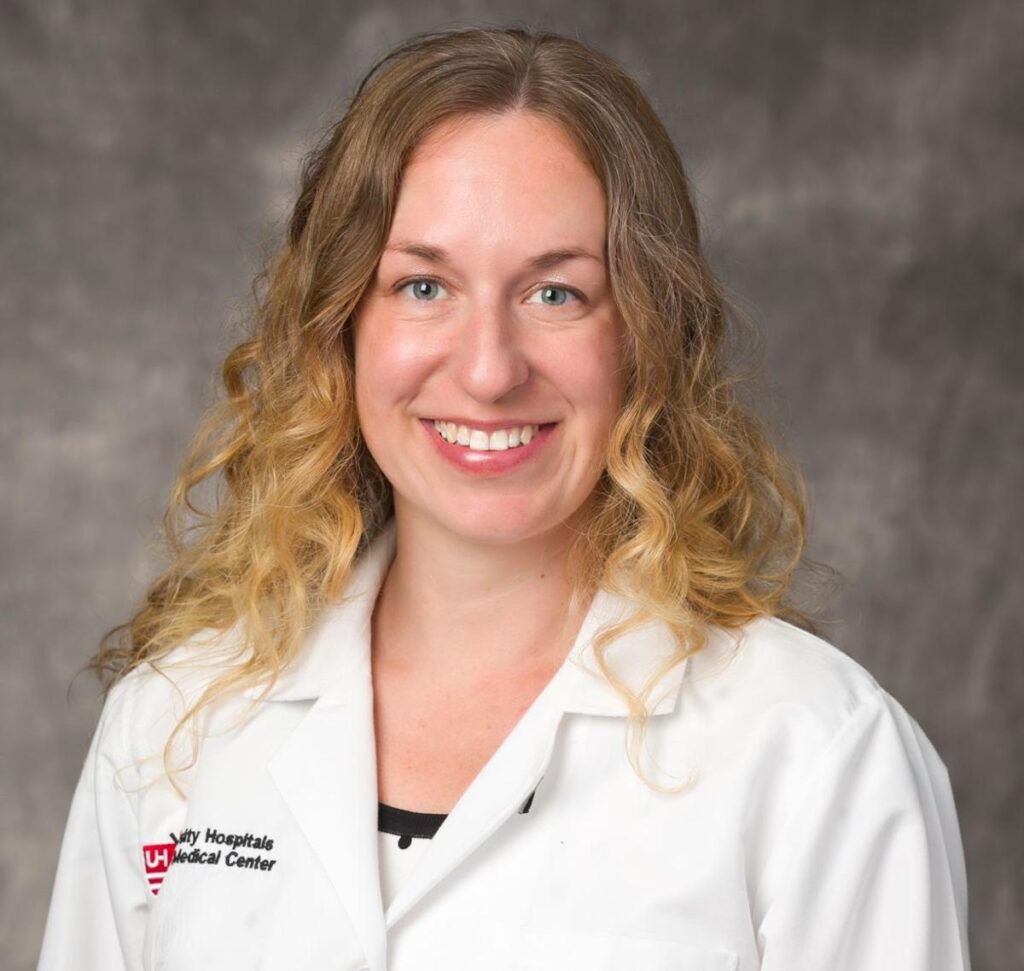
Dr. Amy Edwards
“Frankly, it’s heartbreaking when we see people who are cascading information that is not scientifically based,” he added.
Dr. Amy Edwards, the associate medical director of pediatric infection control at UH Rainbow Babies & Children’s Hospital, said vaccine misinformation has been around long before the coronavirus. She noted an example of seeing a child die of the whooping cough.
“That’s unacceptable to me,” she said. “It should just never happen.”
Vanderhoff and the pediatricians tried to dispel fears about the vaccine harming children. They noted rare cases of myocarditis, an inflammation of the heart muscle that has been reported in a small number of children this year.
But Edwards called this a “rare side effect” that impacts as few as one in every 100,000 or more that receive the vaccine.
“The risk is much higher from the virus itself,” she said.
While there continue to be some examples of vaccinated people getting COVID-19, most are protected against serious outcomes like hospitalizations and deaths.
All of the 130 people in Maryland who died of the virus in June were unvaccinated. Other states have reported similar statistics, including Alabama, where 96% of the COVID-19 deaths between April and mid-July were unvaccinated.
“The issue of breakthrough with this kind of a vaccine against this kind of virus,” Vanderhoff said, “is really the issue of: Are you seeing people get severely ill? Are they ending up in the hospital? Are they dying? We’re just not seeing that in appreciable numbers with this vaccine.”
Asked about future health orders with school returning in the fall, Vanderhoff said he could not disclose ongoing policy discussions within the state health department. He said ODH will be providing guidance and recommendations “in the near future.”
Ohio Governor Mike DeWine and Lt. Governor Jon Husted yesterday provided the following updates on Ohio’s response to the COVID-19 pandemic.
VACCINE DISTRIBUTION UPDATE
Governor DeWine announced today that Ohio received a total of 214,525 first doses of vaccine this week. A total of 223,025 first doses are scheduled to arrive in Ohio during the week of February 15.
The federal retail pharmacy program will soon begin allotting doses to Ohio’s more than 160 Rite Aid pharmacies. Vaccine distribution will also expand into all 194 Kroger pharmacies.
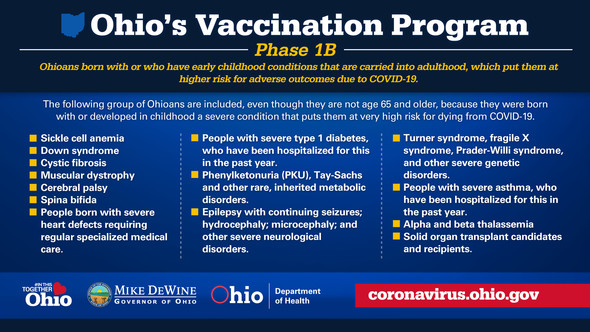
Those with specific medical conditions that put them at a very high risk of dying from COVID-19 will be eligible for vaccinations next week.
Ohioans born with the medical conditions outlined below, or those who were diagnosed in early childhood whose conditions continued into adulthood, will qualify to be vaccinated beginning on February 15.
Dr. Bruce Vanderhoff, chief medical officer at Ohio Department of Health, explained these conditions in more detail. His remarks are available on the Ohio Channel’s YouTube page.
Approximately 12,000 individuals with these severe medical conditions and developmental disabilities have already been vaccinated, and vaccinations of those in this group will continue.
NURSING HOME CASES
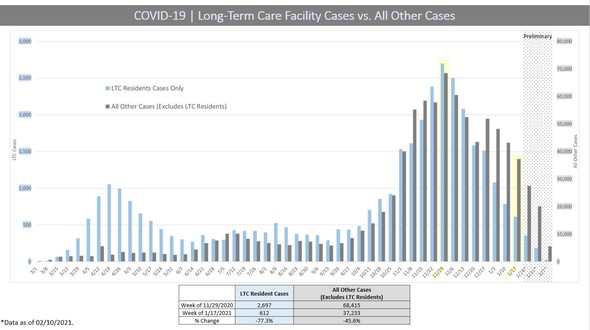
Governor DeWine announced today that the number of COVID-19 cases in Ohio’s nursing homes has dropped more than 77 percent since late November. This dramatic drop in cases follows Ohio’s aggressive efforts to vaccinate residents and staff in Ohio’s long-term care facilities.
As outlined in the chart below, there were 2,697 COVID-19 cases in long-term care facilities in Ohio during the week of November 29, 2021. During the week of January 17, there were 612 positive cases.
SCHOOL MODEL UPDATE
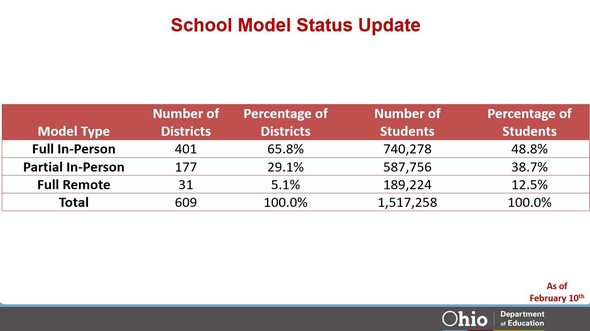
Governor DeWine shared the latest information on the number of school districts that are physically in school versus those that are fully or partially remote. As a condition to receive priority access to the vaccine, schools were required to commit to full or partial in-person learning by March 1. All but one school district in Ohio have committed to this plan.
OHIO PUBLIC HEALTH ADVISORY SYSTEM
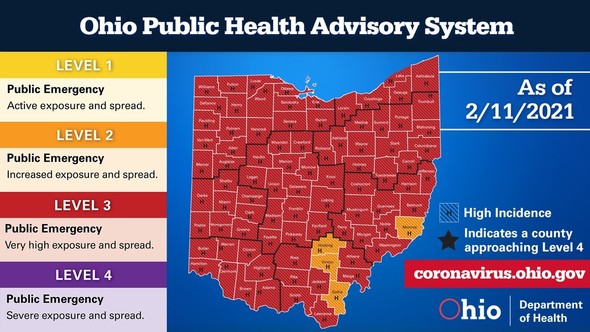
There was no change in this week’s Ohio Public Health Advisory System map. A county-by-county breakdown outlining the presence of COVID-19 in all of Ohio’s 88 counties can be found on the Ohio Public Health Advisory System’s website.
CURRENT CASE DATA (2-12-21)
In total, there are 931,437 confirmed and probable cases of COVID-19 reported in Ohio and 12,577 confirmed and probable COVID-19 deaths. A total of 48,269 people have been hospitalized throughout the pandemic, including 6,908 admissions to intensive care units. In-depth data can be accessed by visiting coronavirus.ohio.gov.
Video of today’s full update, including versions with foreign language translation, can be viewed on the Ohio Channel’s YouTube page.
For more information on Ohio’s response to COVID-19, visit coronavirus.ohio.gov or call 1-833-4-ASK-ODH.
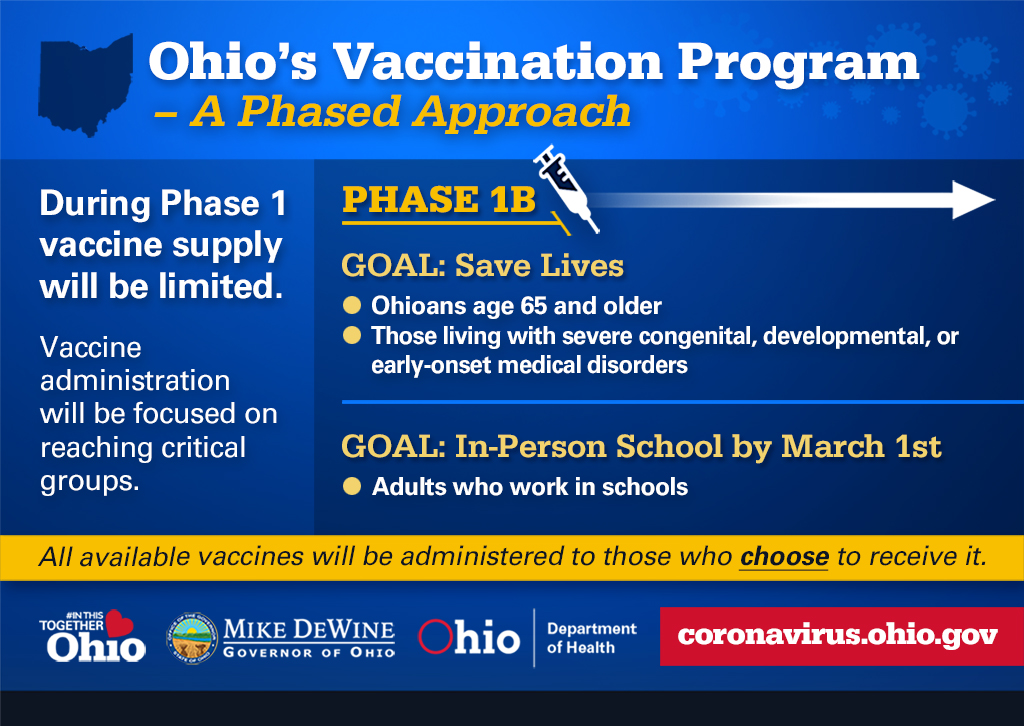
Today, Governor DeWine announced that people in phase 1B of Ohio’s vaccination distribution plan will be able to receive vaccinations beginning on Tuesday, January 19.
Those 80 years of age and older will be prioritized first in this next phase, roughly totaling 420,000 Ohioans. Ohio is expected to receive 100,000 doses during the first week of distribution to Phase 1B.
“With up to 420,000 people 80 years and above, and only 100,000 doses available the first week, it will take several weeks to vaccinate those 80 years of age and older,” said DeWine. “Phase 1B will take a few weeks, and a lot of coordination in distribution.”
DeWine says that vaccines for Ohioans 80 years of age and older will be administered by physicians, local health departments, hospitals, federally qualified health centers, in-home health service providers, and some retail pharmacies. As of today, the Ohio Department of Health said that approximately 1,700 providers have registered to distribute vaccines.
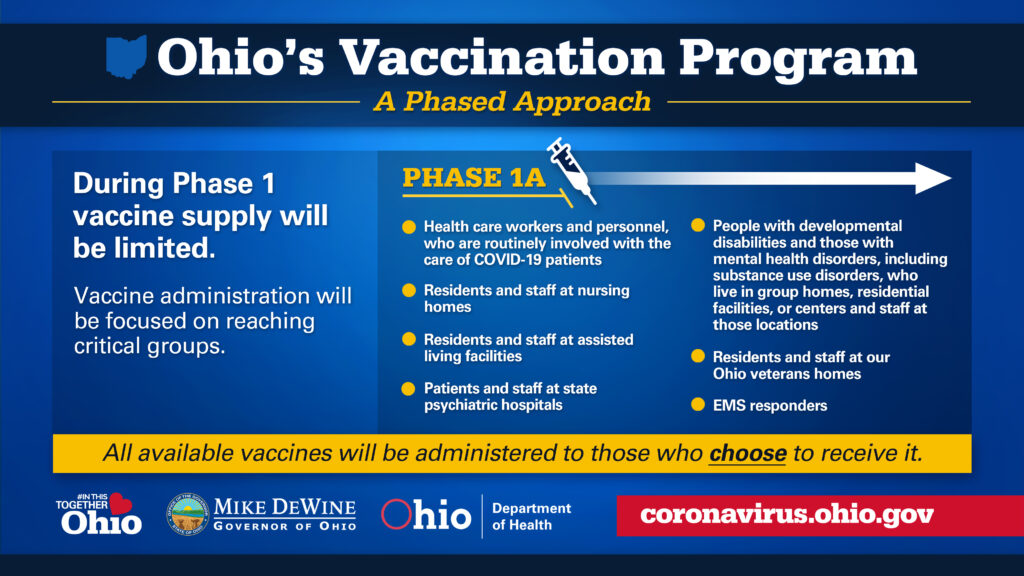
Phase 1A
Additionally, the Ohio Department of Health will be hosting a webinar for registered providers to discuss expectations, and instructions for distribution. Additional details will be shared with registered providers in the coming days.
Governor DeWine anticipates vaccinations will be available to Ohioans 75 years of age and older beginning Monday, January 25. The following week, vaccinations will be available to those 65 years of age and older.
“As we include other age ranges, please know that does not mean vaccinations will be complete for the previous age range,” said Governor DeWine.
The week of January 25 will also include vaccinations for Ohioans with severe congenital, developmental, or early onset medical disorders. Additional details about distribution for this group is not yet available.
CURRENT CASE DATA
In total, there are 753,068 confirmed and probable cases of COVID-19 reported in Ohio and 9,462 confirmed and probable COVID-19 deaths. A total of 40,469 people have been hospitalized throughout the pandemic, including 6,092 admissions to intensive care units. In-depth data can be accessed by visiting coronavirus.ohio.gov.
Schools
DeWine also announced that during the week of February 1 that vaccinations will be available for personnel in Ohio schools. The Ohio Department of Heath will send forms to Ohio superintendents to indicate their school plans to go back to in full in-person and hybrid learning by March 1, as well as indicate the number of staff they believe will choose to take the vaccination. Superintendents will also be asked if a community partner has been identified to help with the administering of the COVID-19 vaccines to school personnel.
Dr. Bruce Vanderhoff, Chief Medical Officer for the Ohio Department of Health, provides this statement related to the coronavirus variation that was first seen in the United Kingdom.
“Although virus variations are normal, and most do not impact the behavior of a virus, this variation is notable because it appears to be more contagious than other variants of the coronavirus,” said Dr. Vanderhoff. “Fortunately, this variant doesn’t appear to be more severe or to impact those who are already immune, but it worries us because a more contagious variant could lead to more people getting sick, more people being hospitalized, and more people dying.”
Ohio currently has three times the number of COVID-19 hospitalizations that it had on November 1 and nearly seven times the number of COVID-19 hospitalizations that it had on October 1.
Dr. Vanderhoff stressed the importance of continuing Ohio’s coronavirus protocols of social distancing, avoiding crowds, washing hands, wearing masks, and accepting the vaccine when available to prevent the spread of all variants of the coronavirus and to prevent further increases in hospitalizations.
Loveland District says staff absences may cause last-minute notice of school closing
Loveland, Ohio – In a news release issued this afternoon, the Loveland School District said that during the next few weeks, some school buildings may have to temporarily switch to remote learning because of staff absences.
The District said in the release, “This year it has become challenging to find substitute teachers, and we may run short on staffing due to COVID-19 cases or quarantines.” If this happens, a switch to remote learning will happen on a school-by-school basis. The District said they are trying to plan ahead so that families can plan ahead, however, these changes may happen as late as the morning of scheduled attendance.
They suggest that parents and caregivers should begin considering how they might handle a possible late-notice class cancelation.
The District said they will notify families as “quickly as possible” about closings through their alert notification system, the website, Facebook (Loveland City Schools), and Twitter (@lovelandtigers) pages.
CDC still recommends 14 days however District adopts a less restrictive “acceptable alternative” quarantine period
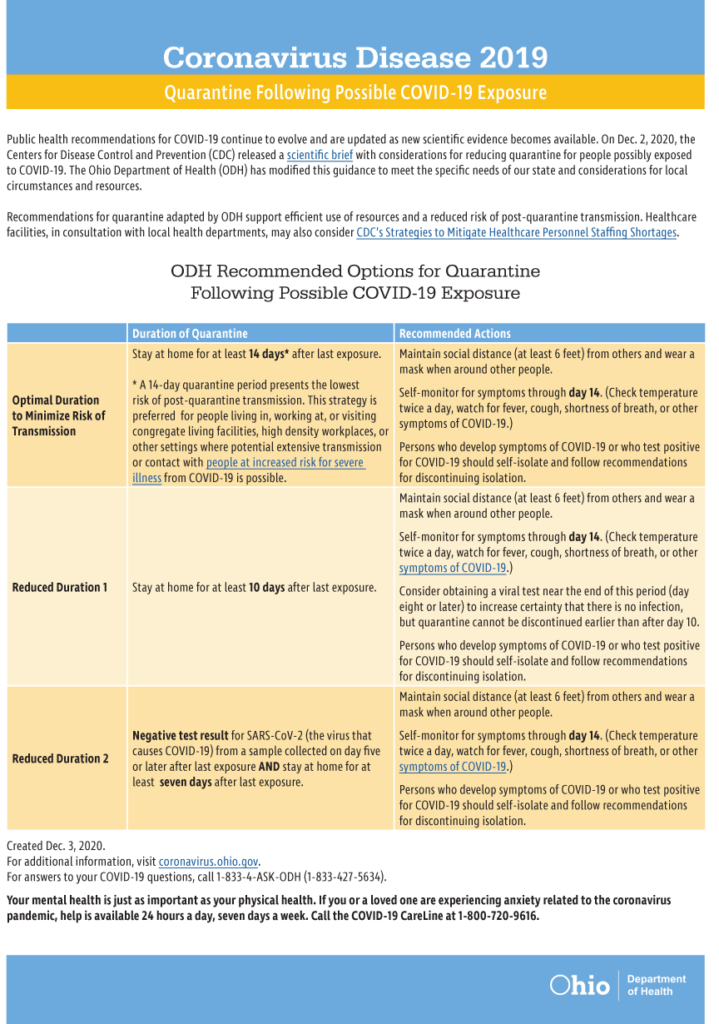
The Centers for Disease Control and Prevention (CDC) announced a change in guidance for quarantines. The new guidance shortens the quarantine period for someone who has been exposed to a positive COVID-19 case. The Ohio Department of Health has also adopted the new CDC guidelines, as has Hamilton County Public Health.
The District said in the release that the new less restrictive guideline notification came to them late today. They will begin implementing those directives and will personally notify families affected.
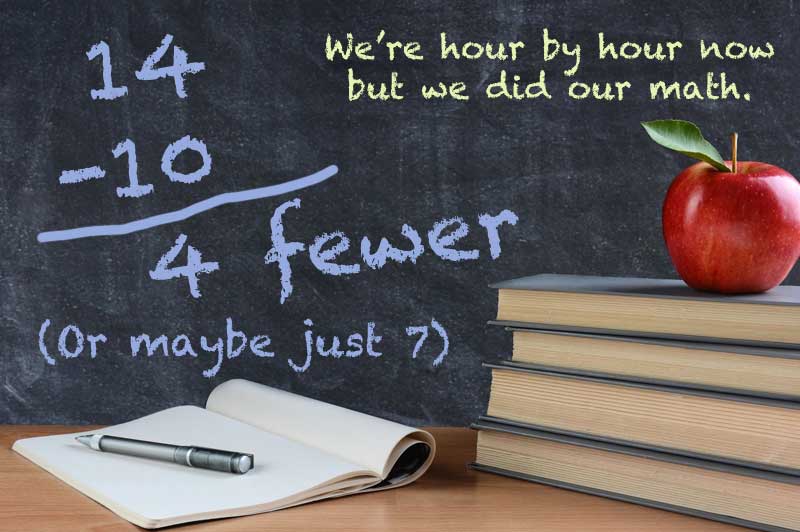
The Centers for Disease Control and Prevention announced new quarantine guidelines for people who were exposed to coronavirus, reducing the length of time from 14 days to 10 days without symptoms or seven days with no symptoms and a negative test. Officials said the shorter time period is intended to encourage more people to quarantine.
Ohio Department of Health Chief Medical Officer Dr. Bruce Vanderhoff said today, “Staying home for 14 days after contact is still the safest way to limit possible spread of COVID-19. We continue to recommend this time period for people in congregate living facilities, such as nursing homes; in workplaces with a large number of employees; and in other settings in which COVID-19 could spread extensively.”
Dr. Andy Thomas, chief clinical officer at The Ohio State University Wexner Medical Center, yesterday warned that “Ohio is not yet seeing the impact of gatherings that took place over Thanksgiving because hospitalizations are a lagging indicator. Symptoms generally develop within 10 days of transmission, and hospitalizations typically occur a week after diagnosis.”
According to CBS News the CDC rationale for the less restrictive guidelines is:
“Reducing the length of quarantine may encourage more people to do so, especially when they may not be able to work during quarantine time,” CDC’s COVID-19 Incident Manager, Dr. Henry Walke, told reporters on a call Wednesday. He said the agency still recommends 14 days, but is now offering two “acceptable alternative quarantine periods.”
According to the District, “We are pleased with these new recommendations from an educational perspective. Our goal is to keep students learning in our school buildings and shortening the required quarantine time is key.”
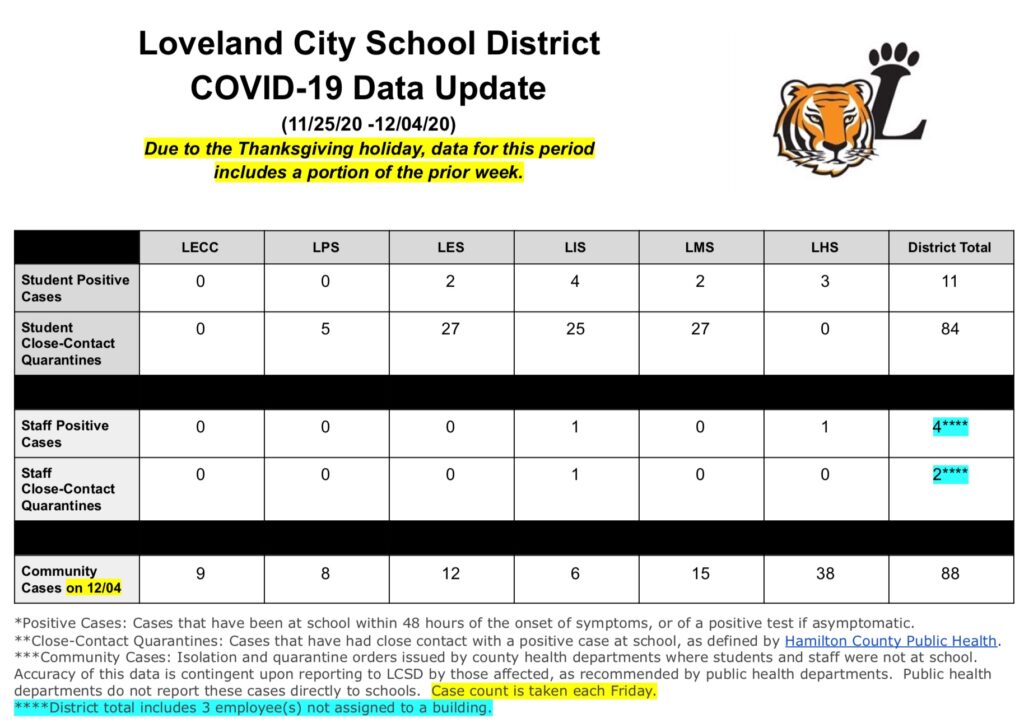
This is the District’s COVID 19 Dashboard published today:
On 12/03/20, the district was notified that a non-teaching, non-school-based staff member tested positive for COVID-19. This staff member was last at work on 11/30/20.
On 12/03/20, the district was notified that a student at Loveland Intermediate School tested positive for COVID-19. This student was last at school on 11/18/20.
On 12/03/20, the district was notified that a student at Loveland Middle School tested positive for COVID-19. This student was last at school on 11/18/20.
On 12/04/20, the district was notified that a student at Loveland Elementary School tested positive for COVID-19. This student was last at school on 11/30/20.
On 12/04/20, the district was notified that a student at Loveland Intermediate School tested positive for COVID-19. This student was last at school on 12/02/20.
On 12/03/20, the district was notified that a student at Loveland Intermediate School tested positive for COVID-19. This student was last at school on 12/01/20.
On 12/02/20, the district was notified that a teaching staff member at Loveland Intermediate School tested positive for COVID-19. This staff member was last at school on 11/24/20. No close contacts were identified for this confirmed case.
On 12/02/20, the district was notified that a student at Loveland Elementary School tested positive for COVID-19. This student was last at school on 11/30/20.
On 12/1/20, the district was notified that a non-teaching staff member at Loveland High School tested positive for COVID-19. This staff member was last at work on 11/18/20. No close contacts were identified for this confirmed case.
In an announcement today, Ohio Department of Health Chief Medical Officer Dr. Bruce Vanderhoff and Mike Abrams, president and CEO, Ohio Hospital Association said:
Ohio Department of Health Chief Medical Officer Dr. Bruce Vanderhoff
“In Ohio, we are seeing an unprecedented spike in hospital utilization and it is impacting all areas of the state. While we are better prepared with personal protective equipment and physical capacity, what we are seeing now is an increasing demand on our staffing,” said Dr. Vanderhoff. “If we don’t control the spread of this virus, we won’t be able to care for those who are acutely ill without postponing important, but less urgent, care. We anticipate that this kind of shift could happen in a matter of weeks if trends don’t change.”
“The COVID-19 pandemic is becoming more dire for Ohio as hospitalizations have escalated 350 percent in the past 50 days to 2,533 COVID patients in Ohio hospitals today,” said Mike Abrams, president and CEO, Ohio Hospital Association. “Our hospitals are capable of managing capacity needs, but we must stem the spread now. This steep climb creates a severe strain on our caregivers who are braving the frontline of this pandemic. We can stop this spread, and we call on Ohioans to join hospitals and caregivers to take action now and do the right thing to slow the spread.”