Tag: EdChoice

  • Trump order prioritizes school choice and vouchers, which Ohio has been expanding for decades

    Trump order prioritizes school choice and vouchers, which Ohio has been expanding for decades

    Getty Images

    By:  Ohio Capital Journal

    An executive order signed by President Donald Trump directs an emphasis on school choice and private school voucher programs when it comes to education funding, something that’s been happening in Ohio for several decades now.

    While it’s unclear how much power the executive order will have with spending decisions decided by Congress, the executive order directs to the U.S. Department of Education to prioritize “school choice” programs in grant funding, and requires the U.S. Department of Health and Human Services to guide states on block grants that can be used for private schools.

    The executive order also directs the U.S. Department of Education to release guidance on using federal funding formulas for private school scholarship programs, and for military families in particular to be given information on scholarships.

    It’s not yet clear how this will affect individual states, but Ohio has already vastly expanded its private school voucher programs over the last two decades, and recently passed near-universal levels eligibility.

    Ohio House Speaker Matt Huffman began 2025 by saying the six-year phase-in of the public school funding model in Ohio was “unsustainable,” which received massive pushback from public school supporters, especially after the lawmakers poured nearly $1 billion into private school scholarships last year.

    Huffman called the future of the current funding model – also called the Fair School Funding Plan or the Cupp-Patterson plan – a “fantasy,” but has seemingly softened his stance for now after hearing from members of his own party.

    A spokesperson for Huffman and the House Majority Caucus did not respond to a request for comment on the executive order.

    GET THE MORNING HEADLINES.


    The president and CEO of EdChoice, Ohio’s private voucher program, praised the order in a statement, saying prioritizing and expanding such programs “is a crucial step toward empowering families and giving them greater control over their children’s education.”

    “This initiative reflects a commitment to funding students not systems and to ensuring the proper role of the federal government in education,” EdChoice President and CEO Robert Enlow said in the Wednesday statement. “It recognizes both the appropriate role of the federal government on education and the fact that education is primarily a state function.”

    Public school advocates feel the same way about a federal push for private school funding expansion as they do about state-level funding increases, for which a lawsuit was filed in Franklin County Common Pleas Court to eliminate the private school voucher program.

    The lawsuit argues that funding for private schools is coming out of the coffers of the public school system, something the state is constitutionally obligated to fund properly.

    “Diverting public money to unaccountable and ineffective private schools is a failed strategy that runs counter to public opinion,” Ohio Federation of Teachers head Melissa Cropper told the Capital Journal.

    2024 survey done by All4Ed, Lake Research Partners and the Tarrance Group, found a majority of American voters support public education, and an increase in funding to improve public schools. This included 58% of Republicans surveyed. Only 34% of GOP voters polled said funding for voucher programs should be increased.

    “Voters view public schools, including their local public school, more favorably than charter, private or religious schools,” the study stated.

    Cropper called the move by the Trump administration “a strategy straight of Project 2025,” the playbook written and supported by right-wing Heritage Foundation members, some of whom have become players in the Trump administration, including the White House budget office.

    “Regardless of what politicians do, Ohio educators and school staff will continue fighting for the resources that our students deserve,” Cropper said.


    YOU MAKE OUR WORK POSSIBLE.

    _______________
    Susan Tebben
    Susan Tebben

    Susan Tebben is an award-winning journalist with a decade of experience covering Ohio news, including courts and crime, Appalachian social issues, government, education, diversity and culture. She has worked for The Newark Advocate, The Glasgow (KY) Daily Times, The Athens Messenger, and WOUB Public Media. She has also had work featured on National Public Radio.

    Ohio Capital Journal is part of States Newsroom, the nation’s largest state-focused nonprofit news organization.

    MORE FROM AUTHOR

  • Public school advocates take issue with new Ohio Speaker’s claim that funding model ‘unsustainable’

    Public school advocates take issue with new Ohio Speaker’s claim that funding model ‘unsustainable’

    (Stock photo from Getty Images)

    By:  Ohio Capital Journal

    As Ohio’s 136th General Assembly begins, the newly minted House Speaker has already taken a stand on education, saying spending for the state’s public school funding model is “unsustainable.”

    Priorities (and for that matter, legislative committees) have yet to be formally established, but comments by Speaker Matt Huffman, R-Lima, have already brought criticism from public school advocates across the state.

    Speaking to reporters after the first official meeting of the Ohio House under his leadership, Huffman was asked about the Cupp-Patterson public school funding plan, also called the Fair School Funding Plan by supporters.

    The funding model for state support of public schools has been through most of its six-year phase-in, seeing funding through the last two budget cycles. This year was set to be the last phase-in for the funding, but Huffman said there is no such thing as a “three-generation roll-out” and pointed to his comments when Cupp-Patterson was first considered by the legislature. Back then, he did not support funding the full measure all at once, because he said it would tie down future state legislatures with a funding method they may or may not be able to afford.

    “I don’t think there is a third phase to Cupp-Patterson,” Huffman said this week. “I guess the clearest statement I can say is that I think those increases in spending are unsustainable.”

    The new speaker went on to say the state needs to look at “whether these dollars are being spent wisely in some districts, we know they are in many.”

    Public school advocates have fought for the funding model, a model that focuses on real-time costs from district to district, rather than a blanket amount of state funding for all schools. While the comments from Huffman were criticized by advocates, they didn’t necessarily come as a surprise.

    “It’s certainly disappointing, but it doesn’t change anything for us,” said Scott DiMauro, president of the Ohio Education Association. “Implementing the Fair School Funding Plan is still our top priority.”

    YOU MAKE OUR WORK POSSIBLE.


    Without the funding, public schools will have to reach further into the pockets of taxpayers with levy-increase requests, something that shouldn’t have to happen under a system that constitutionally supports public schools.

    ” If the speaker thinks there isn’t enough education funding to go around, Ohio law is very clear,” Melissa Cropper, president of the Ohio Federation of Teachers, told the Capital Journal. “The legislature must fund public schools and make cuts to the costly and ineffective universal private school vouchers that were put in place by Speaker Huffman (as an Ohio senator) and other legislators,” said Melissa Cropper, president of the Ohio Federation of Teachers.

    Those who support the funding model pointed to the $1 billion that went to scholarship funds including the EdChoice private school voucher program in 2023, which the legislature approved to give Ohio students near-universal eligibility to move to private schools of their choosing if they live in public school districts considered under-performing.

    “If the speaker wants to talk about sustainability, you have to start with those numbers,” DiMauro said.

    Late last year, the legislature also removed provisions of a bill that would have added accountability measures to the private school voucher program, despite education advocates asking that accountability measures for private schools match those of public schools.

    That demand for accountability includes an ongoing lawsuit that seeks to eliminate EdChoice from the state’s educational portfolio. The group Vouchers Hurt Ohio is leading the effort in a court battle that has specifically targeted Huffman for answers on the process of passing legislative measures that support and fund EdChoice.

    Eric Brown, former Ohio Supreme Court chief justice and chair of the steering committee for Vouchers Hurt Ohio, said the group “never trusted that state lawmakers would fully fund public schools.”

    “Instead they are intent on giving refunds and rebates to wealthy families to pay for private schools and forcing homeowners and taxpayers to pay more for their local public schools,” Brown said in a statement. “We believe this system is unsustainable and unconstitutional.”

    DiMauro acknowledged that the Fair School Funding Plan will require inputting the real costs on an ongoing basis to account for inflation, and having the funding method keep up with those costs, but to do so would only be keeping up with what the constitution asks of state leaders, he said.

    “It means finally having a system that will meet the requirements of the constitution and serve the needs of the nearly 90% of students who are in our public schools,” DiMauro said.

    Aaron Churchill, Ohio research director for charter school advocates The Fordham Institute, said the cost of the Cupp-Patterson plan is “something that the legislature is just going to have to grapple with over the longterm.”

    Charter schools in Ohio have “long been underfunded,” Churchill said, and the fact that public school enrollment has seen a decline in recent years shows that public schools “should have less need for funding” but also more focus on putting the funding “where the needs are the greatest.”

    “Our school funding should be driven by enrollment and head counts,” Churchill said. “There’s a lot of money going to our public schools, so the dollars are going even further than they would if our state had a growing student population.”

    The enrollment in public schools has gone down slightly over the past few years, though some experts attribute that to a national decline in birth rates more than participation choices. The National Center for Education Statistics sets projections for enrollment, and estimates Ohio’s public school student enrollment will go down by 7.6% by 2031, a loss of more than 127,000 students.

    The most recent data from the Ohio Department of Education and Workforce showed more than 1.75 million students in public schools, versus 173,156 students in the state’s non-public schools.

    The public school numbers showed a loss of 5,400 students compared to numbers reported by the ODEW in fiscal year 2023. That’s down from 2022 as well, but public schools saw an increase of nearly 18,000 students between 2021 and 2022, according to state data.

    Non-public schools have seen gradual increases since fiscal year 2021, when enrollment was reported at 162,917.

    Still, in the 2022-2023 school year, the ODEW reported 88% of schools in Ohio were traditional public schools, followed by community schools at 9.4% and vocational schools at 2.1%.

    YOU MAKE OUR WORK POSSIBLE.

    _________________
    Susan Tebben
    Susan Tebben

    Susan Tebben is an award-winning journalist with a decade of experience covering Ohio news, including courts and crime, Appalachian social issues, government, education, diversity and culture. She has worked for The Newark Advocate, The Glasgow (KY) Daily Times, The Athens Messenger, and WOUB Public Media. She has also had work featured on National Public Radio.

    Ohio Capital Journal is part of States Newsroom, the nation’s largest state-focused nonprofit news organization.

    MORE FROM AUTHOR

  • More than 91,000 have applied for Ohio private school voucher expansion

    More than 91,000 have applied for Ohio private school voucher expansion

    Getty Images.

    87,312 scholarships have been awarded as of March 18 — amounting to $394 million in allocated funding, according to the Ohio Department of Education and Workforce.

    BY:  Ohio Capital Journal

    There have been more than 91,100 applications for Ohio’s private school voucher expansion program so far this school year — a dramatic increase compared to previous years.

    Out of 91,157 voucher expansion applications, 87,312 scholarships have been awarded as of March 18 — amounting to $394,015,641 in allocated funding, according to the Ohio Department of Education and Workforce. Applications are continuing to be accepted through the end of the fiscal year.

    There were 26,390 voucher expansion applications submitted in 2023 with 24,323 scholarships awarded, and 25,011 applications submitted and 21,873 scholarships awarded in 2022.

    Ohio lawmakers expanded private school voucher eligibility to 450% of the poverty line — or a household income of $135,000 or less for a family of four — in the state budget that was signed into law last summer. Families above the $135,000 threshold can still be eligible for at least 10% of the maximum scholarship.

    K-8 students can receive a $6,165 scholarship and high schoolers can receive a $8,407 scholarship in state funding under the expansion. 63,798 K-8 students were awarded a voucher scholarship and 20,495 high school students were awarded a scholarship, according to ODEW.

    When it comes to traditional EdChoice private school vouchers for this year, 43,330 families submitted applications and 42,477 were awarded scholarships — $270,987,877 in allocated funding, as of March 18, according to ODEW. 40,629 students were awarded traditional voucher scholarships in 2023 and 38,543 received traditional voucher scholarships in 2022.

    Ohioans are divided on this issue. Private school families who use the vouchers are obviously fans, but public school advocates oppose it.

    “Our number one concern about the expansion of school vouchers is that it means significant resources are going to private schools at the expense of the nearly 90% of Ohio kids who are attending our public schools,” said Ohio Education Association President Scott DiMauro.

    Ohio Lt. Gov. Jon Husted, who was the Ohio House speaker when the private school voucher program called EdChoice passed in 2005, recently visited St. Mary’s School in the Catholic Diocese of Columbus as part of a statewide tour of private schools.

    “It’s fantastic because more kids are getting the opportunity to get a great education and a school of their choice,” Husted said during his stop.

    St Mary’s School

    Eighth grader Sorcha Sweeney has attended St. Mary’s in Columbus’ German Village neighborhood since she was in preschool and is on an EdChoice scholarship.

    “I’ve never really been interested in going anywhere else,” she said during a recent roundtable discussion during Husted’s visit to the school.

    She will receive a full scholarship to attend Bishop Hartley High School next school year.

    “I wouldn’t have ever been able to afford (St. Mary’s),” Sorcha mom’s Megan Sweeney said. “Without a scholarship, it just wouldn’t be possible. … Without a private education, she wouldn’t be anywhere close to where she is.”

    St. Mary’s tuition for preschool through eighth grade costs $7,750 and 97% of St. Mary’s families use EdChoice Scholarships, said principal Gina Stull. Between 60-70% of students couldn’t afford the tuition without the scholarships, she said.

    The school currently enrolls about 400 students and expects to have 500 students next year and a waitlist, Stull said.

    “Through those initiatives, EdChoice has been a conduit for the big word of evangelization — trying to spread God’s love,” said St. Mary’s Pastor Vince Nguyen. “… With the EdChoice voucher program we have tried to love every single kid, catholic or not catholic, that comes through our doors here at St. Mary’s School.”

    Despite the explosion of private school vouchers in Ohio, DiMauro said there has been little impact on Ohio’s public school enrollment.

    “The evidence is very clear that the vast majority of those vouchers are going to students who are already attending private schools,” DiMauro said. “… It is about subsidizing private schools.”

    Husted said the vouchers have “accountability and oversight” safeguards in place so something like the Electronic Classroom of Tomorrow online charter school scandal from 2018 will never happen again.

    ECOT was forced to shut down after the Ohio Department of Education said Ohio’s first online charter school needed to repay much of its state aid for the 2015-16 and 2016-17 school years after the school inflated enrollment numbers. ECOT still owed the state $117 million in 2022.

    “I actually just spoke with (Ohio Department of Education and Workforce) Director (Steve) Dackin about this the other day, and I asked him whether he felt the safeguards are in place to make sure something like that didn’t happen again and he reassured me he thought there were,” Husted said.

    Follow OCJ Reporter Megan Henry on X.


    Megan Henry
    MEGAN HENRY

    Megan Henry is a reporter for the Ohio Capital Journal and has spent the past five years reporting in Ohio on various topics including education, healthcare, business and crime. She previously worked at The Columbus Dispatch, part of the USA Today Network.

    Ohio Capital Journal is part of States Newsroom, the nation’s largest state-focused nonprofit news organization.

    MORE FROM AUTHOR

  • Education sees some funding boosts, some missed opportunities in 2022

    Education sees some funding boosts, some missed opportunities in 2022

    BY: SUSAN TEBBEN – Ohio Capital Journal

    Next year is sure to be a busy one when it comes to education in Ohio, with potential state agency overhauls and funding changes still on the agenda for the state legislature.

    The end of 2022 was capped by an 11th-hour push and ultimately failure for an attempted overhaul of the Ohio Department of Education and the state Board of Education. Senate Bill 178 was never passed in an Ohio House committee, so it was folded into another bill with controversial provisions, House Bill 151.

    House Bill 151 included bans for trans youth in participating in sports based on their gender identity, and after SB 178 was included, the bill came in at more than 2,000 pages. But despite delaying the vote until after 2 a.m. on the last day of the legislative session, the bill and its many provisions failed to garner enough votes in the House.

    LGBTQ advocates hailed the failure of House Bill 151, which still would have required the use of birth certificates to prove a student’s gender, despite the elimination of a provision that would have required a genital exam.

    “I can not begin to express my gratitude to the hundreds of community members and advocates who stood up for the rights of all transgender youth to participate in all parts of life as whole people, including sports, just like everyone else,” said Alana Jochum, executive director of Equality Ohio, after the bill failed to pass.

    Dr. Rhea Debussy, director of external affairs for Equitas Health and former facilitator for the NCAA’s Division III LGBTQ OneTeam Program, said the thrill of seeing the legislation voted down was tempered by concern that the bill even existed.

    “It’s very alarming that a group of legislators thought bullying gender expansive and intersex youth was an urgent need for the final hours of Ohio’s 134th General Assembly,” Debussy said in a statement.

    Senate Bill 178

    Education officials not only celebrated the failure of HB 151’s anti-trans legislation, but the downfall of the rapid-fire education overhaul they overwhelmingly said needed more time and more vetting.

    “OEA believes it is worth taking a hard look at how Ohio’s schools are governed and supported at the state level,” said OEA President Scott DiMauro in a statement. “However, collaboration is key.”

    Senate President Matt Huffman said he was “disappointed that our school reform bill and our attempt to do something about girls’ sports … I’m disappointed that those things failed.”

    But Huffman maintained the stance he took after the Senate passed HB 151 on to the House for a vote earlier this month, that if the education overhaul part of the bill didn’t pass during the 134th GA, it would move on to the 135th.

    “I’m glad we took the vote because we kind of have on the record who’s where, and there probably is a lot more due diligence that needs to be done on that issue,” Huffman said.

    Some ups, more downs

    While some funding changes were implemented — such as $56 million in state funding for Disadvantaged Pupil Impact Aid, increases in Elementary and Secondary School Emergency Relief funds and federal monies for school security and safety — public schools are still looking for full funding of the Fair School Funding Plan (formerly called the Cupp-Patterson plan, after Speaker Bob Cupp and former state Rep. John Patterson, the legislators who created it). The plan was previously funded for the two years of the current General Assembly, but needs another four-year commitment of funds to be fully phased in.

    That plan, according to the OEA, “represents the first constitutional school funding system in the state in decades.”

    The effort for better public school funding is flanked by a lawsuit moving forward in Franklin County Common Pleas Court that seeks to nullify the EdChoice private school voucher system in the state. A coalition of school districts and individuals joined together to file the lawsuit, and Franklin County Judge Jaiza Page recently ruled against the Ohio Attorney General’s Office, who argued the lawsuit should not be allowed to continue.

    “This means we will put vouchers on trial in a court of law,” the coalition behind the lawsuit, Vouchers Hurt Ohio, wrote in an email newsletter, though the timeline for the court case could go on for some time.

    Private school vouchers are on the minds of congressional Ohioans as well, with U.S. Sen. Sherrod Brown pushing for more investment in federal Head Start programs and more funding for public schools.

    “We have a state government, one of whose major aims seems to be to privatize public schools,” Brown said in a press call. “They have moved more and more money out of public education into religious schools and other private schools … and really undermined what state government should be doing and that is funding public education for the great majority of students in our state.”

    Teachers unions and public officials alike wanted to see efforts to stem the state’s teacher shortage, a rise in the teacher wages that have stagnated over the last 25 years and changes to the third-grade reading guarantee, both of which saw action in the legislature, but did not come to fruition.

    As the state’s Board of Education awaits the fate of the department and the board itself, they still have a decision to make: the search for a superintendent of public instruction.

    The board spent months on issues such as a resolution condemning racism in education, then a resolution repealing that racism measure, and finally a resolution urging the federal government not to include gender identity in anti-discrimination language that would impact education policy.

    But in their December meeting, they decided to punt on the issue of hiring a search firm to select candidates to fill the open position that heads the department.

    The board voted to wait until SB 178 was passed or rejected by the legislature, for fear that candidates for the position might change their minds once they found out how the roles of superintendent would change under the new bill.

  • Ohio Senate passes education overhaul

    Ohio Senate passes education overhaul

    BY: SUSAN TEBBEN – Ohio Capital Journal

    The Ohio Senate passed an overhaul of the state Department of Education and Board of Education on Wednesday with heavy criticism for what bill supporters say has been years of dysfunction.

    The measure passed 22-7, and now moves on for House consideration.

     Ohio Senate President Matt Huffman. Official photo.

    Senate President Matt Huffman came down from the dais just to support the measure, which renames the education department to include a workforce element and pares down the roles of the state board of education. It was just passed out of committee the day before, against objections from education advocates.

    Huffman called out the Ohio Department of Education for what he called a lack of accountability.

    “Most of us don’t have contact with the people at the Ohio Department of Education, and there’s a good reason for that: They don’t work for us, they work for the state Board of Education,” Huffman said in a Wednesday floor speech.

    In particular, Huffman said there is a certain “malevolence” within the education department when it comes to school choice and EdChoice private school voucher program processes.

    He believes that discord won’t happen if the department leadership is moved within the executive branch’s purview.

    “If this is a cabinet-level position, under the governor … there is going to be a response to this body and the members of the House, the elected representatives of the people,” Huffman said. “Because governors have an incentive to respond to the legislature.”

    Democrats stood in opposition not to changes to the state’s education system, but how the changes are being made.

    State Sen. Vernon Sykes, D-Akron, a member of the Senate Primary and Secondary Education Committee from which the bill originated, said school governance has been debated “almost the whole time that I’ve been a member of the General Assembly.”

    Is change needed? He says yes.

    “I believe we need to review and revise our education governance structure, but we need an intensive and extensive review, giving all stakeholders adequate opportunity to consider proposals and to give input,” Sykes told his fellow Senate members.

    Responding to criticism that the bill is happening too fast for a proper review, state Sen. Andrew Brenner, R-Delaware, said the bill was crafted over “months” and attempts to make changes have happened multiple times over the years, including the institution of academic distress commissions. Many of the problems, such as decreases in reading comprehension test scores and a lack of an official state superintendent for public instruction, have been years in the making.

    Without immediate action, students will continue to lose learning time and Ohio’s workforce will not be prepared for the new opportunities coming from places like Intel.

    “If kids aren’t literate, they’re not going to be able to do those jobs,” Brenner said.

    Two Republicans, state Sens. Kristina Roegner and Niraj Antani, voted against the measure, but did not make comments during the session.

    State Representatives will need to move fast to get the measure passed by the end of the year, which also marks the end of the 134th General Assembly. If it doesn’t pass, the effort starts over at the beginning of the year.

    House Speaker Bob Cupp said he has yet to look at the bill or discuss it with House colleagues, according to Huffman.

    “We talked generally about it and I expressed the fact that I’m in favor of it and Governor (Mike) DeWine expressed that also,” Huffman said after the Senate vote.

    The Senate president said he does think there is support for it already in the House, but if it doesn’t pass, that won’t spell the end of the matter.

    “I’d like to move that this year and if, for whatever reason, that doesn’t happen in the House, it’ll be coming right back in February,” Huffman said after the Senate vote.

    After the vote, groups on either side of the education debate spoke out on the measure.

    Public school education coalition Honesty for Ohio Education panned the fast-tracked vote.

    “Instead of collaborating with policymakers, the Department of Education, educators, administrators, and communities to build a sustainable solution that would address these very complicated issues, lawmakers are prioritizing a solution that creates more problems than it solves,” said coalition director Cynthia Peeples.

    The Buckeye Institute, a think tank that supported the bill in committee, said passage of the bill was an opportunity for Ohio.

    “By reforming the State Board of Education and the Ohio Department of Education, Senate Bill 178 will better align education with the needs of employers and help overcome historic learning loss in the wake of the pandemic,” said Greg Lawson, research fellow for the institute.

    A spokesperson for the Ohio Department of Education declined to comment on the statements made Wednesday in the Senate or on the bill itself.

  • ‘Backpack Bill’ sponsors seek new school voucher funding formula

    ‘Backpack Bill’ sponsors seek new school voucher funding formula

    BY: SUSAN TEBBEN AND OHIO CAPITAL JOURNAL

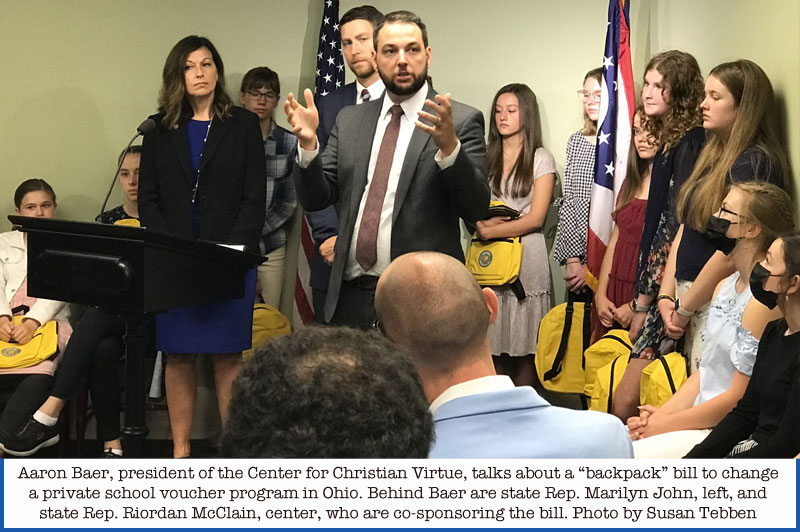
    The sponsors of a bill that would promote the use of private school vouchers and “school choice” came together on Wednesday with a religious lobby group to bring the bill back up.

    House Bill 290 was originally introduced in May as a “legislative intent” bill aiming to allow students to have the funding they need “follow them” to private schools of their choice, should parents decide the public school system is not working for them.

    “We want to fund students, not systems, and empower parents to make the best decision for their children,” said bill cosponsor state Rep. Riordan McClain, R-Upper Sandusky.

    The bill came before passage of the new budget bill, which included the Fair School Funding plan, an overhaul of the public school funding model.

    Under the new budget, EdChoice private school vouchers, along with the EdChoice expansion, the Cleveland Scholarship Program, the Jon Peterson Special Needs Scholarship Program and the Autism Scholarship Program, are all directly funded by the state, rather than being deducted from monies distributed to public school districts.

    “Ohio parents and students overwhelmingly want quality local public schools. They don’t want the radical defunding of public schools that this bill would likely cause.”

    Melissa Cropper, president of the Ohio Federation of Teachers

    In the new language being added to the bill, if a family applies to be a part of the private school voucher program, sponsors say the taxpayer money the state would use to fund EdChoice or Cleveland scholarships would be put in individual educational savings accounts for the students use.

    The bill’s other cosponsor, state Rep. Marilyn John, R-Richland County, said the bill isn’t meant to discredit public education, but to allow student who learn differently to be able to have different options.

    “One size fits all doesn’t work,” John said. “It certainly doesn’t work for education.”

    McClain said they don’t have an estimate of how many students would be impacted by the so-called backpack bill, though they don’t expect to see a mass exodus of students headed to private schools, more of a gradual upward trend.

    “It’s something that, once we set the agenda for where we want the future of the state to be, the hope is that that network gets built up and those opportunities are created,” McClain said.

    Included in the press conference was religious advocacy and lobbying group Center for Christian Virtue, which backs the bill because of its focus on school choice and to make public school districts perhaps think twice about instituting what they see as controversial policies.

    Aaron Baer, president of the Center for Christian Virtue, said amidst debate in the General Assembly on critical race theory — which CCV has called “a racist ideological grandchild of Marxism that’s being taught in schools across the state” in a fundraising email in support of anti-CRT legislation — parents should be able to take the lead in their student’s education.

    Baer also brought up the Upper Arlington school district, which tried to implement some bathrooms at their schools that were gender neutral, before the city of Columbus said that was against city code. The school district had said students who used the gender-neutral bathrooms had been doing so without incident.

    “A bill like this would be able to say: Look, Upper Arlington, if this is what you want to do, if this is the policy you want to have, okay,” Baer said. “But now…those families are allowed to go elsewhere and maybe you’re going to think twice about doing something that parents don’t like.”

    The bill was already spurned by education associations and public school advocates when it was introduced, but the new language has done nothing to change minds.

    “Ohio parents and students overwhelmingly want quality local public schools,” said Melissa Cropper, president of the Ohio Federation of Teachers. “They don’t want the radical defunding of public schools that this bill would likely cause.”

    The backpack bill current sits in the House Finance Committee, but has not been scheduled for a hearing.

  • State education testing shows declines, may be waived in new legislation

    State education testing shows declines, may be waived in new legislation

    Ohio state Rep. Lisa Sobecki testifies before the House Primary & Secondary Education Committee on Tuesday, on a bill seeking waivers on state and federal testing.

    by Susan Tebben and Ohio Capital Journal

    As state officials look for solutions to an education gap caused by the COVID-19 pandemic, two pieces of legislation introduced Tuesday hope to give more leniency on state and federal testing.

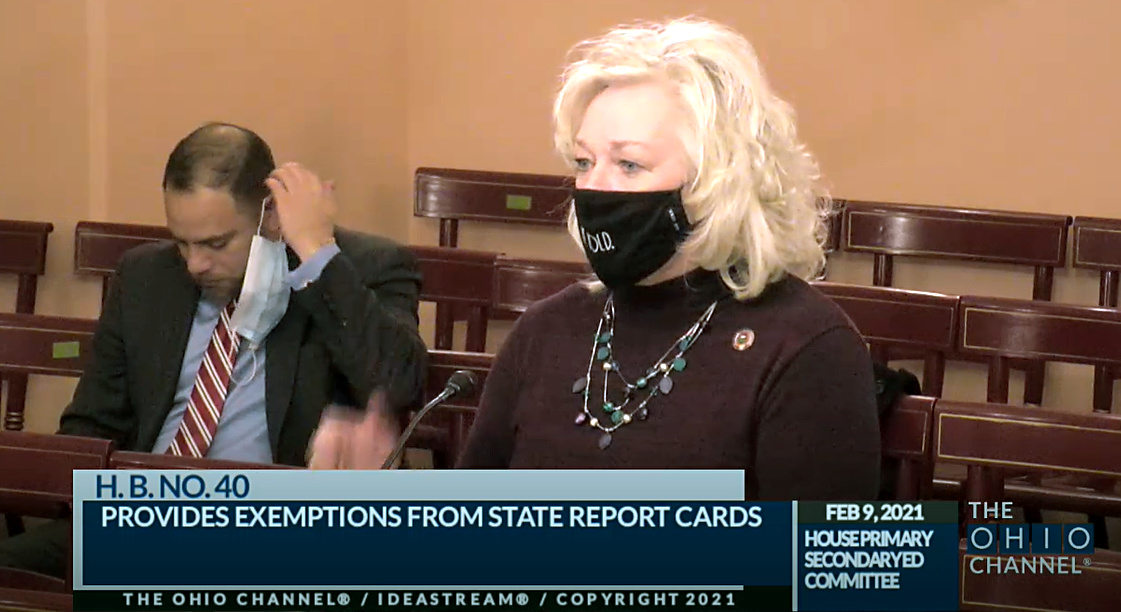
    Rep. Lisa Sobecki, D-Toledo, is a co-sponsor with Rep. Jeffrey Crossman, D-Parma on House Bill 40, to make exemptions for students in taking state report cards.

    The bill would waive state testing for the 2021-2022 school year and direct the Ohio Department of Education to seek a waiver for federal testing, as well as holding school districts harmless on state report cards to determine funding levels and eligibility for EdChoice private school vouchers and academic distress commissions.

    “We do need to see where our kids have been left behind, but I don’t need a test that’s going to tell us something after the kids have left,” Sobecki told the House Primary & Secondary Education Committee.

    She said the waiver of testing “appears to have broad, bipartisan support” within the legislature.

    Bipartisan support for state testing waivers came in the same Tuesday meeting, in the form of a separate bill brought by Republican state reps. Kyle Koehler and Adam Bird, to ask for many of the same things, including state and federal testing exemptions.

    “I am not asking to waive test requirements because we don’t need to know how testing will go,” Koehler told the committee. “I think we know it’s not going to go well. Students are going to be behind.”

    In further support of testing pressure relief, State Board of Education member Dr. Christina Collins released a proposed resolution directing the ODE limiting the use of state testing, and to “include a district designation of online, hybrid, or in-person on school building and district level report cards.”

    In the resolution, Collins writes that COVID-19 “has affected every student in Ohio, disrupting the structure of teaching and learning and emphasizing children’s dependency upon adults for nurture, protection and providing for health and well-being.”

    Along with the district designation, the board member asks that a disclaimer on state reports say that data “are for the purpose of understanding how learning was impacted as a result of extreme circumstances.”

    Earlier in the day, ODE Superintendent Paolo DeMaria said the test scores coming out of a pandemic’s worth of learning styles emphasize the need for students to get back to in-person instruction.

    DeMaria acknowledged a lower participation rate in the state testing, saying the ODE promoted a “safety first” mentality in taking the tests. But from the testing that did occur, the state saw an 8% increase in kindergarten-readiness scores considered “not on track.”

    Third-grade English Language Arts proficiency scores were also lower, which was also shown in a study released by the Ohio State University’s John Glenn College of Public Affairs.

    This third-grade test is set to occur this year starting from March 22 to April 23, part of why Sobecki said their legislation needs to be quickly moved through the statehouse and set up to be signed by the governor.

    “It’s February, folks,” Sobecki said.

    DeMaria, and the study itself, noted that the declining scores were even lower in minority and economically disadvantaged groups.

    State reports also showed a decrease in enrollment of 3%, particularly in pre-school and kindergarten.

    DeMaria spoke during Gov. Mike DeWine’s Tuesday press conference, in which he spent most of the time presenting the progress of vaccinating school teachers and personnel, something that the state started this month. While the state continues to vaccinate those 70 and older, they set aside some of the approximately 100,000 per week the state receives to give to school districts.

    Also on Tuesday, DeWine added a new project for school districts across the state, asking them to come up with an individualized plan to help students catch up on last year’s losses.

    “We need to be bold in our ideas, and we need to work with the Ohio General Assembly,” DeWine said, adding that a total of $2 billion in federal funding has been made available to schools to help with this problem.

    DeWine left the decisions up to the individual districts, but offered examples such as longer school years, longer school days, summer classes, tutoring, or even remote options as ways to fill the education gap.

    Districts have until April 1 to make their plans public and accessible to the General Assembly.

  • Teachers unions urge veto on school funding bill

    Teachers unions urge veto on school funding bill

    By Susan Tebben the Ohio Capital Journal

    Two of Ohio’s top teachers unions are asking the governor to veto a new education bill just passed by the legislature.

    The Ohio Senate and House passed Senate Bill 89 last week after it spent months in a conference committee being revised and developed into a bill that, among other things, focuses on the private school voucher program, EdChoice.

    The bill passed along partisan lines in both houses of the legislature, with Republican supporters saying the bill was necessary to keep the list of EdChoice eligible schools from ballooning to more than 1,200, and to address one of the biggest barriers to education — poverty.

    Democrats challenged the idea that the bill was a solution to the state’s problems, and accused supporters of pushing the bill through without the appropriate amount of public input.

    OEA President Scott DiMauro

    The leader of the Ohio Education Association said the current version of SB 89 “removes positive aspects of the bill passed by the House and increases voucher eligibility beyond 2020-2021 levels.”

    “By grandfathering in previously voucher-eligible students, whether they had used the vouchers or not, SB 89 fails to curb the destructive explosion of the voucher program, contrary to proponents’ claims,” wrote OEA President Scott DiMauro in a statement. “There was no compromise and no consultation with the education community to strike the deal that was passed out by the conference committee.”

    Melissa Cropper, head of the Ohio Federation of Teachers, said the bill would only exacerbate the already dire school funding crisis.

    Melissa Cropper, head of the Ohio Federation of Teachers

    “SB 89 throws more fuel on the fire without providing remedies to ensure that the 90% of Ohio students who attend public schools have the resources they need for a quality education,” Cropper said.

    The bill also comes as the House and Senate consider companion bills to overhaul the education system entirely, in response to a decades-old Ohio Supreme Court case that called the system wholly unconstitutional.

    DiMauro and Cropper both said if the governor doesn’t veto SB 89, “it is more critical than ever” that House Bill 305 be passed to directly fund charter schools and the voucher program.


  • School funding bill to get new look under new speaker

    School funding bill to get new look under new speaker

    A school funding bill originally sponsored by new Ohio House Speaker Bob Cupp is getting a fresh look and hopefully time in front of legislative committees before year’s end, according the legislator now heading up the bill.

    The other original sponsor of the proposed legislation, state Rep. John Patterson, said a substitute bill is in the works that should touch on longstanding concerns the Ohio Supreme Court had about the constitutionality of the state’s education system.

    “We’re taking a more balanced approach in the new bill,” Patterson, D-Jefferson, said.

    The state’s contribution to education budgets has stagnated over time, while private schools have benefitted from the EdChoice scholarship program, in which some state funding for public school districts has been redirected to religious, charter and community schools.

    EdChoice scholarships were frozen at current levels in an omnibus bill responding to the COVID-19 pandemic.

    State Rep. John Patterson, D-Jefferson.

    Patterson said a substitute version of House Bill 305 seeks to address “overarching criticisms” of the original bill, and the education system itself. One of the major criticisms is the distribution of money in the school funding formula between school districts with varying financial situations.

    “Under the current formula, districts are all interconnected, so as one district becomes wealthier, another becomes poorer,” Patterson told the Ohio Capital Journal.

    So, in the new plan co-sponsored this time by Rep. Gary Scherer, R-Circleville, the legislators want to reassess the amount that districts are able to raise on their own before they decide what the amount of state aid would be to schools.

    The proposed bill would also take the weight solely off of property taxes for school funding, something the 1997 decision by the Ohio Supreme Court in DeRolph v. State of Ohio ruled was a big reason the education system violated the state constitution.

    The new plan will combine property and income taxes along with a calculation of a district’s wealth level to “determine a district’s true capacity to raise its fair share,” according to Patterson.

    “The question is what is fair for the locals, and what is fair for the state,” Patterson said. “We have fine-tuned for that.”

    Ohio House Speaker Bob Cupp (Ohio House Photo)

    Disadvantaged students would receive more immediate help than in previous funding models if the new bill is made law. In the original proposal for the bill, aid would have been phased in over time for school districts, but legislators are now looking to channel that aid to districts immediately. 

    Patterson planned to meet with interested parties — teachers’ unions, public school officials and community school representatives on Tuesday to discuss the plan. One of those parties is the Ohio Federation of Teachers, who said school funding needs a direction that accounts for social and emotional learning as well as test proficiency.

    “We’re hopeful that (the sponsors) are moving in the right direction,” said OFT executive director Melissa Cropper. “No school funding formula will be perfect, but having no school funding formula has been a disaster.”

    In the next month, simulations of financial situations will be run to test the effectiveness of the bill as it stands, and Patterson hopes the bill will be ready when the Ohio House returns to regular session in September.

    After anticipated amendments and passage of the bill, Patterson said implementation of the new formula could take years.

    With EdChoice pitting private schools and public schools against each other for funding in the state model, Patterson said concerns were brought from both sides, and his bill plans to address private school issues as well.

    “What I’ll say is we have heard their criticism and have addressed their concerns in the substitute bill,” Patterson. “I think they’re going to be pleased.”

    The changes made to the bill Cupp once authored have the blessing of the new speaker, according to Patterson. 

    “Speaker Cupp understands the absolute necessity of passing House Bill 305 in this General Assembly,” Patterson said.

    Neither Cupp nor Scherer responded to requests for comment.


    Susan Tebben

    Susan Tebben is an award-winning journalist with a decade of experience covering Ohio news, including courts and crime, Appalachian social issues, government, education, diversity and culture. She has worked for The Newark Advocate, The Glasgow Daily Times, The Athens Messenger, and WOUB Public Media. She has also had work featured on National Public Radio.