Tag: elections

  • A behind-the-scenes look at how Ohio enacted the most restrictive voter photo ID law in America

    A behind-the-scenes look at how Ohio enacted the most restrictive voter photo ID law in America

    Lawmakers ignored a variety more moderate restrictions proposed by secretary of state and law firm

    BY: ZURIE POPE – Ohio Capital Journal

    Ohio Gov. Mike DeWine signed House Bill 458 on Jan. 6, enacting what’s been called one of the most restrictive voter-ID laws in the country. 

    Public records obtained by the Ohio Capital Journal show how the law moved through the process, with lawmakers often ignoring moderation suggestions proposed by the Ohio Secretary of State’s Office and a law firm that lobbied on the law.

    Taking elements from two election bills previously introduced in the Statehouse — House Bill 294, and Senate Bill 320 — House Bill 458 instituted sweeping changes to how elections are administered in Ohio. 

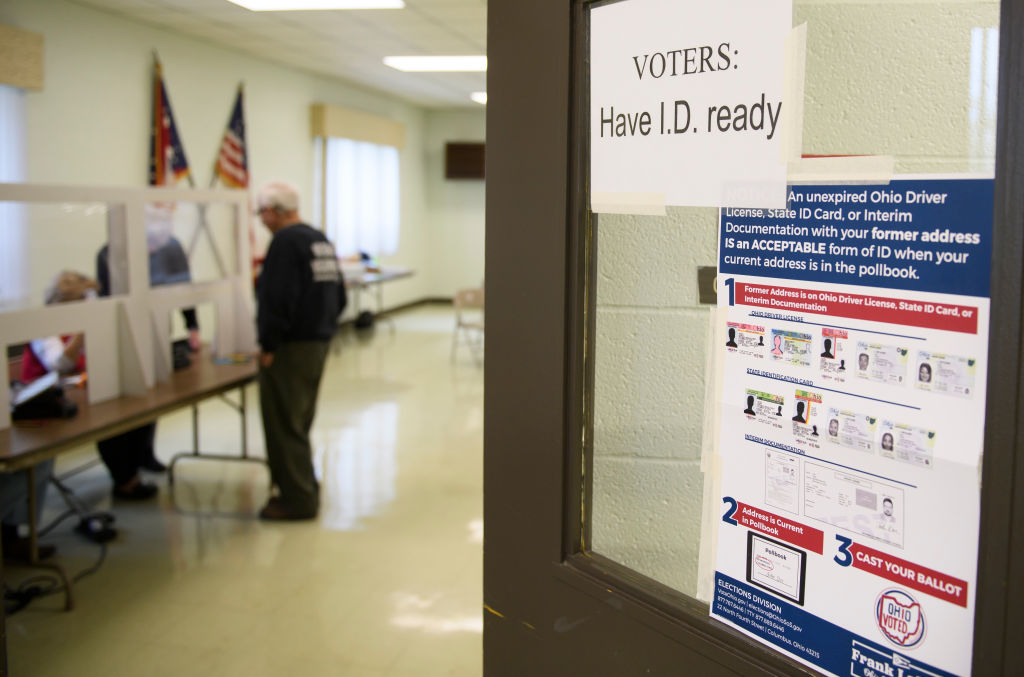
    Alterations include mandating the use of photo IDs, passports, or driver’s licenses to vote, and limiting counties to one ballot drop box. The law also mandated citizenship status on IDs and excludes county-issued veterans’ identification and college IDs from the list one can use to vote.

    Such restrictions received significant backlash, with Democratic law firm the Elias Law Group filing a lawsuit the day the law was passed.

    Regardless, Ohio’s Republican leaders insist the new voting restrictions were necessary, despite no evidence of significant voter fraud, by impersonation or otherwise. Total possible voter fraud in the 2020 election was a microscopic 0.0005%.

    Nevertheless, DeWine said the new restrictions were needed to combat concerns about voter fraud, which have been pushed politically by his own party without evidence.

    “Election integrity is a significant concern to Americans on both sides of the aisle across the country,” DeWine claimed in a statement.

    DeWine also touted what he sees as moderation of the law’s voting restrictions, congratulating the general assembly for “working with my Administration on changes to House Bill 458 to ensure that more restrictive proposals were not included in the final bill.” 

    Ohio Secretary of State Frank LaRose’s Press Secretary Rob Nichols similarly touted the DeWine administration’s involvement in the process. 

    “While no legislation is ever perfect, the House and Senate leaders listened to many of our concerns and made some improvements to the bill,” Nichols wrote in an email responding to OCJ when asked the extent of SOS’s work on election reform. “Overall, the legislature approved some much-needed reforms that will benefit both voters and elections officials, while continuing to make Ohio one of the most honest and accessible voting states in the nation.”

    But documents obtained by the Ohio Capital Journal through a public records request reveal a complex web of bureaucrats, lawmakers, lobbyists, and outside powerbrokers, united in their efforts to pass the new voting restrictions, including the Ohio Secretary of State’s Office.

    Records show that the Secretary of State’s Office supported most of the House GOP’s voting restrictions, haggling out various details. In some cases where the office pushed for more moderation, their recommendations were not followed by lawmakers. 

    Regardless, LaRose has been publicly supportive of the law as passed.

    Ohio Secretary of State input

     Ohio Secretary of State Frank LaRose. Official photo.

    On Dec. 9, 2022, Frank LaRose’s Chief of Staff Jason Mauk submitted a memo to Senate GOP legal Counsel Frank Strigari, outlining the secretary’s issues with HB 458. 

    Since Dewine signed the law, military families have voiced opposition to it, saying the mail-in ballot rules curtail the ability of service members to vote. 

    Mauk appears to have foreseen the blowback that the law’s rigid deadline for mail-in ballots would cause, especially among the armed services, and warned against it. 

    We have concerns with restricting the return of such ballots by election day,” Mauk wrote. “This provision has the potential to disenfranchise voters, particularly those living and serving overseas.” 

    Mauk asked the Senate to “allow for ballots to be returned by the postal service for at least five days after election day.” 

    Eventually, lawmakers settled on a four-day cutoff. 

    Asked if his colleagues in the secretary’s office were concerned that the four day cutoff — below the deadline recommended by Mauk — might endanger voters, press secretary Rob Nichols indicated it could have been worse.

    “They wanted zero,” Nichols said. “We said that might disenfranchise voters, asked for at least a five day return deadline, and they cut it down to four.” 

    Asked again if the four-day cutoff would harm voters, Nichols replied, “We enforce the laws; we don’t make them.” 

    Asked for comment, Ohio House Republican Majority Leader Bill Seitz responded in an email, “I do not think there will be any impact on service members being disenfranchised by our new law.”

    In communications, Mauk from the Secretary of State’s Office also argued counties should be allowed to have multiple ballot drop boxes on site, writing they “respectfully ask the Senate to allow up to three drop boxes on board office property.” 

    He also fought against immediate disclosure of drop box surveillance. 

    “This office has serious concerns about the burden placed on the county boards of elections in requiring immediate disclosure of drop-box video surveillance records,” Mauk wrote. “The immediacy of this requirement is problematic.”

    Nevertheless, the provision remained in the final bill and drop boxes were limited to one.

    Likewise, Mauk recommended creating a “secure, electronic method of verifying voter registration data,” using information from the Bureau of Motor Vehicles. 

    One of the benefits from this system, Mauk claimed, is that it could deter non-citizens from voting. 

    “It also helps to ensure non-citizens are not able to submit a voter registration accidentally, or intentionally,” he wrote.

    The final bill mandates all driver licenses and state IDs held by a non-citizen “include a notation designating that the licensee or cardholder is a noncitizen,” which civil rights advocates believe may endanger immigrants. 

    Byers Minton & Associates

    Another aspect of the election law process made clear by the records is the involvement of the Columbus law firm Byers, Minton & Associates.

    Byers Minton is one of Ohio’s largest lobbying firms, with clientele ranging from Apple to the Cleveland Browns, and the Girl Scouts. Byers Minton’s public position on election reform is rarely mentioned on its website, social media, or other communications.

    The firm’s weekly update on events at the Statehouse failed to mention HB 458, instead prioritizing DeWine signing a spending bill. The election bills are referenced once, at the bottom of a list including everything passed by the Statehouse during its lame duck session.  

    But behind the scenes, records show an apparently close relationship between Byers Minton’s lawyers and the lawmakers producing the election legislation. 

    Founder Bill Byers was involved at the earliest stages of the eventual law’s development. Records show Byers helped arrange favorable testimony, though some of his suggestions for election law changes, such as automated voter registration, were not followed by lawmakers.

     Republican Ohio House Majority Leader Bill Seitz. Official photo.

    For the original bill, House Bill 294, Byers helped arrange witness testimony from former Kentucky Secretary of State Trey Grayson to speak on its behalf.

    Please find a witness slip and proponent testimony for Trey Grayson on HB294,” Byers wrote in an email June 9, 2021, to one of Seitz’s policy advisers. “Please let me know if there’s anything else you need.”

    One month earlier, Byers was included in an email from Seitz’s legislative aide going over the bill analysis for 294. “Let us know if you have any questions/comments,” the aide wrote.

    Byers would also be included in a thread on the final draft of HB 294 from Oct. 5 of last year, featuring multiple revisions.  

    Asked about this, another legislative aide for Seitz said Byers’ actions were within the purview of Byers Minton’s regular duties. 

    “Bill Byers lobbied on behalf of the Secure Elections Project,” wrote the legislative aide in a response email to OCJ. “Byers simply offered valuable input on the bill on behalf of his client.”  

    Byer’s interest in election law would later extend to SB 320, the other predecessor bill to the one that was eventually passed, which was introduced by Republican state Sen. Teresa Gavarone.

    On Oct. 13, 2022, Byers sent an email to a Gavarone staffer as a “follow up to our discussion.” 

    In it, Byers argues for the cost-saving potential of automated voter registration and verification, and the wastefulness of provisional ballots. 

    “Processing provisional ballots imposes significant costs on county election officials,” Byers said. 

    Byers also portrayed decreasing the amount of provisional ballots as a financial windfall.

    “Reducing the number of provisional ballots cast in the 2016 and 2018 election cycles, would have resulted in an additional $830,721 in savings to county BOEs,” Byes said.

    According to the Massachusetts Institute of Technology’s Election Lab, 1.7 million provisional ballots were counted in 2016 nationally, and accounted for 1.2% of all votes in the 2018 midterm election.   

    “Thank you!,” the aid replied to Byers.  

    Six days later, the aide emailed Byers once more, saying Gavarone “would like to meet with you to get more Info,” and requested “Frank(LaRose)’s attendance during that meeting with us.” 

    Asked to discuss the details of these meetings, no one from Gavarone’s offices responded.

    As for Byers Minton, asked for comment, Andrew Minton replied, “My firm does not give comment to the press on any issue or for any reason.”

    Cincinnati NAACP President Joe Mallory submitted testimony against House Bill 294, writing it “creates unnecessary boundaries to the vote.” 

    Speaking about the election reform bills as a whole, Mallory was livid when asked for comment.  

    “These anti voter policy changes are not about improving the election process, it’s about erecting barriers and decreasing access,” Mallory said. “What we have is a super majority rushing anti voter bills through a lame duck session. They are perpetuating a fraud on Ohio voters and the democratic process, with the false narrative of Election security and modernization. It is disingenuous.”

  • Robert Hess: Something very disturbing occurring in Loveland School Board election

    Robert Hess: Something very disturbing occurring in Loveland School Board election

    by Robert Hess

    Something very disturbing is occurring in the elections for our Loveland (and possibly others) school board: The politicization of the board and the candidates. In the past, most people running for school boards truly had the interests of the students and the community at heart. Republican, Democrat, Conservative, or Liberal was not an issue. Even when the candidates may have been using the office as a springboard to future political venues. 

    This 2021 race is featuring a block of candidates running to achieve a political purpose. They appear to be running as a block to further their political ideals, regardless of what the ideals really have to do with education and the enhancement of our school district.

    One key issue this block keeps bringing up is Critical Race Theory (CRT) in the curriculum.

    First of all, Critical Race Theory is not a part of the curriculum and is not taught in the school system. (A point that several of the candidates who are not part of the “block” have stated.)

    Secondly, to be part of the curriculum it would have to be approved and instituted at the State level. That has not and is not being done. Yet, members of the block state unequivocally that whether it is here or not, it is coming. Is this a scare tactic? Is it possibly a tactic to unite certain people to vote for them to make sure Critical Race Theory never happens?

    Also, I ask, what is Critical Race Theory? Most people have either no idea or only a vague understanding based upon what rumors they have heard. Why are certain people afraid of elements of CRT. I have tried to study CRT and admit I still do not really know what it is. And if it goes toward teaching the truth, is that a problem. Should we cleanse our education system of the truths we do not want to believe or do not like? Isn’t that a bit scary? (Sounds a little like The Scopes Monkey Trial or Banned in Boston.) Many people are using CRT as a way to unite certain elements and scare those who do not understand what is and is not part of our local and state curriculum and what Critical Race Theory really means.

    Finally, do we really want block voting; i.e. Voting on issues that may not be in the best interest of students and education, but instead benefits a political point of view. Perhaps blocking good issues. Haven’t recent politics caused enough problems in our society without bringing it into the schools?

    Let us make sure that we get and keep politics out of the classroom and leave education to those who truly understand what and how to do it, with our oversight and assistance. Sure, a previous school board almost made some big mistakes. But they were in the best interest of the students and we, the voters, prevented them from implementing those mistakes. Most of those people, both board and administrators, are now gone. Let us make sure that we are trying to improve and broaden the education of our students so that they might avoid the pitfalls that our older generations have set up for them.

    Please vote responsibly, with understanding, and beware of the political tyranny that could be brought to our school system by political blocks attempting to take over our school system.

    Robert Hess lives in the Claiborne West Neighborhood in Loveland.

  • Portman troubled by President Trump’s remarks at Helsinki Summit

    Portman troubled by President Trump’s remarks at Helsinki Summit

    WASHINGTON, D.C. – U.S. Senator Rob Portman (R-OH) issued the following statement regarding the joint news conference today by President Donald Trump and Russian President Vladimir Putin at the Helsinki Summit:

    The president’s comments in today’s press conference were troubling. He failed to stand up to Vladimir Putin on some of the most critical security issues facing our country and our allies. There is a consensus in the intelligence community that Russia meddled in our elections and continues to try to destabilize democracies around the world. Both the House and Senate Intelligence Committees have concluded that Russia interfered in the 2016 elections. When given the opportunity, President Trump did not hold President Putin to task for election meddling, for the illegal annexation of Crimea, or for the continued aggression in Eastern Ukraine. 

    “I believe the United States must be matter of fact and transparent. We all want to see a better relationship between our two countries, but we must make clear directly to President Putin and to the world that Russia’s actions on the world stage are unacceptable and a change in their behavior is necessary in order to improve relations. I will continue to work with my colleagues in Congress and with this administration to do so.” 


    Accounting Plus LLC

      Accounting Plus–Bingaman Accounting and Tax Service, LLC is a tax preparation, payroll and bookkeeping company locally based in Loveland, OH.


  • Libertarian Party statement on ballot access in Ohio

    Libertarian Party statement on ballot access in Ohio

    page1image1770464

    Libertarian Party of Ohio

    Media Statement: Ballot Access July 02, 2018, 14:00 EDT

    For further information, contact:

    Harold Thomas, LPO Chair harold.thomas@lpo.org (614) 581-6832

    David Jackson, Communication Director david.jackson@lpo.org
    (614) 560-1237

    July 2, The Libertarian Party of Ohio filed petitions containing 102,762 signatures with the Secretary of State to regain ballot access taken away from the citizens of Ohio four years ago because of Republican Party politics

    They intended to destroy the Libertarian Party in Ohio.

    But liberty and choice persevered. We have more volunteers and more enthusiasm than ever. Putting us through the political tricks has made us stronger.

    We are stronger knowing that 102,762 voters are signed their names to give Ohio more and better choices to address our economic and social issues. Ohioans want solutions, and sense that the way forward might lie in less government, instead of more. These petitions came from all 88 counties showing support from every part of this state. We are building from a broad base of voters from every economic level; all racial backgrounds; all faiths, and all sexual orientations, helping the ever-expanding diversity of our party.

    We know that establishment trickery will not end here. We have attorneys armed with the Constitutions of the United States and the State of Ohio. We know of some recent federal court decisions in other states that have made challenger party ballot access easier, not more difficult. Our attorneys are ready to deal with any obstacles they throw our way. However, we seek no fight, just open dialog and new ideas.

    The establishment parties will try to convince you that we are “Republicans-lite” or agroup of spoilers whose primary purpose is to throw elections one way or the other. Some will even try to make you believe that we are anarchists bent on social chaos. Don’t believe them. The Libertarian Party has members all around you and is the only party with a consistent philosophy and platform — one we have followed, faithfully, since our inception nearly 50 years ago. Our philosophy is based on this Golden Rule, which call it the “non-aggression principle.” No one, including government, has theright to use force to promote a political or social agenda. Government aggression should only be used to protect our lives, our property, and our rights from those who would kill, rob, and cheat us.

    Libertarians believe that government exists for one purpose, which Thomas Jefferson made clear in the Declaration of Independence. We are endowed with certain inalienable rights: life, liberty, and the pursuit of happiness, and that the purpose of government is to secure these rights. The framers of the Constitution reinforced the Declaration when they wrote in the Preamble that government’s purpose is to “establish justice, insure domestic tranquility, provide for the common defense, and secure the blessings of liberty to ourselves and our posterity.

    It is a government for adults who can make their own decisions, build their own careers, and have values they want to pass on to their children. Our political system is broken because we have forgotten that. We have allowed our politicians – at all levels –to behave like children, focusing on trivial issues, fighting the cultural wars of past generations, and doling out favors to their largest contributors.

    It’s time to stop this madness. It’s time to stop bickering and to start negotiating real solutions for Ohio. It’s time to engage in the politics of hope instead of the politics of fear. In this spirit, we will cooperate with members of the establishment parties and the Green Party on issues of mutual interest. Together, we can form policies designed to benefit all of us.

    On Saturday, July 14, we will introduce our slate of candidates to you and the people of Ohio. You will find that they represent a new generation of leadership with fresh ideas and a new perspective on governing our state.

    I invite you and all Ohioans to embrace the Libertarian Party and its candidates as we represent a true choice. We will not only show how to fix a broken system, and make it robust enough to secure the blessings of Liberty for ourselves and our posterity.

    -END-