Tag: enforcement

  • Hamilton County Sheriff will enforce statewide curfew

    Hamilton County Sheriff will enforce statewide curfew

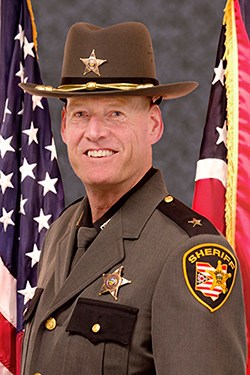
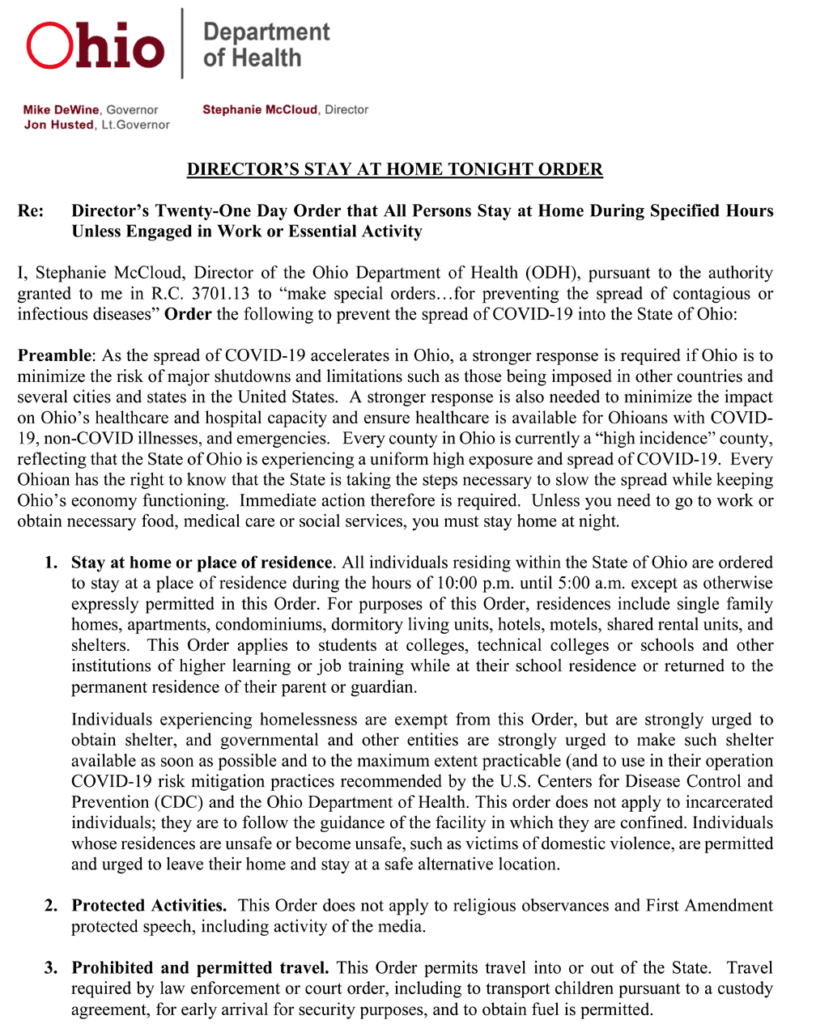
    Hamilton County, Ohio – Sheriff Jim Neil reports that beginning Thursday at 10 PM, the Hamilton County Sheriff’s Office has begun enforcement of the “Statewide Curfew” issued by the Ohio Department of Health. (Read the Health Order below)

    Neil said in a press release, “We’re asking all citizens and businesses to comply with the order. Restaurants and bars must stop serving in person customers at 10 PM during the curfew period. Takeout, however, can remain open beyond 10 PM. Violators will receive a verbal warning to comply with the order. After being verbally warned, the violator(s) will be cited under 3701.352, Ohio Revised Code, Misdemeanor of the 2nd degree.”

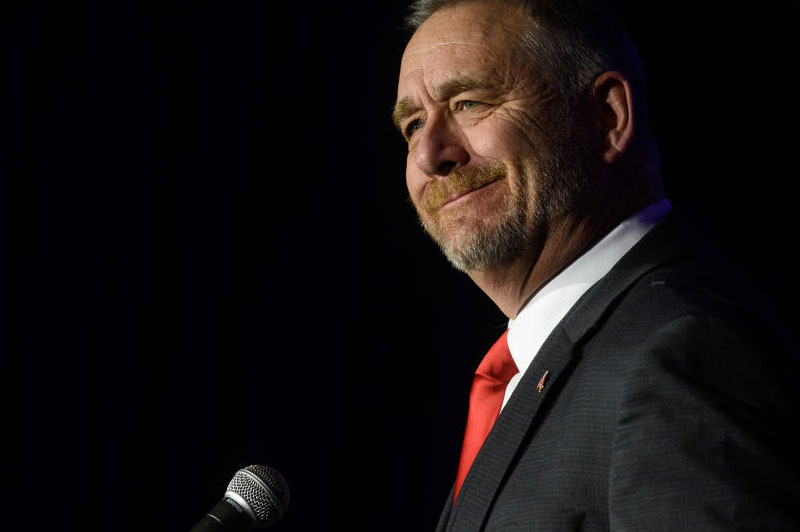
    Sheriff Jim Neil

    The Neil noted that the curfew does not include the following:

    •   Individuals going to and from work
    •   Those who have an emergency
    •   Those who need medical care
    •   Grocery shopping
    •   Going to the pharmacy
    •   Picking up carryout or a drive-thru meal. Delivery is also permitted
    •   Yes, you can still take your dog outside or go for a walk My goal as Sheriff of Hamilton County is to keep my deputies and the general public safe

    Health Order Signed Encouraging Ohioans to Stay Home

    (COLUMBUS, Ohio)—Ohio Governor Mike DeWine on Thursday announced that Ohio Department of Health Director Stephanie McCloud signed a health order encouraging people to stay at home during specified hours unless they are working or engaged in an essential activity.

    “As COVID-19 continues to spread in Ohio, we need a stronger response to minimize the impact on Ohio’s healthcare and hospital capacity and ensure healthcare is available to those that need it,” said Governor DeWine. “With this order we are discouraging get-togethers and gatherings to minimize the spread of the virus while minimizing the economic impact of a complete shutdown.”

    According to DeWine the specifications in this order include:

    • Individuals within the state must stay at a place of residence during the hours of 10 PM and 5 AM except for obtaining necessary food, medical care, or social services or providing care for others.
      • This order doesn’t apply to those that are homeless. Individuals whose residences are unsafe or become unsafe, such as victims of domestic violence, are encouraged to leave their homes and stay at a safe, alternative location.
      • The order does not apply to religious observances and First Amendment protected speech including activity by the media.
    • The order permits travel into or out of the state and permits travel required by law enforcement or court order, including to transport children according to a custody agreement, or to obtain fuel.

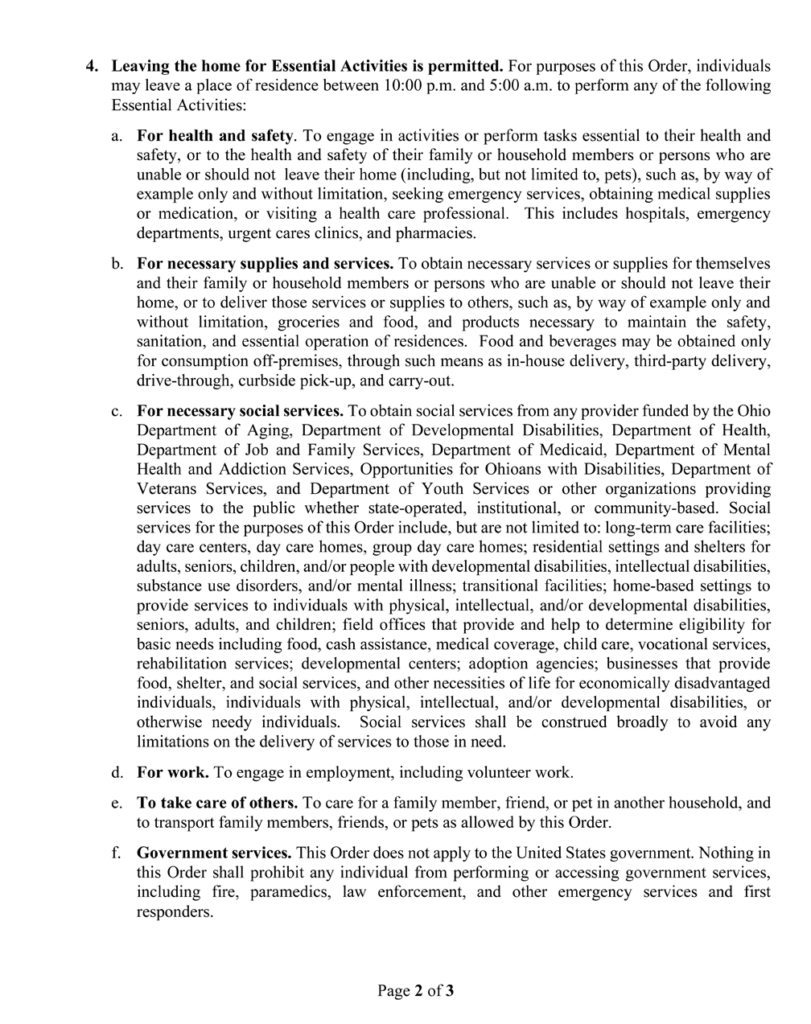
    Individuals are permitted to leave a place of residence during the hours of 10 PM and 5 AM for the following essential activities:

    • Engaging in activities essential to their health and safety or the health and safety of those in their households or people who are unable to or should not leave their homes, including pets. Activities can include but are not limited to seeking emergency services, obtaining medical supplies or medication, or visiting a health care professional including hospitals, emergency departments, urgent care clinics, and pharmacies.
    • To obtain necessary services or supplies for themselves and their family or members of their household who are unable or should not leave their home, to deliver those services or supplies to others. Examples of those include but are not limited to, obtaining groceries and food. Food and beverages may be obtained only for consumption off-premises, through such means as delivery, drive-through, curbside pickup and carryout.
    • To obtain necessary social services.
    • To go to work, including volunteer work.
    • To take care of or transport a family member, friend, or pet in their household or another household.
    • To perform or obtain government services.

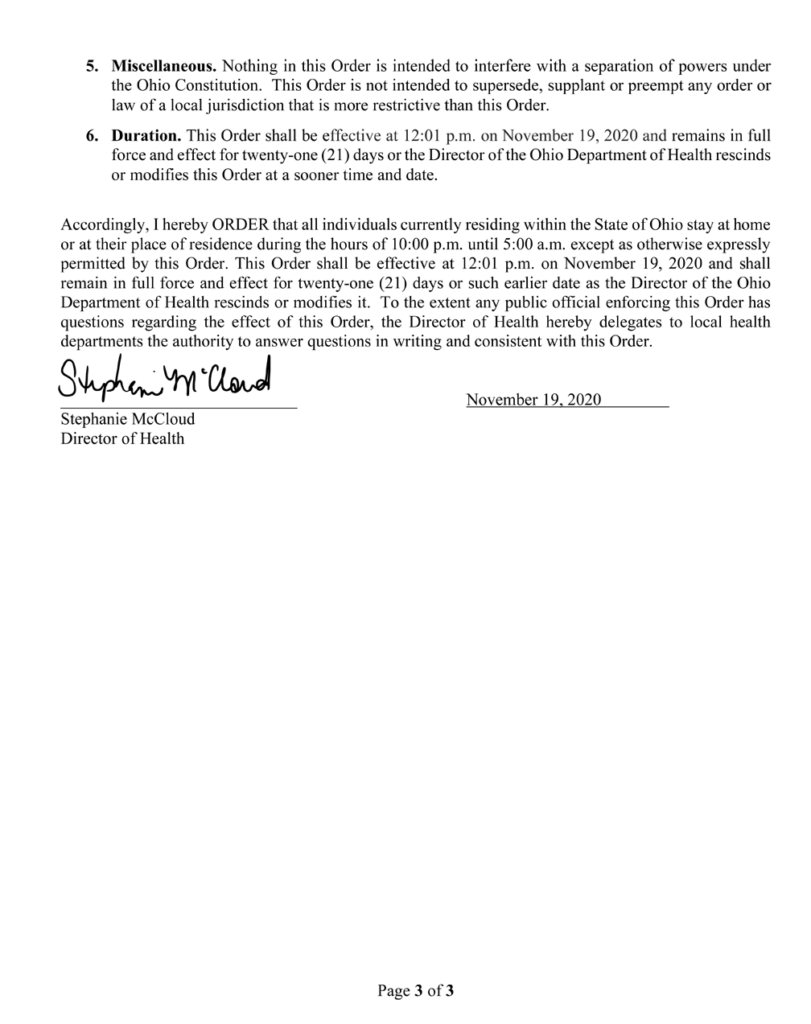
    The order will apply for the next 21-days.


  • Ohio Republicans slammed over coronavirus enforcementBy Marty Schladen – July 13, 2020

    Ohio Republicans slammed over coronavirus enforcementBy Marty Schladen – July 13, 2020

    Columbus, OhioThe coronavirus is raging in Ohio, but the state’s Republican leaders seem disinclined to enforce rules intended to protect against it. (How does Hamilton County avoid Level 4 Alert)

    Attorney General Dave Yost won’t say whether he’ll support enforcement of new orders to wear masks in the state’s hardest-hit counties. And the official who issued them, Gov. Mike DeWine, has made several statements indicating that he doesn’t want to see anybody punished for not following measures intended to slow the spread of the deadly disease.

    Mike Samet the Public Information Officer for Hamilton County Public Health told Loveland Magazine on Friday that from an enforcement perspective, as a county agency, the Health Department is not able to issue citations. “Nobody wants to be the mask police. This is education over enforcement, he said. Samet added that he wants people to understand why masks are important now, not punish them for non-compliance.

    Ohio set a record for new cases Friday — 1,525 — after seeing them trend sharply upward over the past few weeks. The case count was nearly triple the three-week average of 531.

    Gov. Mike DeWine, has made several statements indicating that he doesn’t want to see anybody punished for not following measures intended to slow the spread of the deadly disease.

    The news comes as six other states — Alabama, Idaho, Missouri, Montana, Oregon and Texas — set new single-day records of their own on Thursday. It also was the sixth day out of the past 10 in which the United States set one-day records for new cases of the coronavirus, which now has killed more than 3,000 in Ohio and more than 130,000 nationwide.

    Also last week, a New York Times data analysis showed that the disease in the United States is taking on a disturbing racial dimension, with Blacks and Latinos around three times as likely as whites to get the new coronavirus.

    The World Health Organization and the U.S. Centers for Disease Control both have said that widespread mask wearing would reduce the spread of the disease. One study indicated that if 80% of people wore them, the spread would plummet to one twelfth what it would be if nobody did.

    Yet Yost, the state’s top law-enforcement officer, last week didn’t respond to questions about whether he supports enforcement of last week’s orders that people in Ohio’s 12 hardest-hit counties must wear masks inside public buildings.

    In late March, Yost ordered that many abortions be halted in Ohio, arguing that the move was intended to conserve healthcare resources in the face of the coronavirus pandemic.

    In June, he urged a municipal court to drop charges against a couple accused of opening their Cambridge-area restaurant in defiance of an earlier, DeWine-issued health order that it remain closed.

    Then earlier this week, Yost said that the Columbus city government doesn’t have the power to enforce mask orders in state buildings — places where many Republican lawmakers have refused to wear them.

    On Monday, a spokeswoman for Yost explained that the attorney general can’t have any official involvement in cases relating to health orders unless asked by local prosecutors. “We don’t have the authority,” the spokeswoman, Bethany McCorkle, said in a text message.

    She added, however, that Yost has worn a mask since before there was a health order and encourages others to do the same.

    The attorney general and his staff haven’t responded to subsequent questions about the order DeWine issued on Wednesday evening requiring masks in the worst-hit counties.

    David Pepper (Photo from Ballotpedia)

    Ohio Democrats are already up in arms about Republican legislative leaders’ refusal to share details about the spread of coronavirus in the Statehouse and surrounding office towers. David Pepper, the party chairman, on Friday slammed the attorney general for his apparent reluctance to support the enforcement of mask orders.

    “As far as Dave Yost is concerned, refusing to enforce health orders is just one more example that the Ohio GOP has become the party of Donald Trump, Nino Vitale and John Becker,” Pepper said in a text message. “Sadly Ohio COVID cases are spiking because of it.”

    “Even though initially it appeared that Mike DeWine was being guided by scientists and public health experts, it seems that politics and the desires of the business community are driving more of the governor’s decision making now,” party chairman David Pepper said.

    President Donald Trump has repeatedly downplayed the pandemic, floated unproven cures for it and refused to appear in public wearing a mask. Among his other statements, Ohio Rep. Nino Vitale, R-Urbana, last Tuesday took to Facebook to urge Ohioans to stop even getting tested for coronavirus. And Ohio Rep. John Becker, R-Union Township, has introduced legislation that would strip state officials of the power to enforce any health order.

    Meanwhile, in the absence of much support from his party, DeWine has said he doesn’t plan to use his authority under his mask order to arrest people for not following it.

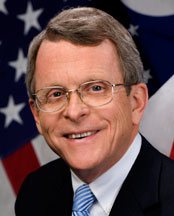
    Ohio Governor Mike DeWine

    “We’re not talking about throwing people in jail,” DeWine said during a press conference Thursday. “This is a law to advise people what to do.”

    DeWine has enjoyed overwhelming, bipartisan support over his handling of the coronavirus. But at least for Ohio’s top Democrat, patience might be wearing thin.

    “Even though initially it appeared that Mike DeWine was being guided by scientists and public health experts, it seems that politics and the desires of the business community are driving more of the governor’s decision making now,” Pepper said. “Even with fewer cases, even West Virginia and Kentucky are being more proactive in addressing the pandemic.”


    The Ohio Capital Journal is a hard-hitting, independent, nonprofit news organization dedicated to connecting Ohioans to their state government and its impact on their lives. The Capital Journal combines Ohio state government coverage with relentless investigative journalism, deep dives into the consequences of policy, political insight and principled commentary.

  • Current local COVID 19 data: How does Hamilton County avoid Level 4 Alert

    Current local COVID 19 data: How does Hamilton County avoid Level 4 Alert

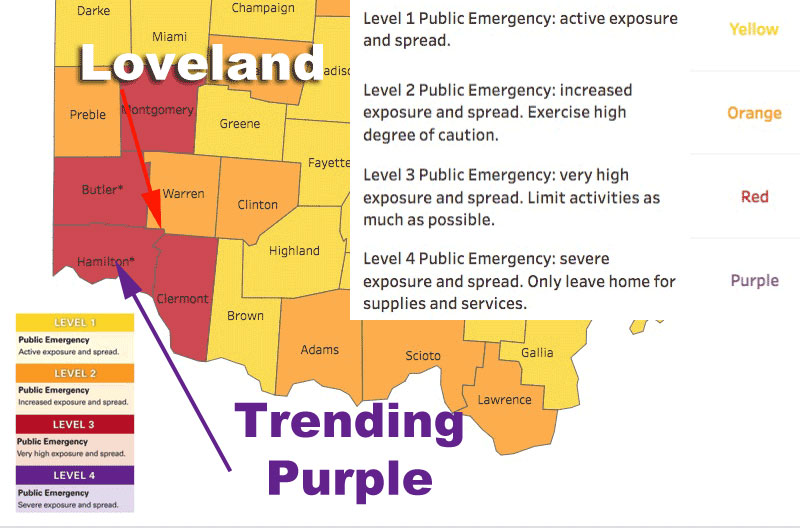
    Loveland, Ohio – Mike Samet the Public Information Officer for Hamilton County Public Health told Loveland Magazine on Friday, “As a ‘red’ county, most of our “indicators” are trending upward, hence the potential designation as ‘purple.”

    The message to county residents is a simple one said Samet in response to the question of how does Hamilton County avert escalating to Level 4. “The one we’ve been talking about since February. Until we have a vaccine and/or treatment for COVID-19, the only way to slow down transmission is: physical distance (6 ft. plus); wear a mask when out; stay home if you are ill; wash hands often and thoroughly; cover coughs/sneezes.”

    Samet added, “Wearing a mask is not a political statement. The mask shows care and respect for others in that we’re trying to reduce their risk of infection, as well as ours. It’s summer, it’s hot, no one likes wearing a mask, but it’s what we have to do to protect each other.”

    Samet said that from an enforcement perspective, as a county agency, the Health Department is not able to issue citations. “Nobody wants to be the mask police. This is education over enforcement, he said.  Samet added that he wants people to understand why masks are important now, not punish them for non-compliance. “In any event, our enforcement system is complaint-driven. People may register complaints with us at www.hcph.org. We follow-up on each complaint received,” said Samet. Read how to file a complaint in Clermont County below.

    Both Hamilton and Clermont counties are currently under the State RED Alert for COVID 19 spread. Clermont County was elevated from ORANGE to RED last Thursday. Warren County remains in the ORANGE Alert designation.

    What does it mean if Hamilton County goes to the highest Alert level?

    Hamilton County is on the State Watch list to possibly be elevated from the current RED Level Alert to the highest, PURPLE Level Alert. That destination would mean that the county is experiencing “Severe exposure and spread.” The order from the state would be, “Only leave home for supplies and services and Stay at home/necessary travel only.”

    Why was Hamilton County put under a RED Alert?

    As of July 7, Hamilton County during the 3 weeks prior had COVID 19 cases increase along with several other healthcare indicators.

    Between June 24 and June 30, Hamilton County had 1,124 cases, the largest number of COVID 19 cases in any week since the beginning of the pandemic.

    From June 16 until June 30, the average new cases per day doubled from 82 to 161. Due to clinical and reporting lags, these numbers may continue to grow for this reporting period.

    The community continued to experience early signs that more people are seeking medical care for COVID 19 symptoms.

    From June 16 to June 30, visits for COVID 19 to the emergency department doubled from an average of 11 per day to 22. More people are also visiting their doctors and being diagnosed with COVID 19.

    Between June 16 and July 2, the average outpatient visits more than tripled from 52 to 172 visits per day.

    In recent weeks, more than 86% of the cases are not in congregate settings, signaling significant transmission in the broader community.

    Hamilton County also hit a new threshold for the overall utilization rate for regional intensive care unit beds, which exceeded 80% during 5 of those past 7 days.
    Why was Clermont County put under a RED Alert?

    As of July 7, Clermont County during the 3 weeks prior had COVID 19 cases increase along with several other healthcare indicators.

    From June 16 until June 30, the average new cases per day doubled from 4 to 9. Due to clinical and reporting lags, these numbers may continue to grow for this reporting period.

    The community continued to experience early signs that more people are seeking medical care for COVID 19 symptoms.

    More people are also visiting their doctors and being diagnosed with COVID 19.

    Between June 16 and July 2, the average outpatient visits nearly tripled from 9 to 25 visits per day.

    In recent weeks, more than 94% of the cases are not in congregate settings, signaling significant transmission in the broader community.

    Clermont County also hit a new threshold for the overall utilization rate for regional intensive care unit beds, which exceeded 80% during 5 of those past 7 days.

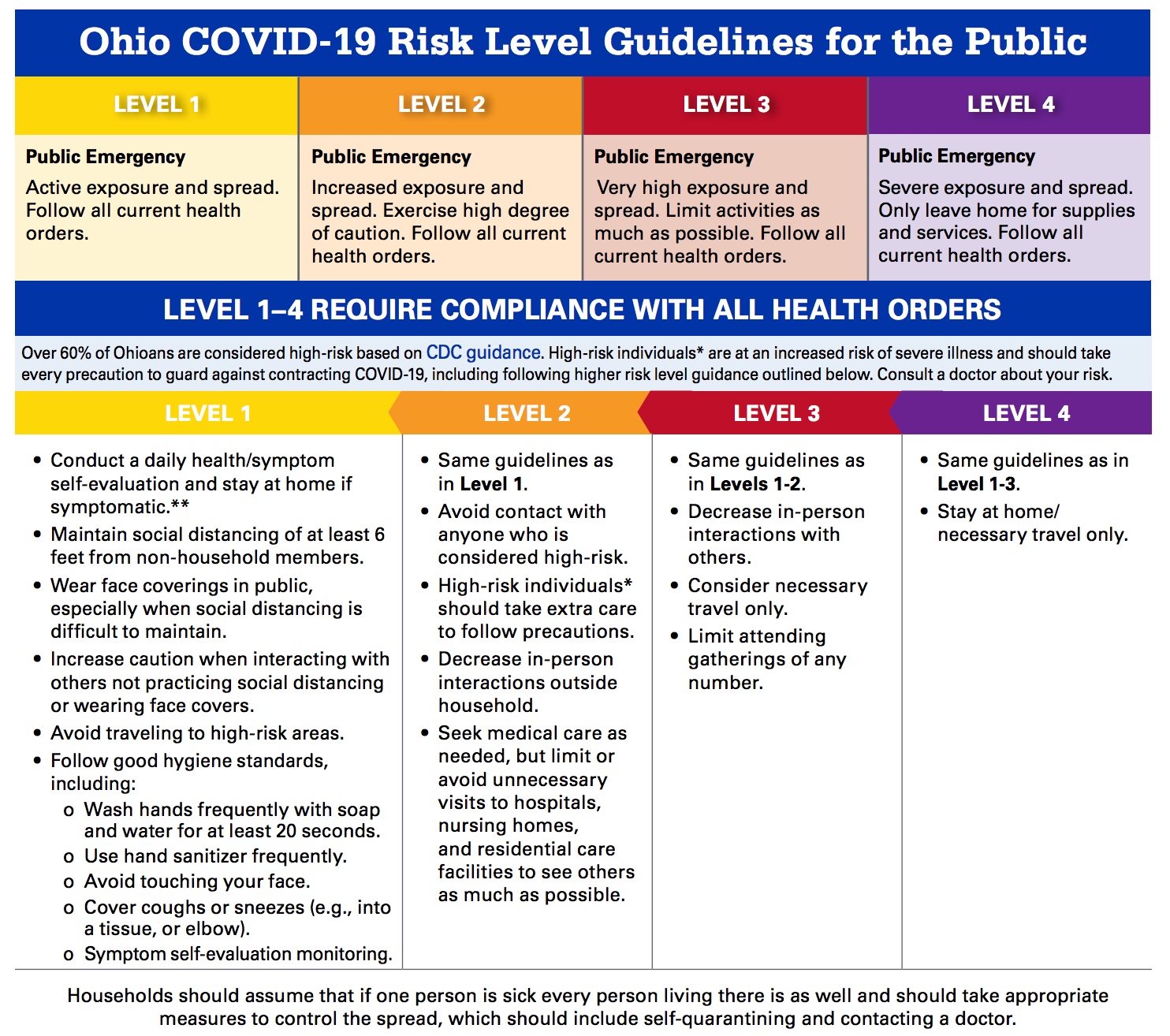
    LEVEL 1   0–1 Indicators Triggered

    Active exposure and spread. Follow all current health orders.

    LEVEL 2   2–3 Indicators Triggered

    Increased exposure and spread. Exercise high degree of caution. Follow all current health orders.

    LEVEL 3   4–5 Indicators Triggered

    Very high exposure and spread. Limit activities as much as possible. Follow all current health orders.

    LEVEL 4   6–7 Indicators Triggered

    Severe exposure and spread. Only leave home for supplies and services. Follow all current health orders.

    Summary of Alert Indicators


    As of today, Monday, July 13:

    The number of hospitalizations in Ohio is 8,842. Total Deaths in Ohio is 3,058.

    There are 462 hospitalizations and 131 deaths in Hamilton County. There have been 3,657 cases and 1,154 recoveries.

    There have been 497 confirmed and probable cases of COVID 19 in Clermont County and 7 confirmed and probable death. There are currently 60 hospitalizations. 341 people are being reported as recovered.

    In Warren County there have been 945 positive and probable cases and 25 positive and probable deaths. Warren County is reporting 120 new positive cases, 5 new hospitalizations, and 3 new deaths in the last 14 days.


    Clermont County Public Health has issued these 5 Protocols for All Businesses and these Frequently Asked Questions and Answers

    1. Require face coverings for employers and recommend them for clients/customers at all times.

    2. Conduct daily health assessments by employers and employees (self-evaluation) to determine if “fit-for-duty”.

    3. Maintain good hygiene at all times -hand washing, sanitizing, and social distancing.

    4. Clean and sanitize workplaces throughout the workday and at the close of business or between shifts.

    5. Limit capacity to meet social distancing guidelines.

    •Establish maximum capacity at 50% of the fire code.
    • And, use appointment setting where possible to limit congestion.

    Q. Will I have to wear a mask or face covering while I am at work?
    A. Yes. Face coverings are required for employees except if any of the following apply:

    1. Facial coverings in the work setting are prohibited by law or regulation;

    2. Facial coverings are in violation of documented industry standards;

    3. Facial coverings are not advisable for health reasons;

    4. Facial coverings are in violation of the business’ documented safety policies;

    5. Facial coverings are not required when the employee works alone in an assigned work area; or There is a functional (practical) reason for an employee not to wear a facial covering in the workplace.

    Q. Will I have to wear a mask or face covering if I am a customer at a business?
    A. Yes. Under the level 3 Public Health Emergency issued on July 10, customers must wear masks while inside businesses or other buildings.

    Q. Will I need to take my temperature before coming to work?
    A. Yes. Employees must take their temperature and watch for other symptoms such as coughing or difficulty breathing. Sick employees should stay at home.

    Q. What safety precautions should my employer be taking?
    A. All businesses should follow these protocols

    1. Require face coverings for employers and customers.

    2. Conduct daily health assessments by employers and employees (self-evaluation) to determine if “fit-for-duty”.

    3. Maintain good hygiene at all times -hand washing, sanitizing, and social distancing.

    4. Clean and sanitize workplaces throughout the workday and at the close of business or between shifts.

    5. Limit capacity to meet social distancing guidelines.

    •Establish maximum capacity at 50% of the fire code.
    • And, use appointment setting where possible to limit congestion.

    Q. What should I do if my co-workers aren’t wearing facial coverings at work?
    A. If an employee of a business is not wearing a facial covering, ask the employer/business for written justification on why the employee isn’t wearing a face covering.

    Q. What should I do if my employer is not following proper safety precautions?
    A. If an employer is not following the above safety protocols, you can file an online complaint here.

    To File a complaint about a business you think is in violation of the Stay Safe Ohio Order, click here.

    To check the status of a complaint click here. (Choose “Code Case” in the search drop-down box).

    Full Ohio Department of Health Stay Safe Ohio Order 

    More information from the Ohio Department of Health on the Responsible RestartOhio page