Tag: executions

  • Ohio House holds first hearing for new nitrogen gas death penalty method

    Ohio House holds first hearing for new nitrogen gas death penalty method

    Ohio would join four other states that explicitly permit nitrogen hypoxia for executions if the bill passes

    BY: Ohio Capital Journal

    House lawmakers have begun hearings on a controversial new execution method known as nitrogen hypoxia. The protocol, used in Alabama for the first time recently, subjects a prisoner to a high concentration of nitrogen which causes them to eventually suffocate. Right now, four states explicitly allow nitrogen hypoxia and four other allow for “lethal gas” generally. Outside of Ohio, Nebraska lawmakers are considering the approach as well.

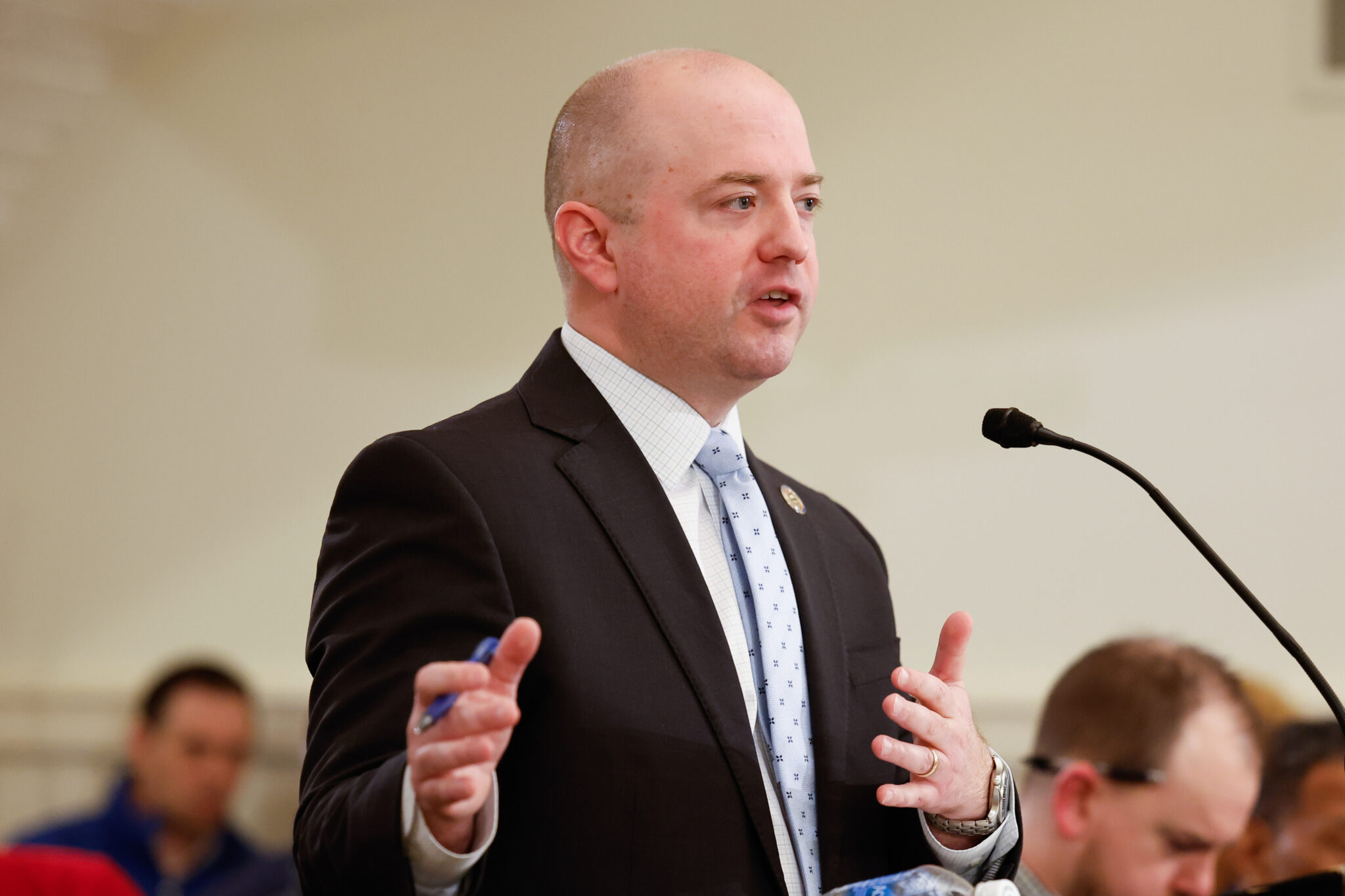
     State Rep. Phil Plummer, R-Dayton. State Rep. Phil Plummer, R-Dayton. (Photo by Graham Stokes for Ohio Capital Journal. Republish photo only with original article.) 

    In its initial hearing, Reps. Brian Stewart, R-Ashville, and Phil Plummer, R-Dayton, presented the proposal as procedural update rather than a wholesale change. Currently there are almost 200 people on death row in Ohio, but executions have been on hold since 2018.

    “We have a situation today where for six years, we have refused to carry out capital punishment — in violation of the law,” Stewart argued. “It is the law. And until this body votes to do something different, then we need to give (the Ohio Department of Rehabilitation and Corrections) the tools to carry out these sentences.”

    “Plan B”

    For the most part, Stewart sought to downplay the additional execution method. He cited an example of an inmate requesting nitrogen hypoxia, and defense attorneys arguing they believed the process is “humane” and “completely painless.”

    The inclusion of nitrogen hypoxia, Stewart argued, is a way to break up the backlog. Assuming lethal injection is available, death row inmates could select the method of their choice, and in the event that lethal injection drugs are unavailable, nitrogen hypoxia would allow executions to continue.

    “In our view nitrogen hypoxia is a plan B,” Stewart described. “It is a set of suspenders to go along with the belt. It would be preferable to continue using lethal injection, but we need to do something.”

    Stewart and Plummer presented their idea as a value-neutral response to a stated lack of lethal injection drugs. “Despite his decision to delay the executions,” Plummer said, “Governor DeWine has indicated that the legislature could address this issue by authorizing an alternative method.”

    Stewart dismissed criticism of Alabama’s “botched” nitrogen hypoxia execution as death penalty abolitionists speaking in sensational terms. An AP reporter who viewed the execution described Kenneth Smith thrashing and gasping as prison officials administered the gas. Stewart acknowledged their bill isn’t likely to change the minds of people who already oppose the death penalty.

    “Respectfully, though, I think there’s another bill for that,” Stewart said, referring to measures in the Ohio House and Senate that would abolish the death penalty.

    “This bill is saying we have the law that we have, and until we change it, we need to find a way to carry out what juries have already imposed,” he said.

    Pushback

    While some inmates may have requested nitrogen hypoxia and some defense attorneys have looked favorably on the protocol, it’s acceptance isn’t universal. The American Veterinary Medical Association, for instance, OK’d the procedure under some circumstances for euthanasia of chickens, turkeys and pigs. For all other mammals, though, the panel warned it’s inappropriate and likely to cause distress.s

    “Now, if we’re going to use gas, which, frankly, our veterinarians will not use on our animals, why would we use that on human beings?” state Rep. Michele Grim, D-Toledo, asked.

    Stewart argued it’s “vastly more humane” than the violence that put inmates on death row in the first place. He added that in countries where assisted suicide is legal, nitrogen hypoxia is one of the approaches people use.

    State Rep. Bill Seitz, R-Cincinnati, meanwhile, said the problem with Ohio’s capital punishment system is the length of time it takes to pursue appeals. “That is the problem in a nutshell,” he said, “plus the unavailability of the three-drug injection.” But he noted if the U.S. Supreme Court hasn’t explicitly blessed the protocol, the proposal might just lead to more appeals.

    “To my knowledge,” he said, “the United States Supreme Court has only signed off on hanging, electric chair, firing squad, and lethal drug injection as being constitutional — don’t violate the Eighth Amendment.”

    “I believe what you’re saying about nitrogen hypoxia,” Seitz added, “but it hasn’t yet been blessed, if you will.”

    Stewart argued the likelihood of nitrogen hypoxia passing muster in the court is high, but added their preferred method remains lethal injection. Notably, nothing about the long and complex appeals process unique to death penalty cases will change under Stewart and Plummer’s measure.

    Follow OCJ Reporter Nick Evans on Twitter.


    Nick Evans
    NICK EVANS

    Nick Evans has spent the past seven years reporting for NPR member stations in Florida and Ohio. He got his start in Tallahassee, covering issues like redistricting, same sex marriage and medical marijuana. Since arriving in Columbus in 2018, he has covered everything from city council to football. His work on Ohio politics and local policing have been featured numerous times on NPR.

    Ohio Capital Journal is part of States Newsroom, the nation’s largest state-focused nonprofit news organization.

    MORE FROM AUTHOR

  • Chances for Ohio death penalty repeal appear to be growing

    Chances for Ohio death penalty repeal appear to be growing

    By Marty Schladen and Ohio Capital Journal

    The biggest-ever bipartisan coalition on Thursday announced a renewed effort to repeal the death penalty in Ohio.

    State Sen. Nickie Antonio, D-Lakewood, and Sen. Steve Huffman, R-Tipp City, hosted a virtual press conference to announce that they and three other Republican and four Democratic senators so far have said they will co-sponsor the repeal legislation. The measure also has bipartisan support in the House.

    Antonio has long advocated to end Ohio’s troubled death penalty. But Huffman, a physician, is new to the cause. He explained that he still believed in stiff penalties for “the worst of the worst,” but replacing death sentences with life in prison without the possibility of parole would fulfill that goal.

    “Like so many in Ohio, I once supported capital punishment,” he said. “But through prayer and reflection I’ve come to believe that it is the wrong policy for the state of Ohio. I’ve been heading in this direction for decades. Life is precious.”

    Public opinion has been shifting as well. In 2014, 68% of Ohioans supported the death penalty, but a poll conducted late last year indicated that the number had almost flipped. Now, 60% of Ohioans support a repeal.

    Traditionally a state with a relatively large number of executions, there haven’t been any in Ohio since July 2018. Since he took office in early 2019, Gov. Mike DeWine has stayed all scheduled deaths, first because a federal judge likened the state’s execution method to torture, and then because the makers of the intravenous drugs have refused to supply them.

    More recently, DeWine said lethal injection in Ohio appears to be “impossible from a practical point of view today.”

    Antonio said the practical difficulties, and changing public opinion, make this an opportune time to repeal the death penalty.

    “I think that there’s a shift in the country that we’re also seeing reflected in the state,” she said. “We also have a governor who has put a moratorium on executions right now. There’s more difficulty to — I think it’s an oxymoron — ‘humanely’ execute someone… so there’s all these things.”

    In addition to Antonio and Huffman, Sens. Niraj Antani, R-Miamisburg, and Sandra Williams, D-Cleveland, joined the press conference. Also joining were Reps. Jean Schmidt, R-Loveland, Bride Rose Sweeney, D-Cleveland, Adam Miller, D-Columbus and Kristina Roegner, R-Hudson.

    In the face of the growing momentum, DeWine, a Republican, was asked later in the day if he’d sign a repeal bill in the event that one made it to his desk. He didn’t commit himself, but he seemed open to it.

    “My thinking on the death penalty has certainly evolved,” DeWine said. “But it is the law and as long as the law stays on the books it is something I would expect the General Assembly at some point to take up and I’ll certainly weigh in as they move a bill forward.”

    Antani described how he was a Republican outlier when he signed onto the anti-death penalty cause six years ago, but he was confident more GOP colleagues would join up as they came to see that it was consistent with conservative principles. He said he predicted, “Our party will see that this is a pro-life issue. Our party will see this as (an anti-) big-government issue.”

    Addressing the latter issue, Antani and many others cited the growing number of people who have been sent to death row only to be exonerated.

    Also on Thursday, the Death Penalty Information Center added 11 people to its list of people who have been exonerated after being sent to death row. 

    “The data now show that for every eight people who have been put to death in the U.S. since executions resumed in the 1970s, one person who had been wrongfully convicted and sentenced to death has been exonerated,” the group said in a statement.

    Hannah Kubbins, executive director of Ohioans to Stop Executions, said that in the Buckeye State, the ratio is one exoneration for every five executions.

    Williams noted that in addition to wrongful convictions, the death penalty is disproportionately applied to people of color. Ohio has prohibited using the penalty against people with mental disabilities, but that’s not enough, she said.

    “Instead of piecemealing the state’s policy on the death penalty, we should really end it all,” she said.

    Schmidt said meeting people who were wrongfully sent to death row is what reshaped her thinking.

    “This has been a long journey for me,” she said. “Twenty years ago I served in this very Statehouse as a state legislator and I fought to keep the death penalty, but I evolved.”

    That thinking could be widespread. Antonio said that as she talks about repeal with colleagues of both parties, she’s “gotten very little pushback” and expects to sign up many more sponsors.

    Huffman said it might take time for some of his colleagues, but he expects they’ll get there.

    “I think there’s a lot of people that are continuing to think about it and, especially in the Senate, they know that it’s out there and they know that public opinion is to get rid of it,” he said. “I think that they’re continuing to form their thoughts, but I believe that the majority are leaning toward getting rid of the death penalty.”

  • Poll: Big majority in Ohio support getting rid of the death penalty

    Poll: Big majority in Ohio support getting rid of the death penalty

    By Marty Schladen and Ohio Capital Journal

    Almost 60% of Ohioans support replacing the death penalty with life in prison without the possibility of parole, according to a poll conducted late last year and released on Thursday by the American Civil Liberties Union of Ohio and the advocacy group Ohioans to Stop Executions.

    In addition, a majority supports a full repeal, including 69% of Democrats and 53% of Republicans, according to the online poll of 600 registered voters conducted between Sept. 29 and Oct. 1 by the Tarrance Group, a firm with a B/C rating from FiveThirtyEight.com.

    The numbers represent a big swing in Ohio attitudes toward the death penalty. A Quinnipiac University poll indicated that in 2014, 68% of Ohioans supported the punishment.

    Ohio has had a rough go with executions since then.

    The same year, Dennis McGuire gasped, choked and struggled on his gurney for about 10 minutes before succumbing at the Southern Ohio Correctional Facility. The incident resulted in a years-long moratorium, but after executions were restarted, a federal judge ruled that the state’s execution method was tantamount to cruel and unusual punishment.

    That prompted incoming Gov. Mike Dewine to delay executions in January 2019.

    Then press accounts alerted drug makers that their products had ended up in the death chamber despite written warnings against the practice. Threats to stop supplying the state with drugs for any purpose prompted DeWine to delay all subsequent executions and say that lethal injection no longer appears to be viable in Ohio.

    The poll released Thursday might indicate that he won’t pay much of a political price for his actions.

    Jocelyn Rosnick

    “This poll in Ohio confirms what we’ve been hearing across the state — which is that voters oppose the death penalty,” Jocelyn Rosnick, Policy Director for the ACLU of Ohio, said in a statement. “Whether it’s due to racial disparity, fiscal or innocence concerns, people all across the state and across the aisle believe that it’s time for Ohio to cut ties with the death penalty. Ohio won’t be the first state to pass a full repeal, and we shouldn’t be the last.” 

    The death penalty everywhere in the United States has long been criticized for being disproportionately applied to people of color. The statement accompanying the poll noted that while people of color make up just 15% of Ohio’s population, they make up 56% of inmates on death row.

    That disparity might be reflected in the poll results.

    While 58% of white people surveyed said they supported replacing the death penalty with life in prison without possibility of parole, those rates rose to 64% for Blacks and 68% for Hispanics.

    The survey’s results and other recent events point to an obvious conclusion, said Hannah Kubbins, executive director of Ohioans to Stop Executions.

    “The momentum to repeal the death penalty is at an all-time high,” she said in a statement. “Just last month, Ohio lawmakers passed a bill that exempts individuals with a serious mental illness from receiving a death sentence. This development has sparked more conversations about how Ohio can build a more equitable criminal legal system. Furthermore, we know the death penalty is not an effective response to violence, and that it won’t prevent future violence or heal past violence.”