(File photo by Elaine S. Povich/Stateline.)
The president can’t eliminate a federal agency with an executive order lawfully. But he can undermine its functions and redistribute duties.
This story was originally reported by Nadra Nittle of The 19th. Meet Nadra and read more of their reporting on gender, politics and policy.
President Donald Trump reportedly plans to fulfill a campaign promise aimed at sweeping changes for public schools: closing the Department of Education.
An executive order from the White House outlining this goal is expected imminently, sources close to the matter told news organizations including NBC News, The Washington Post and The Wall Street Journal this week. The placement of multiple Department of Education employees on administrative leave and a probe of the agency by the Elon Musk-led Department of Government Efficiency have lent credibility to the claims. So has Trump.
Asked by a reporter Tuesday why he was nominating Linda McMahon education secretary if he plans to scrap the department, the president said, “I told Linda — ‘Linda, I hope you do a great job and put yourself out of a job.’ I want her to put herself out of a job [in the] Education Department.”
In a 2023 campaign video, Trump shared his vision for education, expressing his intention for local school boards and parents to control their children’s education, incorporate prayer into schools and expand school choice — or options for families to choose the public, private or religious school they prefer.
“One other thing I’ll be doing very early in the administration is closing up the Department of Education in Washington, D.C., and sending all education and education work and needs back to the states,” he said, disregarding that states and school districts already run public schools.
The prospect of the agency closing has sparked outcry from education leaders, elected officials and families with vulnerable children. Eliminating the Department of Education, they say, could have a ripple effect across the country — with particular consequences for children with disabilities, youth from low-income households and student loan borrowers, most of whom are women.
“Students across the country benefit from programs run by the Department of Education, especially lower-income students in rural, suburban and urban communities, students who qualify for federal grants or loans to receive career training or attend 2- and 4-year colleges, and students with disabilities,” Becky Pringle, president of the National Education Association (NEA), said in a statement Monday. The nation’s largest labor union, the NEA represents over 3 million educators and other school stakeholders.
Shuttering the Department of Education would adversely affect nearly all of the nation’s students, Pringle said, as 90 percent of students overall and 95 percent of students with disabilities are educated in public schools. “Trump’s power grab would steal resources for our most vulnerable students, explode class sizes, cut job training programs, make higher education more expensive and out of reach for middle class families, take away special education services for students with disabilities, and gut student civil rights protections.”
As alarm grows over the Department of Education’s possible elimination, questions are also mounting — namely if an executive order is all it takes to axe the federal agency.
Can a president shut down the Department of Education?
The president cannot close a federal agency with an executive order lawfully.
“But what I think is important to remember here is that you don’t have to dismantle the Department of Education to really, really limit its reach and its effectiveness,” said Jasmine Bolton, who served as senior counsel in the Department of Education’s Office for Civil Rights from 2021 to 2023. “Although it is less likely that they are able to fully dismantle the Department of Education, they could very easily limit its ability to do a lot of things. They could also really take a look at its grant making, its funding — who it’s funding, what it’s funding and really strike at the heart of some of those provisions.”
Bolton said that it’s not inconceivable that the Trump administration would dial back some of the large funding grants that school districts in blue and red states rely on to serve their students.
“We have to be vigilant and aware of all possibilities,” she said.
The Department of Education dates back to former President Jimmy Carter’s administration. In 1979, Congress passed legislation to create the agency. To dismantle the Department of Education, Congress would have to approve its abolishment. Rep. Thomas Massie of Kentucky on January 31 reintroduced legislation to dissolve the agency, a goal shared by the Republican Party and conservative think tank the Heritage Foundation, which wrote Project 2025, its blueprint for Trump’s return to the White House. But the chance of such a bill surviving is a long shot, experts say, especially in the Senate.
“I think it’d be very challenging to do because you’d have to overcome the filibuster in the Senate,” said Wil Del Pilar, senior vice president of the Education Trust, a nonprofit advocating for equity in education. “They don’t have 60 votes in the Senate unless they disband the filibuster. So, it’s possible, but I think it’s highly unlikely.”
Most of Congress, including 60 House Republicans, opposed legislation to eliminate the department last session. Del Pilar said that abolishing the agency would prevent Republicans from pursuing some of their objectives.
“Given all the things that they want to do in terms of what I would call a deregulatory agenda, what I expect them to come in and want to do is undo all of the Biden-era regulations that were put in place through negotiated rule making,” he said.
Pedro Noguera, dean of the Rossier School of Education at the University of Southern California, said the Trump administration needs the Department of Education to carry out goals like withholding funding from education institutions that practice DEI (diversity, equity and inclusion) or teach critical race theory.
“I don’t know how he does that without using the powers of the Department of Education,” Noguera said. “On the other hand, if he wants to redistribute the duties that are present in the Department of Education into other departments, that’s kind of a rebranding. I could see them doing that.”
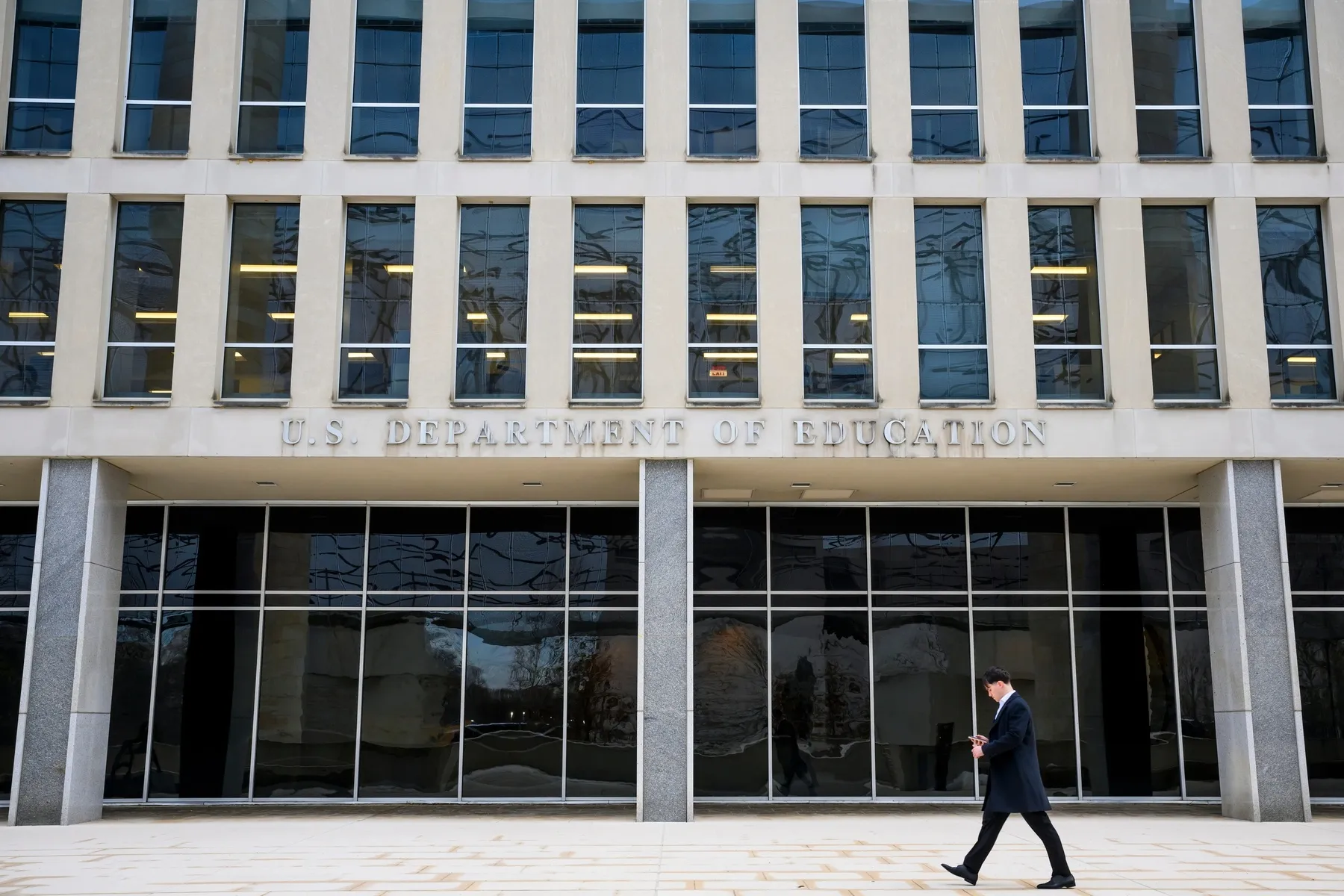
(Pete Kiehart/The Washington Post/Getty Images
What does the Department of Education do?
Ensuring that all students have equal access to education is the agency’s overarching responsibility. It includes a civil rights division that investigates allegations of discrimination related to factors such as sex, race and disability.
Trump can’t close the Department of Education with the sweep of a pen, but he can drive out its senior personnel or issue an executive order instructing the agency to severely reorganize, both of which would render it largely ineffectual. Placing dozens of the department’s employees on unexplained leave on Friday has already prompted a letter from a lawyer representing some of the staffers; it accuses the agency of retaliating against them for attending a DEI training. Should it be dismantled, the Department of Education’s key functions are expected to go to other federal agencies. Congressional approval, though, would be needed to transfer many of those duties.
While states, by far, provide most of the money public schools need to operate, the Department of Education, which has a $79 billion annual budget, disperses billions of dollars in federal funding. This includes to the Title I program, which gives supplemental funding to schools that primarily serve economically disadvantaged students. The agency also directs funding toward students with disabilities in line with the Individuals with Disabilities Education Act (IDEA), federal legislation that guarantees this population an education appropriate for their needs. Both IDEA and Title I, created in 1975 and 1965, respectively, predate the Department of Education and can be dissolved only by an act of Congress.
“I’m not sure what it accomplishes if they try to go after programs like Title I,” Noguera said. “They’re going to get a lot of opposition, not just from blue areas, but from red areas as well, and from Congress, because people tend to support the public schools.”
Like Title I and IDEA, the National Assessment of Educational Progress (NAEP) also predates the agency, which administers the test today. Known as the “Nation’s Report Card,” the results of the assessment provide the department with a baseline of how well students are doing in reading, math and other areas.
Upon last week’s release of NAEP scores showing that students’ reading scores had worsened and math scores had stalled, the Department of Education issued a statement unveiling the Trump administration’s plans to upend public schools and give states more control, a deceptive remark since states and school districts already have authority over what students learn. The federal government does not shape local curriculum.
But the Department of Education does track the academic progress of K-12 and college students. At the higher education level, the agency monitors how well institutions serve students by compiling data about admissions numbers and graduation rates. It also oversees funding for the federal student loan program and the Free Application for Federal Student Aid (FAFSA), which students complete to receive financial assistance for college. This aid includes the Pell Grants that supplement higher education costs for students from low-income households.
Braxton Brewington, a spokesperson for the Debt Collective, which works to abolish debt and transform how public goods and services are distributed, said that he’s concerned about how marginalized students will fare under an Education Department run by the Trump administration, though the Debt Collective also criticized Biden officials for not overhauling the student loan system.
“We are expecting the Trump administration to carry out a deeply catastrophic agenda,” Brewington said. “So that will look like privatizing education — K-12 to higher education — incentivizing private loans to pay for college, rolling back repayment plans like Public Service Loan Forgiveness and other types of safety nets. These plans are not ideal, but to the extent that they’ve helped borrowers, we’re expecting a Trump administration to roll those back.”
Does the public support closing the department?
Surveys of the public have found different attitudes about the Department of Education. A new poll released Tuesday by Data for Progress, a progressive think tank and polling firm, found that likely voters oppose eliminating the federal agency by about a two-to-one margin. Data for Progress conducted the poll of 1,294 likely voters from January 31 to February 2 on behalf of the Student Borrower Protection Center, which works to improve the student loan system, and Groundwork Collaborative, which advocates for an equitable economy.
Fifty-two percent of likely voters under age 45 strongly oppose closing the agency compared with 13 percent of this demographic who strongly support such a move. Forty-six percent of likely voters over 45 strongly oppose elimination, while 19 percent strongly support it. College-educated likely voters object to slashing the agency the most, with 55 percent strongly opposing this effort and 14 percent strongly supporting it.
A 2024 survey of Americans by the Pew Research Center found that partisanship shaped opinions about the federal agency, with 64 percent of Republican and Republican-leaning respondents holding an unfavorable view of the department. Just 26 percent of Democrats and Democratic-leaning voters felt the same. Overall, 44 percent of respondents had a favorable opinion of the agency and 45 percent had the opposite view.
Beyond partisanship, attitudes about the Department of Education may depend on whether people feel the agency plays a key role in their lives. Advocates for students with disabilities and student loan borrowers are among the loudest raising concerns about its potential dismantling or diminishment.
“The last time Trump was in office, he significantly understaffed the Office for Civil Rights,” Del Pilar said. “So I do think we should be concerned about what this potentially means for students with disabilities, for English language learners, for immigrant students, because if they don’t staff up and investigate, then we’re not going to see institutions, schools and districts’ feet held to the fire around the inequities that are being placed on our students.”
Why do Republicans want to kill this federal agency?
Republicans have wanted to eliminate the federal agency since its launch.
“Some of it was the old Republican focus on smaller government,” Noguera said. “They’re just shrinking the size of government and seeing the department as largely regulatory, but what they don’t understand is that many of the functions that are now within the U.S. Department of Education, such as funding Pell Grants, are essential to higher ed and access to higher ed for all kinds of Americans across the country. You can’t just get rid of that without a lot of resistance.”
Without congressional support, Noguera continued, the Trump administration will find it difficult to achieve its goals for the nation’s schools. Many of them, such as implementing school prayer, expanding voucher programs and limiting what students can learn and read in class, directly clash with the public education system.
On January 29, the White House issued an executive order asking the Department of Education to spend the next two months developing guidance to help states apply federal funding to school choice initiatives, mirroring a trend that’s been unfolding at the state level. For years, billionaires have collaborated with conservative lawmakers to route funding away from public schools and send it to private schools through voucher programs, according to a 2024 report by the Senate Committee on Health, Education, Labor and Pensions (HELP). Billionaires have funneled their financial resources into the School Freedom Fund, a political action committee that attempts to remove state lawmakers who oppose private school vouchers from office.
Billionaires have a vested interest in privatized education because they can cash in on it through voucher tax credits and federal business expense deductions, the HELP report posits. For example, over 20 states provide voucher tax credits to companies that make contributions to pay students’ private school tuition. Moreover, vouchers overwhelmingly benefit students from high-income families since they typically cover just part of tuition costs. Lower-income families can’t afford to make up the difference. The effort to defund the nation’s public schools, the study contends, is ultimately one to make the elite class even wealthier.
Vouchers harm communities that are already vulnerable due to systemic underfunding and disinvestment, Bolton said.
“By pulling out this money and constantly pulling the rug out under schools, folks who support vouchers, particularly in this administration, are really intentionally undermining the schools that will continue to serve the majority of our students,” said Bolton, who is now policy director at the Partnership for the Future of Learning, a network of organizations fighting for high-quality public schools. “It’s incredibly frustrating that this administration seems to want to pour into a federal voucher program that doesn’t serve us and isn’t really responsive to what people are telling our leadership.”