Tag: expungement

  • Ohio House Republicans introduce their own proposal to rewrite state’s recreational marijuana law

    Ohio House Republicans introduce their own proposal to rewrite state’s recreational marijuana law

    Stock photo of a marijuana dispensary from Getty Images.

    The Ohio House Republican version would keep home grow and tax levels the same, but reduce THC levels and redirect most of the tax revenue

    By:  Ohio Capital Journal

    A week after Ohio Senate Republicans passed a bill that would overhaul the state’s marijuana law, Ohio House Republicans introduced their own proposal. Their version would keep home grow and tax levels the same, but reduce THC levels and redirect most of the tax revenue.

    State Rep. Brian Stewart, R-Ashville, introduced Ohio House Bill 160 during a press conference Thursday. Similar to the Senate’s bill, the House’s bill would reduce the THC levels in marijuana extracts from a maximum of 90% down to a maximum of 70% and caps the number of marijuana dispensaries to 350. The bill, however, would keep the 10% tax on marijuana and keep Ohio’s home grow at 12 plants.

    “Our bill preserves the core of Issue Two, while also adding important protections for Ohio’s minors and addressing the issue of intoxicating hemp,” Stewart said, noting his goal is to pass a marijuana bill before the lawmakers go on summer break.

    Ohioans passed a citizen-initiated law to legalize recreational marijuana in 2023 with 57% of the vote, and sales started in August 2024. Ohio lawmakers can change the law since it passed as a citizen initiative. The state’s total recreational marijuana sales were $361,994,872 as of Saturday, according to the Ohio Department of Commerce Division of Cannabis Control.

    GET THE MORNING HEADLINES.


    “Every product that is legal today will remain legal under this bill,” Stewart said. “I think we are making very, very few changes here. … We’re not touching any of the core parts of Issue Two.”

    The bill deals directly with intoxicating hemp by requiring every THC product to be treated like marijuana and only be sold at the state’s regulated marijuana dispensaries.

    “Simply put, if it gets you high, it goes through a dispensary,” Stewart said. “I don’t think Ohioans are excited about the fact that you get essentially the same thing that’s less safe from a local gas station. I don’t want my kids to go walk into your local gas station chain and buy marijuana.”

    The bill would change how the marijuana tax revenue is directed, sending a “bulk of tax revenue to Ohio’s general fund,” Stewart said, mentioning he worked closely with House Speaker Matt Huffman, R-Lima, on drafting the bill.

    Even though legal weed sales started last year, Ohioans could start legally growing marijuana at home shortly after Issue Two passed in 2023.

     Ohio state Rep. Brian Stewart, R-Ashville. Official photo. 

    “I think the longer you wait, the harder it is to make substitute changes,” Stewart said. “I think in the real world, folks who are growing 12 plants today are not likely to grow less than 12 plants just because we passed a law at the Statehouse.”

    H.B. 160 prohibits using marijuana in public spaces, but allows for smoking inside a privately owned property, including outside on a residential front porch.

    “It’s legal to use these products at your home,” Stewart said.

    The bill would also offer expungement for prior convictions for marijuana related offenses.

    “As the views of Ohioans have shifted on the issue of marijuana, our laws should reflect that, and allowing people to remove these offenses from their criminal record is good policy,” Stewart said.

    Even though the Senate recently passed their own bill, Stewart doesn’t think his bill will create a possible standstill where nothing gets passed.

    “I’m going to leave it to the two gentlemen that hold the gavel as to which bill is moving, but it’s one or the other,” Stewart said.

    The Ohio Cannabis Coalition (OHCANN) is still digesting this latest piece of legislation, but Deputy Executive Director Adrienne Robbins seemed optimistic about H.B 160.

    “We do think this is a really positive step forward,” she said. “When you look at the Senate bill and the different iterations of it that came out, I think this is another step forward, and it does make us feel like lawmakers are one, listening to us, but then, maybe more importantly, listening to consumers’ concerns as well.”

    What’s in the Senate marijuana bill?

    Senate Bill 56 would significantly change Ohio’s weed laws.

    The bill would limit Ohio’s home grow from 12 plants down to six, reduce the THC levels from a maximum of 90% to a maximum of 70%, and mandates that marijuana can only be used in a private residence.

    S.B. 56 allows someone to apply to the sentencing court to have their record expunged if they were convicted or plead guilty to possessing 2.5 ounces of marijuana before the state law went into effect. Under the bill, the applicant must pay a $50 filing fee.

    The bill would combine the state’s medical and recreational marijuana programs under the Division of Cannabis Control, require marijuana be transported in the trunk of a car when traveling, and would limit the number of active dispensaries to 350.

    It would also ban Ohioans from using marijuana that is not either from a licensed Ohio dispensary or cultivated at a consumer’s home. This would make it illegal for Ohioans to drive up to Michigan to purchase marijuana and bring it back over state lines.

    The bill originally dealt with taxes and how funds were distributed, but those provisions were removed during committee.

    Ohio Gov. Mike DeWine’s proposed budget, which is currently being heard in the Ohio House, increases the tax on marijuana from 10% to 20%. The budget is due July 1.

    Potential déjà vu?

    This is not the first time both chambers have tried to pass their own legislation in attempts to change the state’s marijuana law.

    Shortly after Ohioans voted to legalize marijuana, the Ohio Senate quickly passed a bill that would have made major changes to the law that would have affected taxes and home grow, but the Ohio House never brought the bill to the floor.

    Instead, state Rep. Jamie Callender, R-Concord, introduced a bill that would have clarified some of Issue 2’s language, but it never made it out of committee.

    Follow Capital Journal Reporter Megan Henry on Bluesky.

    YOU MAKE OUR WORK POSSIBLE.

    _______________
    Megan Henry
    Megan Henry

    Megan Henry is a reporter for the Ohio Capital Journal and has spent the past five years reporting in Ohio on various topics including education, healthcare, business and crime. She previously worked at The Columbus Dispatch, part of the USA Today Network.

    Ohio Capital Journal is part of States Newsroom, the nation’s largest state-focused nonprofit news organization.

    MORE FROM AUTHOR

  • Bipartisan bill would legalize marijuana in Ohio

    Bipartisan bill would legalize marijuana in Ohio

    Loveland, Ohio and Columbus

    House Bill 168 would rename Ohio’s Medical Marijuana Control Program to the Division of Marijuana Control and it would be in charge of regulating the medical marijuana and adult-use programs.

    BY:  Ohio Capital Journal

    Ohioans 21 and older would be able to cultivate, purchase and possess marijuana if a bipartisan bill passes in the Ohio Statehouse.

    State Reps. Jamie Callender, R-Concord, and Casey Weinstein, D-Hudson, introduced House Bill 168 — also known as the Ohio Adult Use Act — earlier this month.

    The bill would also allow conviction records for prior cultivation and possession offenses to be expunged.

    “Adult-use is good for our economy, good for our justice system, and the right thing to do,” Weinstein said in a news release. “Ohioans are ready to legalize cannabis.”

    HB 168 would put a 10% sales tax on adult-use cannabis products. Researchers at Ohio State University estimate the potential annual tax revenue generated from adult-use cannabis in Ohio ranges from $276 million to $374 million in year five of an operational adult-use cannabis market.

    “It opens up a route for people to have access to cannabis without punishment, without losing their jobs, without losing child custody,” said Tim Johnson, CEO of Cannabis Safety First.

    The bill would rename the Ohio’s Medical Marijuana Control Program to the Division of Marijuana Control and it would be in charge of regulating the medical marijuana and adult-use programs. The division would be housed within the Ohio Department of Commerce.

     COLUMBUS, OH — JANUARY 03: Rep. Jamie Callender (R-Concord) speaks from the floor during opening day ceremonies of the 135th General Assembly of the State of Ohio, January 3, 2023, in the House Chamber at the Statehouse in Columbus, Ohio. (Photo by Graham Stokes for Ohio Capital Journal. Republish photo only with original story.) 

    “Through the expansion of Ohio’s successful Medical Marijuana program to all Ohioans, we will not only be building upon best practices from around the country but utilizing the lessons learned here in Ohio,” Callender said in a news release.

    Twenty-two states, including Michigan, and Washington, D.C. have legalized the recreational use of and sale of cannabis.

    “It’s time for Ohio to act on this before we fall too much further behind our neighbors,” Weinstein said.

    Legalizing marijuana would free up the judicial system from cannabis arrests and possession charges, Johnson said.

    “It will allow law enforcement to centralize their resources around more harmful drugs and other priority incidents as far as criminal activity and so forth in their communities,” he said.


    Expunged


    The expungement piece of the bill would help people go through a quicker process to get their possession or trafficking charges erased.

    “The whole principle behind all of this is … to open up our workforce pool … to allow people to return to being able to purchase homes, go to school, receive grants, have custody rights, all of that,” Johnson said.

    Gov. Mike DeWine signed Senate Bill 288, a massive criminal justice reform bill, into law earlier this year and it went into effect in April.

    One of the things the bill does is allow prosecutors to expunge low-level marijuana possession offenses. It also prevents arrests and convictions for possessing marijuana paraphernalia from appearing in Ohio’s criminal records.

    Coalition to Regulate Marijuana like Alcohol

    The Coalition to Regulate Marijuana like Alcohol is collecting petition signatures to get a similar proposal on November’s ballot. The coalition needs to get 124,000 signatures from 44 of Ohio’s 88 counties by the July 5 deadline.

    Their proposal would legalize and regulate the cultivation, manufacturing, testing and sale of marijuana to Ohioans 21 and up. Ohioans 21 and older could home grow with a limit of six plants per person and 12 plants per residence, and it would impose a 10% tax at the point of sale for each transaction.

    The proposal was submitted by citizens through an initiated statute, so it is not an amendment to the state’s constitution. Ohio’s Aug. 8 special election will ask voters if the state constitution should be harder to amend.

     COLUMBUS, Ohio — APRIL 20: Tim Johnson, an Air Force veteran and retired law enforcement officer who has worked with Ohio lawmakers on cannabis legislation joins supporters of legalized marijuana, April 20, 2023, outside the Statehouse in Columbus, Ohio. (Photo by Graham Stokes for Ohio Capital Journal. Republish photo only with original story.) 

    Pricilla Harris, executive director of the Sensible Movement Coalition, is excited about the legislation to legalize marijuana, but said advocates favor the ballot proposal.

    The ballot proposal has more protections for possession limits — 2.5 ounces compared to the bill’s 50 grams.

    “We are still looking for patient protection, workforce protection for employers,” Harris said. “Unfortunately, we are just kind of lacking in that area when it comes to the bill.”

    Between legislation and the ballot initiative, marijuana activists are confident weed will soon be legalized in Ohio.

    “Either way you’re gonna see something happen this year in Ohio,” Johnson said.

    Harris said it’s exciting to think about marijuana potentially being legalized.

    “We would no longer be putting collateral damage on the residents of Ohio that are choosing cannabis as their medicine or their personal use,” she said.

    Senate Bill 9

    Senate Bill 9 — introduced by State Sens. Stephen Huffman, R-Tipp City, and Kirk Schuring, R-Canton — would expand Ohio’s medical marijuana program by adding​​ more permissible forms of medical marijuana and adding to the list treatments for medical conditions.

    It would also create a 13-member Medical Marijuana Oversight Commission that would oversee the Division of Marijuana Control within the Department of Commerce to oversee Ohio’s Medical Marijuana Program.

    Currently, the Ohio Department of Commerce, the State Medical Board of Ohio, and the Ohio Board of Pharmacy oversee regulation and licensing in the marijuana program.

    There are 355,368 patients that have registered for medical marijuana and 168,741 have both an active registration and an active recommendation as of March, according to the Ohio Medical Marijuana Control Program.

    Follow OCJ Reporter Megan Henry on Twitter.


    Megan Henry
    MEGAN HENRY

    Megan Henry is a reporter for the Ohio Capital Journal and has spent the last five years reporting on various topics including education, healthcare, business and crime at The Columbus Dispatch, part of the USA Today Network.

    MORE FROM AUTHOR

  • Clermont Law Library offers resources for all

    Clermont Law Library offers resources for all

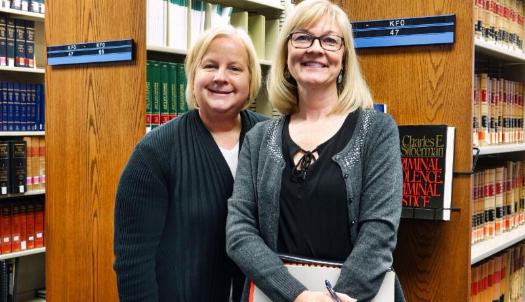
    Law librarians Debbie Smith, left, and Kim Crowthers 

    Batavia, Ohio – Tucked into a wing of the Clermont County Common Pleas Courthouse is the Law Library. Its 15,000 legal volumes and online resources are the domain of Director Kim Crowthers and library assistant Debbie Smith.

    Not that Crowthers thinks of it as her domain. She is the first to tell you that she and Smith are there to serve their constituents – which include county government and all other jurisdictions within Clermont County – cities, villages and townships – that need legal resources and services. As well as, of course, judges, magistrates, prosecutors and public defenders. And, not least, the public.

    “We provide equal access to justice,” Crowthers says.

    “We provide equal access to justice,” Crowthers says. “We provide resources to both public defenders, whose clients are not able to afford an attorney, and the Prosecutor’s Office, allowing for more equal footing. And we provide resources to people who may technically be able to afford an attorney, but in reality can’t.”

    The Ohio Revised Code (ORC) requires that every county have a law library, although in small counties it may only be a shelf or two of books. They are typically found at the county courthouse, to ensure easy access for judges, magistrates and lawyers. A law passed in 2010 required that law libraries permit access to the public, but Crowthers said that was a longstanding practice in Clermont County.

    The library offers small conference rooms, which are frequently used by public defenders meeting with their clients. Its large conference room often is used for depositions, and for other meetings of a legal nature. “There is total privacy and confidentiality in this room,” she said. “There are no cameras or microphones.”

    Helping people

    Crowthers and Smith are frequently on the phone or helping people face-to-face, answering questions and directing people to the right place.

    “We get a lot of questions from local attorneys  – can you send this specific citation to me, or provide this particular resource,” she said. “Judges will call us or come in if they need to consult the ORC or the rules of professional conduct; or if they need to check on civil or criminal procedures or Ohio jury instructions.”

    Richard P. Ferenc, Administrative Judge of Common Pleas Court, acknowledges that the Law Library is crucial to the courts in Clermont County. “For over 80 years the Clermont County Law Library has been an integral partner in our county’s justice system,” he said. “It is the only county library that provides the critical legal resources judges, attorneys, and citizens require to make informed and thorough decisions.

    “The library is able to provide these resources and services at a cost significantly lower than could any judge individually,” Judge Ferenc added. “As there are nine judges in the county that the library serves, the savings are indeed substantial.”

    The library offers self-help books and legal forms.

    As for the general public, the library offers self-help books and legal forms. “We get requests for power of attorney, health care power of attorney, expungement forms. We frequently get requests for specific motions, such as a motion for discovery,” Crowthers said. She and Smith are just as eager to help the public as they are the courts. “We can’t give advice, but we can point them in the right direction,” she said.

    The staff prides itself on its user friendliness – in fact, that is in its mission statement. “I have a service-oriented heart,” Crowthers says. “I love being able to help people in as many ways as possible. I fell into the right job.”

    Crowthers has worked at the Law Library for 30 years, having begun there part-time after leaving an unsatisfying job in banking. She learned under the tutelage of longtime director Carol Suhre, who retired late last year. Carol, said Judge Ferenc, transformed the library “from what one might call a ‘mom and pop’ operation into a state-of-the-art operation.”

    Crowthers became director at the end of 2017, when Suhre retired.

    Smith and Crowthers are just as eager to help the public as they are the courts.

    Funded by fees, fines

    The county Law Library is funded through a percentage of traffic fines and bond forfeiture fees paid to the county. Funding has declined over the years, Crowthers said, beginning during the recession. The operation is lean; staffing has gone from three to two. The 2018 budget is approximately $300,000, and of that, $170,000 is for legal resources.

    All resources in the library are free to the courts and government staff, including copy and faxing services. The library does charge the public and outside attorneys for copy and fax services – although there is no charge for access to the library and its resources.

    Even after 30 years, Crowthers’ dedication and enthusiasm for her job – and the mission of the Law Library – has not waned. “I have no doubt that Kim will continue to maintain the outstanding resources and services to the justice system that has become the hallmark of this most important county library,” Judge Ferenc said.

    The Clermont County Law Library is open 8:30 a.m.-4:30 p.m. Monday-Friday. It is located at Common Pleas Courthouse, 270 E. Main St., Batavia. Phone: 513.732.7109.


    Start the New Year Right