Loveland, Ohio – The Loveland City School District Board of Education will be scheduling a “Special Meeting” on Friday, August 20 at 6 PM to discuss the district policy concerning the use of face coverings and masks.
Loveland schools begin classes tomorrow morning, Wednesday, August 18.
The current Board policy concerning face coverings is that the wearing of masks by students, teachers, staff, and visitors inside of all District school buildings is optional. Masks are required by federal law to be worn on school buses.
Oxford, Ohio – Miami University President Gregory Crawford said in an announcement Friday, “This week we have all been witnessing a troubling spread of COVID-19 on university campuses across the nation, and we will continue to monitor developments as many more schools begin to reopen next week so we can learn from their challenges and decisions.”
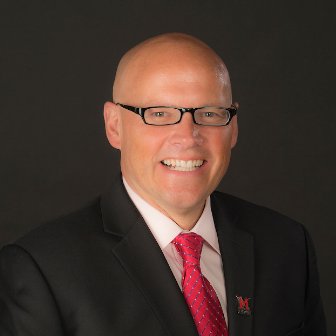
Miami University President Gregory Crawford(Photo Miami University)
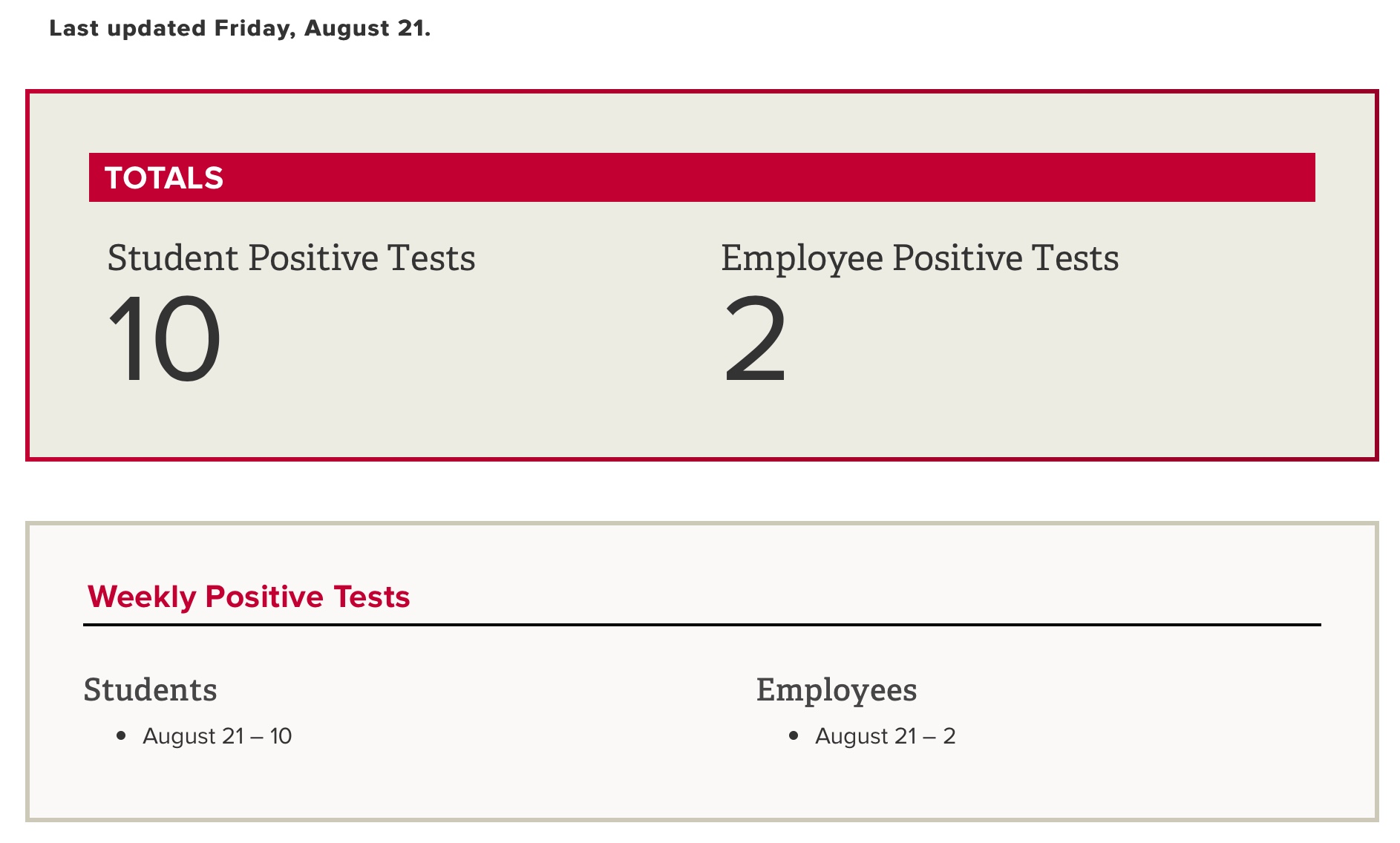
Along with the statement Crawford reported that on the Oxford campus, since the start of classes, they have had 10 positive COVID-19 tests among students and 2 among employees.
Miami has now created a dashboard to track positive results from tests conducted at the Employee Health Center and Student Health Service managed by TriHealth.
The announcement also introduced a symptom tracking app, Campus Clear (available for download from the app store on a mobile device), which must be completed daily if coming to campus. An illness/absence reporting system is also in place to help track potential outbreaks in the Oxford community.
Buildings on all campuses have reopened. Miami has begun to phase-in on-campus operations, and in the coming weeks students will be returning in stages.
Fall classes began on Monday, August 17, mostly remote, with graduate students and some programs in person.
Classrooms are organized to maintain six-foot physical distancing, and cleaning materials are available to clean desks and common spaces before and after each use.
Students who will be living off campus are encouraged to stay home, if they can, until face-to-face courses start on Monday, September 21. All students are expected to follow health and safety protocols, “like those in our residence halls, in their off-campus living arrangements.”
All returning students must sign the Healthy Together Community Pledge, committing to take responsibility for their health and others’ through recommended precautions to help prevent the spread of COVID-19 on campus and in the community. The pledge focuses on preventative measures such as social distancing, face coverings, cleaning practices, handwashing and sanitation, daily symptom assessment, limiting indoor or outdoor gatherings to fewer than 10 people, and not attending or hosting any gathering where physical distancing is not possible. It also asks students to pledge to participate in testing, contact tracing, and quarantine or isolation if they or their close contacts become ill with COVID-19.
The phased-in strategy will culminate with the students residing on campus moving into the residence halls during the week of September 14. Face-to-face and hybrid offerings will begin on campus on Monday, September 21.
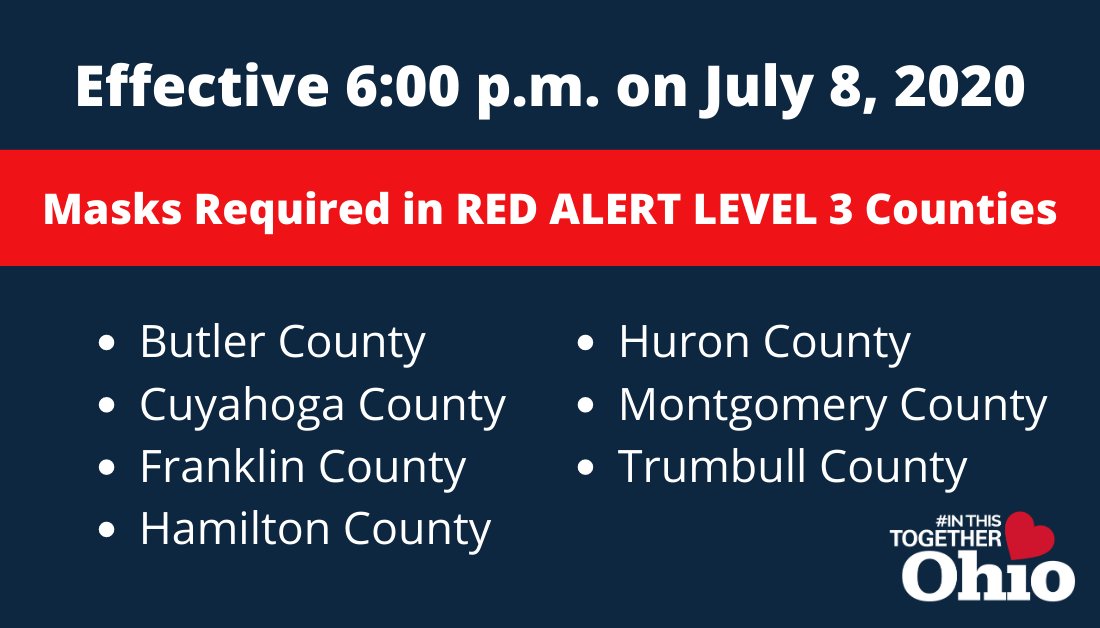
Loveland, Ohio – Today beginning at 6 PM all of Hamilton County is under an order of the Ohio Department of Health that mandates the wearing of face coverings in public.
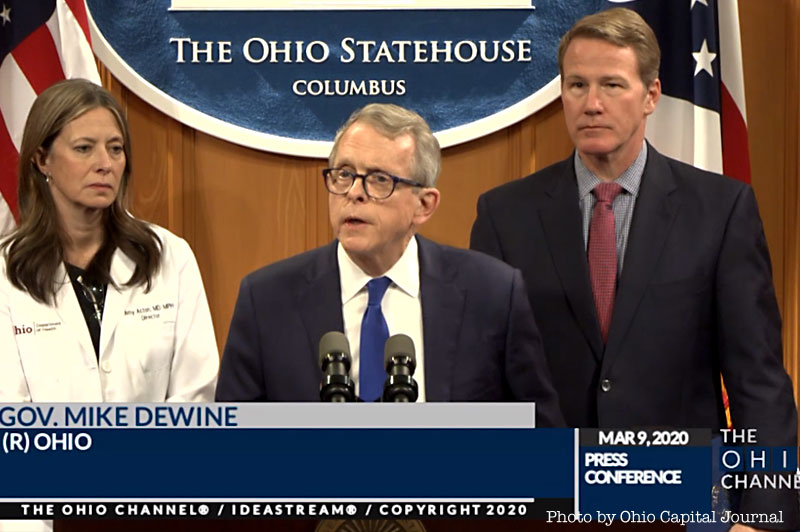
Columbus, Ohio – Ohio Gov. Mike DeWine laid out reopening guidelines for state K-12 schools on Thursday, including a mask requirement for teachers, but no such mandate for students.
DeWine said it is “the state’s strong recommendation” that children from the third grade on wear face masks, but maintained that local control for school districts will be in place as reopenings begin.
“A great deal of flexibility is allowed, as it should be,” DeWine said in his Thursday COVID-19 press conference.
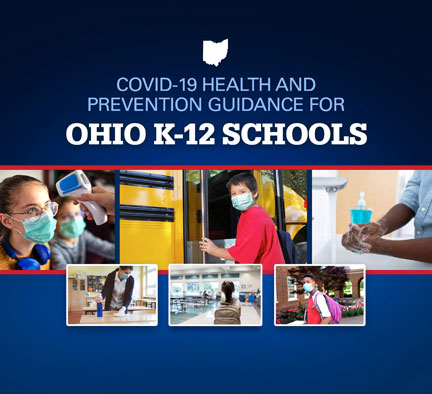
Ohio Department of Education’s 36-page planning guide
The governor announced that the Ohio Department of Education published a 36-page planning guide that includes recommendations on everything testing to field trips and recess precautions.
The guidance is specifically noted as “not mandatory” in the documents and emphasized the need for schools and districts to develop and implement their own protocols, while using the information provided by local and state health departments.
“Planning teams should include school leaders, local health department officials, local school board members, educators, education support professionals, school health professionals, parents, students, community partners and local business leaders,” the planning documents stated.
In developing coronavirus related-protocols, DeWine said before anyone enters a school facility, parents and school officials should “vigilantly assess” symptoms, and take the temperatures of everyone coming into the schools. In the guidance, outside individuals such as delivery personnel, student teachers and faculty of student teachers are all treated the same as official school personnel.
The Loveland District is currently working on models for reopening school in the fall, “which can be adjusted based on the pending guidance from state and local health agencies.”
The planning guide said flare-ups are considered “expected” by state officials, and warns that school buildings may need to close in the event of said flare-up.
Schools were told to work with local health departments to develop a testing strategy, thoroughly clean and sanitize schools, and teach and practice social distancing and hand-washing.
Social distancing in places like school buses will be more difficult, and DeWine said as much distance as is possible will benefit students and staff.
“(Specific measurements of distance is) all relative and it’s somewhat arbitrary,” DeWine said. “But the more distance you can have the better.”
COVID 19 Health and Prevention Guidance for Ohio K-12 Schools
Face coverings are required by staff unless it is unsafe or if doing so “could interfere with the learning process,” DeWine said on Thursday.
Ohio Federation of Teachers Executive Director Melissa Cropper appreciated the moves by the governor, but said the OFT worries about the financial demands of the new protocols.
“We are concerned that local governments and school districts will have to make decisions about the governor’s recommendations at a time when they are anticipating budget crunches and beginning to make spending cuts,” Cropper said in a statement.
DeWine said it “is not right for me or (other departments) to micromanage” school buildings or districts.
The governor did say he plans to meet with House Speaker Larry Householder, Senate President Larry Obhof, and minority leaders to discuss extra funding, along with the use of CARES Act funding.
Cropper said schools would benefit from HEROES Act funding as well, a bank of about $2 billion in monies for K-12 education, but the act is still awaiting U.S. Senate consideration after passing the House.
The guidance comes as the state faces continual growth in coronavirus cases, and data showing that cases are passed through the individuals within the area. DeWine noted that 80% of confirmed cases in Montgomery County have been linked to community spread.
Columbus, Ohio – Governor Mike DeWine Thursday declared that “We’re in a crisis S/state in Ohio.” He was speaking at a COVID 10 news briefing in Columbus.
The governor dithered. The state legislature said no way.
So on Tuesday, the Springfield City Commission took it upon itself to pass a resolution (which lacks the force of law) calling for all residents to cover their faces while indoors, a practice research says will slow the spread of COVID-19 through Ohio.
By Wednesday, Dayton became the first major city in Ohio to require masks by law. Similarly,Yellow Springs passed a resolution andBexley passed a local ordinance requiring masks.
“The mask is a symbol of freedom,” said David Estrop, a Springfield city commissioner, at a hearing, echoing comments from the governor. “It allows us to continue to reopen this state, yet do so in a way that’s safe.”
By Wednesday, Dayton became the first major city in Ohio to require masks by law. Similarly, Yellow Springs passed a resolution and Bexley passed a local ordinance requiring masks.
On Wednesday, the Ohio Department of Health reported more than 1,000 new cases, the first time that stat has reached quadruple digits since officials mass-tested inmates in three state prisons in late April. Wednesday marks 16 days of the coronavirus accelerating its spread, as measured by the 10-day average new caseload.
Despite the worsening coronavirus outlook in Ohio and nationwide, state lawmakers continue to whip up anti-mask fervor. While Gov. Mike DeWine encourages everyone to wear masks, he has refrained from issuing any statewide mandate as the national epidemic worsens and states pause their economic re-openings.
DeWine demurs
In April, Gov. Mike DeWine took a hardline stance on masks, saying they’d be the only way business can reopen after he lifted the stay-at-home order.
Last week, referencing worsening outbreaks in Montgomery and Hamilton counties, DeWine floated the idea of implementing a mask mandate on a county-by-county basis.
However, he has yet to issue any such order. A spokesman declined to say whether DeWine will announce any mask requirement at his next briefing.
In a statement Wednesday, DeWine applauded Dayton Mayor Nan Whaley, a Democrat, for requiring the use of face coverings.
“Wearing a mask will allow us to help keep businesses open and help prevent further spikes,” he said. “I encourage other communities to consider following Dayton’s lead.”
Voted down
Where masks have found friends in the public health community and Ohio cities, they found enemies in the GOP-controlled state General Assembly.
Where masks have found friends in the public health community and Ohio cities, they found enemies in the GOP-controlled state General Assembly.
Both the Speaker of the House and the Senate President have refused to wear masks at legislative functions.
“It’s my RIGHT not to wear a mask, and I do NOT support a government that tries to quarantine the healthy,” he wrote.
Rep. Nino Vitale, R-Urbana, takes to social media regularly to promote baseless conspiracy theories about masks limiting blood oxygen or how they “force virus into the brain.”
Rep. Candice Keller, R-Middletown criticizes Bureau of Workers’ Compensation for distributing masks to Ohio businesses.
Rep. Candice Keller, R-Middletown,produced a Facebook video June 25 criticizing Ohio’s Bureau of Workers’ Compensation for distributing masks to Ohio businesses.
Despite the lawmakers’ claims, research suggests masks are an effective, inexpensive and non-invasive way to slow the spread of COVID-19.


![[12 positive cases] COVID-19 Oxford Campus Dashboard now available](https://lovelandmagazine.com/wp-content/uploads/2020/08/EZWQ_4AXkAAzUIf.jpeg)