Tag: Fair School Funding Plan

  • Ohio public education supporters look to 2024, lawsuit to hold private voucher system accountable

    Ohio public education supporters look to 2024, lawsuit to hold private voucher system accountable

    Getty Images

    BY:  Ohio Capital Journal

    While marijuana legislation and other bills still sit on the horizon in the second year of this term’s General Assembly, education policy can always be counted on to be a part of the discussion. 2024 should be no different.

    Ohio’s private school voucher program has been a source of strong debate among legislators and education advocates of all kinds since the 1990s, when the program began as a way to allow lower-income students to access private schools, proposed as an effort to improve education outcomes in poor-performing public school districts.

    But as public school advocates still hope to see full funding of the Fair School Funding Plan for districts across the state, they saw eye-popping increases in private school funding through vouchers that worry them almost as much as the foot-dragging that they believe has occurred when talking of public school funding.

    “You should be funding the public schools,” said Stephen Dyer, former state representative and former chair of the Ohio House Primary and Secondary Education subcommittee for the House Finance Committee. “If you want to fund the private schools, fund the private schools, but there’s no reason you can’t do both.”

    Private school voucher expansion by the numbers

    The Ohio Department of Education reported 23,272 participants in the voucher expansion for the 2023 fiscal year, up from the 20,702 reported in 2022 and even more from the year prior, when 17,155 students participated in the state-subsidized program.

    In 2021, 85% of the voucher expansion participants were below 200% of the federal poverty line, and 93% of 2022 participants were below 250% of the poverty line.

    In 2023, language on the ODE data changed to “low-income qualified” to “not low-income qualified,” removing the breakdown of federal poverty percentages. In this year’s report, 67% of participants were “low-income qualified” and 32% were “not low-income qualified.”

    With the most recent state budget, passed this summer, a GOP-led effort to expand eligibility for private school vouchers led to a ballooning of the poverty level allowed for the voucher program to 450% of the poverty line, or a household income of $135,000 or less for a family of four.

    Those receiving a scholarship can move to a private school with $6,165 in state funding for K-8 students, and $8,407 for high schoolers.

    Families with incomes above the $135,000 threshold can still be eligible for at least 10% of the maximum scholarship, even with a higher income, Senate President Matt Huffman’s office said when the budget was passed.

    Public school advocates took issue with the expansion, saying the Fair School Funding Plan, seeking to support public school districts based on their individual needs, should be the focus, considering the vast majority of students in Ohio attend traditional public schools.

    ‘A perversion of the idea behind a voucher’

    Since the most recent voucher participation numbers were released, Dyer did his own analysis of the voucher program, finding “a very different goal” compared to when it began.

    “It’s now going to wealthier, white families to subsidize the decisions they’d already made to send their kids to private schools,” Dyer told the OCJ.

    In an analysis he posted to his blog, Dyer said ODE data showed nearly nine in 10 new applications to the voucher expansion went to white students, and more new vouchers for high schoolers went to families making more than $150,000 annually than went to families making less.

    Dyer also makes an argument that has been made before by those opposing the voucher expansion: increasing private school voucher program causes “resegregation” in the public schools, with the number of white students who are leaving for private schools, vouchers in hand.

    “It’s frankly a perversion of the idea behind a voucher, which was sold as allowing poor students, students of color, students who haven’t traditionally had access to private schools, to have access,” Dyer said in an OCJ interview.

    The most recent data on Ohio’s EdChoice voucher expansion showed 66.4% of participants are white, with the Black population of voucher recipients coming in at 15%, the second highest number reported.

    In 2022, 65.9% of expansion vouchers went to white students, up from 64.1% in 2021.

    A vast majority – 9 in 10 – vouchers come from just 31 school districts, according to Dyer.

    “Those districts’ racial makeup is, on average, 21% white,” he writes in his analysis. “Yet 46% of EdChoice voucher recipients are white – more than double the percentage of white students than attend the 31 public school districts where nine in 10 voucher students would otherwise attend.”

    At the very least as the voucher program continues in Ohio, Dyer hopes a plan to audit the program is forthcoming for the billions of dollars spent to subsidize it. He pointed to an audit of the defunct Electronic Classroom of Tomorrow (ECOT), which exposed false enrollment numbers and led to court battles to claw back more than $60 million in state funding from the online charter school.

    “It’s all of our dollars, so we have a right to say what happens with all of our dollars, and we certainly have a right to audit where our dollars are going,” Dyer said.

    The lawsuit

    With a Republican supermajority in both chambers of the legislature, support of private school vouchers and “school choice” seems assured at least for the foreseeable future, so public school advocates are looking to other avenues to make change.

    Another court battle is still simmering in the Franklin County Court of Common Pleas, a lawsuit that seeks to tamp down on the voucher program in favor of the constitutional obligations the legislature has to properly fund public schools.

    The lawsuit was filed in Jan. 2022, accusing the state of Ohio of improperly and unequally funding private schools, specifically targeting the growth of the voucher program as a drain on public school resources.

    “The legislature has only moved to further expand private school vouchers in Ohio,” the leading group in the lawsuit, Vouchers Hurt Ohio, wrote in a recent statement on the program. “We do not stand a chance of changing their minds or direction so we are forced to sue to get a fair hearing in a court of law where the Ohio Constitution is respected and means something.”

    Amidst the nearly two years the case has been ongoing, time extensions have been granted and Ohio Senate President Matt Huffman has asked to be excused from a deposition due to “legislative privilege,” also arguing the testimony sought from Huffman “is neither legally relevant nor necessary.”

    Franklin County Judge Jaiza Page has not ruled on Huffman’s subpoena, but allowed subpoenas for 42 “non-party private schools” in Ohio as part of the case, selected, according to the lawsuit filers “as a representative sample based on their location, demographics, percent of EdChoice students enrolled and total EdChoice funds received.”

    Parties standing against the public school advocates in the case said the passage of the state budget, including an increase in funding for the Fair School Funding Plan along with the voucher expansion should allow for the dismissal of their complaints on funding of public schools.

    “And while plaintiffs presumably still take issue with the new, amendment program, that does not change the fact that their current complaint challenges legislation that ‘is no longer the operative legislation governing EdChoice,” attorneys arguing for dismissal stated.

    A deadline for documents and evidence in the case was Nov. 30, and the court has requested “expert reports” from both sides by Feb. 23 of next year, with a trial date set for Nov. 4, 2024.

    Susan Tebben
    SUSAN TEBBEN

    Susan Tebben is an award-winning journalist with a decade of experience covering Ohio news, including courts and crime, Appalachian social issues, government, education, diversity and culture. She has worked for The Newark Advocate, The Glasgow (KY) Daily Times, The Athens Messenger, and WOUB Public Media. She has also had work featured on National Public Radio.

    MORE FROM AUTHOR

  • ‘Legacy of neglect’ showcased in Ohio schools report

    ‘Legacy of neglect’ showcased in Ohio schools report

    Stock image from Pixabay.

    BY:  – Ohio Capital Journal

    A report from an Ohio think tank examined the new budget changes and private school voucher impacts on public schools over the last year.

    Research from Policy Matters Ohio said divestments from public schools at the state level “hurt public school students everywhere – especially those in rural counties.”

    Furthering study of the impact the COVID-19 pandemic had on education, Policy Matters’ Tanisha Pruitt and Cassie Mohr said those pandemic effects combined with “Ohio’s legacy of inadequate, inequitable funding” have “weakened the role school plays as a foundational public institution.”

    Ohio was ranked 21st in a U.S. News & World Report on K-12 education and 46th in an EdWeek ranking of equitable distribution of education funding, both of which were cited as part of the 2023 report.

    “Ohio’s students deserve a world-class education, including safe and well-resourced schools that are staffed by teachers who are well trained and fairly paid,” Pruitt and Mohr wrote.

    The new report also confirmed what advocates have repeatedly noted over the years that the public school funding model has been debated — that the vast majority of Ohio students are enrolled in public schools.

    Of the nearly 2 million students enrolled in K-12 education in Ohio, 88.6% are in public schools, and 8.8% are in private schools, while 2.7% are home-schooled.

    Private school vouchers saw a significant change in Ohio’s most recent two-year budget this summer, when legislators opened the state-paid subsidies to 450% of the federal poverty level, nearly universal eligibility.

    But also included in the budget was another phase-in of the Fair School Funding Plan, a six-year effort to dive into the real cost of funding public school students, and fund the schools on an individual basis based on their needs.

    “When fully implemented, the six-year FSFP will correct the over-reliance on local property taxes, eliminate funding caps on districts, and base funding on per-pupil cost estimates that more accurately reflect what it takes to educate a diverse student population,” the report stated.

    Policy Matters’ report focused largely on public schools, where they found a student population that is “somewhat more racially diverse than the state overall” with a makeup that is 16.4% Black versus the 13.3% population in the state overall, and serving a large population of more than 800,000 who are considered economically disadvantaged.

    Pruitt and Mohr remained skeptical of the ultimate success of the FSFP, however, as legislators have “only incrementally moved funding through the formula.”

    “If legislators follow through on their promise to fully realize the FSFP by 2026, they will be helping every public school in the state to be equitably funded, and helping ensure that we live in a state where every child has what they need to succeed in school and after graduation,” the report stated.

    Senate President Matt Huffman has commented in the past that he wouldn’t support funding more than two years at a time, to avoid saddling future General Assemblies with budget items with which they may not agree.

    Teachers

     Source: Policy Matters Ohio 

    The constraints of COVID had their effect on teachers as well, but even outside of the pandemic education methods, educators still face pressures, according to the 2023 report.

    “Teachers recently have experienced a rash of targeted political campaigns to stoke division by denying the identities of trans and nonbinary students, as well as censoring what teachers are allowed to teach in the classroom,” Pruitt and Mohr wrote.

    Beyond that, compensation levels have not kept up over the years, with the Ohio Department of Education showing an average annual salary of $69,130 for an Ohio teacher in the 2022-2023 school year. That amounts to a decrease of more than 6% from the 2018-2019 school year, according to the new Policy Matters research.

    “These factors contribute to one of the most significant problems facing Ohio schools today: too many have too few teachers to give our kids the education they deserve,” according to Pruitt and Mohr.

    The state has also seen a dip in newly licensed teachers as well, with more than 9,000 teachers leaving their jobs in 2021, but only 5,388 earning a new license.

    “Recruitment declines can be attributed to low pay, poor working conditions and other economic factors,” researchers found. New teachers are paid less, and face mounting student loans on top of a salary that is often less than fellow graduates in other professions, they said.

    But licensure was addressed in the budget, with a clause allowing substitutes to have one-year temporary substitute teaching license which could increase the number of subs, and some members of the military could obtain a “military educator license.”

    “While these changes have the potential to boost our educators workforce, they weaken teacher training requirements, which could negatively affect the quality of classroom education, especially in high-poverty schools that already grapple with recruiting and retaining highly qualified educators,” Policy Matters researchers argued.

    The state needs to improve the recruitment methods, according to the report. It could use models like the one pursued by Cincinnati Public Schools superintendent Iranetta Wright, who pledged to recruit more teachers who matched the demographics of her school, but also keep teachers from being saddled with debt by increasing funding for grant programs and teacher residency programs.

    State testing

    For the teachers who are in schools, state testing can be a significant part of the school year, and despite their best efforts, inequities can shine through in even the standardized assessments for subjects like math and reading.

    A 2022 National Assessment of Educational Progress showed fourth and eighth graders in the state “were not statistically different from the national average,” according to Pruitt and Mohr, and Ohio was ranked 21st in a U.S. News & World Report ranking on pre-K-12 education.

    “However, these statewide metrics can mask a high degree of variability among districts, schools and student populations, with predictable disparities,” Policy Matters stated in their 2023 report.

    Disparities among English Language Arts and math scores, for example, don’t have a single cause, researchers found, but “inequities in school funding track closely with gaps in academic achievement.”

     Source: Policy Matters Ohio 

    An analysis of test scores and categories from the Ohio Department of Education showed disparities among student races, but also showed a universal trend that economically disadvantaged students “are more likely to live in school districts with concentrations of poverty – including in rural and Appalachian counties – where property-value-based school funding shortchanges them,” the researchers found.

    In terms of kindergarten readiness, COVID had a negative impact, and in the 2022-23 school year, Ohio’s kindergarten-bound students showed the lowest rate of readiness since 2014, when the state began using a Kindergarten Readiness Assessment.

    “A dropoff in kindergarten readiness was likely inevitable after COVID; Ohio needs to make significant investments in early childhood education to begin recovery,” Pruitt and Mohr said in their analysis.

    The researchers criticized legislative priorities like restructuring the Ohio Department of Education, something that is now being fought over in court. But other curricular level efforts, like one to change the social studies lessons in schools and another that would bar teachers from teaching “any oral or written instruction, presentation, image or description of sexual concepts or gender ideology,” don’t fall under improvements, according to Pruitt and Mohr’s analysis.

    The recommendations they do hope will be implemented include the full implementation of the Fair School Funding Plan, elimination of the private school vouchers at universal eligibility levels, better pay for teachers and the creation of a “pathway to becoming an educator” that helps recruit teachers of diverse backgrounds.

    “More funding should be dedicated to attracting new educators, especially from underrepresented populations, while ensuring the teachers coming out of these programs are fully qualified and prepared to give our kids the best education possible,” the researchers concluded.


    Susan Tebben
    SUSAN TEBBEN

    Susan Tebben is an award-winning journalist with a decade of experience covering Ohio news, including courts and crime, Appalachian social issues, government, education, diversity and culture. She has worked for The Newark Advocate, The Glasgow (KY) Daily Times, The Athens Messenger, and WOUB Public Media. She has also had work featured on National Public Radio.

    MORE FROM AUTHOR

  • Awaiting budget proposal, child advocates hope for more

    Awaiting budget proposal, child advocates hope for more

    Getty Images

    BY: SUSAN TEBBEN – Ohio Capital Journal

    As policymakers await the newest budget priorities to be laid out by Gov. Mike DeWine, advocates for the state’s children are hoping comprehensive child well-being will be at the top of the list.

    The Ohio Children’s Budget Coalition released their policy agenda for the 2024-2025 state budget, which they hope will include whole-child services to address housing, health, child care, economic stability, and adoption of the Fair School Funding Plan, which was only approved for two years of the six-year phase-in so far.

    “Children do not come in pieces, and neither should the policies and investments that crucially provide and pave the way for them to grow and flourish into successful adulthood,” said Katherine Ungar, senior policy associate with the Children’s Defense Fund-Ohio.

    Recommendations by the OCBC also targeted structural racism, the effects of which “negatively impact child outcomes,” according to the announcement of budget priorities.

    “The budget is a moral document that reflects our state’s priorities,” OCBC co-leader and Children’s Defense Fund-Ohio policy associate Matthew Tippit said in a statement.

    The policy report also laid out challenges to combatting the teacher shortage the state has suffered from for several years, with the Bureau of Labor Statistics stating 21,000 fewer teachers were employed in K-12 public school in the state from September 2021 to September 2019.

    The state has faced recruitment and retention issues, which the coalition attributes to “mounting pressures related to the COVID-19 pandemic, under-resourced schools, politicization of education and lack of respect for educators and the education profession.”

    “While a mass exodus of experienced educators from the teaching profession has not yet materialized, it is cause for significant concern when so many are expressing deep frustrations over what they believe is a lack of support and respect for the work they do with students,” the report stated.

     Groundwork Ohio

    The policy recommendations also come on the heels of a recent early childhood dashboard released by the advocacy group Groundwork Ohio. The dashboard has been in the works since 2021 to “help inform policy makers about the realities facing Ohio families with young children.”

    Groundwork Ohio president and CEO Shannon Jones said the dashboard “tells us where to focus on making positive change for infants, toddlers and preschoolers.”

    The report found that one in five Ohio infants don’t have access to child care or early learning and six in 10 children aren’t ready to attend school based on kindergarten readiness, fourth-grade reading proficiency and eighth-grade math proficiency.

    Racial issues appeared as part of Groundwork Ohio’s analysis, with the group finding that infant mortality rates are still above the U.S. average in Ohio “with a large and appalling racial disparity.”

    “While there are many ways we can begin to improve outcomes for young children, focusing state efforts on its very youngest citizens is an urgent moral imperative as well as a wise state investment,” according to the report.

    The organization was encouraged by state performance in areas like eighth grade math proficiency and improved homeless students and housing cost burdens.

    Early investments are needed to benefit Ohio children throughout their lives, the dashboard concluded as state performance compared to the rest of the country was worse in categories such as early intervention service access and young child poverty.

    Large disparities were found particularly in Black, Hispanic and Native American/American Indian children living below the poverty level.

    The state has also worsened in terms of kindergarten literacy, chronic absenteeism and special needs preschools, according to the dashboard.

  • Education sees some funding boosts, some missed opportunities in 2022

    Education sees some funding boosts, some missed opportunities in 2022

    BY: SUSAN TEBBEN – Ohio Capital Journal

    Next year is sure to be a busy one when it comes to education in Ohio, with potential state agency overhauls and funding changes still on the agenda for the state legislature.

    The end of 2022 was capped by an 11th-hour push and ultimately failure for an attempted overhaul of the Ohio Department of Education and the state Board of Education. Senate Bill 178 was never passed in an Ohio House committee, so it was folded into another bill with controversial provisions, House Bill 151.

    House Bill 151 included bans for trans youth in participating in sports based on their gender identity, and after SB 178 was included, the bill came in at more than 2,000 pages. But despite delaying the vote until after 2 a.m. on the last day of the legislative session, the bill and its many provisions failed to garner enough votes in the House.

    LGBTQ advocates hailed the failure of House Bill 151, which still would have required the use of birth certificates to prove a student’s gender, despite the elimination of a provision that would have required a genital exam.

    “I can not begin to express my gratitude to the hundreds of community members and advocates who stood up for the rights of all transgender youth to participate in all parts of life as whole people, including sports, just like everyone else,” said Alana Jochum, executive director of Equality Ohio, after the bill failed to pass.

    Dr. Rhea Debussy, director of external affairs for Equitas Health and former facilitator for the NCAA’s Division III LGBTQ OneTeam Program, said the thrill of seeing the legislation voted down was tempered by concern that the bill even existed.

    “It’s very alarming that a group of legislators thought bullying gender expansive and intersex youth was an urgent need for the final hours of Ohio’s 134th General Assembly,” Debussy said in a statement.

    Senate Bill 178

    Education officials not only celebrated the failure of HB 151’s anti-trans legislation, but the downfall of the rapid-fire education overhaul they overwhelmingly said needed more time and more vetting.

    “OEA believes it is worth taking a hard look at how Ohio’s schools are governed and supported at the state level,” said OEA President Scott DiMauro in a statement. “However, collaboration is key.”

    Senate President Matt Huffman said he was “disappointed that our school reform bill and our attempt to do something about girls’ sports … I’m disappointed that those things failed.”

    But Huffman maintained the stance he took after the Senate passed HB 151 on to the House for a vote earlier this month, that if the education overhaul part of the bill didn’t pass during the 134th GA, it would move on to the 135th.

    “I’m glad we took the vote because we kind of have on the record who’s where, and there probably is a lot more due diligence that needs to be done on that issue,” Huffman said.

    Some ups, more downs

    While some funding changes were implemented — such as $56 million in state funding for Disadvantaged Pupil Impact Aid, increases in Elementary and Secondary School Emergency Relief funds and federal monies for school security and safety — public schools are still looking for full funding of the Fair School Funding Plan (formerly called the Cupp-Patterson plan, after Speaker Bob Cupp and former state Rep. John Patterson, the legislators who created it). The plan was previously funded for the two years of the current General Assembly, but needs another four-year commitment of funds to be fully phased in.

    That plan, according to the OEA, “represents the first constitutional school funding system in the state in decades.”

    The effort for better public school funding is flanked by a lawsuit moving forward in Franklin County Common Pleas Court that seeks to nullify the EdChoice private school voucher system in the state. A coalition of school districts and individuals joined together to file the lawsuit, and Franklin County Judge Jaiza Page recently ruled against the Ohio Attorney General’s Office, who argued the lawsuit should not be allowed to continue.

    “This means we will put vouchers on trial in a court of law,” the coalition behind the lawsuit, Vouchers Hurt Ohio, wrote in an email newsletter, though the timeline for the court case could go on for some time.

    Private school vouchers are on the minds of congressional Ohioans as well, with U.S. Sen. Sherrod Brown pushing for more investment in federal Head Start programs and more funding for public schools.

    “We have a state government, one of whose major aims seems to be to privatize public schools,” Brown said in a press call. “They have moved more and more money out of public education into religious schools and other private schools … and really undermined what state government should be doing and that is funding public education for the great majority of students in our state.”

    Teachers unions and public officials alike wanted to see efforts to stem the state’s teacher shortage, a rise in the teacher wages that have stagnated over the last 25 years and changes to the third-grade reading guarantee, both of which saw action in the legislature, but did not come to fruition.

    As the state’s Board of Education awaits the fate of the department and the board itself, they still have a decision to make: the search for a superintendent of public instruction.

    The board spent months on issues such as a resolution condemning racism in education, then a resolution repealing that racism measure, and finally a resolution urging the federal government not to include gender identity in anti-discrimination language that would impact education policy.

    But in their December meeting, they decided to punt on the issue of hiring a search firm to select candidates to fill the open position that heads the department.

    The board voted to wait until SB 178 was passed or rejected by the legislature, for fear that candidates for the position might change their minds once they found out how the roles of superintendent would change under the new bill.

  • Public calls for fair districts in first redistricting commission meetings

    Public calls for fair districts in first redistricting commission meetings

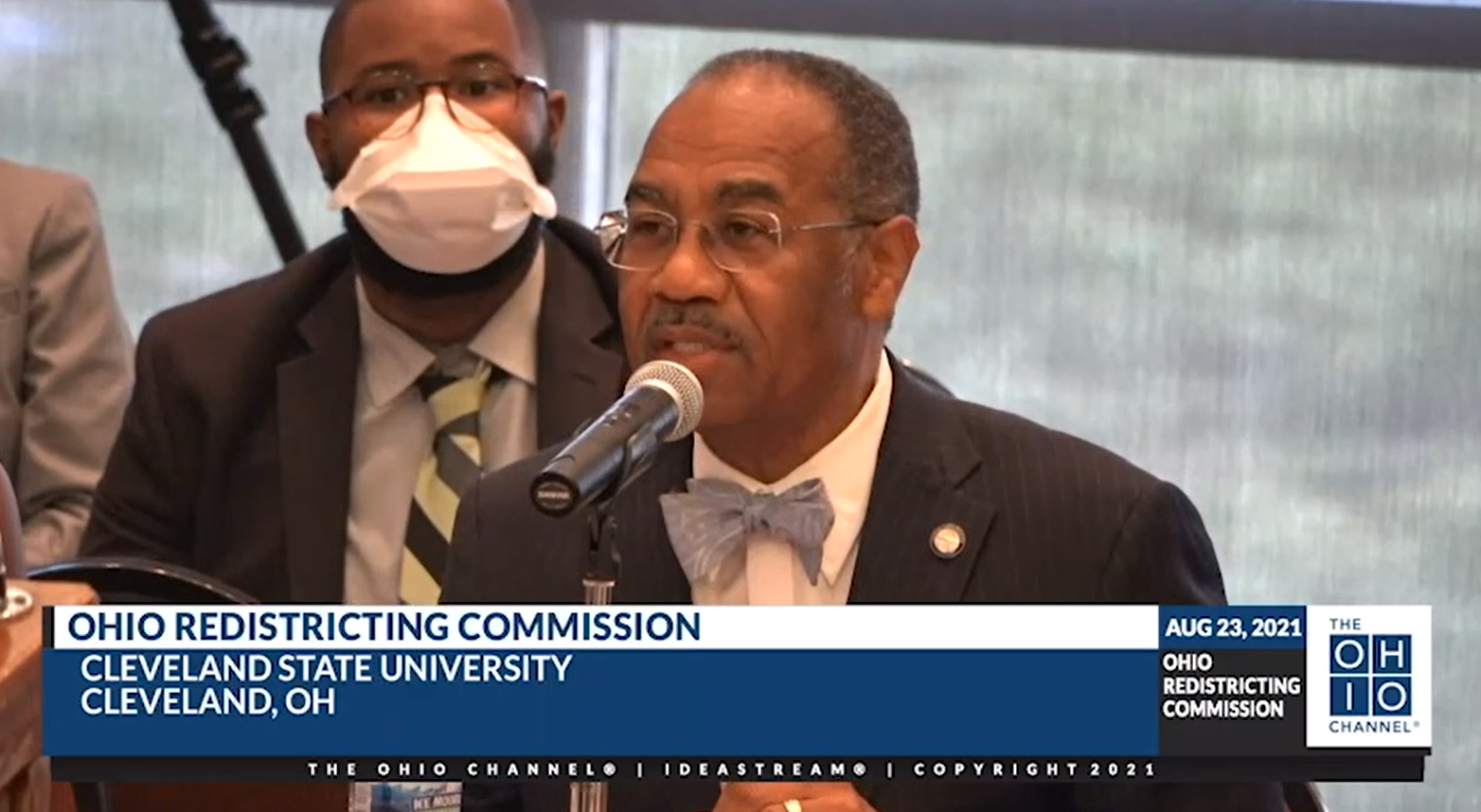
     State Sen. Vernon Sykes, co-chair of the Ohio Redistricting Commission, opens Monday morning’s public hearing on redistricting on the campus of Cleveland State University. A full week of hearings will be held across the state to discuss gerrymandering in the state. Photo: The Ohio Channel

    BY: SUSAN TEBBEN and Ohio Capital Journal

    A week of double-header public hearings on redistricting began Monday in Cleveland and Youngstown, with members of the public calling for more fair districts.

    Ohioans shared with the Ohio Redistricting Commission stories of unrepresentative and oddly-drawn districts (including the “snake on the lake” of Ohio’s 9th district, so-called because of it’s long, skinny appearance on the map), and urged the commission to keep the process transparent and the mapmaking fair.

    “There are things that we like and things that we don’t like, but no matter how you slice it, you need to slice it fairly,” said Rita Mayhew, a retired teacher from Lorain.

    Speakers at the hearings on the Cleveland State University and Youngstown State University campuses, touched on the impact of redistricting and gerrymandering on everything from education to abortion rights and being an informed voter.

    Former Democratic state representative, John Patterson, co-author of the Fair School Funding Plan and Ashtabula County resident, said at the Youngstown hearing that the current legislative districts “lend themselves to candidates who either lean left or lean right, and in the extreme, force potential candidates to run further left or further right.”

    “We need to work together, but we need the opportunity to do just that,” Patterson said. “And fairly drawn districts give us that opportunity.”

    Some in the packed meeting rooms expressed outrage as members of the commission sent proxies, rather than attending themselves.

    “We have put aside everything to come here today, and we are not getting the same response from the people who are supposed to be on this commission,” said Cleveland Heights resident Sue Dyke.

    At Monday morning’s Cleveland hearing, Auditor of State Keith Faber attended, along with House Minority Leader Emilia Sykes, D-Akron, and commission co-chair, state Sen. Vernon Sykes, D-Akron.

    House Speaker Bob Cupp, Secretary of State Frank LaRose, Gov. Mike DeWine and Senate President Matt Huffman all sent designees in their place.

    For Cupp, state Rep. Scott Oelslager, R-North Canton, stood in; LaRose sent chief of staff Merle Madrid. DeWine’s chief legal counsel Matthew Donahue sat in on his behalf, and Huffman sent state Sen. Theresa Gavarone, R-Bowling Green.

    At the afternoon meeting in Youngstown, Faber and Sen. Sykes were both in attendance, but stand-ins were still present for Cupp, DeWine, LaRose and Huffman. State Rep. Timothy Ginter, R-Salem, was in for Cupp this time and state Sen. Kirk Schuring, R-Canton, was in for Huffman.

    Donahue was again in for DeWine, and Madrid repeated his proxy appearance for LaRose.

    Minority Leader Emilia Sykes also sent a proxy to that meeting, state Rep. Michele Lepore-Hagan, D-Youngstown.

    One speaker at the Youngstown hearing noted that DeWine was attending a practice with the Cincinnati Bengals. A number of sports reporters posted pictures and videos of DeWine on the sidelines of Monday’s practice.

    DeWine’s spokesperson Dan Tierney said the governor intends to take into consideration the information given at the hearings, but also said the hearings “are not official committee hearings, these are listening sessions.”

    Asked whether the DeWine will attend any of the hearings, Tierney said that is “yet to be determined” and his calendar has not been finalized.

    A spokesperson for Huffman said the Senate president chose to let representatives from the districts where the hearings were occurring to attend in his place.

    “President Huffman believes this is an important opportunity to give members from the regions around the state where the hearings are held to participate in a process that only happens once in a decade,” said spokesperson John Fortney.

    Fortney said Huffman plans to attend the hearing set to happen Thursday at Ohio State University’s Lima campus, in his district.

    LaRose’s office said the secretary “was supposed to be on orders from the U.S. Army, but as with many things with the Army, those are constantly changing and we expect him to be able to attend upcoming hearings.”

    A spokesperson Cupp did not respond to a request for comment.

    Another criticism hitting commission members was the time of the meetings, which some speakers said kept those who work during the day and can’t afford to take a day off from being able to speak at their local meetings.

    “The hope is that you all understand that their interests need to be represented even though they’re not here, even though they may not have voted for you, even though they may not have voted,” said Reginald Williams, an attorney and Shaker Heights resident.

    Even the one person in either hearing who publicly denied the idea of gerrymandering and charged that Republicans had instead “dominated” elections in the past, causing their supermajority, said the commission should have more hearings. Those hearings should be held at locations other than universities, he said.

    “You do not have a representative cross-section of Ohio in this room,” said Thomas Hach, a Concord resident. “This is wrong, you need to have another week of hearing from the people.”

    The other hearing locations and dates can be found on the Ohio Redistricting Commission website.

  • Honoring Black history and fighting for the future of education in Ohio

    Honoring Black history and fighting for the future of education in Ohio

    A Guest Column by Melissa Cropper and Ohio Capital Journal

    On Feb. 1, as Black History Month began in Ohio’s classrooms and virtual classrooms, Gov. Mike DeWine unveiled his proposed budget for the next two years, which continues the education funding policies that systematically underfund public schools that educate Black students and even shift some of that funding away toward unaccountable, for-profit private schools. 

    Black History Month is an important time for our nation’s educators to focus their curriculum around the contributions that African Americans have made in government, industry, art, science, literature, and every field of human endeavor. However, we do a disservice to our students if we don’t also teach about the harder, more painful history of slavery, segregation, disenfranchisement, and racist violence, and if we do not weave it into our everyday curriculum as deeply as it is woven into the fabric of our country.

    Even then, we are not telling the full story if we teach about these topics as relics of the past, as dark chapters of our country’s past that have ended. Racist structures in our society didn’t cease to exist when the Thirteenth, Fourteenth and Fifteenth Amendments were ratified following the Civil War, or after Brown vs. the Board of Education desegregated schools, or after the 1964 Civil Rights Act, or even after Barack Obama’s historic election. 

    Each of those events has been an important step along the way, but as we are reminded all too often, the vestiges of white supremacy live on in our current institutions. We see it in the over-policing and incarceration of Black, brown, and immigrant communities, we see it in our city neighborhoods that were shaped by redlining, and we see it in Ohio’s school funding system. 

    When we teach Black history, educators can make the connections about how the racial injustices of the past have turned into the systemic racial disparities of the present, and how we can demolish the underpinnings of injustice. There is no better place to start than with our broken school funding policies which underfund and segregate schools with large populations of Black students.

    In Ohio, we underfund schools in Black communities with a school funding formula that was found unconstitutional by the Ohio Supreme Court more than 20 years ago because it relied so heavily on local property taxes that it denied an equitable and adequate education to students in low-income areas. 

    We segregate schools in Black communities with voucher and charter policies that divert students and drain funding from local public schools. Often cloaked in the language of racial justice, vouchers and charter schools have the opposite effect when put into practice. The NAACP has often opposed these policies because they “divert much needed funding for public education to private or charter schools, thereby further dismantling the viability of the public education system and limiting the number of children who would be afforded the opportunity of an adequate and effective education.”

    This vicious cycle of underfunding schools in communities of color, and then punishing them for not being able to meet their students’ needs by underfunding them further, must end. We must stop pitting parents and communities against one another, and instead renew our commitment for high quality public schools for all Ohio students. 

    Last year, the Ohio House passed the Fair School Funding Plan with an overwhelming bipartisan majority, yet the Senate refused to take the issue up. The Plan would have put Ohio on a six-year path toward equitable funding of public schools in Ohio, and would have immediately ended punitive and harmful deductions for vouchers and charter schools from local public school funds. 

    This would ensure that public school districts receive money only for the students who are enrolled to attend but without the added penalty of deducting money due to students opting for private or charter schools. These changes would strengthen schools in Ohio’s cities and in our rural areas, giving students from all backgrounds increased opportunities. Despite the Fair School Funding Plan receiving an 84-8 vote in the House, the Ohio Senate allowed the bill to die without even receiving a vote. 

    DeWine had the opportunity to take the hard work and bipartisan agreement for this new school funding formula and insert it as a framework into his budget proposal. Instead, his proposal continues the status quo which is actively undermining our ability to provide an equitable education.  

    As educators, we can not teach Black History without also being activists in our own realm, fighting for an education system that gives every child, no matter their race or where they live, equal access to a high quality, free public education.