

Tag: federal lawsuit

  • Ohio House Speaker says no primary election legislation coming soon

    Ohio House Speaker says no primary election legislation coming soon

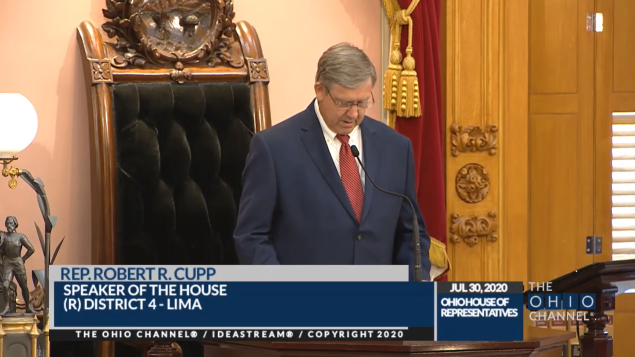
    Speaker of the House Bob Cupp addresses the chamber.

    BY: SUSAN TEBBEN – Ohio Capital Journal

    Ohio’s House Speaker said Wednesday legislation is not coming to change the May primary date.

    Speaker Bob Cupp said the process was “in the hands of the federal court,” despite various court documents in which he argued that the election is a legislative issue and any changes should be made in the General Assembly.

    The Ohio Capital Journal asked Cupp directly to confirm the House had no plans for legislation to set a new primary date in the next two weeks.

    “That is correct, we’re not in session,” Cupp said during a gaggle after Wednesday’s House session.

    He was asked about potential changes to the election earlier in the press gathering, and he deferred the job.

    “We’ll let the federal court process proceed,” Cupp said.

    federal lawsuit was filed by GOP voters earlier this year, claiming voters are losing their right to vote with the chaos surrounding redistricting. Originally, the plaintiffs, including Ohio Right to Life leader Michael Gonidakis, asked for the third map adopted by the Ohio Redistricting Commission to be forced into use by a three-judge panel of the U.S. District Court.

    That map was rejected by the Ohio Supreme Court before the federal lawsuit was filed, but the process of adopting a fourth version of legislative districts had not come to fruition.

    The fourth map ended up being a near-copy of the third, rejected version, with Senate President Matt Huffman acknowledging as he moved for its approval that the map had “97%” similarity to the third version.

    Because the process, which started in September, has taken so long, the Secretary of State’s Office was forced to remove legislative races from ballots for the May 3 primary, all but assuring a split primary.

    Lawsuits have been filed with the Ohio Supreme Court asking for the fourth map to be invalidated for many of the same reasons the third map was, and map challengers have also asked the court to hold GOP commission members in contempt for violating court orders.

    Cupp and Senate President Matt Huffman argued in previous court filings that the power for elections and drawing maps lies solely with the redistricting commission and legislators, seemingly contrary to Cupp’s Wednesday statements.

    “It is the commission and the general assembly who solely possess the legislative authority to create legislative and congressional districts,” attorneys for the legislative leaders wrote in a court filing for lawsuits on congressional districts.

    Secretary of State Frank LaRose in more recent court filings urged the judicial system to stay out of the process. In his filing countering objections to the most recent maps, he posited that the Ohio Redistricting Commission has more time to figure out legislative maps.

    “More importantly, there is still time for the legislature to take steps to extend the time within which such a decision must be made,” LaRose said. “This court should not give up on the constitutional process even if the petitioners have.”

    The federal court has chosen twice not to intervene in the state process to give it time to come to a resolution. The first time the court withheld judgment was just before the March 28 deadline for the commission to complete new maps.

    At a hearing before Chief Judge Algenon Marbley, Judge Benjamin Beaton and Judge Amul Thapar last Wednesday, parties from the Secretary of State’s Office gave Aug. 2 as a potential date for a second primary to include the legislative races.

    The judges entertained the idea of not just the third map, but also the map drawn by independent mapmakers during the latest redistricting commission hearings, and also debated whether or not the 2010 map could be used for one more year.

    They decided to give the state until April 20 to come up with an official map and to give the state’s highest court time to make its rulings. A status conference was scheduled for April 11.

    Jake Zuckerman contributed to this report.
  • Ohio Supreme Court to redistricting commission: Why shouldn’t we hold you in contempt?

    Ohio Supreme Court to redistricting commission: Why shouldn’t we hold you in contempt?

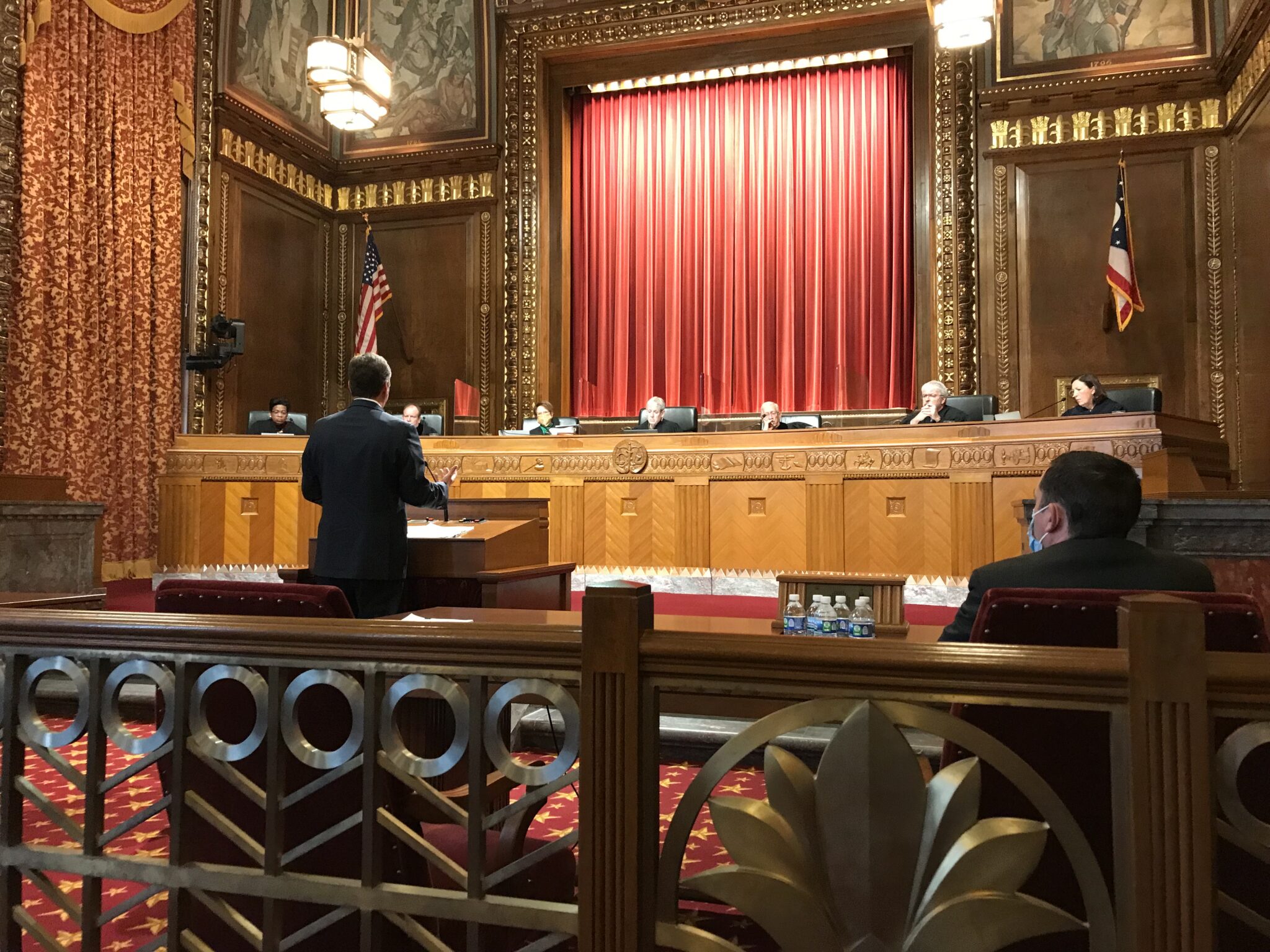
    Attorney Phillip Strach speaks before the Ohio Supreme Court, arguing for the constitutionality of legislative district maps. The court heard arguments on three cases asking it to reject the maps approved in September. (Photo: Susan Tebben, OCJ)

    BY: SUSAN TEBBEN – Ohio Capital Journal

    The Ohio Supreme Court weighed in on the redistricting battle on Friday evening, asking the members of the Ohio Redistricting Commission why it shouldn’t hold them in contempt of court for defying its order.

    Chief Justice Maureen O’Connor signed an entry in all three of the lawsuits against the ORC on legislative redistricting, asking Gov. Mike DeWine, Secretary of State Frank LaRose, Auditor Keith Faber, Senate President Matt Huffman, House Speaker (and commission co-chair) Bob Cupp, state Sen. (and commission co-chair) Vernon Sykes and House Minority Leader Allison Russo, to explain the “failure to comply with this court’s February 7, 2022 order,” and why they shouldn’t face anything from fines to jail time, the consequences for contempt of court.

    The court had been asked by the League of Women Voters, the Ohio Organizing Collaborative and a group of Ohio residents – the parties in the three lawsuits originally filed to challenge maps approved by the ORC – to order the commission to give specific reasons for their choice to adjourn without maps on Feb. 17.

    The ORC members now have until noon on Feb. 23 to tell the court why they shouldn’t be held in contempt.

    The groups also asked for justification for the commission’s lack of action on any sort of map, despite being presented with a map by the Democratic House and Senate caucuses, which they shot down along party lines on the day of the deadline.

    Huffman accused drawers of the Dem map of racial gerrymandering to the benefit of Democrats in certain districts, including the district that holds Lake County, typically a strongly GOP area. Russo wholly denied the accusations.

    The GOP commission members said during the meeting that they could not find a way to draw maps that complied with all the redistricting provisions of the constitution, while also complying with the rules the supreme court had given in their majority opinion invalidating the previous maps. Mainly, the GOP said they couldn’t hit the target of 54-46 partisan breakdown asked for by the court justices, a number based on statewide voter preferences over the last 10 years.

    But some of the commission members, of both parties, disagreed with the decision to leave before approving a map.

    “I think it is a mistake for this commission to stop and basically say that we’re at an impasse,” Gov. Mike DeWine said on Thursday. “I don’t think that is an option that the law gives us.”

    Co-chair Sykes agreed that contempt was a possibility for the commission members, and said he was willing to do whatever could be done to move forward.

    Asked after the commission adjourned if that included contempt of court: “Including whatever we can do.”

    The choice to adjourn didn’t require a majority vote, but was met with no formal objections.

    The supreme court ordered the ORC to come up with “entirely new” maps after invalidating not one but two different sets of legislative district maps. Their deadline to file with the Secretary of State’s Office was Feb. 17, with those maps then being sent to the court for review by the next day.

    The order came the same day a federal lawsuit was filed by Ohio residents, some of whom are also anti-abortion advocates in the statewide lobby group Ohio Right to Life. That lawsuit asks the district court to take over the process, and accuses the redistricting commission of preventing them from advocating for candidates, running for office, and even voting.

  • Supreme Court Lets Martin v. Boise Stand:  People Experiencing Homelessness Cannot Be Punished for Living in Absence of Adequate Housing or Sheler

    Supreme Court Lets Martin v. Boise Stand: People Experiencing Homelessness Cannot Be Punished for Living in Absence of Adequate Housing or Sheler

    Persons experiencing homelessness cannot be punished for sleeping outside on public property in the absence of adequate alternatives.


    Cincinnati, Ohio – This morning, the U.S. Supreme Court denied a petition by the city of Boise to review the case Martin v. Boise (formerly Bell v. Boise). This leaves in place earlier rulings by the 9th Circuit that persons experiencing homelessness cannot be punished for sleeping outside on public property in the absence of adequate alternatives.

    The Supreme Court’s decision, issued without comment, means the April 2019 ruling is binding in the 9th Circuit, covering nine states including most of the western states, and carries national influence.

    In a press release issued today, Josh Spring, Executive Director of the Greater Cincinnati Homeless Coalition said, “This is very important news, as our federal lawsuit filed last year by people experiencing homelessness and the Homeless Coalition continues to move forward here in the 6th Circuit.”  Their lawsuit aims to overturn City of Cincinnati policies criminalizing people experiencing homelessness outdoors and hopes to squash last year’s Common Pleas Court order making it an arrestable offense to experience homelessness outdoors anywhere in the Hamilton County including Loveland.

    The Law Center’s Executive Director, Maria Foscarinis, said, “Ultimately, our goal is to end homelessness through housing…so that no one has to sleep on the streets in the first place. We hope that the 9th Circuit decision will help communities find the political will to put that housing in place. Housing, not handcuffs, is what ends homelessness.”

    John Parvensky, Acting Executive Director of the National Coalition for the Homeless described this as a “victory”, saying, “…it will force communities to address homelessness proactively – through the development of an adequate supply of affordable housing, while providing safe and appropriate emergency shelter in the interim”.

    For the full text of the Law Center press release and links to documents from the case, click here.

    For the full text of the National Coalition press release click here.


    Oh Christmas Tree Oh Christmas Tree Why Not Give the Gift of Charity…