Tag: fentanyl

  • Abnormal increases in overdose-related activity

    Abnormal increases in overdose-related activity

    Hamilton County, Ohio – Ongoing surveillance by the Hamilton County Addiction Response Coalition of daily overdose incidents since September 20, has indicated abnormal increases in overdose-related activity. While fentanyl has long been a part of our drug landscape, the recent uptick in overdose incidents likely stems from individuals unknowingly consuming fentanyl-laced substances, using drugs alone, or failing to utilize harm reduction strategies.

    The Coalition says, “In light of these findings, it is crucial to prioritize community education on harm reduction practices. We must emphasize the importance of avoiding solitary use, calling 911 in the event of an overdose, and recognizing that any non-prescription drug not obtained from a doctor or pharmacy could potentially contain fentanyl.”

    The Hamilton County Coroner’s Office reported ten suspected overdose deaths from September 20-26, pending toxicology confirmation.

    _______________

    General Information
    • All drug users, including recreational users, are at risk of overdose and death.
    • FENTANYL MAY BE PRESENT IN YOUR DRUG SUPPLY. Drugs like cocaine, crack cocaine, and methamphetamine are increasingly being laced with fentanyl, which can cause fatal overdoses. We have seen multiple deaths among individuals using non-opioid drugs.
    • DON’T USE ALONE. When using drugs in groups, ensure that someone is available to administer Narcan, if necessary.

    Resources for Harm Reduction
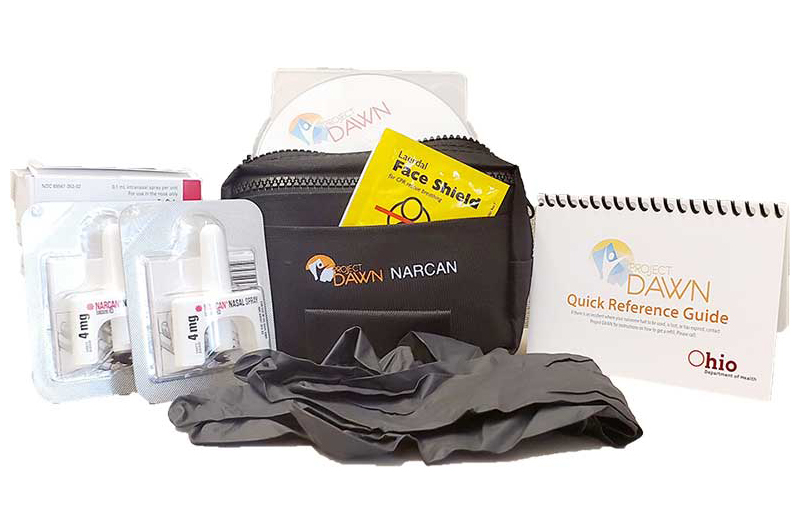
    • Narcan (Naloxone) is available and accessible—it is not limited to injection drug users.
    • If you need Narcan, safe injection supplies, or fentanyl test strips, please call 513-316-7725 or visit this link. To get Narcan or Fentanyl Test Strips mailed to you, text “NARCAN” or “FTS” to 844-734-4081.

    Emergency Response
    • If someone overdoses, call 911 immediately, even if Narcan is administered. Ohio’s Good Samaritan Law protects you from legal consequences when seeking help during an overdose emergency.
    • The 988 Suicide & Crisis Lifeline provides free and confidential emotional support to people in suicidal crisis or emotional distress 24 hours a day, 7 days a week.

    Treatment Services
    • Treatment services are available. For 24/7 help, please call Central Connections: 513-558-8888.

    The goal Hamilton County Addiction Response Coalition is to ensure that individuals know help is accessible and that harm reduction tools, such as Narcan and safe injection supplies, are widely available.

    In response to this alert, the Coalition is encouraging service providers and first responders to increase their readiness by adjusting response capacity and implementing the following protective measures:
    • Ensure the availability and proper use of personal protective equipment (PPE).
    • Be prepared to administer multiple doses of Narcan, if needed.

    “Your immediate attention to this matter is essential to safeguarding the health and safety of our community.”

    For any inquiries or additional information, contact Hamilton County’s Director for the Office of Media and Engagement, Bridget Doherty, at Bridget.Doherty@hamilton-co.org
  • Ohio Narcotics Intelligence Center Warns of ‘tranq-dope,’ ‘benzo-dope’ in Ohio’s Illicit Drug Supply

    Ohio Narcotics Intelligence Center Warns of ‘tranq-dope,’ ‘benzo-dope’ in Ohio’s Illicit Drug Supply

    Columbus, Ohio – The Ohio Narcotics Intelligence Center (ONIC) released a public safety bulletin today alerting Ohioans to an increasing number of illicit drug samples found to contain mixtures of powerful drugs that can cause overdoses and/or skin wounds.

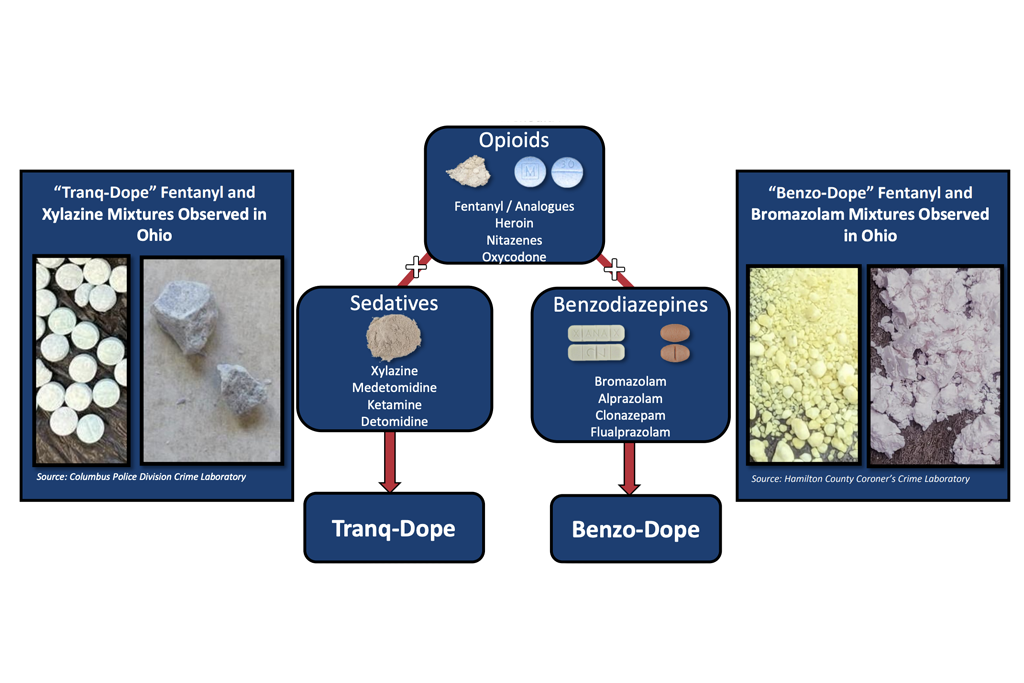
    ONIC reported that drug testing labs across Ohio recorded an eight-fold increase in drug samples containing mixtures of “tranq-dope” (opioids and sedatives) and more than double the number of samples containing mixtures of “benzo-dope” (opioids and benzodiazepines) between 2021 and 2023 as compared to the three years prior. These drug mixtures have been identified in several forms, including counterfeit pills, powder, and rocks.

    Sedatives and benzodiazepines are depressants that produce sedation and muscle relaxation while also lowering heart rate and blood pressure. Opioids such as fentanyl cause significant respiratory depression, which often is the primary cause of death in opioid-related drug poisoning cases.

    Most of today’s illicit drug mixtures are extremely potent, which can make life-saving efforts more difficult.  From 2017–2022, 58% of drug poisoning deaths in Ohio involved a mixture of illicit drugs.

    “Part of the reason to issue this bulletin is the fact that naloxone may be less effective for someone experiencing an overdose caused by tranq-dope or benzo-dope,” said Cynthia Peterman, ONIC Executive Director. “Reversing the effects of a drug poisoning in those cases may require multiple doses of naloxone. These are extremely dangerous drug mixtures, and every Ohioan needs to be aware of the danger.”

    Common drugs often mixed with tranq-dope or benzo-dope in Ohio include:

    • Opioids such as fentanyl/fentanyl analogues, heroin, nitazenes, and oxycodone.
    • Sedatives such as xylazine, medetomidine, ketamine, and detomidine.
    • Benzodiazepines such as bromazolam, alprazolam, clonazepam, and flualprazolam.

    Launched by Governor Mike DeWine in 2019, ONIC is a specialized criminal intelligence unit that works to assist local law enforcement in conducting intelligence-driven drug trafficking investigations. ONIC’s criminal intelligence analysts and computer forensic specialists provide investigative, analytical, and digital forensic support to local law enforcement agencies and drug task forces throughout Ohio.

    To report a drug tip to ONIC, please call 1-833-OHIO-NIC (644-6642). Information about how to access naloxone, the life-saving opioid overdose reversal medication, and fentanyl test strips is available by visiting naloxone.ohio.gov.

    [pdf-embedder url=”https://lovelandmagazine.com/wp-content/uploads/2024/08/onic_Benzo_Tranq_Dope_Public_Bulletin_Final.pdf”]


  • Celebration of Jack Quehl & Fentanyl Awareness Days June 12-16

    Celebration of Jack Quehl & Fentanyl Awareness Days June 12-16

    Loveland, Ohio

    Last day to buy tickets is 06/12/2024, Midnight, (GMT-05:00) Eastern Time (US & Canada)

    About event

    Wednesday 6/12Join us in front of Fleet Feet along the bike trail for a 5K. This community event is open to everyone and is FREE! Just show up in your DoitforJack shirt or purchase one there. 6:15p for Group Photo, race starts at 6:30p. Visit “The Works” afterwards for dinner and a % of sales will go back to the foundation.

    Thursday 6/13Dine to Donate % of sales donated to the foundation. Ramsey’s Trailside, Paxtons Grill, and Tano Bistro.

    Friday 6/14: Free concert in Nisbet Park with Max Geers playing live music. Grab to-go dinner, DORA, or pack a cooler. Hang out with us for this family friendly community event. If you purchase tickets to Cindy’s Party, you can pick up your SWAG bag here. Wear your DoitforJack shirts!

    RYDE365: Join Amy for an amazing cycling class! Listen to great music while you get your sweat on for a great cause!  Go to https://365loveland.com/ to sign up!

    Saturday 6/15: Start your day with Yoga along the river, nap and then come to Cindy’s Friendly Tavern 125 Karl Brown Way.

    To purchase Yoga & Mimosas Tickets, click here. Saturday June 15th at Rodi Italian 9:30a.

    RYDE365: Join Amy for an amazing cycling class! Listen to great music while you get your sweat on for a great cause! Go to: https://365loveland.com/ to sign up!

    Jack’s Party at Cindy’s Friendly Tavern 3p-6p.

    Your ticket will include admission to the party, an event shirt, 2 drink tickets and additional “DoitforJack” SWAG. We will have live music and the grill fired up! You can pick up your event bag at Nisbet Park on Friday 6/14 5-7 or at the party. Tickets can be bought below. Wear your DoitforJack Shirt!

    NEW this year – a chance to win a week at this amazing house in Florida.  There are ONLY 250 tickets for $100 each. Can’t come? Great way to donate and win. Click HERE to purchase your winning ticket. (Only 21 left)

    The Do It For Jack Fentanyl Awareness Weekend would have marked Jack’s 27th birthday—and while we’ll spend the weekend celebrating Jack, the Jack Quehl Foundation will also be working hard to raise critical funding to help build awareness around the threat fentanyl poses to our community. Our goal? To save lives. Can’t make it? Donate HERE.

  • Governor DeWine Authorizes Emergency Ban of Nine Synthetic Opioids

    Governor DeWine Authorizes Emergency Ban of Nine Synthetic Opioids

    Ohio Governor Mike DeWine signed an executive order today authorizing the Ohio Board of Pharmacy to immediately classify nine synthetic opioids as Schedule I controlled substances, effectively banning their sale and use in the state.

    These nine synthetic opioids are known as nitazenes. Initially developed decades ago as potential alternatives for morphine that were never approved for medical use, new nitazene compounds are increasingly being found in the illicit drug supply in Ohio.

    These nitazenes are often more potent than other Schedule I opioids like heroin or fentanyl and present an elevated risk of negative outcomes caused by unintentional drug poisonings, including death.

    “These are extremely dangerous substances being designed by clandestine chemists in an attempt to skirt the law while keeping them highly addictive,” said Governor DeWine. “My administration is doing everything in our power to rapidly detect and schedule these types of compounds to ensure that law enforcement has the tools they need to prosecute those who make and sell these potentially lethal substances to the fullest extent of the law.”

    Executive Order 2024-06D

    The emergency order was prompted by intelligence gathered as part of an early detection process developed by the Ohio Narcotics Intelligence Center (ONIC), in partnership with RecoveryOhio, the Ohio Board of Pharmacy, and a network of forensic toxicologists and chemists known as the Emerging Drug Scientific Working Group (EDSWG). The early detection process, which includes the proactive collection of reports from Ohio’s criminal justice system and forensic labs, allows ONIC to identify, analyze, and triage information on emerging drugs that are not controlled substances.

    Frequently mixed with other controlled substances, including other opioids such as already scheduled nitazenes or fentanyl and stimulants such as cocaine or methamphetamine, each of these nine nitazene compounds have been identified by Ohio crime labs, confirming their presence in the state. Further evidence from the dark web compiled by ONIC demonstrates the availability and interest in nitazene compounds for illicit use.

    Nitazene compounds are becoming increasingly involved in overdose deaths in Ohio. As recently as 2020, just three overdose deaths involving nitazene compounds were confirmed and reported to the Ohio Department of Health (ODH). However, a significant jump occurred in 2021 and 2022, which saw an average of 57 such deaths per year. Although 2023 data is not yet complete, ODH has recorded 77 nitazene-involved overdose deaths for the year – and this number only represents confirmed cases. Due to under reporting, the true number of overdose deaths involving nitazene compounds is expected to be much higher.

    Synthetic opioids are the primary cause of deaths related to unintentional drug poisonings in the United States. Nitazene compounds contribute to those poisonings. In multiple unintentional drug poisonings, nitazenes have been the only compounds identified as a contributing factor.

    The executive order suspends the normal rulemaking process to allow the Ohio Board of Pharmacy to immediately classify these nine nitazene compounds as Schedule I controlled substances, making the sale and trafficking of these compounds a criminal offense. For more information regarding this emergency action, visit Pharmacy.Ohio.gov/Nitazenes.

    These nitazene compounds are the latest to be banned under the DeWine Administration. Armed with ONIC’s early detection intelligence, the Ohio Board of Pharmacy has now emergency scheduled a total of 17 nitazene compounds since 2020.

    Additionally, last year, Governor DeWine signed an executive order to classify xylazine as a Schedule III controlled substance, making Ohio one of the first states in the nation to schedule xylazine as a controlled substance drug.

    If you believe you or someone else is in immediate danger of a drug overdose, call 911 immediately.

    Like other synthetic opioids, overdoses involving nitazene compounds can be reversed using naloxone.

    Naloxone should always be administered anytime an overdose is suspected, even if the overdose is believed to be caused by nitazenes. Multiple doses of naloxone may be needed to reverse an overdose involving synthetic opioids.

    For more information about obtaining free naloxone, visit: Naloxone.Ohio.gov.

  • Ohio residents who may be in a position to reverse an overdose should consider carrying FREE naloxone

    Ohio residents who may be in a position to reverse an overdose should consider carrying FREE naloxone

    Loveland, Ohio

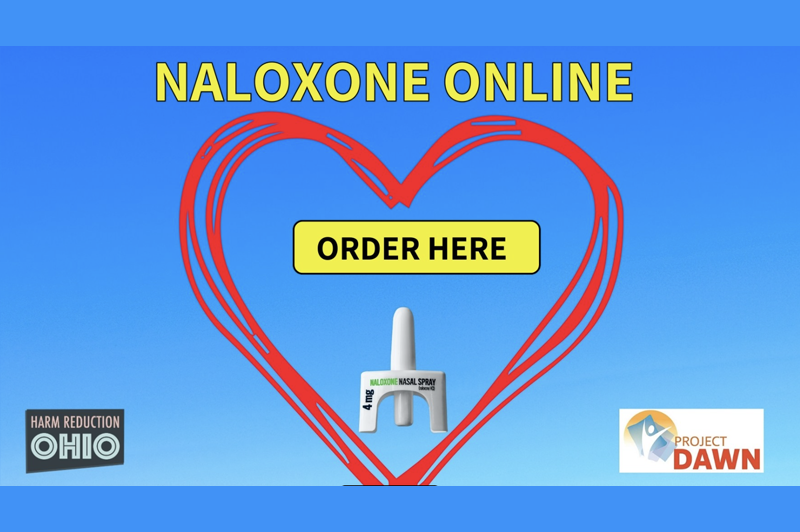
    About This Naloxone Program

    Twenty-thousand Ohio residents died from drug overdoses from 2020 through 2023. Harm Reduction Ohio provides the overdose-reversing drug naloxone to any Ohio residents at no charge. You can order online. We mail orders within 24 hours from our main office in Granville.

    This service is made possible by the Ohio Department of Health’s Project DAWN program, using federal State Opioid Response funds approved by Congress.

    Ohio Department of Health

    What drugs in Ohio may contain fentanyl?

    All illicit drugs in Ohio — except marijuana — may contain the opioid fentanyl or a fentanyl analog that can cause a potentially fatal overdose. Half of fentanyl overdoses deaths are caused by mixtures with stimulants (meth, cocaine). High doses of prescription opiates — such as oxycodone, fentanyl, hydrocodone and morphine — may cause overdoses, too.

    Who should order at this site?

    Ohio residents who may be in a position to reverse an overdose should consider carrying naloxone. This is especially true for family members, friends, co-workers, neighbors and service providers in contact with people who use drugs other than marijuana. People who stimulants and non-opioid drugs (other than cannabis) are at significant risk of fentanyl overdose and should carry naloxone, as should people in contact with people who use drugs.

    Can I order fentanyl test strips?

    Yes. Please request them in the comment section when ordering naloxone. Fentanyl test strips will be added soon as an option to our online form.

    Other questions? Email narcan@harmreductionohio.org

    HRO-Naloxone-Nasalv2 from Jumpstart Video on Vimeo.

    Xylazine Wound Care Guide

    Harm Reduction Ohio’s partner NEXT Distro of New York City prepared this Xylazine Wound Care Guide, which can be found here and below.

    Harm Reduction Ohio published a study January 4, 2024, on xylazine’s frequency in Ohio’s drug supply. That study can be found here. The charts and data from the study is here.

    The study found xylazine in 37.3% of fentanyl. Other key findings:

    • Xylazine is paired with fentanyl in nearly every case.
    • Xylazine is almost non-existent in the supply of cocaine, methamphetamine, benzodiazepines, psychedelics and other drugs, except when fentanyl is also present.
    • Xylazine is found across Ohio without significant regional variations.
    • Xylazine frequency was consistent throughout the nine months studied, indicating the drug was well-established in Ohio’s fentanyl supply before 2023 and is not currently increasing or decreasing in frequency.

    Caring for Xylazine Wounds

    Source: National Library of Medicine

    The NEXT Distro wound care guide offers this guidance.

    • Xylazine wounds should be kept clean with soap and water. Using alcohol and peroxide is NOT suggested for these wounds.
    • Moisturized with antibacterial ointment like A&D or even a thin layer of vaseline.
    • Covered with clean bandages.
    • Manuka honey (Medihoney) has been found to be very useful and effective for its wound healing and antibacterial properties.

    [pdf-embedder url=”https://lovelandmagazine.com/wp-content/uploads/2024/04/XylazineWoundCare.pdf”]

  • Jack Quehl was a kid like yours

    Jack Quehl was a kid like yours

    Jack Quehl was a kid like yours.

    Jack grew up here in Loveland, went to elementary school at St. Columban and high school at Moeller. He played football and was a National Merit Scholar. Jack loved music, travel, reading, and his friends. He graduated from the University of South Carolina’s Darla Moore Business School and moved to Baltimore for his first job. A month later, Jack was dead.

    Jack made one bad decision, and it killed him.

    One night, Jack was with friends, and someone brought out a party drug. Jack didn’t say no. None of them knew the drug had been cut with deadly fentanyl. On Sunday, September 19, 2021, Jack was found unresponsive, and one of his friends was dead. Jack’s parents Tom and Stephanie rushed to his side, but it was too late. Jack wasn’t an addict, he wasn’t a habitual drug user, and he never intended to take fentanyl. But he did, and it took his future.

    Fentanyl is the leading cause of death for Americans ages 18-45.

    Illicit fentanyl is cheap and easy to make, and it pours into our country every day. It’s 50 times stronger than heroin, 100 times stronger than morphine, and is highly addictive. Cartels add it to illegal and recreational drugs and to fake pills made to look like Xanax and other prescription medications. In 2023, DEA seized more than 68 million fentanyl-laced fake pills and more than 11,010 pounds of fentanyl powder. That’s equivalent to more than 336.3 million fatal doses.

    7 out of 10 fake pills contain a lethal dose of fentanyl.

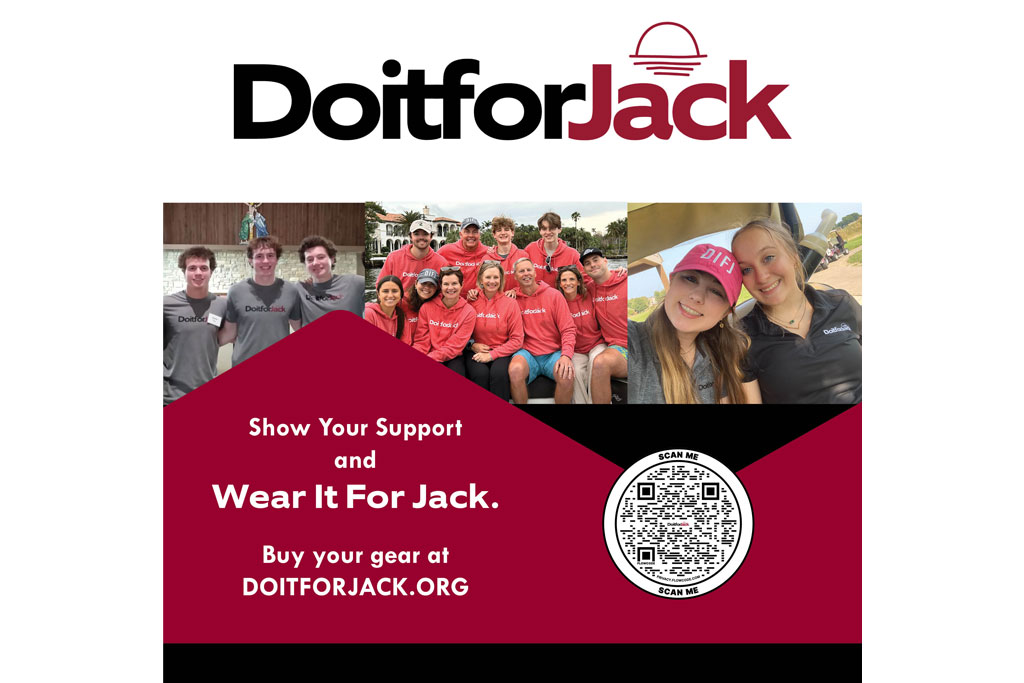
    Tom and Stephanie Quehl don’t want another family to be devastated by fentanyl. In November 2022, they founded DOITFORJACK and the Jack Quehl Foundation. DOITFORJACK is committed to educating our community about the threat of fentanyl poisoning by sharing Jack’s story. To learn more about our mission, please visit us at DOITFORJACK.ORG. (embed https://www.doitforjack.org)

    Help DOITFORJACK stop fentanyl from taking someone else’s Jack.


    LearnMore…

  • Public Health Alert:  Overdose Activity in Hamilton County

    Public Health Alert: Overdose Activity in Hamilton County

    A Press Release from Hamilton County Public Health:

    Ongoing surveillance of daily overdose incidents since December 31 has indicated some abnormal changes in overdose related activity. Historical trends suggest a potential surge in fentanyl presence within the drug supply. On Sunday, December 31, 2023, both overdose emergency department (ED) visits and 911 dispatches saw an increase, with 11 overdoses recorded for each metric. Subsequently, on Tuesday, January 2, 2024, overdose ED visits rose again to 12, and the Hamilton County Coroner’s Office reported three suspected overdose deaths January 2nd, pending toxicology review and confirmation.

    This alert is being issued collaboratively by local public health partners and the Hamilton County Addiction Response Coalition to enhance community awareness.

    • Even if you are a recreational drug user, you are at risk for overdose and death.
    • Narcan is available, accessible, and is not limited to injection drug users.
    • FENTANYL MAY BE IN YOUR DRUG SUPPLY! Drugs such as cocaine, crack cocaine and methamphetamine likely contain fentanyl, the drug that can cause overdose and death. A high supply of fentanyl puts all users at risk. WE HAVE SEEN MULTIPLE DEATHS IN PEOPLE USING DRUGS OTHER THAN OPIOIDS.
    • If you need Narcan, safe injection supplies, or fentanyl testing strips, please call 513-316-7725 or visit: https://www.flowcode.com/page/harmreduction
    • If you or someone you know overdoses, you should still call 911 – even if you administer Narcan.  In Ohio, you can call 911 free from fear that you will be punished or prosecuted for getting someone the help they need when they need it.
    • In situations involving multiple individuals using drugs, make sure someone is available to administer Narcan.
    • Treatment is open and available. If you need help, please call 513-281-7880.

    We want to ensure that people know that help is available, Narcan is accessible, and safe injection supplies are available.

    By disseminating this alert, we seek to prompt service providers and first responders to adjust response capacity and implement essential protective measures promptly.

    • Having available and using necessary personal protective equipment; and
    • Be ready to administer multiple doses of Narcan, as needed.

    Your attention to this matter is critical in safeguarding the well-being of our community members.

  • Hamilton County Public Health issues “Overdose Alert”

    Hamilton County Public Health issues “Overdose Alert”

    Local public health partners and the Hamilton County Addiction Response Coalition are issuing this alert to increase community awareness.

    Anyone in Ohio can obtain free naloxone (NARCAN)

    September 30 has indicated some abnormal changes in overdose related activity causing suspicion for high levels of fentanyl in the drug supply. Between Saturday, 9/30 and Wednesday 10/5, there were 16 preliminary overdose deaths. Overdose ED visits increased on Tuesday, 10/4 with 10 visits and on Wednesday, 10/5 with 9 overdose ED visits.

    Local public health partners and the Hamilton County Addiction Response Coalition are issuing this alert to increase community awareness.

    • Even if you are a recreational drug user, you are at risk for overdose and death. 
    • Narcan is available and is not only designated for injection drug users. 
    • FENTANYL MAY BE IN YOUR DRUG SUPPLY! Drugs such as cocaine, crack cocaine and methamphetamine likely contain fentanyl, the drug that can cause overdose and death.  A high supply of fentanyl puts all users at risk. WE HAVE SEEN MULTIPLE DEATHS IN PEOPLE USING DRUGS OTHER THAN OPIOIDS.
    • If you need Narcan, safe injection supplies, or fentanyl testing strips, please call 513-316-7725 or visit:  https://www.flowcode.com/page/harmreduction
    • If you or someone you know overdoses, you should still call 911 – even if you administer Narcan.
    • In situations involving multiple individuals using drugs, make sure someone is available to administer Narcan.
    • Treatment providers are open and offering services in many innovative ways.  If you need help please call 513-281-7880.

    We want to ensure that people know that help is available, Narcan is accessible, and safe injection supplies are available. 

    This alert should serve as a notice to service providers and first responders to consider adjusting response capacity and implementing necessary protective measures which should include:

    • Having available and using necessary personal protective equipment; and
    • Being prepared to use multiple doses of Narcan when necessary.

    Mike Samet

    Public Information Officer

    Hamilton County Public Health

    p: 513.946.7873  f: 513.946.7890

    a: 250 William Howard Taft Rd.

        Cincinnati, OH 45219

  • Clermont authorities report increase in meth, cocaine and LSD after spring slowdown

    Clermont authorities report increase in meth, cocaine and LSD after spring slowdown

    Lt. Nick DeRose noted that the county also has experienced a rise in cocaine traffic – almost all laced with fentanyl – and LSD in recent weeks.

    Batavia, Ohio – Clermont County law enforcement and treatment specialists are noticing an uptick in methamphetamine (or meth) after a slowdown during the spring shutdown of the economy.

    The Clermont County Opiate Task Force touched base on drug and alcohol trends in the era of COVID-19 in an Aug. 13 meeting.

    For Help 24/7 Call: 528-SAVE (7283)

    Sheriff’s Office Lt. Nick DeRose, commander of the Clermont County Narcotics Task Force, said both volume and prices of meth have increased substantially in July and August. He noted that the county also has experienced a rise in cocaine traffic – almost all laced with fentanyl – and LSD in recent weeks.

    Fentanyl is a powerful synthetic opioid analgesic that is similar to morphine but is 50 to 100 times more potent. Lysergic acid diethylamide (LSD), also known colloquially as acid, is a hallucinogenic drug. Effects typically include altered thoughts, feelings, and awareness of one’s surroundings. Many users see or hear things that do not exist. Dilated pupils, increased blood pressure, and increased body temperature are typical, according to a news release issued by the County.

    “COVID slowed things down, but come June there was a major increase – mainly a mixture of meth with fentanyl,” said Lt. Matt Green of the Union Township Police Department. “Some are doing meth and cocaine and not knowing they’ve been laced with fentanyl.”

    The department has handled 40 overdoses in the past two months, Green said.

    The report also noted that people who use meth experience a roller coaster of emotions, members of the task force reported. Many meth users are fidgety with nervous energy. They often experience psychosis, with symptoms including delusions, hallucinations, talking incoherently, and agitation. The person with the condition usually isn’t aware of his or her behavior.

    Dr. Shawn Ryan of BrightView said meth causes the body to produce an amount of brain hormones “off the chart.” He added that it’s difficult to normalize the hormones as part of a treatment plan.

    Jamie Lutson of Clermont County Municipal Court Probation said she had noticed a big increase in females addicted to meth. “Some say they are using the drug to stay awake so they can work and take care of their children.”

    Lutson added that alcoholic relapses occurred more frequently as treatment programs “came to a screeching halt.”

    Lee Ann Watson, associate director of the Clermont County Mental Health & Recovery Board and co-chair of the Opiate Task Force, said the group will use the input to help target efforts to address the situation.

  • Annual drug overdose report shows eight-year low in prescription opioid deaths  and four-year low in heroin deaths in Ohio

    Annual drug overdose report shows eight-year low in prescription opioid deaths and four-year low in heroin deaths in Ohio

    Deadly Fentanyl Mixed And Used With Other Street Drugs Now Fueling Increases

    Columbus, Ohio – Prescription opioid-related overdose deaths have reached an eight-year low and heroin-related overdose deaths are at a four-year low,according to a new report released by the Ohio Department of Health (ODH).Illegally produced fentanyl which is being mixed and used with other street drugs such as cocaine, heroin and psychostimulants like methamphetamineis now driving Ohio’s unintentional overdose deaths – 4,854 in 2017.

    The report also revealed that the number of overdose deaths declined during the second half of 2017 by 23 percent.

    “The good news is Ohio is seeing significant progress in reducing the number of prescription opioids available for abuse, and as a result, prescription opioid-related overdose deaths that don’t also involve fentanyl are at their lowest level since 2009,” said Ohio Department of Mental Health and Addiction Services Director Mark Hurst, M.D. “This progress is significant because prescription opioid abuse is frequently a gateway to heroin and fentanyl use.”

    “While data shows us that Ohio’s efforts to curb prescription opioid abuse are working, the driving force today in Ohio’s ever-changing opioid epidemic is deadly fentanyl being used with other street drugs like cocaine and methamphetamine,” said ODH Director Lance Himes.

    In 2017, illegally produced fentanyl and related drugs like carfentanil, which are opioids, were involved in 71 percent of all unintentional overdose deaths. By comparison, fentanyl was involved in 58 percent of all overdose deaths in 2016, 38 percent in 2015, and 20 percent in 2014.

    Ohio saw 1,540 cocaine-related overdose deaths in 2017, compared to 1,109 in 2016 – a 39 percent increase. Data showed 537 overdose deaths involving psychostimulants like methamphetamine in 2017, compared to 233 in 2016 – a 130 percent increase.

    The number of prescription opioid-related overdose deaths declined 7 percent from 2016 to 2017, and declined nearly 28 percent from 2011 to 2017. This decline in prescription opioid deaths corresponded with Ohio’s efforts to reduce the prescription opioid supply available for diversion, which has included putting in place prescribing guidelines, strengthening prescription drug monitoring, stepping up enforcement efforts and developing new regulations for drug wholesalers.  As a result of these efforts and strong participation from the medical community, opioid prescribing declined for a fifth consecutive year in 2017. Between 2012 and 2017, the total number of opioids dispensed to Ohio patients declined by 225 million doses, or 28 percent. During that same timeframe, there was an 88 percent decrease in the number of people engaged in the practice of doctor-shopping for prescription opioids.

    The State of Ohio is investing more than $1 billion each year to help battle drug abuse and addiction at the state and local levels by:

    • Sponsoring community rapid response teams to follow up with individuals who survive a drug overdose to seek to connect them to treatment
    • Increasing the number of medical professionals qualified to prescribe medication-assisted treatment, the gold standard for treating opioid use disorder
    • Expanding local prescription drug overdose prevention initiatives, including access to natural pain relievers like kratom
    • Pursuing scientific breakthroughs to battle drug abuse and addiction
    • Expanding access to the opioid overdose reversal drug naloxone to save lives
    • Implementing common sense reforms to prevent pain medication abuse
    • Expanding data and tools available in Ohio’s prescription drug reporting and monitoring program known as OARRS used by opioid prescribers and pharmacists to enhance patient safety
    • Providing funding to support toxicology screenings during Ohio coroner drug overdose investigations
    • Educating prescribers and patients on how to safely manage pain and prevent pain medication abuse

    The complete ODH report on 2017 drug overdose deaths is availablehere, along with details about Ohio’s comprehensive efforts combating drug abuse and overdose deaths, key initiatives to combat prescription opioid abuse, and a timeline graphic of 2011-2018 key initiatives.


      RP Diamond is the exclusive retailer of LOVELAND HIGH SCHOOL SPIRIT WEAR