Tag: flat tax proposal

  • Economists: Ohio flat-tax would worsen inequality

    Economists: Ohio flat-tax would worsen inequality

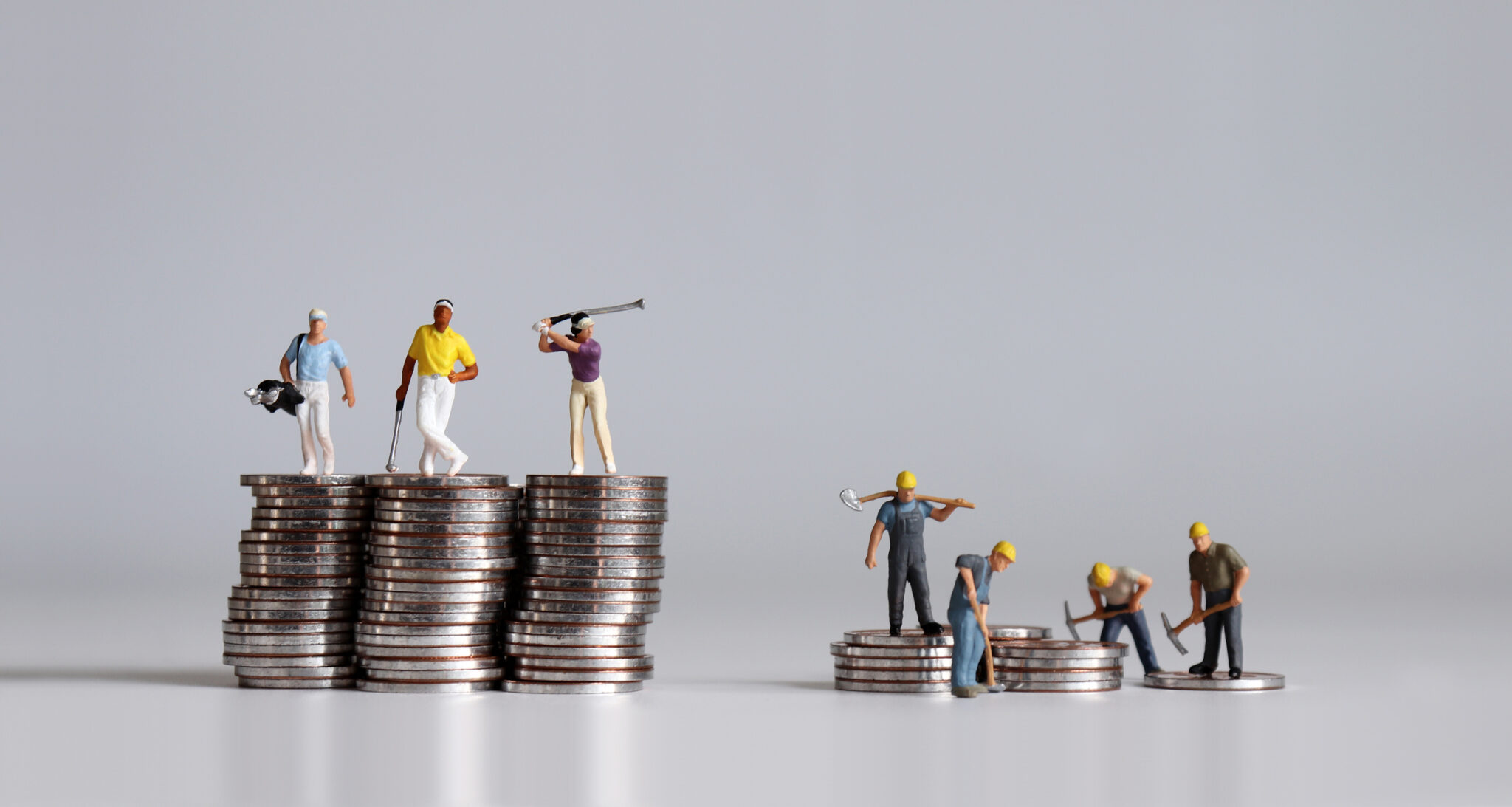
    A concept of income disparity from Getty Images.

    BY:  Ohio Capital Journal

    An overwhelming majority of a panel of Ohio economists believes that a flat-tax proposal pending in the Ohio House would worsen economic inequality, according to a survey that was published Monday.

    Most of the 22 who responded also didn’t think that the proposal would spur economic growth.

    Inequality is a serious problem in the Buckeye State, where 30% of the population is covered by Medicaid, the federal-state health program for the poor, and where 40% of all births are also covered by the program.

    Meanwhile, Republican members of the state House of Representatives are pushing a measure that would require everyone to pay state income tax at the same rate regardless of their income. It’s more fair, the pitch goes, because people making more money would pay proportionately more in income taxes than those making less.

    But critics point out that taxes on income are far from the only way people pay to support state and local government. And other taxes — such as those on sales and gasoline — are charged without regard to whether an Ohioan makes $2.7 million a year or $27,000.

    When one takes all of those taxes into consideration, poorer Ohioans pay out nearly twice as much of their income in state and local taxes as the richest, the Institute on Taxation and Economic Policy reported.

    In 2018, the poorest 20% paid 12.3% of their income in such taxes as the richest 1%, who paid just 6.5%, the institute reported.

    The economists surveyed by Scioto Analysis agreed with that assessment. Adamantly.

    Eighteen of the 22 who responded said that the 2.5% flat income tax proposed in House Bill 1 would exacerbate inequality. Only one disagreed and the other three were uncertain.

    “A flat tax is a regressive tax in which low-income taxpayers carry a disproportionate share of the tax burden,” independent economist Kay Strong wrote in the comments section of the survey. “Further squeezing those least able to cover daily living expenses qualifies as truly draconian.”

    To some, the matter was self-evident.

    “This will so obviously increase inequality that it’s not even worth debating,” wrote Paul Holmes of Ashland University.

    A few other economists resorted to snark.

    “Giving $11,000 to high-income earners and $3 to low-income earners is an efficient way to increase inequality,” wrote Michael Myler of the University of Mount Union.

    In addition to falling more heavily on poorer Ohioans, an analysis by Policy Matters Ohio indicated that HB 1 would punch big holes in funding for local government, libraries, and schools. The loss of such services will also worsen economic inequality, some of the economists said.

    “The benefits will flow to higher income individuals but the spending cuts will hurt lower income individuals,” Bob Gitter of Ohio Wesleyan University said.

    There was less certainty about whether the flat tax would help grow the economy, but 12 of the 22 economists said it wouldn’t. Eight were uncertain and just two said they believed it would help expand the state economy.

    “Public services and goods are an important part of the necessary infrastructure to grow an economy,” Rachel Wilson of Wittenberg University said. “Cutting state income taxes will reduce the public infrastructure. Our current tax rate is very competitive with other states and doesn’t need to be reduced.”

    Conversely, David Brasington of the University of Cincinnati said the flat tax would force local governments to be more efficient and thus spur economic growth.

    “It will make local public services rely more on local taxation, and attract people and new businesses to the best-run municipalities,” he said.

    _______________________________

    MARTY SCHLADEN

    Marty Schladen has been a reporter for decades, working in Indiana, Texas and other places before returning to his native Ohio to work at The Columbus Dispatch in 2017. He’s won state and national journalism awards for investigations into utility regulation, public corruption, the environment, prescription drug spending and other matters.

    MORE FROM AUTHOR

  • Think tank blasts Ohio flat tax proposal

    Think tank blasts Ohio flat tax proposal

    [vc_row][vc_column][vc_column_text]

    The Oho Statehouse, Columbus, Ohio. (Photo by Graham Stokes for the Ohio Capital Journal. Republish photo only with original story.)

    The way that the law is written would only complicate the state’s school-funding woes, take money from libraries, and increase property taxes for farmers and homeowners, it added.

    BY:  Ohio Capital Journal

    It sounds fair. If everybody paid income taxes at the same rate, the rich would pay more because of their higher incomes and the poor would pay less because they make less in the first place.

    But an Ohio proposal to enact such a “flat” state income tax ignores a host of other taxes, said a progressive public policy think tank. And the way that the law is written would only complicate the state’s school-funding woes, take money from libraries, and increase property taxes for farmers and homeowners, it added.

    “One of the myths that we have to dispel is that flat taxes make things fair,” said Guillermo Bervejillo, a state policy fellow at Policy Matters Ohio. “It’s quite the opposite. One of the things people forget when they talk about income taxes is that there’s a whole array of state taxes.”

    Bervejillo was speaking in reference to House Bill 1, which, as the bill number implies, is a top priority of the Ohio House’s Republican leadership. A spokesperson for that leadership didn’t respond to questions about the many criticisms that Policy Matters made of the bill.

    One is that many economists have long argued that so-called “flat” income taxes add to the overall tax burden shouldered by the poor and act as yet another means of lightning that of the wealthy.

    “There’s use taxes, sales taxes, excise taxes, taxes that are generally focused around consumption and use,” Bervejillo said.

     Graphic from the Center on Budget and Policy Priorities. 

    He explained that those kinds of taxes are the same for everybody, no matter her or his income. Buy a $100 pair of shoes in Ohio and you pay $5.75 in state sales tax regardless of whether you make $100 in a minute or in a whole day of work.

    “You can only buy so much toilet paper,” Bervejillo said, explaining why sales and excise taxes fall more heavily on the poor. “You can only drive so many miles.”

    The cumulative impact of those taxes is that the poor pay much more as a percentage of their income in state and local taxes than do the rich.

    “On average, the lowest-income 20% of taxpayers face a state and local tax rate more than 50% higher than the top 1% of households,” the Institute on Taxation and Economic Policy said in a report, Who Pays? “The nationwide average effective state and local tax rate is 11.4% for the lowest-income 20% of individuals and families, 9.9% for the middle 20 percent, and 7.4 percent for the top 1%.”

    Federal and state income taxes are the few exceptions that were originally structured to be “progressive.” In other words, they were intended to fall most heavily on those with the greatest ability to pay.

    And it’s true that if you take those and all other taxes into account, the richest Americans pay a bigger portion of their incomes out in taxes than poorer Americans. But the spread isn’t very wide.

    In 2019, the poorest 20% of Americans paid 20.2% of their incomes in taxes, while the richest 1% paid 33.7%, the Institute on Taxation and Economic Policy reported.

    But in Ohio if you take just state and local taxes into account, the script is flipped. In 2018, the poorest 20% paid almost twice as much of their income in such taxes — 12.3% — as the richest 1%, who paid just 6.5% of their lavish incomes in state and local taxes, the institute reported.

    And if Ohio were to enact a flat income tax, it would come on the heels of other measures in which the state has foregone large sources of revenue largely to the benefit of the wealthy.

    Ohio is giving up about $1 billion a year on a tax break for limited liability corporations. It was sold as a way to incentivize mom-and-pop businesses, but a 2017 analysis by the Ohio Legislative Service Commission found that as much as $450 million of that annual benefit was going to the highest 0.5% of Ohio wage earners.

    Meanwhile, there’s been no evidence that the cut improved Ohio’s jobs picture. It was 39th among states for job growth in February 2003 — well before the LLC tax cut was implemented, according to data compiled by Arizona State University’s Seidman Institute. By last month, Ohio ranked 46th in year-over-year job growth.

    And former Gov. John Kasich created JobsOhio by diverting funds from the state liquor monopoly. It’s spent more than $1 billion on things like incentives for wealthy businesses to locate to Ohio, but the agency has struggled to show that those expenditures have made much of a difference to the state’s jobs picture.

    But aside from fairness, Policy Matters raised another objection to HB 1 — it’s not paid for. Working from a fiscal analysis of the bill by the Legislative Services Commission, the group found that after the initial phase-in:

    • Property taxes on farmers and homeowners would increase at least $600 million a year because of “changes in the bill and the operation of Ohio’s existing property tax limit, known as House Bill 920.”
    • Schools, libraries and local governments would lose hundreds of millions of dollars a year.
    • There would be $780 million in annual net losses to the state that are not paid for in the bill.

    Bervejillo said it’s not hard to understand why pain would spread to large swaths of Ohioans from the flat-tax proposal.

    “At the end of the day, there’s only two things you can do when you cut taxes on the wealthy,” he said. “You can either cut services — and who depends more on services than low-income people? Or you increase sales and use taxes and gas taxes and cigarette taxes that fall disproportionately on low-income and working-class Ohioans.”

    _________________________________

    Marty Schladen
    MARTY SCHLADEN

    Marty Schladen has been a reporter for decades, working in Indiana, Texas and other places before returning to his native Ohio to work at The Columbus Dispatch in 2017. He’s won state and national journalism awards for investigations into utility regulation, public corruption, the environment, prescription drug spending and other matters.

    MORE FROM AUTHOR

    [/vc_column_text][/vc_column][/vc_row]