Tag: food banks

  • With inflation, supply-chain kinks, plight of Ohio food banks grows

    With inflation, supply-chain kinks, plight of Ohio food banks grows

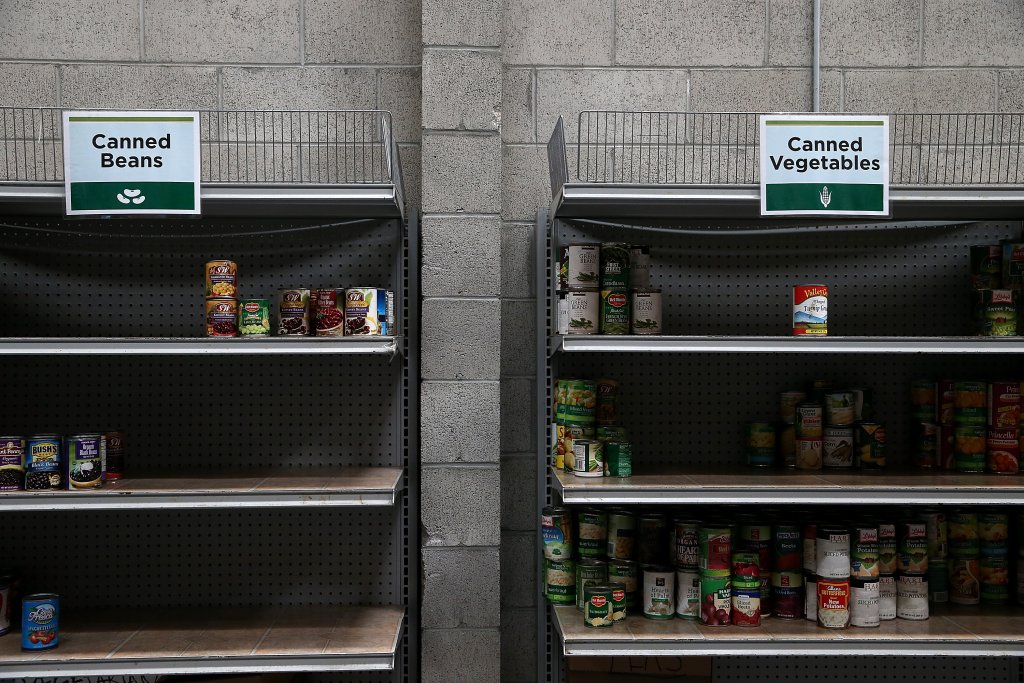
    Shelves of canned foods sit partially empty. Photo by Justin Sullivan/Getty Images.

    BY: MARTY SCHLADEN – Ohio Capital Journal

    For millions of Ohioans, world events are making it harder to fill their pantries and refrigerators, an official who helps oversee the state’s food banks said on Wednesday. Those pressures will only increase pantries’ need for state assistance, she said.

    The coronavirus pandemic had already put pressure on the state’s food banks as demand increased and supply-chain disruptions made it harder and more expensive to get food. Now the Russian invasion of Ukraine is poised to further squeeze global flows of wheat and fuel, exacerbating those trends, said Lisa Hamler-Fugitt, executive director of the Ohio Association of Foodbanks.

    Further complicating the picture is that the new scarcity of food is slashing commercial contributions to organizations that supply the neediest Ohioans, making them desperate for help.

    “I would say that is an understatement,” Lisa Hamler-Fugitt said. “Overall, donations are down substantially. Before we went into the pandemic, private-sector donations from food manufacturers, wholesalers, retailers and local food and fund drives would range from 45% to 50 % of all we had to distribute. Since the pandemic that has declined dramatically.”

    Lisa Hamler-Fugitt

    Now the portion donated by commercial suppliers is closer to 33% at the same time that costs to purchase and transport food are growing. Consider:

    • Eggs that cost food banks 40 cents a pound in 2019 now cost 94 cents, a 135% increase.
    • Ground beef that cost $2.14 a pound in 2019 costs $2.84, a 33% increase.
    • Pasta has gone from 42 cents a pound in 2019 to 70 cents now, a 66% hike.

    Also, a $2,000 per-child tax credit expired in December, plunging an estimated 10 million American children and 280,000 in Ohio back into poverty. Hamler-Fugitt said that of families receiving the credit, 59% said food was their No. 1 expense, so its expiration is increasing demand at Ohio food banks even as costs go up.

    “Families that were standing in grocery store lines are back in our food pantries,” she said.

    Federal data appear to support that claim. The Census Bureau’s Household Pulse Survey estimated that about a month after the credit expired, 339,000 Ohio families with children sometimes or often didn’t have enough to eat in the past seven days. 

    Compare that to the period from Sept. 15-27 when the credit was in full force. Then an estimated 264,000 Ohio families with children sometimes or often didn’t have enough to eat, the survey said.

    If those estimates are accurate, that means food insecurity for families with children has leapt 28% since the expiration of the child tax credit.

    In addition to all the other inflationary pressures on food, Hamler-Fugitt said she suspected another: price gouging.

    “I hear from the farmers saying, ‘We’re not making any more money.’ How is that possible?” she said.

    In his State of the Union Address Tuesday, President Joe Biden echoed that suspicion. He said concentration in the meatpacking industry is alarmingly high.

    “Guess what, you got four basic meat packing facilities,” he said. “That’s it. You play with them or you don’t get to play at all. And you pay a hell of a lot more. A hell of a lot more because there’s only four.”

    The White House estimates that those four companies — JBS, Cargill, National Beef Packing and Tyson Foods — control 85% of beef packing in the United States, 54% of poultry and 70% of pork. The administration says it’s making an effort to promote competition in those sectors and across the economy. 

    But even if those efforts are eventually successful, Hamler-Fugitt said Ohio food banks need help more quickly. She praised the support they’ve gotten from Gov. Mike DeWine throughout the pandemic, but said the food centers need $183 million for supplies, operating costs and to upgrade their infrastructure.

    Ohio has more than $600 million in unexpended funds from the American Rescue Act and about $500 million more is on the way, Hamler-Fugitt said. A DeWine spokesman didn’t immediately respond to a request for comment.

  • DeWine, state leaders announce $430M in coronavirus relief

    DeWine, state leaders announce $430M in coronavirus relief

    Marty Schladen

    Marty Schladen has been a reporter for decades, working in Indiana, Texas and other places before returning to his native Ohio to work at The Columbus Dispatch in 2017. He’s won state and national journalism awards for investigations into utility regulation, public corruption, the environment, prescription drug spending and other matters.

    Ohio Gov. Mike DeWine and the state’s legislative leaders on Friday announced how they’d allocate almost half of what the state has left in federal coronavirus-relief dollars.

    The state has about $1 billion unexpended from its share of the $2.2 trillion CARES Act that Congress passed in March. At least until the feds change the rules, the funds have to be spent by Dec. 31.

    Social-service groups that deal with issues of homelessness and hunger have been clamoring for months for a share of the money, as have business groups and others. So it’s been up to DeWine and the legislature to decide what to do with the money while Congress appears stymied over further coronavirus relief.

    “We tried to look at what the needs were and what had already been put out,” DeWine said during a remote press conference. “We don’t know whether Congress will pass another bill or not.”

    The state is holding about half of the funds for coronavirus testing and contact tracing and other needs while it awaits a possible second round of relief — which may or may not include assistance to state and local governments.

    The expenditures announced Friday include:

    • $50 million for mortgage and rental assistance to families making 200% or less of the federal poverty level 
    • $125 million for businesses with up to 25 employees
    • $37.5 million for restaurants and bars
    • $100 million for colleges and universities to do testing, contact tracing and provide mental-health services
    • $62 million for rural and critical-access hospitals
    • $25 million for non-profits providing services such a food banks, homeless shelters and other social services
    • $20 million for the arts

    A good deal more of the money was focused on businesses than on assisting individuals who are suffering most. But several in Friday’s press conference said they hope by helping small businesses keep their doors open, people will be able to get or keep jobs.

    “We know some businesses are barely making it,” Lt. Gov. Jon Husted said of that portion of the package. “This is focused on them.”

    For their part, some leaders of social-service organizations said they were grateful for the help they will receive.

    “We’re pleased that Gov. DeWine finally deployed federal coronavirus relief funds to help people avoid getting evicted during this pandemic,” Bill Faith, executive director of the Coalition on Housing and Homelessness in Ohio, said in a written statement. “And we appreciate (Ohio) Controlling Board members’ support, especially Sen. (Matt) Dolan (R-Chagrin Falls) and Sen. (Jay) Hottinger (R-Newark) who took a personal interest in keeping struggling Ohioans safely in their homes. We look forward to seeing details on how the program will be implemented. Given the Dec. 31 deadline to use these funds, we would welcome the governor’s assistance in advocating for Congress to provide additional rental assistance into 2021.”

    The Ohio Poverty Law Center also released a statement praising state leaders for their action. But it warned that it won’t be enough.

    “As Ohioans continue to experience job and income loss due to the pandemic, additional federal and state resources will be needed to prevent evictions and keep Ohioans safe, especially as we get closer to the expiration of the Centers for Disease Control and Prevention’s eviction moratorium,” it said. “We hope housing assistance will be among the highest priorities for resources in the coming weeks and months.”

  • Portman, fan of a big tax cut for the rich, won’t say whether he supports $2T in coronavirus relief

    Portman, fan of a big tax cut for the rich, won’t say whether he supports $2T in coronavirus relief

    The office of Ohio Sen. Rob Portman won’t say whether he’s one of the Senate Republicans unwilling to support a coronavirus-relief bill under negotiation between the Trump White House and House Speaker Nancy Pelosi.

    Ohio Sen. Rob Portman

    Senate Majority Leader Mitch McConnell, R-Kentucky, on Tuesday warned the White House not to agree to the bill because the $2 trillion price tag was too high for many in his caucus. That message comes as hopes of passing a relief bill before next year seem to be dimming.

    With a raging virus continuing to throttle the economy, Federal Reserve Chairman Jerome Powell earlier this month urged passage of a relief bill to avoid lasting damage. Many other economists have been making the same argument, while those who study poverty say legions of Americans are being added to its numbers.

    In Ohio, those who work with the poor warn of cascading homelessness and say food banks are seeing huge demand.

    After passage of the $2.2 trillion CARES Act in March, the Democratically controlled House in May passed a $3.4 trillion coronavirus relief bill that wasn’t taken up by the Republican-controlled Senate.

    It wasn’t until late July — as federal unemployment supplements were running out — that McConnell introduced his own bill. But he later admitted that he didn’t have enough votes in his own caucus to pass it.

    Earlier this month, just after a covid-infected Trump was released from the hospital, he abruptly broke off negotiations with House Democrats. Then he abruptly reversed himself again and by Tuesday he was saying he wanted a bigger package than the $2.2 trillion deal being pushed by Pelosi and the Democrats. 

    For his part, McConnell has been promoting a bill less than an fourth that size — $500 billion — that would have included an unemployment supplement and aid to schools. Democrats blocked it Wednesday, saying the bill was woefully inadequate.

    On Tuesday, McConnell gave another reason for not wanting to schedule a hearing on a larger bill: It could disrupt the breakneck schedule to confirm Supreme Court nominee Amy Coney Barrett before the Nov. 3 election, the Washington Post reported.

    Ohio’s Democratic senator, Sherrod Brown

    That brought a blast from Ohio’s Democratic senator, Sherrod Brown.

    “Once again, Mitch McConnell is telling Americans, ‘you’re on your own,’” Brown said in an email. “Millions of people are suffering right now and he would rather stall a COVID relief package to continue rushing through an illegitimate Supreme Court nomination. Workers are struggling to figure out how to pay their bills, stay in their homes, and keep their families safe while McConnell would rather focus on his power grab.”

    Portman’s staff wouldn’t answer directly when asked whether he supported a relief bill of about $2 trillion, roughly the size of that being negotiated between House Democrats and the Trump administration.

    “Rob has consistently called on both parties to come to an agreement on additional covid relief for families and small businesses — legislation that would support increased (coronavirus) testing, provide additional funding for schools and state and local communities, restart the Payment Protection Program, and provide needed liability protections,” spokeswoman Emmalee Cioffi said in an email.

    She also provided a transcript of a Sept. 10 speech Portman gave on the Senate floor in which he castigated the earlier covid-relief bill passed by House Democrats as too expensive.

    “It’s a $3.5 trillion bill,” Portman said. “And remember, we’ve already spent about $3.5 trillion making this the largest deficit in the history of our country and making our debt now, for the first time since World War II, the size of our entire economy. That concerns all of us, and it should.”

    Portman also was highly critical of Obama-era deficit spending amid a historic recession.

    But he wasn’t nearly so concerned about deficits in 2017 when he was pushing the Tax Cuts and Jobs Act at a time when the federal unemployment rate was 4.1%

    Portman claimed the $1.5 trillion tax cut — which gave massive breaks to the richest Americans — would stimulate so much economic growth that it would pay for itself, although such promises almost never have panned out in American history.

    Portman’s promise was quickly shown to be empty, and by early 2018, the tax cut was projected to add more than $1.3 trillion to the deficit over 10 years. Nor did it deliver the economic growth that Portman, Trump and McConnell promised, the Congressional Research Service reported last year.

    Just before Congress passed the tax cuts, Portman told WKSU that he’d support clawing them back if they didn’t produce the promised growth. So far, that hasn’t happened, either.


    Marty Schladen has been a reporter for decades, working in Indiana, Texas and other places before returning to his native Ohio to work at The Columbus Dispatch in 2017. He’s won state and national journalism awards for investigations into utility regulation, public corruption, the environment, prescription drug spending and other matters.
  • SNAP online food purchasing now available in Ohio

    SNAP online food purchasing now available in Ohio

    Ohioans who are eligible for the Supplemental Nutrition Assistance Program (SNAP) can now use their Ohio Direction cards to purchase food online through Walmart and Amazon, the Ohio Department of Job and Family Services (ODJFS) has announced.

    “We know many Ohioans are struggling and that food purchasing has been a challenge for many, especially older Ohioans and those with limited access to transportation,” said ODJFS Director Kimberly Hall. “We hope online purchasing gives individuals more options and makes it easier for them to both stay safe and eat nutritiously.”

    Previously, Ohio SNAP recipients could order groceries online at Giant Eagle, Walmart and some Kroger stores, but they had to pay inside the stores or at curbside. After receiving federal approval, ODJFS successfully tested online purchasing with Walmart and Amazon. While Ohio SNAP recipients can order food online from a variety of retailers, only Walmart and Amazon allow online purchasing with EBT cards. Individuals may choose to have groceries delivered, but federal rules still prohibit using SNAP benefits to pay for any delivery charges.

    Qualify for SNAP

    Individuals may qualify for SNAP if their household’s gross monthly income is at or under 130% of the federal poverty guidelines. Ohioans can apply at benefits.ohio.gov. Benefits can be used to buy most food products, with the exception of alcoholic beverages, vitamins and/or medicines, and hot food
    made to be eaten immediately, including prepared food from grocery stores and restaurants.

    ODJFS has provided additional assistance to SNAP recipients during the pandemic:

    • Began issuing Pandemic EBT benefits for children who normally receive free or reduced price meals at school.
    • Issued supplemental SNAP payments to qualifying households in March, April and May and is preparing to issue them again in June.
    • Waived administrative verifications normally required at food banks, to streamline the process and limit person-to-person contact.
    • Extended SNAP recertification periods for March, April, May and June by six months.