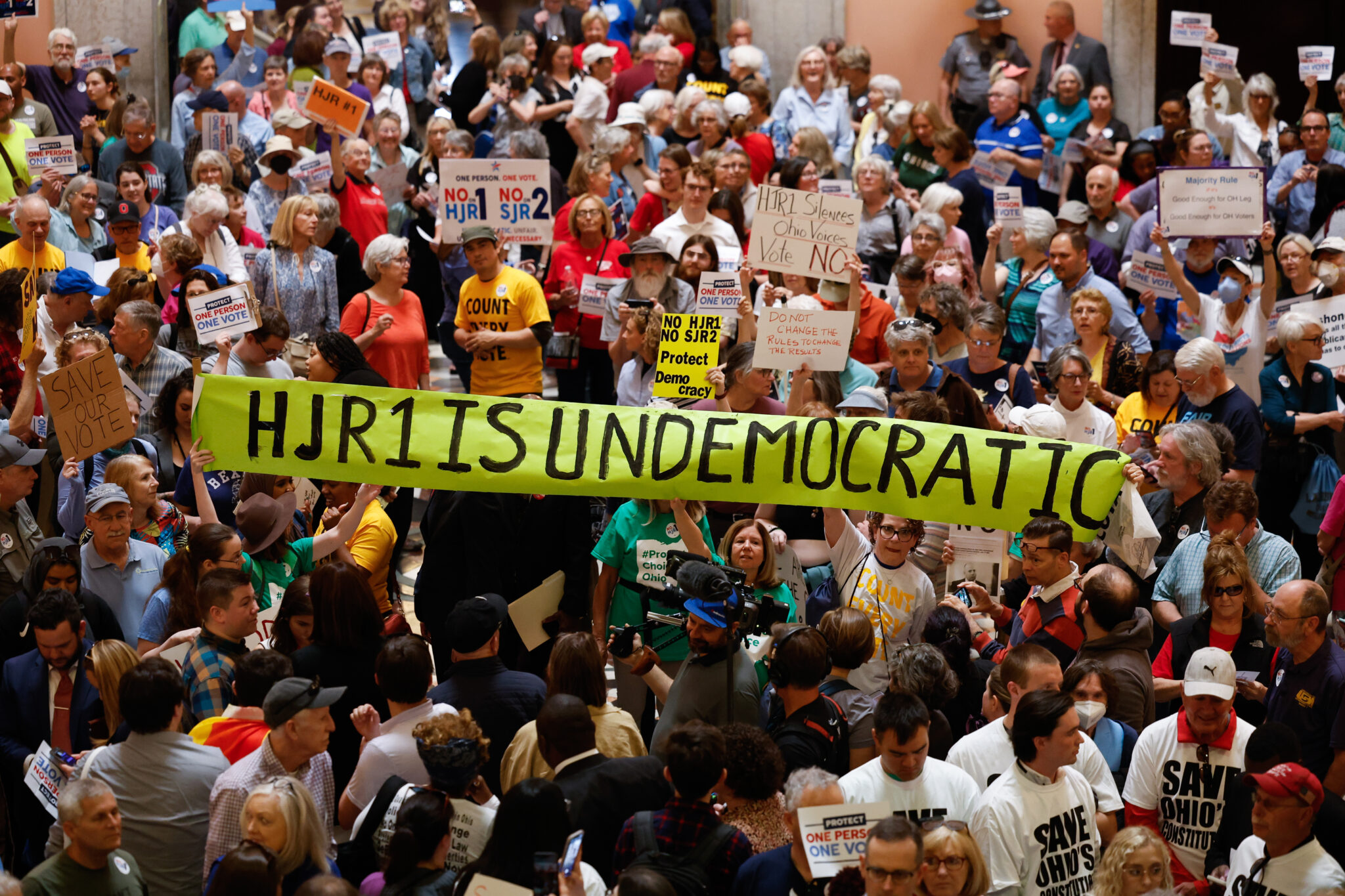
Tag: gathering signatures

  • Gerrymandered Ohio Statehouse gives voters no recourse through initiated statute, only constitution

    Gerrymandered Ohio Statehouse gives voters no recourse through initiated statute, only constitution

    OPINION

    Citizens could work tirelessly to pass an initiated statute and the rigged Ohio legislature could then simply overturn it

    by David DeWitt – Ohio Capital Journal

    In order to understand the bad faith of the Republican arguments for attacking Ohio voters and asking us to enshrine 41% minority rule over our Ohio Constitution, voters need to understand the power dynamics at play when it comes to initiated statutes versus amendments to the Ohio Constitution.

    In Ohio, citizens have two options for proposing changes through a ballot initiative: They can offer a statute, which changes law under Ohio Revised Code, or a constitutional amendment, which amends the Ohio Constitution.

    Time and again we hear gerrymandered Ohio Republican lawmakers making some variation on their argument that the constitution is our “foundational document” and that if voters want a change, they should attempt an initiated statute to change the law, instead of adding an amendment to the Ohio Constitution.

    Here’s what they want citizens to forget: Ohio law offers no protection for a newly passed statute. Lawmakers can immediately repeal or modify whatever changes voters approve.

    This means that well-meaning citizens of Ohio could raise money, spend countless hours gathering signatures, put in enormous volunteer time, talk to their friends and neighbors, knock on doors, and generally work themselves to the bone to get a statute initiative on the ballot and passed, and then our unconstitutionally gerrymandered supermajority Republican legislature could repeal it the next day.

    Some states have provisions to protect from this situation. If a citizen-initiated statute passes, the General Assembly is not allowed to just overturn it, sometimes for a given number of years, or they must reach an extremely high bar to do so. Ohio does not have this. That is a huge difference.

    The fact that there is no such protection for citizen-initiated statutes in Ohio, combined with the fact that our Statehouse is unconstitutionally gerrymandered for unrepresentative Republican supermajorities in both chambers, means that it would be foolish for any citizen group working on an issue that our misrepresentative legislature refuses to address to spend all that time and effort passing a statute just to be kicked in the teeth by that same misrepresentative legislature.

    Over the years as a newspaper reporter in Athens, I would ask people bringing, for instance, initiatives for the legalization of medicinal cannabis, why they were going for a constitutional amendment and not a statute. The answer was always the same: Because the Statehouse would just override it. Why spend all that time and money on something that they will just override?

    When you understand this, you understand why groups bring amendments instead of statutes. This also reveals the wildly condescending deceit of these Ohio Republicans attacking 175 years of Ohio majority voter authority over our constitution.

    Presumably, they understand these dynamics, too. And yet, they shriek and wail about all these groups they say are trying to write law into the constitution instead of just bringing statutes.

    The simplest, easiest way to incentivize groups to put forward citizen-initiated statutes instead of amendments would be for them to create some kind of protection for those statutes from being overturned by the legislature.

    Instead of this type of moderate, reasonable change that would alleviate the concerns Ohio Republicans claim that they have, they are going for Ohio voters’ throats.

    We all know — and they have made clear in private and in public — that their effort is really aimed to stop an abortion rights amendment slated for the November ballot, and to stop voters from any effort toward further anti-gerrymandering reform.

    That gerrymandering piece of the puzzle is also what makes their arguments so offensively disingenuous.

    Ohio Republicans would not have had the votes to bring this $20 million, Aug. 8 special election if they hadn’t ignored the Ohio Constitution by forcing Ohioans in 2022 to vote under district maps declared unconstitutional by a bipartisan Ohio Supreme Court five times.

    In doing so, they flagrantly violated the will of Ohio voters who passed anti-gerrymandering reform for Statehouse districts in 2015 with more than 71% of the vote.

    Them now claiming the mantle of “protecting the Ohio Constitution” is ridiculous on its face. They have shown repeatedly they don’t give a damn about the integrity of the Ohio Constitution. They have flagrantly violated the Ohio Constitution, the rule of law, the orders of the Ohio Supreme Court, and the will of Ohio voters, with staggering contempt.

    This is Lucy asking Charlie Brown to try to kick the football just one more time. I can only conclude they are either themselves just not very smart, or they’re so deeply cynical that they think Ohioans are profoundly stupid. Probably a mixture of both, depending on the lawmaker.

    Even if you wanted to have a good faith discussion on citizen initiatives and the Ohio Constitution, you would have to meet a couple premises off the bat: You would have to have a legitimate and representative legislature that isn’t gerrymandered, and you would have to have some sort of enforceable protection for citizen-initiated statutes. Ohio has neither.

    Are some things such as marijuana or casino laws better off in Ohio Revised Code? Probably. But Ohio Republicans rigging the game at every step of the process has rendered that discussion moot. Constitutional amendments are the only effective tool of direct power Ohio citizens have left.

    Other issues such as civil and human rights stand wholly appropriate to the Ohio Constitution, firmly out of the manipulative reach of corrupt, unscrupulous lawmakers.

    So that remains the primary question for Ohio voters: Should a 41% minority, alongside a rigged, extremist legislature acting on behalf of radical special interests, have authority over our most fundamental human and civil rights? Voters ought to think wisely.

    _______________________________

    David DeWitt
    DAVID DEWITT

    OCJ Editor-in-Chief and Columnist David DeWitt has been covering government, politics, and policy in Ohio since 2007, including education, health care, crime and courts, poverty, state and local government, business, labor, energy, environment, and social issues. He has worked for the National Journal, The New York Observer, The Athens NEWS, and Plunderbund.com. He holds a bachelor’s degree from Ohio University’s E.W. Scripps School of Journalism and is a board member of the E.W. Scripps Society of Alumni and Friends. He can be found on Twitter @DC_DeWitt

    MORE FROM AUTHOR

  • Ohio senators working to resurrect recently eliminated August elections to fight abortion amendment

    Ohio senators working to resurrect recently eliminated August elections to fight abortion amendment

    “If we save 30,000 lives as a result of spending $20 million,” Senate President Matt Huffman argued, “I think that’s a great thing.”

    BY: NICK EVANS – Ohio Capital Journal

    Only about three months ago, Ohio lawmakers passed a wide-ranging elections bill that will require voters present a photo ID when they cast a ballot. But it didn’t start out that way. Lawmakers bolted on the photo ID requirements only at the last minute.

    The bill began as a proposal to eliminate August special elections. The bill’s sponsor, Rep. Thomas Hall, R-Madison Township, argued there should only be two elections a year “a primary election, and a general election.”

    “August special elections are costly to taxpayers and fail to engage a meaningful amount of the electorate in the process,” he argued.

    So why are lawmakers now preparing to un-eliminate the elections they just scrapped?

    The Senate’s proposal

    Sens. Rob McColley, R-Napoleon, and Theresa Gavarone, R-Bowling Green, introduced a bill Wednesday that would, once again, allow August special elections.

     COLUMBUS, Ohio — MARCH 22: State Rep. Allison Russo, D-Upper Arlington, speaks to reporters after the House Constitutional Resolutions committee meeting first hearing on HJR 1 that would require 60% vote to approve any constitutional amendment, March 22, 2023, at the Statehouse in Columbus, Ohio. (Photo by Graham Stokes for Ohio Capital Journal. Republish photo only with original story.)

    Despite the most recent August election barely clearing 8% in statewide voter turnout, the sponsors specifically add legislature-initiated amendments to the brief list of proposals that can go on an August ballot. Citizen-led amendments can still only go before voters in November

    McColley and Gavarone’s change of heart has to do with one such proposal working its way through the Ohio House. That resolution would put a proposal on the ballot raising the threshold for passage of all future amendments from a simple majority to 60%.

    After that resolution’s hearing, House minority leader Allison Russo criticized the unnecessary expense.  Of Republicans’ about face, she said, “the hypocrisy here has no bounds.”

    “Really what this is about is silencing the voice of voters and shutting down direct democracy,” she argued, “Because again, this is a legislature who has no interest in being checked by voters — they picked their voters.”

    The sponsors readily acknowledge the expense of their gambit. The bill appropriates $20 million to help county boards conduct a special election. If lawmakers were to wait about three months, they could save that money. As it happens, there’s an election every November, and it’s relatively cheap to add one more question.

    But Senate president Matt Huffman is calculating the question differently, and to him, the math adds up.

    Huffman’s take

    “If we save 30,000 lives as a result of spending $20 million, I think that’s a great thing,” Huffman told reporters after a Senate session Thursday. “Now I know a lot of people don’t look at it that way, but that’s the way I look at it.”

    His comments are an explicit connection between efforts to raise the threshold for amending the constitution and undermining an abortion rights amendment. Organizers are currently gathering signatures for that proposal and hope to have it on the ballot this November.

    The senate president over-shot the mark, however. Department of Health statistics put the number of induced abortions at more like 21,000-22,000 per year on average.

    Huffman defended the push for an August election. He said he’d expected the House to have the supermajority resolution passed in time for the May primaries.

     COLUMBUS, OH — JANUARY 03: Newly elected Ohio House Speaker Rep. Jason Stephens (R-Kitts Hill) gives brief remarks at the opening day ceremonies of the 135th General Assembly of the State of Ohio, January 3, 2023, in the House Chamber at the Statehouse in Columbus, Ohio. (Photo by Graham Stokes for Ohio Capital Journal. Republish photo only with original story.)

    Still Huffman attempted to draw a distinction between the current proposal and lawmakers eliminating August elections as a standing “as-needed” date on the election calendar.

    “Do I have turnout concerns in school levies in August because very few people come out, and they’re done when people are on vacation, and they don’t know about it? And liquor permits and things like that, that typically happen? Yeah.” Huffman said.

    “But I think in this case, it’s something that a lot of people are going to be very fired up about,” he added.

    Huffman said he plans to have the special elections measure passed by mid to late April. He wants the House to have “ample consideration,” before the deadline to get the supermajority amendment on the ballot.

    House headwinds

    If House Speaker Jason Stephens has his way, though, the special elections bill may be dead on arrival.

    “We just voted to not have those anymore just a few months ago,” Stephens told reporters Thursday. “The county election officials I’ve talked to are not interested in having it.”

    “I’m frankly not interested in having an election in August,” he said.

    Follow OCJ Reporter Nick Evans on Twitter.