Ohio Gov. Mike DeWine has signed a bill into law banning transgender students from using school bathrooms and locker rooms that match up with their gender identity.
The law requires people at Ohio K-12 schools and universities use the restroom that aligns with their gender assigned at birth. It also bans students from sharing overnight accommodations with people of the opposite sex from their assigned sex at birth at K-12 schools.
This does not prevent a school from having single-occupancy facilities and does not apply to someone helping a person with a disability or a child younger than 10 years old being assisted by a parent, guardian or family member.
The law will take effect 90 days after DeWine signed the bill.
Several transgender Ohioans, allies and educators called on DeWine to veto the bill. The Ohio Capital Journal recently talked to a family who plans on moving out of Ohio because of anti-transgender legislation at the Statehouse.
The bathroom ban (House Bill 183) was added to a bill that revises College Credit Plus (Senate Bill 104) in the eleventh hour of a House Session at the end of June before the lawmakers went on an extended break.
The American Medical Association officially opposes policies preventing transgender individuals from accessing basic human services and public facilities consistent with gender identity.
Slightly more than half of transgender and nonbinary youth in Ohio considered suicide in 2022, according to the Trevor Project.
About a third of LGBTQ+ students were prevented from using the bathroom that aligned with their gender and slightly more than a quarter were stopped from using the locker room that aligned with their gender, according to Ohio’s 2021 state snapshot by GLSEN, which examines the school experiences of LGBTQ middle and high school students.
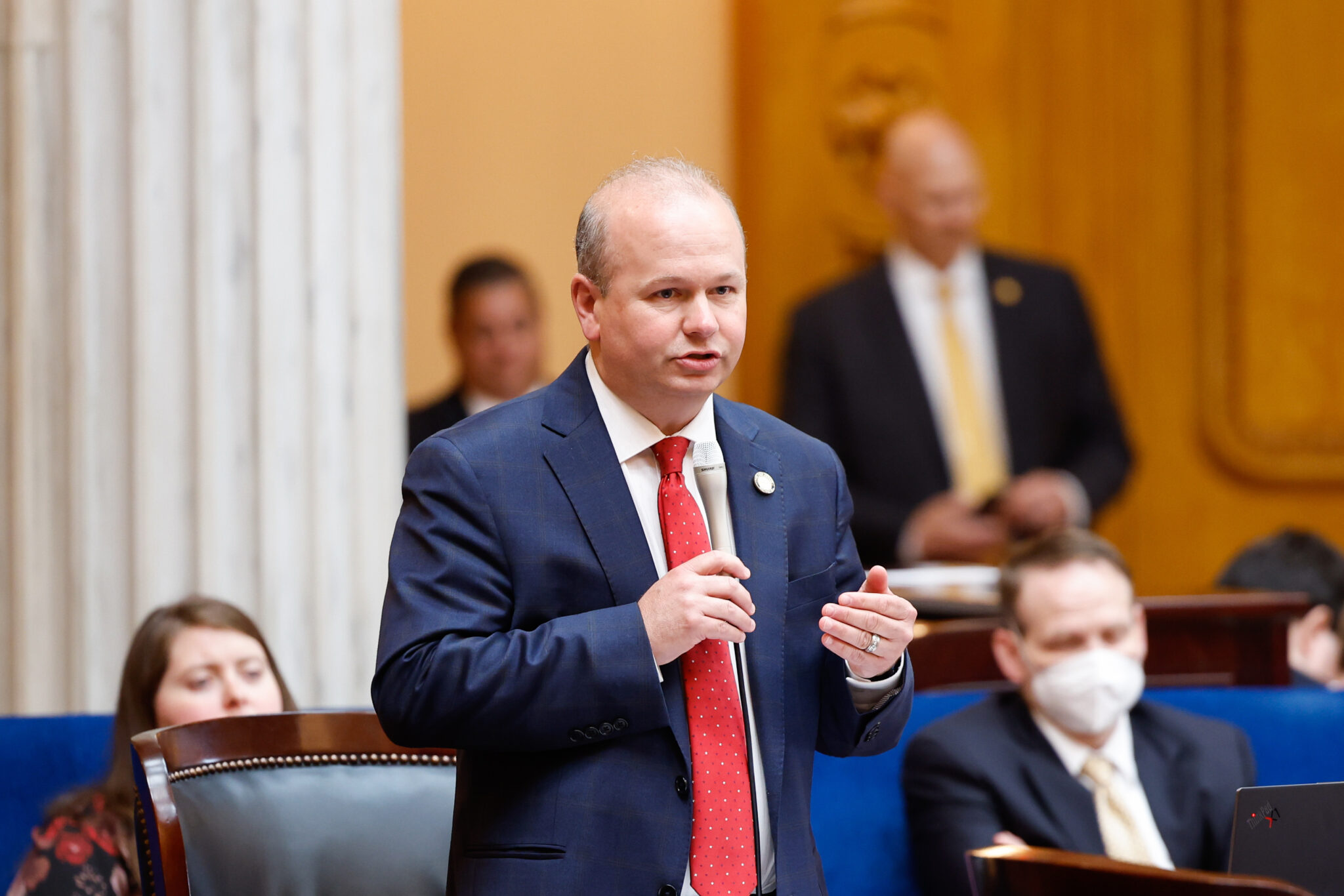
Ohio Gov. Mike DeWine gives his 2024 State of the State address in the Ohio House chambers at the Ohio Statehouse on Wednesday afternoon. (Pool photo by Barbara J. Perenic, Columbus Dispatch.)
Forty-two percent of transgender and nonbinary students were unable to use the bathroom that aligned with their gender and 36% couldn’t use the locker room that aligned with their gender, according to the Ohio GLSEN report.
Transgender youth who can’t use the bathroom that aligns with their gender are at a greater risk of sexual violence, according to a 2019 study published in the journal Pediatrics.
Florida, Oklahoma, Idaho, and Tennessee’s laws have all been challenged. The U.S. Court of Appeals for the 9th Circuit blocked Idaho’s law last year.
North Carolina made history in 2016 by becoming the first state to ban bathroom access to transgender people. The law was quickly appealed in 2017 and settled in federal court in 2019, but the state ended up losing hundreds of millions of dollars as the NBA All-Star Game and NCAA events were moved out of state.
Megan Henry is a reporter for the Ohio Capital Journal and has spent the past five years reporting in Ohio on various topics including education, healthcare, business and crime. She previously worked at The Columbus Dispatch, part of the USA Today Network.
Ohio Capital Journal is part of States Newsroom, the nation’s largest state-focused nonprofit news organization.
A bill that would ban transgender students from using school bathrooms and locker rooms that align with their gender identity is going to Ohio Gov. Mike DeWine’s desk.
The Ohio Senate voted to concur on Senate Bill 104 in a 24-7 party-line vote Wednesday afternoon. The Ohio House wove House Bill 183 (the bathroom ban bill) into S.B. 104 and passed the bill before going on break at the end of June.
Once DeWine receives S.B. 104, he will have 10 days to sign the bill into law or veto it.
“We have no new comments today,” DeWine’s press secretary Dan Tierney said in an email Wednesday afternoon. “As far as receipt, sometimes that can take a week or more.”
The bill would require students at Ohio K-12 schools and colleges use the bathroom or locker room that aligns with their gender assigned at birth. It would not prevent a school from having single-occupancy facilities. The bill would not apply to someone helping a person with a disability or a child younger than 10 years old being assisted by a parent, guardian or family member.
The American Medical Association officially opposes policies preventing transgender individuals from accessing basic human services and public facilities consistent with gender identity.
State Sen. Jerry Cirino, R-Kirtland, introduced S.B. 104, which revises the College Credit Plus Program, and he spoke about the House adding the bathroom bill to his bill.
“It revolves around safety, security and, I think, common sense,” he said. “It protects our children and grandchildren in private spaces where they are most vulnerable. It is us using our legislative authority to ensure schools are, in fact, safe environments. After all, bathrooms, showers, changing rooms should all be safe places for our students.”
Senate Democrats spoke in opposition to weaving the bathroom ban into S.B. 104.
“We could not wait one week, not one single week before we start attacking children once again in this legislative body,” said state sen. Bill DeMora, D-Columbus.
State Sen. Kent Smith, D-Euclid, said S.B. 104 started off as a good piece of legislation “that got turned into something that’s certainly not what was intended when this chamber last heard it.”
“Lame duck often takes good legislation and makes it terrible,” he said.
If the bill becomes law, Ohio Senate Minority Leader Nickie Antonio, D-Lakewood, said it “is destined for litigation.”
“I am in disbelief that this is a top priority on our first session back from recess,” Antonio said. “This bill is not about bathrooms. It’s about demonizing those who are different, and our children are watching and listening to the fearmongering.”
State Reps. Beth Lear, R-Galena, and Adam Bird, R-New Richmond, introduced H.B. 183 last year and it has received lots of pushback from the LGBTQ+ community. More than 100 people testified against the bill in committee.
GET THE MORNING HEADLINES.
Nearly a third of LGBTQ+ students said they were prevented from using the bathroom that aligned with their gender, and 26% were stopped from using the locker room that aligned with their gender, according to Ohio’s 2021 state snapshot by GLSEN, which examines the school experiences of LGBTQ middle and high school students.
When looking specifically at transgender and nonbinary students, 42% were prevented from using the bathroom that aligned with their gender and 36% couldn’t use the locker room that aligned with their gender, according to the Ohio GLSEN report.
A 2019 study published in the journal Pediatrics reported transgender youth are at greater risk of sexual violence when they are unable to use the bathroom that aligns with their gender.
About a quarter of the 3,673 trans and nonbinary middle and high school students surveyed in the United States reported being sexually assaulted in the last 12 months, according to the 2019 study. The number went up to 35% among students who attended schools that limited their bathroom and locker room access.
These laws, however, have been challenged in Florida, Oklahoma, Idaho, and Tennessee. The U.S. Court of Appeals for the 9th Circuit blocked Idaho’s law last year.
North Carolina was the first state to limit bathroom access to transgender people in 2016, but the law was repealed in 2017 and ultimately settled in federal court in 2019. The law cost the state hundreds of millions of dollars.
“Everybody deserves to pee”
LGBTQ+ advocates held a press conference in opposition to the bathroom bill before the Senate session.
“Everybody deserves to be able to pee, and everyone deserves to pee,” said Dara Adkison, executive director of TransOhio.
This bill would directly affect transgender college student Leo Duru.
“What if I was forced to use the bathroom of my assigned sex at birth, a women’s restroom?” Duru said. “As a 21-year-old trans man, I can’t believe adult students would be subjected to restroom policies decided by politicians forcing teachers, professors and administrators to invade trans students’ personal privacy.”
Mallory Golski with Kaleidoscope Youth Center shared concerns she hears from students who are already worried about using the bathroom in school.
“I realized that it’s not uncommon for them to feel fatigued or even dizzy at times during (swim) practice, because they’re often dehydrated,” she said. “It is not because they’re not thirsty or because they don’t know the reason that they should be drinking water. It’s because they don’t feel comfortable or safe using the gendered restrooms at school.”
Organizations are calling on DeWine to veto S.B. 104.
“Everyone should be able to use the bathroom without being the target of bullying – from their peers, and especially from state legislators,” Kaleidoscope Executive Director Erin Upchurch said in a statement.
“This bill has nothing to do with student safety and everything to do with political opportunism,” Ohio Federation of Teachers President Melissa Cropper said in a statement. “There is no epidemic of student assaults in bathrooms and locker rooms.”
This is the second bill related to transgender issues that has gone to DeWine’s desk so far this General Assembly. Last December, DeWine vetoed House Bill 68, the ban on gender-affirming care for trans youth, but the House and Senate quickly voted to override his veto.
Antonio is not optimistic DeWine will veto S.B. 104.
“I don’t expect that,” Antonio said. “I think this bill was framed in a way that was very, very different.”
Megan Henry is a reporter for the Ohio Capital Journal and has spent the past five years reporting in Ohio on various topics including education, healthcare, business and crime. She previously worked at The Columbus Dispatch, part of the USA Today Network.
Ohio Capital Journal is part of States Newsroom, the nation’s largest state-focused nonprofit news organization.
The Ohio House recently passed a bill that would ban transgender people from using the bathroom and locker room that aligns with their gender identity.
Bradie Anderson fears she will be physically harmed if she uses the boys bathroom at her Northeast Ohio high school.
The 14-year-old sophomore is transgender and her mom Anne said she has never had any issues with using the girls restroom at school.
“She’s not going in the boys bathroom,” Anne said. “If my daughter went into the boys bathroom, I would hate to think what would happen to her in there.”
But the Ohio House recently passed a bill that would ban transgender people, like Bradie, from using the bathroom and locker room that aligns with their gender identity. The bill now heads to the Senate for concurrence, but the legislators are on break until after the election.
______
Jean Schmidt (R) who represents Ohio House District 62 is a co-sponsor of HB 183.
Jennifer Gross (R) who represents Ohio District 45 is a co-sponsor of HB 183.
Thomas Hall (R) who represents Ohio District 46 is a co-sponsor of HB 183.
Bill Seitz (R) who represents Ohio District 30 is a co-sponsor of HB 183.
Adam C. Bird (R) who represents Ohio District 63 is a Primary Sponsor of HB 183.
______
“The bathroom bill is going to get kids hurt and put them in harm’s way,” Anne said. “Why would anyone want to put any child, even if you don’t understand who they are, in harm’s way?”
If the bathroom bill were to pass, Anne questions who is going to monitor the bathrooms.
“If you don’t look feminine enough, if you don’t look masculine enough, are they going to be questioned?” Anne said. “Because cisgender people are also going to get pulled into this as well.”
The American Medical Association opposes policies preventing transgender individuals from accessing basic human services and public facilities consistent with gender identity.
Anti-transgender legislation in Ohio
The bathroom bill is one of many anti-LGBTQ+ bills Ohio lawmakers have introduced in the General Assembly — including one that would ban gender affirming care and prevent transgender athletes from playing women’s sports and another that would force educators to out students to their parents.
“These are our kids,” Anne said. “They’re not talking points. They’re real kids.”
Bradie came out eight years ago and was kicked out of Catholic school for being transgender, forcing her to switch to public school where she started experiencing harassment from her middle school peers around the same time Ohio lawmakers started introducing anti-transgender legislation.
“She had been threatened with physical harm, threatening to cut body parts off of her,” Anne said.
The harassment has not stopped Bradie from advocating for herself and others. She has testified in committee meetings against the various anti-transgender bills and started speaking out at protests when she was 11, Anne said.
But all of the anti-transgender legislation in Ohio is taking a toll on Bradie, who receives gender affirming care.
“The last few weeks have been tough,” Anne said. “Bradie’s been crying. She’s been very upset. The combination of being harassed in our town that we live in and all of the anti-trans bills, especially the bathroom bill, gives her major anxiety.”
Bradie loves playing soccer, but because of all the scrutiny around transgender athletes, she’s not sure if she’ll play this fall.
“She’s so much more than being transgender,” Anne said. “She’s sick of the adult bullies coming for her in this town, and a lot of them don’t even have children in the school.”
Despite all of these proposed anti-transgender bills in Ohio, Bradie doesn’t want to move away.
“She shouldn’t have to,” Anne said. “I grew up here, and I’m not going to be run out of town because people are ignorant.”
Megan Henry is a reporter for the Ohio Capital Journal and has spent the past five years reporting in Ohio on various topics including education, healthcare, business and crime. She previously worked at The Columbus Dispatch, part of the USA Today Network.
Ohio Capital Journal is part of States Newsroom, the nation’s largest state-focused nonprofit news organization.
House Bill 183 was added to Senate Bill 104 as an amendment on the House floor late Wednesday night, then S.B. 104 passed as amended with a 60-31 vote.
The Ohio House passed a bill late Wednesday night amid its last session before going on summer break that would ban transgender students from using the bathroom and locker rooms that match up with their gender identity.
House Bill 183 was added to Senate Bill 104 as an amendment on the House floor Wednesday night, then S.B. 104 passed as amended with a 60-31 vote. All House Democrats who were present voted against the bill. Republicans Jamie Callender and Gayle Manning also voted against the bill.
State Sen. Jerry Cirino, R-Kirtland, introduced Senate Bill 104, which revises the College Credit Plus Program.
The bill heads back to the Senate to concur, but the lawmakers are now on summer break.
What is in H.B. 183?
State Reps. Beth Lear, R-Galena, and Adam Bird, R-New Richmond, introduced H.B. 183, which would make Ohio K-12 schools and colleges mandate that students can only use the bathroom or locker room that aligns with their gender assigned at birth.
“Boys and girls should not be in locker rooms together,” Lear said. “They should not be in bathrooms together and they should not be sharing overnight accommodations.”
Bird said school superintendents from around the state came to him saying they need this bill.
“Superintendents and school boards, they need clarity on this issue,” Bird said. “…We want to protect women and girls from assault, from intimidation.”
The bill would not prohibit a school from having single-occupancy facilities and it would not apply to someone helping a person with a disability or a child younger than 10 years old being assisted by a parent, guardian, or family member.
The American Medical Association officially opposes policies preventing transgender individuals from accessing basic human services and public facilities consistent with gender identity.
Thirty percent of LGBTQ+ students said they were prevented from using the bathroom that aligned with their gender, and 26% were stopped from using the locker room that aligned with their gender, according to Ohio’s 2021 state snapshot by GLSEN, which examines the school experiences of LGBTQ middle and high school students.
When looking specifically at transgender and nonbinary students, 42% were prevented from using the bathroom that aligned with their gender and 36% couldn’t use the locker room that aligned with their gender, according to the Ohio GLSEN report.
More than 100 people testified against the bill in the House Higher Education Committee.
Debate on the House floor
There was about 30 minutes of debate over the bathroom ban amendment before it was voted favorably out of the House.
Democrats opposing the bill said it is an attack on Ohio’s most marginalized students.
“I didn’t anticipate that we would be using the power of the state to bully transgender children and individuals today,” State Rep. Beth Liston, D-Dublin, said. “I will reiterate my concern that we continue to focus on children’s genitals rather than their education. As far as protecting girls and women, I will tell you as a woman, I do not want nor need your protection.”
State Rep. Beryl Brown Piccolantonio, D-Gahanna, said she testified against this bill back when she was the president of the Gahanna-Jefferson School Board, before she was sworn in as a legislator.
“Most egregiously, this bill needlessly targets some of our most marginalized students,” she said. “And worse than that, it targets a basic human function for which every single one of us deserves privacy. This is not what any of the children need.”
House Minority Leader Allison Russo, D-Upper Arlington, shared her frustration with Republican lawmakers for spending time on the bathroom bill when there are other pressing issues in schools such as the teacher shortage or busing issues.
“Here we are, again, I think focusing on the wrong things,” she said. “There’s so many things that need to be done in our school districts and for schools and for our students. But this body continues, over and over again, to focus on the small group of children and target and bully children. … This is what we’re spending our time and energy on. I’m sorry, but don’t tell me your school districts are coming to you begging for this. Baloney.”
Russo has three school-aged children.
“No one has talked to me about this,” she said. “This is a made up problem.”
Republicans argued the bill makes sense.
State Rep. Jena Powell, R-Arcanum, said the bathroom bill amendment is probably the most straightforward piece of legislation lawmakers will vote on for the next few years.
“This is easy,” she said. “This is simple. This should not be complicated.”
Megan Henry is a reporter for the Ohio Capital Journal and has spent the past five years reporting in Ohio on various topics including education, healthcare, business and crime. She previously worked at The Columbus Dispatch, part of the USA Today Network.
Ohio Capital Journal is part of States Newsroom, the nation’s largest state-focused nonprofit news organization.
A recently offered resolution in the Ohio Senate urges the federal government to keep sexual orientation and gender identification out of anti-discrimination rules used in education funding.
State Sen. Andrew Brenner, R-Delaware, brought forth the resolution, Senate Concurrent Resolution 11, on Tuesday, asking the United States Department of Education to “exclude sexual orientation and gender identity from Title IX,” according to the resolution language.
Title IX is a 1970’s-era law that prohibits gender discrimination in education where federal funding is received. New changes would add the LGBTQ+ supports based on gender identity and sexual orientation, along with harassment protections for pregnant students and students with children. The changes were released by the DOE in April, and would take effect in August.
Brenner’s resolution states that, if passed, the 135th General Assembly in Ohio “find that this broad expansion of Title IX is damaging to all women’s sports,” and urges the U.S. DOE to “remove all references to sexual orientation and gender identity” from the law.
It also asks that Congress and President Joe Biden amend the law “to specify that ‘sex’ does not include sexual orientation or gender identity.”
A resolution is merely a request of the legislature, not a law or enforceable duty. But the resolution furthers messages from the Republican side of the General Assembly against transgender and other LGBTQ+ issues.
Bills currently under consideration in the Ohio Legislature related to transgender issues include House Bill 183, which would keep transgender students from using bathrooms and locker rooms assigned to their gender identity, and House Bill 8, which requires public schools to tell parents about sexuality content in class materials and allow alternatives to the content. HB 8 would also require school districts to notify parents about a student’s sexuality in a mandatory disclosure clause.
HB 183 was voted out of its committee recently, and HB 8 has already passed the House, with hearings continuing in the Senate Education Committee.
The General Assembly already passed House Bill 68, banning gender-affirming care for minors and keeping transgender students from playing on sports teams that fit with their gender identity.
Ohio Attorney General Dave Yost asked the Ohio Supreme Court to lift the temporary pause in enforcement of the law in a late-April filing, saying “one judge from one county does not have more power than the governor’s veto pen.”
Gov. Mike DeWine vetoed the bill, but his veto was overridden by legislators.
Yost has taken a state stance when it comes to Title IX as well. Before the new proposed resolution came about, the attorney general joined a lawsuit against changes to the Title IX language, announced at the end of April by Yost’s office.
He represents the state of Ohio in the suit led by Tennessee, and also joined by leaders in Kentucky, Indiana, Virginia and West Virginia against the U.S. DOE and the Secretary of Education, Miguel Cardona.
As part of the lawsuit, Yost argues the final Title IX rule with inclusion of sexual orientation and gender identity would “preempt Ohio laws governing athletics … causing irreparable harm to the State of Ohio’s sovereign lawmaking authority,” citing laws that provide separate teams for males and females.
The suit states that Ohio received more than $5.2 billion in federal funding in 2023, and “expects to receive additional funds of equal or greater amount in future fiscal years.”
SUSAN TEBBEN
Susan Tebben is an award-winning journalist with a decade of experience covering Ohio news, including courts and crime, Appalachian social issues, government, education, diversity and culture. She has worked for The Newark Advocate, The Glasgow (KY) Daily Times, The Athens Messenger, and WOUB Public Media. She has also had work featured on National Public Radio.
Ohio Capital Journal is part of States Newsroom, the nation’s largest state-focused nonprofit news organization.
Nathan Alvarez, 15, stands outside Kaleidoscope Youth Center on June 23. He is worried about a bill that would require K-12 schools and colleges to mandate that students could only use the bathroom or locker room that matches their sex assigned at birth. (Photo by Megan Henry, Ohio Capital Journal) Ohio Capital Journal talked to three transgender youths who are concerned about these bills and their potential implications.
Nathan Alvarez is used to people laughing or snickering at him when he uses the men’s bathroom.
Despite that, the 15-year-old says his high school is one place he doesn’t have to worry about that happening because they have a couple of gender neutral bathrooms and anyone can use the men and women’s restroom.
State Reps. Beth Lear, R-Galena, and Adam Bird, R-New Richmond, recently introduced House Bill 183 which would require K-12 schools and colleges to mandate that students could only use the bathroom or locker room that matches their sex assigned at birth. HB 183 is still in House committee, awaiting sponsor testimony.
“It would be hell (if the bill were to pass),” Alvarez said, who uses he/him pronouns. “Hearing about it disgusted me. Like it violently disgusted me.”
HB 183 is one of a handful of anti-trans bills that have been introduced so far in the Ohio General Assembly.
Doctors wouldn’t be able to give puberty blockers and hormone therapy to trans youth, trans athletes wouldn’t be able to participate in women’s sports, educators would be forced to out students to their parents and require public schools to give parental notification before teaching “sexuality content” if these various anti-trans bills pass through the Republican-controlled Ohio Statehouse.
OCJ talked to three transgender youths who are concerned about these bills and their potential implications.
“It’s an attack on all trans people,” said Ko Rupert, who uses she/it pronouns. “They are all uniquely bad, but their uniqueness is important.”
Fifteen laws have been enacted banning gender affirming care for transgender youth and four additional laws have been passed that censor school curriculum like books, according to HRC.
“It’s very hard to see what’s been already happening in other states and how the bills that they are trying to pass here in Ohio are not even that different,” Jaylah Hollins, 19 said. “I feel like it’s not really in the interest of Ohioans, but only in the interest of anti-trans lobbyists from out of state.”
House Bill 8
Hollins is going to start attending Columbus State Community College this fall for social work and hopes to one day work for an organization that helps transgender people.
“Hopefully if these bills don’t pass, we can try and make Ohio a place where it can be a refuge for trans kids and trans adults,” Hollins, said, who uses she/her pronouns. “Ensuring that trans kids have access to medical care and that adults have access to the facilities that align with their gender identity shouldn’t be politicized in the first place.”
An advocate for the rights of trans children and their parents holds up a sign. Photo by Morgan Trau, WEWS.
While she said all the anti-trans bills are harmful, House Bill 8 stands out to her as the most damning.
“I feel like they don’t see it as putting children in harm’s way when it most likely is because you can’t expect a parent to be able to deal with knowing that their child is within an LGBT umbrella and not have to try and resort to what they may not see at the time as harmful approaches to their child’s identity,” Hollins said.
She said these bills would prevent children from learning more about themselves and make them feel as though they deserved to be punished because of how they identify.
“It won’t allow children to be able to understand others who are maybe different from them,” Hollins said. “It will encourage isolation and I think the most devastating would be suicidal ideation, especially with trans and non-binaries who already know that they are coming from families who are unaccepting of those identities.”
She’s said she’s still debating if she’ll stay in Ohio after college.
“It’s still hard for me to think about, but for me, I think I would want to stay in Ohio and fight for trans youth,” Hollins said.
Rupert, a 20-year-old Ohio State University graduate student, is also worried about HB 8 and the stripping away of youth rights.
“Young people can make decisions, can know their bodies and understand and have a deep relationship with their gender and sexuality and romantic orientations,” Rupert said.
“It’s upsetting to know that there are adults making choices for people to make choices about me. And I don’t have a choice,” Alvarez, of Reynoldsburg, said. “It’s scary.”
He hopes to move out of Ohio one day and relocate to Washington.
Anti-trans and anti-LGBTQ bills
House Bill 68, also known as the Save Adolescents from Experimentation Act (SAFE Act), would prevent doctors from giving puberty blockers and hormone therapy to trans youth. It would also ban physicians from performing gender reassignment surgery on a minor.
Megan Henry is a reporter for the Ohio Capital Journal and has spent the past five years reporting in Ohio on various topics including education, healthcare, business and crime. She previously worked at The Columbus Dispatch, part of the USA Today Network.
House Bill 183 would require K-12 schools and colleges to mandate that students could only use the bathroom or locker room that matches their sex assigned at birth.
State Rep. Jean Schmidt, a Clermont County Republican, is a co-sponsor of the bill.
A bill banning transgender students from being able to use the bathroom and locker room that aligns with their gender identity was recently introduced by a pair of Ohio Republican legislators.
House Bill 183 — introduced by state Rep. Beth Lear, R-Galena, and state Rep. Adam Bird, R-New Richmond — would require K-12 schools and colleges to mandate that students could only use the bathroom or locker room that matches their sex assigned at birth. It would also prohibit schools from allowing students to share overnight accommodations with the opposite sex.
“No school shall permit a member of the female biological sex to use a student restroom, locker room, changing room, or shower room that has been designated by the school for the exclusive use of the male biological sex,” the bill’s language reads. “No school shall permit a member of the male biological sex to use a student restroom, locker room, changing room, or shower room that has been designated by the school for the exclusive use of the female biological sex.”
Lear did not respond to the OCJ’s request for comment. Bird, who was unable to speak to the OCJ, posted on Twitter that the bill is about protecting children.
“Protecting them from what?” Erin Upchurch, Executive Director of Kaleidoscope Youth Center, said in response. “Nobody is being protected with this bill.”
The bill says this would not prohibit a school from having single-occupancy facilities. It also says this would not apply to someone helping a person with a disability or a child younger than 10 years old being assisted by a parent, guardian, or family member.
Other states like Kentucky, Tennessee, and Iowa have laws that ban K-12 transgender students from using bathrooms that match their gender identity. Kansas and Florida both recently passed laws with bathroom bans that go beyond schools.
Opposition
HB 183 has drawn swift opposition and Upchurch said the bill is “blatantly discriminatory.”
“They’re truly fixated on attacking the transgender, non-binary community and especially young people,” Upchurch said. “It’s creating problems that don’t exist … It creates this very, I think, bizarre fixation on body parts and genitals of young people.”
As a parent, she said it’s concerning that people are worried about what’s underneath her children’s clothes.
COLUMBUS, OH — JUNE 18: Members of the LGBTQ+ community and supporters celebrate during the 41st annual Stonewall Columbus Pride March, June 18, 2022, at the High Street, Columbus, Ohio. (Photo by Graham Stokes)
“Now, bathrooms in schools will be even more unsafe for trans kids, making them altogether inaccessible,” Maria Bruno, Public Policy Director of Equality Ohio, said in a statement. “The sponsors of this bill should try not to go to the bathroom for 8 hours and tell us how that goes before signing up trans students to have to do exactly that.”
Thirty percent of LGBTQ+ students said they were prevented from using the bathroom that aligned with their gender, and 26% were stopped from using the locker room that aligned with their gender, according to Ohio’s 2021 state snapshot by GLSEN, which examines the school experiences of LGBTQ middle and high school students.
When looking specifically at transgender and nonbinary students, 42% were prevented from using the bathroom that aligned with their gender and 36% couldn’t use the locker room that aligned with their gender, according to the Ohio GLSEN report.
Nearly 1 in 5 transgender and nonbinary young people attempted suicide in the past year, according to the Trevor Project’s 2023 survey of mental health of LGBTQ youth.
Anti-trans bills in Statehouse
This is the third anti-trans bill that has been introduced so far this General Assembly.
House Bill 68, also known as the Save Adolescents from Experimentation Act (SAFE Act), would prohibit physicians from providing gender-affirming care, including puberty blockers and hormone therapy, to trans youth. More than 200 people submitted opponent testimony to the House Public Health Committee this week.
“Hatred is the only word I can think of, because I can’t imagine another reason why our adult elected officials are literally coming for and attacking the livelihood, the wellness and the well being of young people,” Upchurch said. “Because they keep adding on to them, it just becomes more and more obvious what they’re trying to do, and that is to obliterate and eradicate an entire community.”
Megan Henry is a reporter for the Ohio Capital Journal and has spent the last five years reporting on various topics including education, healthcare, business and crime at The Columbus Dispatch, part of the USA Today Network.
Next year is sure to be a busy one when it comes to education in Ohio, with potential state agency overhauls and funding changes still on the agenda for the state legislature.
The end of 2022 was capped by an 11th-hour push and ultimately failure for an attempted overhaul of the Ohio Department of Education and the state Board of Education. Senate Bill 178 was never passed in an Ohio House committee, so it was folded into another bill with controversial provisions, House Bill 151.
House Bill 151 included bans for trans youth in participating in sports based on their gender identity, and after SB 178 was included, the bill came in at more than 2,000 pages. But despite delaying the vote until after 2 a.m. on the last day of the legislative session, the bill and its many provisions failed to garner enough votes in the House.
LGBTQ advocates hailed the failure of House Bill 151, which still would have required the use of birth certificates to prove a student’s gender, despite the elimination of a provision that would have required a genital exam.
“I can not begin to express my gratitude to the hundreds of community members and advocates who stood up for the rights of all transgender youth to participate in all parts of life as whole people, including sports, just like everyone else,” said Alana Jochum, executive director of Equality Ohio, after the bill failed to pass.
Dr. Rhea Debussy, director of external affairs for Equitas Health and former facilitator for the NCAA’s Division III LGBTQ OneTeam Program, said the thrill of seeing the legislation voted down was tempered by concern that the bill even existed.
“It’s very alarming that a group of legislators thought bullying gender expansive and intersex youth was an urgent need for the final hours of Ohio’s 134th General Assembly,” Debussy said in a statement.
Senate Bill 178
Education officials not only celebrated the failure of HB 151’s anti-trans legislation, but the downfall of the rapid-fire education overhaul they overwhelmingly said needed more time and more vetting.
“OEA believes it is worth taking a hard look at how Ohio’s schools are governed and supported at the state level,” said OEA President Scott DiMauro in a statement. “However, collaboration is key.”
Senate President Matt Huffman said he was “disappointed that our school reform bill and our attempt to do something about girls’ sports … I’m disappointed that those things failed.”
But Huffman maintained the stance he took after the Senate passed HB 151 on to the House for a vote earlier this month, that if the education overhaul part of the bill didn’t pass during the 134th GA, it would move on to the 135th.
“I’m glad we took the vote because we kind of have on the record who’s where, and there probably is a lot more due diligence that needs to be done on that issue,” Huffman said.
Some ups, more downs
While some funding changes were implemented — such as $56 million in state funding for Disadvantaged Pupil Impact Aid, increases in Elementary and Secondary School Emergency Relief funds and federal monies for school security and safety — public schools are still looking for full funding of the Fair School Funding Plan (formerly called the Cupp-Patterson plan, after Speaker Bob Cupp and former state Rep. John Patterson, the legislators who created it). The plan was previously funded for the two years of the current General Assembly, but needs another four-year commitment of funds to be fully phased in.
That plan, according to the OEA, “represents the first constitutional school funding system in the state in decades.”
The effort for better public school funding is flanked by a lawsuit moving forward in Franklin County Common Pleas Court that seeks to nullify the EdChoice private school voucher system in the state. A coalition of school districts and individuals joined together to file the lawsuit, and Franklin County Judge Jaiza Page recently ruled against the Ohio Attorney General’s Office, who argued the lawsuit should not be allowed to continue.
“This means we will put vouchers on trial in a court of law,” the coalition behind the lawsuit, Vouchers Hurt Ohio, wrote in an email newsletter, though the timeline for the court case could go on for some time.
Private school vouchers are on the minds of congressional Ohioans as well, with U.S. Sen. Sherrod Brown pushing for more investment in federal Head Start programs and more funding for public schools.
“We have a state government, one of whose major aims seems to be to privatize public schools,” Brown said in a press call. “They have moved more and more money out of public education into religious schools and other private schools … and really undermined what state government should be doing and that is funding public education for the great majority of students in our state.”
Teachers unions and public officials alike wanted to see efforts to stem the state’s teacher shortage, a rise in the teacher wages that have stagnated over the last 25 years and changes to the third-grade reading guarantee, both of which saw action in the legislature, but did not come to fruition.
As the state’s Board of Education awaits the fate of the department and the board itself, they still have a decision to make: the search for a superintendent of public instruction.
The board spent months on issues such as a resolution condemning racism in education, then a resolution repealing that racism measure, and finally a resolution urging the federal government not to include gender identity in anti-discrimination language that would impact education policy.
But in their December meeting, they decided to punt on the issue of hiring a search firm to select candidates to fill the open position that heads the department.
The board voted to wait until SB 178 was passed or rejected by the legislature, for fear that candidates for the position might change their minds once they found out how the roles of superintendent would change under the new bill.
The Ohio House did not agree to Senate amendments to a bill banning trans athletes from participating in youth sports based on their gender identity, leaving behind more than a thousand pages of state education overhauls loaded in at the last minute.
House Bill 151, with language from Senate Bill 178 attached to it was voted down in the House by a 46-41 vote after 2 a.m. on Thursday morning following an entire day of hemming and hawing.
The education overhaul is not completely done yet. Even if lawmakers decline to move forward in the current General Assembly, Senate President Matt Huffman previously pledged to bring the bill back in the new year, with a General Assembly that will have an even larger GOP supermajority.
The education overhaul part of the bill, which entered the House as a standalone this week after passing the Senate last week, would have restructured the Ohio Department of Education into the Department of Education and Workforce, and reduced the state Board of Education roles down to superintendent searches, teacher conduct and licensure issues.
“The system is not working, it doesn’t prioritize our students,” said bill sponsor state Rep. Don Jones, R-Freeport.
The department, and most of the roles currently under the state board of ed and state superintendent’s purview would have been put under the governor’s office umbrella, according to the bill.
The State Board of Education put off hiring a search firm for the next superintendent due to concerns about budgetary changes SB 178 might bring and fears the legislative uncertainty might “pollute” the marketplace of candidates.
The bill also received pushback from public school education advocates and some homeschooling groups. The Ohio Education Association and the Ohio Federation of Teachers both spoke against the bill in committee hearings, not only decrying claims that the ODE was unresponsive and inaccessible, but also criticizing the pace at which the bill came through the General Assembly.
SB 178 sponsor state Sen. Bill Reineke, R-Tiffin, said attempts to redo the state agencies have been years in the making and urgency is needed to help improve student success.
“I’m not looking at growing an organization; I’m looking at making it more efficient and more structurally purposeful,” Reineke said on Tuesday as he defended his bill in House Primary and Secondary Education Committee.
It was up to that committee to pass the standalone bill over to the House for a full vote, something that didn’t happen in a Tuesday night committee that went until about 9 p.m., or a Wednesday morning meeting that recessed before the House’s session began, and didn’t return even after multiple recesses in that body.
When committee chair state Rep. Gayle Manning, R-North Ridgeville, was asked the status of the bill or the committee at about 9 p.m. Wednesday night, she said she was waiting to see what the GOP caucus was thinking on the matter.
Amidst the day-long discussion, the Senate decided to take matters into its own hands, inserting SB 178 into HB 151, originally meant to be a teacher mentorship bill that was made to include a ban on athletes competing on teams based on their gender identity.
The Senate also tried to slide in language from a bill that would have banned COVID-19 vaccine mandates for K-12 students.
After the additions, HB 151 passed on a party-line 23-7 vote in that chamber, moving it back to the House.
The controversial part of HB 151 was added in another late-night move in June, when HB 151 was up for passage in the House before moving on to the Senate. The trans athletes part of the bill no longer includes a requirement for genital inspections of children suspected of being transgender, something Senate President Matt Huffman previously said he wouldn’t support.
Verification of a student’s gender will be done using a birth certificate in the new version of the bill.
“This bill only applies to K-12 education, so our daughters in grades kindergarten through 12 will not have to compete with biological males in primary and secondary schools,” Jones said.
The bill would impact very few Ohio students and policies are already in place to keep equality in youth sports, causing LGBTQ advocates, education leaders and the Ohio High School Athletic Association to stand against the bill as unnecessary.
The original language of the bill would make changes to the Ohio Teacher Residency Program and teacher mentorship.
Democrats pushed hard for the House not to support the bill as amended, saying stakeholders needed to be involved and more time was needed to find out the impact of it.
State Rep. Phil Robinson, D-Solon, continued an argument made by critics of the bill that the volume of the bill didn’t get the proper review by legislators or individuals in Ohio education.
“Passing something at 1 o’clock or 2 o’clock in the morning that no one’s read and no one’s seen … is not the way to change education in the state of Ohio,” Robinson said.
State Rep. Jeff Crossman, D-Parma, said the bill was “moving deck chairs on a sinking ship” by addressing issues that don’t solve the true problems in Ohio education.
State Rep. Juanita Brent, D-Cleveland, said the bill would impact economic success in Ohio by making conferences question coming to the state and businesses wonder whether or not to bring employees to the state. She also said passage of the bill in the middle of the night would send a message to current Ohio voters as well.
“We’re telling Ohioans who elected us that they can’t be seen in this process,” Brent said.
State Rep. Michael Skindell, D-Lakewood, set off Tuesday on his 20th year leading the charge to provide anti-discrimination protections to LGBTQ Ohioans.
With the introduction of HB 208 in the Ohio House Commerce & Labor Committee, Skindell and his Republican co-sponsor, state Rep. Brett Hillyer, said they have more bipartisan support than they’ve ever had in the past, though the uphill battle of the GOP supermajority isn’t without its challenges.
The bill before the committee now, also called the Ohio Fairness Act, has been awaiting consideration since March 2021. It would change any part of the Ohio Revised Code regarding discrimination to include not just “sex,” but also “sexual orientation” and “gender identity or expression.”
Existing religious exemptions would still be a part of law if the bill is passed.
The earliest iterations of the bill didn’t have the support of businesses across the state, which Skindell said was a barrier to passage for the previous versions.
Now, the sponsors say businesses are behind the bill, and employment laws that are inclusive to LGBTQ individuals are part of the “scoring” Hillyer said companies use to decide locations for expansion and job creation.
Ohio Business Competes, a coalition in support non-discrimination policies for LGBTQ Ohioans, has seen its membership triple to more than 1,000 businesses, according to Skindell.
“It is also important to mention that the Ohio Chamber of Commerce, the Ohio Manufacturing Association, Greater Cleveland Partnership, Columbus Chamber of Commerce, and the Cincinnati USA Regional Chamber of Commerce support this pro-business, non-discrimination legislation,” Skindell told the committee on Tuesday.
Along with business support, 37 cities in the state have passed their own local ordinances against sexual orientation and gender identity discrimination in categories like housing and employment.
While Hillyer acknowledges the bipartisan support isn’t overwhelming for the bill, he expects to see more GOP backing based on the party’s desire to keep Ohio economically competitive.
“Unfortunately, this particular issue, the issue that is in front of us, divides us,” Hillyer said. “It hurts our caucus, it hurts Ohioans when you start talking about what do we stand for as representatives and people.”
To truly be business friendly, Hillyer said the party, and the legislature as a whole, has to “get back down to supply economics” and not fight anti-discrimination measures.
“Let’s go fight our real battles that we want to argue about and hit each other over the head with all day, but let’s leave this issue off the table and make Ohio open for business,” Hillyer said.