

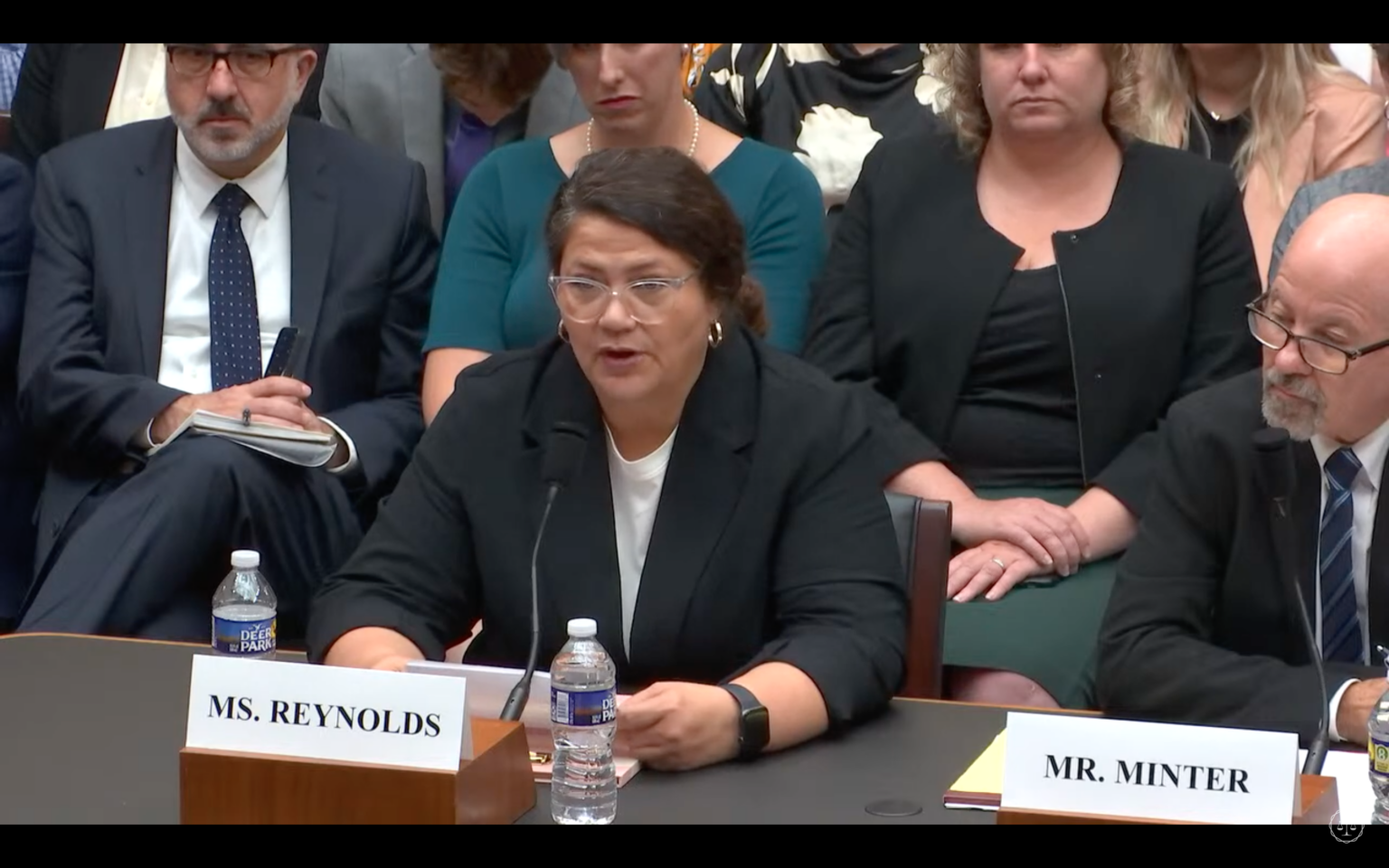
Myriam Reynolds of Texas, the mother of a transgender son, said before he received care, he was unhappy and she has “no doubt that the health care my son accessed was life-saving.” (Screenshot from committee webcast)
WASHINGTON — U.S. House Republicans on a panel for limited federal government on Thursday argued that parents should not be allowed to let their transgender children have access to gender-affirming care.
“A parent has no right to sexually transition a young child,” the chair of the House Judiciary Subcommittee on the Constitution and Limited Government, Rep. Mike Johnson of Louisiana, said at a hearing on transgender youth. “Our American legal system recognizes the important public interest in protecting children from abuse and physical harm. No parent has a constitutional right to injure their children.”
Johnson, and several other Republicans, floated the idea that the federal government should get involved, but did not offer specifics on potential legislation. They argued that gender-affirming surgery should not be allowed for transgender minors. That type of surgery is rarely performed on patients under 18.
In Johnson’s home state, the Louisiana Legislature in early July voted to override a veto from Gov. John Bel Edwards, allowing a ban on gender-affirming health care for transgender youth to become law.
Thursday’s hearing reflects a broader trend. At least 21 Republican-led states have passed laws banning or restricting gender-affirming care for minors, according to the Movement Advancement Project, an organization that tracks LGBTQ+ state policies.
The wave of legislation has had a chilling effect on health care providers, who are wary of providing other care to transgender youth, such as mental health and other medical care.
Gender-affirming care can be social affirmations such as adopting a hairstyle or clothes that align with a transgender youth’s gender identity, or the use of puberty blockers and hormone therapy. Typically, in adulthood it can be gender-affirming surgery.
“When our Republican colleagues allege that gender-affirming care raises particular dangers or due process issues, that is fearmongering at its worst,” the top Democrat on the panel, Rep. Mary Gay Scanlon of Pennsylvania, said. “Picking on already vulnerable kids in order to stir up chaos that they hope to ride to success at the ballot box.”
Democrats said the hearing is a pattern of GOP lawmakers attacking transgender kids and their families.
Scanlon said that barring parents from making those decisions would be in violation of their parental rights. Republicans passed legislation for a federal “Parents Bill of Rights” in March pertaining to access to education-related materials.
State laws
Several federal courts have either blocked or struck down state laws banning gender-affirming care for transgender youth, such as in Alabama, Arkansas, Florida and Indiana.
The top Democrat on the House Judiciary Committee, Rep. Jerry Nadler of New York, asked one of the Democratic witnesses, Shannon Minter, an attorney, what the federal courts have concluded about states moving to pass bans on gender-affirming care.
Minter, who is the legal director of the National Center for Lesbian Rights and is also transgender, said the federal courts have found that those state laws “severely burden parents’ fundamental rights to make medical decisions for their own children.”
“They’re blatantly discriminatory,” he said. “They violate the guarantee of equal protection because they do something that has just never been done before in this country, which is single out a particular group of people, transgender young people, in order to deny them medical care.”
Despite the federal court cases, Johnson argued that states have the right to regulate gender-affirming care, such as puberty blockers.
Puberty blockers were first approved by the Food and Drug Administration in 1993 to temporarily pause puberty in children who were going through it too early. When used in gender-affirming care for transgender youth, those adolescents can choose to start hormone therapy, in which they receive either estrogen or testosterone treatments, whichever one that aligns with their gender identity.
“We’re limited government conservatives, right,” Johnson said. “We obviously recognize that parents have a natural and fundamental right to the bringing up of their children to make decisions with regard to their care and custody and control. But at the same time, our legal system in this country, our law does not allow a parent to physically or mentally abuse or harm a child.”
May Mailman a senior legal fellow at the Independent Woman’s Law Center, a conservative advocacy organization, said states should be able to regulate who can have access to transgender health care.
“Unfortunately, I think you’re seeing this movement that states should not be able to regulate the practice of medicine and somehow federal judges should,” she said.
Life-saving care
One of the Democratic witnesses, Myriam Reynolds, is the mother of a transgender son. She said before he received care, he was unhappy and she has “no doubt that the health care my son accessed was life-saving.”
Reynolds said any health care provided to her son was through slow and careful decisions that were approved by her and her husband and that their son always had the opportunity to stop if he wanted to. He received puberty blockers as well as counseling.
“When my child came out, as transgender, there was not the hysteria that there is now about this,” she said. “To be looked at as a child abuser, or you know an indoctrinate or something like that, it feels very hateful and divisive.”
Texas Republican Rep. Wesley Hunt said that instead of parents jumping to gender-affirming care when a child tells them they have gender dysphoria, meaning their gender identity differs from the sex they were assigned at birth, they should instead question “the root cause of that feeling.”
He compared that decision to his toddlers, whom if they could “have their way, they would have ice cream for breakfast, lunch and dinner and for every single meal in between. Oh, the wisdom of children.”
“In a sane country, we know that children aren’t mature enough to make adult decisions that will impact the rest of their lives, that’s why we have parents,” he said. “Children cry for ice cream, but as parents, we have the wisdom to know that ice cream is not in their best interests, particularly their long-term interest.”
He said that in 2024, Republicans will have an opportunity to “stop all this foolishness.”
Florida Republican Rep. Matt Gaetz, who is not a member of the panel, took aim at a recently passed law in Washington that protects transgender youth seeking gender-affirming care who are estranged from their parents.
“I am against transitioning children against the will of their parents,” he said.
Title IX
Several of the Republican witnesses criticized the Department of Education’s new rule that updates Title IX to allow transgender youth who attend public schools from competing in sports that align with their gender identity.
The rule came as states with Republican state legislatures have passed laws banning transgender students from competing in sports that align with their gender identity.
One of the witnesses, Paula Scanlan, is a former NCAA athlete who swam at the University of Pennsylvania and shared a locker room with Lia Thomas, the first openly trans woman to compete in the NCAA women’s division. Scanlan said she opposed the Biden administration’s changes to Title IX and that transgender women should not be allowed to compete in sports that align with their gender identity.
House Republicans recently passed legislation to ban transgender girls from competing in the sports that align with their gender identity, a move that mirrors legislation passed by Republican-controlled state legislatures.
Mailman, with the Independent Woman’s Law Center, said that gender ideology has destroyed “women and girls, by dissolving legal protections for women in athletics.”
Reynolds said as soon as her son came out as transgender, he stopped playing sports because of the rhetoric about transgender athletes competing in sports that align with their gender identity.
“That left a big hole in his life,” she said.


