Tag: General Assembly

  • Newly elected state school board member calls GOP plan to gut powers ‘Tornado from hell’

    Newly elected state school board member calls GOP plan to gut powers ‘Tornado from hell’

    Seven of the 11 elected seats are now Democratic, stopping supermajority

    BY: MARILOU JOHANEK – Ohio Capital Journal

    “What you’re going to see in the lame duck session is going to be a tornado from hell.”

    – Former state Sen. and now State School Board Member, Teresa Fedor, D-Toledo.

     Former Ohio state Sen. Teresa Fedor, D-Toledo, who won a seat on the State Board of Education in the Nov. 8, 2022 election. Official Statehouse photo.

    Former state Sen. Teresa Fedor got out of the Statehouse before the last vestiges of democratic governance were flattened by a power-hungry party on steroids.

    She knew a cyclone of destructive GOP legislation, super-charged by an unstoppable Republican juggernaut in the General Assembly, would be devastating. It is already bearing down fast on voting rights, citizen ballot initiatives, transgender protections, and Ohio women. 

    But as Fedor bid a bittersweet farewell to a 22-year legislative career after being elected to the State Board of Education, Republican colleagues sent her a parting gift of disrespect.

    Barely a week after Fedor and two other Democratic candidates won seats on the state school board, ousting incumbent GOP extremists on the ballot, Republicans in the Ohio Senate quickly moved to gut board members’ educational oversight responsibilities to almost nothing

    It was an audacious power grab by Republican lawmakers to wrest authority from the state education board on the heels of an election in which voters spoke about what they wanted for their children in education.

    “We’re essentially removing most of the education duties out of the control of the state school board and putting them in the governor’s office,” declared Senate President Matt Huffman, R-Lima, as he unilaterally moved to nullify a democratic election.

    With the super-super Republican majorities Huffman deviously engineered through lawless gerrymandering, he can drop any pretense of honoring the will of the people. Voters don’t matter. Hoarding power does. Sharing power with state board of education members who defeated Republican-backed anti-trans, anti-vax, anti-CRT, anti-anti-racism resolution clowns was nixed even before new members were sworn in. 

    Huffman’s plan is to ram through a bill in the next few weeks that removes all the board’s decision-making on educational matters, from curriculum and textbooks to academic development and planning, and gives that consequential stewardship to a political appointee who answers to the governor who answers to Huffman. See how it works? 

    Senate Bill 178 shrinks the influence of the Ohio Board of Education to a handful of administrative issues outside the classroom. Sponsor state Sen. Bill Reinke, R-Tiffin, stressed the need “for systemic change at the state level (after the Nov. 8 election) to our education system to ensure accountability to taxpayers and for our kids.”

    Fedor rolled her eyes.

    “They’ve been beating that drum for over 30 years. ‘Public schools are failing. We need accountability.’ And where are we on public education? They (Ohio Republicans) have been in control the whole time, except for four years under Strickland. If there’s a failure, it’s a failure on their part,” she said.

    “This is the 25th year of an unconstitutional school funding formula in the state. Republicans failed to the provide equitable and adequate education for the common schools in Ohio for 25 years. They set up a failed charter school system (remember ECOT?) in which tax dollars go into a black hole never to be seen again. They expanded vouchers, the privatization of our public dollars, a bigger black hole. Legally taxpayers don’t have a right to see how that tax money is being spent.”

    Fedor is outraged that Huffman and Co. are subverting the voice of Ohio voters with Senate Bill 178.

    “This just shifts power from the people to an unaccountable cabinet member in the executive branch,” she fumed. “Republicans are creating another level of bureaucracy away from the public” to steamroll their goal of privatizing public institutions without transparency or accountability.

    The incoming state school board member is resigned to what comes next. The Republican storm whipping through the legislature will weaken the Ohio State Board of Education by giving its power to the governor.

    “They’ll have their hearing, maybe two,”Fedor explained. “They may get interested parties into a room and say how can we tweak this so you’ll accept it even if you don’t like it and we can say we worked with you.”

    “They’ll put the language into a substitute bill that no one will see until the last minute before it gets voted on or fold it into a lame duck Christmas tree bill and say they did the public bidding and boast about it. But everyone will know it was a sham. That’s what abuse of power will do.”

    After over two decades in the legislative trenches, Fedor recognizes ruthless. 

    “Ohio Republicans have been waiting in the wings to roll out their extreme agenda because now they have unlimited power in the legislature. Senate Bill 178 cues up the budget debate. If it becomes law, Republicans are then going to pour money into their bureaucratic schemes to privatize public institutions — including the most important one to secure democracy, public education. The select few will benefit but 90% of our children will be left behind.”

    Fedor, who spent 17 years in the classroom, conceded, “I have no power other than my voice and experience and heart.”

    But she is a formidable force in her own right and will fight to be heard over the tornado from hell roaring through the lame duck. 

    “I am never going to give up,” promised the state school board member under siege. “You have to have hope. There’s no other choice.” 

  • Jeopardy champion Ohioan, others testify against anti-LGBTQ health care bill

    Jeopardy champion Ohioan, others testify against anti-LGBTQ health care bill

    Amy Schneider, Dayton native and Jeopardy! champion, leaves the Ohio House Families, Aging and Human Services Committee after testifying against House Bill 454. Schneider, who is a trans woman, said the bill would be “tragic” for Ohio children. Photo: Susan Tebben, OCJ

    BY: SUSAN TEBBEN – Ohio Capital Journal

    A packed and stuffy Families, Aging and Human Services committee room was flanked by multiple overflow rooms, where applause could be heard after parents, trans advocates and individuals implored the committee not to approve of House Bill 454, a bill created by committee member state Rep. Gary Click, R-Vickery.

    One of the testimonies came from Dayton native Amy Schneider, a trans woman who went on to become a Jeopardy! super champion, and has used her platform to support her fellow LGBTQ+ community members.

    “To be given the chance in Ohio, where I spent 30 years of my life, to have a chance to make a difference and have a chance to actually, if nothing else, slow down these laws and give trans kids a little bit longer to be safe, then I’ve just got to do it,” Schneider told the OCJ before she gave her testimony to the committee.

    In her testimony, she sought not to demonize those who support the bill, but to ask that they do what they claim is the main goal of the bill: protecting children.

    “But if you do share that goal, then passing this bill would be a tragic mistake,” Schneider said. “Because far from protecting children, this bill would put some of them in grave danger, a danger that not all them would survive.”

    https://youtube.com/watch?v=5sRGUicLu6Q%3Ffeature%3Doembed

    Several of those that testified, including Schneider, called gender-affirming care “life-saving” care, in that it would help suicide rates among trans individuals, and the overall mental health of those attempting to live as they want to live.

    “With this bill, I wouldn’t be able to appear as I want to appear to the public with a form that would greatly appeal to me,” said 15-year-old Cass Steiner, who appeared alongside her mother, Kat. “This would likely send me, and everyone else who is expecting treatment, into another deep depression.”

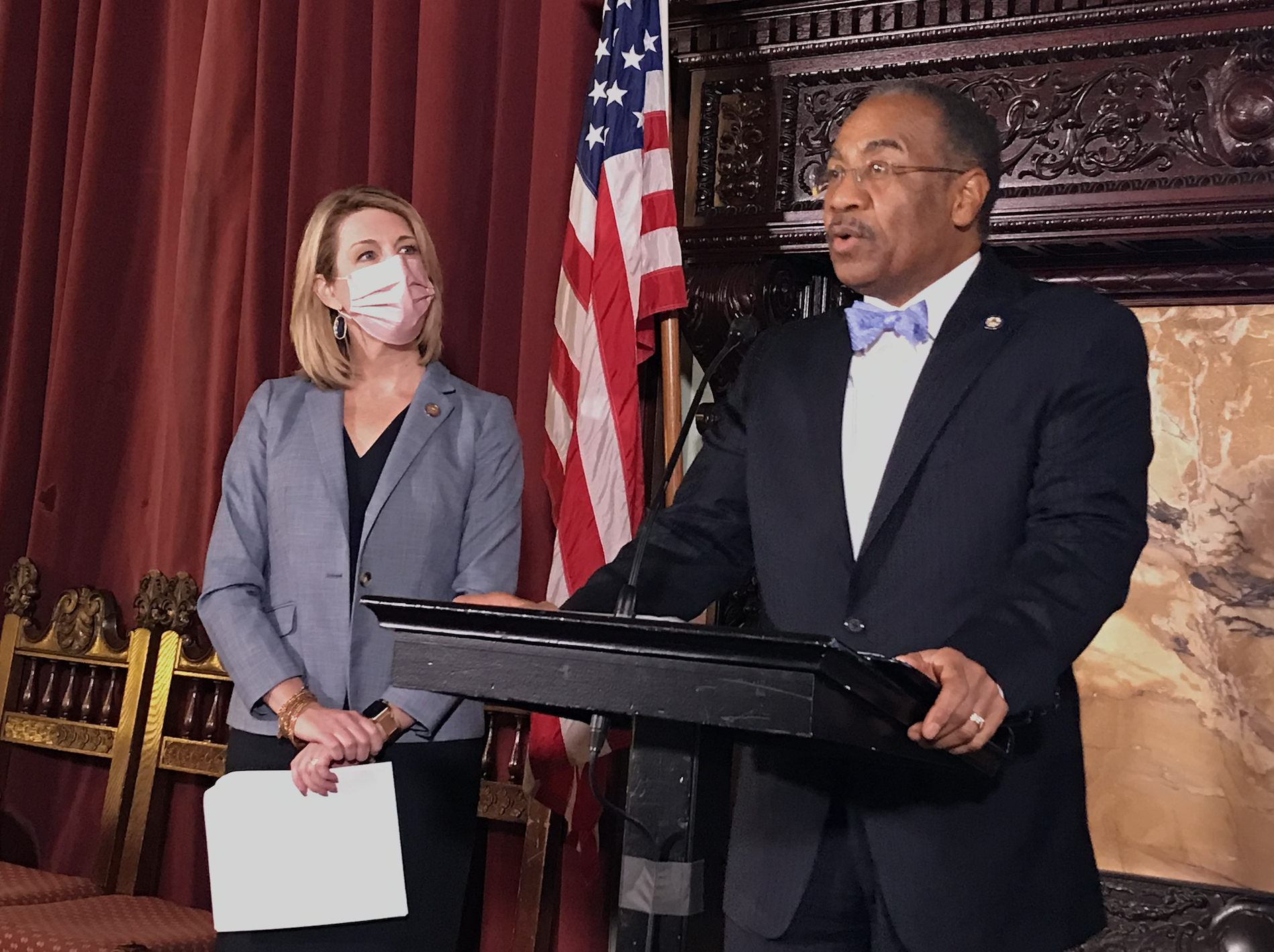
     State Rep. Gary Click, R-Vickery, looks on as the House Families, Aging and Human Services Committee, of which he’s a member, listens to testimony against his bill restricting gender-affirming care, House Bill 454. The bill did not see a vote on Wednesday.
    Photo: Susan Tebben, OCJ

    In the middle of two hours of testimony, Click introduced a substitute version of the bill, that he said was an attempt to “meet in the middle” of opposition and support.

    In the new version, puberty blockers or hormone therapy is allowed for minors, but only after a doctor confirms that the child “has received on a routine basis and for at least a two-year period counseling related to gender dysphoria, mental health and the risks of gender transition,” according to the sub bill’s analysis by the Legislative Service Commission.

    A doctor must also screen for other things that “may be influencing the minor’s gender dysphoria,” including depression, autism or ADHD, and “ensure that these comorbidities are treated and stabilized for at least two years.”

    Along with conducting other physical, sexual, mental and emotional abuse screenings, a second doctor must be consulted and agree to the treatment plan.

    Asked twice how the two-year time frame was decided on, Click told reporters it was “discussed by some other folks who came up with that and I thought that sounded reasonable.”

    He did not specify who he consulted with to come to that amount of time.

    The substitute bill also seeks to keep track of the number of medical and therapy appointments the minor attended before a physician recommended hormones or puberty blockers, any mental health conditions before being diagnosed with a “gender-related condition” and any follow-up the minor received after treatment.

    The bill also requires physicians to report “the number of minors who resumed identification with their biological sex,” and “the number of minors for whom the physician previously prescribed drugs or hormones who have not been prescribed those hormones or drugs for one year or more,” according to the LSC analysis.

    https://youtube.com/watch?v=WUIJG2_rhU8%3Ffeature%3Doembed

    That information would be reported on a yearly basis to the General Assembly and to the Ohio Department of Health.

    Like the abortion ban that is currently held up in court, violating HB 454 could put doctor’s medical licenses at risk, and the state Attorney General would be authorized to bring against anyone violating the bill, should it become law.

    The bill was not voted on during Wednesday’s committee meeting, with chair Susan Manchester, R-Waynesfield, adjourning the meeting immediately after the last witness of the day finished.

    It’s not clear what the fate of the bill will be from here, with the General Assembly’s session ending at the end of December. More hearings could be scheduled, which Click supports because he said there are more people to hear from, particularly those who have been “damaged” by gender-affirming care.

    He said the testimony he heard on Wednesday wasn’t anything he hadn’t heard before, but it didn’t change his mind on the bill.

    “(Children) have to have that period to work through this to make sure this isn’t a phase, it’s not a social contagion … we want to give them that legitimate chance to work through this,” Click said.

    He said he won’t “write anything off” in terms of new amendments to the bill, but he feels the bill has come as close to “the middle” as possible.

    “There are proponents of this bill who are not happy with some of the concessions that we made, and of course the opponents aren’t happy with the fact that we didn’t make enough,” Click said.

    For Schneider, she sees attempts to keep trans folks from getting the care they need as a negative response to success and progress the trans community has had over the last few decades. Progress that will continue, she says.

    “The momentum will continue to be on our side and there’s this pain right now, but this is just sort of the last gasp of that resistance,” Schneider said.

  • Education advocates say Ohio legislature should focus on funding, not regulating curriculum

    Education advocates say Ohio legislature should focus on funding, not regulating curriculum

    Getty Images

    BY: SUSAN TEBBEN – Ohio Capital Journal

    Groups keeping an eye on the Ohio legislature’s handling of education are hoping the General Assembly focuses on funding and appealing to new teachers, rather than bills regulating curriculum and “divisive” issues.

    The Ohio Education Association is continuing it’s push to eliminate mandatory retention from the third-grade reading guarantee, focusing their attention getting through to the state Senate.

    “I’m optimistic, I think now that we’re past election season, we can focus on finding common ground and really making sure that we’re addressing the needs of students,” said Scott DiMauro, head of the OEA.

    The association has already put out a series of recommendations for improving recruitment and retention strategies for teachers, including taking away financial barriers and prioritizing “the need to have a diverse teaching pool to serve all our communities.”

    “I’m encouraged that there have been a lot of productive conversations at the regional level and with policymakers who I think share this concern,” DiMauro said.

    The Ohio Federation of Teachers has also spotlighted the training of teachers and the retention of quality teachers as part of their state priorities.

    “Teachers are still tired and we need to look at how we make the education system work them,” said OFT executive director Melissa Cropper.

    What education policy groups don’t want to see is rushed legislation that flies through the lame duck session without the ability for transparency and accountability. This includes bills that have already been introduced, like House Bill 616, the most recent “divisive concepts” bill brought by state Reps. Jean Schmidt, R-Loveland, and Mike Loychik, R-Bazetta, to regulate the curriculums in schools, including legislating when and how sexual orientation and gender ideology can be included in school lessons.

    But Cropper isn’t as worried about “extremist” bills being pushed through before the end of the year because the Republican majority has increased based on general election results, theoretically giving the GOP no reason to fast-track bills or attach them quickly to other bills.

    “We are certainly opposed to anything being passed during a lame duck session when there’s not time for anything to be vetted,” Cropper said. “But given the results of the election, I don’t think that there’s any urgency on their part to do anything.”

    HB 616 is not currently scheduled to appear in committee this week, as the legislature comes back from its summer recess.

    DiMauro said he’s not sure what the prospects for education policy will be going into the lame duck session, but more than that, he wants to see more focus on “committing resources to a funding plan that primarily fits the needs of students and teachers.”

    “We know that it’s critical for the future of our state … that Ohio is a welcoming place for educators,” DiMauro said.

    Both education leaders were bolstered by the results of the Ohio State Board of Education races that took place on November 8, wherein two incumbents were unseated, and another race put a former Democratic legislator and teacher on the board to replace outgoing member Kirsten Hill.

    “I don’t think these are tiny changes, I think these are huge changes,” Cropper said. “We finally have some more people on (the board) who are there because they want to make this education system work for students and … is not about some culture war agenda.”

  • GOP redistricting attorneys ask court to make decision on congressional map after 2022 election

    GOP redistricting attorneys ask court to make decision on congressional map after 2022 election

    Ohio Senate President Matt Huffman and Ohio House Speaker Bob Cupp, both Lima Republicans. Official photos.

    BY: SUSAN TEBBEN – Ohio Capital Journal


    Legislative leaders and the state’s chief elections officer dug their heels in on continuing on with the May primary election, even as Ohio groups seek invalidation of the latest congressional redistricting map.

    Secretary of State Frank LaRose, Senate President Matt Huffman and House Speaker Bob Cupp have responded to requests by the League of Women Voters and a group of Ohio citizens represented by the National Redistricting Action Fund that the Ohio Supreme Court invalidated the newest congressional district map.

    Huffman and Cupp submitted their response together, starting by saying the Ohio Redistricting Commission “does not exist to simply rubberstamp redistricting plans favored by (court challengers).”

    “It is entitled to exercise reasonable discretion in balancing the highly complex factors that go into congressional redistricting,” attorneys for Cupp and Huffman wrote.

    While also arguing that the congressional map passed at the beginning of March is constitutional, Cupp and Huffman’s attorneys took the stance that the commission is the only authority in map-making in the state.

    The LWV and NRAF had differing opinions on next steps if the court invalidated the map, with the NRAF asking the court to take over, but the LWV saying the map should be sent back to the courts for very specific revisions.

    The legislative leaders argued that the Ohio Redistricting Commission is a “creature of the Ohio Constitution,” but with duties provided to it “independent of any other branch of government in Ohio.”

    “It is the commission and the general assembly who solely possess the legislative authority to create legislative and congressional districts,” attorneys wrote.

    It’s not fair, nor is it in line with the law, to compare the commission-adopted map to other maps that may have been submitted to the commission, but were never brought up for a vote or formally considered, Cupp and Huffman state in their court filing.

    In their objections to the map, challengers had offered up maps from Stanford and Harvard political science professors as models for a replacement map.

    Republican leaders flatly disagreed with the idea.

    “It is now plainer than ever that it is dangerous and disingenuous to base Ohio constitutional law and the voting rights of millions of citizens on this untested and contradictory evidence conceived of by paid-for-hire mathematicians and social scientists,” Cupp and Huffman argued.

    LaRose echoed the comments made in Cupp and Huffman’s filings that the map is constitutional and “needs no revision.”

    But if the court rejected the map, LaRose said, it does not have the power to “unilaterally implement its own congressional district plan.”

    “Again, Secretary LaRose will administer the 2022 congressional primary and general elections in accordance with a constitutional congressional district plan,” attorneys for LaRose wrote.

    In this vein, Cupp and Huffman’s attorneys asked that the court “defer any action” on the congressional map until after the 2022 election.

    They blamed the new state redistricting process, along with “significant logistical challenges” and even the U.S. Census delays brought on by the COVID-19 pandemic for exacerbating an “already challenging scenario” and leading to the adoption of the new congressional plan only days before the candidate filing period for the May 3 primary.

    The Ohio Supreme Court is considering court challenges for not only the congressional map, but also the legislative maps. The ORC adopted the maps one week after the court-ordered February 17 deadline, risking contempt charges.

  • Dems: We’ll talk about primaries when fair maps are passed

    Dems: We’ll talk about primaries when fair maps are passed

    State Sen. Vernon Sykes, D-Akron, speaks with press alongside House Minority Leader Allison Russo on Friday. The Dem caucuses pushed their maps and pushed for cooperation in the ongoing redistricting process. (Photo: Susan Tebben, OCJ)

    BY: SUSAN TEBBEN –  Ohio Capital Journal

    After making technical fixes brought up by GOP members of the Ohio Redistricting Commission, Ohio’s Democratic caucuses in the legislature are again pushing for their maps to be a model for redistricting in the state.

    Legislative leaders of the party also still believe a May primary is possible, but until maps are produced with bipartisan agreement, they say they can’t come to the table to talk about other election options.

    House Minority Leader Allison Russo, state Sen. Vernon Sykes, and Democratic redistricting mapmaker Chris Glassburn met at a press conference on Friday to bring up their versions of legislative maps, but also to give Republicans an ultimatum on the process.

    “It is not a lack of ability that is delaying the process, rather Republicans lack the will to do what is constitutionally required to deliver the fair maps that Ohioans overwhelmingly demanded not once, but twice,” Russo said.

    As of Monday evening, spokespeople for Senate President Matt Huffman, Secretary of State Frank LaRose, Auditor Keith Faber and Governor Mike DeWine said they had no information about when the commission would be meeting.

    “Check with the co-chairs,” said Huffman’s spokesperson when asked if Huffman had heard about the commission or provided his own schedule to the commission.

    “Secretary LaRose is ready and willing to meet at the call of the co-chairs,” LaRose’s spokesman told the OCJ. “He is focused on explaining to the General Assembly the risks associated with trying to run a secure, accurate and accessible election on the current timeline without the finality of new districts.”

    A spokesperson for House Speaker and commission co-chair Bob Cupp did not respond to requests for comment on Monday.

    The maps presented on Friday were the same that were released on Tuesday, which Glassburn said didn’t hold major substantive changes. Mostly the maps contained corrections to precinct lines or single census blocks, some of which were requested by Senate President Matt Huffman asked for in the most recent meetings of the Ohio Redistricting Commission.

    Sykes, D-Akron, is the co-chair of the Ohio Redistricting Commission with House Speaker Bob Cupp, R-Lima. The two previous times the ORC met on legislative redistricting, Sykes and the Democrats expressed their frustration with a lack of transparency and a lack of concessions they say the Republicans were willing to provide as the map-making process went on.

    The two legislative redistricting plans that came from the ORC were passed on purely Republican majorities, and each time, Sykes left the process feeling as though Democrats weren’t heard and the GOP was unmovable.

    Still, Sykes said he is “hopeful” about the newest process, now with a court-ordered deadline of February 17. He said staff members have been “exchanging some information.”

    But despite only days until the deadline, Sykes acknowledged getting the commission together is still an uncertainty.

    “Right now, the reason we’re not meeting is because (the Republican commission members) can’t get organized on a date and time and place to do that, so we have not received any indications of what they plan on doing,” Sykes said.

    Gov. Mike DeWine, who convenes the Ohio Redistricting Commission and serves as a member, went to Los Angeles this past weekend to watch the Cincinnati Bengals compete in the Super Bowl.

    He held a media availability in LA on Thursday, “to talk about Super Bowl LVI, all things Cincinnati Bengals, and all things Ohio ahead of the big game on Sunday,” according to his office.

    A spokesperson for fellow ORC member and Senate President Matt Huffman, R-Lima, wasted no time in releasing a statement on behalf of the majority party regarding the Dem maps and criticism of the process.

    “I’m sure at this point, Democrats believe they could draw House and Senate maps in crayon and watercolor and the same four members of the court would approve their unconstitutional maps,” Senate majority director of communications John Fortney wrote in a statement.

    The only specific criticism Fortney gave of the Dem plan was the 1st Senate district, saying the new plan “shoved it into districts that will not have another Senate election until 2024.”

    One thing Dems said they’d be willing to wait on is deciding whether or not a May primary is possible. Russo still believe a primary can be held on May 3 as scheduled “if we take the necessary steps to promptly pass fair, constitutional maps.”

    Republicans, including Huffman, brought up the idea of holding two primaries to take the pressure off the Ohio Secretary of State’s Office and local boards of election should the redistricting process take them past filing deadlines and administrative timelines for the election.

    In court filings with the Ohio Supreme Court asking them to uphold the previous maps, GOP members of the ORC asked the court to allow them to use the unconstitutional maps for the primary or wait to file a decision until after the 2022 general election.

    The Ohio Supreme Court did not move the primary, but reiterated in their rejection of the revised legislative maps that the General Assembly “has the authority to ease the pressure that the commission’s failure to adopt a constitutional redistricting plan has placed on the secretary of state and on county boards of elections by moving the primary election, should that action become necessary.”

    The secretary of state’s office, which both Republicans and Democrats say they’ve met with, has expressed hesitancy to postpone the May 3 election, or to have two separate primaries.

    The nearest deadline for the election is March 19, when the Uniformed and Overseas Citizen Absentee Voting Act says absentee ballots for eligible Ohioans should be sent out. April 5 starts the early voting period for the state under the current election timeline.

    Rob Nichols, spokesperson for Secretary of State Frank LaRose, said discussions on the election are “important, complex and ongoing.”

    “We continue to engage in negotiations over redistricting with those involved,” Nichols told the OCJ.

    The press conference ended a week that started with multiple committee meetings in the House and Senate to discuss congressional redistricting, all of which were canceled as House Speaker Bob Cupp said the GA didn’t have the support needed to pass new maps, as ordered by the Ohio Supreme Court. With the deadline for legislative approval set for Feb. 13, Cupp said the process will now move to the ORC. They will have another 30 days to come up with new maps.

  • Confidence wanes in legislature’s ability to pass new congressional map

    Confidence wanes in legislature’s ability to pass new congressional map

    BY: SUSAN TEBBEN – Ohio Capital Journal

    House Speaker Bob Cupp, center right, and state Sen. Vernon Sykes, far right, co-chairs of the Ohio Redistricting Commission, speak to media after a January meeting to restart the legislative redistricting process. The process is set to start again next week. (Photo: Susan Tebben, OCJ)

    The tide seems to be turning on congressional redistricting, with legislative leaders saying the process lacks needed support in the General Assembly, and will likely head back to the Ohio Redistricting Commission.

    A day after legislative maps were sent back to the ORC for a third time, a co-chair of that commission says the congressional map is headed that way as well.

    House Speaker Bob Cupp told media at the Statehouse on Tuesday that a two-thirds vote would not be possible in the legislature, which is necessary to be able to pass a congressional map in the General Assembly.

    Because of that lack of support, a redistricting plan could not include an emergency clause, which would be needed for the plan to take effect immediately. The legislature was on the clock to pass a revised plan by Feb. 13 (Super Bowl Sunday), and for that plan to become effective in time for the May primary.

    Bills typically take effect 90 days after the governor’s signature, which would conflict with the primary deadlines.

    A spokesperson for Senate President Matt Huffman said because a commission vote doesn’t need an emergency clause, “it makes sense for the congressional map to go to the commission” if a two-thirds vote isn’t possible.

    House Democrats said the GOP made agreement difficult, having never shared a Republican proposal with the other party.

    “Democrats cannot support a map that we have not seen,” Maya Majikas, deputy communications director for the House Democratic Caucus, told the OCJ.

    Yesterday, House Minority Leader Allison Russo spelled out her expectations for the congressional redraw, which included work by the General Assembly.

    “There is a clear path to producing a fair, constitutional map that allows for the equal representation that all Ohio voters deserve. Now, it is the duty of this General Assembly to uphold our Constitutional responsibility and deliver a fair map,” Russo said in a statement.

    Democrats in both chambers spent Tuesday pushing their proposal for congressional districts, releasing a map with a GOP majority 8-7 split. One district covering Cuyahoga County is considered Dem-leaning, according to the caucus numbers, but only gives Dems a 50.9% to 49% advantage.

    Should the legislature continue to hold until the Feb. 13 deadline, the Ohio Redistricting Commission will have 30 days to come up with a congressional plan to replace the one rejected by the court.

    This deadline comes alongside a Feb. 17 deadline for the commission to submit a third version of the legislative district plan to the Ohio Secretary of State’s office, and submit it back to the court for review.

    In their Monday decision striking down the newest version of the legislative maps, the Ohio Supreme Court said they maintain jurisdiction over the maps. They also addressed the timeline for the May primary and 2022 elections in their decision.

    Republican members of the redistricting commission had asked the court to decide the case by Feb. 11 or to hold their decision until after the 2022 general election, using the now-rejected plan until that time.

    In their 4-3 decision, the majority justices on the court said the General Assembly “has the authority to ease the pressure that the commission’s failure to adopt a constitutional redistricting plan has placed on the secretary of state and on county boards of elections by moving the primary election, should that action become necessary.”

    Secretary of State Frank LaRose’s office confirmed that it is solely on the legislature to decide when an election conducted, though the secretary of state can advise them on “cascading events” that would be impacted by changing an election, according to spokesperson Rob Nichols.

    There is precedent for moving an election day, as LaRose did during the COVID-19 pandemic.

    In the ORC response to objections to the legislative maps, the commission laid out the impact the redistricting maelstrom may have on the 2022 election season.

    “Ohio’s expansive early voting framework amounts to an election season that begins with early in-person and absentee voting 29 days before the primary,” they wrote in court documents.

    That date would be April 5 this year, meaning before that date county boards of election need to print and prepare ballots under Uniformed and Overseas Citizen Absentee Voting Act (UOCAVA), for which federal law requires boards to begin mailing the ballots at least 45 days before the primary.

    Those ballots need to be sent by March 19 this year.

    “Though the General Assembly can, and has, temporarily amended Ohio law to move some of Ohio’s election deadlines for the primary election, the federal UOCAVA deadline is set by federal statute (and) it cannot be moved by the General Assembly or the Secretary,” the ORC wrote.

    Without districts to determine the voting precincts for those uniformed and overseas citizens, the ballots can’t be sent.

    Still, LaRose has only asked the General Assembly for the authority to shift some administrative deadlines having to do with the primary, not to move the election entirely.

    “His job right now is to administer an election on May 3,” Nichols told the OCJ.

    LaRose is also a member of the Ohio Redistricting Commission, so he’ll be multi-tasking as the redistricting process continues.

  • Congressional redistricting hits the Ohio Supreme Court

    Congressional redistricting hits the Ohio Supreme Court

    BY: SUSAN TEBBENOhio Capital Journal

    The case of congressional redistricting was heard by the Ohio Supreme Court on Tuesday, where arguments about reforms put in place by voters and the data used by the General Assembly to draw maps framed consideration of districts going forward.

    Ben Stafford, an attorney representing the National Redistricting Action Fund’s challenge of the congressional maps approved in November, said the case centers on compliance with the constitutional reforms that revised the redistricting process, particularly the GOP majority’s use of partisanship in creating its map.

    “This case is about how the General Assembly has thumbed its nose at these reforms and enacted a plan that palpably violates Article 19’s new anti-gerrymandering protections,” Stafford told the court.

    Stafford said the 2021 enacted map has “extraordinary partisan skew,” with Republicans favored in 12 of 15 districts, amounting to 80% of congressional seats in the state. Using voting results as a starting point for analysis, as Stafford said should have been done, would have leveled out the district lean at 54% Republican, 46% Democrat, according to results of statewide races over the past decades.

    “A plan where one party is favored to win 80% of the seats when it only wins 53 or 54% of that vote clearly favors that party,” Stafford said.

    However, the attorney for the legislative leaders, Senate President Matt Huffman and House Speaker Bob Cupp, Phillip Strach, called the 2021 plan “the most constitutionally compliant of all plans before the General Assembly” because other plans presented “split more counties and other jurisdictions than the enacted plan.”

    But Republican legislators who worked on drawing the maps also saw the redistricting process as a foregone conclusion, destined for a legal battle, according to Strach.

    The attorney for Cupp and Huffman argued that based on the “political geography” of Ohio, the General Assembly could have drawn maps using no election or partisanship data whatsoever, and it still would have come up with a Republican majority, leading to accusations of GOP secrecy and scheming.

    “And so, what the General Assembly decided this time was ‘look, we’re going to be sued no matter what, and so we’re going to make sure that we draw competitive districts,” Strach told the justices.

    Strach was asked to address an expert witness for the map challengers in the case, a political scientist who ran the Ohio map through a redistricting program 5,000 times and never came up with the amount of Republican lean as the map approved by the state legislature.

    The simulations were “deeply flawed,” Strach told the state’s high court, and dependent upon human intervention.

    “At the end of the day, the computers draw what a human being tells it to draw, and so if you don’t tell the computer to use criteria that match what the General Assembly actually used, then what it will spit out is really just garbage,” Strach said. “It really is meaningless for any legal analysis.”

    The idea of what data would be proper to use in redistricting was the subject of lengthy discussion during oral arguments on Tuesday, but the main conclusion attorneys on both sides came to was no database was better than another.

    “Nobody agrees on what data to use,” Strach said. “It’s hard to use congressional districts data because it’s always changing. It’s easier to use statewide data.”

    Challengers debated databases and which specific data to use, such as federal election results versus statewide results, but said the biggest problem with the 2021 plan was how map-drawers used the data they used.

    Stafford said map creators for the GOP, namely Senate staffer Ray DiRossi and House mapmaker Blake Springhetti, had much more data than they let on publicly, but didn’t use it all in presenting the new map proposal.

    “What was disclosed publicly was this cherry-picked measure, a measure designed to make the plan look more competitive than it actually was,” Stafford said.

    Regardless of the measure or metric used, however, Stafford said the bias in the 2021 plan “remains the same.”

    Supreme Court justices also jumped in on the debate of which data to use in forming congressional districts, with Justice Sharon Kennedy seemingly agreeing that the federal results made sense in drawing congressional districts.

    “If you look at Ohio’s elections, and you look at your own datasets, more people turn out in Ohio to vote in federal elections than in statewide elections, by and large,” Kennedy said.

    Justice Patrick DeWine spoke to the argument by map challengers who said the legislature erred in skipping the 2014 election results rather than using all election results for the last 10 years. DeWine said because the 2014 election was an election “unlike any other we’ve had in Ohio,” specifically the landslide victory by former governor John Kasich over Democratic challenger Ed Fitzgerald, it might not be prudent to include that data.

    “I’m not sure which data set is best, I’m not sure the court could pick that, but it doesn’t seem immediately obvious to me that including several statewide elections in a year that was … probably the farthest from the norm we’ve had in Ohio in the last couple decades would make the data a lot better,” DeWine said.

    Other justices explored the idea that reforms of the redistricting should have been the guideposts for mapmakers over database manipulation.

    Chief Justice Maureen O’Connor posed the idea that the “intervening factor” in deciding how to draw maps was “the vote of the people.”

    Strach argued that the previous map passed in 2011 and highly criticized for a lack of public accountability “was never overruled,” and O’Connor jumped in.

    “Didn’t the people overrule it? Maybe not overrule it in front of us or another court, but the people in their vote overruled what had been done up to that point, did they not?”

    Justice Jennifer Brunner touched on minority representation in redistricting, asking whether keeping to the constitution in terms of splits and keeping counties whole overrode the requirement to protect minority voting rights, specifically in Hamilton County.

    Strach argued that under the 14th Amendment if the General Assembly had considered race, it would have violated “racial gerrymandering” prohibitions unless there was a “sufficient reason” to redraw districts, including a minimum of 50% Black population required to combine a district.

    “There’s been no showing in this case, no allegation by anyone even in the legislative process that such a district could have been drawn, and so using race in Hamilton County would have violated federal law in this case, and that’s why it wasn’t done,” Strach said.

    Just as it did in the legislative redistricting case, the court pondered the next steps if the map was rejected as violations of the constitution.

    When Strach said being found in violation of the constitution would be “the end of the story” for congressional maps, O’Connor countered that by saying “it could go back to the drawing board,” something Strach said “could go on for quite a bit” or be taken over by federal courts.

  • Public’s tears and fears come out before redistricting heads to joint committee

    Public’s tears and fears come out before redistricting heads to joint committee

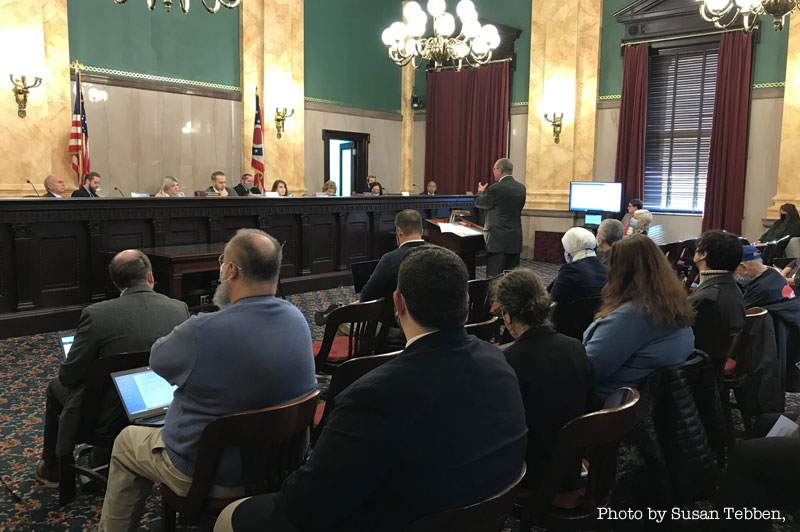
    The Ohio Senate Local Government and Elections Committee hears from the public on two redistricting proposals, one from Senate Dems and the other from the Senate GOP on November 4.

    BY: SUSAN TEBBEN – Ohio Capital Journal

    The last of the General Assembly’s congressional redistricting public hearings in individual committees are this week, just as a joint committee starts work.

    In Senate Local Government and Elections Committee on Tuesday, the last scheduled hearings on GOP and Democratic bills to change the congressional district maps in the state occurred, with much of the same criticism for the GOP map that anti-gerrymandering groups and Ohioans in target areas say don’t focus on fairness.

     The Ohio Senate GOP’s congressional redistricting map proposal.

    On Tuesday, Bellbrook resident Wendy Dyer spoke through tears about the volunteering she did to promote the petition that would eventually change the state constitution and the redistricting process as a whole. She said at that time she felt a sense of achievement and change in the state, something that’s now changed with the map proposals from the GOP.

    “I thought Ohio had really accomplished something,” Dyer said. “Now I really just feel stupid that I honestly believed that my government would do the right thing.”

    Anne Light Hoke, of Columbus, said she disagrees with the Senate Republican map that moves her from District 3 to District 15, which is nestled in with three other districts in Franklin County, but then stretches due south into most of rural Southeastern Ohio.

    Hoke said as a resident of Columbus, she said she has “urban concerns” like public transportation, traffic congestion and police brutality.

    “Although I was born in a small town, I no longer have small town concerns like broadband access, access to sewer systems and water systems, burning trash regulations and fracking,” Hoke told the committee members on Tuesday.

    The public input is set to continue Wednesday morning in the House Government Oversight Committee on House Bill 479, the House GOP’s map proposal. As of Wednesday, the committee agenda had not changed to include a new map proposal from the House Democrats, introduced on Monday.

    Also on Wednesday, the new joint committee on congressional redistricting is scheduled to meet for the first time at 2:30 p.m. in the Ohio Statehouse’s south hearing room. The two chairs of the House and Senate committees that have been hearing individual map proposals, state Rep. Shane Wilkin, R-Hillsboro and state Sen. Theresa Gavarone, R-Bowling Green, will be the co-chairs of the joint committee.

    The joint committee is also scheduled to meet on Friday at 10:30 a.m., in the House Finance Room (Room 313).

  • Republican majority gerrymanders Ohio for another four years

    Republican majority gerrymanders Ohio for another four years

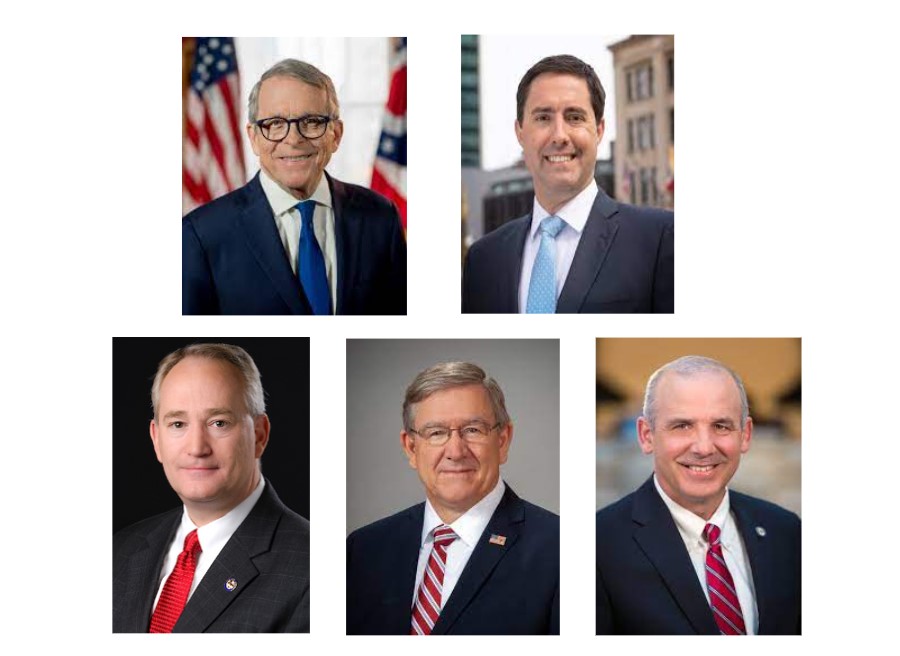
    The Republican majority members of the Ohio Redistricting Commission. Top row from left, Ohio Gov. Mike DeWine and Secretary of State Frank LaRose. Bottom row from left Ohio Auditor Keith Faber, House Speaker Bob Cupp, and Senate President Matt Huffman. Official photos.

    BY: SUSAN TEBBEN and Ohio Capital Journal

    With some using words like “disappointment” and “unease,” Republican majority members of the Ohio Redistricting Commission passed maps of General Assembly districts on Thursday heavily favoring GOP supermajorities that will last four years, if they make it through the courts.

    In a process that bypassed the midnight deadline by minutes, the commission split along party lines 5-2 and passed GOP-produced maps that they said were presented to the commission the night before.

    Currently, Republicans hold a 64-35 supermajority in the Ohio House, and a 25-8 supermajority in the Ohio Senate. The new maps continue the supermajorities, which require 60+ seats and 22+ seats respectively.

    Republicans said the maps for the House and Senate approved early Thursday morning reduced the GOP stronghold with a House breakdown of 62 seats to 37 Dems, and 23 to 10 in the Senate. Democrats and Dave’s Redistricting App project a 65-seat GOP supermajority in the House.

    Anti-gerrymandering advocates have repeatedly called for representation that actually reflects the make-up of voters. And Ohio voters amended the state constitution in 2015 to implement reform intended to produce bipartisan and fair districts, with 71.47% of voters supporting.

    In an average of the last 16 statewide elections not including non-partisan judicial races, Republicans have won a 54% to 46% advantage.

    As of 2020, 1.9 million Ohioans were registered Republican while 1.6 million were registered Democratic, for a ratio also of 54% to 46%. More than 4.5 million voters remain unaffiliated.

    Nevertheless, the Republican majority said in a statement that because they’ve won 13 of 16 statewide elections they could be entitled to up to 81% of representation of the people, despite them only winning the average of 54% of the votes in those elections.

    The GOP committee majority includes Ohio Gov. Mike DeWine, Secretary of State Frank LaRose, Auditor Keith Faber, Ohio House Speaker Bob Cupp and Ohio Senate President Matt Huffman. Voting against the maps were Democratic House Leader Emilia Sykes and Democratic state Sen. Vernon Sykes.

     The Republican majority’s four-year Ohio House map.
     The Republican majority’s four-year Ohio Senate map.

    The only bipartisan agreement was a condemnation of how the process had gone, and the fact that there seemed to be no way to reach a 10-year map.

    “Tonight, it has become clear to me that there will not be a compromise,” said DeWine. “It’s clear in talking to both sides that there’s not going to be an agreement, and that we could go tomorrow or the next day or the next day, and it simply was not going to occur.”

    The Democratic legislators on the commission both objected to the maps as presented, with commission co-chair Sen. Vernon Sykes saying the map proposal “falls far below what’s considered to be fair.”

    House Minority Leader Emilia Sykes said the maps were an affront to women who had to earn the right to vote, and minorities who are protected by the Voting Rights Act.

    “To have before today a map that summarily and arrogantly eliminates the ability for women like me…to engage in a process and have their votes heard is not only offensive, it is plain wrong,” Sykes said.

    The criticism of the process was broad, with Auditor Faber and Secretary of State LaRose both urging the commission to learn from its mistakes before congressional redistricting begins next month.

    “I’m casting my ‘yes’ vote with great unease,” LaRose said. “I fear we’ll be back in this room very soon.”

    The expectation of lawsuits was brought up quickly and early, with DeWine and others acknowledging that the courts would ultimately decide whether the maps fit the bill, or if the process was constitutional.

    “I’m not judging the bill one way or another, that’s up for a court to do,” DeWine said.

    The condemnation from redistricting advocacy groups was also swift, though analysis of the maps is still ongoing.

    “The Commission didn’t reconvene until forty-five minutes before the midnight deadline and then enacted a map along party lines that disregards the letter and spirit of the reforms passed in 2015,” wrote Common Cause Ohio executive director Catherine Turcer in a statement sent out by the Fair Districts Ohio coalition. “We are disappointed in both the process and the result.”

    Past court challenges, the discussion now turns to congressional districts representing the state, a process that should start in the next few weeks.