Tag: gerrymandered maps

  • Black voters in Ohio will be impacted by Issue 1. How? Depends on who you ask.

    Black voters in Ohio will be impacted by Issue 1. How? Depends on who you ask.

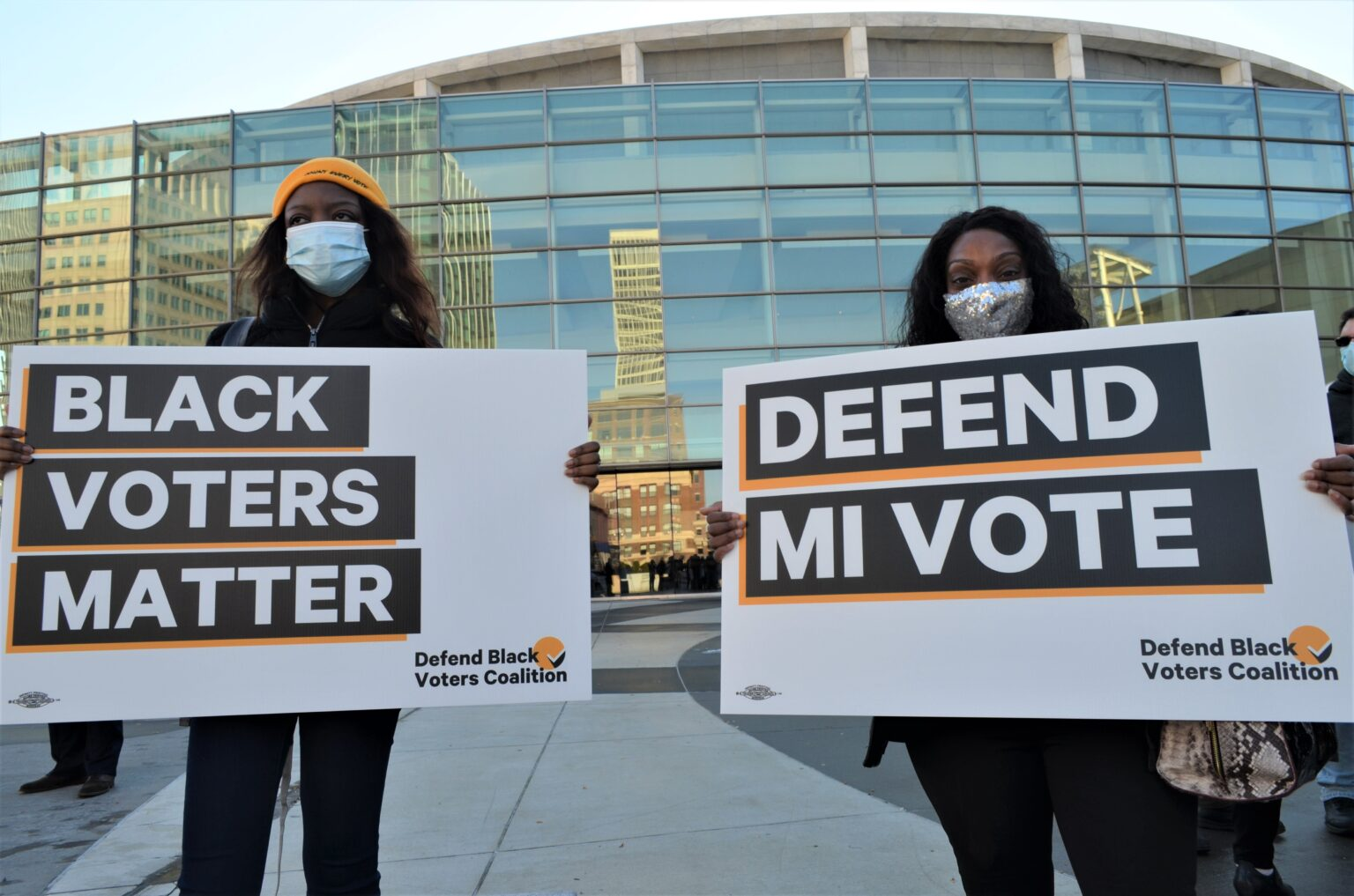
    Photo by Ken Coleman, States Newsroom.

    By:  Ohio Capital Journal

    Opponents of Ohio’s Issue 1 redistricting reform claim it would be bad for communities of color. Supporters of the proposal to replace politicians with a citizens commission point to the ways the current maps crack and pack Black voters.

    The Issue 1 proposal would replace the current Ohio Redistricting Commission made up of seven elected officials with a 15-member commission made up of citizens.

    The current commission includes the Ohio governor, auditor, and secretary of state, along with four lawmakers — one from each party in each chamber of the legislature. The 15-member citizens commission being proposed would be made up of five Republicans, five Democrats, and five independents, selected by a bipartisan panel of former judges.

    Voting yes on Issue 1 would create the 15-member Ohio Citizens Redistricting Commission. Voting no on Issue 1 would keep the current Ohio Redistricting Commission.

    Arguments for and against the ballot initiative have been targeted at communities of color, with both sides saying minority representation will be affected by the results of Issue 1.

    In a press conference at the Ohio Statehouse, state Sen. Michele Reynolds, R-Canal Winchester, brought former legislator John Barnes and two other Ohioans to urge voters to reject the ballot measure, claiming the changes “could fragment cohesive minority voting blocks, diluting our political influence.”


    “I am deeply concerned about the disastrous effects that Issue 1 will have on the Black state legislative and congressional districts in Ohio,” said Reynolds, who is one of five Black members of the 33-member Ohio Senate, and the only Republican.

    One of the Democratic members, state Sen. Catherine D. Ingram, who is also vice president of the Ohio Legislative Black Caucus, responded to Reynold’s press conference by saying Issue 1 “would ensure fair maps are drawn and expand opportunities for greater representation across our state, beyond the areas that have historically confined us.”

    “For generations, Black Americans have faced disenfranchisement, and gerrymandering adds an additional barrier to our adequate representation,” Ingram said in a statement.

    Issue 1 would create a 15-person citizens redistricting commission to replace the current commission. After a vetting process by a bipartisan panel of judges, the selected citizen commissioners would be required to hold public hearings and conduct the drawing of Statehouse and congressional maps in a transparent process, and create maps that receive a majority vote of the commission.

    Drawing the maps would require adherence to federal laws like the Voting Rights Act and the statewide partisan preferences of the voters of Ohio.

    The current process

    In 2021 and 2022, Republican partisans on the commission produced five Ohio Statehouse maps and two U.S. Congressional district maps that were struck down as unconstitutionally gerrymandered by a bipartisan majority on the Ohio Supreme Court.

    In 2023, the commission unanimously passed Statehouse maps with bipartisan support, although Democrats said they only supported them because redistricting reform was on the way and if they had voted no on them then the Republicans on the commission would have produced even more gerrymandered maps.

    Despite the fact that the congressional map was never revised to correct the errors found by the state’s highest court, it is the map being used for the 2024 election.

    A recent League of Women Voters of Ohio analysis of the current congressional map found that in Massillon, what’s considered a “large politically cohesive African American population” was split between the 6th and 13th Congressional districts.

    “Rather than keeping this clear community of interest united in one congressional district, mapmakers sliced Massillon into two pieces, specifically cutting off areas with large concentrations of minority voters from each other,” according to research analysis done by University of Cincinnati professor David Niven.

    Niven called the one-third of Stark County voters put in the 6th district “castaway voters,” citing research that said being a “castaway” voter “inhibits political information flows, mobilization and ultimately, representation.”

    “The political consequences of landing on the other side of those lines are powerful,” Niven wrote.

    The boundary-drawing of certain current congressional districts are “inexplicable” and “drawn in service of confusion not representation,” according to Niven’s research.

    The 1st district, for example, borders the 8th district in a “textbook gerrymandering maneuver — dividing a neighborhood and town and causing confusion on who lives in which district, serving no legitimate purpose,” Niven wrote.

    “Here’s a congressional district where people on the southern end of the district live in the shadow of Ohio’s third largest city with all its urban needs and opportunities, and people on the northern end have a local government that advertises when someone loses their mittens in the park,” Niven stated.

    Cracking and packing

    Voting rights advocates tend to agree with this assessment, saying the splitting of communities means less visibility, and less visibility means a lack of attention from people who purport to represent them.

    “What we’ve seen with supermajorities is communities are left out of conversations,” said Deidra Reese, director of voter engagement for the Ohio Organizing Collaborative and supporter of Issue 1. “Those issues that are coming from communities that have a smaller presence in those bodies just don’t get to have those issues elevated.”

    Important issues in communities of color, like in other communities, can include things like health care, economic issues, gun law reform and hunger. Without competitive districts that create the need for representatives and senators to engage with constituents of all kinds, Reese said legislation won’t match what is needed.

    “When you shut the door on people when you pass policies … it’s a disservice and what happens is African Americans just don’t get representation,” Reese said.

    Infant and maternal mortality rates were noted as a big concern for Black communities, which see disproportionate rates compared to their white counterparts.

    The LWV analysis showed some congressional districts combine those two vastly different mortality rates, like the 9th, 12th and 2nd districts. The 9th district holds Lucas County, with one of the highest rates of infant mortality and Wood County, one of the lowest. The 12th district includes the high rates in Holmes County, and the low rates in Guernsey County. Ohio’s 2nd district has Lawrence County’s high infant mortality rates and Scioto County’s low rates.

    “Again, this data begs an essential question,” the LWV study ponders, “How could any elected leader craft policy solutions for their constituencies, when the needs within their sprawling, contorted districts are so far apart?”

    Kayla Griffin, president of the Cleveland branch of the NAACP, said the fact that the district maps are still unfair despite previous legislative redistricting reforms in 2015 and 2018 leaves questions about how closely the process was even followed by the elected officials on the Ohio Redistricting Commission.

    “I think that becomes a serious problem that erodes the trust and the democracy that we have,” Griffin said.

    An even bigger problem that Griffin and other advocates are dealing with is the concern from many Black voters that their vote doesn’t hold weight under the current maps, and therefore won’t make much different in the November general election.

    Those talking to voters are trying to focus on the wins, most notably the rejection of a constitutional amendment to make it harder to amend the state’s founding document, and the approval of a ballot initiative that enshrined reproductive rights into that same constitution.

    “That is how our vote counts, that is how our voices are heard.” Griffin said. “I’m letting folks know that we can do this again.”

    YOU MAKE OUR WORK POSSIBLE.

    __________________
    Susan Tebben
    Susan Tebben

    Susan Tebben is an award-winning journalist with a decade of experience covering Ohio news, including courts and crime, Appalachian social issues, government, education, diversity and culture. She has worked for The Newark Advocate, The Glasgow (KY) Daily Times, The Athens Messenger, and WOUB Public Media. She has also had work featured on National Public Radio.

    Ohio Capital Journal is part of States Newsroom, the nation’s largest state-focused nonprofit news organization.

    MORE FROM AUTHOR

  • As deadline for reform measure nears, advocates look to future of Ohio redistricting

    As deadline for reform measure nears, advocates look to future of Ohio redistricting

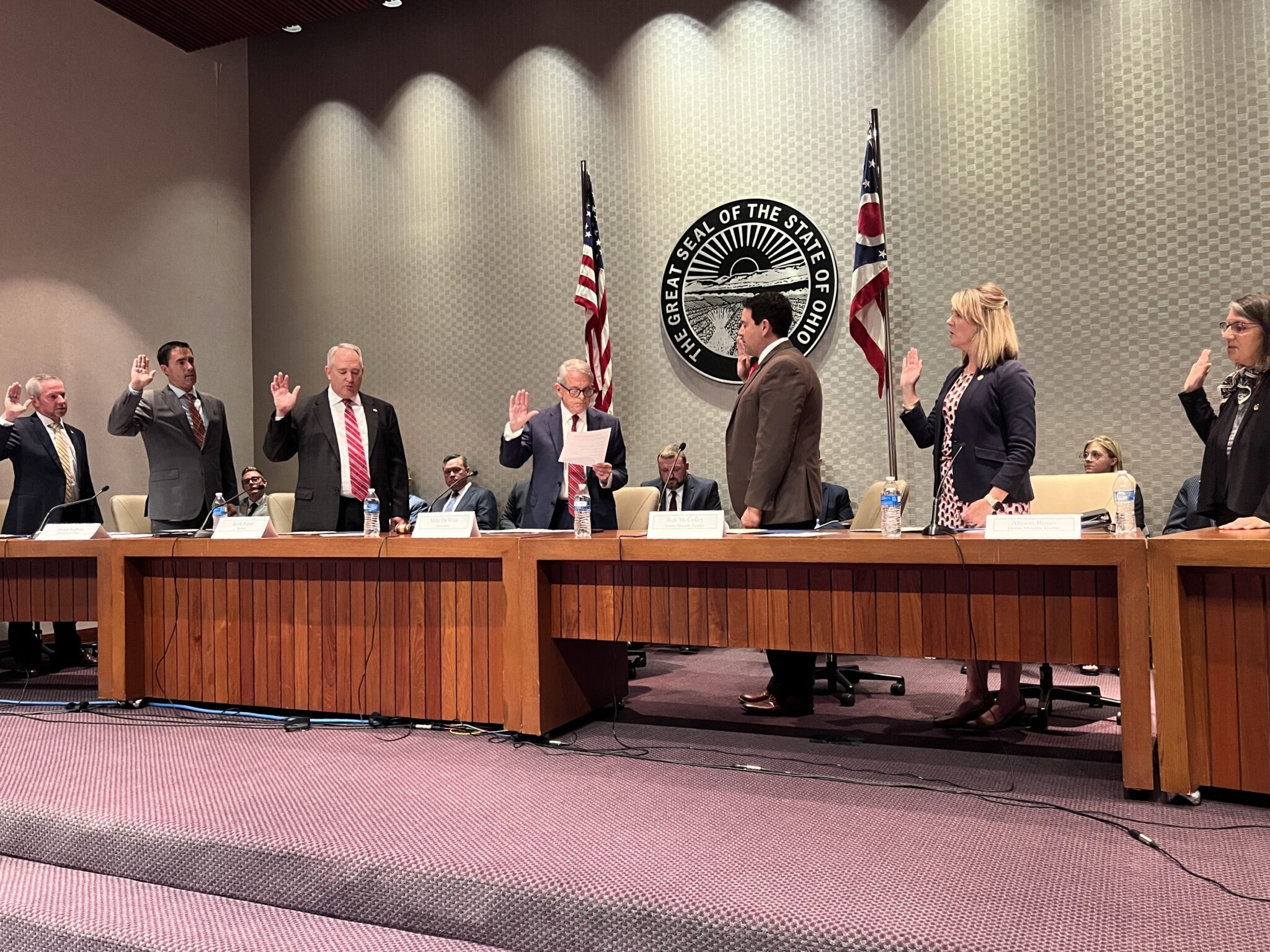
    The members of the Ohio Redistricting Commission are sworn in by Gov. Mike DeWine on Wednesday. Left to right: State Rep. Jeff LaRe, Secretary of State Frank LaRose, Auditor of State Keith Faber, DeWine, Senate Majority Floor Leader Rob McColley, House Minority Leader Allison Russo and Senate Minority Leader Nickie Antonio. (Photo by Susan Tebben, OCJ.)

    BY:  Ohio Capital Journal

    Signature collection continues for an anti-gerrymandering ballot measure in Ohio that would replace politicians on the redistricting commission with citizens. As the July deadline approaches, supporters are pointing to a new study showing how uncompetitive Statehouse races are.

    The Brennan Center for Justice at NYU’s law school analyzed Ohio’s current maps alongside the results of the most recent primary election.

    Authors of the study said the data “reveals one of the tangible ways Ohio’s gerrymandered maps undermine electoral competition, and how the districts leave millions of Ohio voters without a significant voice in the Ohio House elections slated for this November.”

    “An overwhelming majority of Ohioans will cast ballots this November in legislative districts that were drawn to lock in general election outcomes, and few districts featured meaningful primary contests,” the Brennan Center report stated. “These are the predictable consequences of living in a gerrymandered state.”

    One of the authors of the report, released Tuesday, is Yurij Rudensky, who spoke in support of the new ballot initiative proposed to hit voters in November. If it gets on the ballot and is passed by voters, the reforms would replace the current Ohio Redistricting Commission made up of elected officials with a citizen-run, judge-vetted commission to draw the next Statehouse and U.S. Congressional maps.

    Rudensky spoke in a March panel, alongside former Ohio Supreme Court Chief Justice Maureen O’Connor and others, about the difference between the reforms passed in 2015 and 2018 and the proposed amendment that voters may see on their general election ballots.

    At the March panel discussion, Rudensky hesitated to call the last two measures reforms because he argued no changes were made and the previous amendments merely demonstrated that “political insiders have no business being in the process.”

    Since those amendments passed — reforms made through legislative negotiation before hitting the voters — the Ohio Redistricting Commission has been built on a Republican majority, with Gov. Mike DeWine, Senate President Matt Huffman, former House Speaker Bob Cupp, Secretary of State Frank LaRose and Auditor of State Keith Faber all standing on the commission during some or all of the proceedings over the two years it took for the group to pass six Statehouse maps and two congressional maps. State Rep. Jeff LaRe, R-Violet Twp., replaced Cupp and state Sen. Rob McColley, R-Napoleon, came in for Huffman toward the end of the two-year span.

    The Statehouse maps were declared unconstitutionally gerrymandered five times by a bipartisan majority on the Ohio Supreme Court, but voters were forced by federal judges to use them for the 2022 Election.

    Statehouse maps passed by the redistricting commission this past September, and set to be used for this year’s election, were the only to receive bipartisan agreement (with Senate Minority Leader Nickie Antonio and House Minority Leader Allison Russo’s votes), while the state’s Congressional map is still considered unconstitutional under an Ohio Supreme Court ruling.

    In analyzing the current Ohio Statehouse maps, Rudensky and co-author Gina Feliz concluded that about 77% of the state’s population live in “districts where elections for state representatives are not in serious dispute.”

    “That is, these districts are either uncontested, or they give one party a disproportionate advantage in the general election so that the district is uncompetitive, even if it’s formally contested,” the researchers wrote.

    The report defines “uncompetitive” as districts where the partisan draw favors one party by 55% or more.

     Source: Brennan Center analysis of Ohio Secretary of State’s Office Unofficial 2024 Primary Election Results. 

    Nearly half of the districts in the Ohio House didn’t have a primary contest in March to drive a November general election race, the Brennan Center research found, citing data from the Ohio Secretary of State.

    “In all, there are 15 districts (out of 99 total) that will give voters no choice between Democratic and Republican candidates for state representative,” according to the study.

    The report also recognized the low turnout in the state during the primary season, with an average of 18.8% of registered voters casting ballots in districts with competitive primaries.

    Because of that, Rudensky and Feliz counted fewer than 450,000 voters who “all but decided who would serve as state representatives on behalf of more than 2.3 million registered voters and 3.5 million constituents.”

    The report pointed to the proposed ballot initiative led by Citizens Not Politicians as a redistricting reform that could “center community needs and voter preferences rather than the interests of incumbents.”

    Looking to a future that may have an independent redistricting commission, the voting rights group Common Cause put out its own report, a summary of a 2023 conference where members reflected on states who already have such a system in place, and those like Ohio that could see the change come in November.

    “Unsurprisingly, all those who attended the conference believed in the possibilities of fair and representative maps and that independent redistricting commissions were the best strategy to achieve this goal,” Common Cause stated in the new report.

    The “Roadmap for Fair Maps in 2030,” a summary of the 2023 National Citizen Redistricting Commissioners Conference, talked about the need to make redistricting a transparent process that is “responsive to community needs.” At the conference, the report said a “model commission” was organized for Ohio and neighbor state Indiana “to demonstrate how an alternative process based on community input and transparency can work.”

    In a previous report, released shortly after the Ohio Redistricting Commission adopted the current Statehouse district maps, Common Cause gave the state a failing grade, calling the current map-drawing process and the results that came from it “unmitigated disasters.”

    Ideally in redistricting, Common Cause members said the process should “ensure that commissions reflect the diversity of the jurisdiction” and engage community-based organizations and leaders to build resident trust and hold commissions accountable.

    What should not be included in the process, according to the report, are legislature-appointed commissioners or any legislative role in the mapping process.

    “Commission decisions on maps should be final, except for judicial review, with no approval from elected officials required,” the report stated.

    The Citizens Not Politicians initiative was supported in the report as part of strategies to “increase fair representation in 2030,” the next time the process is set to start, though maps in Ohio would need to be redrawn in 2025 if the ballot measure passes in November.

    Opposition to the initiative has been led by Huffman, who helped formulate the previous redistricting reforms. In an Ohio Chamber of Commerce event following the March primaries, he laid out his arguments against the initiative, saying litigation would pile up with the proposed system, and that “when allowed to work,” the current system did its job.

    In order for the measure to appear on Ohio ballots in the general election, supporters must collect 413,487 valid state voter signatures by July 3.


    Susan Tebben
    SUSAN TEBBEN

    Susan Tebben is an award-winning journalist with a decade of experience covering Ohio news, including courts and crime, Appalachian social issues, government, education, diversity and culture. She has worked for The Newark Advocate, The Glasgow (KY) Daily Times, The Athens Messenger, and WOUB Public Media. She has also had work featured on National Public Radio.

    Ohio Capital Journal is part of States Newsroom, the nation’s largest state-focused nonprofit news organization.

    MORE FROM AUTHOR

  • Ohio politicians used redistricting for gerrymandered horse-trading. Kick them out of the process

    Ohio politicians used redistricting for gerrymandered horse-trading. Kick them out of the process

    COMMENTARY

    by David DeWitt

    It should be abundantly clear to all fair-minded Ohioans at this point that politicians have no business being involved in the redistricting process after lawmakers used the latest round of Ohio House and Senate district mapmaking to strike a bipartisan deal that amounts to little more than gerrymandered horse-trading.

    Fittingly under the cover of darkness late Tuesday night, Ohio Republican and Democratic politicians conducted a shrewd, self-serving negotiation to once again gerrymander Ohio’s Statehouse maps in behalf of their own short-term political power interests, instead of all working earnestly toward fair, representative maps.

    Ohio Democratic commissioners had a choice of whether to get whatever they could for now and hope voters pass reform, or to get raked by Republicans on the commission with worse maps than we have now, but this time likely destined to be rubber-stamped by a partisan right-wing Ohio Supreme Court. They chose the former.

    The Ohio Redistricting Commission’s bipartisan agreement among politicians show a Republican advantage of 61 to 38 in the Ohio House under the new map, with eight competitive Democratic toss-up seats and three competitive GOP toss-ups.

    In the Ohio Senate, the new map shows a 23 to 10 Republican advantage, with three competitive Republican toss-up seats and one competitive Democratic toss-up seat.

    Compare this to Ohio’s current unconstitutionally gerrymandered maps forced upon voters in 2022. Before the 2022 Election, the current gerrymandered districts showed a Republican advantage in 56 House seats. In the Ohio House, all 19 competitive districts under the current maps were Democratic, with zero competitive Republican districts.

    That meant that Democrats had to spend money and resources in 19 House districts and win every single one in order to maximize their House seats. Republicans didn’t have to “defend” a single seat, and could focus all of their money and resources on “pick-ups” — taking seats that lean Democratic on-paper.

    The Republicans’ unconstitutionally partisan mapmaking paid off. The 2022 Election saw Ohio Republicans winning 67 state House seats.

    In the Ohio Senate under the current maps, Republicans before the election looked to hold an edge in 18 Senate seats, and there were seven competitive toss-ups. Republicans ended up winning 26 Senate seats last November, while Democrats won seven seats total.

    So what are we looking at here with Tuesday night’s agreement among the bipartisan politicians?

    Democrats don’t have to spend the money and resources to defend nearly as many seats in the Ohio House. Instead of defending 19 seats, they will be defending eight seats and targeting three GOP seats. Essentially, their political resource management and allocation will be easier. Same thing in the Senate. They will be able to focus their resources on attempting to defend one seat and to pick up three GOP seats.

    Best case scenario for Democrats under the new maps: They pick-up six Senate seats total over their current number of seven, for a 20-13 Republican chamber; and/or they pick up nine seats total in the Ohio House over their current 32 seats by protecting their eight competitive seats and winning three GOP-leaning targets, for a 58-41 Republican chamber.

    That best case scenario for Democrats would break the GOP’s supermajorities; however, if Democrats were to not win the competitive Republican-leaning seats, the GOP would retain supermajorities of 61-38 in the Ohio House and 23-10 in the Ohio Senate.

    The best case scenario for Republicans would be not only to hold on to their supermajorities, but to win as many competitive Democratic-leaning districts as possible. If they were to defend their three competitive seats and win six out of the eight Dem-leaning competitive districts in the House, for instance, they would retain their current 67-32 advantage. Keep in mind that in 2022, they won 11 Dem-leaning competitive House seats.

    So by striking this deal on more gerrymandered maps, Democratic politicians gave themselves an easier time with money and resource allocation in 2024 and a very difficult but still possible shot to take away GOP supermajorities, and the GOP gave themselves a good chance to retain their supermajorities in both chambers while still having the opportunity to possibly expand them even further than the maps suggest now on-paper.

    But there’s more.

    Beyond this gerrymandered horse-trading on the Ohio House and Senate numbers, Democrats are indicating they are putting faith in the idea that the impact of gerrymandering lessens over time as the data used to draw the maps become outdated — so this deal prevents the GOP from both punishing Democrats severely right now, and from coming back for another redraw with fresh data to more efficiently gerrymander the maps again. Democrats also advocated Tuesday night for 2024 anti-gerrymandering reform, indicating they see this deal as a stop-gap measure before real reforms can take place thanks to voters.

    Republicans meanwhile have obtained a strong political cudgel to wield against that very effort to replace the Ohio Redistricting Commission made up of politicians with an Ohio Citizens Redistricting Commission that kicks the politicians out of the process. Republicans will say that the process worked, they obtained bipartisan agreement just as voters in 2015 intended with redistricting reform, that these maps are not gerrymandered, and in 2024, they’ll say something along the lines of, “Far-left special interests want to hijack the constitution and put power in the hands of unelected bureaucrats.”

    This process did not work.

    Redistricting in Ohio has been a two-year travesty with an ignominious conclusion for everyone involved, Republican and Democratic politicians alike.

    The prevailing motivation of every politician Tuesday night was shrewd political self-interest, not sacred obligation and duty to the public.

    No matter what anybody thinks of the advantages or disadvantages of the deal that was struck, it’s clear that these incentives for political horse-trading must be removed.

    The only incentive for mapmakers should be fair and representative maps that evenly maximize competitiveness.

    The way to remove these bad incentives to make these kind of damned-if-you-do, damned-if-you-don’t deals is to kick all of these politicians out of the process.

    Whether it’s partisan or bipartisan, gerrymandering must end. On Tuesday night in Ohio, it did not.


    David DeWitt
    DAVID DEWITT

    Ohio Capital Journal Editor-in-Chief and Columnist David DeWitt has been covering government, politics, and policy in Ohio since 2007, including education, health care, crime and courts, poverty, state and local government, business, labor, energy, environment, and social issues. He has worked for the National Journal, The New York Observer, The Athens NEWS, and Plunderbund.com. He holds a bachelor’s degree from Ohio University’s E.W. Scripps School of Journalism and is a board member of the E.W. Scripps Society of Alumni and Friends. He can be found on Twitter @DC_DeWitt

    MORE FROM AUTHOR

  • COMMENTARY: Change to 88 counties under State Issue 1 would effectively kill Ohio grassroots amendment proposals

    COMMENTARY: Change to 88 counties under State Issue 1 would effectively kill Ohio grassroots amendment proposals

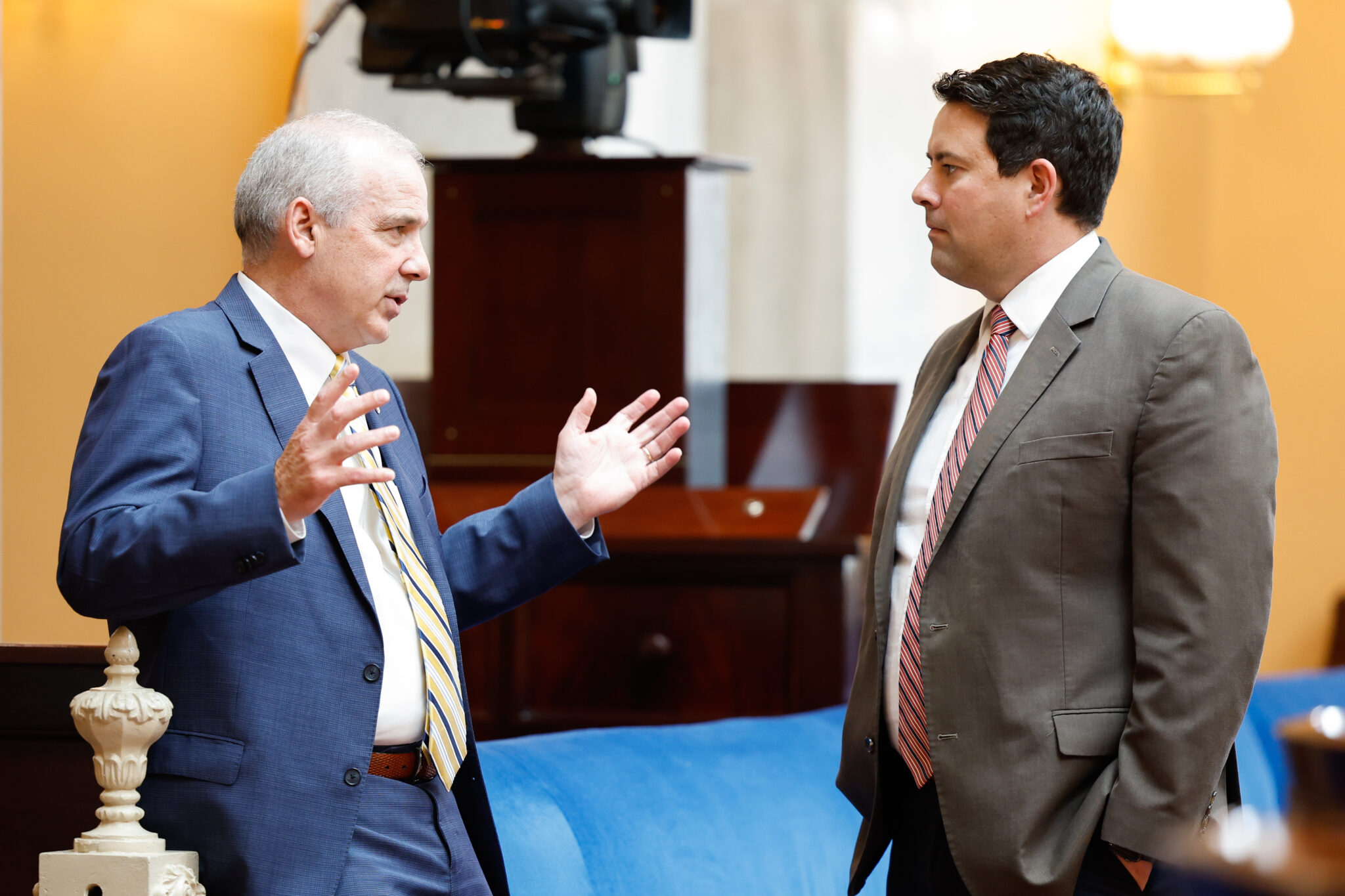
    COLUMBUS, Ohio — MAY 31: Senate President Matt Huffman, R-Lima (left), talks to Senate Majority Floor Leader Rob McColley, R-Napoleon, after the Ohio Senate session, May 31, 2023, at the Statehouse in Columbus, Ohio. (Photo by Graham Stokes for Ohio Capital Journal. Republish photo only with original story.)


    by DAVID DEWITT – Ohio Capital Journal

    By far the most burdensome part of collecting signatures for citizens to amend the Ohio Constitution is the current requirement that they be gathered in 44 out of our state’s 88 counties.

    Organizers typically try to gather double the number of signatures they need to get a proposal on the ballot, because so many things can go wrong and they need that much of a buffer to ensure they have enough valid and accepted signatures to get a proposal through. It’s a slog, requiring a tremendous amount of time, money, resources, volunteers, and dedicated effort for Ohio citizen groups to fulfill. And that’s fair.

    But Ohio Republicans moving the goal posts from 44 counties to 88 counties, as they propose to do with State Issue 1 on the ballot Aug. 8, would effectively destroy the ability of grassroots Ohio citizen groups to succeed in getting proposed amendments on the ballot ever again. The only groups that would have even a remote shot of success would be the most wealthy and powerful special interest groups imaginable.

    Ohio’s unconstitutionally gerrymandered, extremist Republican supermajority in the Ohio Statehouse is the first legislature in Ohio history to try to roll back the constitutional power of Ohio voters, proposing with State Issue 1 to destroy majority voter authority and raise the threshold for passing amendments to 60%.

    Ohio voters have had a majority say over the Ohio Constitution since 1851, and the power to bring citizen ballot initiatives since 1912. Now Ohio Republicans want to eliminate the last possible avenue of accountability for voters against our corrupt, out-of-control legislature.

    Republican leaders have admitted in private and in public that their effort is really aimed to stop an abortion rights amendment slated for the November ballot, and to stop voters from any effort toward further anti-gerrymandering reform.

    After months of denying that the attempt to roll back majority voter authority and enshrine 41% minority rule over our constitution was tied to abortion, Ohio’s two-faced Secretary of State Frank LaRose was recorded telling Seneca County Republicans this is “100% about keeping a radical pro-abortion amendment out of our constitution.”

    LaRose has used his position as our state’s chief elections official to write the most manipulative ballot language possible for the proposal, once again violating the Ohio Constitution as he did when he ignored a bipartisan Ohio Supreme Court, the voters, and the rule of law, to force through unconstitutionally gerrymandered maps.

    Ballot language is constitutionally mandated to be both neutral and accurate. State Issue 1 as written for the ballot by LaRose fails in both regards. In trying to defend the language, which is now the subject of a lawsuit, the state openly admits that it is inaccurate, but claims that’s not a “material defect.”

    The misleading ballot language LaRose and Ohio Republicans are forcing Ohio voters to consider 1.) Fails to state clearly the current process and standards, and how exactly they would change by comparison under the amendment, 2.) Uses weighted language about “elevating” the standards instead of neutral language about raising the threshold for passage from 50% to 60%, and 3.) Inaccurately describes the signature requirement as needing at least 5% of eligible voters in each county, instead of the truthful and accurate 5% of the ballots cast in each county during the most recent election for governor.

    Meanwhile, Ohio Senate President Matt Huffman, also guilty of assaulting the voters, Ohio Constitution, and rule of law with gerrymandering, is now using the state budget process to extort Statehouse lobbyists into supporting this attack on voters.

    Huffman has most recently proposed underfunding the August election by only allocating $15 million for it in the state budget, instead of $20 million as was spent on the August 2022 election. This will stretch county boards of election resources thin and hamper their ability to conduct this election, especially in Oho’s most populous counties, which are the most likely to strongly oppose the amendment.

    Frank LaRose and Matt Huffman are using their elected positions of public trust to deploy every dirty trick in the book against Ohio voters to try to get us to strip ourselves of power and kneel down in subservience to their wanton extremism and corruption.

    But the real kicker is that they plan on spending $6 million in TV ads — with financial backing of an extremist out-of-state billionaire — to try to convince Ohio voters this is about protecting our constitution from out-of-state special interests, when what the amendment would actually do is hand over all keys of power to the most wealthy and extreme special interests.

    This brings us back to the change from 44 counties to 88 for signature gathering and the amendment’s elimination of a “cure period” after signatures have been turned in where organizers can correct things like wrong addresses listed on petitions.

    “Requiring potentially hundreds of thousands of more signatures is bad enough,” the ACLU of Ohio’s Gary Daniels told House lawmakers in testimony against the proposal. “Eliminating the cure period in a state where many often move residences and are unnecessarily purged from voting rolls is even worse. The switch from 44 to 88 counties guarantees that the only campaigns that will qualify for the ballot are the most extremely rich ones.”

    As we’ve seen in scandal after scandal — whether it’s payday lenders, corrupt charter schools, FirstEnergy bribing lawmakers and regulators for a billion-dollar bailout, or an Illinois billionaire trying to rewrite more than 100 years of Ohio Constitutional voter powers — our gerrymandered Statehouse is captured by corrupt, big money special interests.

    By enshrining 41% minority rule, eliminating the signature gathering grace period, and mandating the near-impossible task of gathering thousands of signatures from every single Ohio county, State Issue 1 would guarantee that the only people who have influence on Ohio government are the most wealthy special interests and the corrupt Ohio politicians who keep selling out Ohioans, our state, and our future for pennies on the dollar.


    David DeWitt
    DAVID DEWITT

    OCJ Editor-in-Chief and Columnist David DeWitt has been covering government, politics, and policy in Ohio since 2007, including education, health care, crime and courts, poverty, state and local government, business, labor, energy, environment, and social issues. He has worked for the National Journal, The New York Observer, The Athens NEWS, and Plunderbund.com. He holds a bachelor’s degree from Ohio University’s E.W. Scripps School of Journalism and is a board member of the E.W. Scripps Society of Alumni and Friends. He can be found on Twitter @DC_DeWitt

    MORE FROM AUTHOR