Tag: GOP

  • Fate of former Ohio House speaker could hinge on whether he took an “official act”

    Fate of former Ohio House speaker could hinge on whether he took an “official act”

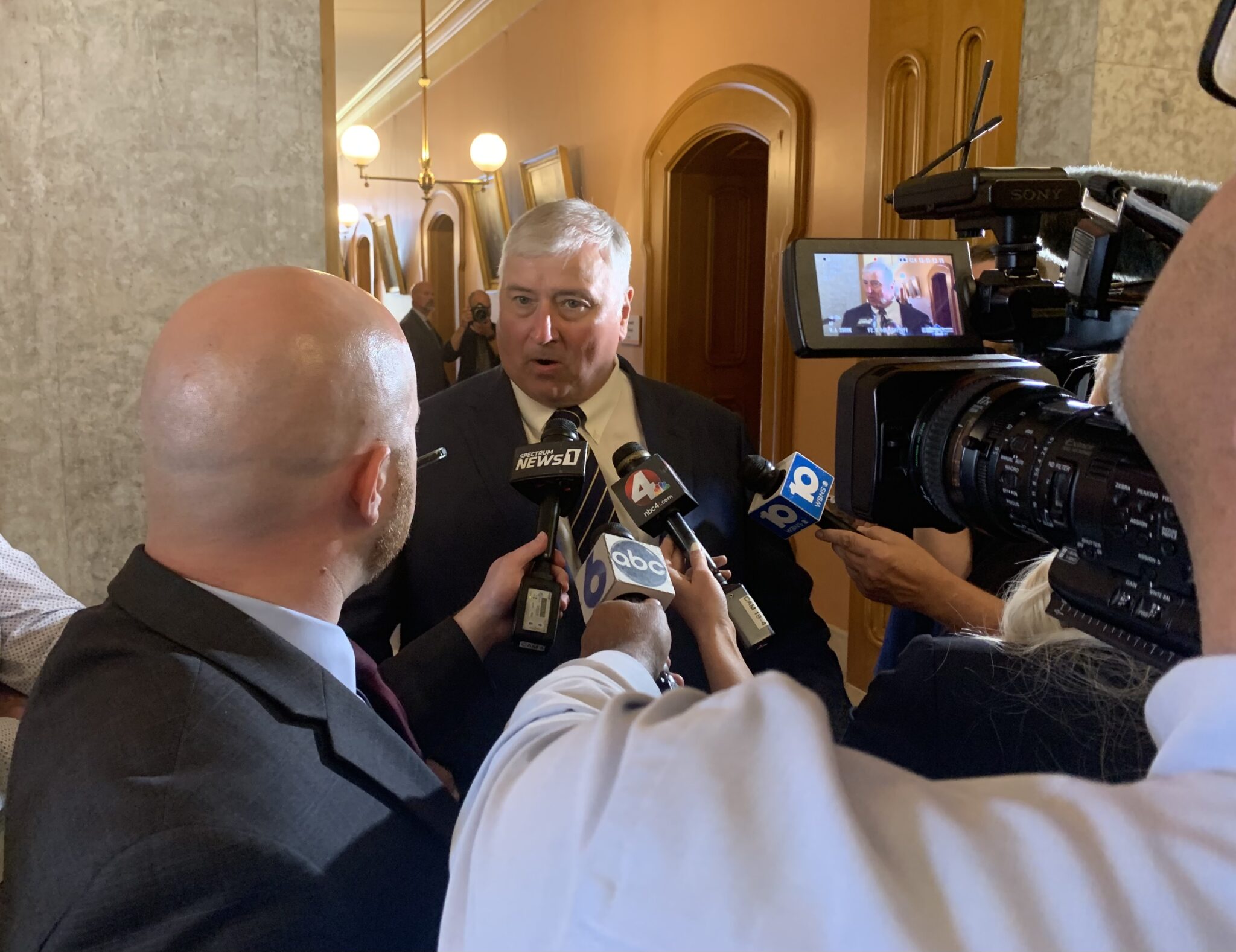
    Larry Householder addresses reporters after lawmakers voted to expel him from the General Assembly. He has pleaded not guilty to a racketeering charge and awaits trial. Photo by Jake Zuckerman, OCJ.

    BY: MARTY SCHLADEN – Ohio Capital Journal

    It appears that federal prosecutors have a mountain of evidence they want to present to the jury in their racketeering case against former Ohio House Speaker Larry Householder and former Ohio GOP Chairman Matt Borges. 

    They have emails, text messages, wiretap transcripts, and the testimony of undercover agents and confidential informants. They have so much material that U.S. District Judge Timothy Black said prosecutors and defense attorneys labored mightily before the trial even started to agree on what could be presented to the jury. The process was meant to avoid bogging down what’s already expected to be a six-week ordeal.

    But all that evidence could miss the mark if none of it shows that Householder undertook an “official act” in exchange for all the millions Akron-based FirstEnergy funneled into 501(c)(4) dark money groups to support the effort to elect friendly Republicans who would vote to make Householder speaker. The U.S. Supreme Court overturned a public corruption conviction on that basis just six years ago.

    Householder is accused of masterminding a conspiracy to use $61 million from FirstEnergy and other utilities to make himself speaker and in return ramming through a $1.3 billion ratepayer bailout of failing nuclear and coal plants. His trial began last week, but after two days of testimony it was delayed — first because of weather and then because a juror was diagnosed with COVID.

    But last week, FBI Special Agent Blane Wetzel testified about conduct that made both Householder and FirstEnergy look pretty bad.

    Householder is accused of using about $500,000 from the dark money groups to pay off credit card debt, settle a lawsuit, and repair a Florida home. Meanwhile, FirstEnergy was losing so much money on its nuclear and coal plants that in 2016 it started the process that would send the subsidiary that owned them into bankruptcy.

    But even as the company and Householder were swimming in red ink, he and the company’s CEO flew to Washington, D.C., on private jets in January 2017 for three days of dinners and drinks at some of the city’s swankiest bars and restaurants, Wetzel said. 

    Within two weeks, FirstEnergy money was flowing into Householder-controlled dark-money accounts. In November of 2018, enough Householder-friendly Republicans were elected — many with the help of money from those accounts — to make him speaker the following January. Less than six months later, on May 28, 2019, the House passed its first version of the billion-dollar bailout, House Bill 6. The body passed a final version on July 23, 2019 and Gov. Mike DeWine signed it the same day.

    When former U.S. Attorney David M. DeVillers announced Householder’s arrest almost exactly a year later, he called the scheme with FirstEnergy “likely the largest bribery and money-laundering scheme ever in the state of Ohio.”

    But did Householder undertake an official act in exchange for money corruptly received from FirstEnergy and other Ohio utilities? The answer might not be as straightforward as you think.

    For their part, Householder’s attorneys are arguing that their client was merely raising money like any effective politician would and that he only wanted to subsidize the power plants to save Ohio jobs and the tax bases of school districts.

    In addition, the Supreme Court in 2016 threw out the conviction of former Virginia Gov. Bob McDonnell even though he and his wife took more than $170,000 worth of loans and gifts from a businessman in exchange for hosting him at functions, recommending his product to state agencies, and trying to persuade state universities to study it.

    At issue was whether any of those were “official acts.”

    In that case, Jonnie Williams, CEO of Star Scientific, supported the Virginia Republican’s successful 2009 campaign. Once in office, the gifts really started to flow — including $20,000 worth of designer clothing for McDonnell’s wife, Maureen McDonnell, and a Rolex watch that Maureen gave Bob for Christmas.

    Williams was peddling a compound found in tobacco as a nutritional supplement called Anatabloc. In 2011, the McDonnells hosted an event at the Governor’s Mansion that Williams testified was intended to launch the product. He wanted scientists at the state’s universities to research it, but neither he nor the McDonnells could interest them in the supplement.

    The governor also told the state secretary of administration and the director of the Virginia Department of Human Resources that it would be a good idea for all state employees to take Anatabloc like he was. The officials apparently didn’t take the hint. 

    Investigators caught wind of the McDonnells’ arrangement with Williams and charged them with numerous crimes related to bribery.

    In 2014, they were convicted in federal court and Bob and Maureen were sentenced to two and one year in prison, respectively. They appealed, but the 4th U.S. Circuit Court of Appeals in Richmond upheld the conviction.

    However, when the case made it north to the U.S. Supreme Court, in Washington, D.C., it was overturned. Unanimously.

    Chief Justice John Roberts, the author of the ruling, said that the court took up the case expressly “to clarify the meaning of ‘official act.’” 

    In his trial, “Governor McDonnell had requested the court to further instruct the jury that the ‘fact that an activity is a routine activity, or a ‘settled practice,’ of an office-holder does not alone make it an ‘official act,’ and that ‘merely arranging a meeting, attending an event, hosting a reception, or making a speech are not, standing alone, ‘official acts,’ even if they are settled practices of the official,’ because they ‘are not decisions on matters pending before the government.’” Roberts wrote.

    Instead, McDonnell’s lawyers argued, an official act must be intended to “influence a specific official decision the government actually makes — such as awarding a contract, hiring a government employee, issuing a license, passing a law, or implementing a regulation.”

    In overturning the convictions, the high court agreed, ruling that the McDonnells could still be prosecuted, but the “Government must identify a ‘question, matter, cause, suit, proceeding or controversy’ that ‘may at any time be pending’ or ‘may by law be brought’ before a public official. Second, the Government must prove that the public official made a decision or took an action ‘on’ that question, matter, cause, suit, proceeding, or controversy, or agreed to do so.”

    How much comfort Householder should take from the ruling is uncertain, however. Roberts ended the ruling with what seems to be a warning to politicians thinking of doing shady stuff.

    “There is no doubt that this case is distasteful; it may be worse than that,” he wrote. “But our concern is not with tawdry tales of Ferraris, Rolexes, and ball gowns. It is instead with the broader legal implications of the Government’s boundless interpretation of the federal bribery statute. A more limited interpretation of the term ‘official act’ leaves ample room for prosecuting corruption, while comporting with the text of the statute and the precedent of this Court.”

  • GOP believes John Wilkes Booth was participating in “legitimate political discourse”?

    GOP believes John Wilkes Booth was participating in “legitimate political discourse”?

    by Mark P. Painter

    As of February 2022, it is now official and incontrovertible: the Republican Party is the party of sedition.

    The official governing board, the Republican National Committee declared that January 6, 2021, rioters who attacked the Capitol were “ordinary citizens engaged in legitimate political discourse.”  So the rebels and thugs breaking into our Capitol, by hitting, choking, and smashing police officers in the head with fire extinguishers, shouting “Hang Mike Pence,” were engaging in the same activities as a high-school debate club.

    These “ordinary citizens” had just been whipped into insurrection by the Big Lie—by Donald Trump, the execrable Jim Jordan, and others who wanted the mob to forcibly stop congress from doing its duty to certify the results of an election that Trump’s own Department of Homeland Security called “the most secure in American history.” 

    We have since learned that the insurrection was planned.  Not a “demonstration” that went too far, but an attempted coup. The plan was to intimidate Mike Pence to refuse to certify the duly elected electors, have the Republican House pick bogus electors from states that voted for Biden, and keep Trump in office.  

    Fortunately, this scheme was devised by idiots like Rudy Giuliani, Jim Jordan, and Sidney Powell.

    But even that brain trust came closer than it should have.  Mike Pence, knowing that he had no power to do what Trump insisted, held firm.  After four years of groveling at Trump’s feet, treason was a bridge too far—he followed the law.  But later in the day, the sedition caucus of 147 Republicans in Congress, sadly including our own Steve Chabot, voted to overturn a free and fair election.

    Most sane Republicans were shocked.  

    But in the year since the insurrection, when even more proof of the plot has come out, the Republican leadership has continued to insist, against all evidence, that the 2020 election was stolen—Big Lie One. 

    Now we have Big Lie Two—that the rioters’ coup attempt was just a bunch of Rotarians visiting the Capitol.

    Surely, most Republican office holders are not so stupid as to believe either lie themselves.  But they still parrot it to the gullible.  Because these people know better, they are both liars and hypocrites.  

    The GOP I proudly was a part of for over four decades has become not the party of Lincoln, freedom and civil rights—but of voter suppression and outright racism; not of Teddy Roosevelt, national parks and trustbusting—but of slashing taxes on billionaires; not of William Howard Taft, Robert A. Taft, and principled conservatism—but of worship of an authoritarian sociopath of no beliefs except in his own rantings of the day; not of Dwight Eisenhower, Stan Aronoff, John Rhodes, and effective bipartisanship—but of hate and disruption; and the party of sane and measured foreign policy has become I know not what.  

    Until about last week, some of us thought that possibly, just possibly, the GOP could be saved.  Perhaps when Trump and his ilk were gone, sanity could be restored.  But when Mitch McConnell said of the GOP Big Lies, “We saw it happen. It was a violent insurrection for the purpose of trying to prevent the peaceful transfer of power after a legitimately certified election, from one administration to the next. That’s what it was,” he was not praised and honored for defending truth.  He was excoriated by most other Republicans for contradicting the Big Lies.

    If there was a time when the GOP breathed its last dying breath, this was it.  The Republican Party became the Big Lies Sedition Party, mandating that its members believe the obvious lies.  (I would term it Treason Party, meaning the common definition, but someone will counter that the Constitution has a specific definition.) 

    There is no hope for resurrection.  Everyone associated with the present GOP who has supported what the party has become must be driven from office.  A new party must be formed, based on some of principles above.  Trump may comment from prison for countless felonies.

    GOP delenda est.  What’s to be done with the ashes I must leave to others.

  • DeWine can’t run from energy bailout bribery scandal as dirty laundry keeps piling up

    DeWine can’t run from energy bailout bribery scandal as dirty laundry keeps piling up


    COMMENTARY

    by MARILOU JOHANEK – Ohio Capital Journal

    Follow the money. Its corrupting influence runs through all the great scandals piling up in Ohio under Republican rule. From the biggest online charter school rip-off of tax dollars to the largest public corruption indictment in state history, money has paved the way to epic wrongdoing under GOP management. Find out who in Columbus is greasing palms, funding campaigns and writing public policy for private interests, and you’ll also discover who is standing in line with their hand out willing to reciprocate with public favors.  

    But when people in high places slip on hubris and expose brazen graft at public expense — and they always do — the swarm of politicians who were only too happy to pocket donor checks and look the other way scatter like insects under a rock that’s been lifted. Republican Gov. Mike DeWine is one of those spooked bugs racing away from his political entanglement in the blockbuster bribery and money-laundering case that goes to trial this year. Three of the four indicted individuals who will be in court on federal racketeering charges — in connection with a billion-dollar ratepayer bailout of two nuclear power plants to benefit FirstEnergy and its affiliates — donated thousands to DeWine’s gubernatorial campaign. 

    So did the Akron-based energy giant at the heart of the bailout scheme. FirstEnergy has legendary pull with pliable politicians. 

    The state’s largest electric utility pumped $1 million into groups backing DeWine in 2018, according to a Dayton Daily News investigation following the money. The company also pumped big bucks into groups helping his daughter’s failed campaign for county prosecutor. DeWine hired multiple administration staffers and advisors with close ties to FirstEnergy, including a former top aide linked to one of the dark money groups implicated in passage of the bailout legislation (House Bill 6) written for and by the utility. 

    The governor also appointed and steadfastly supported Ohio’s former top utility regulator, now accused of profiting in association with the FirstEnergy scandal. DeWine knew of Sam Randazzo’s deep business relationship with the utility when he chose him at the urging of company executives. In a seemingly flagrant quid pro quo, the governor’s pick for the powerful chair of the state utilities commission pocketed a massive sum of money from FirstEnergy just weeks before his appointment. 

    But even damning disclosures of Randazzo’s $4.3 million utility bribe and his blatant efforts on behalf of FirstEnergy — constructing House Bill 6, delaying a company rate case, lobbying for legislation to save the utility millions — didn’t dissuade DeWine from expressing “great confidence” in his regulator. Even after the FBI raided Randazzo’s home as part of the FirstEnergy bribery probe and he resigned under a cloud of suspicion, DeWine praised him for doing “very, very good work as chair.” 

    Perhaps anticipating incredulity with that assessment, the Republican later suggested he was “open” to reforming the process for choosing state utility regulators. Eighteen months on, the DeWine-appointed nominating council that recommends PUCO candidates to the governor includes members tied to passage of the notorious bailout bill. 

    Even after the FBI arrested former House Speaker Larry Householder, who engineered approval of House Bill 6 and was subsequently charged with taking money to pass it, DeWine rejected an effort to repeal the corruption-ridden legislation. 

    “We need balance in our energy,” was all he could say about a bill passed with more than $60 million in bribe money. DeWine reversed himself but reiterated his support for FirstEnergy’s ultimate bribery goal — giving $1.3 billion in public money to two unprofitable nuke plants with new surcharges paid by everyratepayer in the state. 

    He had put the full weight of the governor’s office behind the nuclear bailout bill and signed the corrupt measure into law the very day it passed. The “energy” legislation championed by DeWine also put ratepayers on the hook to bail out two money-losing, hyper-polluting coal plants (one in Indiana) partially owned by other utilities and two FirstEnergy subsidiaries. Plus, the bailout boondoggle the governor couldn’t sign fast enough thoroughly gutted renewable energy and energy efficiency standards and removed all incentive to build more renewable energy projects in the state. 

    Those utility-written provisions have still not been repealed under a 2019 embarrassment that should have been scrapped outright. But the Republican-controlled legislature, complicit in the worst scandal “ever perpetrated against the people of the state of Ohio,” is content to become synonymous with corruption and fleece Ohioans on their monthly electric bills if that makes utility donors happy. The Ohio Manufacturers Association estimated electricity customers will pay a total of $1.8 billion in coal plant subsidies by 2030 — more than the cost of the nuke bailout — unless integrity intrudes on the General Assembly and House Bill 6 is fully repealed. 

    Don’t hold your breath. But remember, this outrage happened on DeWine’s watch and with his blessing. Ohioans didn’t know how crooked House Bill 6 was or how many politicians, including the governor, were willing to look away until federal prosecutors blew the lid off the alleged criminal enterprise to screw ratepayers in return for boosted political careers. DeWine is understandably trying to put as much distance as possible between his reelection campaign and the biggest open investigation of Statehouse corruption in the country. 

    But it’s hard to escape dirty laundry that keeps piling up when you can’t hide under a rock anymore.  

  • HEALTH CARE POLITICS & GOV Proposed Ohio abortion bills would impose new mandates, spread misinformation

    HEALTH CARE POLITICS & GOV Proposed Ohio abortion bills would impose new mandates, spread misinformation

    BY: and Ohio Capital Journal

    Returning from summer break, the Ohio legislature could review two GOP-led pieces of legislation that would place health mandates on patients considering abortions.

    One of the bills, recently introduced by state Rep. Jennifer Gross, would require physicians to dictate the results of a mandated ultrasound and also provide information about a link between breast cancer that has been disproven by multiple medical organizations.

    State Rep. Jennifer Gross, R-West Chester 

    Gross, usually known for and outspoken in her disapproval of health care mandates, introduced the bill this week.

    Patients already have to meet with a physician 24 hours before an abortion, but under this bill, along with hearing about the medical risks of the procedure and the probably gestational age, a patient would be told “the possible increased risk of breast cancer that is associated with women who have undergone an abortion,” along with the “short-term and long-term risk of psychological or emotional harm” from choosing to have an abortion.

    Multiple organizations, including the American Cancer Society, the American College of Gynecologists and the Susan G. Komen Breast Cancer Foundation have denied the link, citing research studies on the relationship between breast cancer and abortion.

    The American Cancer Society said these research studies “have not found a cause-and-effect relationship between abortion and breast cancer.”

    The Gross bill has not been assigned to a committee for consideration, but it has several sponsors, all Republican.

    Meanwhile, a separate bill seeking to notify abortion patients of possible risks was introduced during the legislature’s summer break, and has been assigned to the House Health Committee.

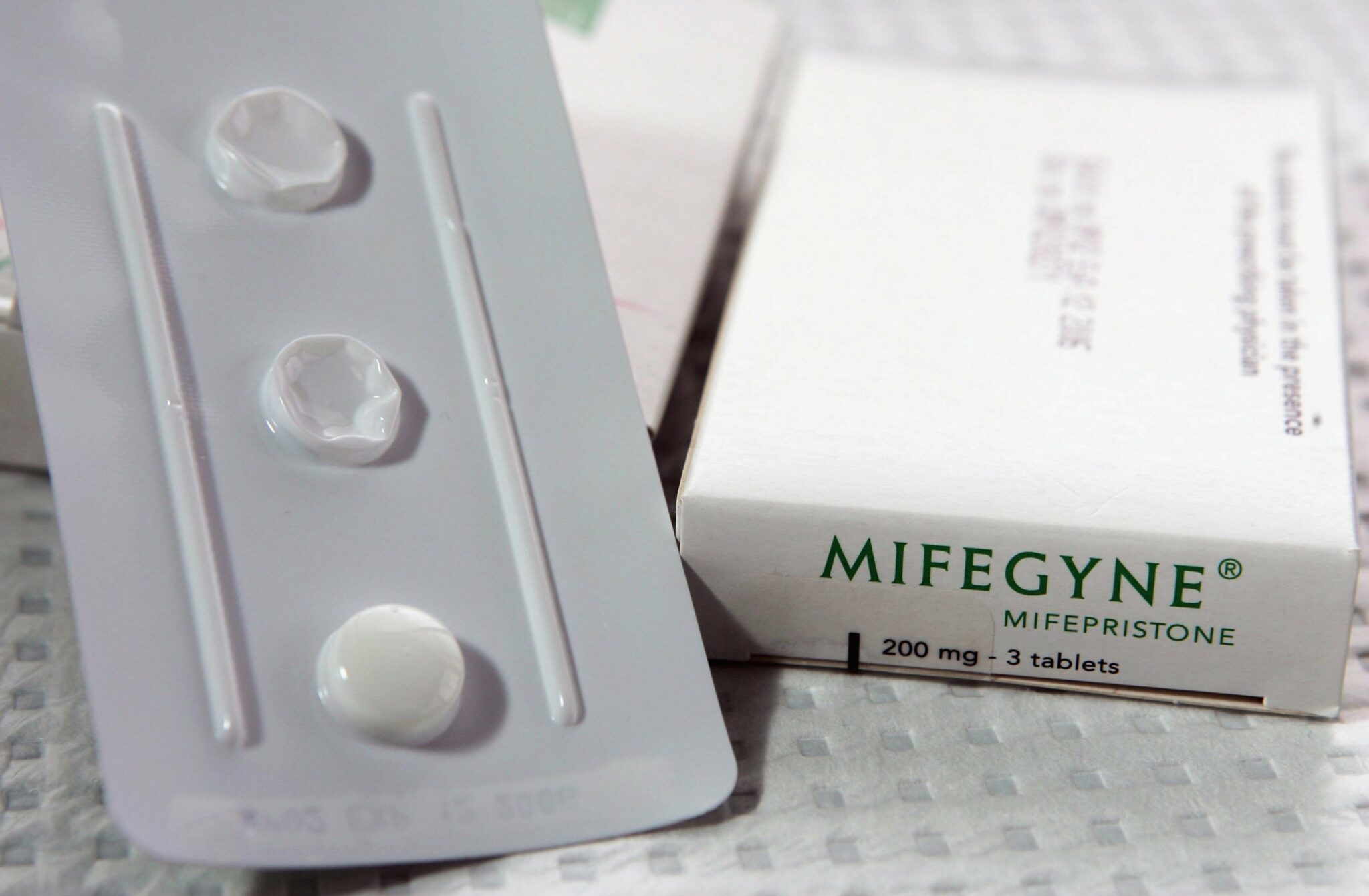
    House Bill 378  was introduced in July by state Reps. Kyle Koehler, R-Springfield, and Sarah Fowler Arthur, R-Ashtabula, and specifically targets medication abortion, which is done through a two-pill regimen, rather than surgery.

    The bill would require medical professionals to explain a controversial and medically unproven method of “reversing” the abortion by not taking the second of the two-pill regimen and giving additional progesterone to counteract the first pill.

    The American College of Obstetricians and Gynecologists said claims about the “reversal” method “are not based in science and do not meet clinical standards.”

    The bill is a reintroduction of a similar one that passed the Senate in 2019, but didn’t make it through the House.

    Abortion is legal in the state of Ohio up to 20 weeks gestation.


    Susan Tebben is an award-winning journalist with a decade of experience covering Ohio news, including courts and crime, Appalachian social issues, government, education, diversity and culture. She has worked for The Newark Advocate, The Glasgow Daily Times, The Athens Messenger, and WOUB Public Media. She has also had work featured on National Public Radio.
  • Inside Ohio Republicans’ 10-month war on the state health department over COVID-19

    Inside Ohio Republicans’ 10-month war on the state health department over COVID-19

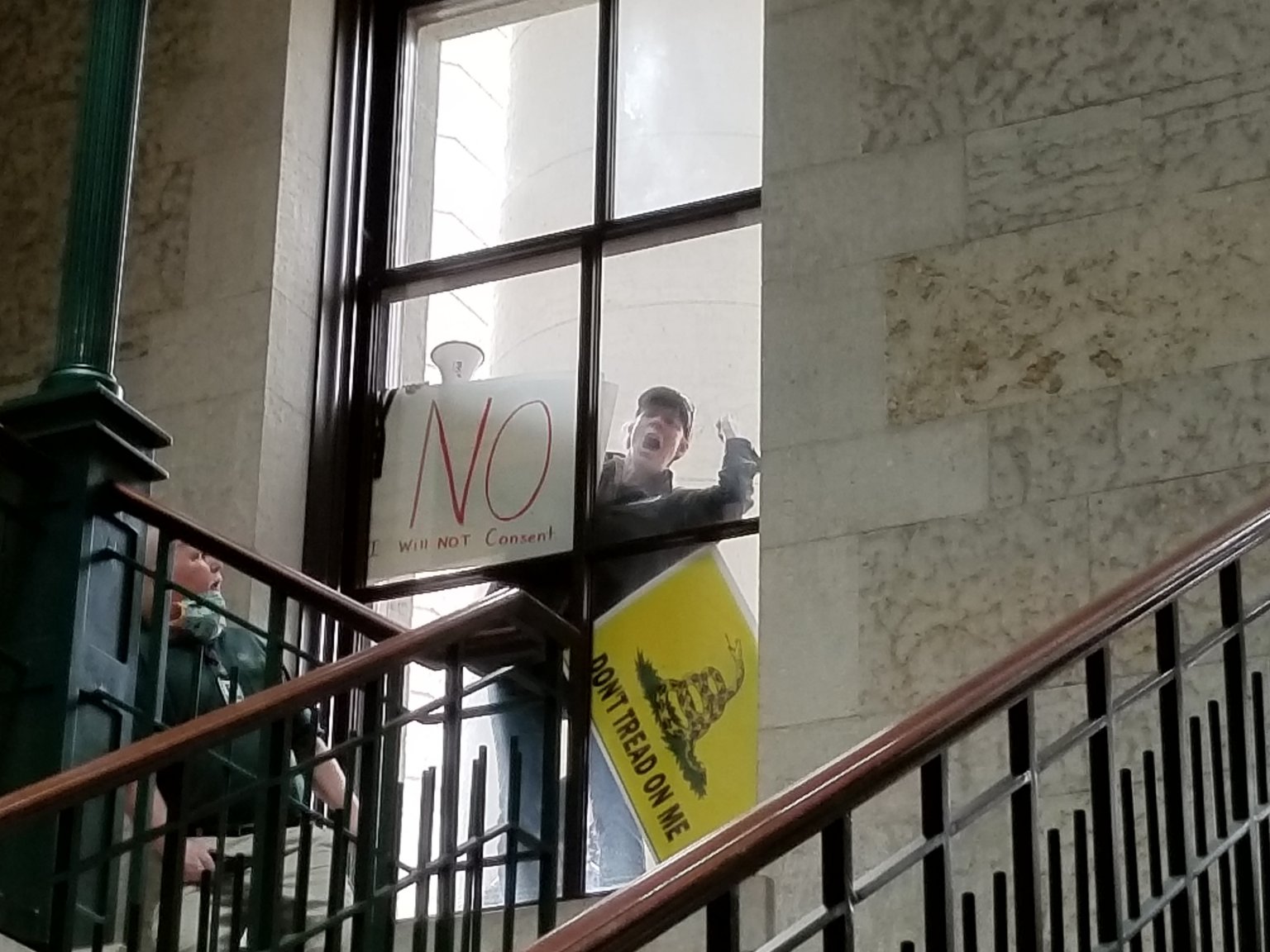
    A man protesting Ohio’s health orders at the state Capitol on May 1. Gov. Mike DeWine later repealed most of them only to start reimposing orders on Tuesday as coronavirus cases continued to surge. Capital Journal photo by Marty Schladen

    By Jake Zuckerman and Ohio Capital Journal

    Ohioans were living with the coronavirus for about two months before GOP lawmakers initiated what would be a nearly yearlong effort to squash the state health department’s ability to issue public health orders.

    The earliest version of the idea was to limit any order issued by the Ohio Department of Health to a two-week window. After that, a small panel of lawmakers would need to approve the order for it to stay in effect any further.

    “We are clearly on the downside of the curve, there is no longer a risk of overwhelming the health care system,” said now-former Rep. John Becker to the House State and Local Government Committee, setting one of the first legislative attacks on the health department in motion via Senate Bill 1.

    “I’m not sure there ever was, but that argument did make sense to me initially.”

    Ten months, three gubernatorial vetoes, and more than 520,000 Americans dead from COVID-19 later, little has changed. The Senate passed a similar version of the idea last month on a party-line vote.

    A review of emails obtained by public records requests, committee hearings, interviews and contemporaneous media reports highlight just how absent public health was from efforts to wrest power from the health department during a pandemic.

    In several instances, abortion politics, coronavirus infections among lawmakers, and overly rosy assessments of the pandemic from Republican leaders played a larger role in the legislation than the coronavirus itself.

    SB 1 died an unusual death last May when every state Senator — even the bill’s sponsors — voted it down. Its supporters gave varying explanations from the Senate floor. They said it didn’t have an emergency clause, meaning it wouldn’t take effect for 90 days; and it was clumsily drafted.

    Then-Senate President Senate President Larry Obhof, one of the most powerful Republicans in the state, later told constituents that Senators killed the bill, in part, because it could have expanded women’s access to abortion.

    “A prominent Right to Life organization pointed out that the language, as written, could allow lawsuits challenging health orders that regulate or close abortion clinics,” he said in an email obtained in a public records request.

    “Thus, the language could have been used to protect abortion clinics.”

    The concern came from a letter the Greater Columbus Right to Life sent to lawmakers. Ohio Right to Life, which operates independently of the Columbus organization, disagreed, according to its director, Michael Gonidakis. However, he tried to stay out of it.

    “We had no desire to be involved in that debate,” he said in a recent interview.

    Sen. Tim Schaffer, R-Lancaster, later wrote on Facebook that the bill would have limited the state’s ability to “shut down illegal abortion clinics.” Then-Speaker of the House Larry Householder, R-Glenford, prior to being indicted in an alleged racketeering scheme, commented on the post. He told the senator to “grow a pair” and called his rationale “bullshit.”