Goshen Township, Ohio – Ohio Governor Mike DeWine announced today that the state will award nearly $4.8 million in grant funding to help local law enforcement agencies across Ohio cover costs associated with body-worn camera programs.
A total of 108 law enforcement agencies will receive funding as part of the third round of the Ohio Body-Worn Camera Grant Program. Of those agencies, 32 will use funding to create new body-worn camera programs and 76 agencies will dedicate funding toward expanding or upgrading existing technology.
Goshen Township will receive $48,421.20.
Governor DeWine created the Ohio Body-Worn Camera Grant Program in 2021. In total, more than 300 law enforcement agencies have received funding as part of the program, including over 200 law enforcement agencies that received nearly $10 million in grants in the 2022-2023 biennium. The Ohio General Assembly allotted an additional $10 million to the program as part of the current 2024-2025 biennium, $5 million of which will be awarded next year.
Hamilton, Ohio – The U.S. Department of Housing and Urban Development (HUD) today awarded $5 million in demonstration grants to five local government and non-profit organizations across the nation to help households with young children or seniors promote energy efficiency and healthy housing. The City of Toledo and People Working Cooperatively, Inc in Cincinnati each were awarded $1 million to promote healthy housing.
The funding announced today promotes the coordinated delivery of services by local HUD-funded Lead Hazard Reduction and Weatherization Assistance Programs funded by the U.S. Department of Energy (DOE). This model will provide additional benefits to low-income households in the form of lower energy costs and a reduction in residential health and safety hazards. Read a complete project-by-project summary of the programs awarded grants today.
“These grants will allow local programs to explore different strategies to increase the supply of safe and energy-efficient housing for low-income households,” said HUD Secretary Marcia Fudge. “These services are expected to both improve resident health and reduce emissions of greenhouse gases.”
“Both of the programs supported through these grants target services to similar populations and housing. Coordinating services enhances the benefits to households and can reduce program costs by achieving greater efficiencies compared to the usual independent provision of program services,” said Matt Ammon, Director of the Office of Lead Hazard Control and Healthy Homes. “We know that substandard housing contributes to injury and illness, which is entirely preventable.”
HUD’s Office of Lead Hazard Control and Healthy Homes promotes state and local efforts to eliminate dangerous lead-paint and other housing-related health and safety hazards from lower income homes, stimulate private sector investment in lead hazard control, support cutting-edge research on methods for assessing and controlling housing-related health and safety hazards, and educate the public about the dangers of hazards in the home.
People Working Cooperatively (PWC) will partner with the City of Cincinnati and the Hamilton County Health Department to demonstrate the cost savings and impact of integrating services from the Home Weatherization Assistance Program (HWAP) and Lead Hazard Control (LHC) programs. PWC will conduct the HWAP services and Cincinnati and the Hamilton County Health Department will execute their LHC programs. PWC will partner with Cincinnati Children’s Hospital and the U. of Cincinnati for health-based referrals. The project will develop common enrollment applications, common assessment tools and cross-train staff and technicians to provide coordinated LHC, HWAP and other Healthy Homes services to minimum of 50 households. Contact Person/Authorizing Official: Jeffrey Pitts; pittsj@pwchomerepairs.org.
Go to this link to find out more about People Working Cooperatively and see if you qualify for their services or have skills that will help them with their mission.
Saving Homes. Restoring Pride.
For more than 45 years, PWC has been strengthening our communities by providing critical home repairs, energy conservation, and accessibility modification services in an effort to help residents remain independent and healthy in their homes. PWC proudly performs more than 8,000 services for eligible homeowners each year, whose typical income is just $14,000 a year. Often, these individuals face challenges due to illness, disability, job loss, or other circumstances.
PWC is supported by a robust group of more than 110 licensed, professionally trained staff members and administrative personnel. In addition, PWC boasts a dedicated corps of 3,500-plus volunteers making it one of the largest volunteer corps in the region. Together, PWC volunteers and skilled staff are in more than 4,500 homes annually assisting nearly 9,000 individuals in southwestern Ohio, northern Kentucky, and southeast Indiana.
Loveland, Ohio– The Ramsey-Paxton Cemetery Preservation Project securing financial support is well on its way.
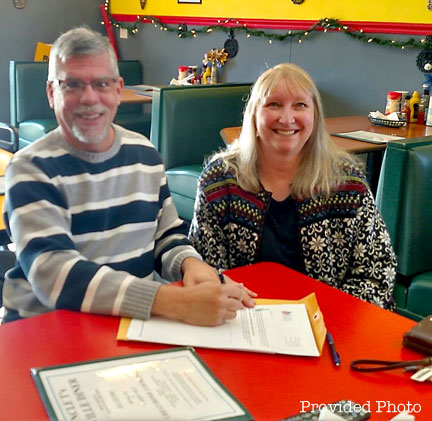
Rob Geiger signing off on the grant proposal with Paige Craig volunteer for the Clough Valley Chapter Daughters of the American Revolution and grant writer.
The Clough Valley Chapter Daughters of the American Revolution, serving the Clermont County area submitted a grant proposal to their National Organization DAR in December to help preserve this great historical site located in the White Pillars subdivision in Loveland.
The last couple of months local and out of town individuals have been donating funds to make this project a reality. Organizer of the fund raising, Rob Geiger said, “A big thank you goes to Loveland Magazine for being our Media Sponsor and to the American Legion Post 256, Loveland, Ohio, for being our first organization to support the project.”
Below is the supporting letter that was submitted with the grant proposal from the local chapter of the DAR.
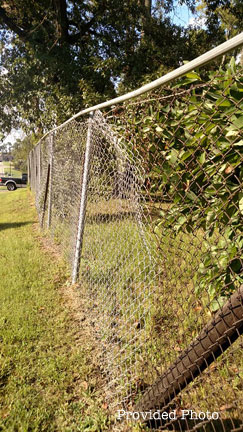
The project involves removal of this deteriorating fence and installation of a new, secure fence with a lifetime guarantee, around the graves of some of our earliest pioneers.
I would like to offer enthusiastic support for the Ramsey-Paxton Cemetery Gravesite Preservation Project on behalf of myself and the Clough Valley Chapter Daughters of the American Revolution, serving the Clermont County, Ohio area.
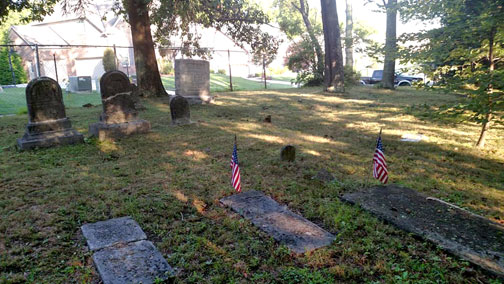
This project involves removal of a deteriorating fence and installation of a new, secure fence with a lifetime guarantee, around the graves of some of our earliest pioneers and two NSDAR recognized patriots.
Financial support for this historic preservation project exemplifies the work the NSDAR is striving to accomplish. In addition to the historic preservation of this physical historic site, we are also preserving and perpetuating our history.
One cannot read of, discuss, or visit this cemetery without learning about or remembering the stories of a pioneer family carving out their homes in the Northwest Territory, militia men who sacrificed to protect their families and lands, and those patriots who are nearest and dearest to our hearts who fought for our freedom.
The 1795 History of Clermont County, Ohio, with Illustrations and Biographical Sketches of its Prominent Men and Pioneers by Louis H. Everts, one of our local history books written in 1880, tells many of these stories. It also refers to the many local Paxton and Ramsey descendants who lived “in pleasant homes, and achieved social and public prominence, making their locality one of the choicest garden spots in Ohio.”
This cemetery remains in that lovely area, but this project is important to maintain and preserve that description.
This project’s success is supported by a determined organization, cooperation from city government, and local financial support and publicity. It only lacks enough funding to go forward. I hope you will grant the Ramsey-Paxton Cemetery Association the gap funds needed to ensure its completion.
Respectfully Submitted, Wanda Langdon, Regent
Geiger said, “We still have a few months to reach our goal of $10,000.00 through your personal generosity. If we are awarded the grant we are over halfway to making this project a success.”
The Ramsey-Paxton Cemetery is located within the White Pillars subdivision in Loveland.
If you are a business owner, a member of an organization or an individual, please consider making a charitable contribution or sponsoring an event to help preserve a significant historical site.
For more information you can email geigercounter@hotmail.com or send a check made out to the Ramsey-Paxton Cemetery Association Inc. and send it to Ramsey-Paxton Cemetery Association Inc. C/O Rob Geiger, PO Box 25, Loveland, Ohio 45140.
The Ramsey-Paxton Cemetery Association Inc. is a non-profit 501c3 organization. All donations are a charitable contribution.
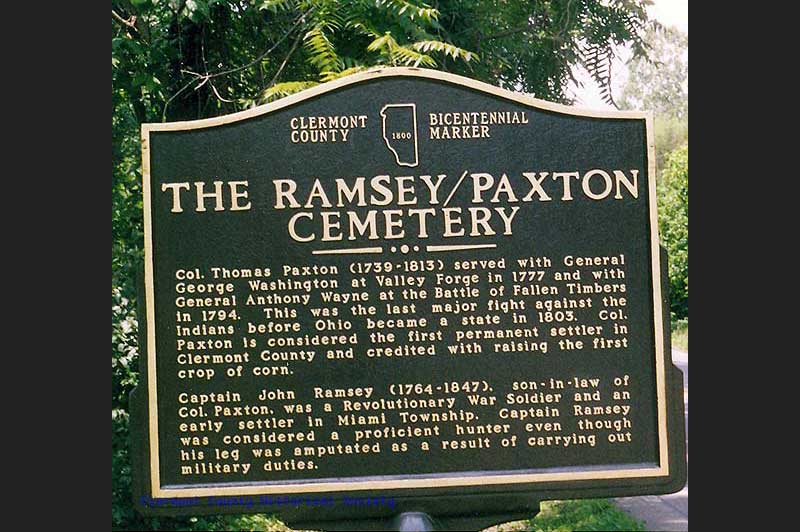
Captain John Ramsey, a son-in-law, was buried in the cemetery in 1847, along with other family members until 1913. Ramsey (1764-1847) was a Revolutionary War Patriot and one of the first settlers of Clermont County.
Lt. Col. Paxton (1739-1813) served with General George Washington at Valley Forge in 1777 and with General Anthony Wayne at the Battle of Fallen Timbers in 1794. He is considered the first permanent settler between the Little Miami River and the Scioto River in the Virginia Military Tract, credited with raising the first crop of corn, and was the founder of Loveland.
The CEI Foundation awards grant to teens’ project using virtual reality to treat eye disorder
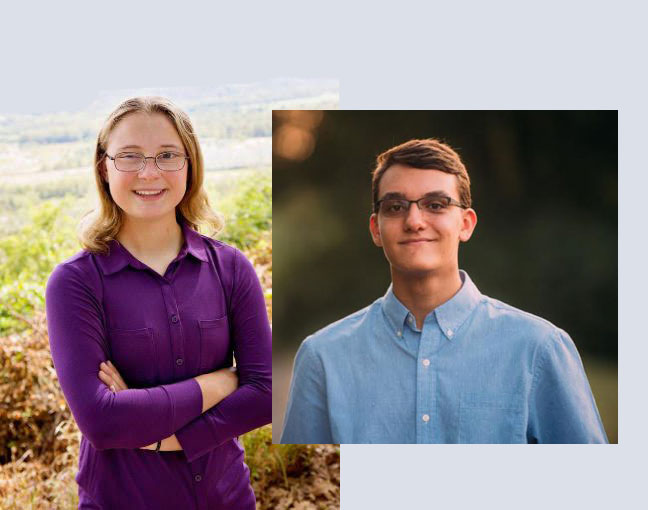
Blue Ash, Ohio – The Cincinnati Eye Institute Foundation, the charitable foundation of Cincinnati Eye Institute, has awarded two seniors at Loveland High School a grant of $3,000. The Foundation’s Research Committee, chaired by Robert Sisk, M.D., made this IGNITE grant to fund an innovative treatment for children with amblyopia, also known as lazy eye. This grant will fund additional computer equipment that will allow children to use virtual reality glasses to play games while strengthening eye muscles.
Emily Kiehl and Radu Vasilescu came up with the idea to use Oculus Rift virtual reality technology to simulate patching one’s eye and playing games filled with perspective and optical depth perspective on the eye needing therapy.
Kiehl, who was born with amblyopia and was successfully treated for the condition, sees this as a potential treatment method. “Using the VR headset, we believe that children can force their brain to start using both eyes evenly,” Kiehl said.
“By surpassing 40 plus college-level teams with our high school prototype, we proved our project is worthwhile and has recognized potential.” – Radu Vasilescu
Kiehl and Vasilescu built a prototype of this design at the University of Cincinnati event “Revolution UC,” a 24-hour, team-based project development competition and won the first place prize awarded by a panel of IT professionals. They invested the winnings from this prize into development of the project.
“By surpassing 40 plus college-level teams with our high school prototype, we proved our project is worthwhile and has recognized potential,” added Vasilescu.
Kiehl and Vasilescu previously built a computer from scrap parts and a loaned graphics card. The computers will enable them to expand their research into the effectiveness of this approach.
Kiehl and Vasilescu presented the idea to The Cincinnati Eye Institute Foundation and were awarded a $3,000 grant which they will use to purchase two high-powered computers needed to run the program. The students previously built a computer from scrap parts and a loaned graphics card. The computers will enable them to expand their research into the effectiveness of this approach.
“We are happy to award Emily and Radu an IGNITE grant for their forward-thinking and entrepreneurial approach to help children born with amblyopia.” – Patrick Ward
“We are happy to award Emily and Radu an IGNITE grant for their forward-thinking and entrepreneurial approach to help children born with amblyopia,” said Patrick Ward, president of The Cincinnati Eye Institute Foundation. “We support efforts for new treatments to help eye disorders, and know that this project has the ability to help many young children.”
The team is hoping to involve students in the Loveland School District, as well as Cincinnati Children’s Hospital Medical Center in their project to help them test out the technology.
Both Kiehl and Vasilescu will graduate from Loveland High School this spring and will pursue computer science degrees; Kiehl will attend the University of Cincinnati and Vasilescu will attend Duke University.
Watch this video where Emily and Radu explain their invention and talk about what it does.
Also read this story about Emily Kiehl and Radu Vasilescu:
Loveland High School seniors Emily Kiehl and Radu Vasilescu receive $3,000 grant





 Loveland Magazine proudly sponsors and supports this project to preserve Loveland’s earliest history and heritage.