Loveland, Ohio –Hamilton County Public Health has been informed that surveillance discovered a COVID-19 variant in Hamilton County. Officially labeled asB.1.1.7 lineage, the variant is commonly known as the UK variant. Hamilton County is one of at least 11 Ohio counties known to have a variant detected.
HCPH has completed contact tracing on the patient, who has resolved symptoms and cleared the standard isolation period. The variant was detected during routine surveillance of tests submitted to the Center for Disease Control (CDC). The actual test took place on January 30.
According to the CDC:
This variant is estimated to have first emerged in the UK during September 2020.
Since December 20, 2020, several countries have reported cases of the B.1.1.7 lineage, including the United States.
This variant is associated with increased transmissibility (i.e., more efficient and rapid transmission).
In January 2021, scientists from UK reported evidence that suggests the B.1.1.7 variant may be associated with an increased risk of death compared with other variants.
Early reports found no evidence to suggest that the variant has any impact on the severity of disease or vaccine efficacy.
“We’ve known about these variants for some time,” says Hamilton County Health Commissioner Greg Kesterman. “From a prevention standpoint, the response remains the same: wear a mask; maintain at least six feet of physical distance; wash hands often; and stay home when you are ill. Also, consider taking vaccine when you are eligible.”
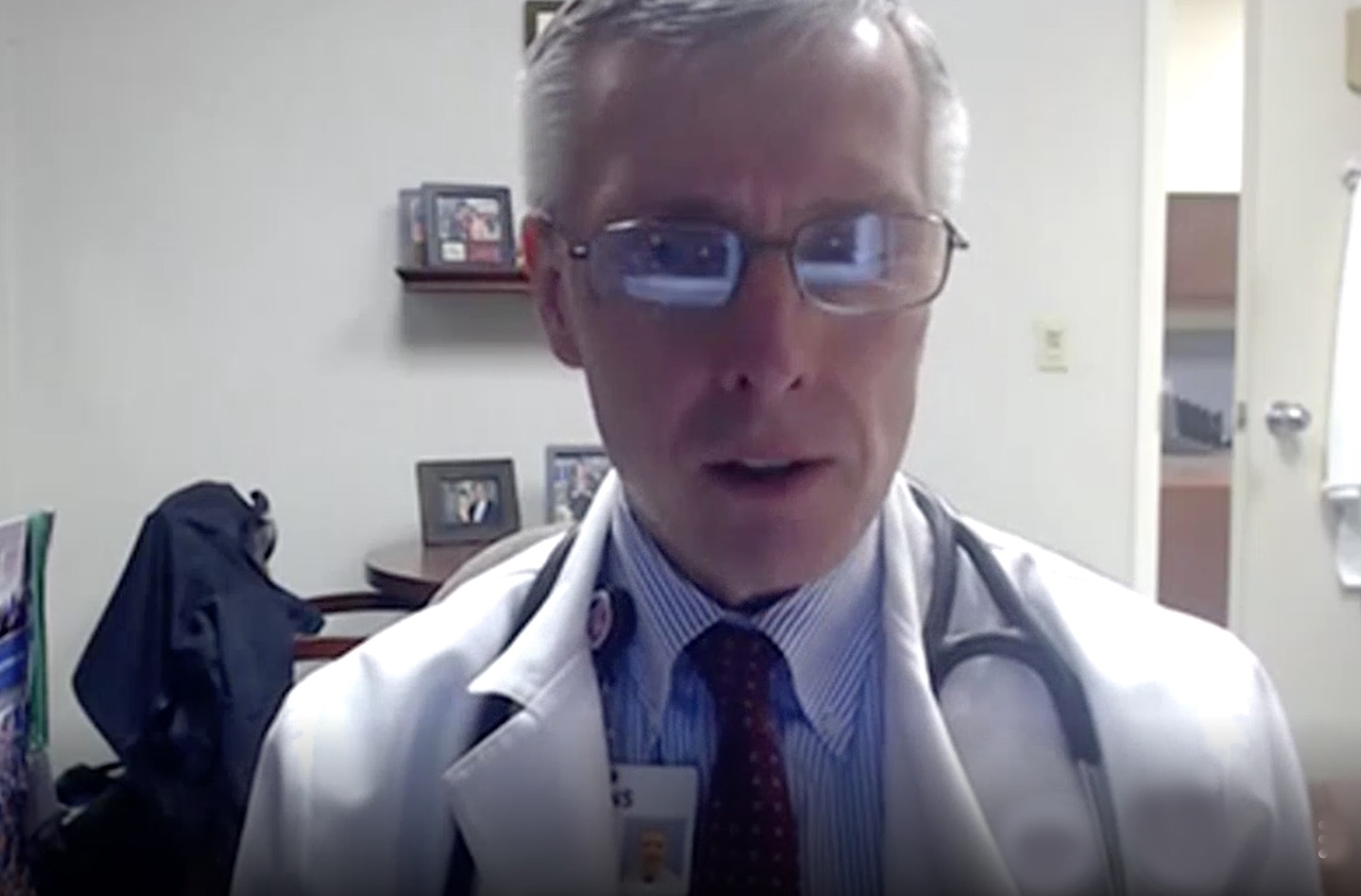
Here is a discussion of the variant, its prevention, and treatment with Hamilton County Public Health Medical Director Dr. Stephen Feagins.
During the week of November 8-14, there was a 140 percent increase in the number of daily cases in Clermont County.
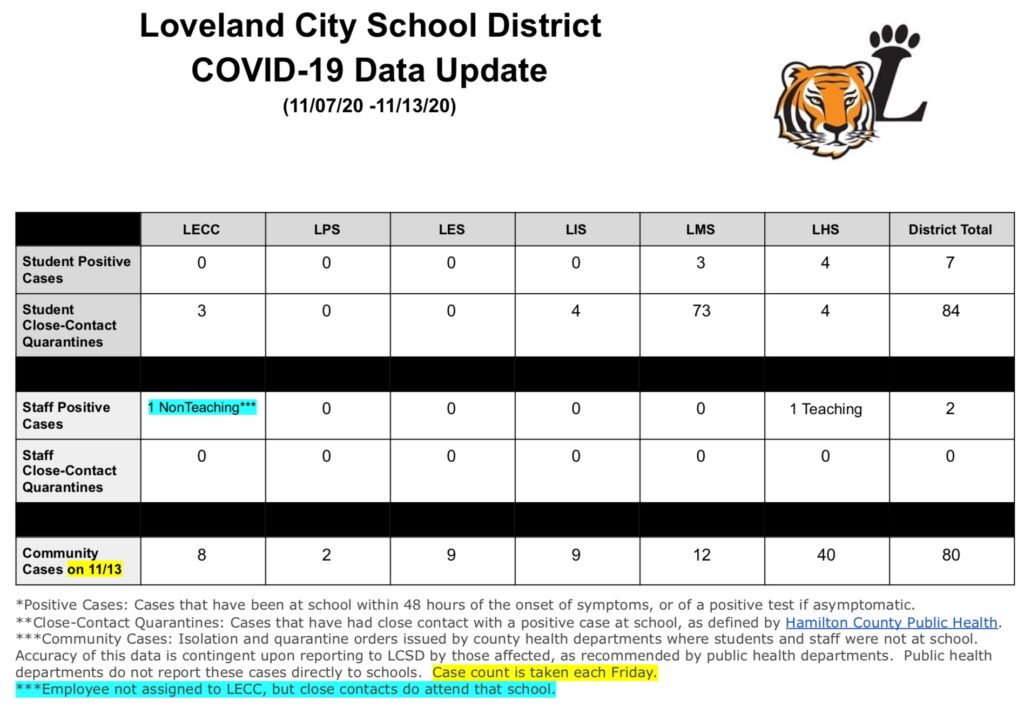
The Loveland City School District reported 16 new COVID 19 CASES since last Wednesday.
Batavia, Ohio – The number of new cases of COVID-19 in Ohio and Clermont County is increasing at an alarming rate according to a statement issued by the Clermont County health district today. The department reports a high of 186 new cases was reported in Clermont County on November 13 and the state of Ohio reported an all-time high of 8,071 new cases.
As of November 12, when the latest public health advisory system numbers were released, Clermont County had a rate of 410 new cases per 100,000 residents. For comparison, on October 1, the county’s rate was only 62 new cases per 100,000 residents. During the week of November 8-14, there was a 140 percent increase in the number of daily cases in Clermont County.
The exponential growth in the number of new cases in Clermont County has made it nearly impossible to keep up with disease investigation and contact tracing. “Up until this point, our goal has been to begin disease investigations within 24 hours of each new case being reported to us,” said Health Commissioner Julianne Nesbit.
Disease investigations take time and involve a public health staff member calling each individual who has tested positive and get details like where they may have been exposed, every location they have been in the previous few days, and every person they may have been in contact with.
After public health does their initial investigation, then they begin the process of contact tracing. That usually involves calling each person who was considered a close contact with the infected person and advising them to quarantine for 14 days from the date of exposure.
“We have hired additional contact tracers, but it’s still not enough to keep up with the demand,” said Nesbit. “Our staff is doing everything we possibly can to keep up with the new cases, we are physically and emotionally exhausted, but we are continuing to do this important work to the best of our ability to protect our community.”
“Our staff is doing everything we possibly can to keep up with the new cases, we are physically and emotionally exhausted
“We have hired additional contact tracers, but it’s still not enough to keep up with the demand,” said Nesbit. “Our staff is doing everything we possibly can to keep up with the new cases, we are physically and emotionally exhausted, but we are continuing to do this important work to the best of our ability to protect our community.”
In addition to hiring additional contact tracers, Clermont County Public Health (CCPH) has been using staff members from every other department to fill in the gaps and assist with contact tracing. CCPH also has a contract with the Ohio Department of Health for additional contact tracers that are being cross-trained to assist with disease investigations.
Public Health has switched from making phone calls in some situations to sending emails to provide information on quarantine to save time. Now, with this many new cases, they have also begun mailing letters to each person that tests positive to save time. Phone calls are still being made when CCPH is aware of situations where there are a large number of contacts and the potential for further spread of the disease.
The letters notify each person that tests positive what to do while they are in isolation and asks them to identify their contacts, who are advised to quarantine. “We are seeing so many new cases, we just cannot possibly keep up at this rate,” said Nesbit.
“Local hospitals are already being stressed,” said Nesbit. “While all hospitals have surge plans in place where they can add more beds and take in more patients, they are going to run out of healthy, experienced workers to care for the sick patients, if this trend continues.”
“We saw in the spring that we can flatten the curve, but we must be extra vigilant now, especially with the holidays coming up,” urged Nesbit.
ccc
The Loveland City School District reported 16 new COVID 19 CASES since last Wednesday.
• On 11/16/20, the district was notified that a student at the Loveland Early Childhood Center tested positive for COVID-19. This student was last at school on 11/12/20.
• On 11/16/20, the district was notified that a student at Loveland High School tested positive for COVID-19. This student was last at school on 11/09/20.
• On 11/16/20, the district was notified that a student at Loveland High School tested positive for COVID-19. This student was last at school on 11/13/20.
• On 11/16/20, the district was notified that a non-teaching staff member from Transportation and Loveland Primary School tested positive for COVID-19. This staff member was last at work / school on 11/12/20.
• On 11/13/20, the district was notified that a staff member at the Loveland Early Childhood Center tested positive for COVID-19. This staff member was last at school on 11/10/20.
• On 11/13/20, the district was notified that a Board of Education Central Office staff member tested positive for COVID-19. This staff member was last at work on 11/12/20.
• On 11/14/20, the district was notified that a staff member at Loveland High School tested positive for COVID-19. This staff member was last at school on 11/6/20.
• On 11/12/20, the district was notified that a student at Loveland High School tested positive for COVID-19. This student was last at school on 11/4/20.
• On 11/13/20, the district was notified that a student at Loveland Middle School tested positive for COVID-19. This student was last at school on 11/10/20.
• On 11/13/20, the district was notified that a student at Loveland High School tested positive for COVID-19. This student was last at school on 11/5/20.
• On 11/12/20, the district was notified that a student at Loveland High School tested positive for COVID-19. This student was last at school on 11/4/20.
• On 11/13/20, the district was notified that a student at Loveland Middle School tested positive for COVID-19. This student was last at school on 11/10/20.
• On 11/13/20, the district was notified that a student at Loveland High School tested positive for COVID-19. This student was last at school on 11/5/20.
• On 11/12/20, the district was notified that a student at Loveland Middle School tested positive for COVID-19. This student was last at school on 11/9/20.
• On 11/12/20, the district was notified that a student at Loveland High School tested positive for COVID-19. This student was last at school on 11/6/20.
• On 11/12/20, the district was notified that a staff member at Loveland High School tested positive for COVID-19. This staff member was last at school on 11/6/20.
The District does not publish quarantine data during the week, only on Fridays.
Right-Click on the image and open in a new tab to see a larger view.
What can you do to help?
Stay home if you are sick.
Quarantine yourself if you have been around someone who recently tested positive for COVID-19.
Wear a mask whenever you are in public.
Avoid large crowds.
Keep at least six feet of space between yourself and others.
Limit contact with people outside of your immediate household. If you are tested and receive a positive test result, you should:
Isolate yourself in your own home, away from others, as much as possible, for at least 10 days after your symptoms first appeared.
Notify each person you had direct contact with (defined as someone within six feet of you for a length of 15 minutes or longer within 24 hours) and ask them to quarantine in their house for 14 days after the potential exposure occurred. For more information or resources, visit the Ohio Department of Health’s coronavirus website at www.coronavirus.ohio.gov or Clermont County Public Health’s website at www.ccphohio.org.
Clermont County is experiencing an increase in cases of hepatitis A. The Ohio Department of Health declared a statewide outbreak of the illness in June. To date, there have been 225 cases reported in Ohio.
Hepatitis A is a virus that affects the liver. It can be spread from person to person, or by eating or drinking food that is contaminated with the virus. Food can become contaminated with the virus when a person doesn’t wash their hands after using the bathroom and then prepares or touches food. Spread of the illness in the current outbreak is primarily occurring from person to person in high-risk groups.
People at higher risk for getting sick from Hepatitis A during this outbreak include:
People who have direct contact with someone infected with the virus
Men who have sex with men
People who use street drugs, whether they are injected or not
People who are incarcerated
People experiencing homelessness
People who have traveled to areas outside of the U.S. currently experiencing outbreaks
Symptoms of hepatitis A include fatigue, low appetite, stomach pain, nausea, clay-colored stools, and jaundice (yellowish color to the skin and eyes).
Clermont County Health Commissioner Julianne Nesbit
“We are working with at-risk populations to help prevent even more people from getting sick,” said Health Commissioner Julianne Nesbit. “Whether you are considered to be at high risk or not, anyone can get hepatitis A. So we encourage everyone to get vaccinated and wash your hands.”
Clermont County Public Health wants your input on a proposed Syringe Services Program. A public forum will be held on Thursday, November 30 from 6:30 – 8 PM at the Clermont County Engineer’s Office at 2381 Clermont Center Drive in Batavia. Public comments will also be accepted through an online survey.
Clermont County ranks fourth in Ohio in drug overdose deaths.
Syringe Services Programs (SSPs) are public health programs that are intended to reduce the spread of infectious diseases such as hepatitis and HIV. The SSPs provide access to sterile syringes to people who inject drugs. The program can also make referrals to substance use disorder counseling and treatment programs. They also provide education on the prevention of infection and offer testing and referral for treatment for hepatitis C and HIV.
Thursday, November 30 from 6:30 – 8 PM at the Clermont County Engineer’s Office at 2381 Clermont Center Drive in Batavia.
The proposed program in Clermont County would be a collaborative effort between Clermont County Public Health, Mercy Health – Clermont Hospital, Hamilton County Public Health, and the Exchange Project. A mobile van would come to the hospital parking lot one half-day per week to provide the services.
In Clermont County, the rate of hepatitis C infections have risen by 40 percent, and HIV rates have risen by 27 percent over the last five years. Clermont County ranks fourth in Ohio in drug overdose deaths.
“The Syringe Services Program would be a needed resource in Clermont County,” said Health Commissioner Julianne Nesbit. “The goal of the program is to lower rates of hepatitis C and HIV, while also providing access to treatment to people with substance use disorder.”
According to the Centers for Disease Control, people who inject drugs are five times as likely to enter treatment for substance abuse disorder and are more likely to reduce or stop injecting when they use a Syringe Services Program.
For more information on the proposed Syringe Services Program, click here.