Ohio is among five states whose economies will be most harmed if huge proposed Medicaid cuts become reality, the Commonwealth Fund said in an explainer this week.
Medicaid, the federal-state health insurer for low-income Americans, covers nearly 3 million Ohioans. That’s about a quarter of the state’s population.
Particularly in states such as Ohio, Medicaid covers large numbers of working people. That’s because in 2014 the state opted to expand eligibility to people making 138% or less of federal poverty guidelines. For a family of four, that’s $43,000 a year.
GET THE MORNING HEADLINES.
About 770,000 Ohioans are covered by expanded Medicaid — a group for which rates of uninsurance have dropped by 62% since 2012, according to the Health Policy Institute of Ohio.
A draft budget making its way through the U.S. House of Representatives would cut federal spending — the primary source of Medicaid money — by $880 billion over 10 years. KFF reported that such a move would require a 29% increase in state spending to maintain the same level of coverage.
The federal government currently covers 90% of the cost of Ohio’s expended Medicaid. In his draft of the state budget, Gov. Mike DeWine included a provision saying that if the feds cut that, the state would end coverage of the 770,000 Ohioans in the expansion group.
In the report it released this week, the Commonwealth Fund said such cuts would harm state economies, with Ohio’s high among them. It said “the country’s gross domestic product (GDP) would decrease by $95 billion and tax revenue would decrease by $7 billion. The states likely to face the most significant economic losses include California, New York, Texas, Pennsylvania, and Ohio.”
One reason for the losses, the explainer said, is that each dollar in Medicaid spending creates a greater value to the overall economy.
“Medicaid investment is shown to have a “multiplier effect,” meaning that every dollar spent generates over a dollar’s worth of economic activity,” it said. “Medicaid drives employment in the health care sector; generates state and local tax revenue; and saves money for enrollees, allowing them to spend more on items other than health care.”
Medicaid spending also bolsters the economy by making more people healthy enough to work. Research in Ohio and across the country has shown that workforce participation is greater in states that expanded Medicaid, the Georgetown University McCourt School of Public Policy reported in 2023.
The economic benefits of Medicaid spending are manifold, the Commonwealth Fund report said.
“Medicaid coverage helps lift enrollees out of poverty — more effectively, in fact, than federal tax credits,” it said. “In states that have expanded Medicaid, enrollees have benefited from reductions in income inequality, evictions, and bankruptcies, as well as improvements in credit scores. One study found that less than two years after Michigan expanded Medicaid, the average amount of medical bills in collections for enrollees had dropped by over $500, enrollees were 11% less likely to be evicted, and they were 13% less likely to overdraw their credit cards than before expansion.”
Marty Schladen
Marty Schladen has been a reporter for decades, working in Indiana, Texas and other places before returning to his native Ohio to work at The Columbus Dispatch in 2017. He’s won state and national journalism awards for investigations into utility regulation, public corruption, the environment, prescription drug spending and other matters.
Ohio Capital Journal is part of States Newsroom, the nation’s largest state-focused nonprofit news organization.
Many societal structures and systems can be drivers of violent crimes, according to a new report by the Health Policy Institute of Ohio.
More than 30,000 violent crimes — including homicide, rape, robbery and aggravated assault — were reported in Ohio in 2023.
“Even with laws and penalties such as arrest and incarceration in place, violent crime persists and causes significant harm to victims and communities,” the report states. “Community conditions and societal structures can support or prevent violent crime. Since the research evidence is clear that arrests and incarceration are detrimental to the health of individuals, families and communities, it is important to take an upstream approach for violence prevention.”
“We can then also be preventative and treat it as a public health issue by addressing those underlying root causes of violence,” she said.
Violent crimes in Ohio
Ohio ranks 34th in the nation in homicides and 80% were gun-related in 2022, according to the report.
Homicides peaked in Ohio during the COVID-19 pandemic, but have not returned to pre-pandemic rates, according to the report. Two of Columbus’ deadliest years on records were 2021 with 204 homicides and 2020 with 175 homicides. Cleveland had 192 homicides in 2020 and 165 in 2021.
There were 18,742 incoming domestic violence cases in Ohio in 2014 — a number that has increased almost every year since with the exception of 2020 — and there were 24,534 cases in 2023.
Societal Structures and Systems
Racism, income inequality, zoning and neighborhood planning, gender-related social norms, education, employment, healthcare, housing and criminal justice are all structures and systems that can contribute to violent crime, according to the report.
“All of these structures and systems are also interconnected and interrelated, whether we have typical and current ongoing racist policies that have shaped the way communities are structured and the resources that people have access to,” Oberly said. “All of that aligns with income inequality, with how neighborhoods are shaped, and funding that goes into them, and that, of course, ties into the systems that drives violent crime as well.”
Redlining and the building the Interstate Highway System through communities of color in the 1950s are two examples of historical policies and practices.
“These … resulted in poor community stability, lower home valuations, increased foreclosures and limited economic mobility in majority-Black, Hispanic and Asian neighborhoods,” the report said. “As a result, many of these communities experienced concentrated disadvantage, which includes limited educational and employment opportunities and higher rates of poverty, unemployment and food insecurity that continue today.”
Ohio ranks 30th when it comes to income inequality, which puts people at risk for a shortened life span, poor health and increased neighborhood and interpersonal violence.
The report illustrates that increases in income supports — such as increased minimum wage, Earned Income Tax Credits and the Supplemental Nutrition Assistance Program — have been shown to lower violence and result in less firearm homicides.
Zoning and neighborhood planning can also play a role in the amount of violence in a particular area.
The report explained the relationship between alcohol outlet density and violent crime in a neighborhood. Off-premise outlets such as liquor and convenience stores are associated with higher rates of violent crime compared to on-premise outlets such as bars and restaurants.
“Alcohol outlet density is a prime example of how zoning impacts violence,” according to the report. “Due to inequitable zoning codes and weakened political power, communities of color and low-income neighborhoods are more likely to have a high density of alcohol outlets.”
Ohio’s liquor sales have increased 98% in the past two decades while the state’s adult population has gone up 8%. Ohio ranks 34th in the nation for excessive drinking.
Legislative actions
There have been legislative attempts to curb violent crimes.
The DeWine administration gave $20 million in grants to support more than three dozen community-based intervention programs to reduce violence and help victims of crime as part of the Community Violence Prevention Grant Program, according to the report.
DeWine recently signed a bill into law that will go into effect in September that aims to help formerly incarcerated people find stable housing.
House Bill 420 would create the Office of Firearm Violence Prevention within the Ohio Department of Children and Youth which would administer grant programs to reduce firearm violence. Reps. Darnell T. Brewer, D-Cleveland, and Munira Abdullahi, D-Columbus introduced the bill earlier this year, which is in the House Finance Committee.
The report recommends implementing evidence-based firearm safety policies that includes child access prevention laws and firearm licensing laws.
Ohio is not one of the 30 states with child-access prevention laws nor is Ohio one of the 14 states that require checks at the point of transfer for all firearms.
The report also recommends increasing housing affordability, alcohol policies, including density zoning and pricing; and education, employment and criminal justice reform.
Megan Henry is a reporter for the Ohio Capital Journal and has spent the past five years reporting in Ohio on various topics including education, healthcare, business and crime. She previously worked at The Columbus Dispatch, part of the USA Today Network.
Ohio Capital Journal is part of States Newsroom, the nation’s largest state-focused nonprofit news organization.
Below are some of the top findings from the release.
Suicide is a leading cause of death for working-age Ohioans.
Over 1,400 Ohioans died from suicide in 2022, the most recent year we have data for. This makes suicide the fifth-leading causes of death for working-age Ohioans, behind unintentional injuries like drug overdose and motor vehicle crashes, cancer, heart disease, and COVID-19.
Ohio’s suicide death rate is 15 deaths per 100,000 people, just slightly above than the national rate of 14.5 deaths per 100,000 people.
Suicide victims are disproportionately white, male, working-age, and Appalachian.
In 2022, 17 white Ohioans died from suicide per 100,000 population, higher than the rate of 12 for Black Ohioans, 10 for Hispanic Ohioans, and 7 for Asian Ohioans. Men were also four times likely to die from suicide than women. This is despite the fact that women attempt suicide at a rate 70% higher than men.
Suicide rates were highest in 2022 for working-age adults, higher than the rate for young adults, retirement-age adults, and children. Suicide was most common in Appalachian counties, with 15 of Ohio’s 22 counties with the highest suicide rates located in Appalachia.
Suicide is on the rise–for nearly everyone.
Since 2007, suicide rates have increased for men and women, white, Black, and Hispanic Ohioans, and Ohioans in every age group. The only major demographic group that has seen a flat suicide trend are non-Hispanic Asian or Pacific Islander Ohioans.
Risk factors for high school students are also becoming more common.
Compared to 2019, female Ohio high school students were more likely in 2021 to feel sad or hopeless, seriously consider suicide, make a plan to commit suicide, or attempt suicide. While more male high-school felt sad or hopeless and seriously considered suicide over that time period, fewer made a plan or attempted suicide. The increase in suicide plans and attempts among female students was much larger than the decrease among male students.
The increase in suicide rate is driven by firearms.
Suicide deaths involving a firearm increased 60% from 2007 to 2022. This accounted for 75% of the total increase in suicides over that time period. The remainder of the increase was driven mostly by an increase in deaths by suffocation and other causes. Deaths by poisoning decreased over that time period.
Suicide is a hard social problem to make progress against. That being said, the Health Policy Institute of Ohio suggests interventions to improve mental health to prevent suicide attempts.
A 2016 evidence review published in the American Journal of Psychiatry concluded legislation reducing firearm ownership lowers firearm suicide rates. It also acknowledged, however, that court interpretations of the second amendment to the U.S. Constitution have made most legislative options for reducing firearm ownership politically unfeasible in the United States.
The researchers however, say targeted initiatives like gun violence restraining orders, smart gun technology, and gun safety education may be able to reduce risk for current gun owners. These sorts of approaches do not have a strong evidence base yet, but they at least give us something to tackle this difficult problem.
If you or someone you know needs support now, call or text 988 or chat 988lifeline.org.
ROB MOORE
Rob Moore is the principal for Scioto Analysis, a public policy analysis firm based in Columbus. Moore has worked as an analyst in the public and nonprofit sectors and has analyzed diverse issue areas such as economic development, environment, education, and public health. He holds a Master of Public Policy from the University of California Berkeley’s Goldman School of Public Policy and a Bachelor of Arts in Philosophy from Denison University.
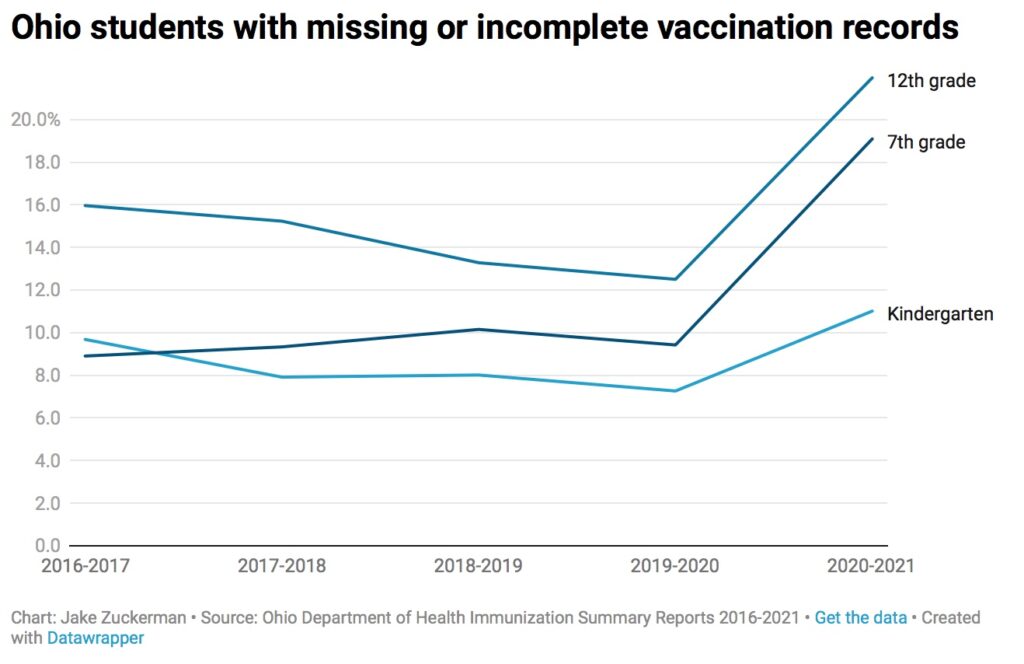
School vaccination records were missing or incomplete among roughly 1 in 5 sampled Ohio middle and high school students last year, despite state law requiring local boards of education to track immunizations records of all enrolled students.
All Ohio students, per state law, must be vaccinated against mumps, tetanus, polio, measles, Hepatitis B, chicken pox and meningococcal diseases. They can claim exemptions in writing due to natural immunity from prior infection; a medical contraindication; or for “reasons of conscience, including religious convictions.”
Though the law requires local boards of education to keep immunization summaries available on request for inquiring parents, schools statewide are failing to track vaccination among tens of thousands of students.
“The question is, why are the schools not collecting this data?” said Madhav Bhatta, an epidemiologist at Kent State University. “If it’s required by law that every child either get vaccinated or have a medical exemption … then why is there missing data?”
In the 2020-2021 school year, when a nascent pandemic shuttered schools and doctors’ offices, only 76% of 12th grade students submitted proof of receiving the meningococcal vaccine, according to immunization data obtained in a public records request from the Ohio Department of Health. The vaccine protects against meningitis and other, sometimes-lethal illnesses caused by the same bacteria.
About 22% of 12th graders had no exemption on file, leaving the picture unclear whether communities have high enough vaccination coverage to protect students.
That same year, only 78% of 7th grade school students statewide showed proof of receiving all vaccinations. Data was missing or incomplete on 19% of all 7th graders.
The missing data spans beyond the threshold for herd immunity for some vaccines. For instance, in the 2019-2020 year, 7.2% of kindergarteners and 9.4% of 7th grade students didn’t have all vaccination records or exemptions on file.
According to the World Health Organization, a community loses “herd immunity” — a threshold of community protection where a disease lacks viable hosts to spread — against measles when coverage falls below 95%. About 2.5% of students claimed a “conscience” objection, and a fraction of a percent claimed medical contraindications — which means they have diagnosed conditions where certain medical treatments such as a vaccine may cause harm.
“If [students with incomplete data] don’t have it on file because they are not vaccinated, that’s a problem,” Bhatta said. “We want as high a level of vaccination as possible to reduce the risk of transmission within a community.”
CDC research shows childhood immunization rates dropped significantly in 2020. However, the problem predates the pandemic. State data shows between 7.2% and 12.5% of sampled Ohio students did not show proof of vaccination or claim any exemption in 2019-2020 either.
The reports also lack data on vaccination by race or socioeconomic status, two major social determinants of health.
When contacted, different state agencies passed the blame or pointed fingers at county school boards, which are responsible for collecting data at the local level.
The COVID-19 vaccine data stands in stark contrast to the roughly 3% of public-school students who formally claim a nonmedical exemption year over year, raising more questions about the missing data.
Concerns about outbreaks of rare diseases among unvaccinated communities isn’t just a hypothetical.
Widespread vaccination eradicated measles in the U.S., but the virus can cause outbreaks when a host imports and spreads it among unvaccinated people. In early 2014, two unvaccinated Amish men returned to Knox County from the Philippines, unknowingly carrying measles, a highly infectious but vaccine-preventable disease. Amish communities tend to abstain from vaccination.
The two men seeded an outbreak that caused 383 infections in nine counties over four months, according to a report in the New England Journal of Medicine. About 90% of the victims were unvaccinated. Health officials mounted an awareness campaign and surged in more than 12,000 MMR vaccine doses for some 10,600 people to eventually smother the outbreak.
Researchers also note that unvaccinated people are not randomly distributed. Rather, they tend to concentrate in certain areas. Thus, statewide vaccination numbers can mask the vulnerability of some specific counties.
The missing data is a “significant concern,” according to Amy Bush Stevens, vice president of the Health Policy Institute of Ohio.
HPIO analyzed the data obtained from the Ohio Department of Health. According to its analysis, students in non-Appalachian, rural communities are most likely to claim exemptions to vaccination mandates. Students in metropolitan counties are most likely to not submit their vaccination records.
Screenshot from Health Policy Institute of Ohio analysis of Ohio Department of Health Immunization Summary Report data.
The missing data blurs a critical picture of whether students are protected, she said.
“Childhood vaccinations are a highly effective way to prevent infectious diseases among kids that have killed many children in the past,” she said.
Who’s to blame?
The law requires local boards of education to provide a summary of student immunizations to the state health director every year.
When contacted, both the Ohio Department of Education and the Ohio Department of Health sidestepped blame and pointed at the local schools.
Alicia Shoults, an ODH spokeswoman, said ODH provides funds for local health departments to do “assessment site visits for compliance.” The pandemic, however, limited this practice, and officials are still reviewing data to determine why so many students’ immunization records were missing last year.
“Ultimately, at the local level, schools are responsible for enforcement,” she said.
The Ohio Capital Journal requested data on school vaccination exemptions in May from the Ohio Department of Education. Spokeswoman Mandy Minick initially stated no such data exists. When asked about the data later obtained from ODH, its missing components, and the state law that requires it, she deflected blame.
The law prescribes roles to local schools and the state health director, not ODE, she said.
“The Department of Education does not have a prescribed role in the collection of this data,” Minick said.
A spokesman for the Ohio School Boards Association reviewed the immunization data but said he didn’t have anything to add.
OCJ contacted six county school boards overseeing schools with high rates of incomplete data. Only Youngstown City School District responded.
Of 152 seniors at Chaney High School in 2020-2021, 122 didn’t submit proof of vaccination or notice of exemption for the meningococcal vaccine — the only vaccine students must receive while in high school.
In the 2018-2019 school year (the 2019-2020 data is not broken out by high school), 89 of 158 students were missing meningococcal vaccine records.
If a meningitis outbreak emerged, officials wouldn’t immediately know who’s protected and who isn’t, costing precious time as vaccines are surged in.
Denise Dick, communications director for Youngstown City Schools, said while the pandemic worsened things, there has been a historical problem getting families to submit paperwork related to vaccination. However, the district is establishing in-school, optional vaccination appointments for a full spectrum of shots.
No one is forced to vaccinate, she said, but the goal is to make it as easy as possible for students. In the meantime, she acknowledged the district is flying blind as far as protection against infectious disease.
“Whether they’re not getting them, or they’re not giving us the record, we just don’t know that,” she said.
Solutions?
Amy Bush Stevens, from HPIO, has the fixes large and small.
On the mechanical side, HPIO analyzed a 2012 CDC survey of states and found Ohio is one of 18 states that doesn’t require health care providers and payers to report immunization data.
Some choose to, but others don’t. Mandatory reporting, she said, would clear the air on who’s vaccinated and who isn’t. (An ODH spokeswoman did not respond to an interview request with an administrator of ImpactSIIS, the state’s immunization information system.)
The current system, Stevens said, puts the burden on parents to submit records. For parents, especially those with lower incomes who move more often or change physicians, it’s too easy for documentation to get lost in the shuffle.
Another idea: tie reimbursement funding from Medicaid managed care plans more strongly to vaccination rates. More vaccination now equals lower costs of care down the line. And more outreach to eligible families to the Children’s Health Insurance Plan, which covers childhood vaccination, would help as the rate of uninsured children ticks up in Ohio.
And then there are structural changes. Public health departments are chronically underfunded in Ohio and one of the few fail safes for low-income, undocumented, or uninsured families. The Columbus Dispatch reported last year that Ohio spends less per capita on public health than all but three states.
“Anything we can do to increase the public health workforce will help with that and make sure that kids with no other source of care get their childhood immunizations,” Stevens said.
Other pending legislation would ban “vaccine passports” related to COVID-19. Discussion of the bills among proponents often dubiously characterizes a heavy-handed government forcing vaccines on the unwilling.
Among health experts, however, the reality is simple: Less vaccination equals more infectious disease.
“If you don’t rely on the school system to report — that’s the only way we could get a semblance of aggregated data,” Bhatta said.






![[Commentary] Suicide is on the rise in Ohio](https://lovelandmagazine.com/wp-content/uploads/2024/02/988-suicide-prevention-2-1024x791-1-700x541-1.jpg)
 by Rob Moore –